fuel cap HONDA CIVIC COUPE 2014 9.G CNG Owners Manual
[x] Cancel search | Manufacturer: HONDA, Model Year: 2014, Model line: CIVIC COUPE, Model: HONDA CIVIC COUPE 2014 9.GPages: 46, PDF Size: 3.84 MB
Page 17 of 46
Refueling
16
Driving
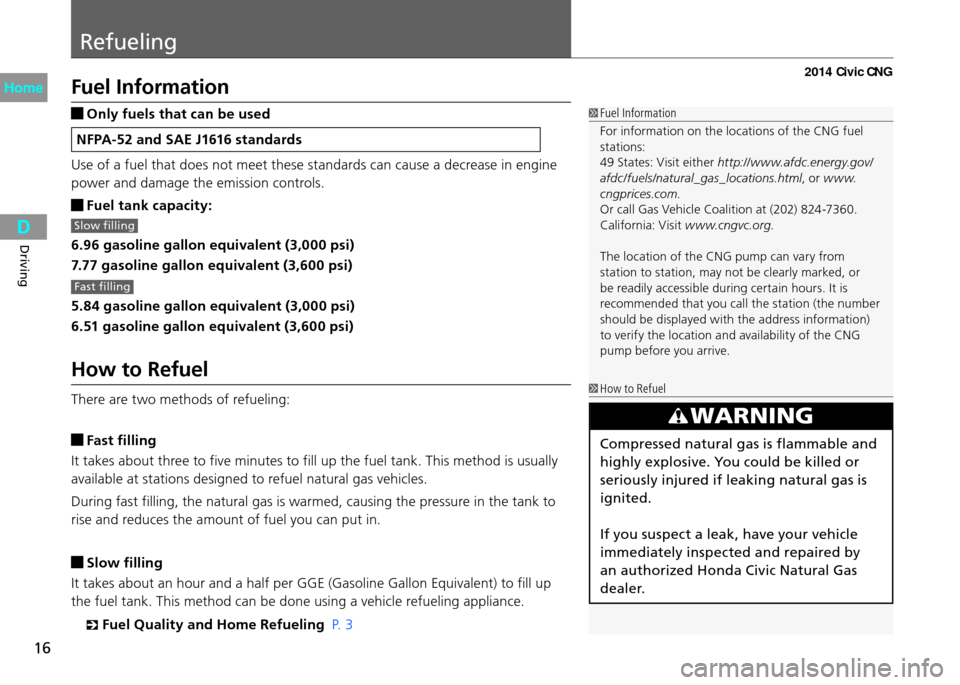
Fuel Information
Only fuels that can be used
NFPA-52 and SAE J1616 standards
Use of a fuel that does not meet these standards can cause a decrease in engine
power and damage the emission controls.
Fuel tank capacity:
Slow filling
6.96 gasoline gallon equivalent (3,000 psi)
7.77 gasoline gallon equivalent (3,600 psi)
Fast filling
5.84 gasoline gallon equivalent (3,000 psi)
6.51 gasoline gallon equivalent (3,600 psi)
How to Refuel
There are two methods of refueling:
Fast filling
It takes about three to five minutes to fill up the fuel tank. This method is usually
available at stations designed to refuel natural gas vehicles.
During fast filling, the natural gas is warmed, causing the pressure in the tank to
rise and reduces the amount of fuel you can put in.
Slow filling
It takes about an hour and a half per GGE (Gasoline Gallon Equivalent) to fill up
the fuel tank. This method can be done using a vehicle refueling appliance.
Fuel Quality and Home Refuelin g
P. 3
Fuel Information
For information on the locations of the CNG fuel
stations:
49 States: Visit either http://w w w.afdc.energy.gov/
afdc/fuels/natural_gas_ locations.html , or www.
cngprices.com.
Or call Gas Vehicle Coalition at (202) 824-7360.
California: Visit www.cngvc.org.
The location of the CNG pump can vary from
station to station, may not be clearly marked, or
be readily accessible during certain hours. It is
recommended that you call the station (the number
should be displayed with the address information)
to verify the location and availability of the CNG
pump before you arrive.
How to Refuel
WARNING
Compressed natural gas is flammable and
highly explosive. You could be killed or
seriously injured if leaking natural gas is
ignited.
If you suspect a leak, have your vehicle
immediately inspected and repaired by
an authorized Honda Civic Natural Gas
d e a l e r.
2014 Civic CNG
Page 18 of 46
Refueling How to Refuel
17Continued
Driving
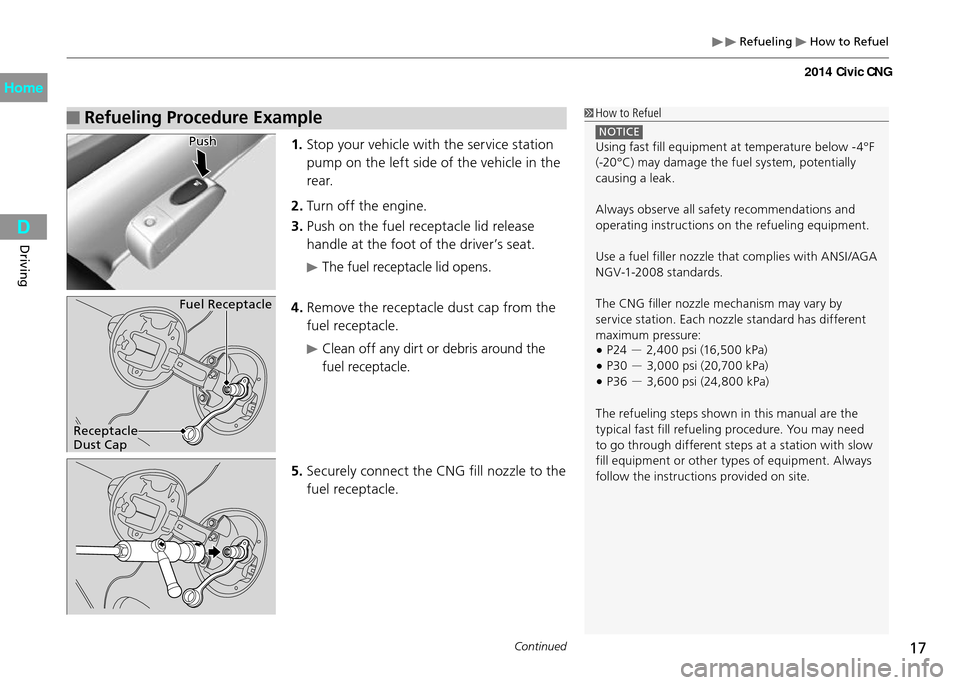
Refueling Procedure Example How to Refuel
NOTICE Using fast fill equipment at temperature below -4°F
(-20°C) may damage the fuel system, potentially
causing a leak.
Always observe all safety recommendations and
operating instructions on the refueling equipment.
Use a fuel filler nozzle that complies with ANSI/AGA
NGV-1-2008 standards.
The CNG filler nozzle mechanism may vary by
service station. Each nozzle standard has different
maximum pressure:P24
•- 2,400 psi (16,500 kPa)
P30
•- 3,000 psi (20,700 kPa)
P36
•- 3,600 psi (24,800 kPa)
The refueling steps shown in this manual are the
typical fast fill refueling procedure. You may need
to go through different steps at a station with slow
fill equipment or other types of equipment. Always
follow the instructions provided on site.
1. Stop your vehicle with the service station
pump on the left side of the vehicle in the
r e a r.
2. Turn off the engine.
3. Push on the fuel receptacle lid release
handle at the foot of the driver’s seat.
The fuel receptacle lid opens.
4. Remove the receptacle dust cap from the
fuel receptacle.
Clean off any dirt or debris around the
fuel receptacle.
5
. Securely connect the CNG fill nozzle to the
fuel receptacle.
Push
Fuel Receptacle
Receptacle
Dust Cap
2014 Civic CNG
Page 19 of 46
Refueling How to Refuel
18
Driving
How to Refuel
If you hear or see fuel/vapor leaking from the
nozzle-receptacle connection, stop refueling
immediately. Turn off the refueling station, remove
the nozzle, reconnect it to the receptacle, and begin
refueling again. Dirt or debris adhered to the inside
of the fuel receptacle can cause a gas leak. Remove
dirt or debris from the CNG filler nozzle with a
clean, dry rag.
If it continues to leak, have an authorized CNG
dealer inspect the sealing O-ring in the fuel
receptacle. It may be missing, damaged, or worn.
If you are not sure how to operate the refueling
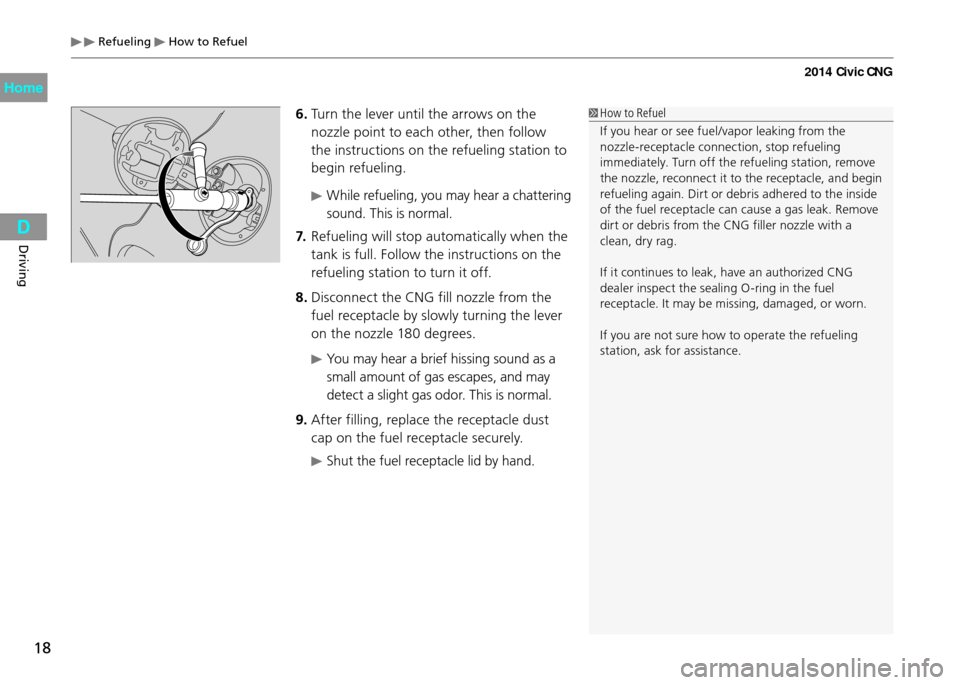
station, ask for assistance.6. Turn the lever until the arrows on the
nozzle point to each other, then follow
the instructions on the refueling station to
begin refueling.
While refueling, you may hear a chattering
sound. This is normal.
7. Refueling will stop automatically when the
tank is full. Follow the instructions on the
refueling station to turn it off.
8. Disconnect the CNG fill nozzle from the
fuel receptacle by slowly turning the lever
on the nozzle 180 degrees.
You may hear a brief hissing sound as a
small amount of gas escapes, and may
detect a slight gas odor. This is normal.
9. After filling, replace the receptacle dust
cap on the fuel receptacle securely.
Shut the fuel receptacle lid by hand.
2014 Civic CNG
Page 43 of 46
Specifications
42
Information
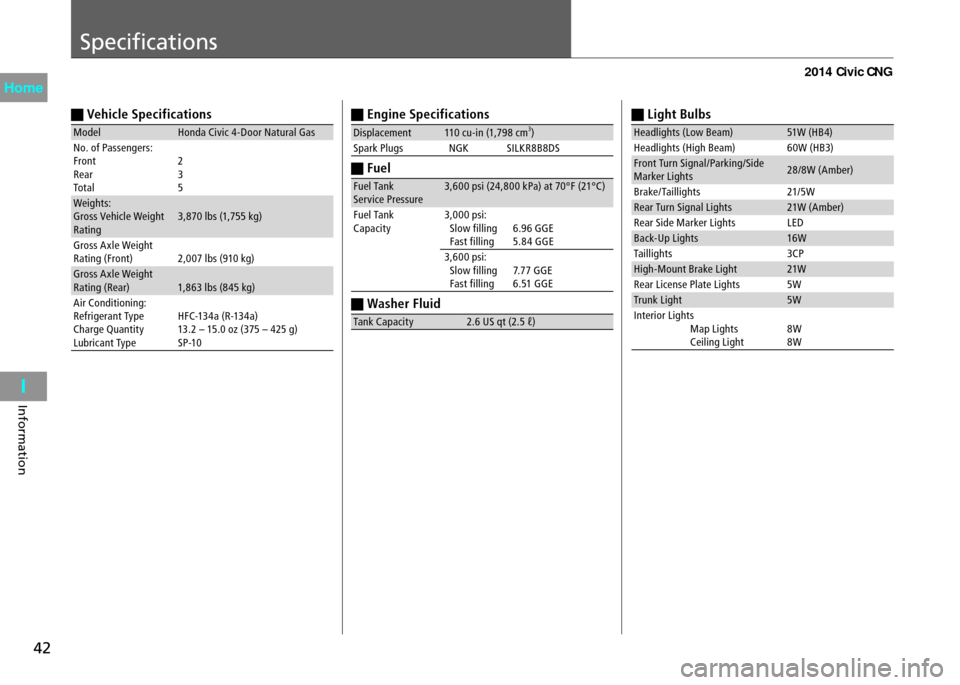
Vehicle Specifications
ModelHonda Civic 4-Door Natural Gas
No. of Passengers:
Front
Rear
Total 2
3
5
Weights:
Gross Vehicle Weight
Rating 3,870 lbs (1,755 kg)
Gross A xle Weight
Rating (Front) 2,007 lbs (910 kg)
Gross A xle Weight
Rating (Rear) 1,863 lbs (845 kg)
Air Conditioning:
Refrigerant Type
Charge Quantity
Lubricant Type HFC-134a (R-134a)
13.2 – 15.0 oz (375 – 425 g)
SP-10
Engine Specifications
Displacement
110 cu-in (1,798 cm3)
Spark Plugs NGKSILKR8B8DS
Fuel
Fuel Tank
Service Pressure 3,600 psi (24,800 kPa) at 70°F (21°C)
Fuel Tank
Capacity 3,000 psi:
Slow filling
Fast filling
6.96 GGE
5.84 GGE
3,600 psi:
Slow filling
Fast filling
7.77 GGE
6.51 GGE
Washer Fluid
Tank Capacity 2.6 US qt (2.5 ℓ)
Light Bulbs
Headlights (Low Beam) 51W (HB4)
Headlights (High Beam) 60W (HB3)
Front Turn Signal/Parking/Side
Marker Lights
28/8W (Amber)
Brake/Taillights 21/ 5W
Rear Turn Signal Lights 21W (Amber)
Rear Side Marker Lights LED
Back-Up Lights 16 W
Taillights 3CP
High-Mount Brake Light 21W
Rear License Plate Lights 5W
Trunk Light 5W
Interior Lights
Map Lights
Ceiling Light 8W
8W
2014 Civic CNG