lock HONDA CIVIC COUPE 2014 9.G CNG Owners Manual
[x] Cancel search | Manufacturer: HONDA, Model Year: 2014, Model line: CIVIC COUPE, Model: HONDA CIVIC COUPE 2014 9.GPages: 46, PDF Size: 3.84 MB
Page 12 of 46
11
When Driving
Continued
Driving
Starting the Engine
Starting the Engine
Keep your foot firmly on the brake pedal when
starting the engine.
The engine is harder to start in cold weather and
in thinner air found at altitudes above 8,000 feet
(2,400 meters).
When starting the engine in cold weather, turn
off all electrical accessories (the lights, heating
and cooling system, and rear defogger) in order to
reduce battery drain.
If you live in a region where winter is extremely
cold, an engine block heater will improve starting
and warming of the engine. If temperatures
consistently below -22°F (-30°C) are expected, the
coolant mixture should be changed to a higher
concentration to prevent freezing. Consult a dealer
for details.
If the exhaust system sounds abnormal or you
can smell exhaust gas inside the vehicle, have
your vehicle checked by a dealer. There may be a
problem with the engine or exhaust system.
Brake Pedal
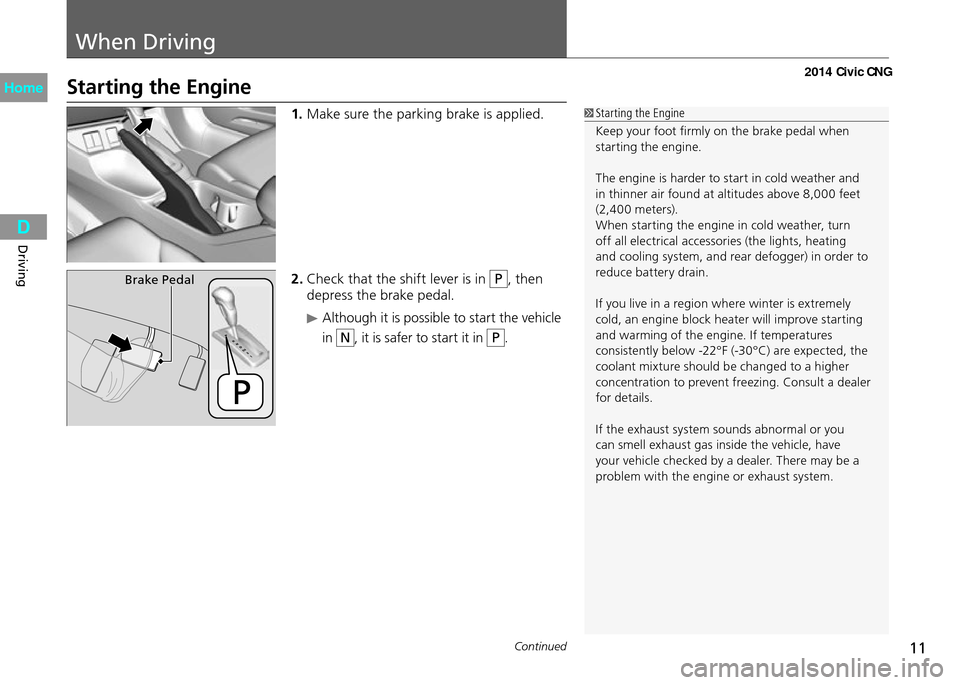
1. Make sure the parking brake is applied.
2. Check that the shift lever is in P
, then
depress the brake pedal.
Although it is possible to start the vehicle
in
N, it is safer to start it in P.
2014 Civic CNG
Page 15 of 46
When Driving Shifting
14
Driving
Shifting
Change the shift position in accordance with your driving needs.
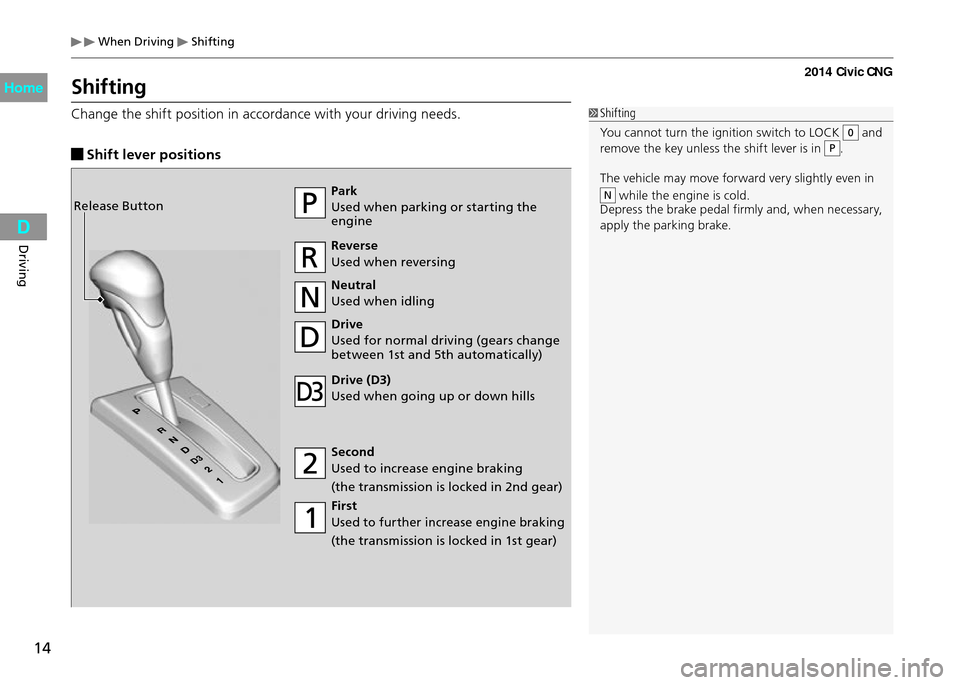
Shift lever positions
Park
Used when parking or starting the
engine
Reverse
Used when reversing
Neutral
Used when idling
Drive
Used for normal driving (gears change
between 1st and 5th automatically)
Drive (D3)
Used when going up or down hills
Second
Used to increase engine braking
(the transmission is locked in 2nd gear)
First
Used to further increase engine braking
(the transmission is locked in 1st gear)
Release Button
Shifting
You cannot turn the ignition switch to LOCK
0 and
remove the key unless the shift lever is in P.
The vehicle may move forward very slightly even in
N while the engine is cold.
Depress the brake pedal firmly and, when necessary,
apply the parking brake.
2014 Civic CNG
Page 28 of 46
27Continued
Handling the Unexpected
If a Tire Goes Flat Changing a Flat Tire
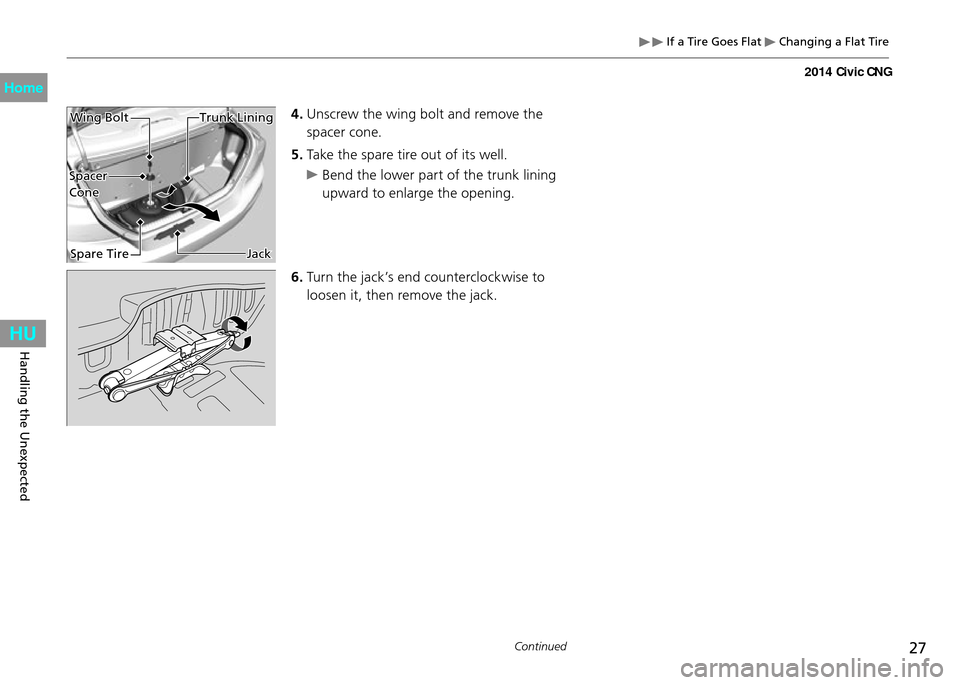
4. Unscrew the wing bolt and remove the
spacer cone.
5. Take the spare tire out of its well.
Bend the lower part of the trunk lining
upward to enlarge the opening.
6. Turn the jack’s end counterclockwise to
loosen it, then remove the jack.
Wing Bolt
Jack
Spacer
Cone
Spare Tire
Trunk Lining
2014 Civic CNG
Page 30 of 46
29Continued
Handling the Unexpected
If a Tire Goes Flat Temporarily Repairing a Flat Tire
Models with tire repair kit
Temporarily Repairing a Flat Tire
This vehicle is not equipped with a spare tire. If the tire has a large cut or is
otherwise severely damaged, you will need to have the vehicle towed. If the tire
only has a small puncture, from a nail for instance, you can use the temporary tire
repair kit so that you can drive to the nearest service station for a more permanent
repair.
If a tire goes flat while driving, grasp the steering wheel firmly, and brake gradually
to reduce speed. Then stop in a safe place.
1. Park the vehicle on firm, level, and non-slippery surface and apply the parking
brake.
2. Put the shift lever in
P.
3. Turn on the hazard warning lights and turn the ignition switch to LOCK
0.
When towing a trailer, unhitch the trailer.
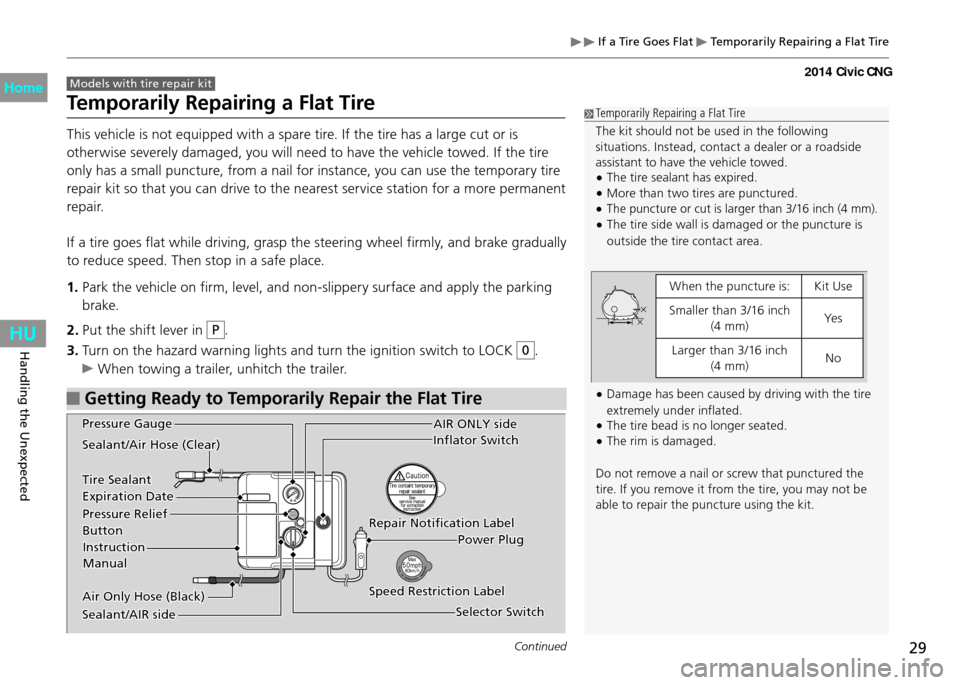
Getting Ready to Temporarily Repair the Flat Tire
AIR ONLY side
Inflator Switch
Repair Notification Label
Power Plug
Speed Restriction Label
Selector Switch
Pressure Gauge
Sealant/Air Hose (Clear)
Tire Sealant
Expiration Date
Pressure Relief
Button
Instruction
Manual
Air Only Hose (Black)
Sealant/AIR side
Temporarily Repairing a Flat Tire
The kit should not be used in the following
situations. Instead, contact a dealer or a roadside
assistant to have the vehicle towed.
The tire sealant has expired.
•More than two tires are punctured.
•The puncture or cut is larger than 3/16 inch (4 mm).
•The tire side wall is damaged or the puncture is
•outside the tire contact area.
When the puncture is: Kit Use
Smaller than 3/16 inch (4 mm) Ye s
Larger than 3/16 inch (4 mm) No
Damage has been caused by driving with the tire
•extremely under inflated.
The tire bead is no longer seated.
•The rim is damaged.
•
Do not remove a nail or screw that punctured the
tire. If you remove it from the tire, you may not be
able to repair the puncture using the kit.
2014 Civic CNG
Page 38 of 46
37
Fuel Leaks
Handling the Unexpected
If a Fuel Leak is Detected
If you smell natural gas or hear a hissing sound, except when refueling, the fuel
system may have a leak. If a Fuel Leak is Detected
WARNING
Compressed natural gas is flammable and
highly explosive. You could be killed or
seriously injured if leaking natural gas is
ignited.
If you suspect a leak, have your vehicle
immediately inspected and repaired by an
authorized Honda Civic Natural Gas
d e a l e r.
Do not jump start your vehicle if you suspect a gas
leak.
Turning Off the Manual Shut-Off Valve
We recommend that you locate the valve before
driving so that you can turn it off quickly if
ne ce s s ar y.
Turn off the valve if you ever suspect a fuel leak or
are involved in an accident.
Turn the manual shut-off valve to OFF also when
you are storing your vehicle for an extended period.
Turning Off the Manual Shut-Off Valve
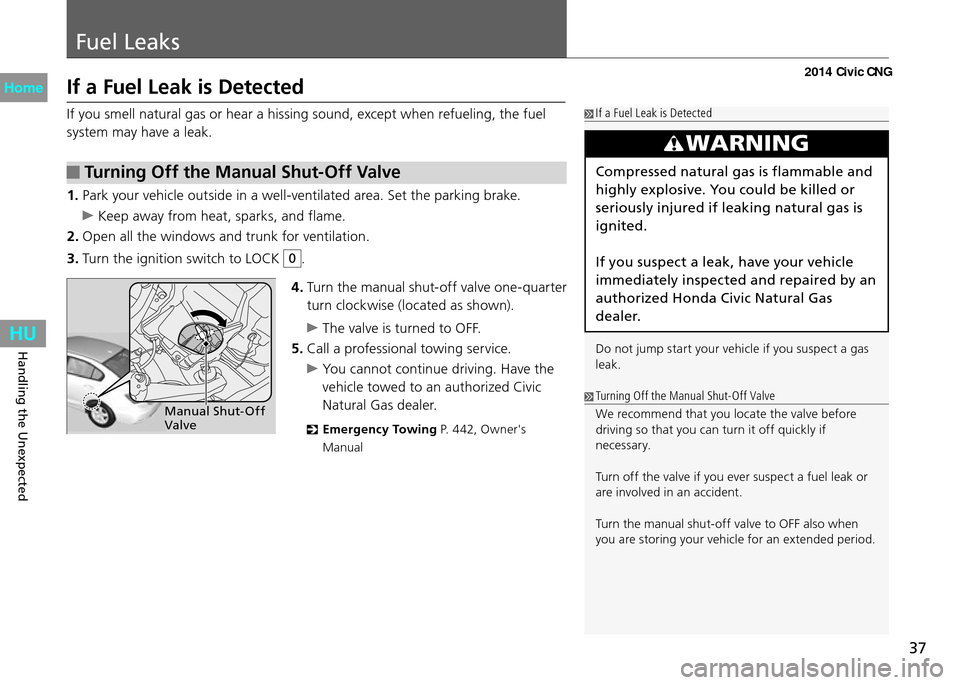
4. Turn the manual shut-off valve one-quarter
turn clockwise (located as shown).
The valve is turned to OFF.
5. Call a professional towing service.
You cannot continue driving. Have the
vehicle towed to an authorized Civic
Natural Gas dealer.
Emergency Towing
P. 442, Owner's
Manual
1. Park your vehicle outside in a well-ventilated area. Set the parking brake.
Keep away from heat, sparks, and flame.
2. Open all the windows and trunk for ventilation.
3. Turn the ignition switch to LOCK
0.
Manual Shut-Off
Valve
2014 Civic CNG
Page 41 of 46
40
Handling the Unexpected
Fuses Fuse Locations
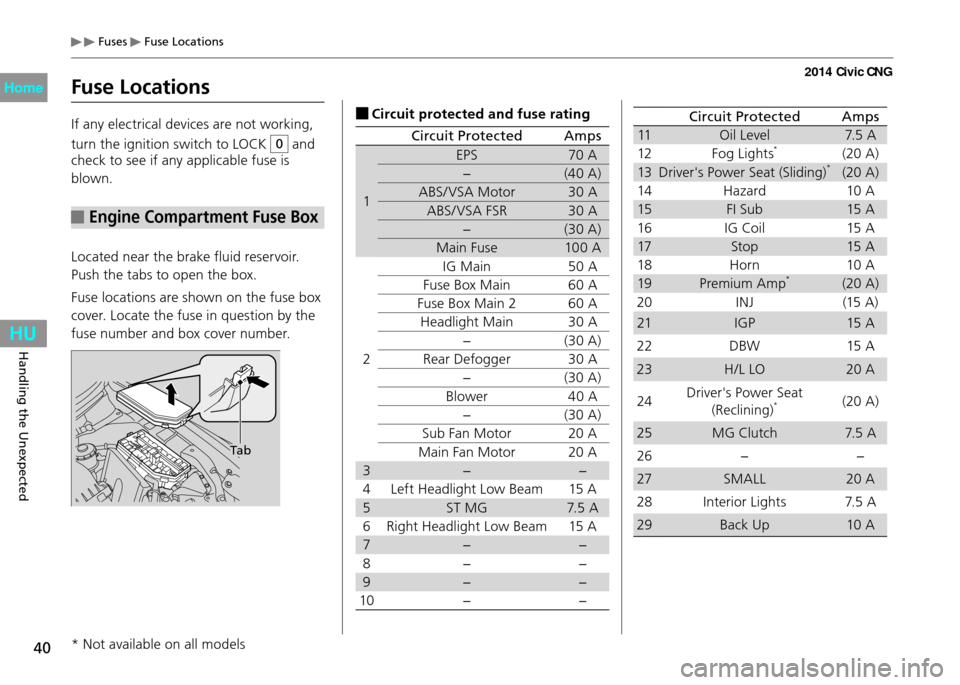
Circuit ProtectedAmps
1 EPS
70 A
− (40 A)
ABS/ VSA Motor 30 A ABS/ VSA FSR 30 A − (30 A)
Main Fuse 100 A
2 IG Main
50 A
Fuse Box Main 60 A
Fuse Box Main 2 60 A Headlight Main 30 A − (30 A)
Rear Defogger 30 A − (30 A)
Blower 40 A
− (30 A)
Sub Fan Motor 20 A
Main Fan Motor 20 A
3 − −
4 Left Headlight Low Beam 15 A
5 ST MG 7.5 A
6 Right Headlight Low Beam 15 A
7 − −
8 − −
9 − −
10 − −
Circuit Protected Amps
11 Oil Level 7.5 A
12 Fog Lights
*(20 A)
13 Driver's Power Seat (Sliding)*(20 A)
14 Hazard 10 A
15 FI Sub 15 A
16 IG Coil 15 A
17 Stop 15 A
18 Horn 10 A
19 Premium Amp
*(20 A)
20 INJ (15 A)
21 IGP 15 A
22 DBW 15 A
23 H/L LO 20 A
24 Driver's Power Seat
(Reclining)
*(20 A)
25 MG Clutch 7.5 A
26 − −
27 SMALL 20 A
28 Interior Lights 7.5 A
29 Back Up 10 A
Fuse Locations
If any electrical devices are not working,
turn the ignition switch to LOCK
0 and
check to see if any applicable fuse is
blown.
Engine Compartment Fuse Box
Located near the brake fluid reservoir.
Push the tabs to open the box.
Fuse locations are shown on the fuse box
cover. Locate the fuse in question by the
fuse number and box cover number.
Circuit protected and fuse rating
* Not available on all models
Ta b
2014 Civic CNG
Page 42 of 46
41
Handling the Unexpected
Fuses Fuse Locations
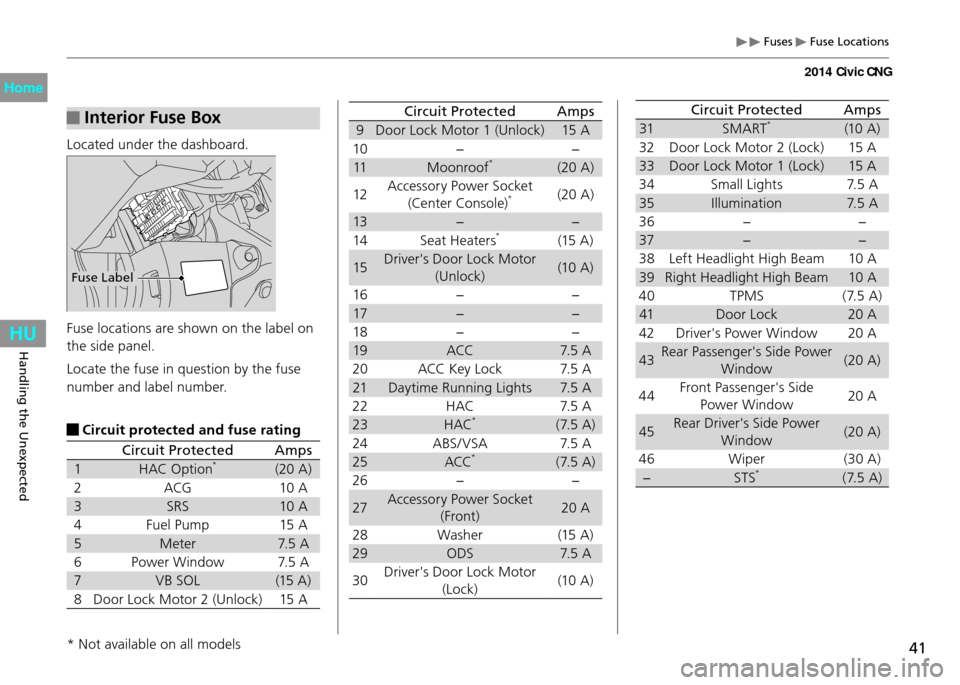
Interior Fuse BoxCircuit ProtectedAmps
9 Door Lock Motor 1 (Unlock) 15 A
10 − −
11 Moonroof
*(20 A)
12 Accessory Power Socket
(Center Console)
*(20 A)
13 − −
14 Seat Heaters
*(15 A)
15 Driver's Door Lock Motor
(Unlock) (10 A)
16 − −
17 − −
18 − −
19 ACC 7.5 A
20 ACC Key Lock 7.5 A
21 Daytime Running Lights 7.5 A
22 HAC 7.5 A
23 HAC
*(7.5 A)
24 ABS/ VSA 7.5 A
25 ACC
*(7.5 A)
26 − −
27 Accessory Power Socket
(Front) 20 A
28 Washer (15 A)
29 ODS 7.5 A
30 Driver's Door Lock Motor
(Lock) (10 A)
Circuit Protected
Amps
31 SMART*(10 A)
32 Door Lock Motor 2 (Lock) 15 A
33 Door Lock Motor 1 (Lock) 15 A
34 Small Lights 7.5 A
35 Illumination 7.5 A
36 − −
37 − −
38 Left Headlight High Beam 10 A
39 Right Headlight High Beam 10 A
40 TPMS (7.5 A)
41 Door Lock 20 A
42 Driver's Power Window 20 A
43 Rear Passenger's Side Power
Window (20 A)
44 Front Passenger's Side
Power Window 20 A
45 Rear Driver's Side Power
Window (20 A)
46 Wiper (30 A)
− STS
*(7.5 A)
Located under the dashboard.
Fuse locations are shown on the label on
the side panel.
Locate the fuse in question by the fuse
number and label number.
Circuit protected and fuse rating
Circuit Protected
Amps
1 HAC Option*(20 A)
2 ACG 10 A
3 SRS 10 A
4 Fuel Pump 15 A
5 Meter 7.5 A
6 Power Window 7.5 A
7 VB SOL (15 A)
8 Door Lock Motor 2 (Unlock) 15 A
* Not available on all models
Fuse Label
2014 Civic CNG