wheel HONDA CR-V 2000 RD1-RD3 / 1.G User Guide
[x] Cancel search | Manufacturer: HONDA, Model Year: 2000, Model line: CR-V, Model: HONDA CR-V 2000 RD1-RD3 / 1.GPages: 322, PDF Size: 4.64 MB
Page 151 of 322
Accessorie
s an d Modification s
Modification s
D o no t remov e an y origina l
equipmen t o r modif y you r vehicl e i n
an y wa y tha t woul d alte r it s desig n o r
operation . Thi s coul d mak e you r
vehicl e unsaf e an d illega l t o drive .
Fo r example , d o no t mak e an y
modification s tha t woul d chang e th e
rid e heigh t o f you r vehicle , o r instal l
wheel s an d tire s wit h a differen t
overal l diameter .
Suc h modification s ca n adversel y
affec t handling , an d interfer e wit h
th e operatio n o f th e vehicle' s anti -
loc k brake s an d othe r systems . I
n addition , an y modification s tha t
decreas e groun d clearanc e increas e
th e chanc e o f undercarriag e part s
strikin g a curb , spee d bump , o r othe r
raise d object , whic h coul d caus e
you r airbag s t o deploy .
D o no t modif y you r steerin g whee l
o r an y othe r par t o f you r
Supplementa l Restrain t System .
Modification s coul d mak e th e
syste m ineffective . Additiona
l Safet y Precautio n
D o no t attac h o r plac e object s o n th e
airba g covers . An y objec t attache d t o
o r place d o n th e cover s marke d "SR S
AIRBAG, " i n th e cente r o f th e
steerin g whee l an d o n to p o f th e
dashboard , coul d interfer e wit h th e
prope r operatio n o f th e airbags . Or ,
i f th e airbag s inflate , th e object s
coul d b e propelle d insid e th e vehicl e
an d hur t someone .
Befor e Drivin g
Page 156 of 322
Drivin
g Guideline s
You r CR- V ha s highe r groun d
clearanc e tha n a passenge r vehicl e
designe d onl y fo r us e o n pavement .
Highe r groun d clearanc e ha s man y
advantage s fo r off-highwa y driving .
I t allow s yo u t o trave l ove r bump s
an d unpave d roads . I t als o provide s
goo d visibilit y s o yo u ca n anticipat e
problem s earlier .
Thes e advantage s com e a t som e cost .
Becaus e you r vehicl e i s talle r an d
ride s highe r of f th e ground , i t ha s a
hig h cente r o f gravity . Thi s mean s
tha t you r vehicl e ca n ti p o r rol l ove r
i f yo u mak e abrup t turns . Utilit y
vehicle s hav e a significantl y highe r
rollove r rat e tha n othe r type s o f
vehicles .
T o preven t th e ris k o f rollove r o r
los s o f control : Tak
e corner s a t slowe r speed s
tha n yo u woul d wit h a passenge r
vehicle .
Avoi
d shar p turn s an d abrup t
maneuver s wheneve r possible . D
o no t modif y you r vehicl e in an y
wa y tha t woul d rais e th e cente r o f
gravity . D
o no t can y heav y carg o o n th e
roof .
Four-wheel
Drive Models
You r CR- V is equippe d wit h a uniqu e
four-whee l driv e (4WD ) system .
Normally , powe r i s delivere d onl y t o
th e fron t wheels . Whe n th e syste m
sense s a los s o f front-whee l traction ,
i t automaticall y transfer s som e
powe r t o th e rea r wheels . Thi s give s
yo u bette r tractio n an d mobility .
Whil e thi s syste m ca n provid e
increase d tractio n o n slipper y
surfaces , yo u stil l nee d t o exercis e
th e sam e car e whe n accelerating ,
steering , an d brakin g tha t yo u woul d
i n a two-whee l driv e vehicle .
Se e page 177 for additional guidelines
for driving off-highway.
Drivin g
Page 165 of 322
Automati
c Transmissio n
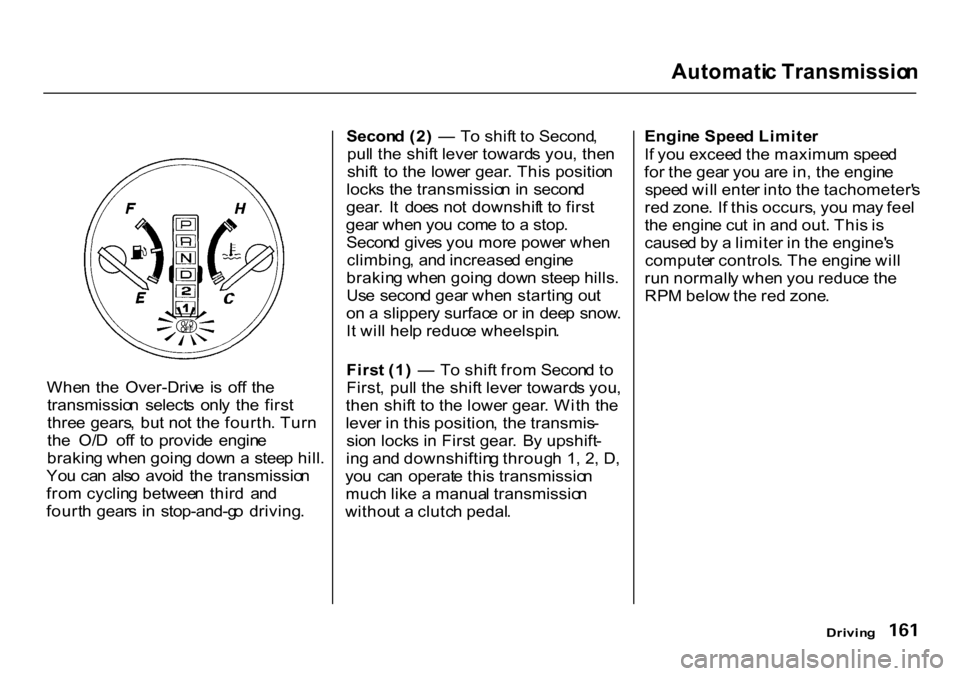
Whe n th e Over-Driv e i s of f th e
transmissio n select s onl y th e firs t
thre e gears , bu t no t th e fourth . Tur n
th e O/ D of f t o provid e engin e
brakin g whe n goin g dow n a stee p hill .
Yo u ca n als o avoi d the transmissio n
fro m cyclin g betwee n thir d an d
fourt h gear s i n stop-and-g o driving .Secon
d (2 ) — To shif t t o Second ,
pul l th e shif t leve r toward s you , the n
shif t t o th e lowe r gear . Thi s positio n
lock s th e transmissio n in secon d
gear . I t doe s no t downshif t t o firs t
gea r whe n yo u com e t o a stop .
Secon d give s yo u mor e powe r whe n
climbing , an d increase d engin e
brakin g whe n goin g dow n stee p hills .
Us e secon d gea r whe n startin g ou t
o n a slipper y surfac e o r i n dee p snow .
I t wil l hel p reduc e wheelspin .
Firs t (1 ) — To shif t fro m Secon d t o
First , pul l th e shif t leve r toward s you ,
the n shif t t o th e lowe r gear . Wit h th e
leve r i n thi s position , th e transmis -
sio n lock s i n Firs t gear . B y upshift -
in g an d downshiftin g throug h 1 , 2 , D ,
yo u ca n operat e thi s transmissio n
muc h lik e a manua l transmissio n
withou t a clutc h pedal . Engin
e Spee d Limite r
I f yo u excee d th e maximu m spee d
fo r th e gea r yo u ar e in , th e engin e
spee d wil l ente r int o th e tachometer' s
re d zone . I f thi s occurs , yo u ma y fee l
th e engin e cu t i n an d out . Thi s is
cause d b y a limite r i n th e engine' s
compute r controls . Th e engin e wil l
ru n normall y whe n yo u reduc e th e
RP M belo w th e re d zone .
Drivin g
Page 167 of 322
Parkin
g
Alway s us e th e parkin g brak e whe n
yo u par k you r vehicle . Th e indicato r
o n th e instrumen t pane l show s tha t
th e parkin g brak e is no t full y
released ; i t doe s no t indicat e tha t th e
parkin g brak e is firml y set . Mak e
sur e th e parkin g brak e is se t firml y
o r you r vehicl e ma y rol l i f i t i s
parke d o n a n incline .
I f you r vehicl e ha s a n automati c
transmission , se t th e parkin g brak e
befor e yo u pu t th e transmissio n i n
Park . Thi s keep s th e vehicl e fro m
movin g an d puttin g pressur e o n th e
parkin g mechanis m in th e
transmissio n — makin g it easie r t o
mov e th e shif t leve r ou t o f Par k
whe n yo u wan t t o driv e away . I
f th e vehicl e i s facin g uphill , tur n
th e fron t wheels away fro m th e curb .
I f yo u hav e a manua l transmission ,
pu t i t i n firs t gear .
I f th e vehicl e i s facin g downhill , tur n
th e fron t wheel s towar d th e curb . I f
yo u hav e a manua l transmission , pu t
i t i n revers e gear .
Mak e sur e th e parkin g brak e i s full y
release d befor e drivin g away .
Drivin g wit h th e parkin g brak e
partiall y se t ca n overhea t o r damag e
th e rea r brakes . Parkin
g Tip s Mak
e sur e th e window s ar e closed . Tur
n of f th e lights . Plac
e an y packages , valuables , etc. ,
i n th e carg o are a o r tak e the m
wit h you . Loc
k th e doors . Neve
r par k ove r dr y leaves , tal l
grass , o r othe r flammabl e
materials . Th e thre e wa y catalyti c
converte r get s ver y hot , an d coul d
caus e thes e material s t o catc h o n
fire .
Driving
Page 168 of 322
Th
e Brakin g Syste m
You r Hond a i s equippe d wit h fron t
dis c brakes . Th e brake s o n th e rea r
wheel s ar e drum . Th e brakin g
syste m is power-assiste d t o reduc e
th e effor t neede d o n th e brak e pedal .
Pu t you r foo t o n th e brak e peda l onl y
whe n yo u inten d t o brake . Restin g
you r foo t o n th e peda l keep s th e
brake s applie d lightly , causin g the m
t o buil d u p heat . Hea t build-u p ca n
reduc e ho w wel l you r brake s work . I t
als o keep s you r brak e light s o n al l
th e time , confusin g driver s behin d
you .
Constan
t applicatio n o f th e brake s
whe n goin g dow n a lon g hil l build s
u p hea t an d reduce s thei r effective -
ness . Us e th e engin e to assis t th e
brake s b y downshiftin g to a lowe r
gea r an d takin g you r foo t of f th e
accelerato r pedal .
Chec k you r brake s afte r drivin g
throug h dee p water . Appl y th e
brake s moderatel y t o se e if the y fee l
normal . I f not , appl y the m gentl y an d
frequentl y unti l the y do . Sinc e a
longe r distanc e is neede d t o sto p
wit h we t brakes , b e extr a cautiou s
an d aler t i n you r driving . Brak
e Wea r Indicator s
Th e fron t dis c brake s o n al l vehicle s
hav e audibl e brak e wea r indicators .
Whe n th e brak e pad s nee d replacing ,
yo u wil l hea r a distinctiv e metalli c
"screeching " soun d whe n yo u appl y
th e brakes . I f yo u d o no t hav e th e
brak e pad s replaced , the y wil l begi n
screechin g al l th e time .
You r brake s ma y sometime s squea l
o r squea k whe n yo u appl y the m
lightly . D o no t confus e thi s wit h th e
brak e wea r indicators . The y mak e a
ver y audibl e "screeching. "
Drivin g
Page 169 of 322
Th
e Brakin g Syste m
Brak e Syste m Desig n
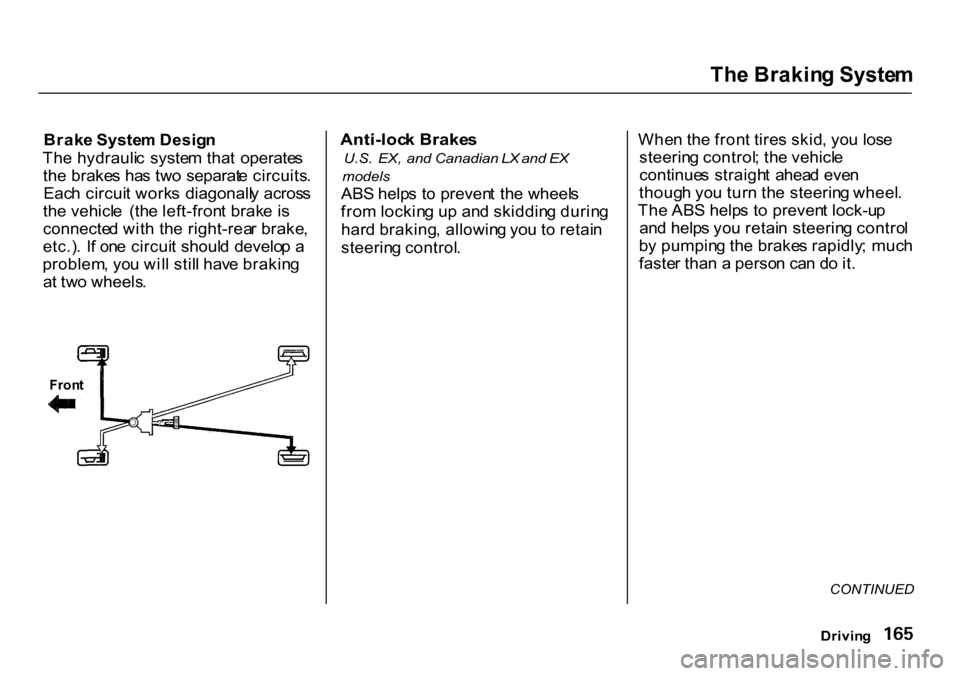
Th e hydrauli c syste m tha t operate s
th e brake s ha s tw o separat e circuits .
Eac h circui t work s diagonall y acros s
th e vehicl e (th e left-fron t brak e i s
connecte d wit h th e right-rea r brake ,
etc.) . I f on e circui t shoul d develo p a
problem , yo u wil l stil l hav e brakin g
a t tw o wheels .
Anti-loc
k Brake s
U.S. EX, and Canadian LX and EX
models
AB S help s t o preven t th e wheel s
fro m lockin g u p an d skiddin g durin g
har d braking , allowin g yo u t o retai n
steerin g control . Whe
n th e fron t tire s skid , yo u los e
steerin g control ; th e vehicl e
continue s straigh t ahea d eve n
thoug h yo u tur n th e steerin g wheel .
Th e AB S help s t o preven t lock-u p
an d help s yo u retai n steerin g contro l
b y pumpin g th e brake s rapidly ; muc h
faste r tha n a perso n ca n d o it .
CONTINUED
Fron
t
Driving
Page 173 of 322
Drivin
g in Ba d Weathe r
Tractio n — Chec k you r (ire s
frequentl y fo r wea r an d prope r
pressure . Bot h ar e importan t i n
preventin g "hydroplaning " (los s o f
tractio n o n a we t surface) . I n th e
winter , moun t sno w tire s o n al l fou r
wheel s fo r th e bes t handling .
Watc h roa d condition s carefully ,
the y ca n chang e fro m momen t t o
moment . We t leave s ca n b e a s slip -
per y a s ice . "Clear " road s ca n hav e
patche s o f ice . Drivin g condition s
ca n b e ver y hazardou s whe n th e
outsid e temperatur e is nea r freezing .
Th e roa d surfac e ca n becom e
covere d wit h area s o f wate r puddle s
mixe d wit h area s o f ice , s o you r
tractio n ca n chang e withou t warning .
B e carefu l whe n downshifting . I f
tractio n is low , yo u ca n loc k u p th e
driv e wheel s fo r a momen t an d caus e
a skid .
B
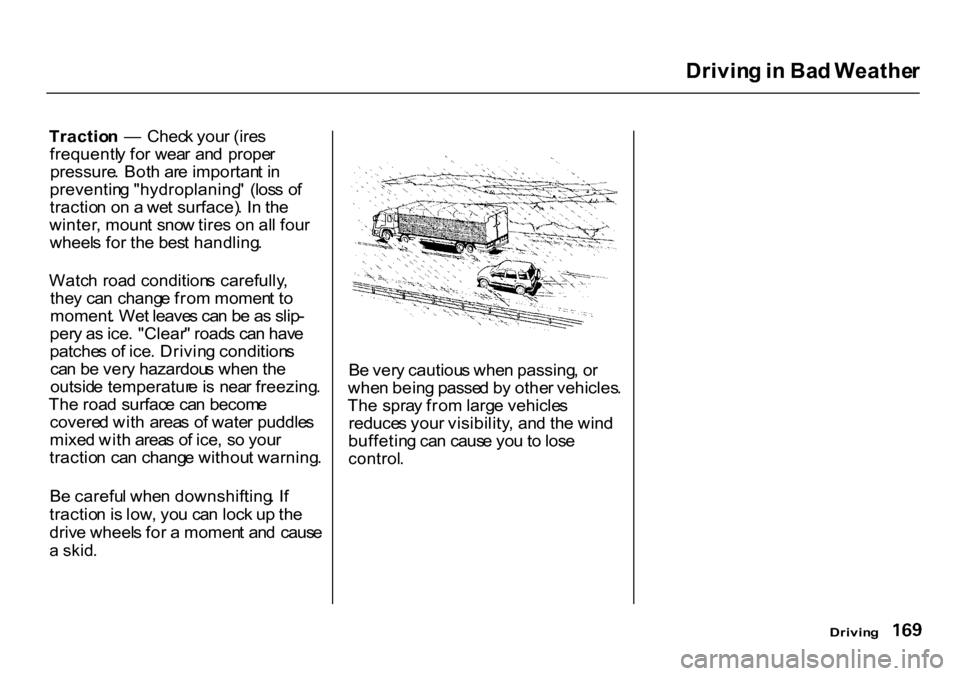
e ver y cautiou s whe n passing , o r
whe n bein g passe d b y othe r vehicles .
Th e spra y fro m larg e vehicle s
reduce s you r visibility , an d th e win d
buffetin g ca n caus e yo u to los e
control .
Driving
Page 179 of 322
Towin
g a Traile r
Handling Crosswinds and Buffeting
Crosswind s an d ai r turbulenc e
cause d b y passin g truck s ca n disrup t
you r steerin g an d caus e traile r
swaying . Whe n bein g passe d b y a
larg e vehicle , kee p a constan t spee d
an d stee r straigh t ahead . D o no t tr y
t o mak e quic k steerin g o r brakin g
corrections .
Backing Up
Alway s driv e slowl y an d hav e
someon e guid e yo u whe n backin g up .
Gri p th e bottom of th e steerin g
wheel ; the n tur n th e whee l t o th e lef t
t o ge t th e traile r t o mov e t o th e left ,
an d tur n th e whee l righ t t o mov e th e
traile r t o th e right . Parking
Follo w al l norma l precaution s whe n
parking , includin g firml y settin g th e
parkin g brak e an d puttin g th e
transmissio n in Par k (automatic ) o r
i n 1s t o r Revers e (manual) . Also ,
plac e whee l chock s a t eac h o f th e
trailer' s tires .
Driving
Page 180 of 322
Towin
g You r Vehicl e Behin d a Motorhom e
You r CR- V ca n b e towe d behin d a
motorhom e a t lega l highwa y speed s
u p to 6 5 mp h (10 0 km/h) . D o no t
excee d 6 5 mp h (10 0 km/h) .
Otherwise , sever e transmissio n
damag e wil l occur . T o avoi d damag e
t o th e 4W D system , i t mus t b e towe d
wit h al l fou r wheel s o n th e groun d
(fla t towing) .
Whe n purchasin g a to w bar , mak e
sur e yo u selec t a reputabl e
manufacture r an d installer . Follo w
th e manufacturer' s attachmen t
instruction s carefully .
Afte r attachin g th e to w ba r t o you r
motorhome , d o th e followin g t o
prepar e you r CR- V fo r "fla t towing" :
5-speed Manual Transmission Mak
e sur e th e transmissio n i s
fille d t o th e correc t leve l (se e pag e
208 ). D o no t overfill . Releas
e th e parkin g brake . Shif
t th e transmissio n t o Neutral . Leav
e th e ke y i n th e ignitio n
switc h an d th e ignitio n switc h in
ACCESSOR Y (I ) s o th e steerin g
whee l doe s no t lock . Mak e sur e
th e radi o an d an y item s plugge d
int o th e accessor y powe r socket s
ar e turne d of f s o yo u d o no t ru n
dow n th e battery .
Automatic Transmission
Whe n preparin g t o to w you r CR-V ,
chec k th e transmissio n flui d leve l
(se e pag e 20 7 ) . Maintainin g th e
correc t leve l i s ver y important . D o
not overfill. Do th e followin g ever y
da y immediatel y befor e yo u begi n
towing . Follo w th e procedur e exactly .
Otherwise , sever e automati c
transmissio n damag e wil l occur . Star
t th e engine . Pres
s o n th e brak e pedal . Shif t th e
leve r throug h al l th e position s (P ,
R , N , D , 2,1 ) Shif
t t o D , the n t o N . Le t th e
engin e ru n fo r thre e minutes , the n
tur n of f th e engine . Releas
e th e parkin g brake . Leav
e th e ignitio n switc h in
ACCESSOR Y (I ) s o th e steerin g
whee l doe s no t lock . Mak e sur e
th e radi o an d an y item s plugge d
int o th e accessor y powe r socket s
ar e turne d of f s o yo u d o no t ru n
dow n th e battery .
Extended Towing
I f yo u to w mor e tha n 30 0 mile s (50 0
km ) i n on e day , yo u shoul d repea t
th e abov e procedur e a t leas t ever y
30 0 mile s (50 0 km) , (whe n yo u sto p
fo r fuel , etc. )
Drivin g
Page 181 of 322
Towin
g You r Vehicl e Behin d a Motorhom e
The steering system can be damaged if
the steering wheel is locked. Leave the
ignition switch in Accessory (I), and
make sure The steering wheel turns
freel y before you begin towing.
Improper towing preparation will
damage the transmission. Follow the
above procedure exactly. If you cannot
shift the transmission or start the
engine, your vehicle must be
transported on a flat-bed or trailer. I
f yo u lo w you r CR- V an d i t i s
equippe d wit h a n automati c
transmission , replac e th e
transmissio n flui d ever y tw o year s o r
30,00 0 mile s (50,00 0 km) , whicheve r
come s first .
Driving
NOTIC
E
NOTIC E