seats HONDA CR-Z 2011 1.G Owners Manual
[x] Cancel search | Manufacturer: HONDA, Model Year: 2011, Model line: CR-Z, Model: HONDA CR-Z 2011 1.GPages: 333, PDF Size: 9.97 MB
Page 2 of 333
Contents
Quick Reference GuideP. 2
Safe DrivingP. 29
Instrument Panel P. 67
ControlsP. 97
FeaturesP. 135
DrivingP. 191
MaintenanceP. 237
Handling the UnexpectedP. 285
InformationP. 311
IndexP. 323
Child Safety P. 56 Exhaust Gas Hazard P. 64 Safety Labels P. 65Opening and Closing the Hatch P. 104 Security System P. 105 Opening and Clos ing the Windows P. 107
Adjusting the Mirror P. 118 Adjusting the Seats P. 119
Climate Control System P. 131
Audio with Navigation System P. 151 Audio Error Messages P. 167 Audio Rem ote Controls P. 169
Bluetooth ®
HandsFreeLink ®
P. 173
When Driving P. 197 Braking P. 219 Parking Your Vehicle P. 223 Accessories and Modifications P. 235
Maintenance Under the Hood P. 245 Replacing Light Bulbs P. 258
Checking and Maintaining Tires P. 269 12 Volt Battery P. 278 Remote Trans mitter Care P. 279
Cleaning P. 281
Engine Does Not Start P. 293 Jump Starting P. 294 Shift Lever Does Not Move P. 296 Fuses P. 304 Emergency Towing P. 308 When You Cannot Open the Hatch P. 310
Devices that Emit Radio Waves P. 315 Reporting Safety Defects (U.S. Vehicles) P. 316
Customer Service Information P. 320 Warranty Coverages P. 321
Page 6 of 333
5
Quick Reference Guide
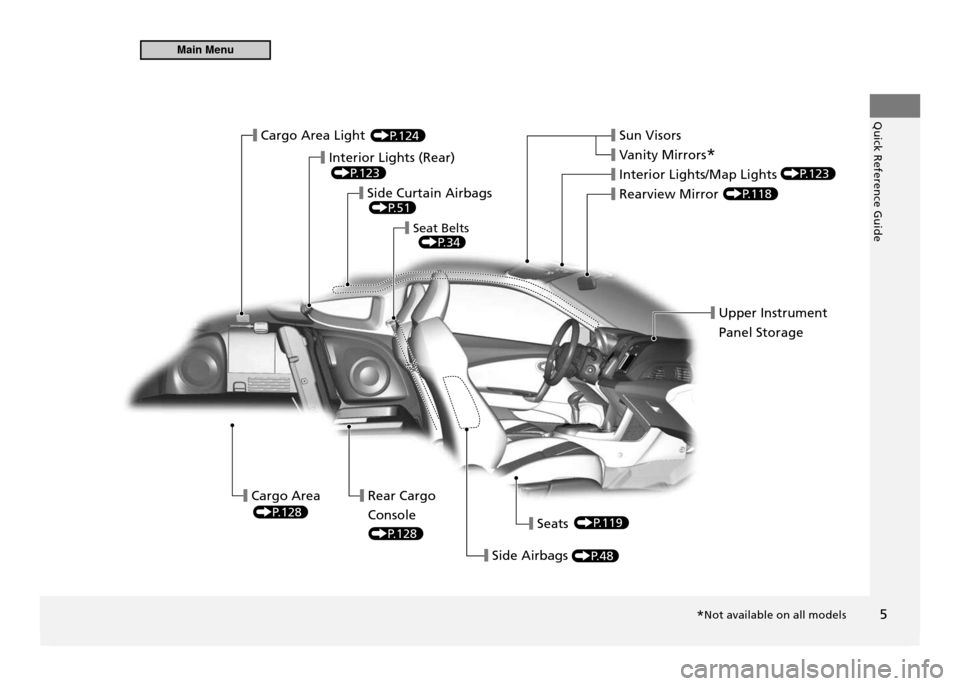
❙ Side Curtain Airbags
❙ Seat Belts
❙ Interior Lights (Rear)
❙ Cargo Area Light
❙ Cargo Area❙ Rear Cargo Console
❙ Interior Lights/Map Lights
❙ Rearview Mirror
❙ Sun Visors
❙ Vanity Mirrors
*
❙ Upper Instrument Panel Storage
❙ Seats
❙ Side Airbags
P.123
P.118
P.34
P.51
P.123
P.124
P.119
P.48
P.128
P.128
* Not available on all models
Main Menu
Page 34 of 333
Safe Driving
33
For Safe Driving Your Vehicle’s Safety Features
Safety Checklist
■
For the safety of you and your passenger, make a habit of checking these items each time before you drive.
After everyone has entered the vehicle, be sure both doors and the hatch are
●
closed and locked. Locking the doors and the hatch helps prevent an occupant from being ejected and an outsider from unexpectedly opening a door or the hatch.
Locking/Unlocking Doors from Inside P.1 0 2
Adjust your seat to a position suitable for driving. Be sure the seats are adjusted
●
as far to the rear as possible while allowing the driver to control the vehicle. Sitting too close to a front airbag can result in serious or fatal injury in a crash.
Adjusting the Seats P.11 9
Always wear your seat belt, and make sure you wear it properly. Confirm that
●
any passenger is properly belted as well.
Fastening the Seat Belts P. 3 7
If you choose to ignore our warnings and carry a child in this vehicle, make every
●
effort to protect them by properly using a seat belt or a child seat according to the child’s age, height, and weight.
Child Safety P. 5 6
Safety Checklist
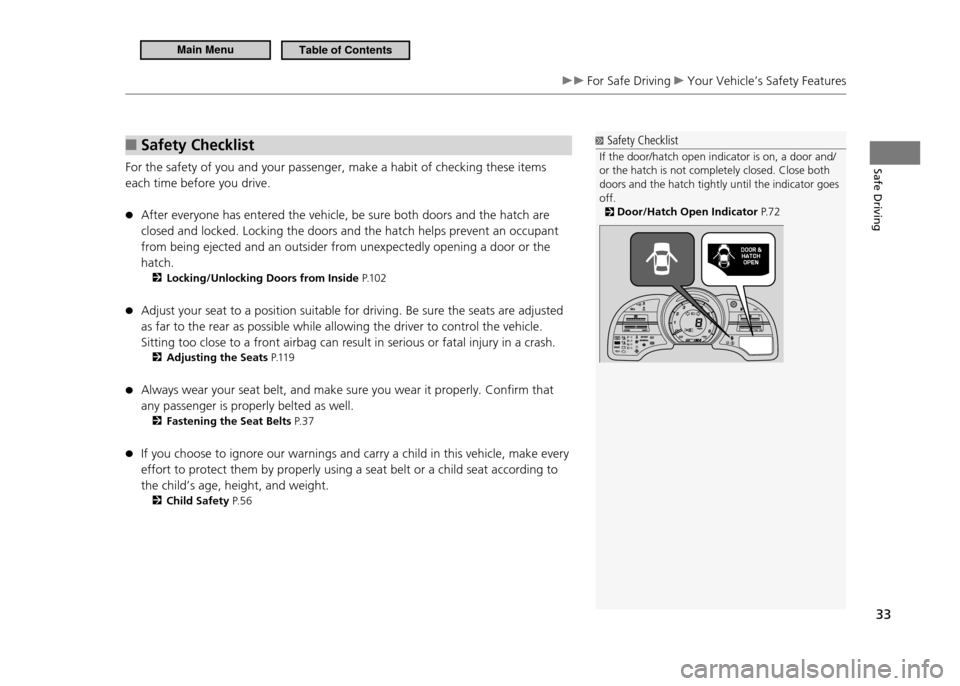
If the door/hatch open indicator is on, a door and/ or the hatch is not completely closed. Close both doors and the hatch tightly until the indicator goes off.
Door/Hatch Open Indicator P. 7 2
Main MenuTable of Contents
Page 37 of 333
Safe Driving
36
Seat Belts About Your Seat Belts
Automatic Seat Belt Tensioners
■
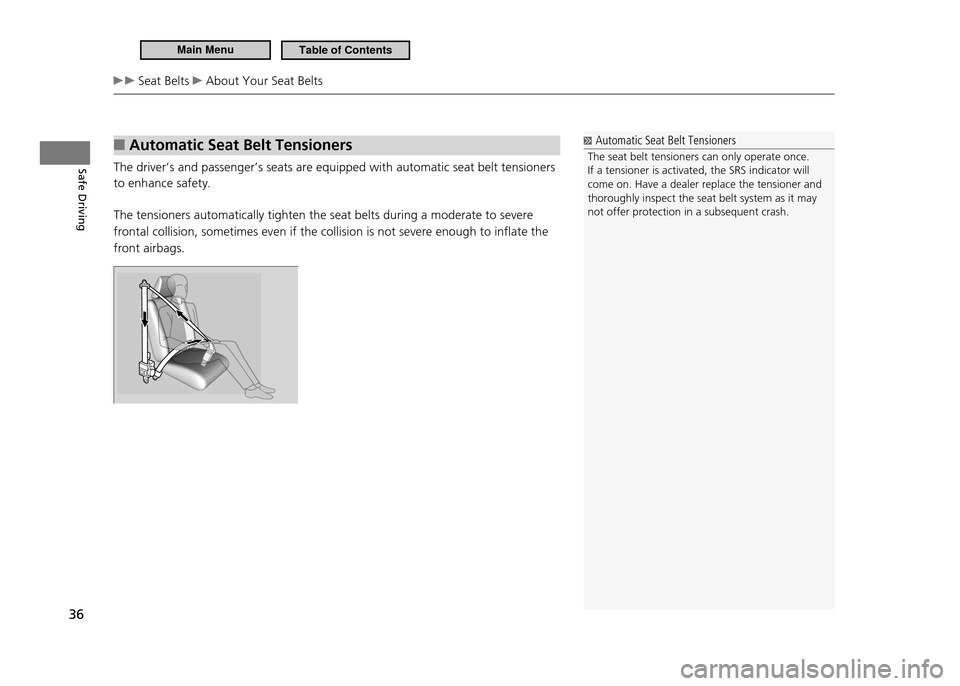
The driver’s and passenger’s seats are equipped with automatic seat belt tensioners to enhance safety. The tensioners automatically tighten the seat belts during a moderate to severe frontal collision, sometimes even if the collision is not severe enough to inlate the front airbags.
Automatic Seat Belt Tensioners
The seat belt tensioners can only operate once. If a tensioner is activated, the SRS indicator will come on. Have a dealer replace the tensioner and thoroughly inspect the seat belt system as it may not offer protection in a subsequent crash.
Main MenuTable of Contents
Page 38 of 333
Safe Driving
37
Seat Belts Fastening a Seat Belt
continued
Fastening a Seat Belt
After adjusting your seat to the proper position, and while sitting upright and well back in the seat:
Adjusting the Seats P.11 9
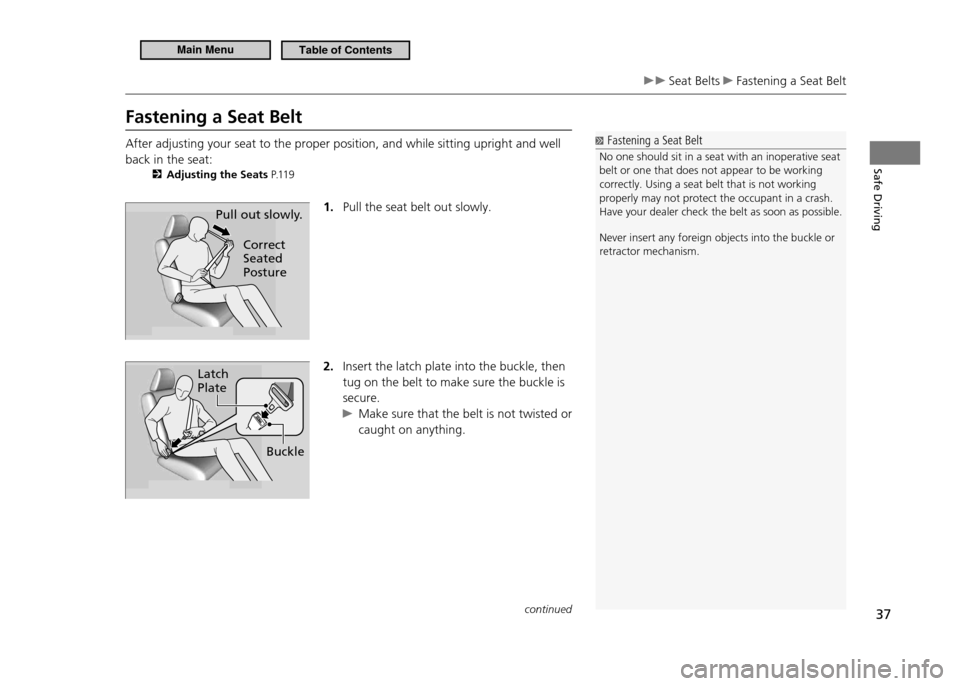
1. Pull the seat belt out slowly.
2. Insert the latch plate into the buckle, then tug on the belt to make sure the buckle is secure.
Make sure that the belt is not twisted or
caught on anything.
Fastening a Seat Belt
No one should sit in a seat with an inoperative seat belt or one that does not appear to be working correctly. Using a seat belt that is not working properly may not protect the occupant in a crash. Have your dealer check the belt as soon as possible. Never insert any foreign objects into the buckle or retractor mechanism.
Correct Seated Posture
Pull out slowly.
Latch Plate
Buckle
Main MenuTable of Contents
Page 45 of 333
Safe Driving
44
Airbags Types of Airbags Front Airbags (SRS)
Types of Airbags
Your vehicle is equipped with three types of airbags:Front airbags:
●
Airbags in front of the driver’s and passenger’s seats.
Side airbags:
●
Airbags in the driver’s and passenger’s seat-backs.
Side curtain airbags:
●
Airbags in the ceiling along side the windows on both
sides of the vehicle.
Each is discussed in the following pages.
Front Airbags (SRS) The front SRS airbags inflate in a moderate to severe frontal collision to help protect the head and chest of the driver and/or passenger. SRS (Supplemental Restraint System) indicates that the airbags are designed to
supplement seat belts, not replace them. Seat belts are the occupant's primary restraint system.
Housing Locations
■
The front airbags are housed in the center of the steering wheel for the driver, and in the dashboard for the passenger. Both airbags are marked SRS AIRBAG.
Type of Airbags
The airbags can inlate whenever the ignition switch is in ON
.
Front Airbags (SRS)
Dual-Stage, Multi-Threshold Front Airbags (SRS)Your vehicle is equipped with dual-stage, multiple-threshold front airbags (SRS).During a frontal crash severe enough to cause one or both front airbags to deploy, the airbags can inlate at different rates, depending on the severity of the crash, whether or not the seat belts are latched, and other factors. Front airbags are designed to supplement the seat belts to help reduce the likelihood of head and chest injuries in frontal crashes.
Main MenuTable of Contents
Page 48 of 333
Safe Driving
47
Airbags Front Airbags (SRS)
Advanced Airbags
■
Your front airbags have advanced features to reduce the likelihood of airbag related injuries to smaller occupants.
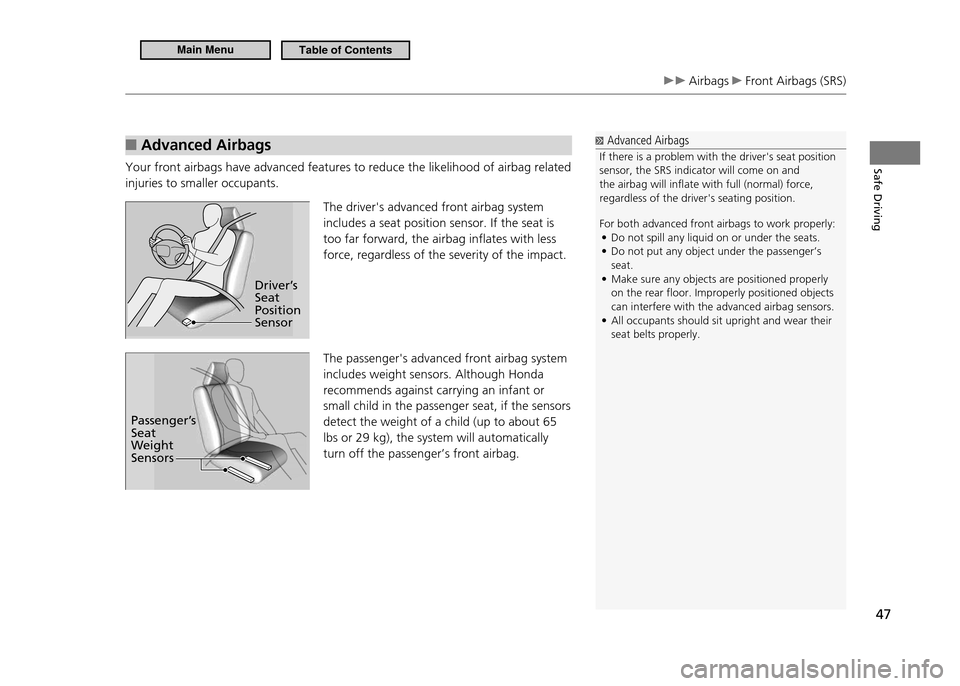
The driver's advanced front airbag system includes a seat position sensor. If the seat is too far forward, the airbag inflates with less force, regardless of the severity of the impact. The passenger's advanced front airbag system includes weight sensors. Although Honda recommends against carrying an infant or small child in the passenger seat, if the sensors detect the weight of a child (up to about 65 lbs or 29 kg), the system will automatically turn off the passenger’s front airbag.
Advanced Airbags
If there is a problem with the driver's seat position sensor, the SRS indicator will come on and the airbag will inlate with full (normal) force, regardless of the driver's seating position. For both advanced front airbags to work properly: Do not spill any liquid on or under the seats.
•
Do not put any object under the passenger’s
•
seat. Make sure any objects are positioned properly
•
on the rear loor. Improperly positioned objects can interfere with the advanced airbag sensors.All occupants should sit upright and wear their
•
seat belts properly.
Driver’s SeatPositionSensor
Passenger’s Seat
WeightSensors
Main MenuTable of Contents
Page 59 of 333
Safe Driving
58
Child Safety Safety of Infants and Small Children
Safety of Infants and Small Children
Protecting Infants
■
An infant must be properly restrained in a rear-facing, reclining child seat until the infant reaches the seat maker’s weight or height limit for the seat, and the infant is at least one year old. Because rear-facing child seats should not be used in this
vehicle, you should never carry an infant in this vehicle.
Protecting Infants
Rear-facing child seats should never be installed in a forward facing position.
WARNING
Placing a rear-facing child seat in the passenger’s seat can result in serious injury or death during a crash. Never install a rear-facing child seat in this vehicle.
Main MenuTable of Contents
Page 60 of 333
Safe Driving
59
Child Safety Safety of Infants and Small Children
Protecting Smaller Children
■
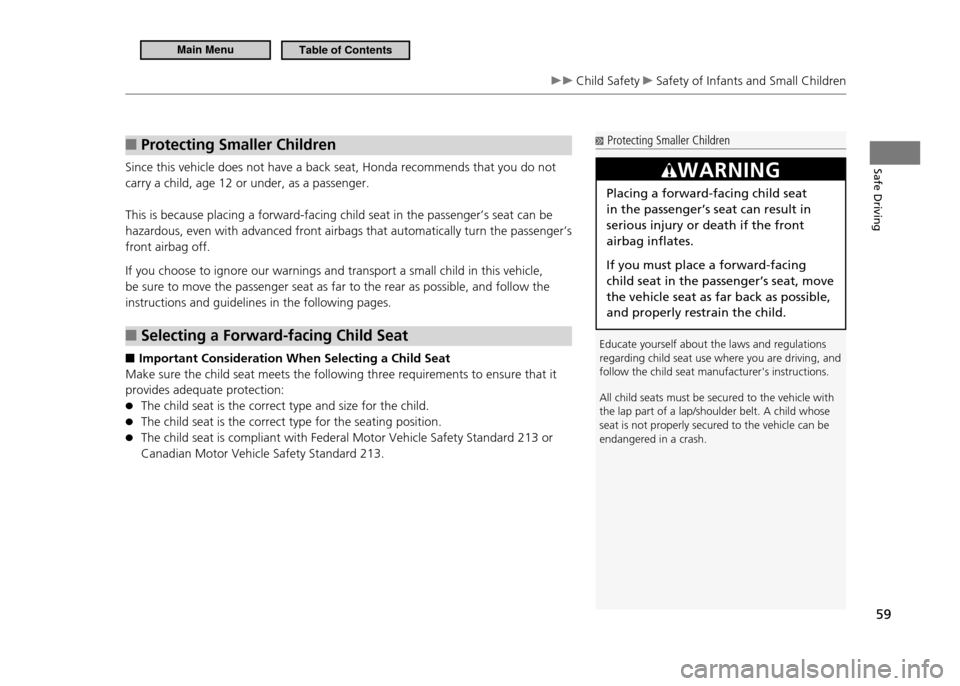
Since this vehicle does not have a back seat, Honda recommends that you do not carry a child, age 12 or under, as a passenger. This is because placing a forward-facing child seat in the passenger’s seat can be
hazardous, even with advanced front airbags that automatically turn the passenger’s front airbag off. If you choose to ignore our warnings and transport a small child in this vehicle, be sure to move the passenger seat as far to the rear as possible, and follow the instructions and guidelines in the following pages.
Selecting a Forward-facing Child Seat
■
Important Consideration When Selecting a Child Seat
■
Make sure the child seat meets the following three requirements to ensure that it provides adequate protection:
The child seat is the correct type and size for the child.
●
The child seat is the correct type for the seating position.
●
The child seat is compliant with Federal Motor Vehicle Safety Standard 213 or
●
Canadian Motor Vehicle Safety Standard 213.
Protecting Smaller Children
Educate yourself about the laws and regulations regarding child seat use where you are driving, and follow the child seat manufacturer's instructions. All child seats must be secured to the vehicle with the lap part of a lap/shoulder belt. A child whose seat is not properly secured to the vehicle can be endangered in a crash.
WARNING
Placing a forward-facing child seat in the passenger’s seat can result in serious injury or death if the front airbag inflates. If you must place a forward-facing child seat in the passenger’s seat, move the vehicle seat as far back as possible, and properly restrain the child.
Main MenuTable of Contents
Page 61 of 333
Safe Driving
60
Child Safety Safety of Infants and Small Children
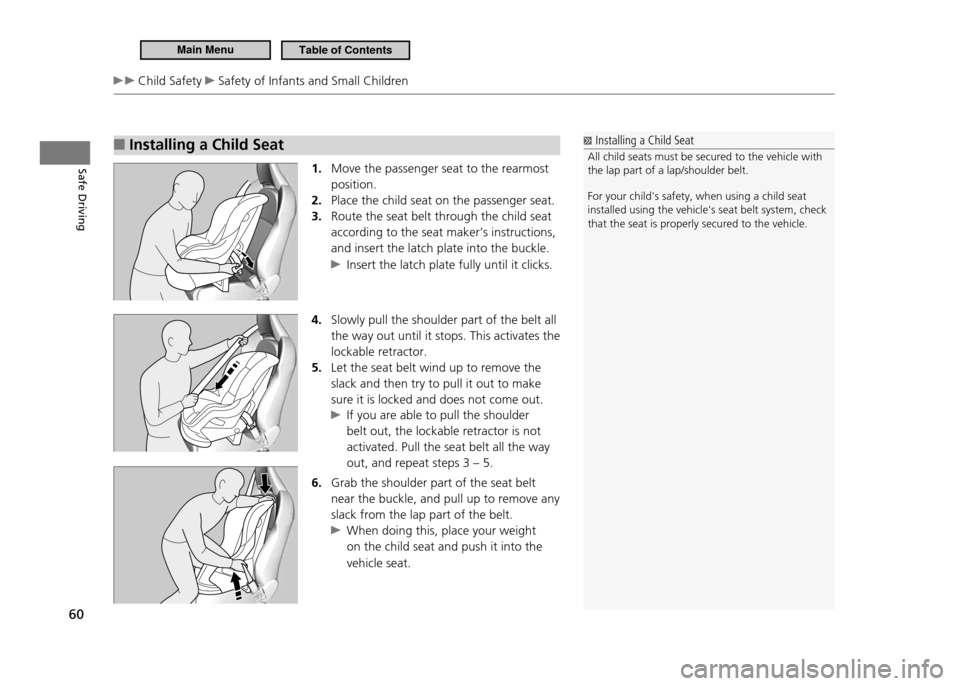
Installing a Child Seat
■
1. Move the passenger seat to the rearmost position.Place the child seat on the passenger seat.
2.
Route the seat belt through the child seat
3.
according to the seat maker’s instructions, and insert the latch plate into the buckle.
Insert the latch plate fully until it clicks.
4. Slowly pull the shoulder part of the belt all
the way out until it stops. This activates the lockable retractor.Let the seat belt wind up to remove the
5.
slack and then try to pull it out to make sure it is locked and does not come out.
If you are able to pull the shoulder belt out, the lockable retractor is not activated. Pull the seat belt all the way out, and repeat steps 3 – 5.
6. Grab the shoulder part of the seat belt near the buckle, and pull up to remove any slack from the lap part of the belt.
When doing this, place your weight
on the child seat and push it into the vehicle seat.
Installing a Child Seat
All child seats must be secured to the vehicle with the lap part of a lap/shoulder belt. For your child's safety, when using a child seat installed using the vehicle's seat belt system, check that the seat is properly secured to the vehicle.
Main MenuTable of Contents