check engine HONDA CR-Z 2011 1.G User Guide
[x] Cancel search | Manufacturer: HONDA, Model Year: 2011, Model line: CR-Z, Model: HONDA CR-Z 2011 1.GPages: 333, PDF Size: 9.97 MB
Page 198 of 333
197
Driving
When Driving
Starting the Engine
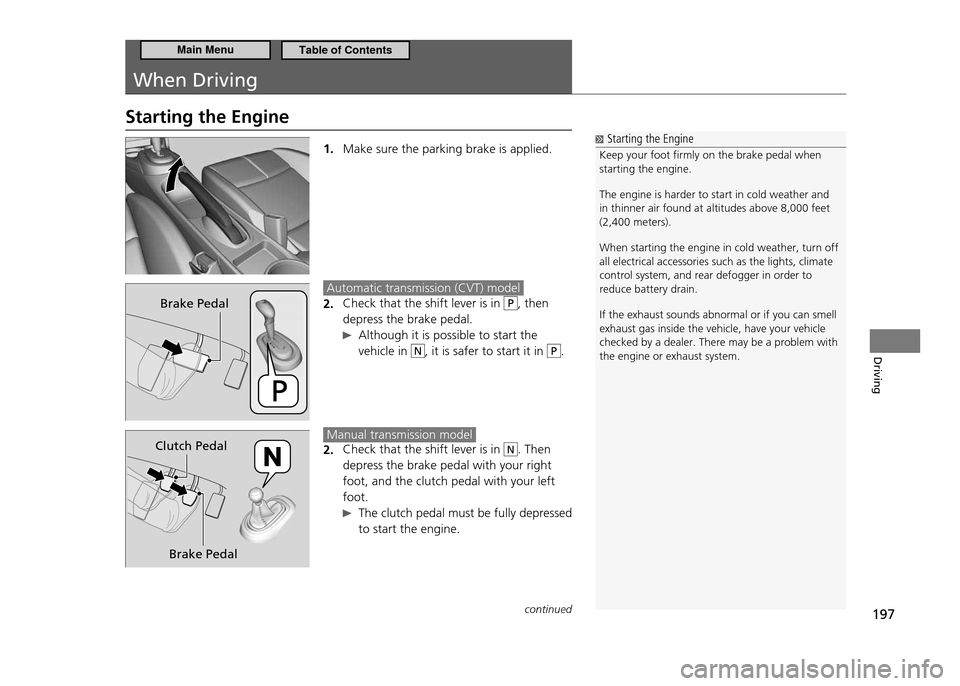
1. Make sure the parking brake is applied.
Automatic transmission (CVT) model
Check that the shift lever is in
2. P, then
depress the brake pedal.
Although it is possible to start the vehicle in
N, it is safer to start it in P.
Manual transmission model
Check that the shift lever is in
2. N. Then
depress the brake pedal with your right foot, and the clutch pedal with your left foot.
The clutch pedal must be fully depressed to start the engine.
Starting the Engine
Keep your foot irmly on the brake pedal when starting the engine. The engine is harder to start in cold weather and in thinner air found at altitudes above 8,000 feet (2,400 meters). When starting the engine in cold weather, turn off all electrical accessories such as the lights, climate control system, and rear defogger in order to reduce battery drain. If the exhaust sounds abnormal or if you can smell exhaust gas inside the vehicle, have your vehicle checked by a dealer. There may be a problem with the engine or exhaust system.
Brake Pedal
Brake Pedal
Clutch Pedal
continued
Main MenuTable of Contents
Page 199 of 333
198
Driving
When Driving Starting the Engine
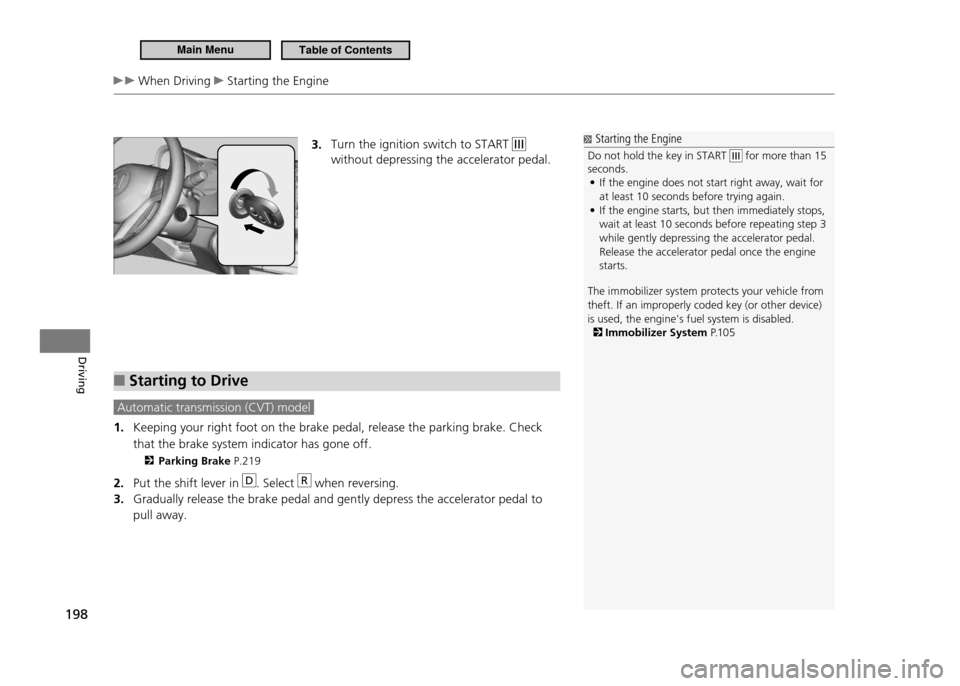
3. Turn the ignition switch to START
without depressing the accelerator pedal.
Starting to Drive
■
Automatic transmission (CVT) model
Keeping your right foot on the brake pedal, release the parking brake. Check
1.
that the brake system indicator has gone off.
Parking Brake P.219
Put the shift lever in
2.
D. Select R when reversing.
Gradually release the brake pedal and gently depress the accelerator pedal to
3.
pull away.
Starting the Engine
Do not hold the key in START
for more than 15
seconds.
If the engine does not start right away, wait for
•
at least 10 seconds before trying again. If the engine starts, but then immediately stops,
•
wait at least 10 seconds before repeating step 3 while gently depressing the accelerator pedal. Release the accelerator pedal once the engine starts.
The immobilizer system protects your vehicle from theft. If an improperly coded key (or other device) is used, the engine's fuel system is disabled.
Immobilizer System P.1 0 5
Main MenuTable of Contents
Page 201 of 333
200
Driving
When Driving Precautions While Driving
Precautions While Driving
In Rain
■
Avoid driving in deep water and on flooded roads. This can damage the engine or cause electrical component failure.
Other Precautions
■
If there is a strong impact with something under the vehicle, stop in a safe location. Check the underside of the vehicle for damage and fuel or brake fluid leaks.
Precautions While Driving
NOTICE Do not operate the shift lever while pressing the accelerator pedal. You could damage the transmission. If the ignition switch is turned to ACCESSORY
or LOCK while driving, the engine will shut
down and all steering and brake power assist functions will stop, making it dificult to control the vehicle. Do not drive with the shift lever in
, as you will
lose engine braking (and acceleration) performance. During the irst 600 miles (1,000 km) of operation, avoid sudden acceleration or full throttle operation so as to not damage the engine or powertrain. Avoid hard braking for the irst 200 miles (300 km). You should also follow this when the brakes are replaced.
Main MenuTable of Contents
Page 204 of 333
203
Driving
When Driving Shifting
Shift Lever Operation
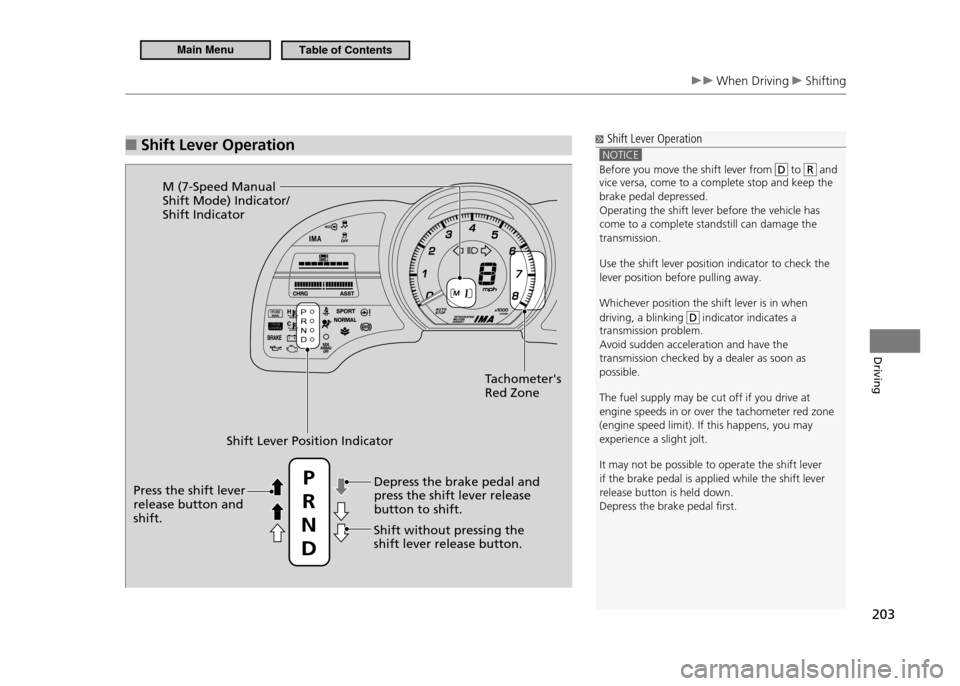
■ Shift Lever Operation
NOTICE
Before you move the shift lever from to and
vice versa, come to a complete stop and keep the brake pedal depressed.Operating the shift lever before the vehicle has come to a complete standstill can damage the transmission. Use the shift lever position indicator to check the lever position before pulling away. Whichever position the shift lever is in when driving, a blinking
indicator indicates a
transmission problem. Avoid sudden acceleration and have the transmission checked by a dealer as soon as possible. The fuel supply may be cut off if you drive at engine speeds in or over the tachometer red zone (engine speed limit). If this happens, you may experience a slight jolt. It may not be possible to operate the shift lever if the brake pedal is applied while the shift lever release button is held down.Depress the brake pedal irst.
Shift Lever Position Indicator
Tachometer's Red Zone
M (7-Speed Manual Shift Mode) Indicator/Shift Indicator
Depress the brake pedal and press the shift lever release button to shift.
Shift without pressing the shift lever release button.
Press the shift lever release button and shift. P
R
N D
Main MenuTable of Contents
Page 210 of 333
209
Driving
When Driving Shifting
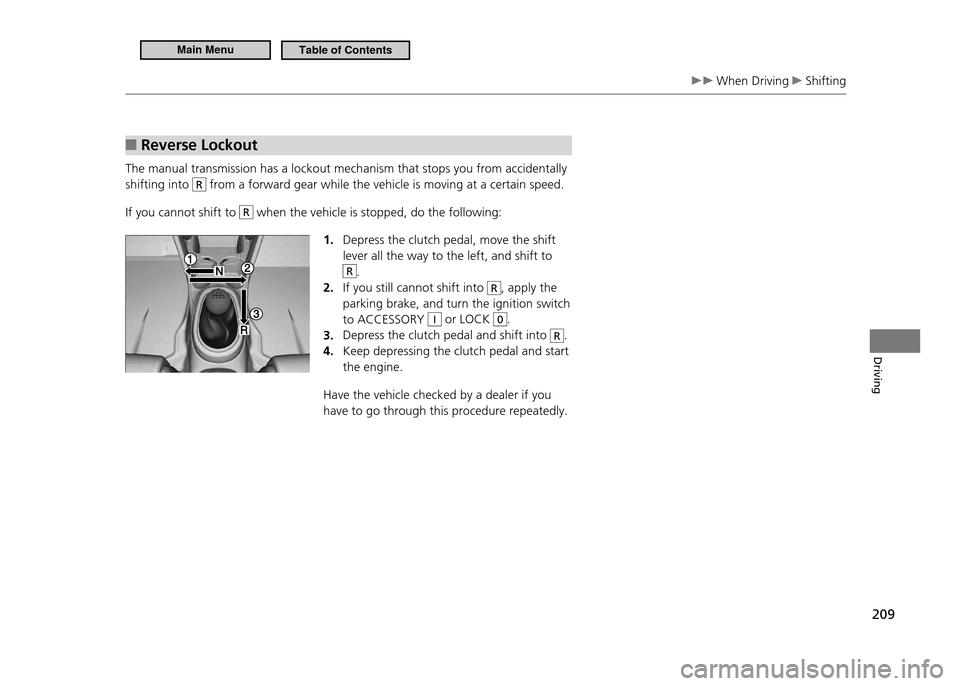
Reverse Lockout
■
The manual transmission has a lockout mechanism that stops you from accidentally shifting into
R from a forward gear while the vehicle is moving at a certain speed.
If you cannot shift to
R when the vehicle is stopped, do the following: 1. Depress the clutch pedal, move the shift lever all the way to the left, and shift to
R.
If you still cannot shift into
2.
R, apply the
parking brake, and turn the ignition switch to ACCESSORY
I or LOCK 0.
Depress the clutch pedal and shift into
3.
R.
Keep depressing the clutch pedal and start
4.
the engine.
Have the vehicle checked by a dealer if you have to go through this procedure repeatedly.
Main MenuTable of Contents
Page 215 of 333
214
Driving
When Driving VSA®
(Vehicle Stability Assist), aka ESC (Electronic Stability Control), System
VSA ®
(Vehicle Stability Assist), aka ESC (Electronic
Stability Control), System VSA ®
helps to stabilize the vehicle during cornering if the vehicle turns more or less
than what was intended. It also assists in maintaining traction on slippery surfaces. It does so by regulating engine output and selectively applying the brakes.
VSA
■®
Operation
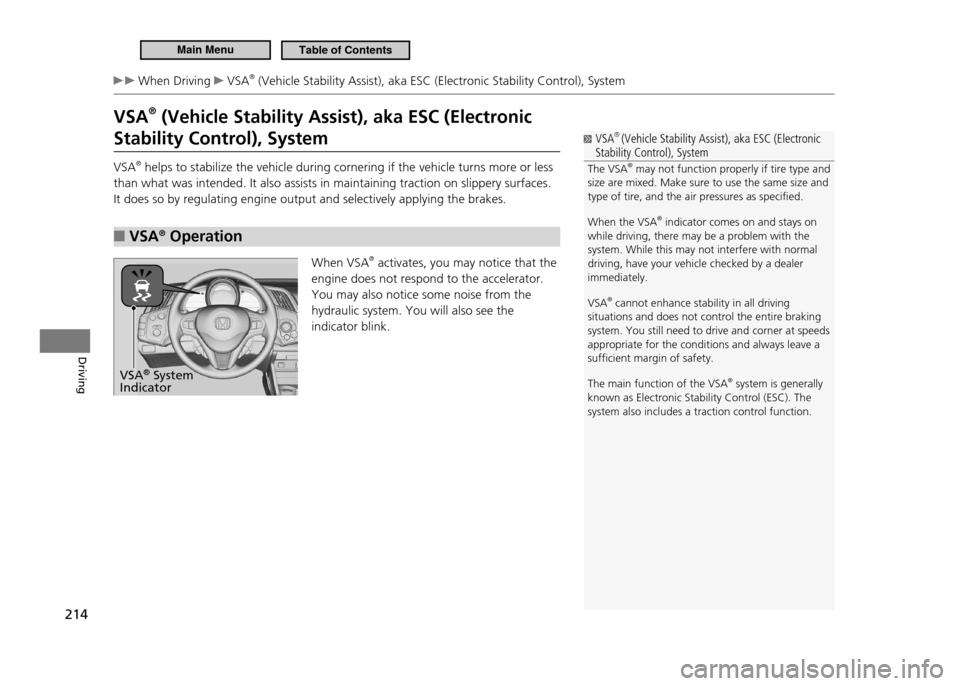
When VSA®
activates, you may notice that the
engine does not respond to the accelerator. You may also notice some noise from the hydraulic system. You will also see the indicator blink.
VSA ®
(Vehicle Stability Assist), aka ESC (Electronic
Stability Control), System
The VSA ®
may not function properly if tire type and
size are mixed. Make sure to use the same size and type of tire, and the air pressures as speciied. When the VSA ®
indicator comes on and stays on
while driving, there may be a problem with the system. While this may not interfere with normal driving, have your vehicle checked by a dealer immediately. VSA ®
cannot enhance stability in all driving
situations and does not control the entire braking system. You still need to drive and corner at speeds appropriate for the conditions and always leave a suficient margin of safety. The main function of the VSA ®
system is generally
known as Electronic Stability Control (ESC). The system also includes a traction control function.
VSA ®
System
Indicator
Main MenuTable of Contents
Page 216 of 333
215
Driving
When Driving VSA®
(Vehicle Stability Assist), aka ESC (Electronic Stability Control), System
VSA
■®
On and Off
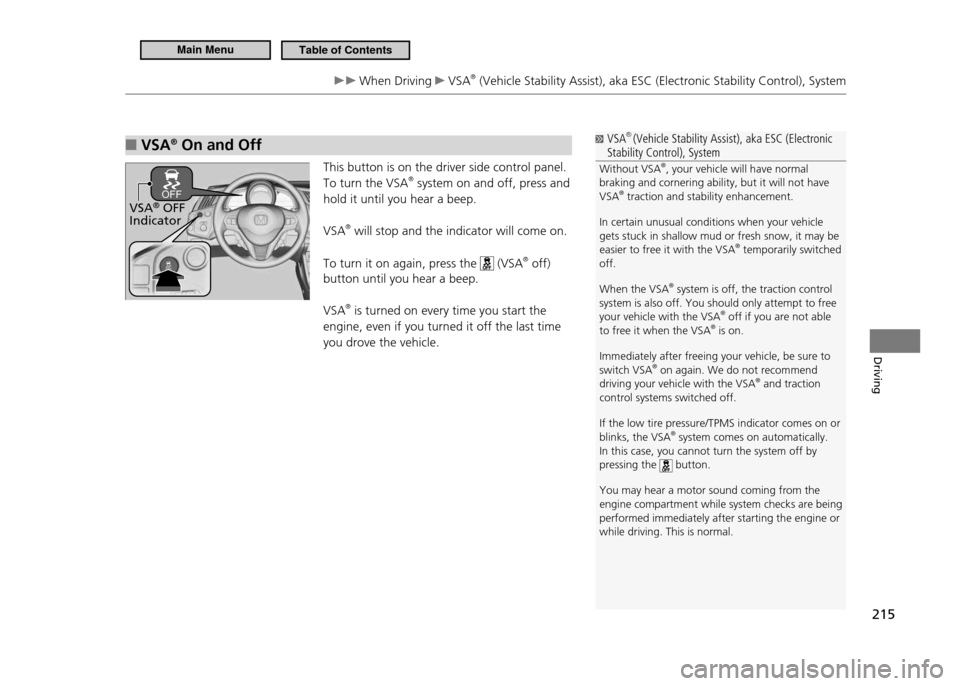
This button is on the driver side control panel. To turn the VSA®
system on and off, press and
hold it until you hear a beep. VSA ®
will stop and the indicator will come on.
To turn it on again, press the
(VSA ®
off)
button until you hear a beep. VSA ®
is turned on every time you start the
engine, even if you turned it off the last time you drove the vehicle.
VSA ®
OFF
Indicator
VSA ®
(Vehicle Stability Assist), aka ESC (Electronic
Stability Control), System
Without VSA ®
, your vehicle will have normal
braking and cornering ability, but it will not have VSA ®
traction and stability enhancement.
In certain unusual conditions when your vehicle gets stuck in shallow mud or fresh snow, it may be easier to free it with the VSA ®
temporarily switched
off. When the VSA ®
system is off, the traction control
system is also off. You should only attempt to free your vehicle with the VSA ®
off if you are not able
to free it when the VSA ®
is on.
Immediately after freeing your vehicle, be sure to switch VSA ®
on again. We do not recommend
driving your vehicle with the VSA ®
and traction
control systems switched off. If the low tire pressure/TPMS indicator comes on or blinks, the VSA ®
system comes on automatically.
In this case, you cannot turn the system off by pressing the
button.
You may hear a motor sound coming from the
engine compartment while system checks are being performed immediately after starting the engine or while driving. This is normal.
Main MenuTable of Contents
Page 221 of 333
220
Driving
Braking Brake System
Foot Brake
■
Your vehicle is equipped with disc brakes at all four wheels. A power assist helps reduce the effort needed on the brake pedal. The brake assist system increases the stopping force when you depress the brake pedal hard in an emergency situation. The anti-lock brake system (ABS) helps you retain steering control when braking very hard.
Brake Assist System P.222
ABS (Anti-lock Brake System) P.221
Foot Brake
Check the brakes after driving through deep water, or if there is a buildup of road surface water. If necessary, dry the brakes by lightly depressing the pedal several times. If you hear a continuous metallic friction sound when applying the brakes, the brake pads need to be replaced. Have the vehicle checked by a dealer.
Constantly using the brake pedal while going down a long hill builds up heat, which reduces the brake effectiveness. Apply engine braking by taking your foot off the accelerator pedal and downshifting to a lower gear. With manual transmission use a lower gear for greater engine braking. Do not rest your foot on the brake pedal while driving, as it will lightly apply the brakes and cause them to lose effectiveness over time and reduce pad life. It will also confuse drivers behind you.
Main MenuTable of Contents
Page 222 of 333
221
Driving
Braking ABS (Anti-lock Brake System)
ABS (Anti-lock Brake System)
ABS
■
Helps prevent the wheels from locking up, and helps you retain steering control by pumping the brakes rapidly, much faster than you can do. The electronic brake distribution (EBD) system, which is part of the ABS, also balances the front-to-rear braking distribution according to vehicle loading. You should never pump the brake pedal. Let the ABS work for you by always keeping firm, steady pressure on the brake pedal. This is sometimes referred to as “stomp and steer.”
ABS Operation
■
The brake pedal may pulsate slightly when the ABS is working. Keep holding the pedal firmly down. On dry pavement, you will need to press on the brake pedal very hard before the ABS activates. However, you may feel the ABS activate immediately if you are trying to stop on snow or ice. When the vehicle speed goes under 6 mph (10 km/h), the ABS stops.
ABS (Anti-lock Brake System)
NOTICE The ABS may not function correctly if you use an incorrect tire type and size. When the ABS indicator comes on while driving, there may be a problem with the system.While normal braking is not affected, there is a possibility of the ABS not operating. Have the vehicle checked by a dealer immediately. The ABS does not reduce the time or distance it takes to stop the vehicle. It only helps with steering control during hard braking. In the following cases, your vehicle may need more stopping distance than a vehicle without ABS: When driving on rough road surfaces, including
•
when driving on uneven surfaces, such as gravel or snow.When tire chains are installed.
•
You may hear a motor sound coming from the
engine compartment while system checks are being performed immediately after starting the engine or while driving. This is normal.
Main MenuTable of Contents
Page 232 of 333
231
Driving
Refueling
Fuel InformationFuel Recommendation
■
Unleaded gasoline, pump octane number 87 or higher
Use of a lower octane gasoline can cause a persiste nt, heavy metallic knocking noise
that can lead to engine damage.
Fuel Tank Capacity: 10.6 U.S. gal (40 L)
■
Fuel Information
NOTICE We strongly recommend that you do NOT use gasoline that contains manganese-based fuel additives such as MMT.Use of gasoline with these additives may adversely affect performance of the emissions control system, breach the emissions warranty, and cause the malfunction indicator lamp to come on. If this happens, have it checked by a dealer.
NOTICE Use of gasoline that contains these additives presents the following risks:
Damage to the exhaust system including the
•
catalytic converterDamage to the engine and fuel system
•
Detrimental effects on the engine and other
•
systems
Some gasoline today is blended with oxygenates such as ethanol. Your vehicle is designed to operate on oxygenated gasoline containing up to 10% ethanol by volume. For more information, visit www.hondacars.com,
www.honda.ca for Canadian customers. For details
about the factors affecting fuel economy ratings, see www.fueleconomy.gov (www.vehicles.gc.ca
for Canada).
Main MenuTable of Contents