mode HONDA CR-Z 2013 1.G User Guide
[x] Cancel search | Manufacturer: HONDA, Model Year: 2013, Model line: CR-Z, Model: HONDA CR-Z 2013 1.GPages: 325, PDF Size: 11.73 MB
Page 18 of 325
17
Quick Reference Guide
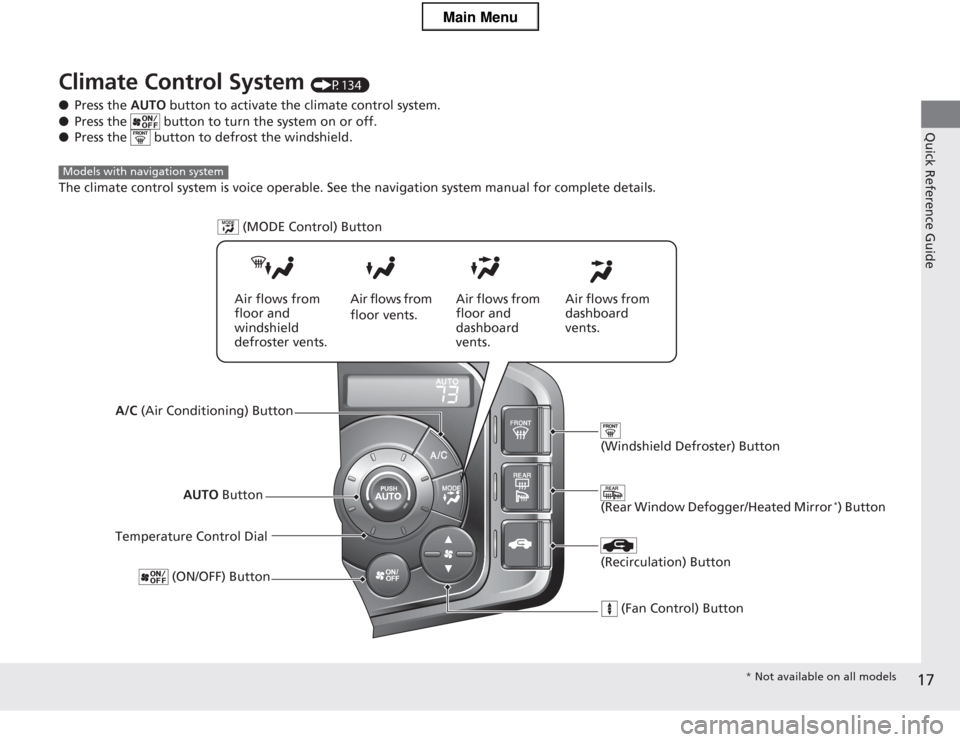
Climate Control System (P134)
● Press the AUTO button to activate the climate control system.
● Press the button to turn the system on or off.
● Press the button to defrost the windshield.
The climate control system is voice operable. See the navigation system manual for complete details.
Models with navigation system
AUTO Button
Temperature Control Dial (ON/OFF) Button
(Recirculation) Button
(Fan Control) Button
(Rear Window Defogger/Heated Mirror *
) Button
(Windshield Defroster) Button
A/C (Air Conditioning) Button (MODE Control) Button
Air flows from floor and
windshield
defroster vents.
Air flows from floor vents.
Air flows from
floor and
dashboard
vents. Air flows from
dashboard
vents.
*
Not available on all models
Main Menu
Page 19 of 325
18
Quick Reference Guide
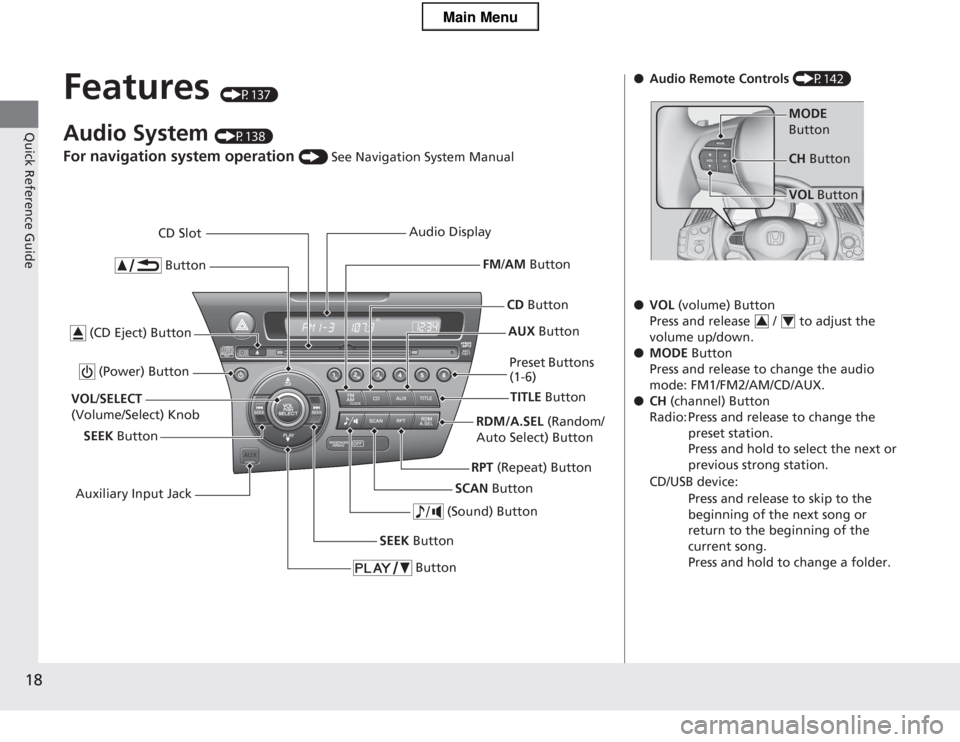
Features (P137)
Audio System (P138)
For navigation system operation () See Navigation System Manual
Button
TITLE Button
FM
/AM Button
(Power) Button
CD Button
AUX Button
CD Slot
(CD Eject) Button
SCAN Button
(Sound) Button
VOL /SELECT
(Volume/Select) Knob
SEEK Button Preset Buttons
(1-6)
Button
SEEK Button
Auxiliary Input Jack Audio Display
RDM/A.SEL (Random/
Auto Select) Button
RPT (Repeat) Button
●Audio Remote Controls (P142)
● VOL (volume) Button
Press and release / to adjust the volume up/down.
● MODE Button
Press and release to change the audio
mode: FM1/FM2/AM/CD/AUX.
● CH (channel) Button
Radio: Press and release to change the preset station. Press and hold to select the next or previous strong station.
CD/USB device:
Press and release to skip to the
beginning of the next song or
return to the beginning of the current song.
Press and hold to change a folder.
MODE
Button
VOL Button
CH
Button
34
Main Menu
Page 20 of 325
19
Quick Reference Guide
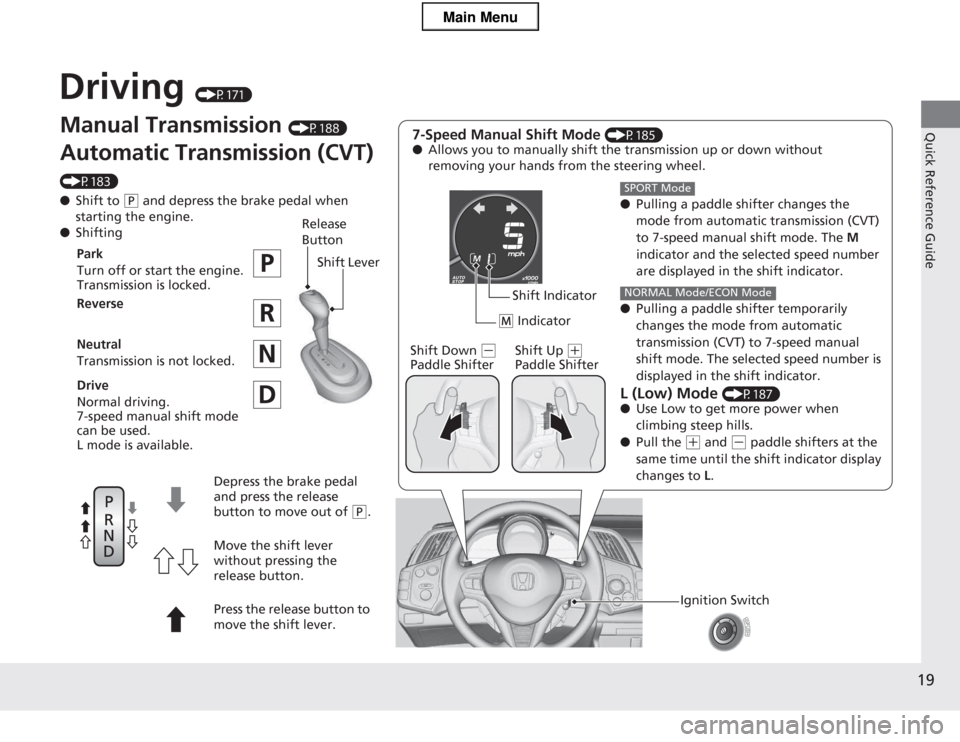
Driving (P171)
Manual Transmission (P188)
Automatic Transmission (CVT)
(P183) ● Shift to
(P and depress the brake pedal when
starting the engine.
● Shifting 7-Speed Manual Shift Mode
(P185)
● Allows you to manually shift the transmission up or down without
removing your hands from the steering wheel.
●Pulling a paddle shifter changes the
mode from automatic transmission (CVT)
to 7-speed manual shift mode. The M
indicator and the selected speed number
are displayed in the shift indicator.
● Pulling a paddle shifter temporarily
changes the mode from automatic
transmission (CVT) to 7-speed manual
shift mode. The selected speed number is
displayed in the shift indicator.
L (Low) Mode (P187)
● Use Low to get more power when
climbing steep hills.
● Pull the
(+ and (- paddle shifters at the
same time until the shift indicator display changes to L.
SPORT Mode
NORMAL Mode/ECON Mode
(
M Indicator
Shift Indicator
Shift Down
(-
Paddle Shifter Shift Up (+
Paddle Shifter
Ignition Switch
Release
ButtonShift Lever
Park
Turn off or start the engine.
Transmission is locked.
Reverse
Neutral
Transmission is not locked.
Drive
Normal driving.
7-speed manual shift mode can be used.
L mode is available.
Depress the brake pedal
and press the release button to move out of
(P.
Move the shift lever
without pressing the
release button.
Press the release button to
move the shift lever.
Main Menu
Page 21 of 325
20
Quick Reference Guide
VSA® OFF Button (P204)
● The vehicle stability assist (VSA ®) system
helps stabilize the vehicle during
cornering, and helps maintain traction
while accelerating on loose or slippery road surfaces.
● VSA ® comes on automatically every time
you start the engine.
● To turn VSA ® on or off, press and hold
the button until you hear a beep.
Cruise Control (P200)
● Cruise control allows you to maintain a
set speed without keeping your foot on
the accelerator pedal.
● To use cruise control, press the CRUISE
button, then press DECEL/SET once you
have achieved the desired speed above 25
mph or 40 km/h.
Tire Pressure Monitoring System (TPMS) (P205)
● TPMS monitors tire pressure.
● TPMS is turned on automatically every time you start the engine.
U.S. models only
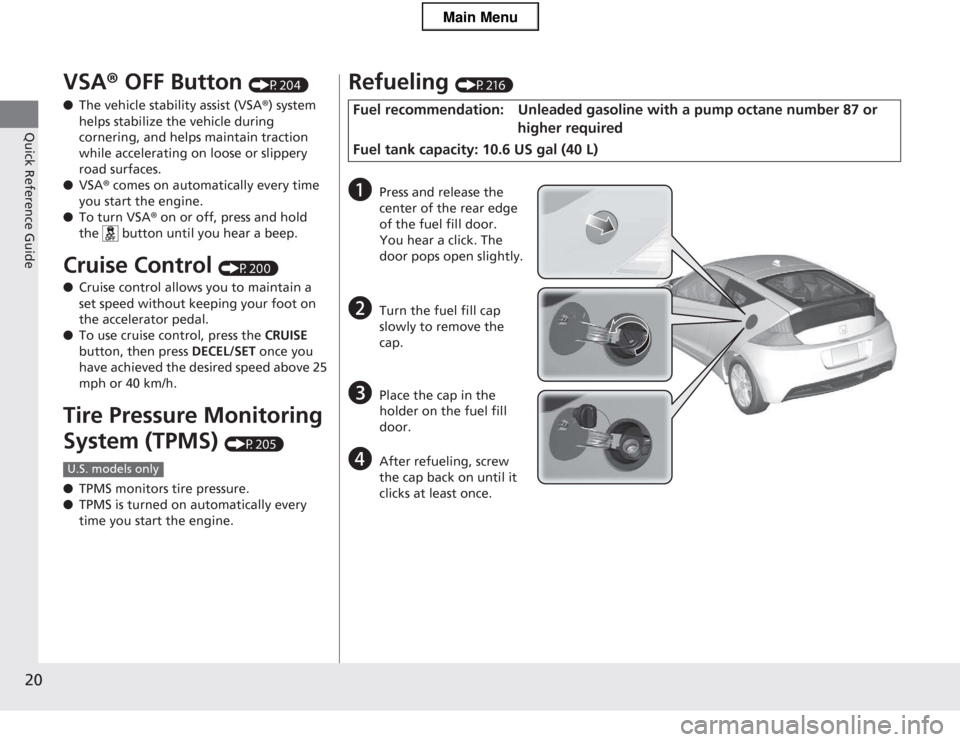
Refueling (P216)
Fuel recommendation: Unleaded gasoline with a pump octane number 87 or higher required
Fuel tank capacity: 10.6 US gal (40 L)
a Press and release the
center of the rear edge of the fuel fill door.
You hear a click. The
door pops open slightly.
b Turn the fuel fill cap
slowly to remove the cap.
c Place the cap in the holder on the fuel fill
door.
d After refueling, screw
the cap back on until it clicks at least once.
Main Menu
Page 23 of 325
22
Quick Reference Guide
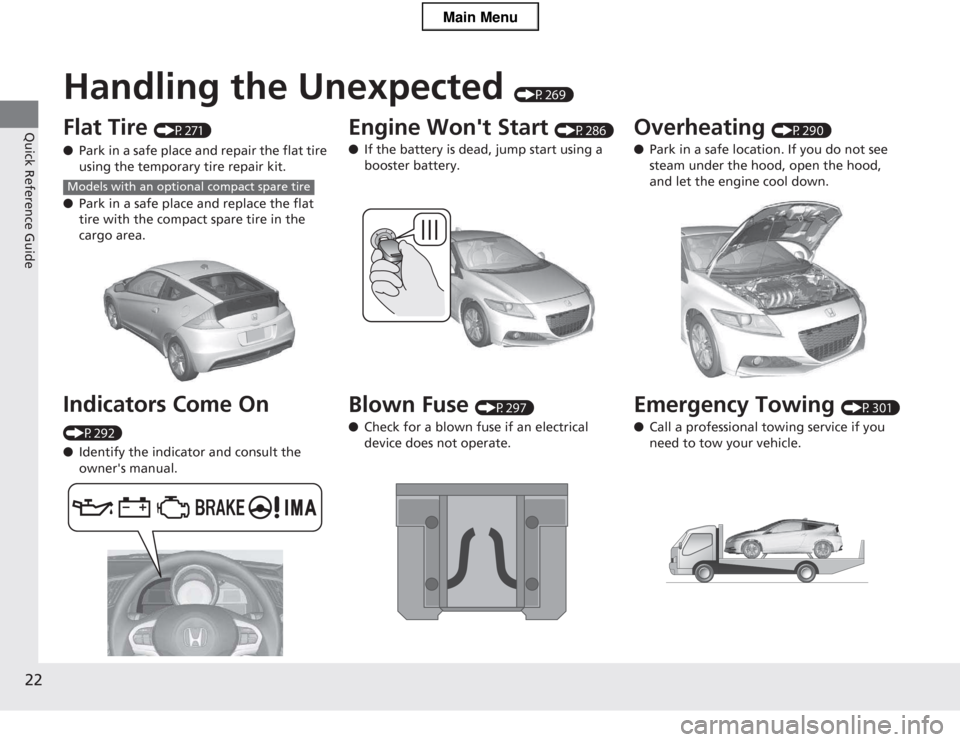
Handling the Unexpected (P269)
Flat Tire (P271)
● Park in a safe place and repair the flat tire
using the temporary tire repair kit.
● Park in a safe place and replace the flat
tire with the compact spare tire in the
cargo area.
Indicators Come On
(P292) ● Identify the indicator and consult the
owner's manual.
Models with an optional compact spare tire
Engine Won't Start (P286)
● If the battery is dead, jump start using a booster battery.
Blown Fuse (P297)
● Check for a blown fuse if an electrical device does not operate.Overheating (P290)
● Park in a safe location. If you do not see
steam under the hood, open the hood, and let the engine cool down.
Emergency Towing (P301)
● Call a professional towing service if you need to tow your vehicle.
Main Menu
Page 24 of 325
23
Quick Reference Guide
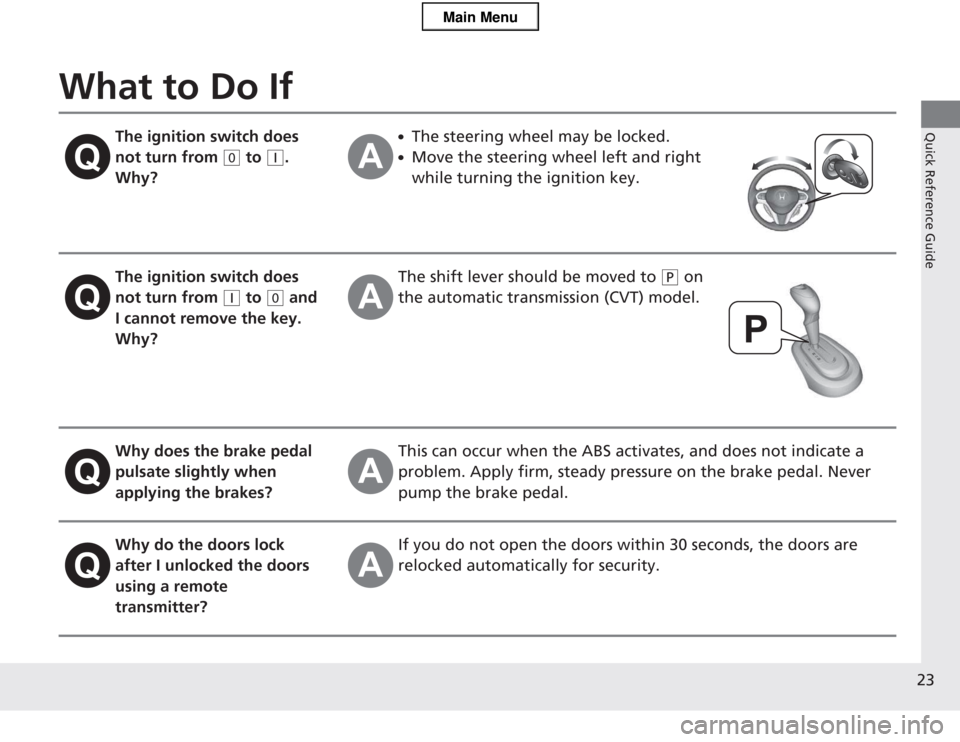
What to Do If
The ignition switch does
not turn from
(0 to (q.
Why?
● The steering wheel may be locked.
● Move the steering wheel left and right
while turning the ignition key.
The ignition switch does
not turn from
(q to (0 and
I cannot remove the key.
Why?
The shift lever should be moved to (P on
the automatic transmission (CVT) model.
Why does the brake pedal
pulsate slightly when
applying the brakes?This can occur when the ABS activates, and does not indicate a
problem. Apply firm, steady pressu re on the brake pedal. Never
pump the brake pedal.
Why do the doors lock
after I unlocked the doors using a remote
transmitter?If you do not open the doors within 30 seconds, the doors are
relocked automatically for security.
Main Menu
Page 35 of 325
uuSeat BeltsuAbout Your Seat Belts
34
Safe Driving
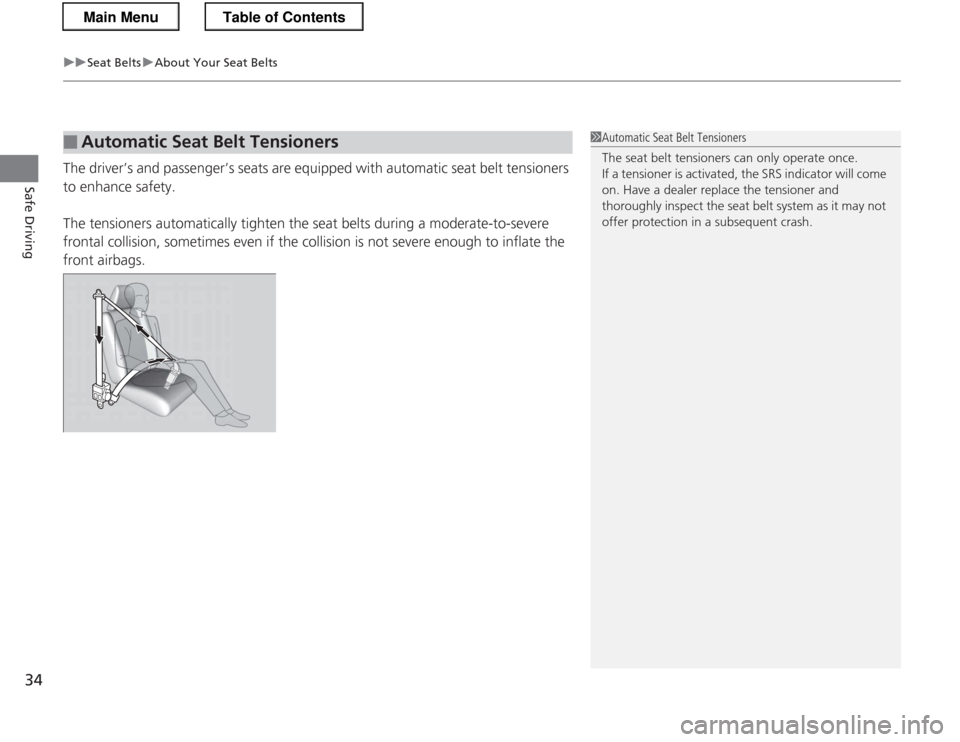
The driver’s and passenger’s seats are equipped with automatic seat belt tensioners
to enhance safety.
The tensioners automatically tighten the seat belts during a moderate-to-severe
frontal collision, sometimes even if the collision is not severe enough to inflate the front airbags.
■Automatic Seat Belt Tensioners1Automatic Seat Belt Tensioners
The seat belt tensioners can only operate once. If a tensioner is activated, the SRS indicator will come
on. Have a dealer replace the tensioner and
thoroughly inspect the seat belt system as it may not
offer protection in a subsequent crash.
Main MenuTable of Contents
Page 41 of 325
40
uuAirbagsuAirbag System Components
Safe Driving
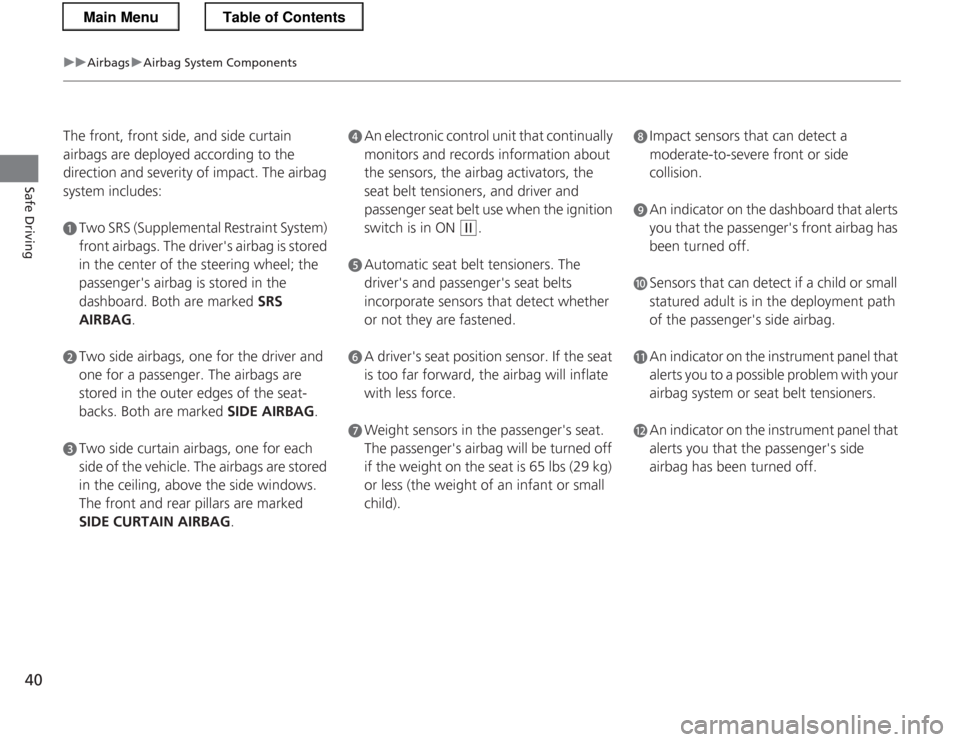
The front, front side, and side curtain
airbags are deployed according to the
direction and severity of impact. The airbag
system includes:
aTwo SRS (Supplemental Restraint System)
front airbags. The driver's airbag is stored
in the center of the steering wheel; the
passenger's airbag is stored in the
dashboard. Both are marked SRS
AIRBAG .
bTwo side airbags, one for the driver and
one for a passenger. The airbags are
stored in the outer edges of the seat-
backs. Both are marked SIDE AIRBAG.
cTwo side curtain airbags, one for each
side of the vehicle. The airbags are stored
in the ceiling, above the side windows.
The front and rear pillars are marked
SIDE CURTAIN AIRBAG .
dAn electronic control unit that continually
monitors and records information about
the sensors, the airbag activators, the
seat belt tensioners, and driver and
passenger seat belt use when the ignition
switch is in ON
(w .
eAutomatic seat belt tensioners. The
driver's and passenger's seat belts
incorporate sensors that detect whether
or not they are fastened.
fA driver's seat position sensor. If the seat
is too far forward, the airbag will inflate
with less force.
gWeight sensors in the passenger's seat.
The passenger's airbag will be turned off if the weight on the seat is 65 lbs (29 kg)
or less (the weight of an infant or small child).
hImpact sensors that can detect a
moderate-to-severe front or side
collision.
iAn indicator on the dashboard that alerts
you that the passenger's front airbag has
been turned off.
jSensors that can detect if a child or small
statured adult is in the deployment path
of the passenger's side airbag.
kAn indicator on the instrument panel that
alerts you to a possible problem with your
airbag system or seat belt tensioners.
lAn indicator on the instrument panel that
alerts you that the passenger's side
airbag has been turned off.
Main MenuTable of Contents
Page 43 of 325
42
uuAirbagsuTypes of Airbags
Safe Driving
Types of Airbags
Your vehicle is equipped with three types of airbags: •Front airbags: Airbags in front of the driver's and passenger's seats.
• Side airbags: Airbags in the driver's and passenger's seat-backs.
• Side curtain airbags: Airbags above the side windows.
Each is discussed in the following pages.
Front Airbags (SRS)
The front SRS airbags inflate in a moderate-to-severe frontal collision to help protect
the head and chest of the driver and/or passenger. SRS (Supplemental Restraint System) indicates that the airbags are designed to
supplement seat belts, not replace them. Seat belts are the occupant's primary
restraint system.
The front airbags are housed in the center of the steering wheel for the driver, and
in the dashboard for the passenger. Both airbags are marked SRS AIRBAG.
■Housing Locations
1Types of Airbags
The airbags can inflate whenever the ignition switch is in ON
(w.
After an airbag inflates in a crash, you may see a
small amount of smoke. This is from the combustion
process of the inflator ma terial and is not harmful.
People with respiratory problems may experience
some temporary discomfort. If this occurs, get out of
the vehicle as soon as it is safe to do so.
1Front Airbags (SRS)
Dual-Stage, Multiple-Threshold Front Airbags
(SRS)
Your vehicle is equipped with dual-stage, multiple-
threshold front airbags (SRS).
During a frontal crash severe enough to cause one or
both front airbags to deploy, the airbags can inflate at different rates, depending on the severity of the
crash, whether or not the seat belts are latched, and/ or other factors. Frontal airbags are designed to
supplement the seat belts to help reduce the
likelihood of head and chest injuries in frontal
crashes.
Main MenuTable of Contents
Page 44 of 325
Continued43
uuAirbagsuFront Airbags (SRS)
Safe Driving
Front airbags are designed to inflate during moderate-to-severe frontal collisions.
When the vehicle decelerates suddenly, the sensors send information to the control
unit which signals one or both front airbags to inflate.
A frontal collision can be either head-on or angled between two vehicles, or when a
vehicle crashes into a stationary object, such as a concrete wall.
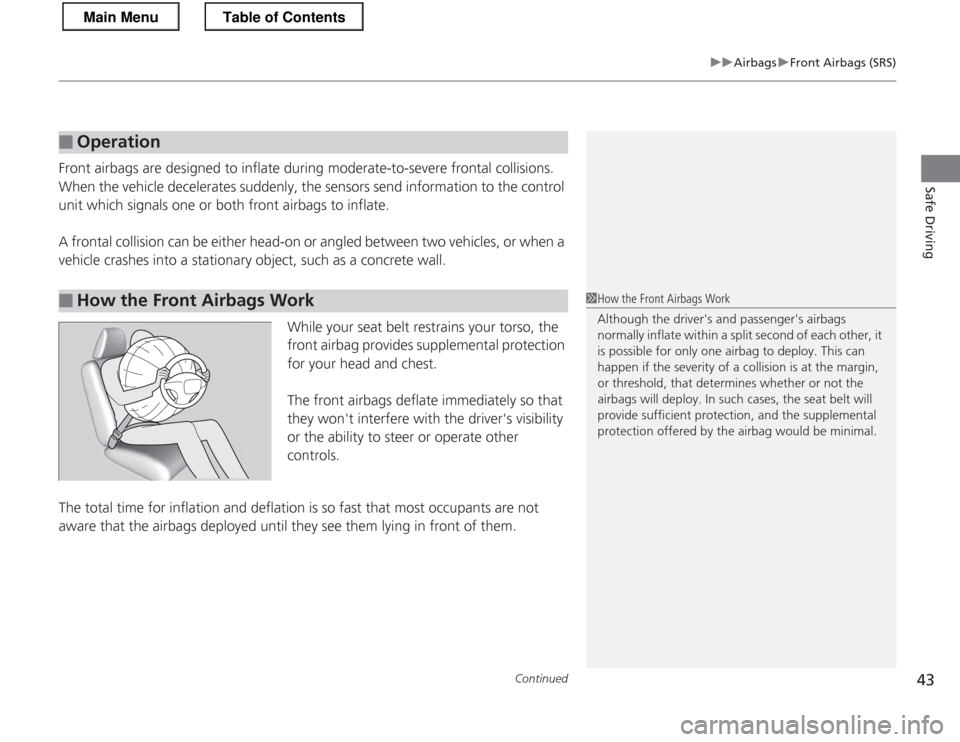
While your seat belt restrains your torso, the
front airbag provides supplemental protection
for your head and chest.
The front airbags deflate immediately so that
they won't interfere with the driver's visibility
or the ability to steer or operate other
controls.
The total time for inflation and deflation is so fast that most occupants are not
aware that the airbags deployed until they see them lying in front of them.
■Operation
■How the Front Airbags Work1How the Front Airbags Work
Although the driver's and passenger's airbags
normally inflate within a split second of each other, it
is possible for only one airbag to deploy. This can
happen if the severity of a collision is at the margin,
or threshold, that determines whether or not the
airbags will deploy. In such cases, the seat belt will
provide sufficient protection, and the supplemental
protection offered by the airbag would be minimal.
Main MenuTable of Contents