mode HONDA CR-Z 2013 1.G Owner's Manual
[x] Cancel search | Manufacturer: HONDA, Model Year: 2013, Model line: CR-Z, Model: HONDA CR-Z 2013 1.GPages: 325, PDF Size: 11.73 MB
Page 45 of 325
44
uuAirbagsuFront Airbags (SRS)
Safe Driving
■When front airbags should not deploy
Minor frontal crashes: Front airbags were designed to supplement seat belts and
help save lives, not to prevent minor scrapes, or even broken bones that might occur
during a less than moderate-to-severe frontal crash.
Side impacts: Front airbags can provide protection when a sudden deceleration
causes a driver or passenger to move towards the front of the vehicle. Side airbags
and side curtain airbags have been specifically designed to help reduce the severity
of injuries that can occur during a mode rate-to-severe side impact which can cause
the driver or passenger to move towards the side of the vehicle.
Rear impacts: Head restraints and seat belts are your best protection during a rear
impact. Front airbags cannot provide any sig nificant protection and are not designed
to deploy in such collisions.
Rollovers: Seat belts and, in vehicles equipped with a rollover sensor, side airbags,
and side curtain airbags offer the best protection in a rollover. Because front airbags could provide little if any protectio n, they are not designed to deploy during a
rollover.
■ When front airbags deploy with little or no visible damage
Because the airbag system senses s udden deceleration, a strong impact to the
vehicle framework or suspension might cause one or more of the airbags to deploy.
Examples include running into a curb, the edge of a hole, or other low fixed object
that causes a sudden deceleration in the vehicle chassis. Since the impact is
underneath the vehicle, damage may not be readily apparent.
■ When front airbags may not depl oy, even though exterior damage
appears severe
Since crushable body parts absorb crash energy during an impact, the amount of
visible damage does not always indicate proper airbag operation. In fact, some
collisions can result in severe damage but no airbag deployment because the airbags
would not have been needed or would not have provided protection even if they
had deployed.
Main MenuTable of Contents
Page 47 of 325
46
uuAirbagsuSide Airbags
Safe Driving
Side Airbags
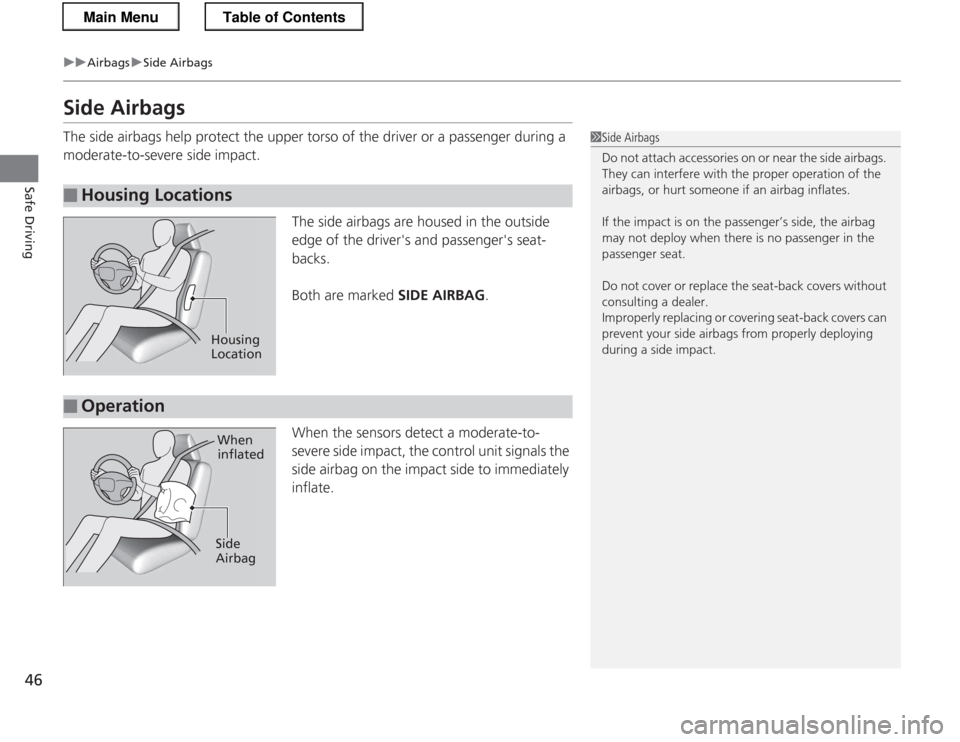
The side airbags help protect the upper torso of the driver or a passenger during a
moderate-to-severe side impact.The side airbags are housed in the outside
edge of the driver's and passenger's seat-
backs.
Both are marked SIDE AIRBAG.
When the sensors detect a moderate-to-
severe side impact, the control unit signals the
side airbag on the impact side to immediately
inflate.
■Housing Locations
1Side Airbags
Do not attach accessories on or near the side airbags.
They can interfere with th e proper operation of the
airbags, or hurt someone if an airbag inflates.
If the impact is on the passenger’s side, the airbag
may not deploy when there is no passenger in the
passenger seat.
Do not cover or replace the seat-back covers without consulting a dealer.
Improperly replacing or covering seat-back covers can
prevent your side airbags from properly deploying
during a side impact.
Housing
Location
■Operation
When
inflated
Side Airbag
Main MenuTable of Contents
Page 50 of 325
49
uuAirbagsuSide Curtain Airbags
Safe Driving
Side Curtain Airbags
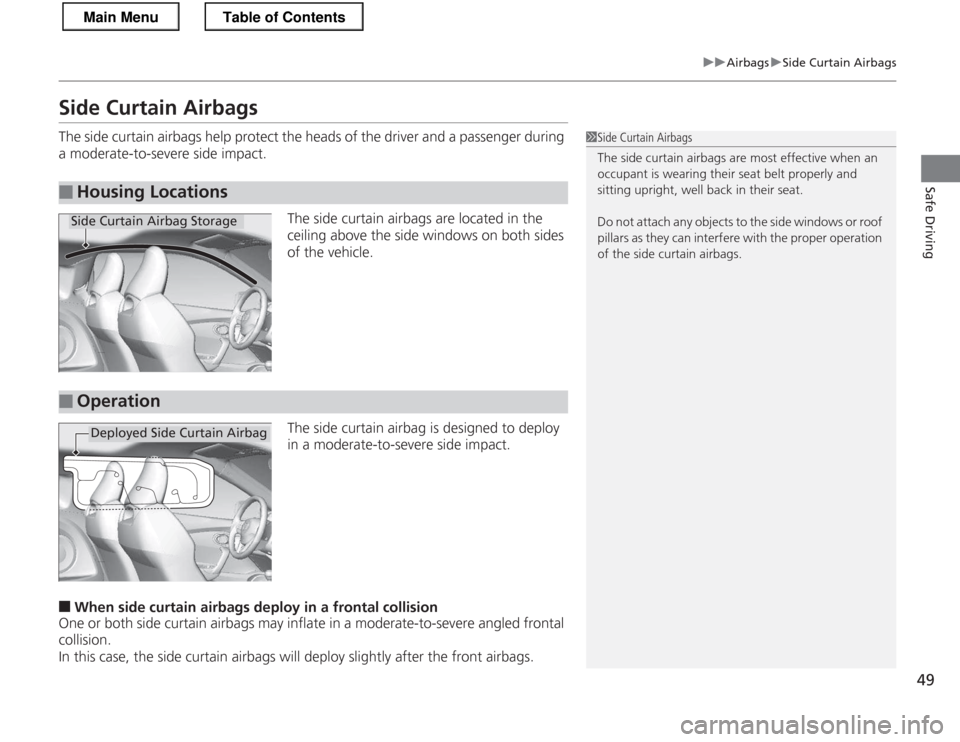
The side curtain airbags help protect the heads of the driver and a passenger during
a moderate-to-severe side impact.
The side curtain airbags are located in the
ceiling above the side windows on both sides of the vehicle.
The side curtain airbag is designed to deploy
in a moderate-to-severe side impact.
■ When side curtain airbags de ploy in a frontal collision
One or both side curtain airbags may inflate in a moderate-to-severe angled frontal
collision.
In this case, the side curtain airbags will deploy slightly after the front airbags.
■Housing Locations
1Side Curtain Airbags
The side curtain airbags are most effective when an
occupant is wearing their seat belt properly and
sitting upright, well back in their seat.
Do not attach any objects to the side windows or roof
pillars as they can interf ere with the proper operation
of the side curtain airbags.
Side Curtain Airbag Storage
■Operation
Deployed Side Curtain Airbag
Main MenuTable of Contents
Page 54 of 325
53
uuAirbagsuAirbag Care
Safe Driving
Airbag Care
You do not need to, and should not, perform any maintenance on or replace any
airbag system components yourself. However, you should have your vehicle
inspected by a dealer in the following situations: ■When the airbags have deployed
If an airbag has inflated, the control unit and other related parts must be replaced.
Similarly, once an automatic seat belt tensioner has been activated, it must be
replaced. ■ When the vehicle has been in a moderate-to-severe collision
Even if the airbags did not inflate, have your dealer inspect the following: the driver’s
seat position sensor, weight sensors in the passenger’s seat, seat belt tensioners,
and each seat belt that was worn during the crash.
■ Do not remove or modify a seat without consulting a dealer
This would likely disable the driver's seat position sensor or the weight sensors in the
passenger’s seat. If it is necessary to remove or modify a seat to accommodate a
person with disabilities, contact a Honda dealer, or for U.S. vehicles, American Honda Automobile Customer Service at 800-999-10 09 and for Canadian vehicles,
Honda Canada Customer Relations at 888-9-HONDA-9.
1Airbag Care
We recommend against the use of salvaged airbag
system components, including the airbag, tensioners,
sensors, and control unit.
Main MenuTable of Contents
Page 56 of 325
55
uuChild SafetyuProtecting Child Passengers
Safe Driving
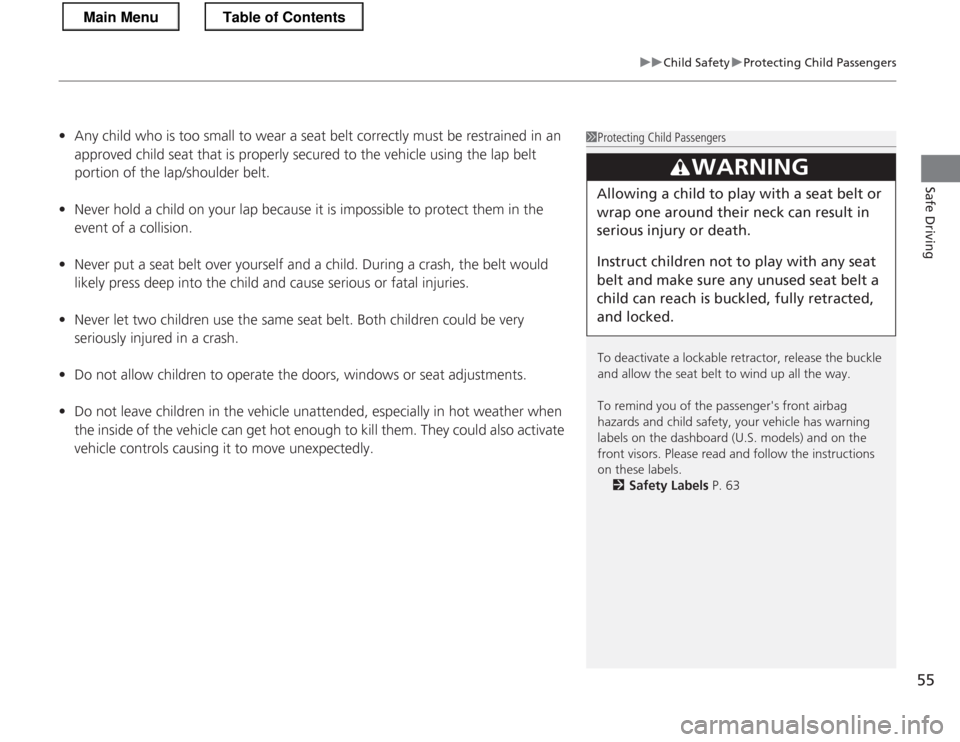
•Any child who is too small to wear a seat belt correctly must be restrained in an
approved child seat that is properly secured to the vehicle using the lap belt
portion of the lap/shoulder belt.
• Never hold a child on your lap because it is impossible to protect them in the
event of a collision.
• Never put a seat belt over yourself and a child. During a crash, the belt would
likely press deep into the child and cause serious or fatal injuries.
• Never let two children use the same seat belt. Both children could be very
seriously injured in a crash.
• Do not allow children to operate the doors, windows or seat adjustments.
• Do not leave children in the vehic le unattended, especially in hot weather when
the inside of the vehicle can get hot enou gh to kill them. They could also activate
vehicle controls causing it to move unexpectedly.1Protecting Child Passengers
To deactivate a lockable retractor, release the buckle
and allow the seat belt to wind up all the way.
To remind you of the passenger's front airbag
hazards and child safety, your vehicle has warning
labels on the dashboard (U.S. models) and on the
front visors. Please read and follow the instructions
on these labels. 2 Safety Labels P. 63
3WARNING
Allowing a child to play with a seat belt or
wrap one around their neck can result in
serious injury or death.
Instruct children not to play with any seat
belt and make sure any unused seat belt a
child can reach is bu ckled, fully retracted,
and locked.
Main MenuTable of Contents
Page 63 of 325
62
Safe Driving
Exhaust Gas Hazard
Carbon Monoxide Gas
The engine exhaust from this vehicle contains carbon monoxide, a colorless,
odorless, and highly toxic gas. As long as you properly maintain your vehicle, carbon
monoxide gas will not get into the interior. ■ Have the exhaust system inspected for leaks whenever
• The exhaust system is making an unusual noise.
• The exhaust system may have been damaged.
• The vehicle is raised for an oil change.
When you operate a vehicle with the hatch open, airflow can pull exhaust gas into
the interior and create a hazardous condition. If yo u must drive with the hatch open,
open both windows and set the climate control system as shown below. 1. Select the fresh air mode.
2. Select the mode.
3. Set the fan speed to high.
4. Set the temperature control to a comfortable setting.
Adjust the climate control system in the same manner if you sit in your parked
vehicle with the engine running.
1Carbon Monoxide Gas
An enclosed area such as a garage can quickly fill up
with carbon monoxide gas.
Do not run the engine with the garage door closed.
Even when the garage door is open, drive out of the
garage immediately after starting the engine.
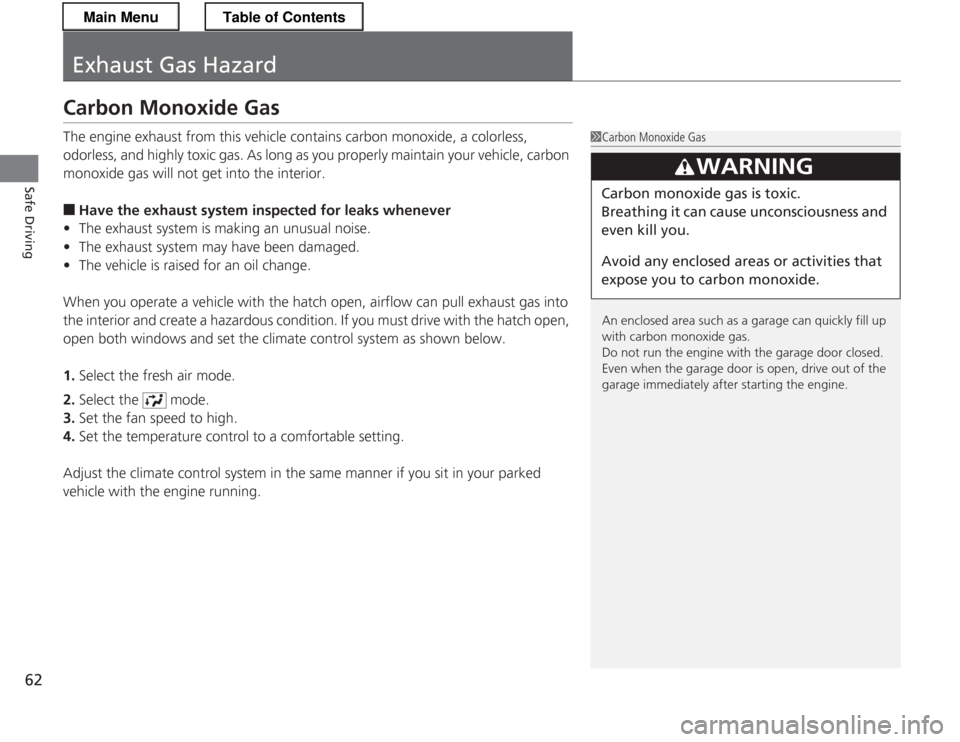
3WARNING
Carbon monoxide gas is toxic.
Breathing it can cause unconsciousness and even kill you.
Avoid any enclosed areas or activities that
expose you to carbon monoxide.
Main MenuTable of Contents
Page 64 of 325
63
Safe Driving
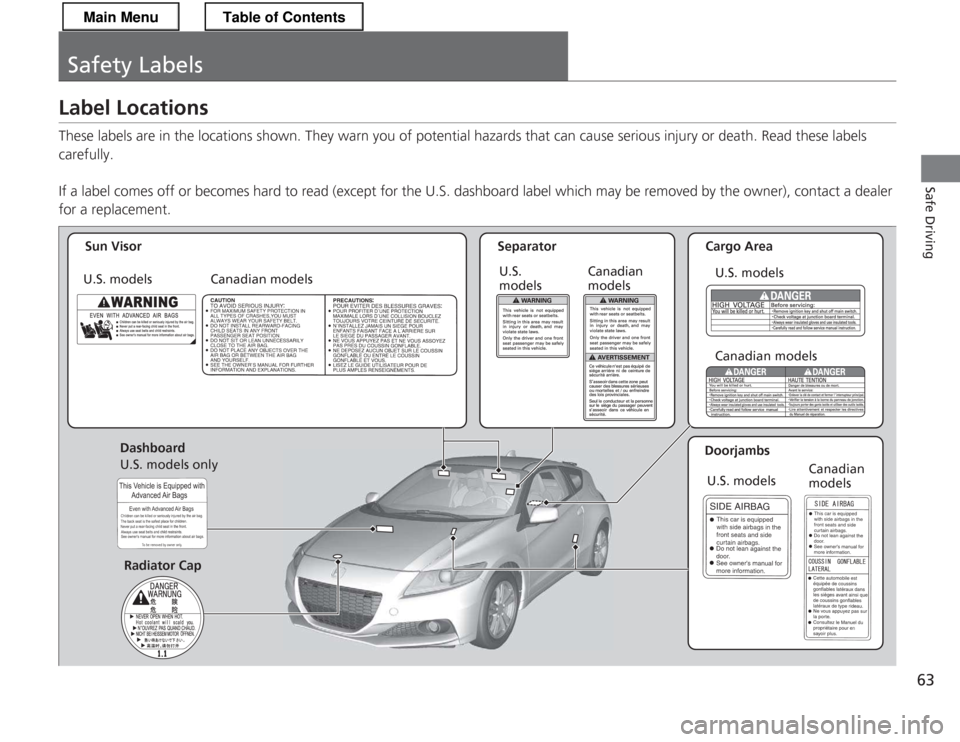
Safety Labels
Label Locations
These labels are in the locations shown. They warn you of potential hazards that can cause serious injury or death. Read these labels
carefully.
If a label comes off or becomes hard to read (except for the U.S. dashboard label which may be removed by the owner), contact a dealer
for a replacement.
Sun Visor
Canadian models Separator
Canadian
models
U.S. models U.S.
modelsCargo Area
U.S. models
Canadian models
Doorjambs U.S. models Canadian
models
Dashboard
U.S. models only
Radiator Cap
Main MenuTable of Contents
Page 68 of 325
67
uuIndicatorsu
Continued
Instrument Panel
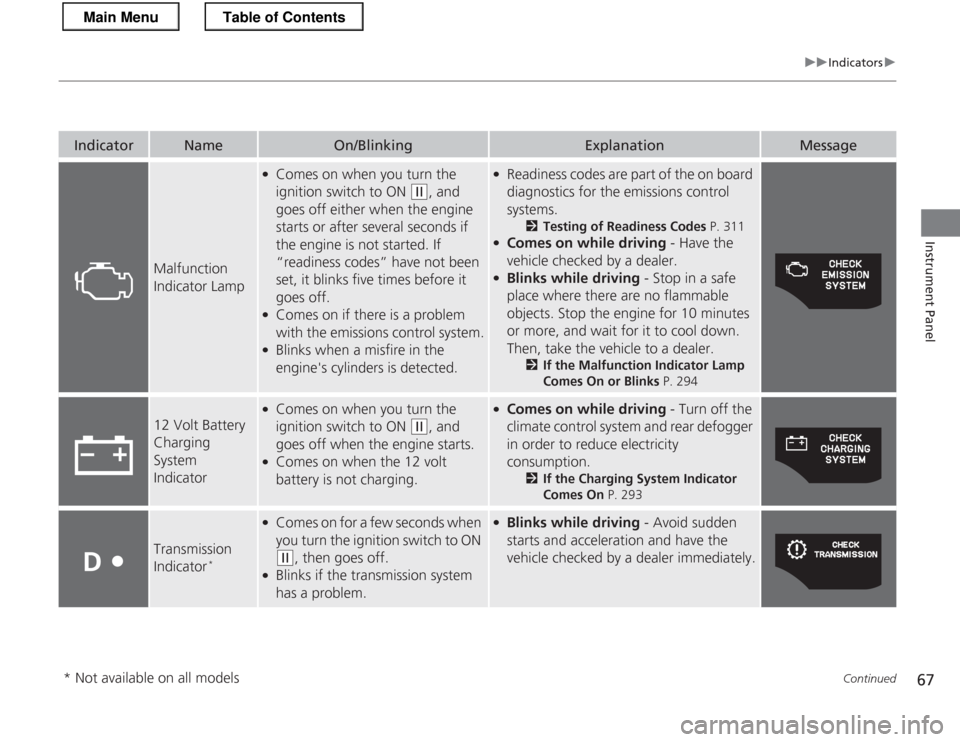
IndicatorNameOn/BlinkingExplanationMessage
Malfunction Indicator Lamp
●Comes on when you turn the ignition switch to ON
(w , and
goes off either when the engine
starts or after several seconds if
the engine is not started. If
“readiness codes” have not been
set, it blinks five times before it goes off.
● Comes on if there is a problem
with the emissions control system.
● Blinks when a misfire in the
engine's cylinders is detected.
●Readiness codes are part of the on board
diagnostics for the emissions control
systems.
2Testing of Readiness Codes P. 311
● Comes on while driving - Have the
vehicle checked by a dealer.
● Blinks while driving - Stop in a safe
place where there are no flammable
objects. Stop the engine for 10 minutes
or more, and wait for it to cool down.
Then, take the vehicle to a dealer. 2If the Malfunction Indicator Lamp
Comes On or Blinks P. 294
12 Volt Battery
Charging System
Indicator
●
Comes on when you turn the ignition switch to ON
(w , and
goes off when the engine starts.
● Comes on when the 12 volt
battery is not charging.
●Comes on while driving - Turn off the
climate control system and rear defogger
in order to reduce electricity
consumption. 2If the Charging System Indicator
Comes On P. 293
Transmission
Indicator*
●
Comes on for a few seconds when
you turn the ignition switch to ON
(w , then goes off.
● Blinks if the transmission system
has a problem.
●Blinks while driving - Avoid sudden
starts and acceleration and have the
vehicle checked by a dealer immediately.
* Not available on all models
Main MenuTable of Contents
Page 72 of 325
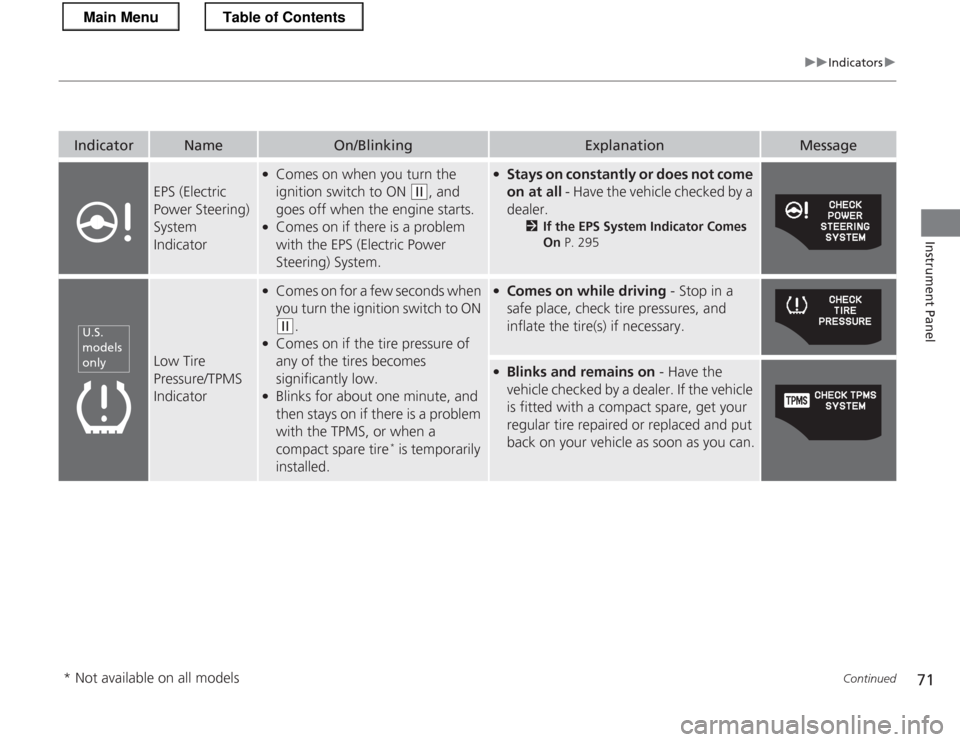
71
uuIndicatorsu
Continued
Instrument Panel
IndicatorNameOn/BlinkingExplanationMessage
EPS (Electric
Power Steering) System
Indicator
●Comes on when you turn the ignition switch to ON
(w , and
goes off when the engine starts.
● Comes on if there is a problem
with the EPS (Electric Power Steering) System.
●Stays on constantly or does not come on at all - Have the vehicle checked by a
dealer. 2If the EPS System Indicator Comes On P. 295
Low Tire Pressure/TPMS
Indicator
●
Comes on for a few seconds when
you turn the ignition switch to ON
(w .
● Comes on if the tire pressure of
any of the tires becomes
significantly low.
● Blinks for about one minute, and
then stays on if there is a problem
with the TPMS, or when a
compact spare tire *
is temporarily
installed.
● Comes on while driving - Stop in a
safe place, check tire pressures, and
inflate the tire(s) if necessary.
● Blinks and remains on - Have the
vehicle checked by a dealer. If the vehicle
is fitted with a compact spare, get your
regular tire repaired or replaced and put
back on your vehicle as soon as you can.
U.S.
models only
* Not available on all models
Main MenuTable of Contents
Page 75 of 325
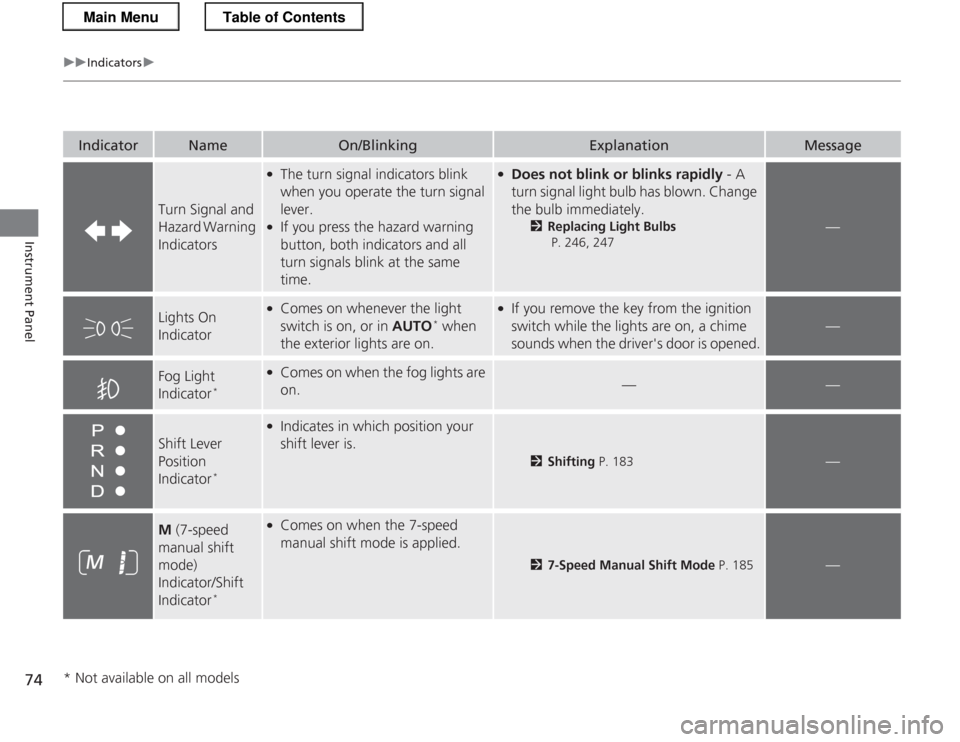
74
uuIndicatorsu
Instrument Panel
IndicatorNameOn/BlinkingExplanationMessage
Turn Signal and
Hazard Warning Indicators
●The turn signal indicators blink
when you operate the turn signal lever.
● If you press the hazard warning
button, both indicators and all
turn signals blink at the same
time.● Does not blink or blinks rapidly - A
turn signal light bulb has blown. Change
the bulb immediately. 2Replacing Light Bulbs
P. 246, 247
—
Lights On
Indicator●
Comes on whenever the light
switch is on, or in AUTO*
when
the exterior lights are on.● If you remove the key from the ignition
switch while the lights are on, a chime
sounds when the dr iver's door is opened.
—
Fog Light
Indicator*●
Comes on when the fog lights are
on.
——
Shift Lever Position
Indicator *
●
Indicates in which position your shift lever is.
2 Shifting P. 183—
M (7-speed
manual shift
mode) Indicator/Shift
Indicator *●
Comes on when the 7-speed
manual shift mode is applied.
2 7-Speed Manual Shift Mode P. 185—
* Not available on all models
Main MenuTable of Contents