ima HONDA CRV 2022 Owners Manual
[x] Cancel search | Manufacturer: HONDA, Model Year: 2022, Model line: CRV, Model: HONDA CRV 2022Pages: 692, PDF Size: 22.05 MB
Page 6 of 692
Contents
This owner’s manual should be considered a permanent part of the
vehicle and should remain with the vehicle when it is sold.
The Navigation Manual is available online at owners.honda.com. If
you are the first registered owner of your vehicle, you may
request a complimentary printed copy of the Navigation
Manual within the first six months of vehicle purchase. To
request a copy, visit owners.honda.com.
This owner’s manual covers all models of your vehicle. You may find
descriptions of equipment and features that are not on your
particular model.
Images throughout this owner’s ma nual (including the front cover)
represent features and equipment that are available on some, but
not all, models. Your particular mo del may not have some of these
features.
This owner’s manual is for vehicles sold in the United States.
The information and specifications in cluded in this publication were
in effect at the time of approval for printing. Honda Motor Co., Ltd.
reserves the right, however, to discontinue or change specifications
or design at any time without notice and without incurring any
obligation.2 Safe Driving P. 41
For Safe Driving P. 42 Seat Belts P. 47 Airbags P. 56
2Instrument Panel P. 89
Indicators P. 90 Gauges and Driver Information Interface P. 126
2Controls P. 149
Clock P. 150 Locking and Unlocking the Doors P. 152
Moonroof* P. 185
Seats P. 208 Interior Convenience Items P. 218
2 Features P. 243
Audio System P. 244 Audio System Basic Operation P. 251, 272
Customized Features P. 362, 369 HomeLink ® Universal Transceiver* P. 395
2 Driving P. 459
Before Driving P. 460 Towing a Trailer P. 465Parking Your Vehicle P. 559 Multi-View Rear Camera P. 570
2Maintenance P. 577
Before Performing Maintenance P. 578 Maintenance MinderTM P. 581
Checking and Maintaining Wiper Blades P. 601
Climate Control System Maintenance P. 618
2Handling the Unexpected P. 627
Tools P. 628 If a Tire Goes Flat P. 629
Overheating P. 649 Indicator, Coming On/Blinking P. 652
If You Cannot Open the Tailgate P. 664
2Information P. 667
Specifications P. 668 Identification Numbers P. 670
Emissions Testing P. 673 Warranty Coverages P. 675
22 CR-V HEV ELP-31TPG6200.book 4 ページ 2021年6月30日 水曜日 午前11時6分
Page 7 of 692
Contents
Child Safety P. 72Exhaust Gas Hazard P. 86Safety Labels P. 87
Tailgate P. 167 Security System P. 178 Windows P. 181
Operating the Switches Around the Steering Wheel P. 186 Mirrors P. 206
Climate Control System P. 235
Audio Error Messages P. 340 General Information on the Audio System P. 345
Bluetooth ® HandsFreeLink ® P. 398, 422 Compass* P. 456
Off-Highway Driving Guidelines P. 467 When Driving P. 469 Honda Sensing ® P. 503 Braking P. 551
Refueling P. 572 Fuel Economy and CO
2 Emissions P. 575
Maintenance Under the Hood P. 586 Replacing Light Bulbs P. 598
Checking and Maintaining Tires P. 606 12-volt Battery P. 615 Remote Transmitter Care P. 617
Cleaning P. 619 Accessories and Modifications P. 624
Handling of the Jack P. 643 Power System Won’t Start P. 644 If the 12-Volt Battery Is Dead P. 647
Fuses P. 659 Emergency Towing P. 663
Refueling P. 665
Devices that Emit Radio Waves P. 671 Reporting Safety Defects P. 672
Authorized Manuals P. 678 Customer Service Information P. 679
Quick Reference GuideP. 6
Safe DrivingP. 41
Instrument PanelP. 89
ControlsP. 149
FeaturesP. 243
DrivingP. 459
MaintenanceP. 577
Handling the UnexpectedP. 627
InformationP. 667
IndexP. 681
22 CR-V HEV ELP-31TPG6200.book 5 ページ 2021年6月30日 水曜日 午前11時6分
Page 8 of 692
6
Quick Reference Guide
Quick Reference Guide
Visual Index
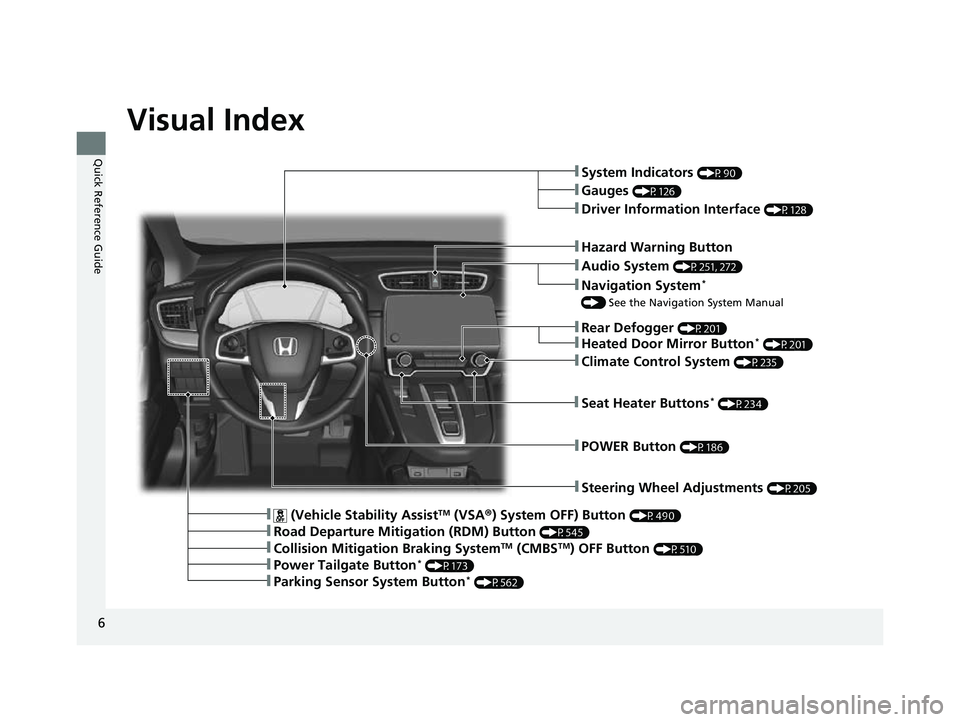
❚Steering Wheel Adjustments (P205)
❚Hazard Warning Button
❚System Indicators (P90)
❚Rear Defogger (P201)
❚Gauges (P126)
❚POWER Button (P186)
❚Audio System (P251, 272)
❚Navigation System*
() See the Navigation System Manual
❚Heated Door Mirror Button* (P201)
❚Seat Heater Buttons* (P234)
❚Driver Information Interface (P128)
❚Collision Mitigation Braking SystemTM (CMBSTM) OFF Button (P510)
❚ (Vehicle Stability AssistTM (VSA ®) System OFF) Button (P490)
❚Road Departure Mitigation (RDM) Button (P545)
❚Climate Control System (P235)
❚Parking Sensor System Button* (P562)
❚Power Tailgate Button* (P173)
22 CR-V HEV ELP-31TPG6200.book 6 ページ 2021年6月30日 水曜日 午前11時6分
Page 13 of 692

11
Quick Reference Guide
SPORT HYBRID i-MMD (intelligent Multi-Mode
Drive)
Your SPORT HYBRID i-MMD vehicle uses both an electric motor and a gasoline engine as propulsion sources, with the electric motor
receiving electricity from an internal High Voltage battery and/or internal generator. The High Voltage battery is charged from the
generator driven by the engine or regenerative braking.
When driving, your vehicle is propelled exclusively by the electric motor, exclusively by the gasoline engine, or by a combination of the two.
The system selects which propulsion source is most appropriate and automatically switches to it. Under certain circumstances, pressing the
EV button can manually enable EV (driven only on electricity) mode.
●Energy efficiency
As with a gasoline-powered vehicle, hybrid vehicle fuel efficien cy and driving range is most impacted by your driving style. Aggressive
acceleration and high-speed driving can easily trigger the system to switch the propulsion source to the gasoline-powered engin e.
In addition, heavy climate control system use negatively affects vehicle range and efficiency. Either of these use patterns will more quickly
reduce the High Voltage battery's state of charge.
●Battery types
There are two types of batteries used in this vehicle; a standard 12-volt battery that powers the airbags, the interior and exterior lights, and
other standard 12-volt systems; and a high voltage battery that is used to power the propulsion motor and recharge the 12-volt battery.
* Not available on all models
22 CR-V HEV ELP-31TPG6200.book 11 ページ 2021年6月30日 水曜日 午前11時6分
Page 17 of 692
15
Quick Reference Guide
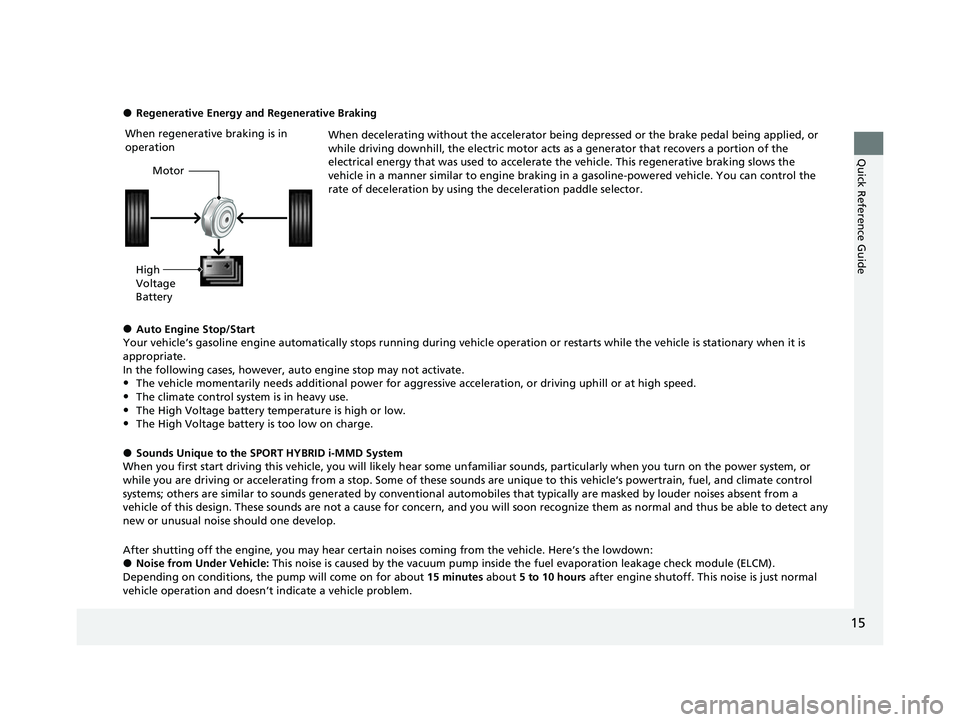
●Regenerative Energy and Regenerative BrakingWhen decelerating without the accelerator being depressed or the brake pedal being applied, or
while driving downhill, the electric motor acts as a generator that recovers a portion of the
electrical energy that was used to accelerate the vehicle. This regenerative braking slows the
vehicle in a manner similar to engine braking in a gasoline-powered vehicle. You can control the
rate of deceleration by using the deceleration paddle selector.
●Auto Engine Stop/Start
Your vehicle’s gasoline engine automatically stops running during vehicle operation or restarts while the vehicle is stationary when it is
appropriate.
In the following cases, however, auto engine stop may not activate.
•The vehicle momentarily needs additional power for aggressive acceleration, or driving uphill or at high speed.
•The climate control system is in heavy use.
•The High Voltage battery temperature is high or low.•The High Voltage battery is too low on charge.
●Sounds Unique to the SPORT HYBRID i-MMD System
When you first start driving this vehicle, you will likely hear so me unfamiliar sounds, particularly when you turn on the power system, or
while you are driving or accelerating from a stop. Some of thes e sounds are unique to this vehicle‘s powertrain, fuel, and climate control
systems; others are similar to sounds generated by conventional automobiles that typically are masked by louder noises absent f rom a
vehicle of this design. These sounds are not a cause for concern, and you will soon recognize them as normal and thus be able to detect any
new or unusual noise should one develop.
After shutting off the engine, you ma y hear certain noises coming from the vehicle. Here’s the lowdown:
●Noise from Under Vehicle: This noise is caused by the vacuum pump inside the fuel evaporation leakage check module (ELCM).
Depending on conditions, the pump will come on for about 15 minutes about 5 to 10 hours after engine shutoff. This noise is just normal
vehicle operation and doesn’t indicate a vehicle problem.
When regenerative braking is in
operation
Motor
High
Voltage
Battery
22 CR-V HEV ELP-31TPG6200.book 15 ページ 2021年6月30日 水曜日 午前11時6分
Page 28 of 692
26
Quick Reference Guide
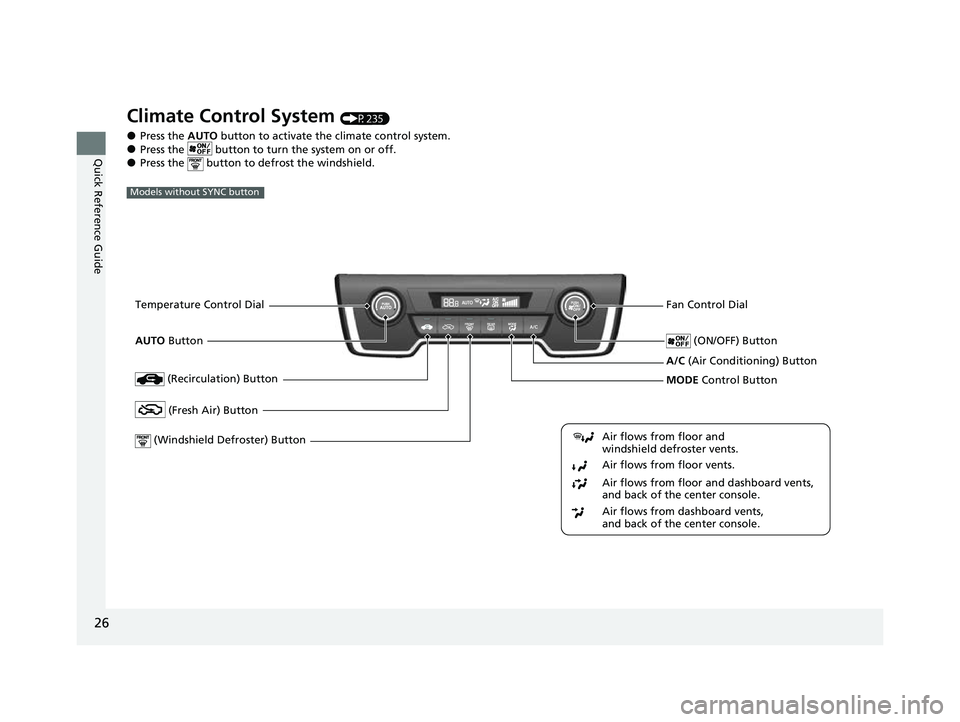
Climate Control System (P235)
●Press the AUTO button to activate the climate control system.●Press the button to turn the system on or off.●Press the button to defrost the windshield.
Models without SYNC button
Fan Control Dial
(Fresh Air) ButtonTemperature Control Dial
Air flows from floor and
windshield defroster vents.
Air flows from floor vents.
Air flows from floor and dashboard vents,
and back of the center console.
Air flows from dashboard vents,
and back of the center console.
(Recirculation) ButtonMODE Control Button
(ON/OFF) Button
AUTO
Button
A/C (Air Conditioning) Button
(Windshield Defroster) Button
22 CR-V HEV ELP-31TPG6200.book 26 ページ 2021年6月30日 水曜日 午前11時6分
Page 29 of 692
27
Quick Reference Guide
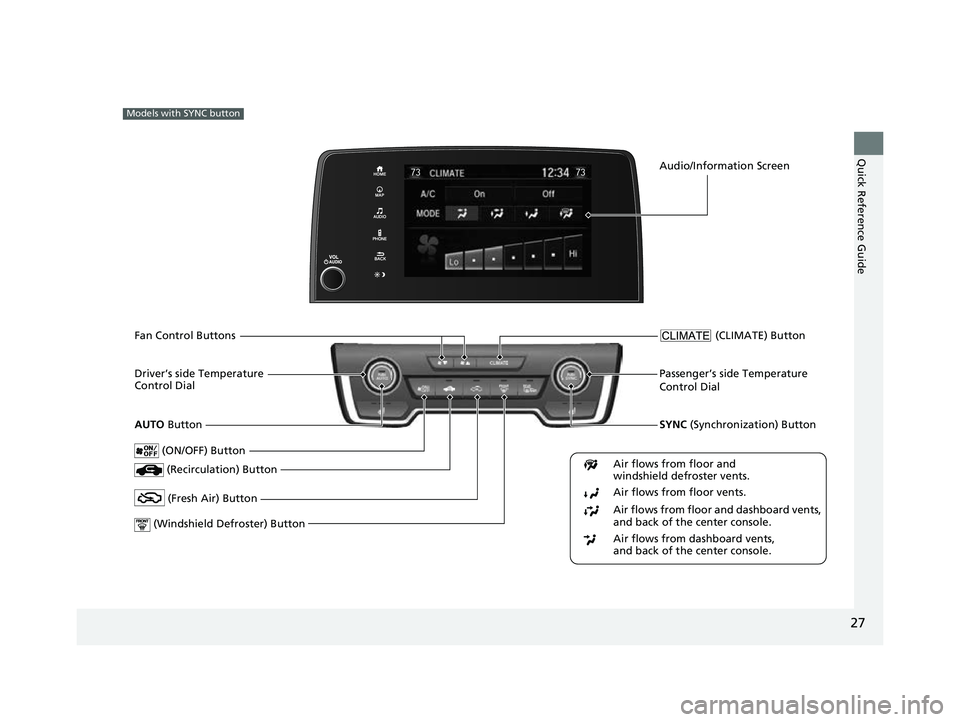
Models with SYNC button
Passenger’s side Temperature
Control Dial
(Windshield Defroster) ButtonDriver’s side Temperature
Control Dial (Recirculation) Button
(CLIMATE) Button
(ON/OFF) Button
AUTO Button
Audio/Information Screen
SYNC (Synchronization) Button
Air flows from floor and
windshield defroster vents.
Air flows from floor vents.
Air flows from floor and dashboard vents,
and back of the center console.
Air flows from dashboard vents,
and back of the center console.
(Fresh Air) Button
Fan Control Buttons
22 CR-V HEV ELP-31TPG6200.book 27 ページ 2021年6月30日 水曜日 午前11時6分
Page 45 of 692
43
uuFor Safe Driving uImportant Safety Precautions
Safe Driving
■Pay appropriate attention to the task of driving safely
Engaging in cell phone conversation or other activities that keep you from paying
close attention to the road, other vehicles, and pedestrians could lead to a crash.
Remember, situations can change quickly, and only you can decide when it is safe to
divert some attention away from driving.
■Control your speed
Excessive speed is a major factor in crash injuries and deaths. Generally, the higher
the speed, the greater the risk, but serious injuries can also occur at lower speeds.
Never drive faster than is safe for current conditions, regardless of the maximum
speed posted.
■Keep your vehicle in safe condition
Having a tire blowout or a mechanical failure can be extremely hazardous.
To reduce the possibility of such problems, check your tire pressures and condition
frequently, and perform all regul arly scheduled maintenance.
■Do not leave children unattended in the vehicle
Children, pets and people needing assistan ce left unattended in the vehicle may be
injured if they activate one or more of the vehicle controls. They may also cause the
vehicle to move, resulting in a crash in wh ich they and/or another person(s) can be
injured or killed. Also, depending on the am bient temperature, the temperature of
the interior may reach extreme levels, which can result in harm or death. Even if the
climate control system is on, never leave them in the vehicle unattended as the
climate control system can shut off at any time.
22 CR-V HEV ELP-31TPG6200.book 43 ページ 2021年6月30日 水曜日 午前11時6分
Page 59 of 692
57
uuAirbags uAirbag System Components
Continued
Safe Driving
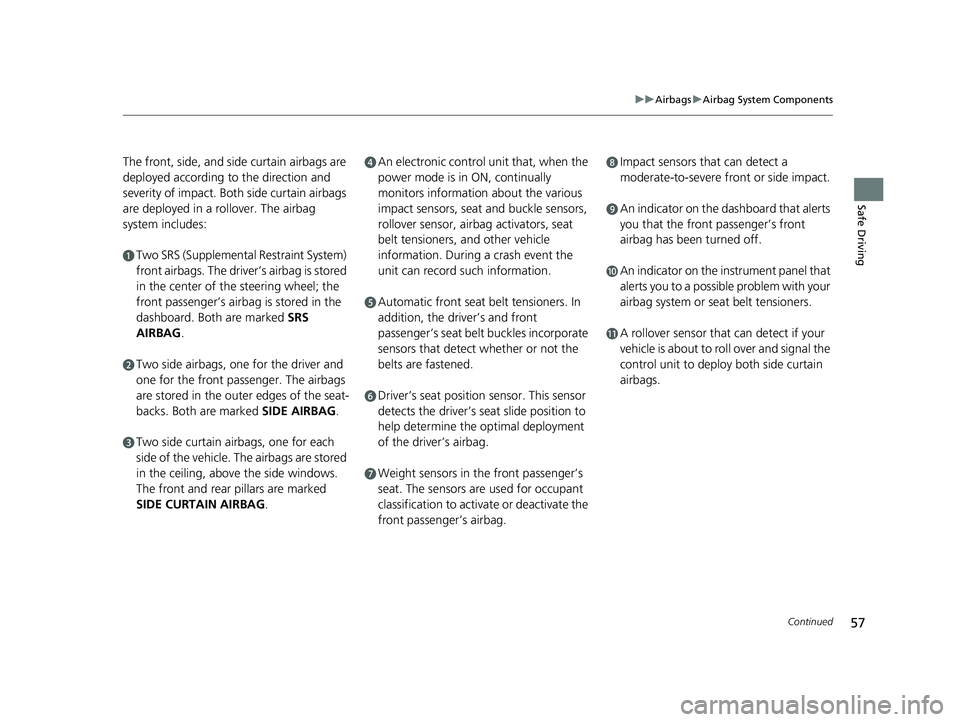
The front, side, and side curtain airbags are
deployed according to the direction and
severity of impact. Both side curtain airbags
are deployed in a rollover. The airbag
system includes:
aTwo SRS (Supplemental Restraint System)
front airbags. The driver’s airbag is stored
in the center of the steering wheel; the
front passenger’s airbag is stored in the
dashboard. Both are marked SRS
AIRBAG.
bTwo side airbags, one for the driver and
one for the front passenger. The airbags
are stored in the outer edges of the seat-
backs. Both are marked SIDE AIRBAG.
cTwo side curtain ai rbags, one for each
side of the vehicle. The airbags are stored
in the ceiling, above the side windows.
The front and rear pillars are marked
SIDE CURTAIN AIRBAG .
dAn electronic control unit that, when the
power mode is in ON, continually
monitors information about the various
impact sensors, seat and buckle sensors,
rollover sensor, airbag activators, seat
belt tensioners, and other vehicle
information. During a crash event the
unit can record such information.
eAutomatic front seat belt tensioners. In
addition, the driver’s and front
passenger’s seat belt buckles incorporate
sensors that detect whether or not the
belts are fastened.
fDriver’s seat position sensor. This sensor
detects the driver’s s eat slide position to
help determine the optimal deployment
of the driver’s airbag.
gWeight sensors in the front passenger’s
seat. The sensors are used for occupant
classification to activate or deactivate the
front passenger’s airbag.
hImpact sensors that can detect a
moderate-to-severe front or side impact.
iAn indicator on the dashboard that alerts
you that the front passenger’s front
airbag has been turned off.
jAn indicator on the instrument panel that
alerts you to a possib le problem with your
airbag system or seat belt tensioners.
kA rollover sensor that can detect if your
vehicle is about to ro ll over and signal the
control unit to deploy both side curtain
airbags.
22 CR-V HEV ELP-31TPG6200.book 57 ページ 2021年6月30日 水曜日 午前11時6分
Page 61 of 692
59
uuAirbags uTypes of Airbags
Continued
Safe Driving
Types of Airbags
Your vehicle is equipped wi th three types of airbags:
• Front airbags: Airbags in front of the driver’s and front passenger’s seats.
• Side airbags: Airbags in the driver’s and front passenger’s seat-backs.
• Side curtain airbags: Airbags above the side windows.
Each is discussed in the following pages.
Front Airbags (SRS)
The front SRS airbags inflate in a moderate-to-severe frontal collision to help protect
the head and chest of the driver and/or front passenger.
SRS (Supplemental Restraint System) indica tes that the airbags are designed to
supplement seat belts, not replace them . Seat belts are the occupant’s primary
restraint system.
The front airbags are housed in the center of the steering wheel for the driver, and
in the dashboard for the front pass enger. Both airbags are marked SRS AIRBAG.
■Housing Locations
1Types of Airbags
The airbags can inflate whenever the power mode is
in ON.
After an airbag inflates in a crash, you may see a
small amount of smoke. This is from the combustion
process of the infl ator material and is not harmful.
People with respiratory pr oblems may experience
some temporary discomfort. If this occurs, get out of
the vehicle as soon as it is safe to do so.
1 Front Airbags (SRS)
During a frontal crash severe enough to cause one or
both front airbags to deploy, the airbags can inflate
at different rates, dependi ng on the severity of the
crash, whether or not the se at belts are latched, and/
or other factors. Frontal airbags are designed to
supplement the seat belts to help reduce the
likelihood of head and chest injuries in frontal
crashes.
22 CR-V HEV ELP-31TPG6200.book 59 ページ 2021年6月30日 水曜日 午前11時6分