service HONDA CRV 2023 Workshop Manual
[x] Cancel search | Manufacturer: HONDA, Model Year: 2023, Model line: CRV, Model: HONDA CRV 2023Pages: 719, PDF Size: 13.43 MB
Page 637 of 719
636
uuChecking and Maintaining Tires uWear Indicators
Maintenance
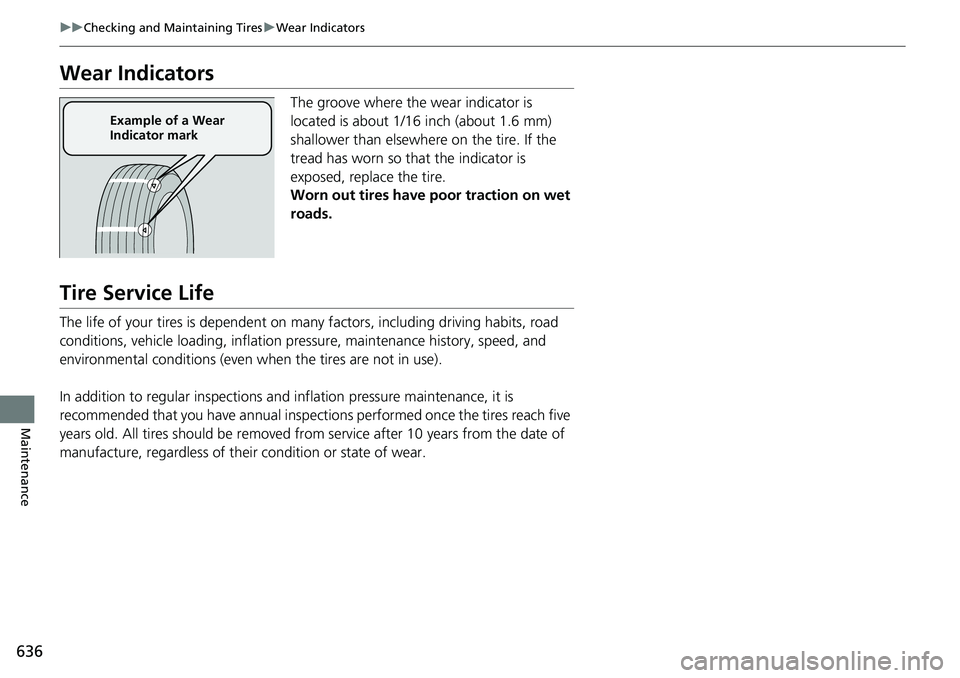
Wear Indicators
The groove where the wear indicator is
located is about 1/16 inch (about 1.6 mm)
shallower than elsewhere on the tire. If the
tread has worn so that the indicator is
exposed, replace the tire.
Worn out tires have poor traction on wet
roads.
Tire Service Life
The life of your tires is dependent on many factors, including driving habits, road
conditions, vehicle loading, inflation pre ssure, maintenance history, speed, and
environmental conditions (even when the tires are not in use).
In addition to regular inspections and inflation pressure maintenance, it is
recommended that you have annual inspections performed once the tires reach five
years old. All tires should be removed fro m service after 10 years from the date of
manufacture, regardless of their condition or state of wear.
Example of a Wear
Indicator mark
Page 644 of 719
643
Maintenance
Climate Control System Maintenance
Air Conditioning
To ensure proper and safe operation, the Society of Automotive Engineers (SAE
J2845) recommends that the refrigerant system only be serviced by trained and
certified technicians.
Never repair or replace the air conditio ning evaporator (cooling coil) with one
removed from a used or salvaged vehicle.
New replacement mobile air conditioning evaporators must be certified (and
labeled) as meeting SAE Standard J2842.
Dust and Pollen Filter
The climate control system is equipped with a dust and pollen filter that collects
pollen, dust, and other debris in the air. The Maintenance MinderTM messages will let
you know when to replace the filter.
We recommend that you repl ace the dust and pollen filter sooner when using your
vehicle in areas with high concentrations of dust.
1 Climate Control System Maintenance
NOTICE
Vented refrigerant is harmful to the environment.
To avoid refrigerant from venting, never replace the
evaporator with one re moved from a used or
salvaged vehicle.
Refrigerant in your vehicle’ s air conditioning system is
flammable and can be igni ted during servicing if
proper procedures are not followed.
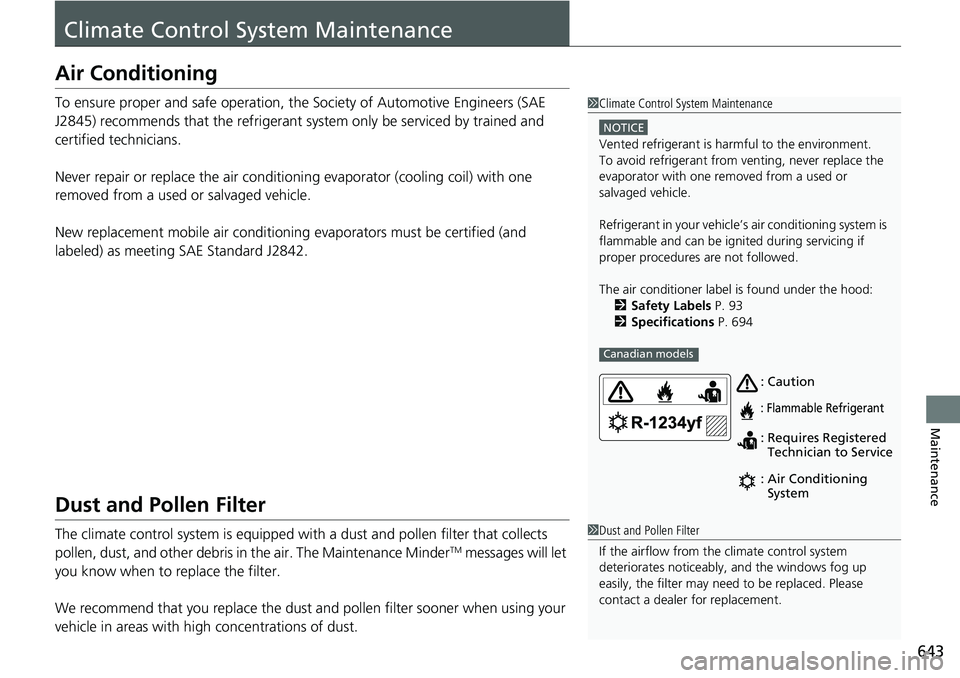
The air conditioner labe l is found under the hood:
2 Safety Labels P. 93
2 Specifications P. 694
Canadian models
: Caution
: Flammable Refrigerant
:
: Requires Registered
Technician to Service
Air Conditioning
System
1
Dust and Pollen Filter
If the airflow from the climate control system
deteriorates noticeably, and the windows fog up
easily, the filter may need to be replaced. Please
contact a dealer for replacement.
Page 654 of 719
653Continued
Handling the Unexpected
If a Tire Goes Flat
Temporarily Repairing a Flat Tire
If the tire has a large cut or is otherwise severely damaged, you will need to have the
vehicle towed. If the tire only has a small puncture, from a nail for instance, you can
use the temporary tire repair kit so that you can drive to the nearest service station
for a more permanent repair.
If a tire goes flat while driving, grasp the steering wheel firmly, and brake gradually
to reduce speed. Then, stop in a safe place.
1. Park the vehicle on a firm, level, non-slippery surface and apply the parking brake.
2. Put the transmission into
(P.
3. Turn on the hazard warning lights an d set the power mode to VEHICLE OFF.
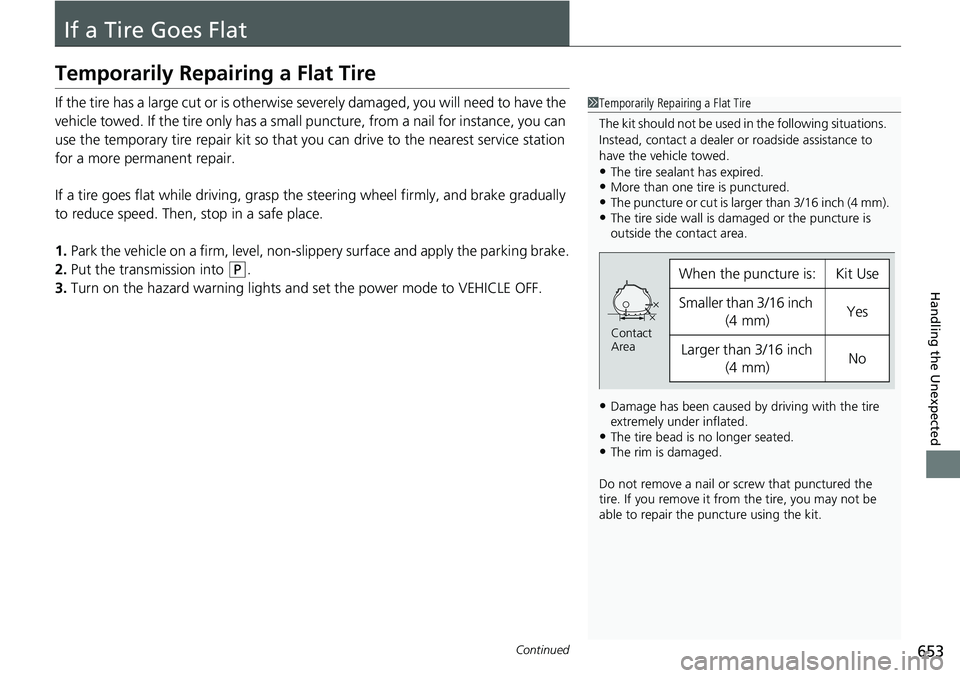
1Temporarily Repairing a Flat Tire
The kit should not be used in the following situations.
Instead, contact a dealer or roadside assistance to
have the vehicle towed.
•The tire sealant has expired.•More than one tire is punctured.•The puncture or cut is larger than 3/16 inch (4 mm).•The tire side wall is da maged or the puncture is
outside the contact area.
•Damage has been caused by driving with the tire
extremely under inflated.
•The tire bead is no longer seated.•The rim is damaged.
Do not remove a nail or screw that punctured the
tire. If you remove it from the tire, you may not be
able to repair the puncture using the kit.
When the puncture is:Kit Use
Smaller than 3/16 inch
(4 mm)Yes
Larger than 3/16 inch (4 mm)No
Contact
Area
Page 661 of 719
660
uuIf a Tire Goes Flat uTemporarily Repairing a Flat Tire
Handling the Unexpected
6. If the air pressure is
• Less than 19 psi (130kPa):
Do not add air or continue driving. The leak is too severe. Call for help and have
your vehicle towed.
2 Emergency Towing P. 689
•Front: 35 psi (240 kPa)/rear: 32 psi (220 kPa) or more:
• 33 psi (230 kPa) or more:
Continue driving for another 10 minutes or until you reach the nearest service
station, whichever is sooner. Do not exceed 50 mph (80 km/h). If you have not
reached a service station, stop and check the tire pressure.
u If the air pressure does not go down after the 10 minute driving, you do not
need to check the pressure any more.
Models with 235/60R18 103H tires
Models with 235/55R19 101H tires
All models
Page 662 of 719
661
uuIf a Tire Goes Flat uTemporarily Repairing a Flat Tire
Continued
Handling the Unexpected
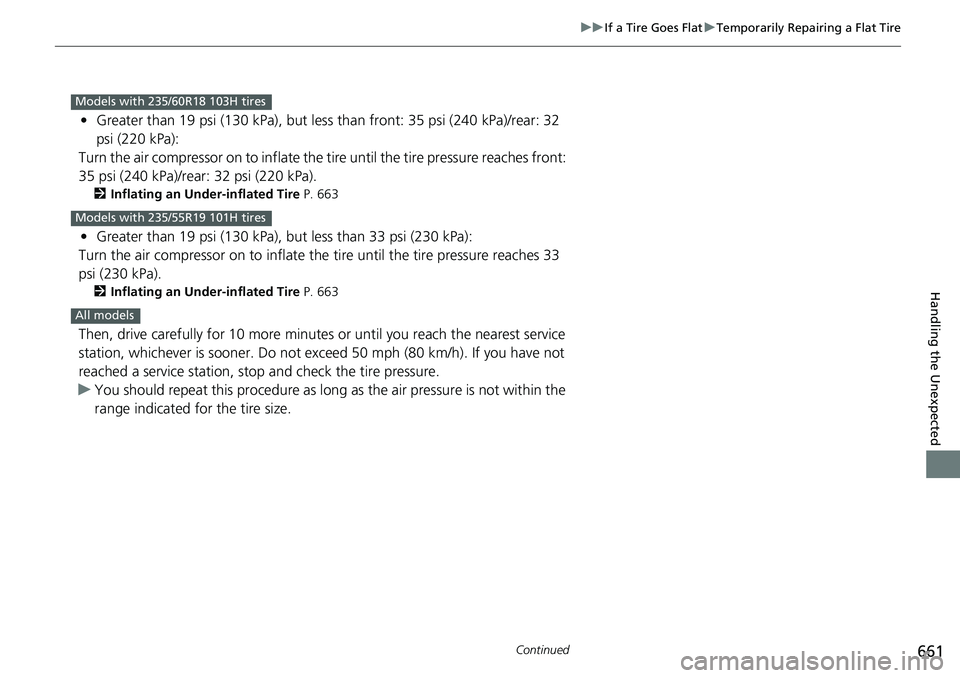
• Greater than 19 psi (130 kPa), but less than front: 35 psi (240 kPa)/rear: 32
psi (220 kPa):
Turn the air compressor on to inflate the ti re until the tire pressure reaches front:
35 psi (240 kPa)/rear : 32 psi (220 kPa).
2Inflating an Under-inflated Tire P. 663
•Greater than 19 psi (130 kPa), but less than 33 psi (230 kPa):
Turn the air compressor on to inflate the tire until the tire pressure reaches 33
psi (230 kPa).
2 Inflating an Under-inflated Tire P. 663
Then, drive carefully for 10 more minutes or until you reach the nearest service
station, whichever is sooner. Do not exc eed 50 mph (80 km/h). If you have not
reached a service station, stop and check the tire pressure.
u You should repeat this procedure as long as the air pressure is not within the
range indicated for the tire size.
Models with 235/60R18 103H tires
Models with 235/55R19 101H tires
All models
Page 673 of 719
672
uuIf the 12-Volt Battery Is Dead uJump Starting Procedure
Handling the Unexpected
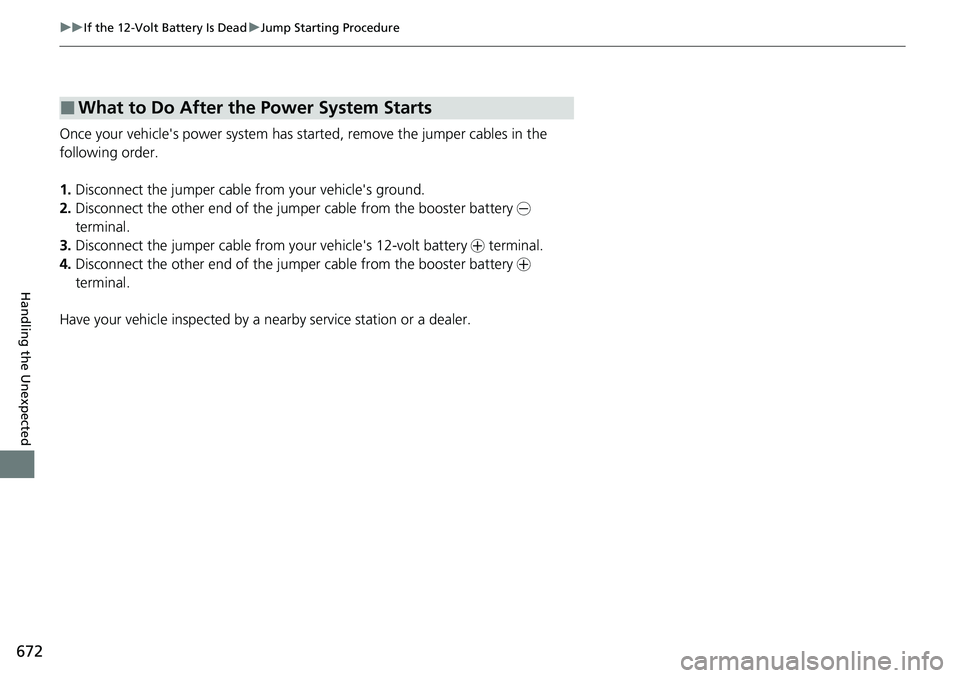
Once your vehicle's power system has sta rted, remove the jumper cables in the
following order.
1. Disconnect the jumper cable from your vehicle's ground.
2. Disconnect the other end of the jumper cable from the booster battery -
terminal.
3. Disconnect the jumper cable from your vehicle's 12-volt battery + terminal.
4. Disconnect the other end of the jumper cable from the booster battery +
terminal.
Have your vehicle inspected by a n earby service station or a dealer.
■What to Do After the Power System Starts
Page 690 of 719
689
Handling the Unexpected
Emergency Towing
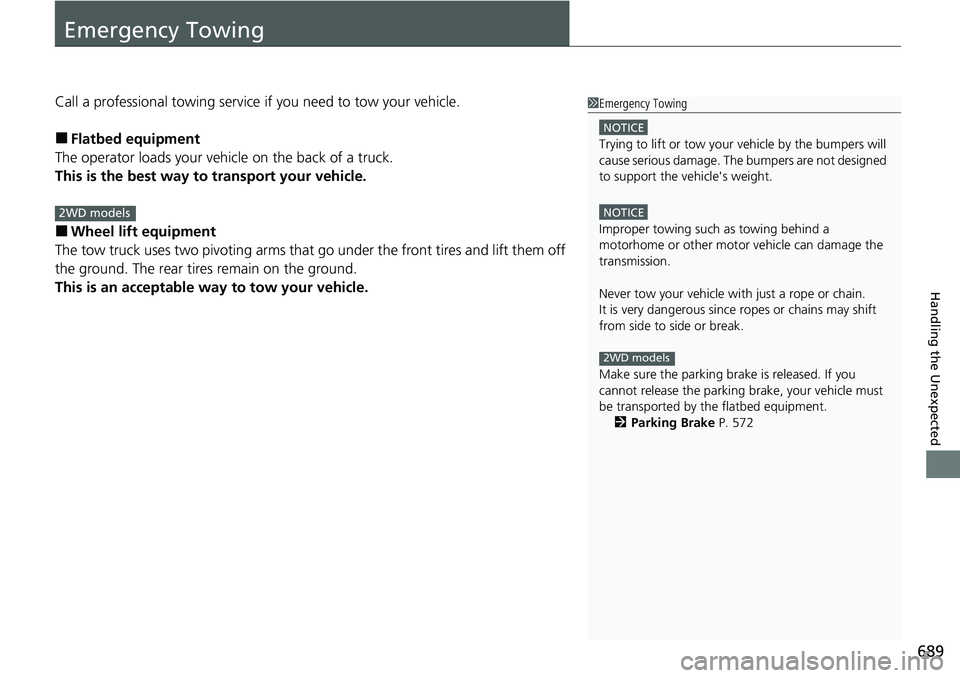
Call a professional towing service if you need to tow your vehicle.
■Flatbed equipment
The operator loads your vehicle on the back of a truck.
This is the best way to transport your vehicle.
■Wheel lift equipment
The tow truck uses two pivoti ng arms that go under the front tires and lift them off
the ground. The rear tires remain on the ground.
This is an acceptable way to tow your vehicle.
1Emergency Towing
NOTICE
Trying to lift or tow your vehicle by the bumpers will
cause serious damage. The bumpers are not designed
to support the vehicle's weight.
NOTICE
Improper towing such as towing behind a
motorhome or other motor vehicle can damage the
transmission.
Never tow your vehicle with just a rope or chain.
It is very dangerous since ropes or chains may shift
from side to side or break.
Make sure the parking brake is released. If you
cannot release the parking brake, your vehicle must
be transported by the flatbed equipment. 2 Parking Brake P. 572
2WD models
2WD models
Page 694 of 719
693
Information
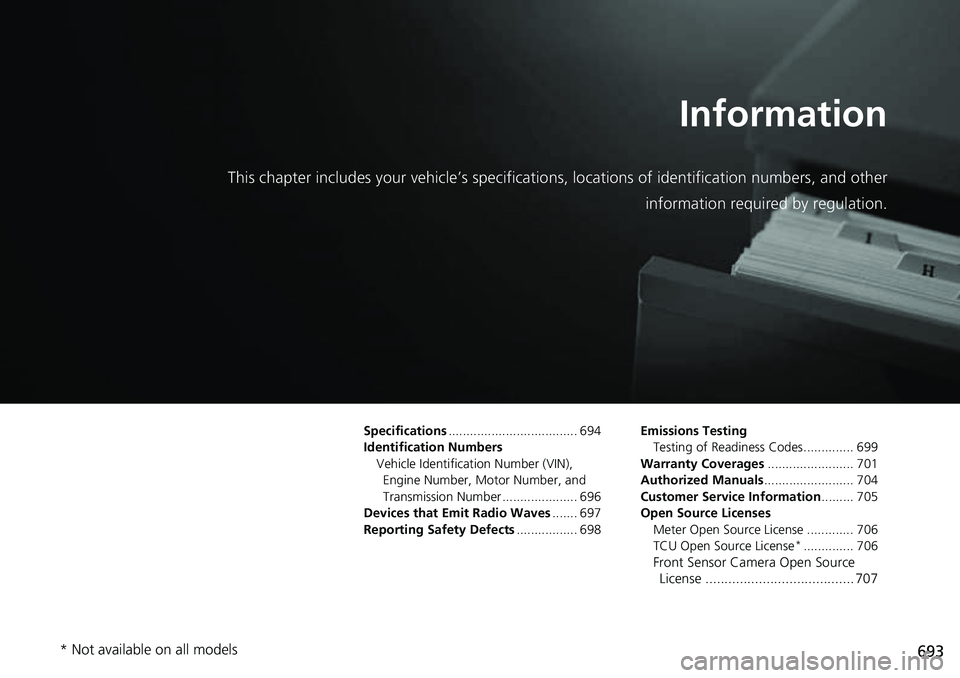
This chapter includes your vehicle’s specifications, locations of identification numbers, and other
information required by regulation.
Specifications .................................... 694
Identification Numbers Vehicle Identification Number (VIN), Engine Number, Motor Number, and
Transmission Number ..................... 696
Devices that Emit Radio Waves ....... 697
Reporting Safety Defects ................. 698Emissions Testing
Testing of Readiness Codes.............. 699
Warranty Coverages ........................ 701
Authorized Manuals ......................... 704
Customer Service Information ......... 705
Open Source Licenses Meter Open Source License ............. 706
TCU Open Source License
*.............. 706
Front Sensor Camera Open Source License ....................................... 707
* Not available on all models
Page 696 of 719
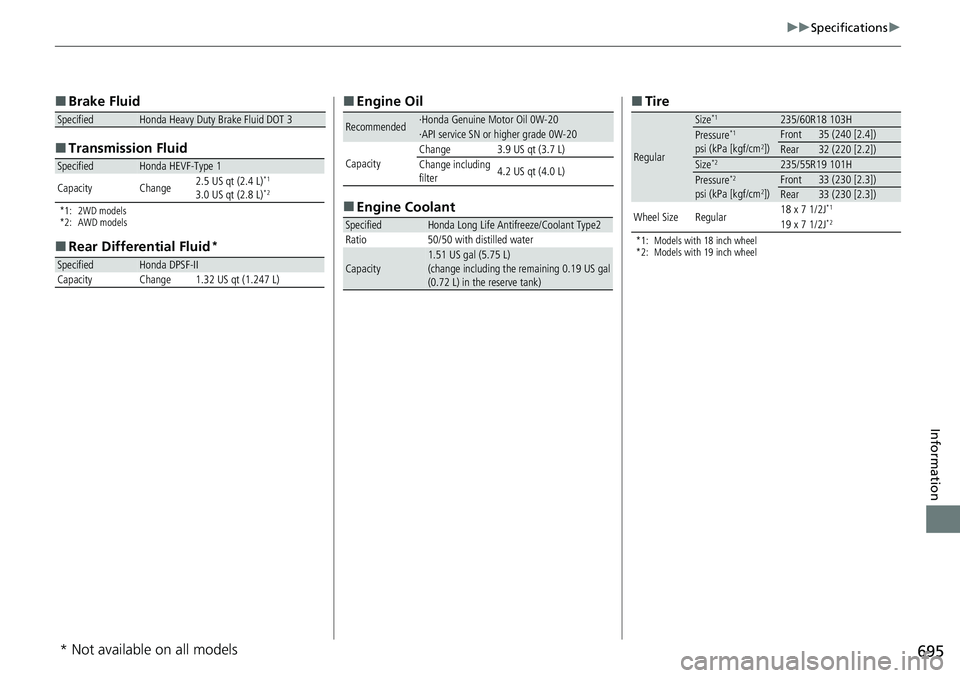
695
uuSpecifications u
Information
■
Brake Fluid
■ Transmissi on Fluid
*1: 2WD models
*2: AWD models
■
Rear Differential Fluid*
SpecifiedHonda Heavy Duty Brake Fluid DOT 3
SpecifiedHonda HEVF-Type 1
Capacity Change 2.5 US qt (2.4 L)*1
3.0 US qt (2.8 L)*2
SpecifiedHonda DPSF-II
Capacity Change 1.32 US qt (1.247 L)
■ Engine Oil
■ Engine Coolant
Recommended·Honda Genuine Motor Oil 0W-20·API service SN or higher grade 0W-20
CapacityChange3.9 US qt (3.7 L)
Change including
filter 4.2 US qt (4.0 L)
SpecifiedHonda Long Life Antifreeze/Coolant Type2
Ratio 50/50 with distilled water
Capacity1.51 US gal (5.75 L)
(change including the remaining 0.19 US gal
(0.72 L) in the reserve tank)
■ Tire
*1: Models with 18 inch wheel
*2: Models with 19 inch wheel
Regular
Size*1235/60R18 103HPressure*1
psi (kPa [kgf/cm2])Front35 (240 [2.4])Rear32 (220 [2.2])Size*2235/55R19 101HPressure*2
psi (kPa [kgf/cm2])Front33 (230 [2.3])Rear33 (230 [2.3])
Wheel SizeRegular18 x 7 1/2J*1
19 x 7 1/2J*2
* Not available on all models
Page 703 of 719
702
uuWarranty Coverages u
Information
Replacement 12-Volt Batte ry Limited Warranty – provides prorated coverage
for a replacement battery purchased from your dealer.
Replacement Muffler Life time Limited Warranty – provides coverage for as
long as the purchaser of the muffler owns the vehicle.
Restrictions and exclusions apply to a ll these warranties. Please read the Honda
warranty information booklet that came wi th your vehicle for precise information on
warranty coverages. Your vehi cle’s original tires are covered by their manufacturer.
Tire warranty information is in a separate booklet.
■Statement on Warranty Coverage for Aftermarket and Recycled Parts
The Magnuson-Moss Warranty Act, 15 U.S.C. s.2301 et seq., makes it illegal for
motor vehicle manufacturers to void a motor vehicle warranty or deny warranty
coverage solely because an aftermarket or recycled part has been used to repair the
vehicle or someone other than the authorized service provider performed service on
the vehicle. This provision does not apply to a new motor vehicle purchased solely
for commercial or industrial use.
Under federal law, a manufacturer may deny warranty coverage and charge for repairs
to a vehicle if it is discovered that an aftermarket or recycled part installed on the
vehicle is defective or was in stalled incorrectly and caused damage to another part of
the vehicle otherwise covered under warran ty. The Federal Trade Commission requires
that a manufacturer demonstrate that an aftermarket or recycled part or service
performed by a person other than an authorized service provider caused damage to
another part of the vehicle otherwise covered under warranty before denying
warranty coverage. Additionally, federal law allows a manufacturer to void a motor
vehicle warranty or deny warranty coverage if the manufacturer provides the article or
service to consumers free of charge unde r the warranty or the manufacturer has
secured a waiver from the Federal Trade Commission.