flat tire HONDA FIT 2009 2.G Owner's Manual
[x] Cancel search | Manufacturer: HONDA, Model Year: 2009, Model line: FIT, Model: HONDA FIT 2009 2.GPages: 352, PDF Size: 17.67 MB
Page 296 of 352
If the date has not expired, shake
the bottle thoroughly and proceed
to step 5.
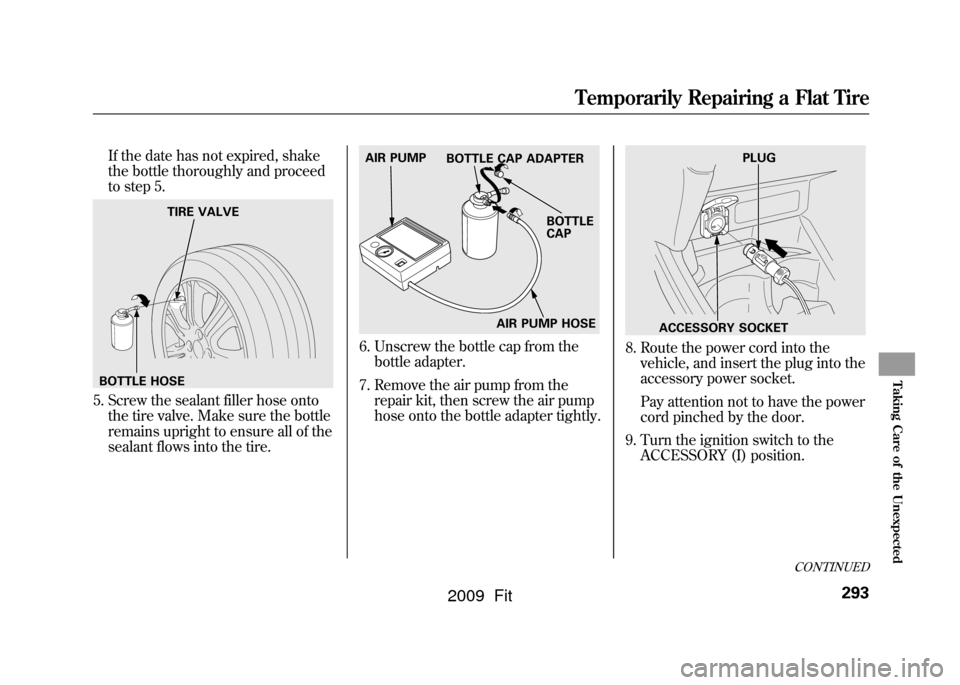
5. Screw the sealant filler hose ontothe tire valve. Make sure the bottle
remains upright to ensure all of the
sealant flows into the tire.
6. Unscrew the bottle cap from the
bottle adapter.
7. Remove the air pump from the repair kit, then screw the air pump
hose onto the bottle adapter tightly.
8. Route the power cord into thevehicle, and insert the plug into the
accessory power socket.
Pay attention not to have the power
cord pinched by the door.
9. Turn the ignition switch to the ACCESSORY (I) position.
BOTTLE HOSE TIRE VALVE
AIR PUMP HOSE
AIR PUMP
BOTTLE CAP ADAPTER
BOTTLE
CAP
PLUG
ACCESSORY SOCKET
CONTINUED
Temporarily Repairing a Flat Tire
293
Taking Care of the Unexpected
2009 Fit
Page 297 of 352
In freezing temperatures, turn the
engine on and leave it running
while the flat tire is being serviced.
Prolonged exposure to the cold
may cause the vehicle's battery to
weaken. Under cold conditions,
safely start the vehicle's engine and
keep the engine running at idle
when operating the air pump.Running the engine with the
vehicle in an enclosed or even
partly enclosed area can cause
a rapid build-up of toxic carbon
monoxide.
Breathing this colorless,
odorless gas can cause
unconsciousness and even
death. Only run the engine to
power the air pump with the
vehicle outdoors.
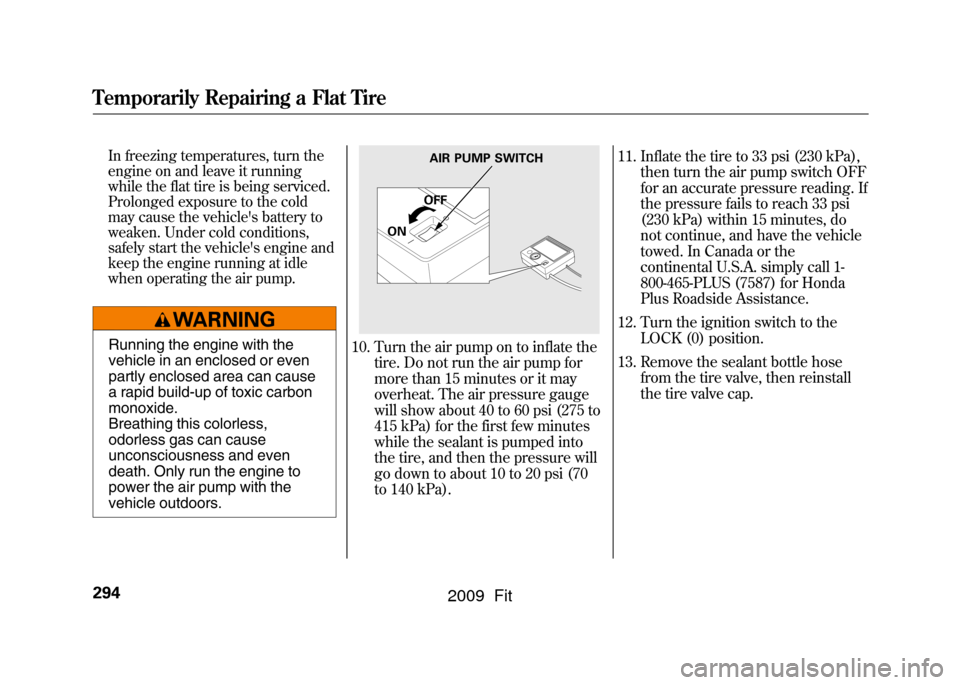
10. Turn the air pump on to inflate thetire. Do not run the air pump for
more than 15 minutes or it may
overheat. The air pressure gauge
will show about 40 to 60 psi (275 to
415 kPa) for the first few minutes
while the sealant is pumped into
the tire, and then the pressure will
go down to about 10 to 20 psi (70
to 140 kPa). 11. Inflate the tire to 33 psi (230 kPa),
then turn the air pump switch OFF
for an accurate pressure reading. If
the pressure fails to reach 33 psi
(230 kPa) within 15 minutes, do
not continue, and have the vehicle
towed. In Canada or the
continental U.S.A. simply call 1-
800-465-PLUS (7587) for Honda
Plus Roadside Assistance.
12. Turn the ignition switch to the LOCK (0) position.
13. Remove the sealant bottle hose from the tire valve, then reinstall
the tire valve cap.
AIR PUMP SWITCH
OFF
ON
Temporarily Repairing a Flat Tire294
2009 Fit
Page 298 of 352
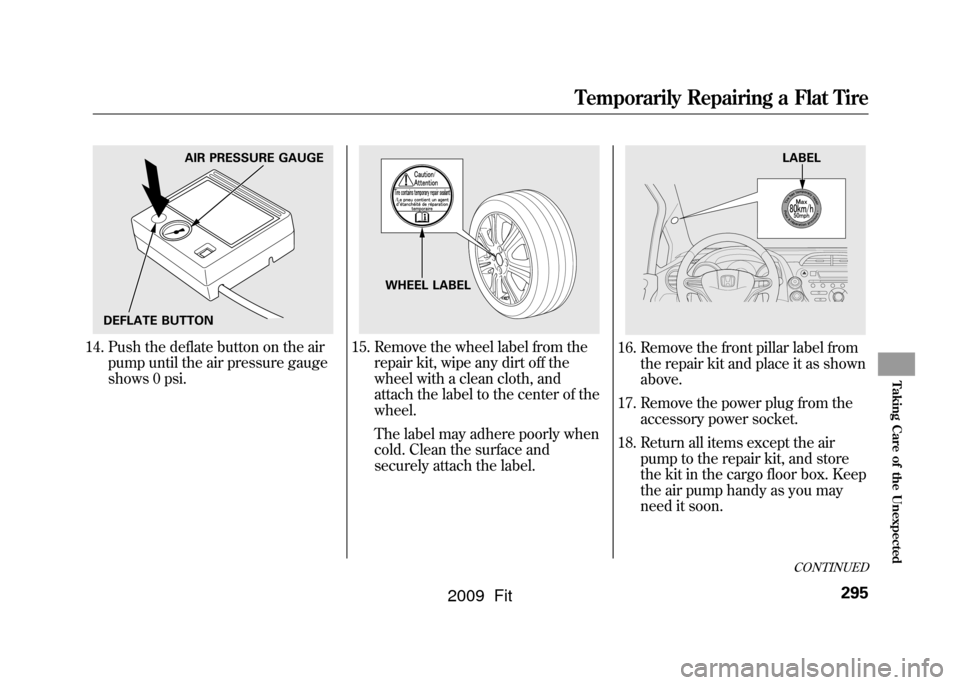
14. Push the deflate button on the airpump until the air pressure gauge
shows 0 psi.
15. Remove the wheel label from the repair kit, wipe any dirt off the
wheel with a clean cloth, and
attach the label to the center of the
wheel.
The label may adhere poorly when
cold. Clean the surface and
securely attach the label.
16. Remove the front pillar label fromthe repair kit and place it as shown
above.
17. Remove the power plug from the accessory power socket.
18. Return all items except the air pump to the repair kit, and store
the kit in the cargo floor box. Keep
the air pump handy as you may
need it soon.
AIR PRESSURE GAUGE
DEFLATE BUTTON
WHEEL LABEL
LABELCONTINUED
Temporarily Repairing a Flat Tire
295
Taking Care of the Unexpected
2009 Fit
Page 299 of 352
19. Drive carefully within the speed of50 mph (80 km/h) for 5 minutes.
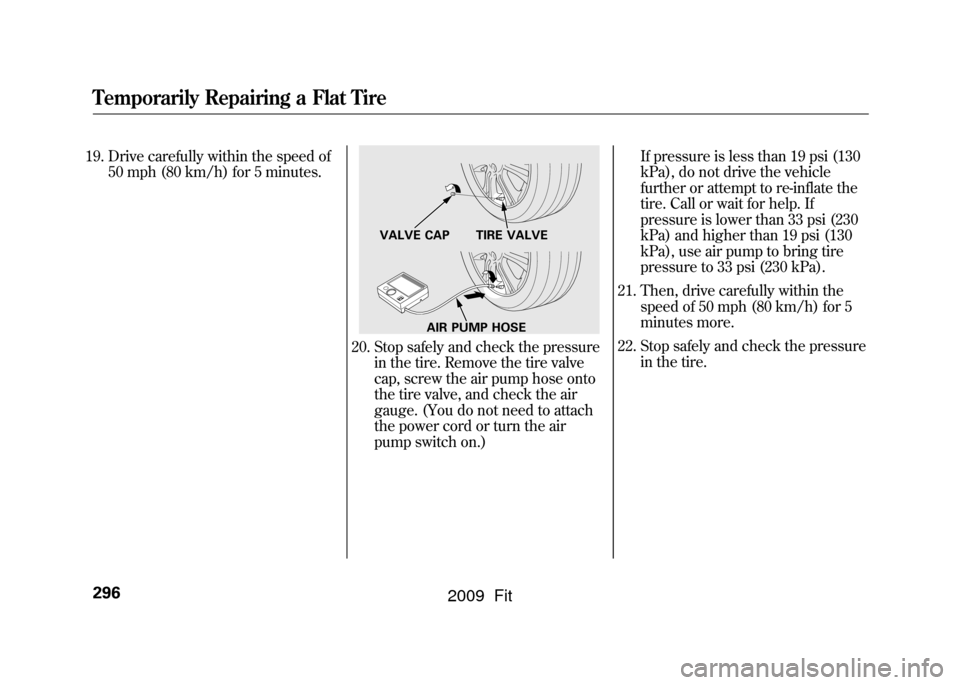
20. Stop safely and check the pressure in the tire. Remove the tire valve
cap, screw the air pump hose onto
the tire valve, and check the air
gauge. (You do not need to attach
the power cord or turn the air
pump switch on.) If pressure is less than 19 psi (130
kPa), do not drive the vehicle
further or attempt to re-inflate the
tire. Call or wait for help. If
pressure is lower than 33 psi (230
kPa) and higher than 19 psi (130
kPa), use air pump to bring tire
pressure to 33 psi (230 kPa).
21. Then, drive carefully within the speed of 50 mph (80 km/h) for 5
minutes more.
22. Stop safely and check the pressure in the tire.
VALVE CAP TIRE VALVE
AIR PUMP HOSE
Temporarily Repairing a Flat Tire296
2009 Fit
Page 300 of 352

If the pressure is lower than 32 psi
(220 kPa) and higher than 19 psi
(130 kPa), use the air pump to
bring air to the desired level as
described in step 11. Then drive to
the nearest service station at no
more than 50 mph (80 km/h).
If the pressure is below 19 psi, do
not continue. Have the vehicle
towed (see page311).
In any case, be sure to have the
damaged tire permanently repaired
as soon as possible.
Remember to return the tire sealant
bottle to your Honda service center
for proper disposal. If the Engine Won't Start
Diagnosing why the engine won't
start falls into two areas, depending
on what you hear when you turn the
ignition switch to the START (III)
position:
●You hear nothing, or almost
nothing. The engine's starter
motor does not operate at all, or
operates very slowly.●You can hear the starter motor
operating normally, or the starter
motor sounds like it is spinning
faster than normal, but the engine
does not start up and run.
Nothing Happens or the Starter
Motor Operates Very Slowly
When you turn the ignition switch to
the START (III) position, you do not
hear the normal noise of the engine
trying to start. You may hear a
clicking sound, a series of clicks, or
nothing at all.
Check these things:
●Check the transmission interlock.
If you have a manual transmission,
the clutch pedal must be pushed
all the way to the floor or the
starter will not operate. With an
automatic transmission, it must be
in Park or neutral.●Turn the ignition switch to the ON
(II) position. Turn on the
headlights, and check their
brightness. If the headlights are
very dim or do not come on at all,
the battery is discharged. See
Jump Starting
on page299.
CONTINUED
Temporarily Repairing a Flat Tire, If the Engine Won't Start
297
Taking Care of the Unexpected
2009 Fit
Page 314 of 352

If your vehicle needs to be towed,
call a professional towing service or
organization. Never tow your vehicle
with just a rope or chain. It is very
dangerous.
There are two ways to tow your
vehicle:Flat-bed Equipment
-The operator
loads your vehicle on the back of a
truck. This is the best way to
transport your vehicle.
Wheel-lift Equipment
- The tow
truck uses two pivoting arms that go
under the front tires and lift them off
the ground. The rear tires remain on
the ground. This is an acceptable
way to tow your vehicle. If, due to damage, your vehicle must
be towed with the front wheels on
the ground, do this:
Manual transmission:●Release the parking brake.●Shift the transmission to neutral.●Leave the ignition switch in the
ACCESSORY (I) position so the
steering wheel does not lock.
Automatic transmission:●Release the parking brake.●Start the engine.●Shift to D position and hold for 5
seconds, then to N. Let the engine
run for 3 minutes, then turn it off.●Turn off the engine.●Leave the ignition switch in the
ACCESSORY (I) position so the
steering wheel does not lock.
Improper towing preparation will
damage the transmission. Follow the
above procedure exactly. If you cannot
shift the transmission or start the
engine (automatic transmission), your
vehicle must be transported with the
front wheels off the ground.
With the front wheels on the ground,
it is best to tow the vehicle no farther
than 50 miles (80 km), and keep the
speed below 35 mph (55 km/h).
CONTINUED
Emergency Towing
311
Taking Care of the Unexpected
2009 Fit
Page 325 of 352

Temperature
The temperature grades are A (the
highest), B, and C, representing the
tire's resistance to the generation of
heat and its ability to dissipate heat
when tested under controlled
conditions on a specified indoor
laboratory test wheel. Sustained high
temperature can cause the material
of the tire to degenerate and reduce
tire life, and excessive temperature
can lead to sudden tire failure. The
grade C corresponds to a level of
performance which all passenger car
tires must meet under the Federal
Motor Vehicle Safety Standard No.
109. Grades B and A represent
higher levels of performance on the
laboratory test wheel than the
minimum required by law.Warning: The temperature grade for
this tire is established for a tire that
is properly inflated and not
overloaded. Excessive speed,
underinflation, or excessive loading,
either separately or in combination,
can cause heat buildup and possible
tire failure.DOT Tire Quality Grading (U.S. Vehicles)322
2009 Fit
Page 327 of 352

Maximum Tire PressureMax Press-The maximum air
pressure the tire can hold.Maximum Tire LoadMax Load -The maximum load the
tire can carry at maximum air
pressure.
Tire Pressure Monitoring System
(TPMS) -Required Federal
ExplanationU.S. models onlyEach tire, including the spare (if
provided), should be checked
monthly when cold and inflated to
the inflation pressure recommended
by the vehicle manufacturer on the
vehicle placard or tire inflation
pressure label.
(If your vehicle has tires of a different
size than the size indicated on the
vehicle placard or tire inflation
pressure label, you should determine
the proper tire inflation pressure for
those tires.) As an added safety feature, your
vehicle has been equipped with a tire
pressure monitoring system (TPMS)
that illuminates a low tire pressure
telltale
when one or more of your tires is
significantly under-inflated.
Accordingly, when the low tire
pressure telltale illuminates, you
should stop and check your tires as
soon as possible, and inflate them to
the proper pressure.
Driving on a significantly under-
inflated tire causes the tire to
overheat and can lead to tire failure.
Under-inflation also reduces fuel
efficiency and tire tread life, and may
affect the vehicle's handling and
stopping ability.
Please note that the TPMS is not a
substitute for proper tire
maintenance, and it is the driver's
responsibility to maintain correct tire
pressure, even if under-inflation has
not reached the level to trigger
illumination of the TPMS low tire
pressure telltale.
Tire Labeling, Tire Pressure Monitoring System (TPMS)
-Required Federal Explanation324
2009 Fit
Page 341 of 352

Bulb ReplacementBack-up Lights
........................
266
Brake Lights
...........................
266
Fog Lights
...............................
265
Front Parking Lights
...............
263
Front Side Marker Lights
........
263
Headlights
..............................
262
Rear Bulbs
..............................
266
Specifications
..........................
319
Taillights
.................................
266
Turn Signal Lights
..........
263, 266
Bulbs, Halogen
..........................
262
C
Cancel Button
............................
196
Capacities Chart
.........................
318
Carbon Monoxide Hazard
............
53
Cargo
.........................................
208
Cargo Hook
................................
212
Cargo, How to Carry
..................
208
Carrying Cargo
..........................
208
CAUTION, Explanation of
............
iii
CD Care
.....................................
186
CD Error Messages
............
128, 157 CD Player
...........................
122,
149
Certification Label
......................
316
Chains, Tires
..............................
278
Changing a Flat Tire
..................
285
Changing Oil How to
....................................
254
When to
..................................
245
Charging System Indicator
...........................
60, 303
Check Fuel Cap Indicator
.............
70
Checklist, Before Driving
...........
215
Childproof Door Locks
.................
82
Child Safety
..................................
34
Booster Seats
...........................
50
Child Seats
..........................
39, 41
Important Safety Reminders.....
38
Infants
......................................
39
Large Children
.........................
49
LATCH
.....................................
43
Risks with Airbags
...................
35
Small Children
.........................
40
Tethers
....................................
47
Warning Labels
........................
36
Where Should a Child Sit?
........
35
Child Seats
.............................
34, 41
LATCH Anchorage Points
........
43 Tether Anchorage Points
.........
47
Cleaning the Seat Belts
..............
267
Clock
..........................................
192
Clutch Fluid
...............................
261
Code, Audio System
...................
191
CO in the Exhaust
................
53, 326
Cold Weather, Starting in
...........
216
Compact Spare Tire
....................
284
Consumer Information (U.S. only)
.......................................
332
Controls, Instruments and
............
57
Coolant Adding
....................................
256
Checking
................................
202
Proper Solution
.......................
256
Temperature Indicator
.............
63
Crankcase Emissions Control System
...................................
326
Cruise Control Indicator
...............
65
Cruise Control Operation
...........
194
Cup Holders
...............................
106
Current Fuel Mileage
...................
70
Customer Service Office
............
332
IndexII
2009 Fit
Page 342 of 352

D
DANGER, Explanation of
.............
iii
Dashboard
...............................
3, 58
Daytime Running Lights (Canada only)
.........................................
75
Daytime Running Lights Indicator (Canada only)
...........................
65
Dead Battery
..............................
299
Defects, Reporting Safety
...........
334
Defogger, Rear Window
...............
76
Defrosting the Windows
............
113
Detachable Anchor
......................
99
Dimensions
................................
318
Dimming the Headlights
..............
74
Dipstick Automatic Transmission
.........
259
Engine Oil
...............................
201
Directional Signals
.......................
63
Disc Brake Wear Indicators
.......
230
Disc Care
...................................
186
Disc Player Error Messages
........................
128, 157
Disposal of Used Oil
...................
255 Doors
Childproof Door Locks
.............
82
Locking and Unlocking
............
81
Power Door Locks
...................
81
DOT Tire Quality Grading (U.S. Vehicles)
................................
321
Downshifting, Manual Transmission
..........................
217
Driver and Passenger Safety
..........
5
Driving
.......................................
213
Economy
.................................
203
Driving Guidelines
.....................
214
Driving with the Paddle Shifters (Sport only)
............................
224
Dust and Pollen Filter
................
268
E
Economy, Fuel
...........................
203
Electric Power Steering (EPS) Indicator
...................................
62
Emergencies on the Road
..........
283
Battery, Jump Starting
.............
299
Brake System Indicator
...........
305
Changing a Flat Tire
...............
285 Charging System Indicator
.....
303
Checking the Fuses
................
307
Driving with a Flat Tire
...........
284
Hazard Warning Flashers
........
76
Jump Starting
..........................
299
Low Oil Pressure Indicator
.....
303
Malfunction Indicator Lamp
....
304
Overheated Engine
.................
301
Towing
....................................
311
Emergency Brake
......................
102
Emergency Flashers
....................
76
Emergency Towing
....................
311
Emissions Controls
....................
326
Emissions Testing
......................
329
CONTINUED
Index
III
INDEX
2009 Fit