steering HONDA FIT 2009 2.G Owner's Manual
[x] Cancel search | Manufacturer: HONDA, Model Year: 2009, Model line: FIT, Model: HONDA FIT 2009 2.GPages: 352, PDF Size: 17.67 MB
Page 234 of 352

The anti-lock brake system (ABS)
helps prevent the wheels from
locking up, and helps you retain
steering control by pumping the
brakes rapidly, much faster than a
person can do it.
The electronic brake distribution
(EBD) system, which is part of the
ABS, also balances the front-to-rear
braking distribution according to
vehicle loading.You should never pump the brake pedal.Let the ABS work for you by always
keeping firm, steady pressure on the
brake pedal. This is sometimes
referred to as‘‘stomp and steer. ’’You will feel a pulsation in the brake
pedal when the ABS activates, and
you may hear some noise. This is
normal: it is the ABS rapidly
pumping the brakes. On dry
pavement, you will need to press on
the brake pedal very hard before the
ABS activates. However, you may
feel the ABS activate immediately if
you are trying to stop on snow or ice.
ABS Indicator
If the ABS indicator comes on, the
anti-lock function of the braking
system has shut down. The brakes
still work like a conventional system,
but without anti-lock. You should
have your dealer inspect your vehicle
as soon as possible.
If the ABS indicator comes on while
driving, test the brakes as shown on
page305.
CONTINUED
Anti-lock Brakes (ABS)
231
Driving
2009 Fit
Page 235 of 352

If the ABS indicator and the brake
system indicator come on together,
and the parking brake is fully
released, the EBD system may also
be shut down.
Test your brakes as instructed on
page305.If the brakes feel normal,
drive slowly and have your vehicle
repaired by your dealer as soon as
possible. Avoid sudden hard braking
which could cause the rear wheels to
lock up and possibly lead to a loss of
control.On vehicles with VSA systemThe VSA indicator will come on
along with the ABS indicator.Important Safety Reminders
ABS does not reduce the time or
distance it takes to stop the
vehicle.
It only helps with the
steering control during braking.
ABS will not prevent a skid that
results from changing direction
abruptly, such as trying to take a
corner too fast or making a sudden
lane change. Always drive at a safe
speed for the road and weather
conditions.
ABS cannot prevent a loss of
stability. Always steer moderately
when you are braking hard. Severe
or sharp steering wheel movement
can still cause your vehicle to veer
into oncoming traffic or off the road. A vehicle with ABS may require a
longer distance to stop
on loose or
uneven surfaces, such as gravel or
snow, than a vehicle without anti-
lock.Anti-lock Brakes (ABS)232
2009 Fit
Page 241 of 352
Towing a Trailer
Your vehicle is not designed to tow a
trailer. Attempting to do so can void
your warranties.Towing Your Vehicle Behind a
Motorhome
Your vehicle can be towed behind a
motorhome at legal highway speeds
up to 65 mph (100 km/h). Do not
exceed 65 mph (100 km/h).
Otherwise, severe transmission
damage will occur.
When purchasing a tow bar, make
sure you select a reputable
manufacturer and installer. Follow
the manufacturer's attachment
instructions carefully.
The steering system can be damaged if
the steering wheel is locked. Leave the
ignition switch in the ACCESSORY (I)
position, and make sure the steering
wheel turns freely before you begin
towing.
Automatic transmission:Perform the following procedure
every day immediately before you
begin towing. Otherwise severe
automatic transmission damage will
occur.
1. Check the transmission fluid level
(see page259).
Do not overfill.
2. Start the engine.
3. Press on the brake pedal. Movethe shift lever through all its
positions.
4. Shift to the D position and hold for 5 seconds, then to N. Let the
engine run for 3 minutes, then turn
it off.Severe transmission damage will occur
if the vehicle is shifted from reverse to
neutral and then towed with the drive
wheels on the ground.
Towing a Trailer, Towing Your Vehicle Behind a Motorhome238
2009 Fit
Page 242 of 352
5. Release the parking brake.Manual transmission:1. Move the shifter into the Neutralposition.
2. Release the parking brake.
Leave the ignition switch in the
ACCESSORY (I) position so the
steering wheel does not lock. Make
sure the radio and any items plugged
into the accessory power sockets are
turned off so you do not run down
the battery.
When you stop towing your vehicle
and shift out of the neutral position,
you may not be able to move the shift
lever from neutral to reverse or Park.
If this happens, press the brake pedal
and turn the ignition switch to the
ON (II) position, then shift out of
neutral.
Extended TowingIf you tow more than 8 hours in one
day, you should repeat the above
procedure at least every 8 hours
(when you stop for fuel, etc.)Failure to follow the recommended
instructions exactly will result in severe
automatic transmission damage. If you
cannot shift the transmission or start
the engine, your vehicle must be
transported on a flat-bed truck or
trailer. When towing your vehicle for long
periods, remove the 20A Accessory
Socket and 30A Radio fuses to
reduce drain on battery. These fuses
are located in the interior fuse box
and are shown as number 13 and 61
below.
CONTINUED
Towing Your Vehicle Behind a Motorhome
239
Driving
2009 Fit
Page 254 of 352

SymbolMaintenance Main Items
A
●Replace engine oil
ꭧ 1
B
●Replace engine oil and oil filter●Inspect front and rear brakes●Check parking brake adjustment●Inspect these items:●Tie rod ends, steering gear box, and boots●Suspension components●Driveshaft boots●Brake hoses and lines (including ABS)●All fluid levels and condition of fluids●Exhaust system
#
●Fuel lines and connections
#
ꭧ 1: If the message ‘‘SERVICE ’’does not appear more than 12 months after the
display is reset, change the engine oil every year.
# : See information on maintenance and emissions warranty on page 249.
NOTE:
●Independent of maintenance message in the information display, replace
the brake fluid every 3 years.●Inspect idle speed every 160,000 miles (256,000 km).●Adjust the valves during services A, B, 1, 2, or 3 only if they are noisy.
Symbol Maintenance Sub Items
1
●Rotate tires
2●Replace air cleaner element If you drive in dusty conditions, replace every 15,000
miles (24,000 km).●Replace dust and pollen filterIf you drive primarily in urban areas that have high
concentrations of soot in the air from industry and from
diesel-powered vehicles, replace every 15,000 miles
(24,000 km).●Inspect drive belt
3●Replace transmission fluid Driving in mountainous areas at very low vehicle
speeds results in higher transmission temperatures.
This requires transmission fluid changes more
frequently than recommended by the maintenance
minder. If you regularly drive your vehicle under these
conditions, have the transmission fluid changed at
60,000 miles (100,000 km), then every 30,000 miles
(48,000 km). (For A/T only)
If you tow a FIT behind a motorhome, the transmission
fluid must be changed every 2 years or 30,000 miles
(48,000 km), whichever comes first. (For A/T only)
4●Replace spark plugs●Inspect valve clearance
5●Replace engine coolant
Maintenance Minder
Maintenance Minder
251
2009 Fit
Page 279 of 352
Tire Maintenance
In addition to proper inflation, correct
wheel alignment helps to decrease
tire wear. If you find a tire is worn
unevenly, have your dealer check the
wheel alignment.
Have your dealer check the tires if
you feel a consistent vibration while
driving. A tire should always be
rebalanced if it is removed from the
wheel. When you have new tires
installed, make sure they are
balanced. This increases riding
comfort and tire life. For best results,
have the installer perform a dynamic
balance.On vehicles with aluminum wheels,
improper wheel weights can damage
your vehicle's aluminum wheels. Use
only Honda wheel weights for
balancing.Tire Rotation
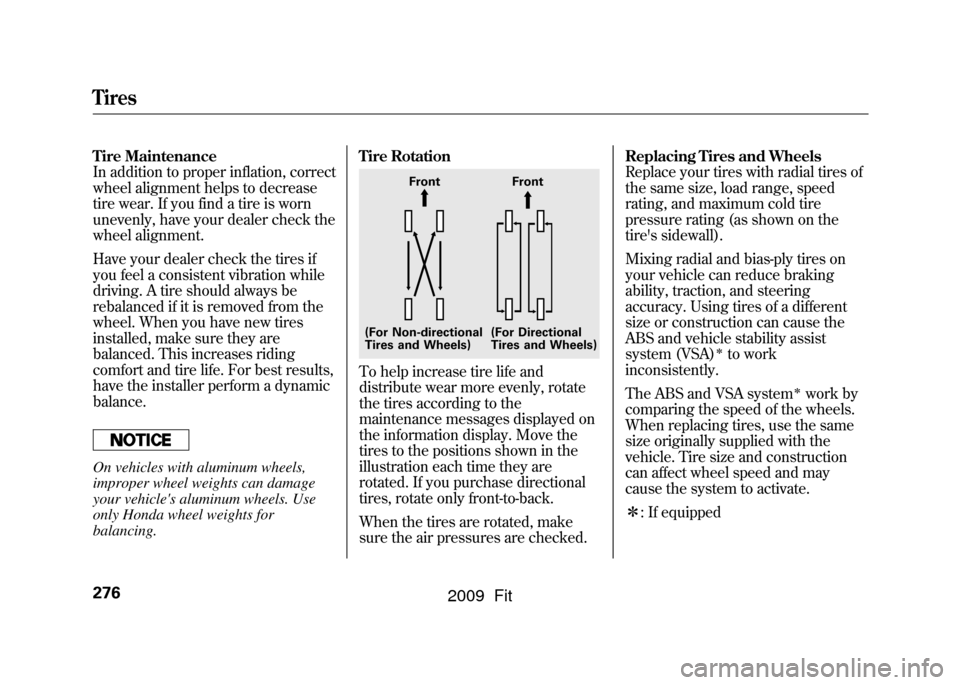
To help increase tire life and
distribute wear more evenly, rotate
the tires according to the
maintenance messages displayed on
the information display. Move the
tires to the positions shown in the
illustration each time they are
rotated. If you purchase directional
tires, rotate only front-to-back.
When the tires are rotated, make
sure the air pressures are checked.Replacing Tires and Wheels
Replace your tires with radial tires of
the same size, load range, speed
rating, and maximum cold tire
pressure rating (as shown on the
tire's sidewall).
Mixing radial and bias-ply tires on
your vehicle can reduce braking
ability, traction, and steering
accuracy. Using tires of a different
size or construction can cause the
ABS and vehicle stability assist
system (VSA)
ꭧto work
inconsistently.
The ABS and VSA system
ꭧwork by
comparing the speed of the wheels.
When replacing tires, use the same
size originally supplied with the
vehicle. Tire size and construction
can affect wheel speed and may
cause the system to activate.
ꭧ : If equipped
Front Front
(For Non-directional
Tires and Wheels) (For Directional
Tires and Wheels)
Tires276
2009 Fit
Page 314 of 352
If your vehicle needs to be towed,
call a professional towing service or
organization. Never tow your vehicle
with just a rope or chain. It is very
dangerous.
There are two ways to tow your
vehicle:Flat-bed Equipment
-The operator
loads your vehicle on the back of a
truck. This is the best way to
transport your vehicle.
Wheel-lift Equipment
- The tow
truck uses two pivoting arms that go
under the front tires and lift them off
the ground. The rear tires remain on
the ground. This is an acceptable
way to tow your vehicle. If, due to damage, your vehicle must
be towed with the front wheels on
the ground, do this:
Manual transmission:●Release the parking brake.●Shift the transmission to neutral.●Leave the ignition switch in the
ACCESSORY (I) position so the
steering wheel does not lock.
Automatic transmission:●Release the parking brake.●Start the engine.●Shift to D position and hold for 5
seconds, then to N. Let the engine
run for 3 minutes, then turn it off.●Turn off the engine.●Leave the ignition switch in the
ACCESSORY (I) position so the
steering wheel does not lock.
Improper towing preparation will
damage the transmission. Follow the
above procedure exactly. If you cannot
shift the transmission or start the
engine (automatic transmission), your
vehicle must be transported with the
front wheels off the ground.
With the front wheels on the ground,
it is best to tow the vehicle no farther
than 50 miles (80 km), and keep the
speed below 35 mph (55 km/h).
CONTINUED
Emergency Towing
311
Taking Care of the Unexpected
2009 Fit
Page 315 of 352
Trying to lift or tow your vehicle by the
bumpers will cause serious damage.
The bumpers are not designed to
support the vehicle's weight.The steering system can be damaged if
the steering wheel is locked. Leave the
ignition switch in the ACCESSORY (I)
position, and make sure the steering
wheel turns freely before you begin
towing.If Your Vehicle Gets Stuck
If your vehicle gets stuck in sand,
mud, or snow, call a towing service to
pull it out (see page311).
For very short distances, such as
freeing the vehicle, you can use the
detachable towing hook that mounts
on the anchor in the front bumper.
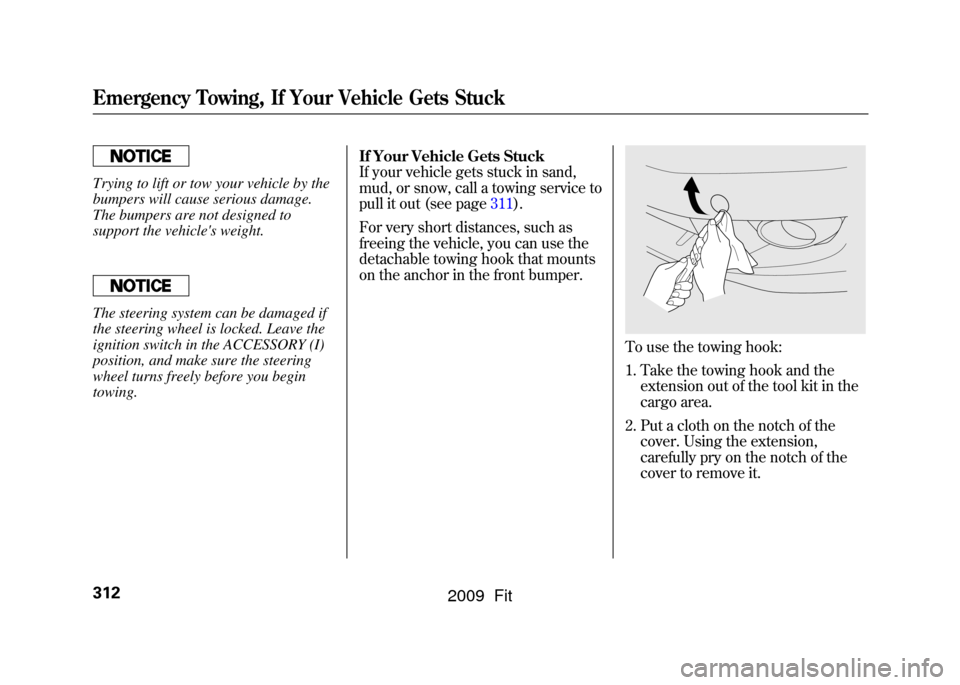
To use the towing hook:
1. Take the towing hook and the
extension out of the tool kit in the
cargo area.
2. Put a cloth on the notch of the cover. Using the extension,
carefully pry on the notch of the
cover to remove it.
Emergency Towing, If Your Vehicle Gets Stuck312
2009 Fit
Page 340 of 352
A
AAABBB ~CCC
.................................
3
Accessories and Modifications
..........................
206
ACCESSORY (Ignition Key Position)
...................................
80
Accessory Power Socket
............
106
Additives, Engine Oil
.................
254
Adjusting the Steering Wheel
......
77
Advanced Airbags
........................
27
Airbag (SRS)
............................
9, 22
Air Conditioning System
............
110
Usage
......................................
111
Air Pressure, Tires
..............
273, 274
Alcohol in Gasoline
....................
198
Antifreeze
...................................
256
Anti-lock Brakes (ABS) Indicator Light
..................
62, 231
Operation
................................
231
Anti-theft, Audio System
.............
191
Anti-theft Steering Column Lock
.........................................
80
Audio System
.............................
115 Auto Control Mode, Starting
Engine
....................................
216
Auto Door Locking
.......................
83
Auto Door Locking/Unlocking
....
83
Auto Door Unlocking
...................
85
Automatic Seat Belt Tensioners
...
20
Automatic Speed Control
...........
194
Automatic Transmission
............
219
Capacity, Fluid
........................
319
Checking Fluid Level
..............
259
Paddle Shifters
........................
224
Shifting
...................................
219
Shift Lever Position Indicators
............................
219
Shift Lever Positions
...............
220
Shift Lock Release
...................
223
Automatic Transmission Fluid
...
259
Auxiliary Input Jack
...................
190
Average Fuel Mileage
..................
70
B
Battery Charging System Indicator
........................
60, 303 Jump Starting
..........................
299
Maintenance
...........................
279
Specifications
..........................
320
Before Driving
...........................
197
Belts, Seat
................................
8, 18
Beverage Holders
......................
106
Booster Seats
...............................
50
Brakes Anti-lock Brakes (ABS)
...........
231
Break-in, New Linings
.............
198
Bulb Replacement
...................
266
Fluid
.......................................
261
Parking
...................................
102
System Design
........................
230
System Indicator
...............
60, 305
Wear Indicators
.......................
230
Braking System
..........................
230
Break-in, New Vehicle
................
198
Brightness Control, Instruments
..............................
76
CONTINUED
Index
I
INDEX
2009 Fit
Page 342 of 352
D
DANGER, Explanation of
.............
iii
Dashboard
...............................
3, 58
Daytime Running Lights (Canada only)
.........................................
75
Daytime Running Lights Indicator (Canada only)
...........................
65
Dead Battery
..............................
299
Defects, Reporting Safety
...........
334
Defogger, Rear Window
...............
76
Defrosting the Windows
............
113
Detachable Anchor
......................
99
Dimensions
................................
318
Dimming the Headlights
..............
74
Dipstick Automatic Transmission
.........
259
Engine Oil
...............................
201
Directional Signals
.......................
63
Disc Brake Wear Indicators
.......
230
Disc Care
...................................
186
Disc Player Error Messages
........................
128, 157
Disposal of Used Oil
...................
255 Doors
Childproof Door Locks
.............
82
Locking and Unlocking
............
81
Power Door Locks
...................
81
DOT Tire Quality Grading (U.S. Vehicles)
................................
321
Downshifting, Manual Transmission
..........................
217
Driver and Passenger Safety
..........
5
Driving
.......................................
213
Economy
.................................
203
Driving Guidelines
.....................
214
Driving with the Paddle Shifters (Sport only)
............................
224
Dust and Pollen Filter
................
268
E
Economy, Fuel
...........................
203
Electric Power Steering (EPS) Indicator
...................................
62
Emergencies on the Road
..........
283
Battery, Jump Starting
.............
299
Brake System Indicator
...........
305
Changing a Flat Tire
...............
285 Charging System Indicator
.....
303
Checking the Fuses
................
307
Driving with a Flat Tire
...........
284
Hazard Warning Flashers
........
76
Jump Starting
..........................
299
Low Oil Pressure Indicator
.....
303
Malfunction Indicator Lamp
....
304
Overheated Engine
.................
301
Towing
....................................
311
Emergency Brake
......................
102
Emergency Flashers
....................
76
Emergency Towing
....................
311
Emissions Controls
....................
326
Emissions Testing
......................
329
CONTINUED
Index
III
INDEX
2009 Fit