manual transmission HONDA FIT 2010 2.G User Guide
[x] Cancel search | Manufacturer: HONDA, Model Year: 2010, Model line: FIT, Model: HONDA FIT 2010 2.GPages: 351, PDF Size: 5.67 MB
Page 228 of 351
This section gives you tips on
starting the engine under various
conditions, and how to operate the
manual and automatic transmissions.
It also includes important information
on parking your vehicle, the braking
system, the vehicle stability assist(VSA
®), and the tire pressure
monitoring system (TPMS).
Driving Guidelines ......................214
Preparing to Drive ......................
215
Starting the Engine .....................
216
Manual Transmission .................
217
Automatic Transmission .............
219
Driving with the Paddle Shifters
(Sport only) .............................
224
Parking .......................................
229
Braking System ..........................
230
Anti-lock Brakes (ABS) ...............
231
Vehicle Stability Assist (VSA
®),
aka Electronic Stability Control
(ESC), System .....................
233
Tire Pressure Monitoring System (TPMS) ...................................
235
Towing a Trailer ..........................
238
Towing Your Vehicle Behind a
Motorhome .............................
238
Driving
213
Driving
Page 231 of 351
1. Apply the parking brake.
2. In cold weather, turn off allelectrical accessories to reduce the
drain on the battery.
3.
Manual transmission:
Press the clutch pedal down all the
way. The START (III) position
does not function unless the clutch
pedal is pressed.
Automatic transmission:
Make sure the shift lever is in
Park. Press on the brake pedal. 4. Without touching the accelerator
pedal, turn the ignition key to the
START (III) position. Do not hold
the key in the START (III) position
for more than 15 seconds at a time.
If the engine does not start right
away, pause for at least 10 seconds
before trying again.The immobilizer system protects your
vehicle from theft. If an improperly-
coded key (or other device) is used, the
engine's fuel system is disabled. For
more information, see page 79.
5. If the engine does not start within
15 seconds, or starts but stalls
right away, repeat step 4 with the
accelerator pedal pressed halfway
down. If the engine starts, release
pressure on the accelerator pedal
so the engine does not race. 6. If the engine fails to start, press
the accelerator pedal all the way
down, and hold it there while
starting to clear flooding. If the
engine still does not start, return to
step 5.
The engine is harder to start in cold
weather. Also, the thinner air found at
altitudes above 8,000 feet (2,400
meters) adds to this problem.
Starting the Engine
216
Table of Contents
Page 232 of 351
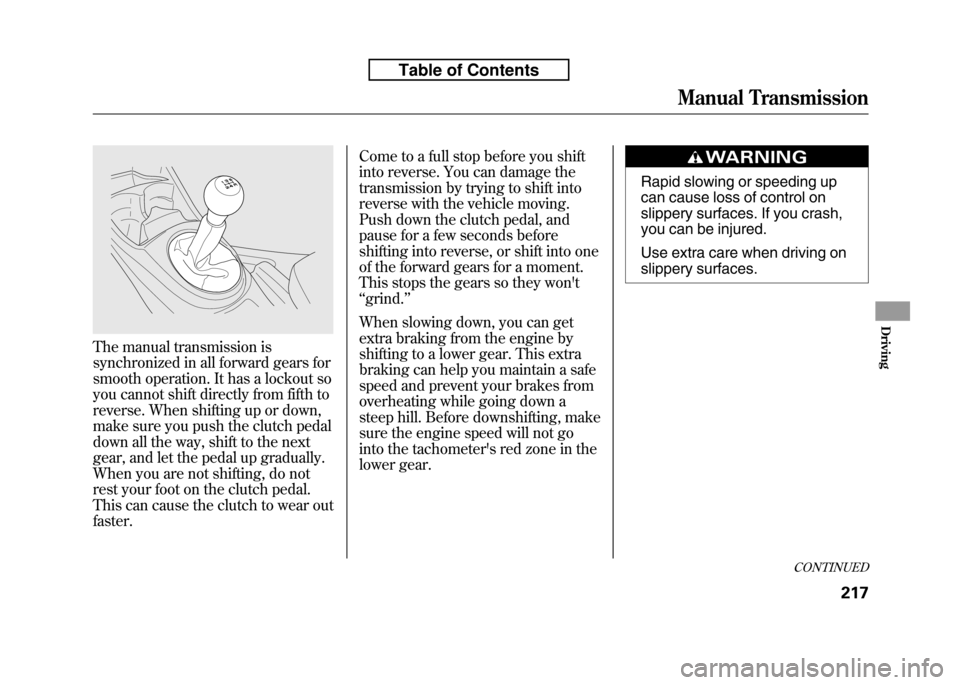
The manual transmission is
synchronized in all forward gears for
smooth operation. It has a lockout so
you cannot shift directly from fifth to
reverse. When shifting up or down,
make sure you push the clutch pedal
down all the way, shift to the next
gear, and let the pedal up gradually.
When you are not shifting, do not
rest your foot on the clutch pedal.
This can cause the clutch to wear outfaster.Come to a full stop before you shift
into reverse. You can damage the
transmission by trying to shift into
reverse with the vehicle moving.
Push down the clutch pedal, and
pause for a few seconds before
shifting into reverse, or shift into one
of the forward gears for a moment.
This stops the gears so they won't‘‘
grind. ’’
When slowing down, you can get
extra braking from the engine by
shifting to a lower gear. This extra
braking can help you maintain a safe
speed and prevent your brakes from
overheating while going down a
steep hill. Before downshifting, make
sure the engine speed will not go
into the tachometer's red zone in the
lower gear.
Rapid slowing or speeding up
can cause loss of control on
slippery surfaces. If you crash,
you can be injured.
Use extra care when driving on
slippery surfaces.
CONTINUED
Manual Transmission
217
Driving
Table of Contents
Page 233 of 351
Recommended Shift Points
Drive in the highest gear that lets the
engine run and accelerate smoothly.
This will give you good fuel economy
and effective emissions control. The
following shift points are
recommended:Shift up Normal acceleration
1st to 2nd
2nd to 3rd
3rd to 4th4th to 5th 15 mph (24 km/h)
27 mph (44 km/h)
39 mph (63 km/h)
53 mph (85 km/h) Engine Speed Limiter
If you exceed the maximum speed
for the gear you are in, the engine
speed will enter into the
tachometer's red zone. If this occurs,
you may feel the engine cut in and
out. This is caused by a limiter in the
engine's computer controls. The
engine will run normally when you
reduce the rpm below the red zone.
The engine speed limiter only works
when you upshift; engine speed is
not limited during downshifts. Before
downshifting, make sure the engine
will not go into the tachometer's redzone.
Manual Transmission
218
Table of Contents
Page 237 of 351
All models except U.S. Sport
First (1)-To shift from second to
first, press the release button on the
front of the shift lever. This position
locks the transmission in first gear.
By upshifting and downshifting
through 1, 2, D 3, and D, you can
operate the transmission much like a
manual transmission without a clutchpedal.
U.S. Sport model
S position (S) -To shift into the S
position, press the release button on
the front of the shift lever, and move
the lever to S. This position is similar
to D, except only first to fourth gears
are selected and fifth gear is no
longer available. However, during
most driving conditions, only first
through third gears are used.
With the shift lever in D or S, you
can also use the paddle shifters to
shift the transmission up or down.
With the paddle shifters, you can
operate the transmission much like a
manual transmission without a clutch
pedal. For more information on
driving with the paddle shifters, see
page 224. Engine Speed Limiter
If you exceed the maximum speed
for the gear you are in, the engine
speed will enter into the
tachometer's red zone. If this occurs,
you may feel the engine cut in and
out. This is caused by a limiter in the
engine's computer controls. The
engine will run normally when you
reduce the rpm below the red zone.
Automatic Transmission
222
Table of Contents
Page 239 of 351
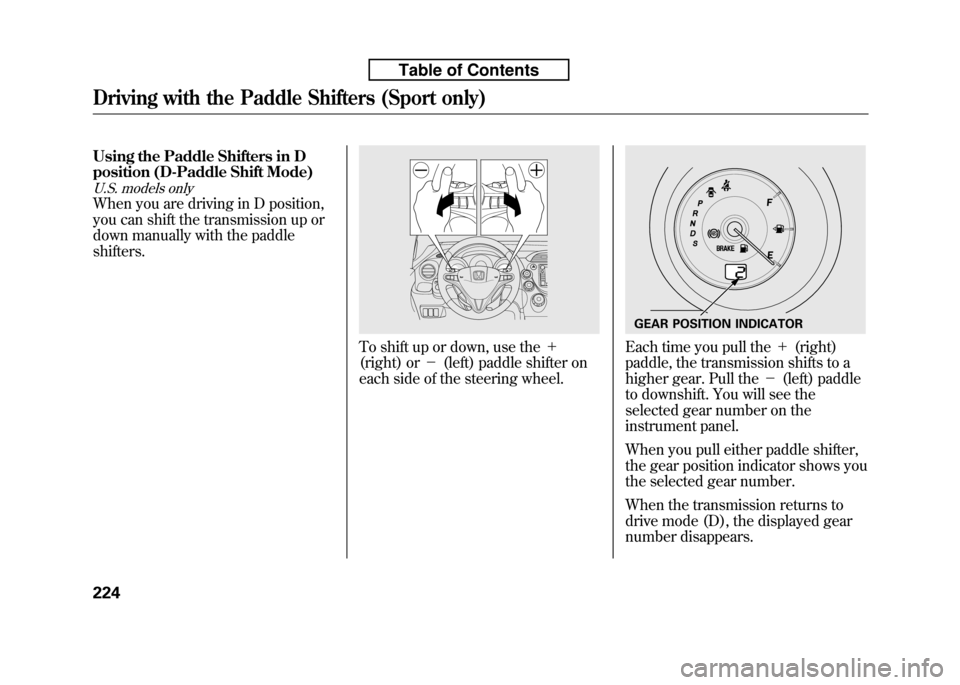
Using the Paddle Shifters in D
position (D-Paddle Shift Mode)
U.S. models only
When you are driving in D position,
you can shift the transmission up or
down manually with the paddleshifters.
To shift up or down, use the+
(right) or -(left) paddle shifter on
each side of the steering wheel.Each time you pull the +(right)
paddle, the transmission shifts to a
higher gear. Pull the -(left) paddle
to downshift. You will see the
selected gear number on the
instrument panel.
When you pull either paddle shifter,
the gear position indicator shows you
the selected gear number.
When the transmission returns to
drive mode (D), the displayed gear
number disappears.
GEAR POSITION INDICATOR
Driving with the Paddle Shifters (Sport only)
224
Table of Contents
Page 240 of 351
Downshifting with the paddle shifter
allows you to increase the engine
braking when going down steep or
long hills, and provides more power
when climbing uphills. You can
upshift the transmission manually to
reduce the rpm. Driving in the
higher gear helps fuel economy.
The transmission control system
monitors the accelerator pedal use
and your driving conditions. When
you press the accelerator pedal as in
normal driving, the system judges
that you are driving at a constant
cruising speed without using the
paddle shifters. Under these
conditions, D-paddle shift mode is
canceled, and the transmission
automatically returns to drive mode(D).The transmission remains in the
selected gear if you do notaccelerate.
Each time you pull either paddle
shifter, the transmission shifts one
gear up or down. If you want to shift
up or down more than two gears, pull
the paddle shifter twice, pause, and
then pull it again.
The automatic transmission will not
allow you to shift up or down if:
● You downshift before the engine
speed reaches the highest
threshold of the lower gear.
If you try to do this, the gear position
indicator will flash the number of the
lower gear several times, then return
to a higher gear. ●
You upshift before the engine
speed reaches the lowest
threshold of the higher gear.
● You pull both paddle shifters at the
same time.
The transmission downshifts to first
gear and returns to drive mode (D)
when the vehicle comes to a
complete stop or the vehicle speed is
about 6 mph (10 km/h).
CONTINUED
Driving with the Paddle Shifters (Sport only)
225
Driving
Table of Contents
Page 241 of 351
When you pull and hold the+
(right) paddle shifter, the
transmission automatically returns to
drive mode (D).
If there is a problem in the
transmission while you are driving
with the paddle shifters, the D
indicator flashes, the D-paddle shift
mode is canceled, and the
transmission returns to drive mode(D). Using the Paddle Shift in S
position (Sequential Shift Mode)
U.S. models only
With the shift lever in the S position,
you can manually shift up or down
with the paddle shifters. The
transmission goes into the sequential
shift mode and holds the selectedgear.
To enter the sequential shift mode,
press the release button on the front
of the shift lever, move the lever to
the S position, then pull either paddle
shifter. To return to drive mode (D),
move the shift lever to the D
position. While you are driving in the
sequential shift mode, the
transmission will not automatically
return to drive mode (D).
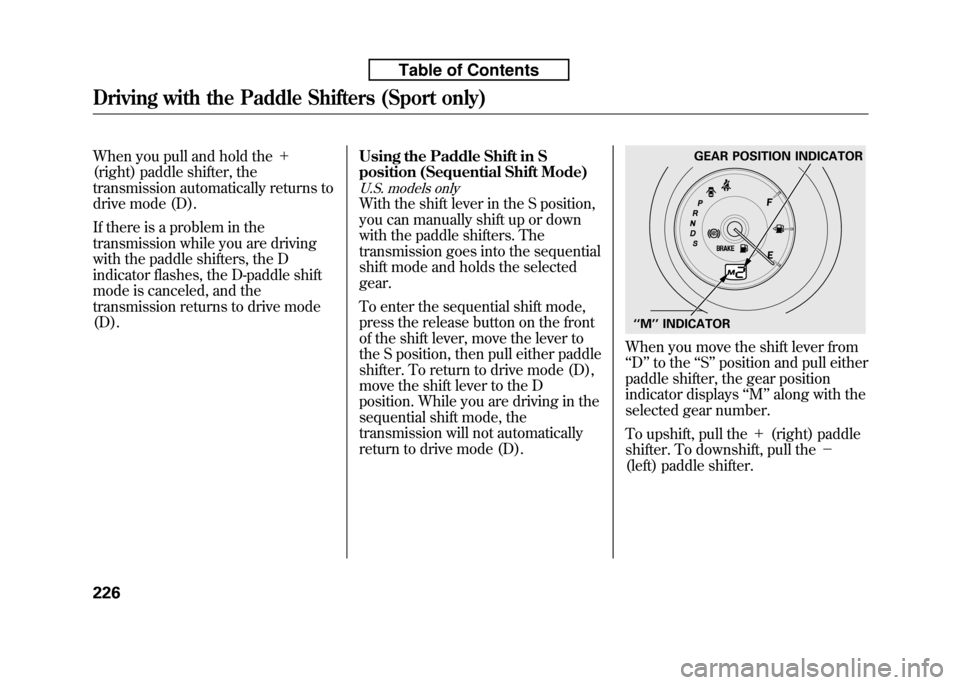
When you move the shift lever from ‘‘
D ’’to the ‘‘S ’’ position and pull either
paddle shifter, the gear position
indicator displays ‘‘M ’’along with the
selected gear number.
To upshift, pull the +(right) paddle
shifter. To downshift, pull the -
(left) paddle shifter.
GEAR POSITION INDICATOR
‘‘ M ’’INDICATOR
Driving with the Paddle Shifters (Sport only)
226
Table of Contents
Page 242 of 351
When you accelerate from a stop, the
transmission starts in first gear, and
you must manually upshift between
first and fifth gears. Make sure you
upshift before the engine speed
reaches the tachometer's red zone.
The transmission remains in the
selected gear (5, 4, 3, 2, or 1). There
is no automatic downshift when you
push the accelerator pedal to thefloor.
When you are driving in 4th or 5th
gear, the transmission downshifts to
the lower gear under the followingconditions:● The vehicle slows down to a
certain speed.
● You press the brake pedal. Downshifting with the paddle shifter
allows you to increase the engine
braking when going down steep or
long hills, and provides more power
when climbing uphills. You can
upshift the transmission manually to
reduce the rpm. Driving in the
higher gear helps fuel economy.
The transmission also shifts
automatically as the vehicle comes to
a complete stop. It downshifts to first
gear when the vehicle speed reaches
6 mph (10 km/h) or less.
The automatic transmission will not
allow you to shift up or down if:
● You downshift before the engine
speed reaches the highest
threshold of the lower gear.
If you try to do this, the gear position
indicator will flash the number of the
lower gear several times, then return
to a higher gear.
CONTINUED
Driving with the Paddle Shifters (Sport only)
227
Driving
Table of Contents
Page 244 of 351
Always use the parking brake when
you park your vehicle. Make sure the
parking brake is set firmly, or your
vehicle may roll if it is parked on anincline.
If your vehicle has an automatic
transmission, set the parking brake
before you put the transmission in
Park. This keeps the vehicle from
moving and putting pressure on the
parking mechanism in thetransmission.Parking Tips
● Make sure the windows areclosed.
● Turn off the lights.
● Place any packages, valuables, etc.
in the cargo area or take them withyou.
● Lock the doors and the tailgate.
On Sport model
Check the indicator on the
instrument panel to verify that the
security system is set.
● Never park over dry leaves, tall
grass, or other flammable
materials. The hot three way
catalytic converter could cause
these materials to catch on fire. ●
If the vehicle is facing uphill, turn
the front wheels away from the
curb. If your vehicle has a manual
transmission, put it in first gear
and set the parking brake.
● If the vehicle is facing downhill,
turn the front wheels toward the
curb. If your vehicle has a manual
transmission, put it in reverse gear
and set the parking brake.
● Make sure the parking brake is
fully released before driving away.
Driving with the parking brake
partially set can overheat or
damage the rear brakes.
Parking
229
Driving
Table of Contents