lock HONDA FIT 2013 3.G User Guide
[x] Cancel search | Manufacturer: HONDA, Model Year: 2013, Model line: FIT, Model: HONDA FIT 2013 3.GPages: 286, PDF Size: 9.38 MB
Page 25 of 286
24
uuFor Safe DrivinguYour Vehicle’s Safety Features
Safe Driving
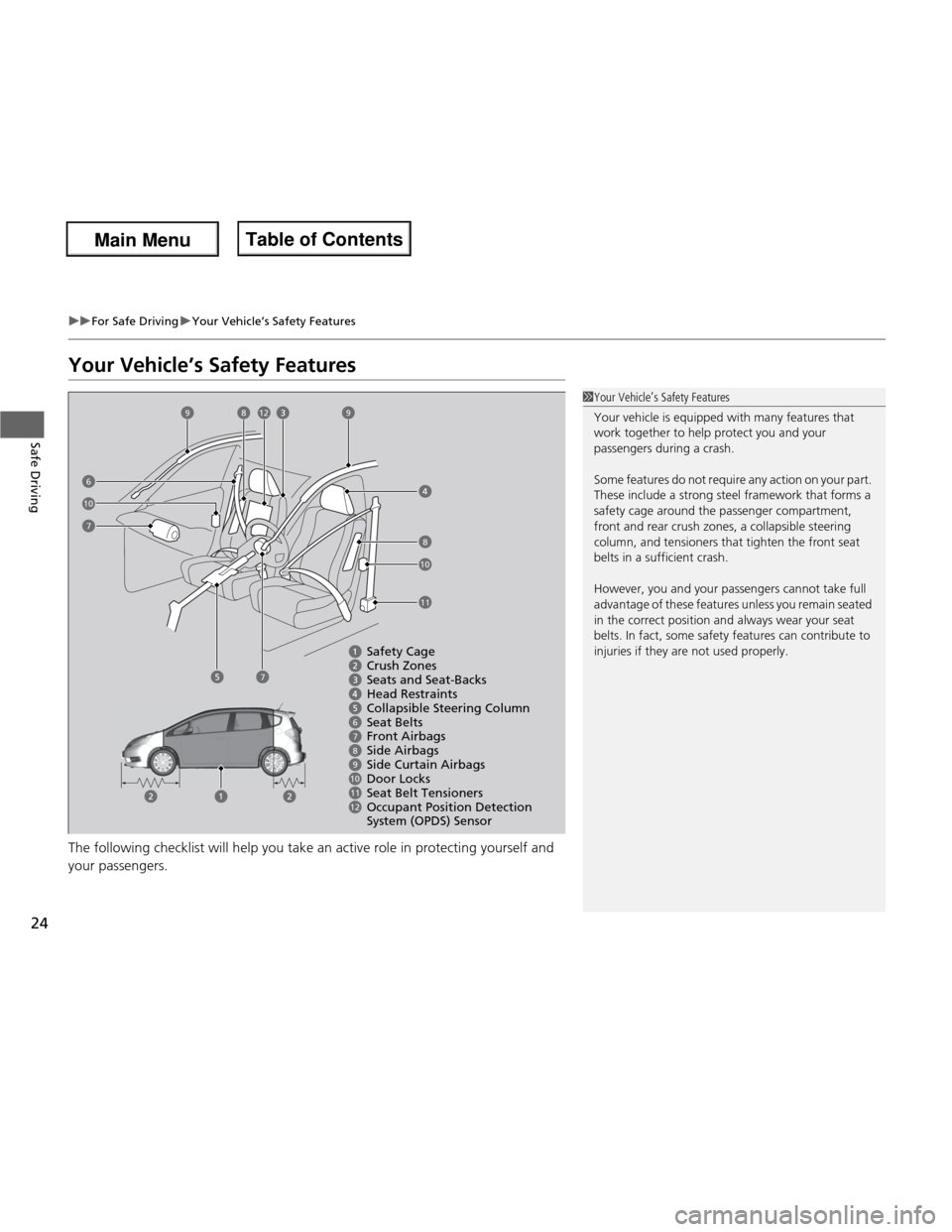
Your Vehicle’s Safety Features
The following checklist will help you take an active role in protecting yourself and
your passengers.
1Your Vehicle’s Safety Features
Your vehicle is equipped with many features that
work together to help protect you and your
passengers during a crash.
Some features do not require any action on your part.
These include a strong steel framework that forms a
safety cage around the passenger compartment,
front and rear crush zones, a collapsible steering
column, and tensioners that tighten the front seat
belts in a sufficient crash.
However, you and your passengers cannot take full
advantage of these features unless you remain seated
in the correct position and always wear your seat
belts. In fact, some safety features can contribute to
injuries if they are not used properly.
6789101112
Safety Cage
Crush Zones
Seats and Seat-Backs
Head Restraints
Collapsible Steering Column
Seat Belts
Front Airbags
Side Curtain Airbags
Seat Belt Tensioners
Occupant Position Detection
System (OPDS) Sensor
Side Airbags
6
7
7
8
8
99
10
11
Door Locks
12
10
Main MenuTable of Contents
Page 26 of 286
25
uuFor Safe DrivinguYour Vehicle’s Safety Features
Safe DrivingFor the safety of you and your passengers, make a habit of checking these items
each time before you drive.•After everyone has entered the vehicle, be sure all doors and the tailgate are
closed and locked. Locking the doors and the tailgate helps prevent an occupant
from being ejected and an outsider from unexpectedly opening a door or the
tailgate. 2 Locking/Unlocking the Doors from the Inside P. 82
• Adjust your seat to a position suitable for driving. Be sure the front seats are
adjusted as far to the rear as possible while allowing the driver to control the
vehicle. Sitting too close to a front airbag can result in serious or fatal injury in a
crash.
2 Adjusting the Seats P. 103
• Adjust head restraints to the proper position. Head restraints are most effective
when the center of the head restraint aligns with the center of your head. Taller
persons should adjust their head restraint to the highest position.
2 Adjusting the Head Restraints P. 105
• Always wear your seat belt, and make sure you wear it properly. Confirm that any
passengers are properly belted as well.
2 Fastening a Seat Belt P. 29
• Protect children by using seat belts or child seats according to a child’s age, height and weight.
2 Child Safety P. 49
■Safety Checklist1Safety Checklist
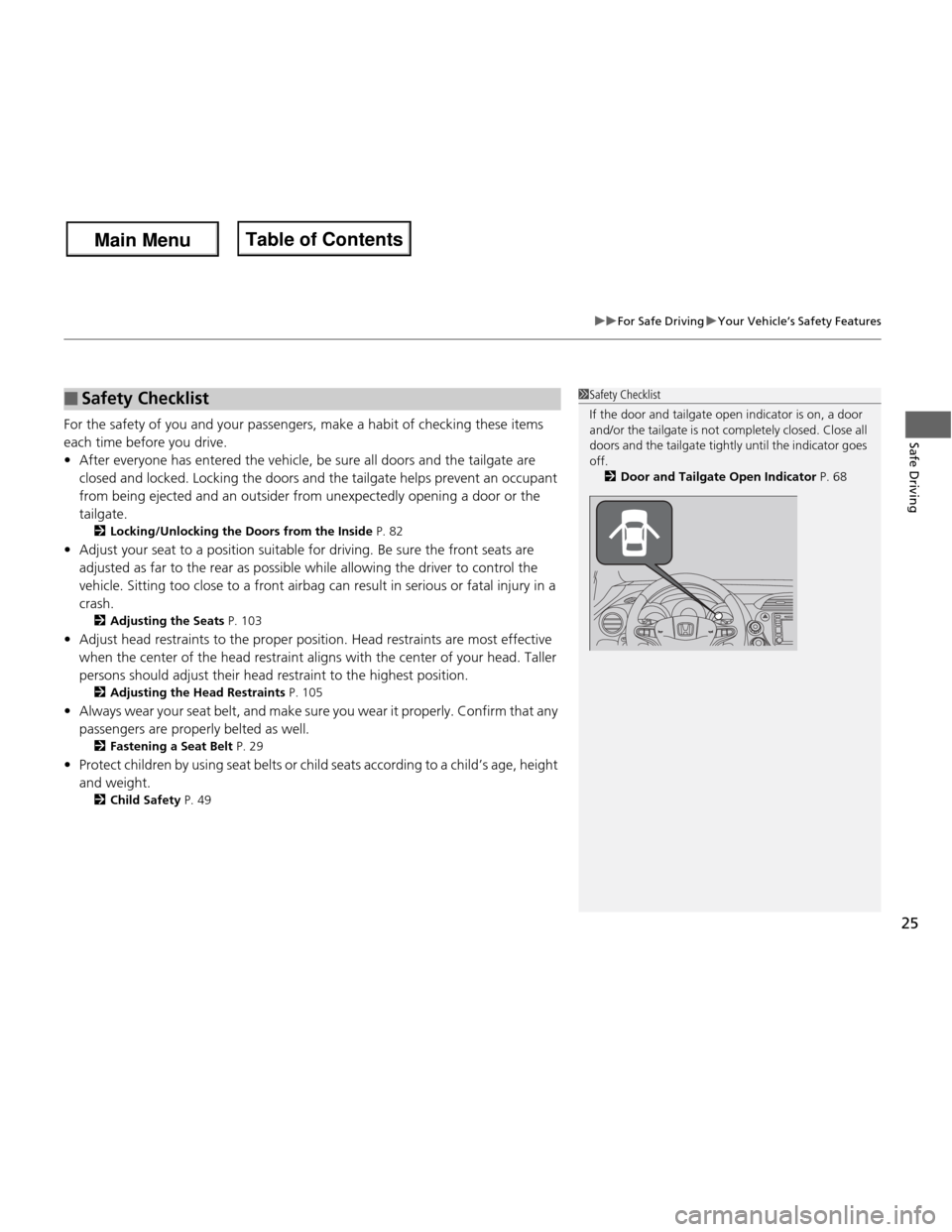
If the door and tailgate open indicator is on, a door
and/or the tailgate is not comple tely closed. Close all
doors and the tailgate tightly until the indicator goes off.
2 Door and Tailgate Open Indicator P. 68
Main MenuTable of Contents
Page 27 of 286
26
Safe Driving
Seat Belts
About Your Seat Belts
Seat belts are the single most effective safety device because they keep you
connected to the vehicle so that you can take advantage of many built-in safety
features. They also help keep you from being thrown against the inside of the vehicle, against other passengers, or out of the vehicle. When worn properly, seat
belts also keep your body properly positioned in a crash so that you can take full
advantage of the additional protection provided by the airbags.
In addition, seat belts help protect you in almost every type of crash, including: - frontal impacts
- side impacts
- rear impacts
- rollovers
■ Lap/shoulder seat belts
All five seating positions are equipped with lap/shoulder seat belts with emergency
locking retractors. In normal driving the retractor lets you move freely while keeping
some tension on the belt. During a collision or sudden stop the retractor locks to
restrain your body. The rear seat belts also have a lockable retractor for use with
child seats. 2 Installing a Child Seat with a Lap/Shoulder Seat Belt P. 56
1About Your Seat Belts
Seat belts cannot completely protect you in every
crash. But in most cases, seat belts can reduce your risk of serious injury.
Most states and all Canadian provinces and territories
require you to wear seat belts.
3WARNING
Not wearing a seat belt properly increases
the chance of serious injury or death in a
crash, even though your vehicle has
airbags.
Be sure you and your passengers always
wear seat belts and wear them properly.
Main MenuTable of Contents
Page 28 of 286
Continued27
uuSeat BeltsuAbout Your Seat Belts
Safe Driving
■Proper use of seat belts
Follow these guidelines for proper use: • All occupants should sit upright, well back in the seat, and remain in that position
for the duration of the trip. Slouching and leaning reduces the effectiveness of
the belt and can increase the chance of serious injury in a crash.
• Never place the shoulder part of a lap/sh oulder seat belt under your arm or
behind your back. This could ca use very serious injuries in a crash.
• Two people should never use the same seat belt. If they do, they could be very
seriously injured in a crash.
• Do not put any accessories on the seat belts. Devices intended to improve comfort
or reposition the shoulder part of a seat belt can reduce the protective capability
and increase the chance of serious injury in a crash.
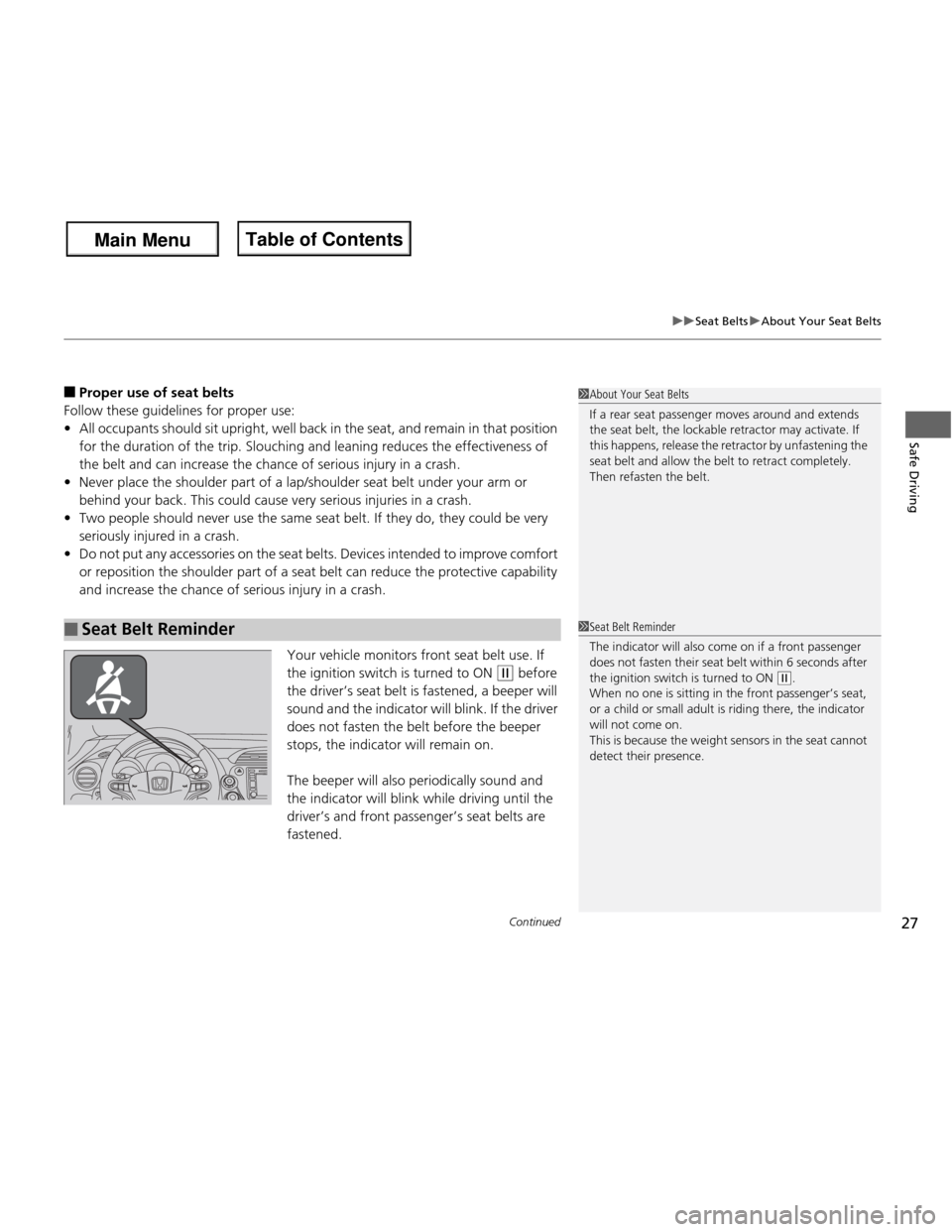
Your vehicle monitors front seat belt use. If
the ignition switch is turned to ON
(w before
the driver’s seat belt is fastened, a beeper will
sound and the indicator will blink. If the driver
does not fasten the belt before the beeper
stops, the indicator will remain on.
The beeper will also periodically sound and
the indicator will blink while driving until the
driver’s and front passenger’s seat belts are
fastened.
■Seat Belt Reminder
1About Your Seat Belts
If a rear seat passenger moves around and extends
the seat belt, the lockable retractor may activate. If
this happens, release the retractor by unfastening the seat belt and allow the belt to retract completely.
Then refasten the belt.
1Seat Belt Reminder
The indicator will also come on if a front passenger
does not fasten their seat belt within 6 seconds after
the ignition switch is turned to ON
(w .
When no one is sitting in the front passenger’s seat,
or a child or small adult is riding there, the indicator
will not come on.
This is because the weight sensors in the seat cannot
detect their presence.
Main MenuTable of Contents
Page 51 of 286
uuChild SafetyuProtecting Child Passengers
50
Safe Driving
• Any child who is too small to wear a seat belt correctly must be restrained in an
approved child seat that is properly secured to the vehicle using either the lap belt
portion of the lap/shoulder belt or the lower anchors of the LATCH system.
• Never hold a child on your lap because it is impossible to protect them in the
event of a collision.
• Never put a seat belt over yourself and a child. During a crash, the belt would
likely press deep into the child and cause serious or fatal injuries.
• Never let two children use the same seat belt. Both children could be very
seriously injured in a crash.
• Do not allow children to operate the doors, windows or seat adjustments.
• Do not leave children in the vehicle unattend ed, especially in hot weather when
the inside of the vehicle can get hot enough to kill them. They could also activate
vehicle controls causing it to move unexpectedly.1Protecting Child Passengers
To deactivate a lockable retractor, release the buckle
and allow the seat belt to wind up all the way.
To remind you of the passenger’s front airbag
hazards and child safety, your vehicle has warning
labels on the dashboard (U.S. models) and on the
front visors. Please read and follow the instructions
on these labels. 2 Safety Labels P. 62
3WARNING
Allowing a child to play with a seat belt or
wrap one around their neck can result in
serious injury or death.
Instruct children not to play with any seat
belt and make sure any unused seat belt a
child can reach is bu ckled, fully retracted,
and locked.
Main Menu
Main MenuTable of Contents
Page 52 of 286
51
uuChild SafetyuSafety of Infants and Small Children
Continued
Safe Driving
Safety of Infants and Small Children
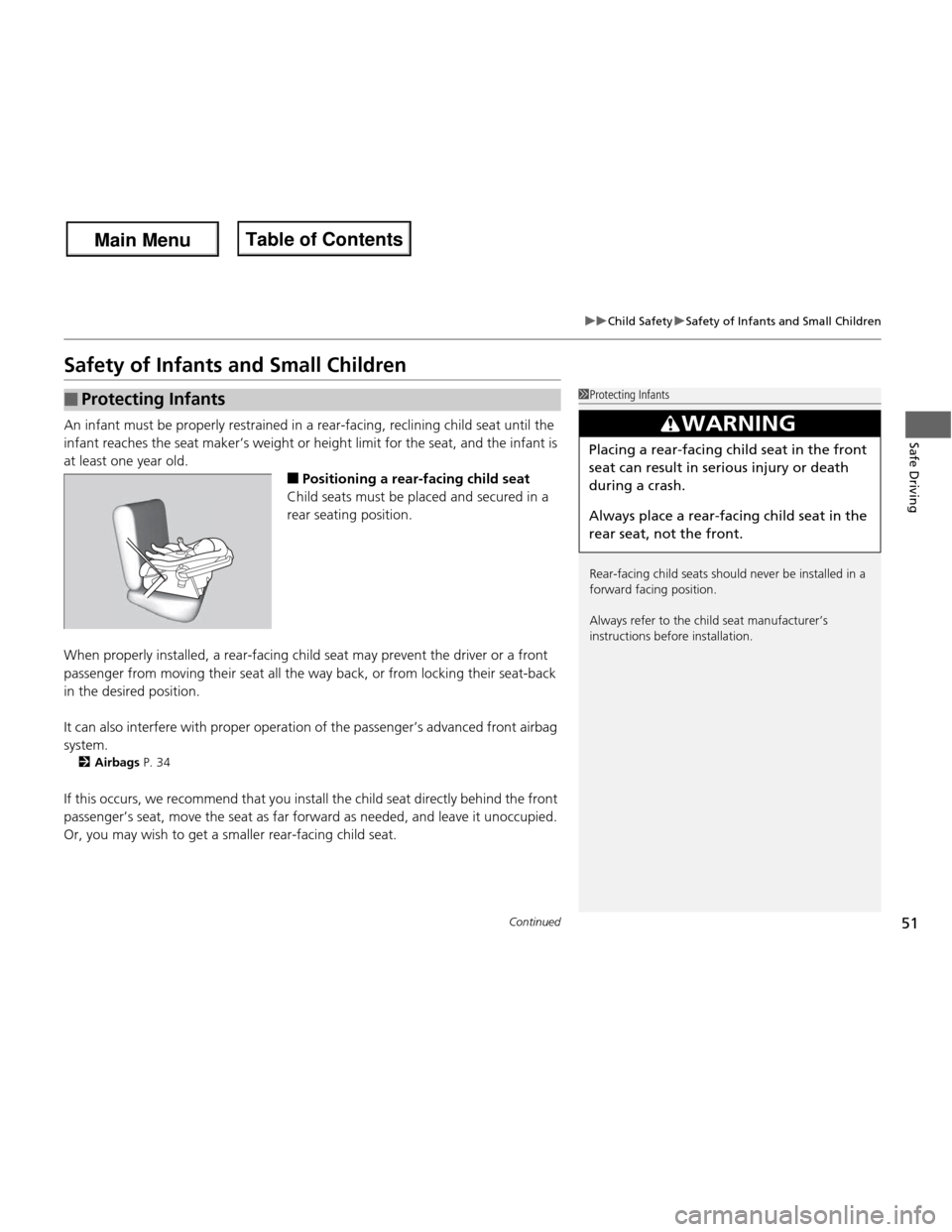
An infant must be properly restrained in a rear-facing, reclining child seat until the
infant reaches the seat maker’s weight or height limit for the seat, and the infant is
at least one year old.■Positioning a rear-facing child seat
Child seats must be placed and secured in a
rear seating position.
When properly installed, a rear-facing child seat may prevent the driver or a front
passenger from moving their seat all the way back, or from locking their seat-back in the desired position.
It can also interfere with proper operation of the passenger’s advanced front airbag
system. 2 Airbags P. 34
If this occurs, we recommend that you install the child seat directly behind the front
passenger’s seat, move the seat as far forward as needed, and leave it unoccupied. Or, you may wish to get a smaller rear-facing child seat.
■Protecting Infants1Protecting Infants
Rear-facing child seats should never be installed in a
forward facing position.
Always refer to the chi ld seat manufacturer’s
instructions before installation.
3WARNING
Placing a rear-facing child seat in the front
seat can result in serious injury or death
during a crash.
Always place a rear-facing child seat in the
rear seat, not the front.
Main Menu
Main MenuTable of Contents
Page 56 of 286
Continued55
uuChild SafetyuSafety of Infants and Small Children
Safe Driving
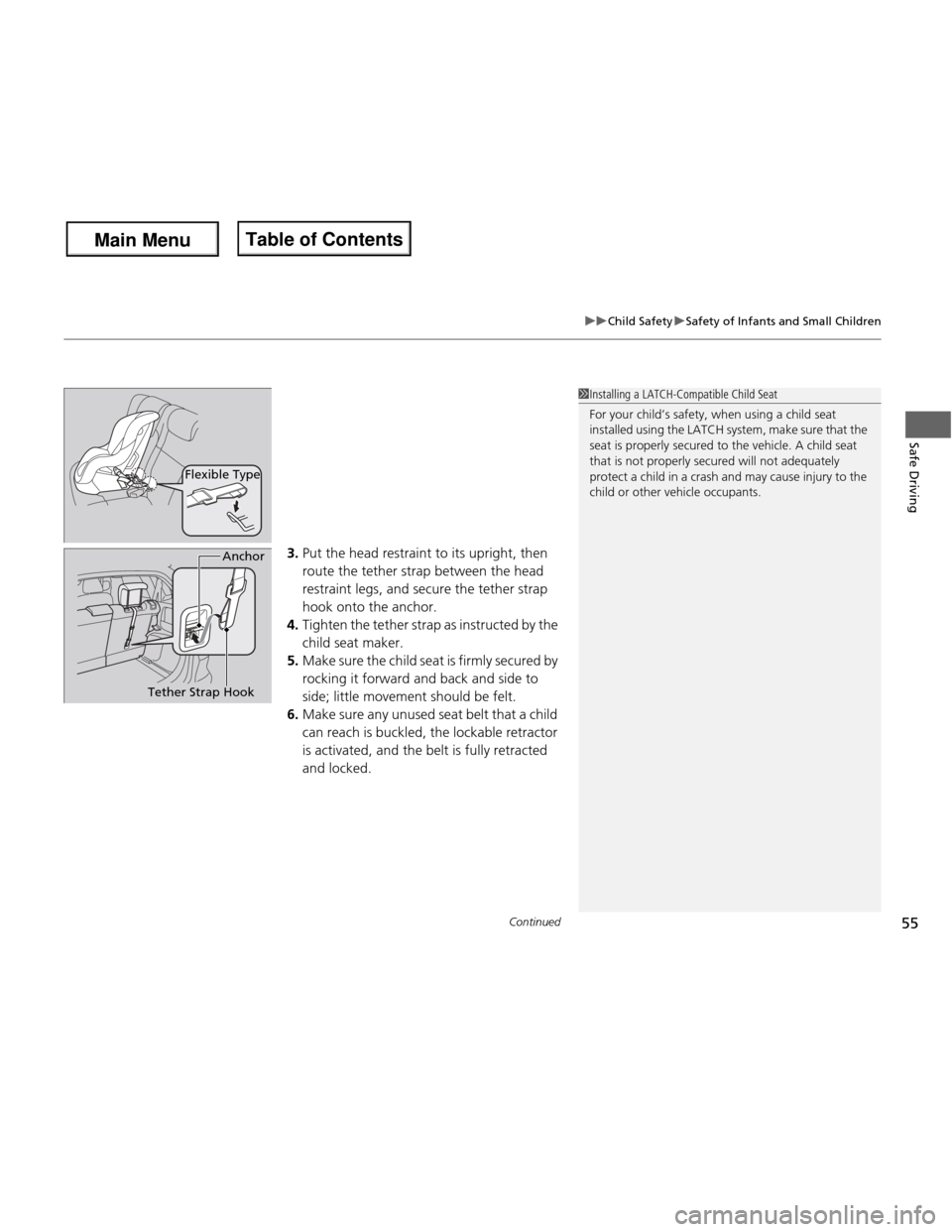
3.Put the head restraint to its upright, then
route the tether strap between the head
restraint legs, and secure the tether strap
hook onto the anchor.
4. Tighten the tether strap as instructed by the
child seat maker.
5. Make sure the child seat is firmly secured by
rocking it forward and back and side to
side; little movement should be felt.
6. Make sure any unused seat belt that a child
can reach is buckled, the lockable retractor
is activated, and the belt is fully retracted and locked.
Flexible Type
1Installing a LATCH-Compatible Child Seat
For your child’s safety, when using a child seat
installed using the LATCH system, make sure that the
seat is properly secured to the vehicle. A child seat
that is not properly secured will not adequately
protect a child in a crash and may cause injury to the
child or other vehicle occupants.
Anchor
Tether Strap Hook
Main Menu
Main MenuTable of Contents
Page 57 of 286
uuChild SafetyuSafety of Infants and Small Children
56
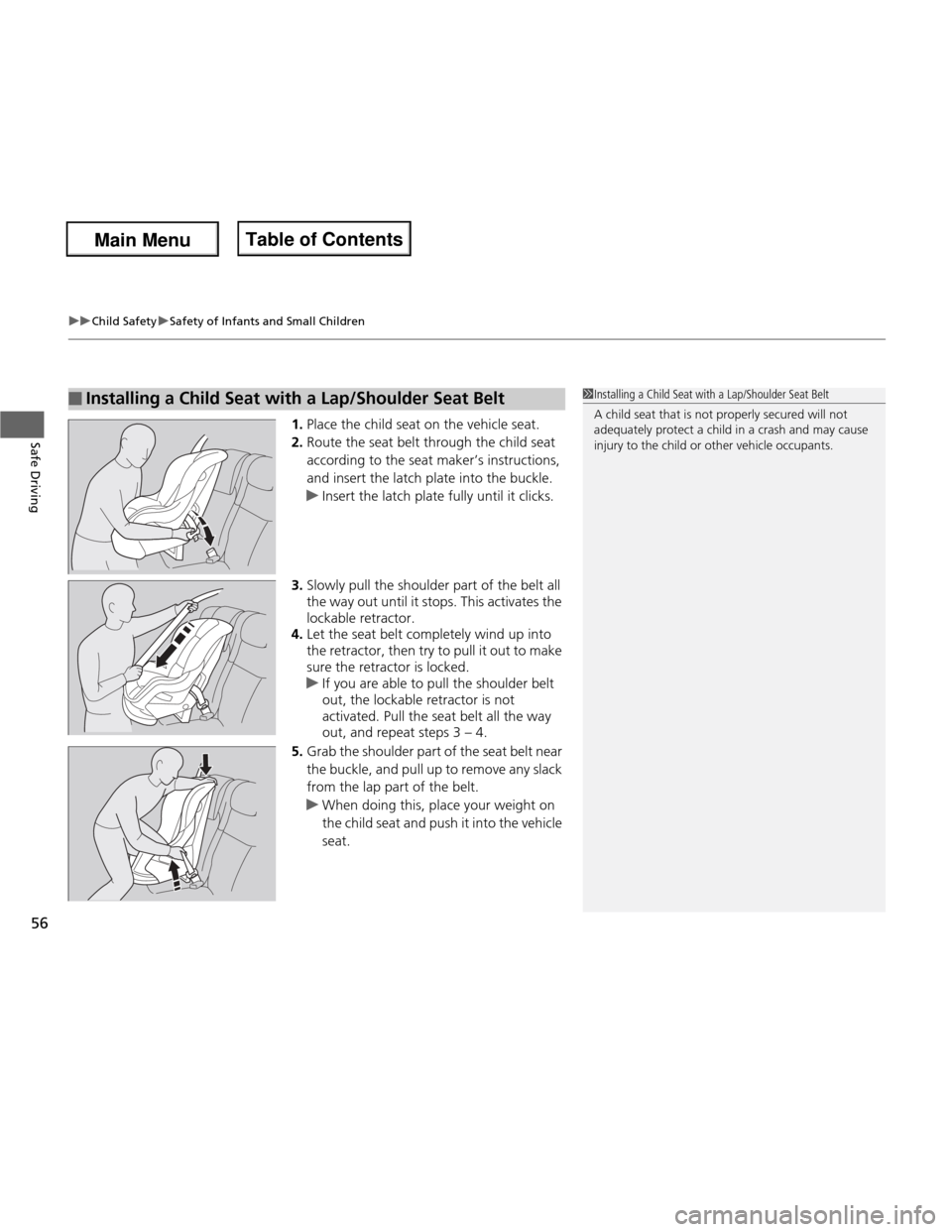
Safe Driving1. Place the child seat on the vehicle seat.
2. Route the seat belt through the child seat according to the seat maker’s instructions,
and insert the latch plate into the buckle.
uInsert the latch plate fully until it clicks.
3. Slowly pull the shoulder part of the belt all
the way out until it stops. This activates the lockable retractor.
4. Let the seat belt completely wind up into
the retractor, then try to pull it out to make
sure the retractor is locked.
uIf you are able to pull the shoulder belt
out, the lockable retractor is not
activated. Pull the seat belt all the way
out, and repeat steps 3 – 4.
5. Grab the shoulder part of the seat belt near
the buckle, and pull up to remove any slack
from the lap part of the belt.
uWhen doing this, place your weight on
the child seat and push it into the vehicle seat.
■Installing a Child Seat with a Lap/Shoulder Seat Belt1Installing a Child Seat with a Lap/Shoulder Seat Belt
A child seat that is not properly secured will not
adequately protect a child in a crash and may cause
injury to the child or other vehicle occupants.
Main Menu
Main MenuTable of Contents
Page 58 of 286
Continued57
uuChild SafetyuSafety of Infants and Small Children
Safe Driving
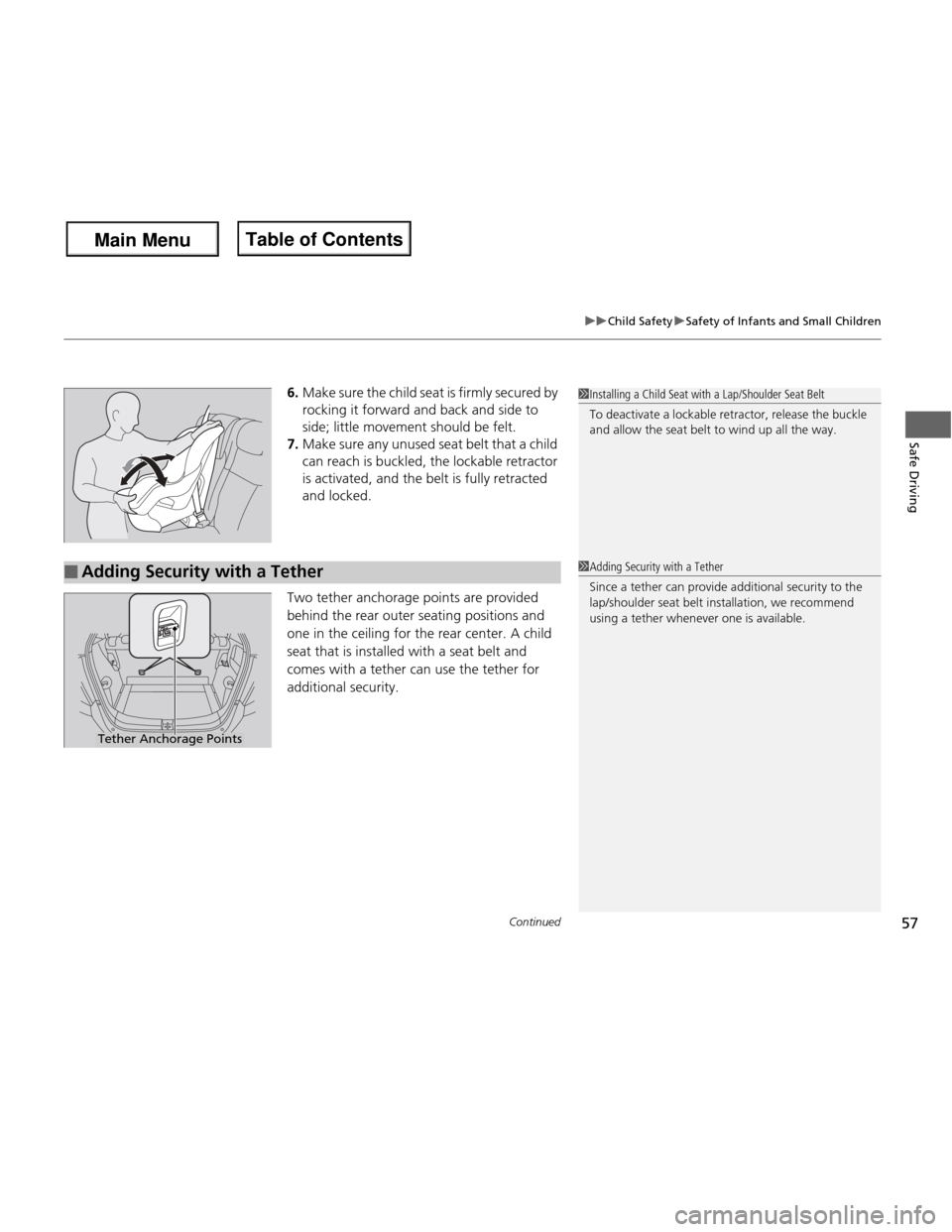
6.Make sure the child seat is firmly secured by
rocking it forward and back and side to
side; little movement should be felt.
7. Make sure any unused seat belt that a child
can reach is buckled, the lockable retractor
is activated, and the belt is fully retracted and locked.
Two tether anchorage points are provided
behind the rear outer seating positions and
one in the ceiling for the rear center. A child
seat that is installed with a seat belt and
comes with a tether can use the tether for additional security.1Installing a Child Seat with a Lap/Shoulder Seat Belt
To deactivate a lockable retractor, release the buckle
and allow the seat belt to wind up all the way.
■Adding Security with a Tether1Adding Security with a Tether
Since a tether can provide additional security to the
lap/shoulder seat belt installation, we recommend
using a tether wheneve r one is available.
Tether Anchorage Points
Main Menu
Main MenuTable of Contents
Page 68 of 286
67
uuIndicatorsu
Continued
Instrument Panel
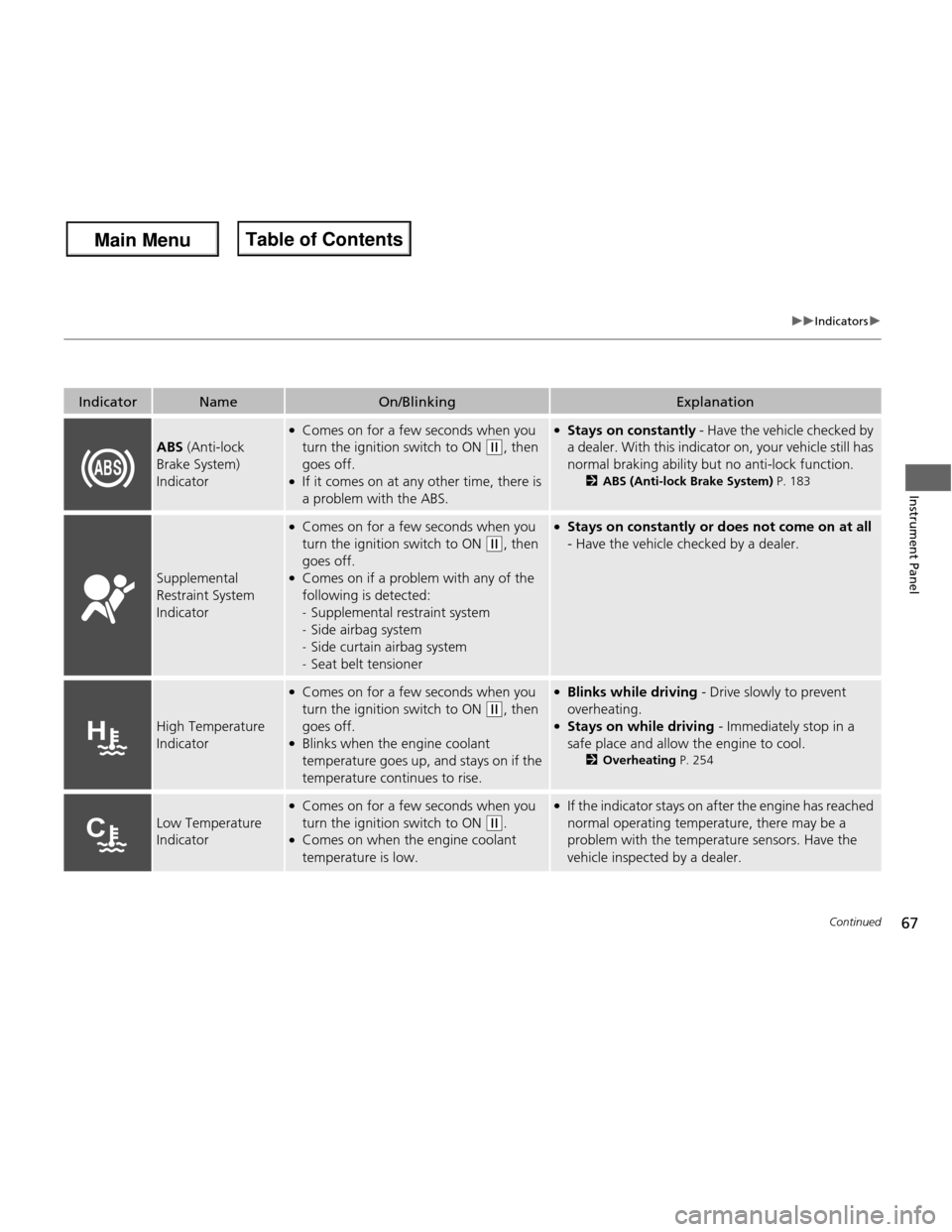
IndicatorNameOn/BlinkingExplanation
ABS (Anti-lock
Brake System)
Indicator
● Comes on for a few seconds when you
turn the ignition switch to ON
(w , then
goes off.
● If it comes on at any other time, there is
a problem with the ABS.
● Stays on constantly - Have the vehicle checked by
a dealer. With this indicator on, your vehicle still has
normal braking ability but no anti-lock function. 2ABS (Anti-lock Brake System) P. 183
Supplemental
Restraint System
Indicator
●
Comes on for a few seconds when you
turn the ignition switch to ON
(w , then
goes off.
● Comes on if a problem with any of the
following is detected: -Supplemental restraint system
- Side airbag system
- Side curtain airbag system
- Seat belt tensioner
●
Stays on constantly or does not come on at all
- Have the vehicle checked by a dealer.
High Temperature
Indicator
● Comes on for a few seconds when you
turn the ignition switch to ON
(w , then
goes off.
● Blinks when the engine coolant
temperature goes up, and stays on if the
temperature continues to rise.
● Blinks while driving - Drive slowly to prevent
overheating.
● Stays on while driving - Immediately stop in a
safe place and allow the engine to cool. 2Overheating P. 254
Low Temperature
Indicator
●
Comes on for a few seconds when you
turn the ignition switch to ON
(w .
● Comes on when the engine coolant
temperature is low.
●
If the indicator stays on after the engine has reached
normal operating temperature, there may be a
problem with the temperature sensors. Have the
vehicle inspected by a dealer.
Main Menu
Main MenuTable of Contents