child seat HONDA INSIGHT 2022 Owners Manual
[x] Cancel search | Manufacturer: HONDA, Model Year: 2022, Model line: INSIGHT, Model: HONDA INSIGHT 2022Pages: 609, PDF Size: 18.48 MB
Page 10 of 609
9
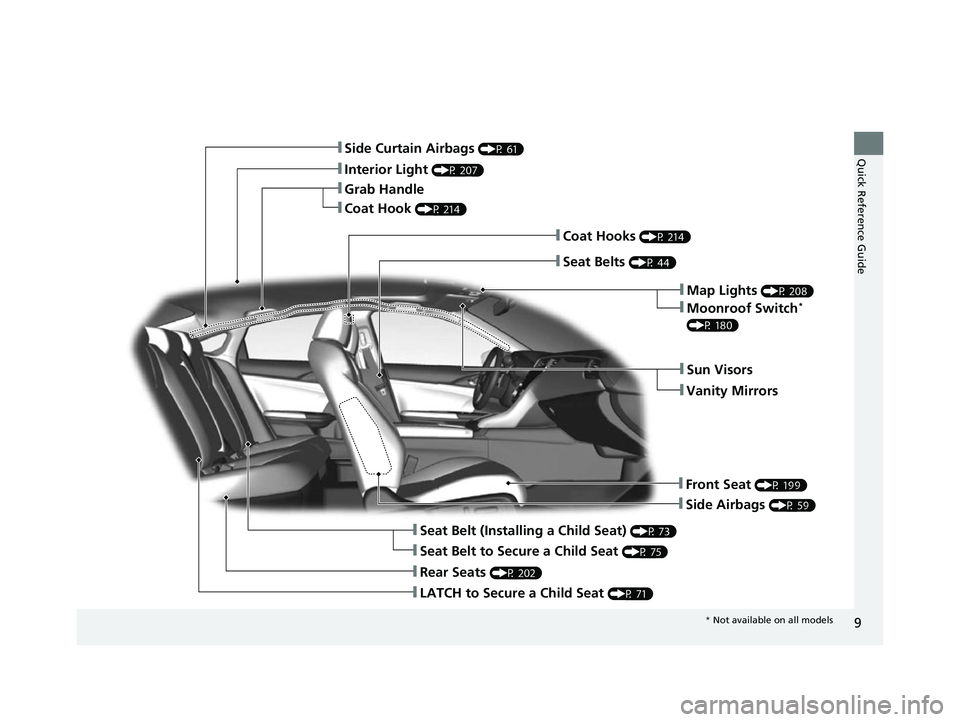
Quick Reference Guide❚Side Curtain Airbags (P 61)
❚Interior Light (P 207)
❚Grab Handle
❚Coat Hook (P 214)
❚Side Airbags (P 59)
❚Seat Belt (Installing a Child Seat) (P 73)
❚Seat Belt to Secure a Child Seat (P 75)
❚LATCH to Secure a Child Seat (P 71)
❚Rear Seats (P 202)
❚Seat Belts (P 44)
❚Coat Hooks (P 214)
❚Sun Visors
❚Vanity Mirrors
❚Front Seat (P 199)
❚Map Lights (P 208)
❚Moonroof Switch*
(P 180)
* Not available on all models
22 INSIGHT HMIN-31TXM6300.book 9 ページ 2021年2月24日 水曜日 午後3時45分
Page 21 of 609
20
Quick Reference Guide
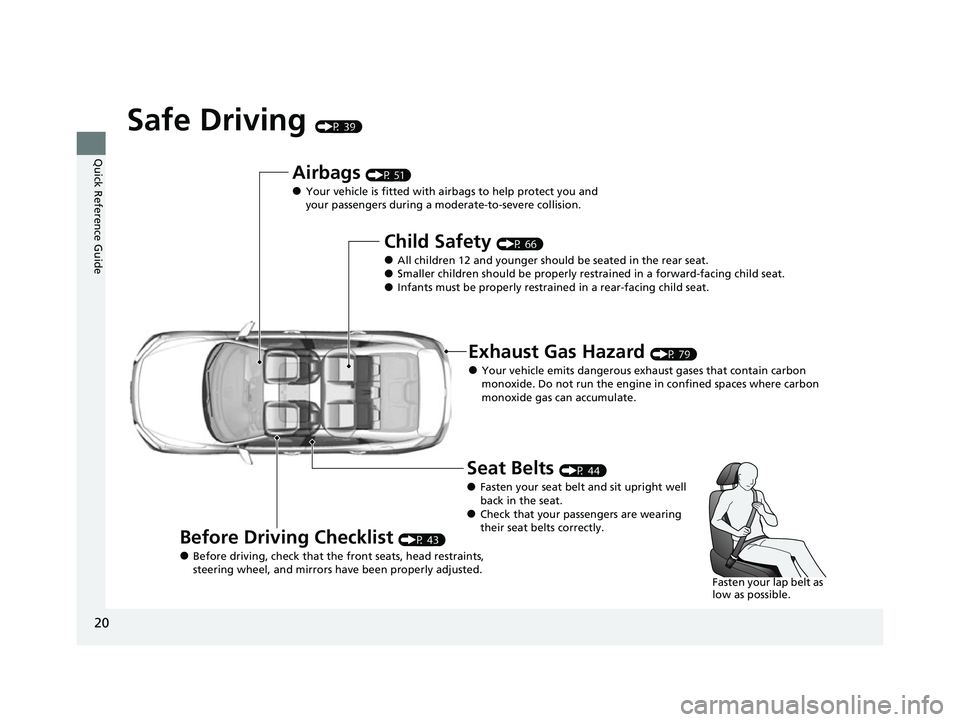
Safe Driving (P 39)
Airbags (P 51)
●Your vehicle is fitted with airbags to help protect you and
your passengers during a moderate-to-severe collision.
Child Safety (P 66)
●All children 12 and younger should be seated in the rear seat.●Smaller children should be properly restra ined in a forward-facing child seat.●Infants must be properly restrained in a rear-facing child seat.
Exhaust Gas Hazard (P 79)
●Your vehicle emits dangerous exhaust gases that contain carbon
monoxide. Do not run the engine in confined spaces where carbon
monoxide gas can accumulate.
Before Driving Checklist (P 43)
●Before driving, check that the front seats, head restraints,
steering wheel, and mirrors have been properly adjusted.
Seat Belts (P 44)
●Fasten your seat belt and sit upright well
back in the seat.
●Check that your passengers are wearing
their seat belts correctly.
Fasten your lap belt as
low as possible.
22 INSIGHT HMIN-31TXM6300.book 20 ページ 2021年2月24日 水曜日 午後3時45分
Page 40 of 609
39
Safe Driving
You can find many safety recommendations throughout this chapter, and throughout this manual.
For Safe Driving
Important Safety Precautions ............. 40
Your Vehicle’s Safety Features............ 42
Safety Checklist ................................. 43
Seat Belts About Your Seat Belts ........................ 44
Fastening a Seat Belt .......................... 47
Seat Belt Inspection............................ 50
Airbags Airbag System Components ............... 51
Types of Airbags ................................ 54
Front Airbags (SRS) ............................ 54 Side Airbags ...................................... 59
Side Curtain Airbags .......................... 61
Airbag System Indicators.................... 62
Airbag Care ....................................... 65
Child Safety Protecting Child Passengers ............... 66
Safety of Infants and Small Children.......68
Safety of Larger Children ................... 77
Exhaust Gas Hazard Carbon Monoxide Gas ....................... 79
Safety Labels Label Locations .................................. 80
22 INSIGHT HMIN-31TXM6300.book 39 ページ 2021年2月24日 水曜日 午後3時45分
Page 41 of 609
40
Safe Driving
For Safe Driving
The following pages explain your vehicle’s safety features and how to use them
properly. The safety precautions below are ones that we consider to be among the
most important.
Important Safety Precautions
■Always wear your seat belt
A seat belt is your best protection in all types of collisions. Airbags are designed to
supplement seat belts, not replace them. So even though your vehicle is equipped
with airbags, make sure you and your passengers always wear your seat belts, and
wear them properly.
■Restrain all children
Children ages 12 and under should ride prop erly restrained in a back seat, not the
front seat. Infants and small children should be restrained in a child seat. Larger
children should use a booster seat and a lap/shoulder seat belt until they can use the
belt properly without a booster seat.
■Be aware of airbag hazards
While airbags can save lives, they can cause serious or fatal injuries to occupants
who sit too close to them, or are not prop erly restrained. Infants, young children,
and short adults are at the greatest risk. Be sure to follow all instructions and
warnings in this manual.
■Don’t drink and drive
Alcohol and driving don’t mix. Even one dr ink can reduce your ability to respond to
changing conditions, and your reaction time gets worse with every additional drink.
So don’t drink and drive, and don’t let your friends drink and drive, either.
1Important Safety Precautions
Some states prohibit th e use of cell phones other
than hands-free de vices by the driver while driving.
22 INSIGHT HMIN-31TXM6300.book 40 ページ 2021年2月24日 水曜日 午後3時45分
Page 44 of 609
43
uuFor Safe Driving uSafety Checklist
Safe Driving
Safety Checklist
For the safety of you and your passengers, make a habit of checking these items
each time before you drive.
• After everyone has entered the vehicle, be sure all doors are closed and locked.
Locking the doors helps prevent an occupant from being ejected and an outsider
from unexpectedly opening a door.
2 Locking/Unlocking the Doors from the Inside P. 167
•Adjust your seat to a position suitable for driving. Be sure the front seats are
adjusted as far to the rear as possible while allowing the driver to control the
vehicle. Sitting too close to a front airbag can result in serious or fatal injury in a
crash.
2 Adjusting the Seats P. 199
•Adjust head restraints to the proper position. Head restraints are most effective
when the center of the head restraint alig ns with the center of your head. Taller
persons should adjust their head restraint to the highest position.
2 Adjusting the Front Head Restraint Positions P. 204
•Always wear your seat belt, and make sure you wear it properly. Confirm that any
passengers are properly belted as well.
2 Fastening a Seat Belt P. 47
•Protect children by using seat belts or child seats according to a child’s age, height
and weight.
2 Child Safety P. 66
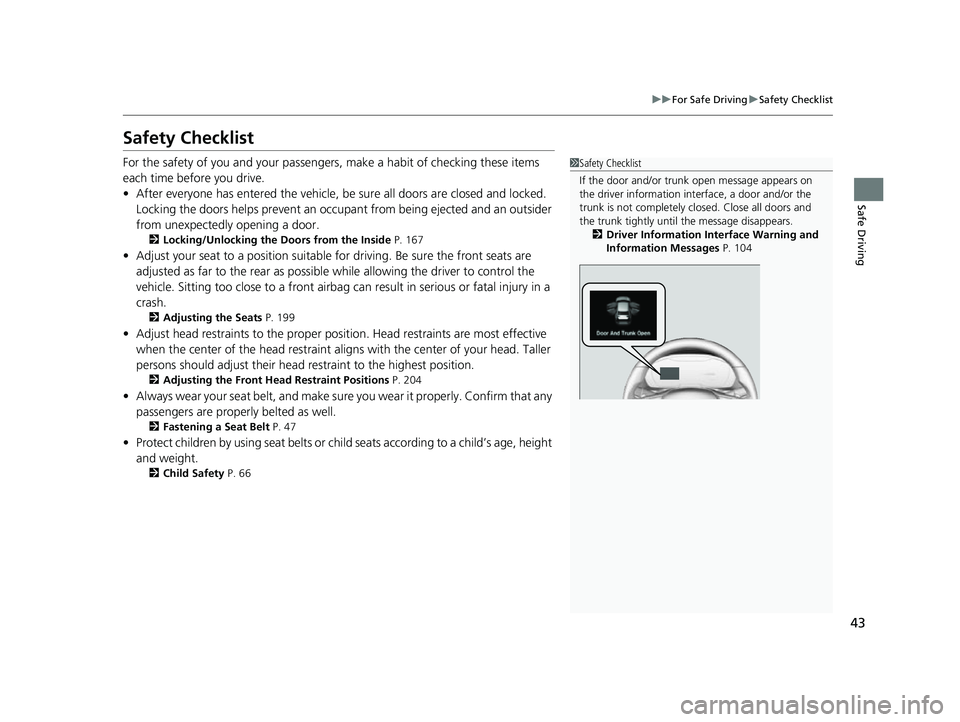
1Safety Checklist
If the door and/or trunk open message appears on
the driver information inte rface, a door and/or the
trunk is not completely cl osed. Close all doors and
the trunk tightly until the message disappears.
2 Driver Information Interface Warning and
Information Messages P. 104
22 INSIGHT HMIN-31TXM6300.book 43 ページ 2021年2月24日 水曜日 午後3時45分
Page 45 of 609
44
Safe Driving
Seat Belts
About Your Seat Belts
Seat belts are the single most effective safety device because they keep you
connected to the vehicle so that you can take advantage of many built-in safety
features. They also help keep you from being thrown against the inside of the
vehicle, against any passenger s, or out of the vehicle. When worn properly, seat
belts also keep your body properly positi oned in a crash so that you can take full
advantage of the additional prot ection provided by the airbags.
In addition, seat belts help protect you in almost every type of crash, including:
- frontal impacts
- side impacts
- rear impacts
- rollovers
■Lap/shoulder seat belts
All five seating positions are equipped with lap/shoulder seat belts with emergency
locking retractors. In normal driving, the re tractor lets you move freely while keeping
some tension on the belt. During a collis ion or sudden stop the retractor locks to
restrain your body.
The front passenger’s and rear seat belts al so have a lockable retractor for use with
child seats.
2 Installing a Child Seat with a Lap/Shoulder Seat Belt P. 73
1About Your Seat Belts
If a passenger moves around and extends the seat
belt, the lockable retractor may activate. If this
happens, release the retractor by unfastening the
seat belt and allow the belt to retract completely.
Then, refasten the belt.
If you extend the seat belt t oo quickly, it will lock in
place. If this happens, sli ghtly retract the seat belt,
then extend it slowly.
Seat belts cannot complete ly protect you in every
crash. But in most cases, seat belts can reduce your
risk of serious injury.
3WARNING
Not wearing a seat belt properly increases
the chance of serious injury or death in a
crash, even though your vehicle has
airbags.
Be sure you and your passengers always
wear seat belts and wear them properly.
22 INSIGHT HMIN-31TXM6300.book 44 ページ 2021年2月24日 水曜日 午後3時45分
Page 46 of 609
Continued45
uuSeat Belts uAbout Your Seat Belts
Safe Driving
■Proper use of seat belts
Follow these guidelines for proper use:
• All occupants should sit upright, well back in the seat, and remain in that position
for the duration of the trip. Slouching and leaning reduc e the effectiveness of the
belt and can increase the chance of serious injury in a crash.
• Never place the shoulder part of a lap/shoulder seat belt under your arm or
behind your back. This could cause very serious injuries in a crash.
• Two people should never use the same seat belt. If they do, they could be very
seriously injured in a crash.
• Do not put any accessories on the seat be lts. Devices intended to improve comfort
or reposition the shoulder part of a seat belt can reduce the protective capability
and increase the chance of serious injury in a crash.
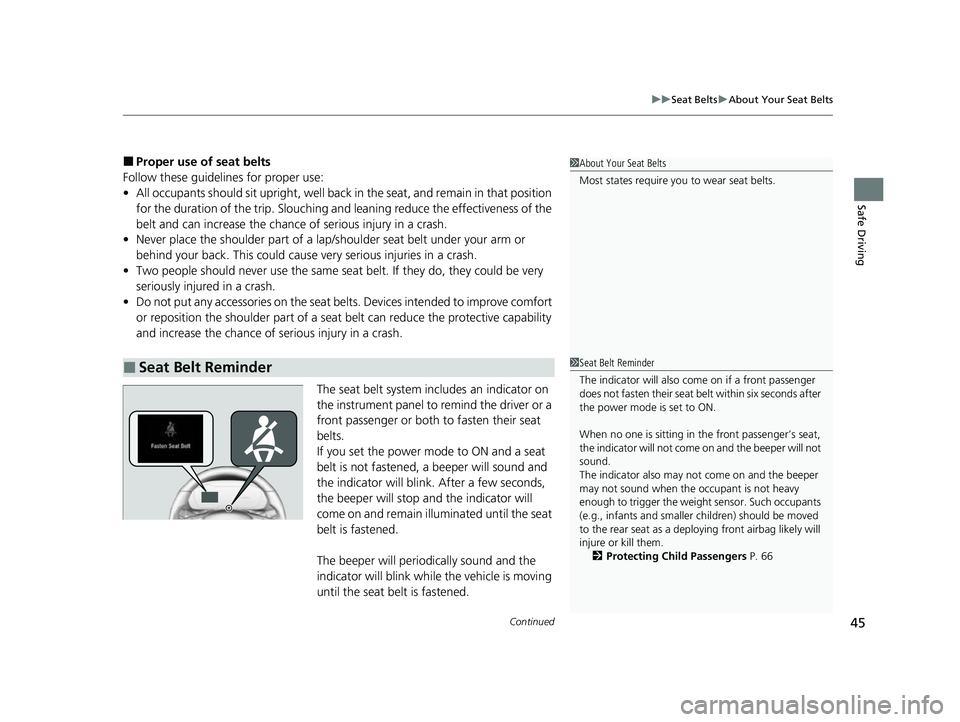
The seat belt system includes an indicator on
the instrument panel to remind the driver or a
front passenger or both to fasten their seat
belts.
If you set the power mode to ON and a seat
belt is not fastened, a beeper will sound and
the indicator will blink. After a few seconds,
the beeper will stop and the indicator will
come on and remain illuminated until the seat
belt is fastened.
The beeper will periodically sound and the
indicator will blink while the vehicle is moving
until the seat belt is fastened.
■Seat Belt Reminder
1About Your Seat Belts
Most states require you to wear seat belts.
1Seat Belt Reminder
The indicator will also co me on if a front passenger
does not fasten their seat belt within six seconds after
the power mode is set to ON.
When no one is sitting in th e front passenger’s seat,
the indicator will not come on and the beeper will not
sound.
The indicator also may no t come on and the beeper
may not sound when the occupant is not heavy
enough to trigger the weight sensor. Such occupants
(e.g., infants and smaller children) should be moved
to the rear seat as a deploying front airbag likely will
injure or kill them. 2 Protecting Child Passengers P. 66
22 INSIGHT HMIN-31TXM6300.book 45 ページ 2021年2月24日 水曜日 午後3時45分
Page 50 of 609
49
uuSeat Belts uFastening a Seat Belt
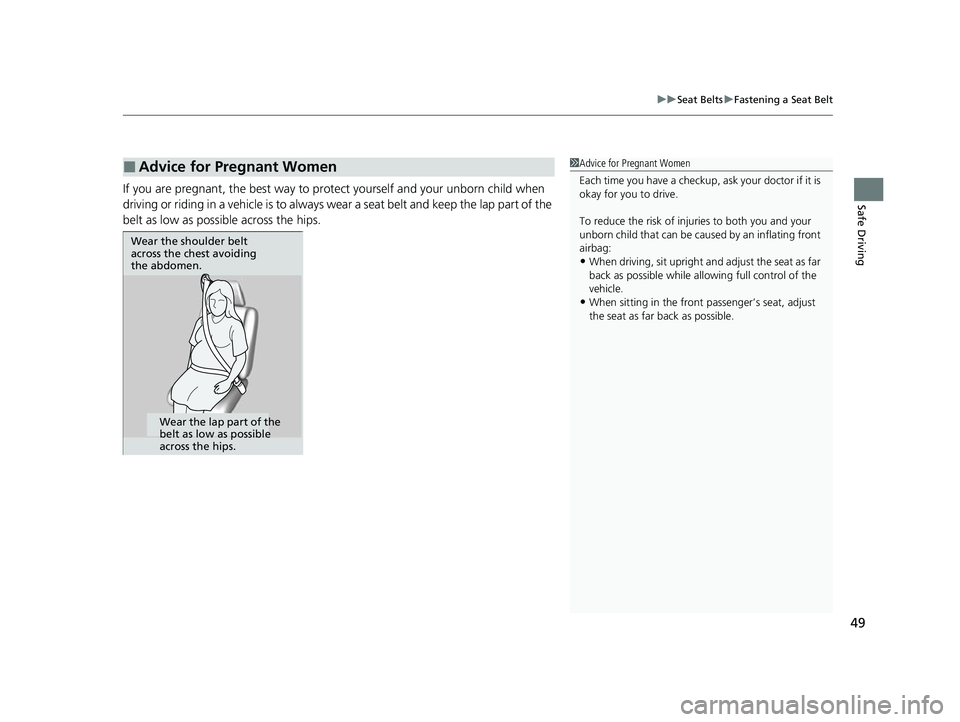
Safe DrivingIf you are pregnant, the best way to prot ect yourself and your unborn child when
driving or riding in a vehicle is to always wear a seat belt and keep the lap part of the
belt as low as possible across the hips.
■Advice for Pregnant Women1 Advice for Pregnant Women
Each time you have a checkup, ask your doctor if it is
okay for you to drive.
To reduce the risk of inju ries to both you and your
unborn child that can be caus ed by an inflating front
airbag:
•When driving, sit upright a nd adjust the seat as far
back as possible while allowing full control of the
vehicle.
•When sitting in the front passenger’s seat, adjust
the seat as far back as possible.
Wear the shoulder belt
across the chest avoiding
the abdomen.
Wear the lap part of the
belt as low as possible
across the hips.
22 INSIGHT HMIN-31TXM6300.book 49 ページ 2021年2月24日 水曜日 午後3時45分
Page 59 of 609
uuAirbags uFront Airbags (SRS)
58
Safe Driving
We advise against allowing a child age 12 or under to ride in the front passenger’s
seat. However, if you do allow a small child or infant to ride in the front passenger’s
seat, the system is designed to automatically deactivate the front passenger’s airbag.
Do not let a small child or infant ride in th e front passenger’s seat if the airbag does
not automatically deactivate.1 Advanced Airbags
•There is no child seat or other object pressing
against the rear of the seat or seat back.
•There is no rear passenger pushing or pulling on
the back of the front passenger’s seat.
•There are no objects placed under or beside the
front passenger’s seat . Improperly positioned
objects can interfere with the advanced airbag
sensors.
•The head restraint is not contacting the roof. 2Passenger Airbag Off Indicator P. 63
•The floor mat behind the front passenger’s seat is
set in the correct position evenly on the floor. An
improperly placed mat can interfere with the
advanced airbag sensors. 2Floor Mats P. 533
22 INSIGHT HMIN-31TXM6300.book 58 ページ 2021年2月24日 水曜日 午後3時45分
Page 64 of 609
Continued63
uuAirbags uAirbag System Indicators
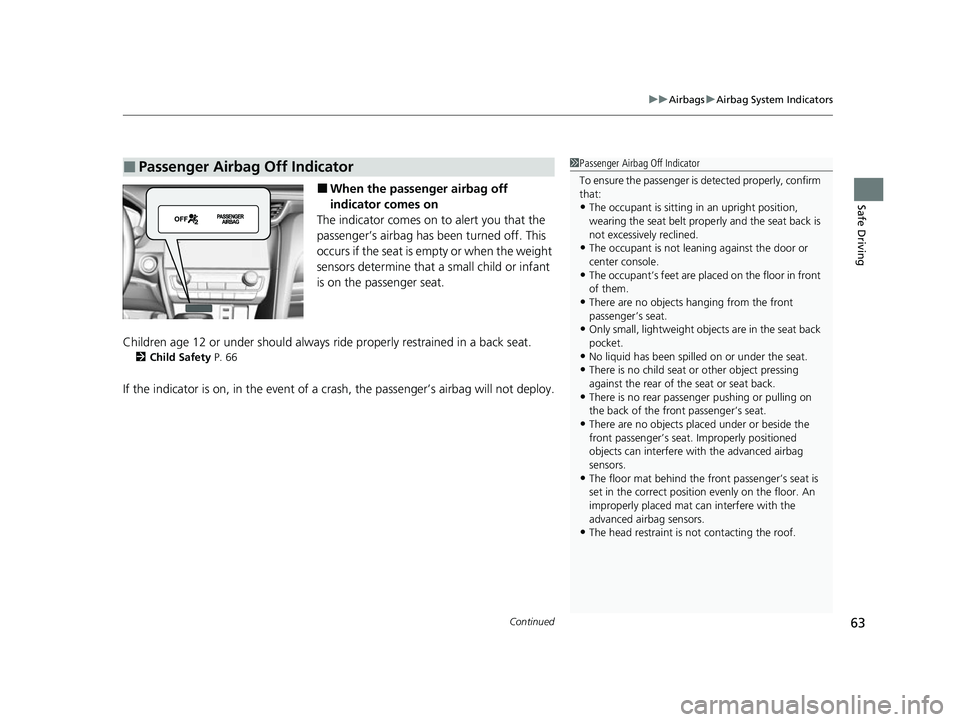
Safe Driving■When the passenger airbag off
indicator comes on
The indicator comes on to alert you that the
passenger’s airbag has be en turned off. This
occurs if the seat is em pty or when the weight
sensors determine that a small child or infant
is on the passenger seat.
Children age 12 or under shou ld always ride properly restrained in a back seat.
2Child Safety P. 66
If the indicator is on, in the event of a cr ash, the passenger’s airbag will not deploy.
■Passenger Airbag Off Indicator1Passenger Airbag Off Indicator
To ensure the passenger is detected properly, confirm
that:
•The occupant is sitting in an upright position,
wearing the seat belt prope rly and the seat back is
not excessively reclined.
•The occupant is not leaning against the door or
center console.
•The occupant’s feet are plac ed on the floor in front
of them.
•There are no objects ha nging from the front
passenger’s seat.
•Only small, lightweight objec ts are in the seat back
pocket.
•No liquid has been spille d on or under the seat.
•There is no child seat or other object pressing
against the rear of the seat or seat back.
•There is no rear passenger pushing or pulling on
the back of the front passenger’s seat.
•There are no objects placed under or beside the
front passenger’s seat . Improperly positioned
objects can interfere with the advanced airbag
sensors.
•The floor mat behind the front passenger’s seat is
set in the correct position evenly on the floor. An
improperly placed mat can interfere with the
advanced airbag sensors.
•The head restraint is not contacting the roof.
22 INSIGHT HMIN-31TXM6300.book 63 ページ 2021年2月24日 水曜日 午後3時45分