Oil pressure HONDA INTEGRA 1994 4.G Owner's Manual
[x] Cancel search | Manufacturer: HONDA, Model Year: 1994, Model line: INTEGRA, Model: HONDA INTEGRA 1994 4.GPages: 1413, PDF Size: 37.94 MB
Page 395 of 1413
The Automatic Transmission is a combination of a 3-e,ement torque convefter and triple-shaft electfonically controlled
automatic transmission which provides 4 speeds forward and 1 speed reverse. The entire unit is positioned in line with
the engine.
Torque Converter, Gears and Clutches
The torque converter consists of a pump, turbine and stator assembly in a single unit, The torque converter is connected
to the engine crankshaft so they turn together as a unit as the engine turns. Around the outside of the torque converter
is a ring gear which meshes with the starter pinion when the engine is being staned. The entire torque converter assem-
bly serves as a flywheel while transmitting power to the transmission mainshaft.
The transmission has three parallel shafts, the mainshaft. countershaft and sub-shaft. The mainshatt is in line with the
engine crankshaft.
The mainshaft includes the clutches for 1 st, and 2ndl4th, and gears for 3rd. 2nd, 4th, reverse and l st (3rd gear is in-
tegral with the mainshaft, while reverse gear is integral with the 4th gear).
The countershaft includes the 3rd clutch and gears Ior 3rd, 2nd,4th, reverse, lst and parking. Reverse and 4th gears
can be locked to the countershaft at its center, providing 4th gear or reverse, depending on which way the selector is moved.
The sub-shaft includes the lst-hold clutch and gears for 1st and 4th
The gears on the mainshait are in constant mesh with those on the countershaft and sub-shaft. When certain combina-
tions of gears in the transmission are engaged by the clutches, power is transmitted from the mainshaft to the counter-
shaft via the sub-shatt to provide @, E, tr. tr and @ position.
Electronic Control
The electronic control system consists of the Transmission Control Module {TCM), sensors, and 4 solenoid valves. Shift-
ing and lock-up are electronically controlled for comfortable driving under all conditions.
The TCM is located below the dashboard, behind the left side kick panel on the driver's side.
Hydraulic Control
The valve bodies include the main valve body, secondary valve body, regulator valve body. servo body, and lock-up valve
body throuqh the respective separator plates.
They are bolted on the torque converter housing.
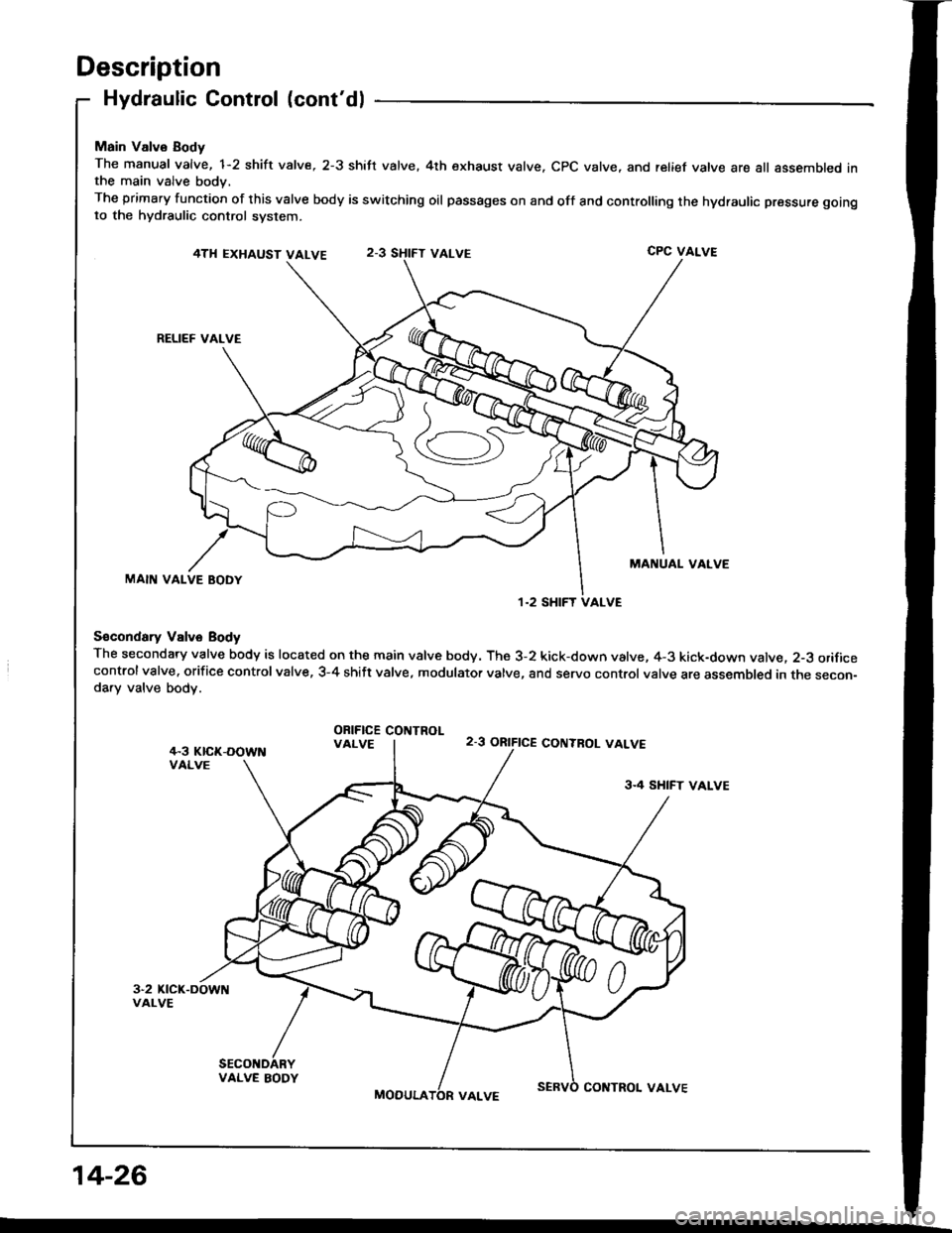
The main valve body contains the manual valve, 1-2 shift valve, 2-3 shift valve, Clutch Pressure Cont.ol (CPC) valve,
4th exhaust valve, relief valve, and oil pump gears.
The secondary valve body contains the 4-3 kick-down valve,3-2 kick-down valve,2-3 orifice cont.ol valve, 3-4 shitt
valve, orifice control valve. modulator valve, and servo control valve
The regulator valve body contains the pressure regulator valve. lock-up control valve, torque converter check valve, and
cooler check valve.
The servo bodv contains the servo valve which is integrated with the reverse shift fork, throttle valve B, and accumulators.
The lock-ug valve bodv contains the lock-up shift valve and lock-up timing B valve. and is bolted on the secondary valve
body.
Fluid from the regulator passes through the manual valve to the various control valves.
Shitt Control Mochanism
Input to the TCM i.om various sensors located throughout the car determines which shift control solenoid valve should
be activated.
Activating a shift control solenoid valve changes modulator pressure, causing a shift valve to move. This pressurizes
a line to one of the clutches. engaging that clutch and its corresponding gear.
Lock-up Mechanism
In @ position. in 2nd, 3rd and 4th, and E position in 3rd, pressurized tluid can be drained from the back of the tor-
que converter through an oil passage, causing the lock-up piston to be held against the torque converter cover. As this
takes Dlace, the mainshaft rotates at the same speed as the engine crankshatt. Together with hydraulic control, the TCM
optimizes the timing ol the lock-up mechanism.
The lock-up valves control the range of lock-up according to lock-up control solenoid valves A and B, and throttle valve B
When lock-up control solenoid valves A and B activate, modulator pressure changes. Lock-up control solenoid valves
A and B are mounted on the torque converter housing, and are controlled by the TCM.
(cont'd)
14-3
Page 398 of 1413
Description
Clutches
The four speed automatic transmission uses hydraulically actuated clutches to engage or disengage the transmission gears.
When clutch pressure is introduced into the clutch drum, the clutch piston is applied. This presses the iriction discs and
steel plates together, locking them so they don't slip. Power is then transmitted through the engaged clutch pack tojts hub-mounted gear.
Likewise, when clutch pressure is bled from the clutch pack. the piston releases the friction discs and steel plates, and
they are {ree to slide past each other while disengaged. This allows the gear to spin independently on its shaft, transmit-
ting no power.
1st ClutchThe l st clutch engages/disengages 1st gear, and is located at the end of the mainshaft, just behind the right side cover.
The 1st clutch is supplied clutch pressure by its oil feed pipe within the mainshaft.
1st-hold clutchThe 1st-hold clutch engages/disengages 1st-hold or I Fosition, and is located at the center ol the sub-shaft. The 1st-
hold clutch is supplied clulch pressure by its oil feed pipe within the sub-shait.
2nd ClutchThe 2nd clutch engages/disengages 2nd gear, and is located at the center of the mainshaft. The 2nd clutch is joined
back-to-back to the 4th clutch. The 2nd clutch is supplied clutch pressure through the mainshaft by a circuit connected
to the regulator valve body.
3rd Clutch
The 3rd clutch engages/disengages 3rd gea.. and is located at the end oJ the countershaft, opposite the right side cover.
The 3rd clutch is supplied clutch pressure by its oil feed pipe within the countershaft,
4th clurch
The 4th clutch engages/disengages 4th gear. as well as reverse gear, and is located at the center of the mainshaft.
The 4th clutch is joined back-to-back to the 2nd clutch. The 4th clutch is supplied clutch pressure by its oil feed pipe
within the mainshalt.
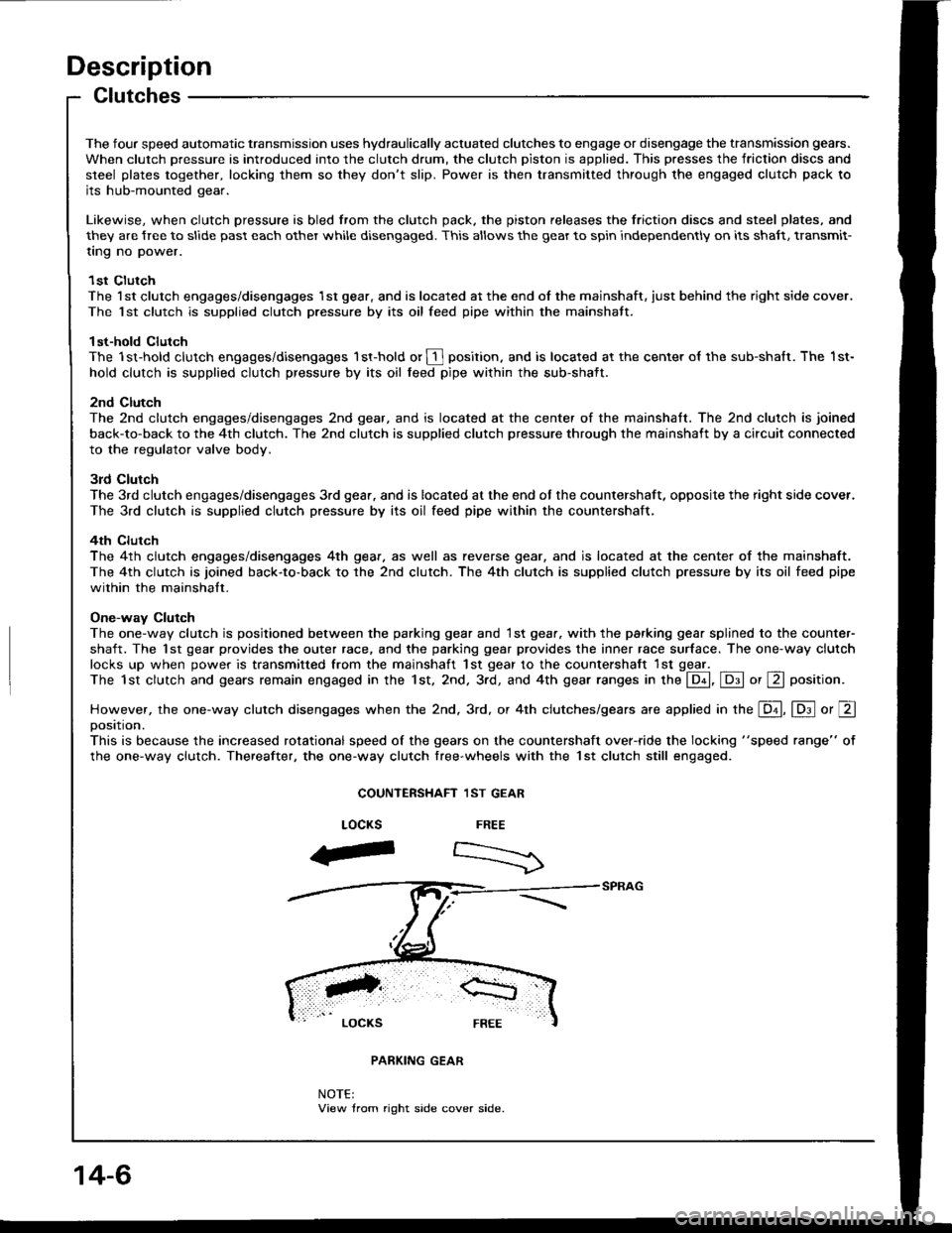
One-way Clutch
The one-way clutch is posjtioned between the parking gear and 1st gear. with the parking gear splined to the counter-
shaft. The 1st gear provides the outer race, and the parking gear provides the inner race surface. The one-way clutch
locks up when power is transmitted from the mainshaft 1st gear to the countershaft lst ggel _The 1st clutch and gears remain engaged in the 1st. 2nd. 3rd, and 4th gear ranges in the @, E or E position.
However, the one-way clutch disengages when the 2nd. 3rd, or 4th clutches/gears are applied in the E, lD.l o, Eoosttton.
This is because the increased rotational speed of the gears on the countershaft over-ride the locking "speed range" of
the one-way clutch. Thereafter, the one-way clutch free-wheels with the lst clutch still engaged.
COUNTERSHAFT 1ST GEAR
FREE
:>
LOCKS
aF
NOTE:View trom right side cover side.
14-6
Page 415 of 1413
Hydraulic Control
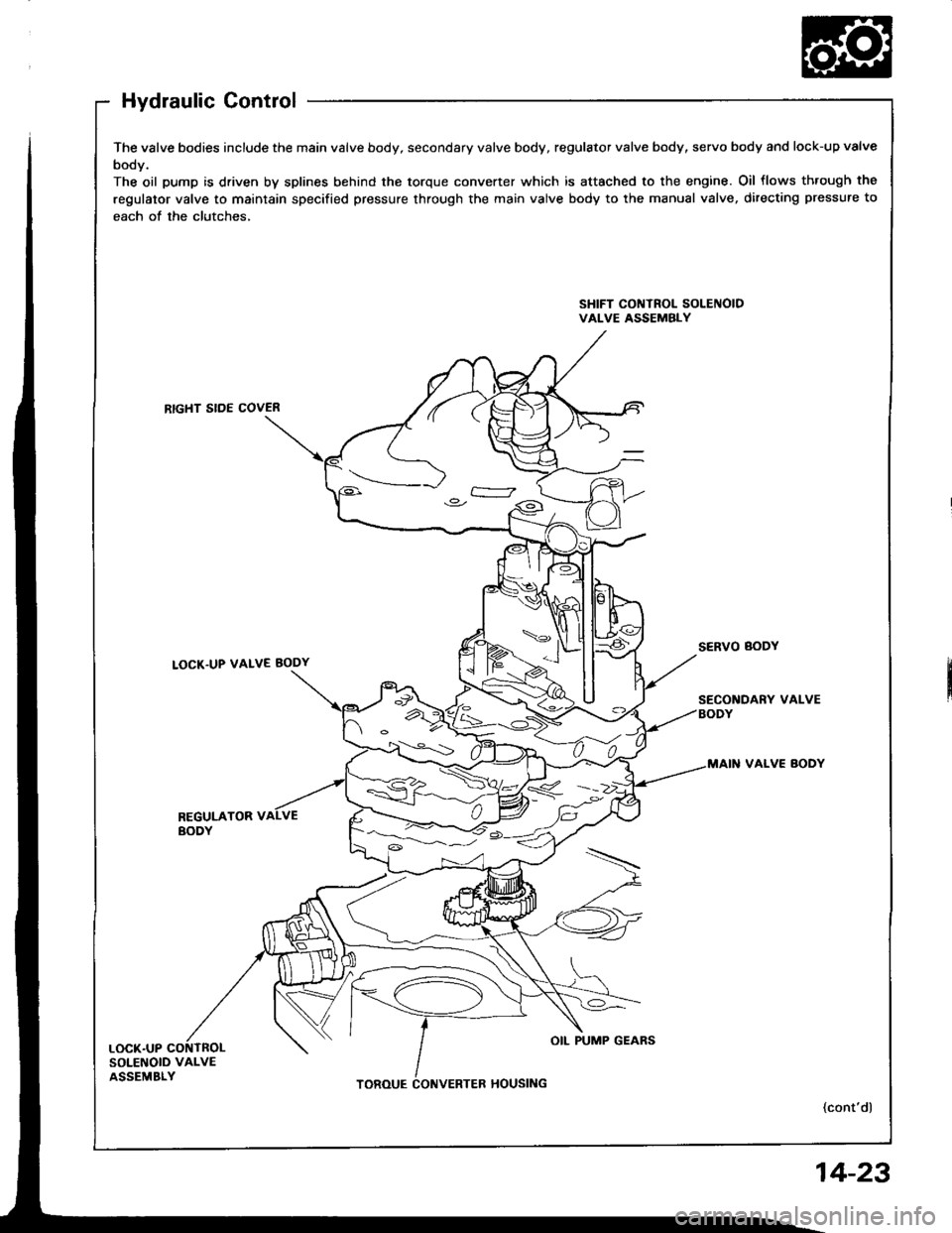
The valve bodies include the main valve body, secondary valve body, regulator valve body, servo body and lock-up valve
body.
The oil pump is driven by splines behind the torque converter which is attached to the engine. Oil flows th.ough the
regulator valve to maintain specified pressure through the main valve body to the manual valve, directing pressure to
each of the clutches,
SHIFT CONTROL SOLEIIOIDVALVE ASSEMBLY
RTGHT SIDE COVER
LOCK.UP VALVE BODY
VALVE BODY
REGULATOR VBODY
SOLENOID VALVEASSEMBLY
4<.__i: )o.-
OIL PUMP GEARS
14-23
Page 417 of 1413
Rcgulator Valve
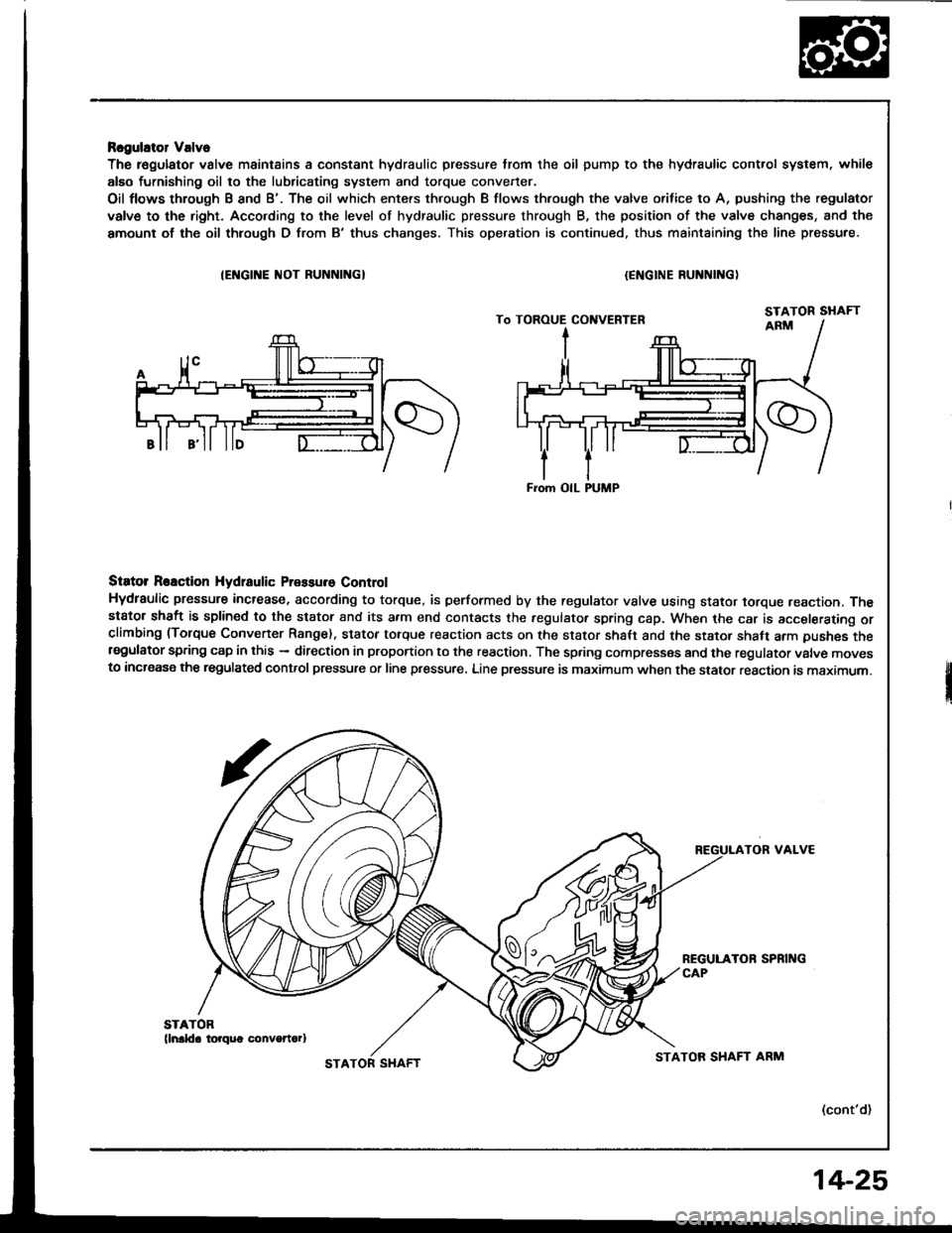
The r€gulator valve maintains a constant hydraulic pressure from the oil pump to the hydraulic control system, whil€
alEo furnishing oil to the lubricating system and torque convener.
Oil flows through B and B'. The oil which enters through B flows thfough the valve orifice to A, pushing the regulator
valve to the right. Acco.ding to the level of hydraulic pressure through B, the position of the valve changes, and the
amount of the oil thlough D from B'thus changes. This operation is continued. thus maintaining the line pressure.
IEI{GINE ]IIOT RUNNINGI{ENGINE RUNNING)
Siator Reaction Hydtaulic Pressure Control
Hydraulic pressure increase, according to torque, is performed by the regulator vslve using stator torque reaction. Thestator shaft is splined to the stator and its a.m end contacts the fegulator spring cap. When the car is accelerating orclimbing (Torque Convener Range). stator torque reaction acts on the stator shalt and the stator shaft arm pushes thersgulator spring cap in this - direction in proportion to the reaction. The spring compresses and the regulator valve movesto increase the regulated control pressure or line pressure. Line pressure is maximum when the stator reaction is maximum.
TOR VALVE
(cont'd)
From OIL PUMP
STATOR SHAFTSTATOR SHAFT ARM
14-25
Page 418 of 1413
Description
Hydraulic Control (cont'dl
Main Valvo Body
The manual valve, 1-2 shift valve, 2-3 shift valve. 4th exhaust valve. CPC valve, and relief vatve are all assembled inthe main valve body,
The primary function of this valve body is switching oil passages on and off and controlling the hydraulic pressure gotngto the hydraulic control system.
4TH EXHAUST VALVECPC VALVE
RELIEF VALVE
MANUAL VALVEMAIN VALVE BODY
S€condary Vslve Body
The secondary valve body is located on the main valve body. The 3-2 kick-down valve, 4-3 kick-down valve. 2-3 orificecontrolvalve. orifice controlvalve, 3-4 shift valve, modulator valve, and servo control valve are assembled in the secon-da.y valve body.
ORIFICE COIITROLVALVE2-3 ORIFICE CONTBOL VALVE
3.4 SHIFT VALVE
VALVE BODY
MOOULACOITTROL VALVE
1.2 SHIFT VALVE
14-26
Page 420 of 1413
![HONDA INTEGRA 1994 4.G Owners Manual Description
Genelal Chart ol Hydraulic Pressure
Hydraulic Flow
. Regulator Valve
. Manual Valve
. Modulator Valve
. 1-2 Shilt Valve l. 2-3 Shitt Valve. 3 4 Shift Vlave ]
. Throttle Valve B
Oil Pump -](/img/13/6067/w960_6067-419.png "HONDA INTEGRA 1994 4.G Owners Manual Description
Genelal Chart ol Hydraulic Pressure
Hydraulic Flow
. Regulator Valve
. Manual Valve
. Modulator Valve
. 1-2 Shilt Valve l. 2-3 Shitt Valve. 3 4 Shift Vlave ]
. Throttle Valve B
Oil Pump -")
Description
Genelal Chart ol Hydraulic Pressure
Hydraulic Flow
. Regulator Valve
. Manual Valve
. Modulator Valve
. 1-2 Shilt Valve l. 2-3 Shitt Valve. 3 4 Shift Vlave ]
. Throttle Valve B
Oil Pump - Regulator Valve -
Distribution ot Hydraulic Pressure
Line Pressure
Torque Converter Pressure
Lubrication Pressure
-,.Ltne rressure
] Torque Converter Pressure
L Lubrication Pressure
To Select Line Pressure
Modulator Pressure
Clutch Pressure
Throttle B Pressure
NO.DESCRIPTION OF PRESSURENO.DESCRIPTION OF PRESSURENO.DESCRIPTION OF PRESSURE
ILIN E6CMODULATOR
ITOCK-UP CONTROL SOLENOID VATVE AI55THROTTLE B
2LIN E6DMODULATOR(IOCX.UP CONTROT SOTENOID VALVE B)56THROTTLE B
3LIN E9LIN E57THROTTLE B
3'LINE10l ST CLUTCH58THROTTLE B
3"LINE1ST-HOLD CLUTCH90TOROUE CONVERTER
4LIN EIt)l ST.HOLD CLUTCH91TOROUE CONVERTER
LIN E18LINE92TOROUE CONVERTER
5LIN E202ND CLUTCH93OIL COOLER
5'LIN E212ND CLUTCH94TOROUE CONVERTER
5"LIN E25LIN E95LUBRICATION
6MODULATOR303RD CLUTCH96TOROUE CONVERTER
6'MODULATOR313RD CLUTCH97TOROUE CONVERTER
6AMODULATOR(SHIFT CONTROL SOTENOID VALVE A404TH CLUTCH99SUCTION
6BMODULATOR(SHIFT CONTROL SOLENOID VALVE B414TH CLUTCHBLEED
14-28
Page 421 of 1413
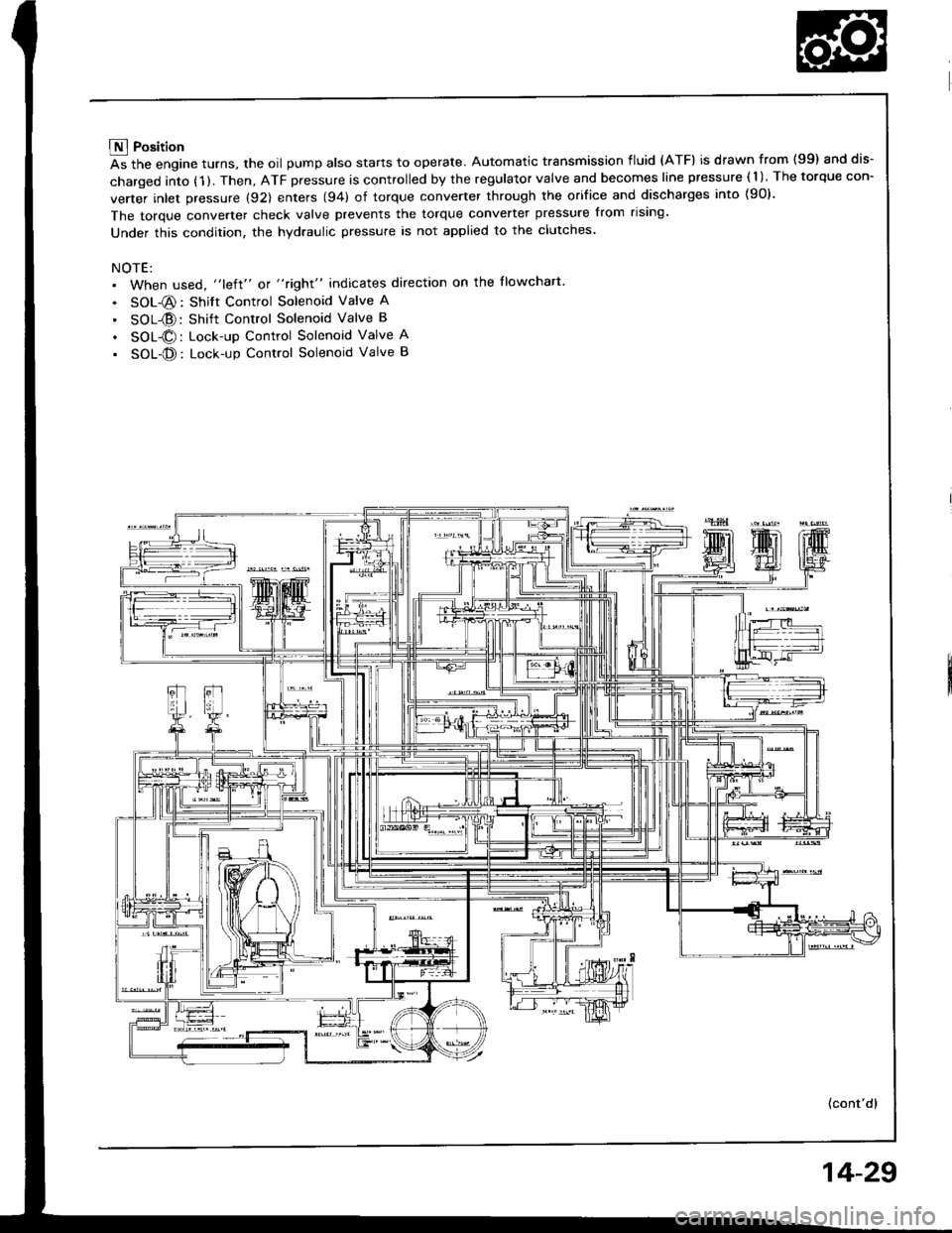
E Position
As the engine turns, the oil pump also starts to operate. Automatic transmission fluid (ATF) is drawn from (99) and dis-
charged into (1 ). Then, ATF pressure is controlled by the regulator valve and becomes line pressure ( 1 ). The torque con-
verter inlet pressure (92) enters (94) of torque converter through the orifice and discharges into {90}.
The torque converter check valve prevents the torque converter pressure from rising'
Under this condition, the hydraulic pressure is not applied to the clutches.
NOTE:. When used, "left" or "right" indicates direction on the llowchart
. SOL-@: Shift Control Solenoid Valve A
' SOL{D:Shift Control Solenoid Valve B
. SOL@: Lock-up Control Solenoid Valve A
. SOL-@: Lock-up Control Solenoid Valve B
(cont'd)
14-29
Page 426 of 1413
Description
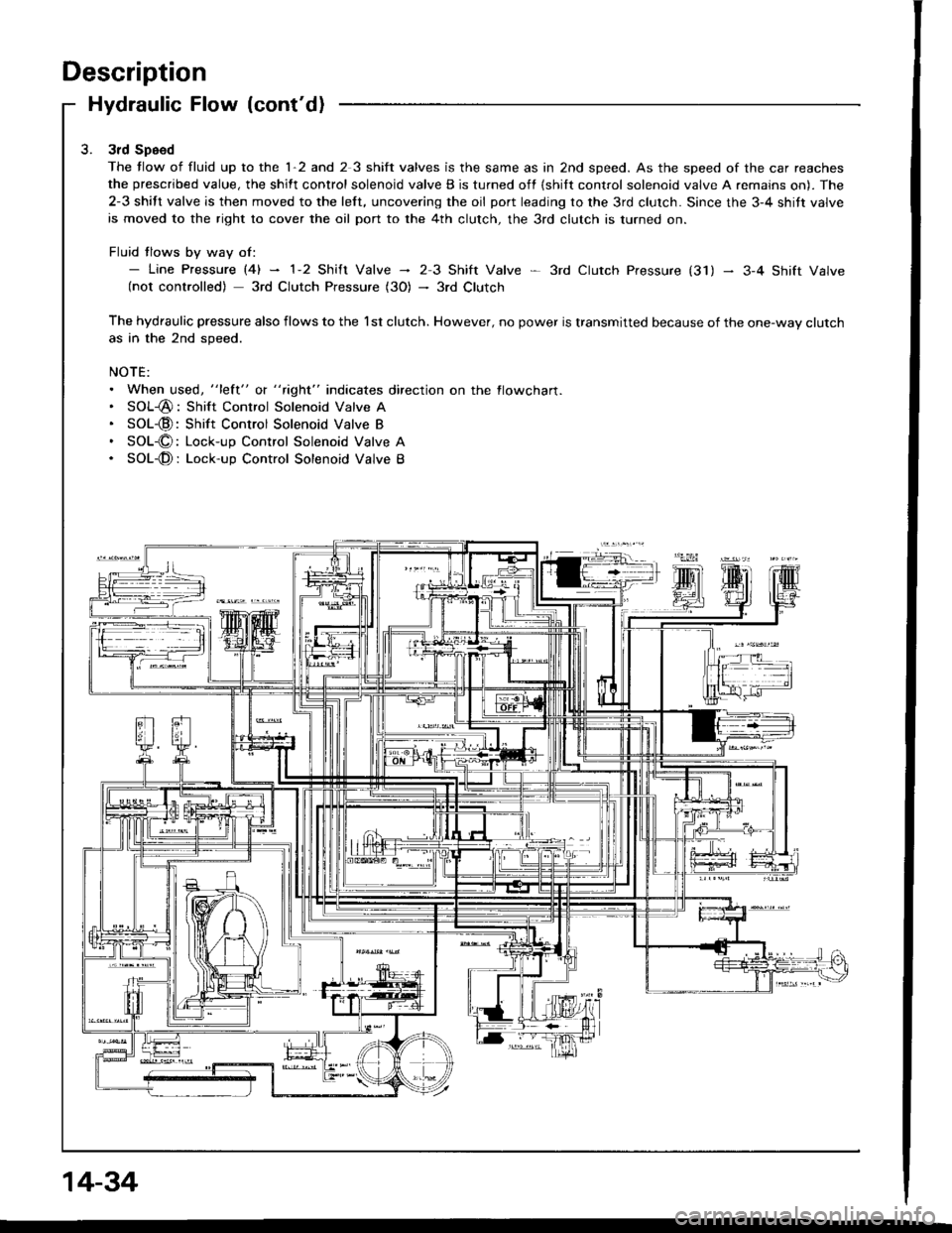
Hydraulic Flow (cont'd)
3rd Speed
The tlow of fluid up to the 1-2 and 2 3 shift valves is the same as in 2nd speed. As the speed of the car reaches
the prescribed value, the shift control solenoid valve B is turned off {shilt control solenoid valve A remains on). The
2-3 shift valve is then moved to the left, uncovering the oil port leading to the 3rd clutch. Since the 3-4 shitt valve
is moved to the right to cover the oil port to the 4th clutch, the 3rd clutch is turned on.
Fluid tlows by way of:- Line pressure l4l - 1-2 shift valve - 23 Shift Valve * 3rd ctutch pressure (31) - 3-4 shift valve(not controlled) 3rd Clutch Pressure (3O) - 3rd Clutch
The hydraulic pressure also flows to the l st clutch. However, no power is transmitted because of the one-way clutchas in the 2nd speed.
NOTE:. When used, "lett" o( " tight" indicates direction on the flowcharl.. SOL-@: Shift Control Solenoid Valve A. SOL-@:Shift Control Solenoid Valve B. SOL-O: Lock-up Control Solenoid Valve A. SOL-@: Lock-up Control Solenoid Valve B
14-34
Page 427 of 1413
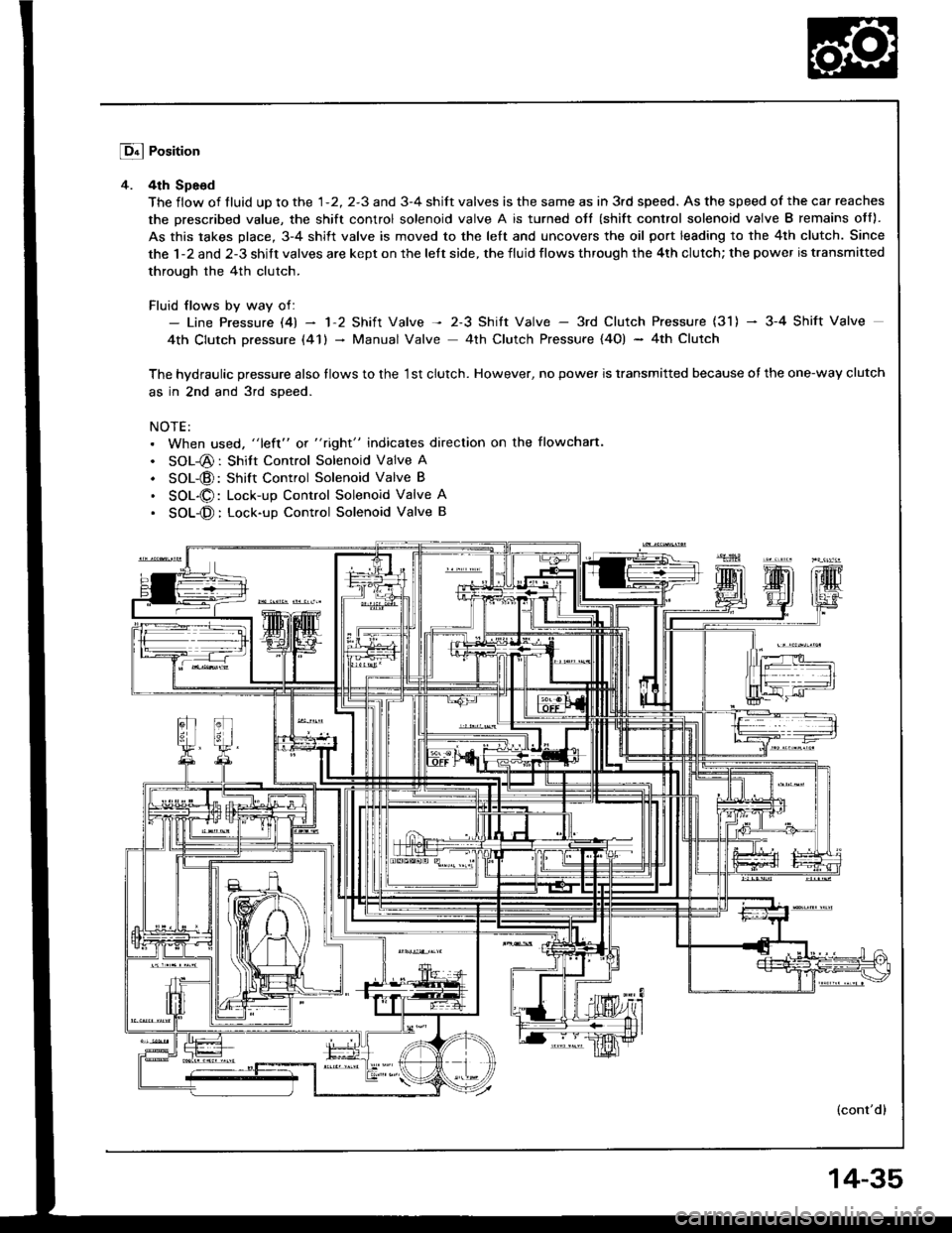
Lq4 Position
4. 4th Spe6d
The flow of tluid up to the 1-2, 2-3 and 3-4 shift valves is the same as in 3rd speed. As the speed of the car reaches
the prescribed value, the shift control solenoid valve A is turned oJt (shift control solenoid valve B remains off).
As this takes place, 3-4 shift valve is moved to the left and uncovers the oil port leading to the 4th clutch. Since
the 1-2 and 2-3 shift valves are kept on the left side, the fluid flows through the 4th clutch; the power is transmitted
through the 4th clutch.
Fluid flows by way of:- Line Pressure l4l - 'l'2 Shift Valve -t 2-3 Shitt Valve - 3rd Clutch Pressure (31) - 3-4 Shift Valve
4th Clutch pressure (41) - Manual Valve 4th Clutch Pressure {4O) - 4th Clutch
The hvdraulic pressure also tlows to the '1st clutch. However, no power is transmitted because of the one-way clutch
as in 2nd and 3rd soeed.
NOTE:. When used, "left" or "right" indicates direction on the flowchan.
. SOL-@: Shitt Control Solenoid Valve A
. SOL-@: Shift Control Solenoid Valve B
. SOL-O: Lock-up Control Solenoid Valve A
. SOL-@: Lock-up Conttol Solenoid Valve B
(cont'dl
14-35
Page 428 of 1413
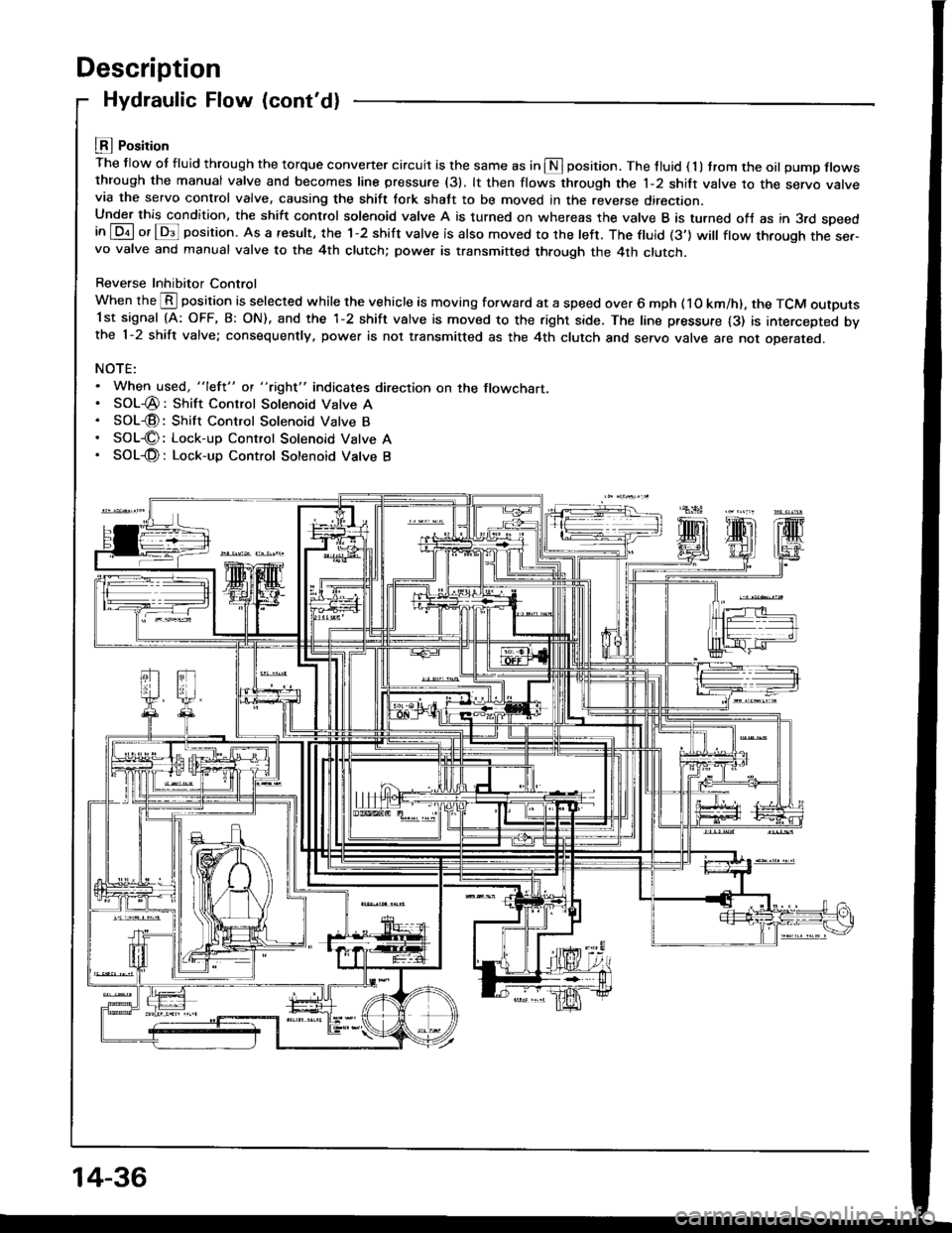
Description
Hydraulic Flow (cont'd)
LEI Position
The flow ot fluid through the torque convener circuit is the same as in S position. The tluid ( 1 ) trom the oil pump flowsthrough the manual valve and becomes line pressure (31. lt then flows through the 1-2 shift valve to the servo varvevia the servo control valve, causing the shift tork shatt to be moved in the reverse direction.Under this condition, the shift control solenoid valve A is turned on whereas the valve B is turned ofJ as in 3rd speedin [Dil or lDs]l position. As a result, the 1-2 shift valve is also moved to the left. The ftuid (3'] will ftow through the ser-vo valve and manual valve to the 4th clutch; power is transmitted through the 4th clutch.
Reverse Inhibitor Control
When the @ position is selected while the vehicle is moving forward at a speed over 6 mph ( 1O km/h). the TCM outputs1st signal (A: OFF, B: ON), and the 1-2 shift valve is moved to the right side. The line pressure {3) is intercepted bvthe 1-2 shift valve; consequently, power is not transmitted as the 4th clutch and servo valve are not oDerareo.
NOTE:. When used, "lefl" ot "tight" indicates direction on the flowchart.. SOL-@: Shift Control Solenoid Valve A. SOL€: Shift Control Solenoid Valve B. SOL€: Lock-up Control Solenoid Vatve A. SOL-@: Lock-up Control Sotenoid Vatve B
14-36