emission HONDA INTEGRA 1994 4.G Owner's Manual
[x] Cancel search | Manufacturer: HONDA, Model Year: 1994, Model line: INTEGRA, Model: HONDA INTEGRA 1994 4.GPages: 1413, PDF Size: 37.94 MB
Page 309 of 1413
lntake Air System
Throttle Body
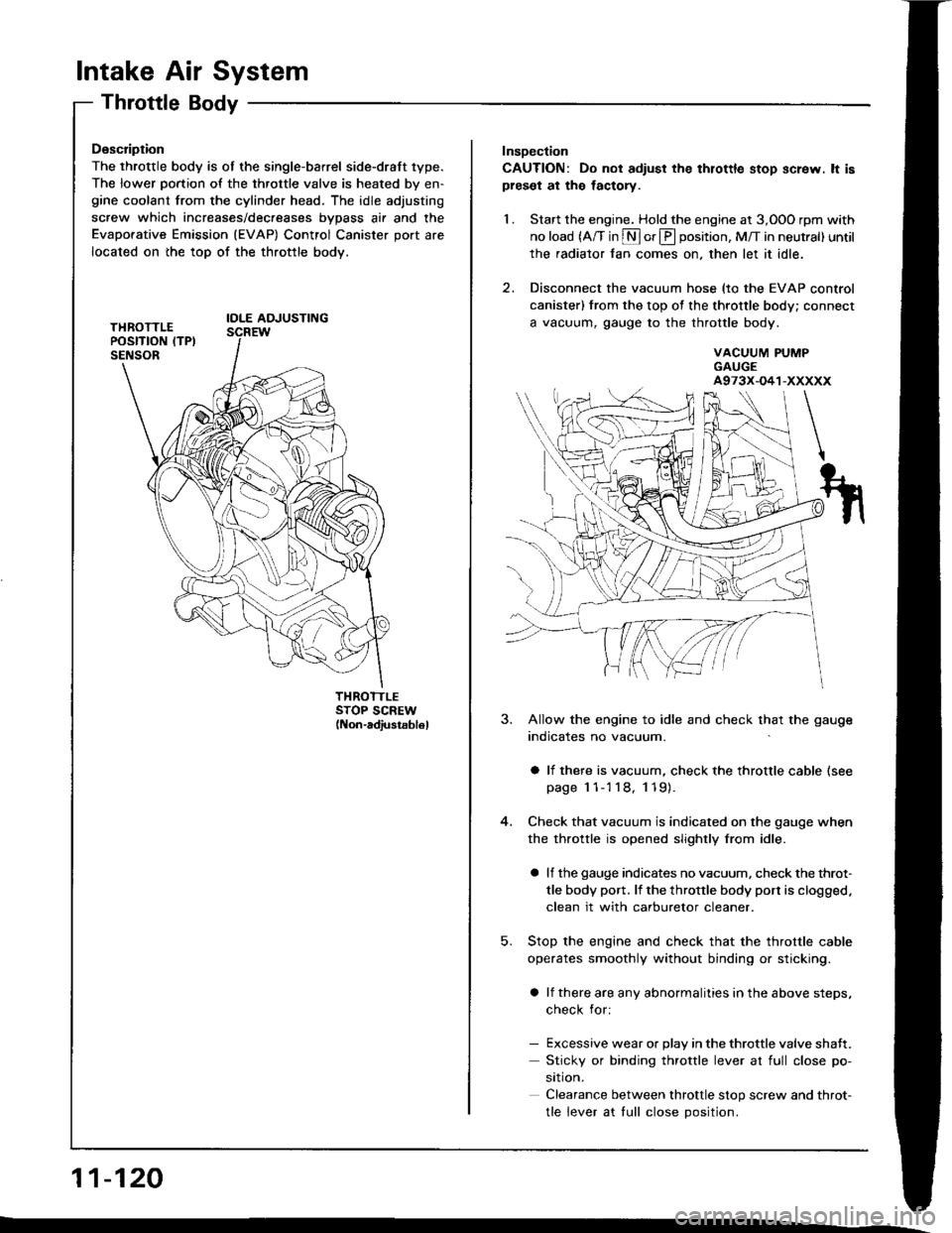
Description
The throttle body is ot the single-barrel side-draft 1ype.
The lower portion of the throttle valve is heated by en-gine coolant from the cylinder head. The idle adjusting
screw which increases/dec.eases bvDass air and the
Evaporative Emission (EVAP) Control Canister port are
located on the top of the throttle body.
IOLE AOJUSTING
THROTTLESTOP SCREW(Non-adiustsb16l
11-120
Insoection
CAUTION: Do not adiust the thlottle stop screw. lt ispreset at the lactory.
1. Start the engine. Hold the engine at 3,OOO rpm with
no load (A/T in S or E position, M/T in neutral) until
the radiator fan comes on, then let it idle.
2. Disconnect the vacuum hose (to the EVAP control
canister) from the top of the throttle body; connect
a vacuum, gauge to the throttle body.
VACUUM PUMPGAUGEA973X-O41-XXXXX
5.
3. Allow the engine to idle and check that the gauge
indicates no vacuum.
a li there is vacuum, check the throttle cable (see
page 1 1-'l 18, 119).
Check that vacuum is indicated on the gauge when
the throttle is opened slightly from idle.
a lf the gauge indicates no vacuum, check the throt-
tle body port. lf the throttle body port is clogged.
clean it with carburetor cleaner.
Stop the engine and check that the throttle cable
operates smoothly without binding or sticking.
a lf there are any abnormalities in the above steps,
check for:
- Excessive wear or Dlav in the throttle valve shaft.
Sticky or binding throttle lever at full close po-
srtron.
Clearance between throttle stop screw and throt-
tle lever at tull close Dosition.
Page 318 of 1413
Emission Control System
System Troubleshooting Guide
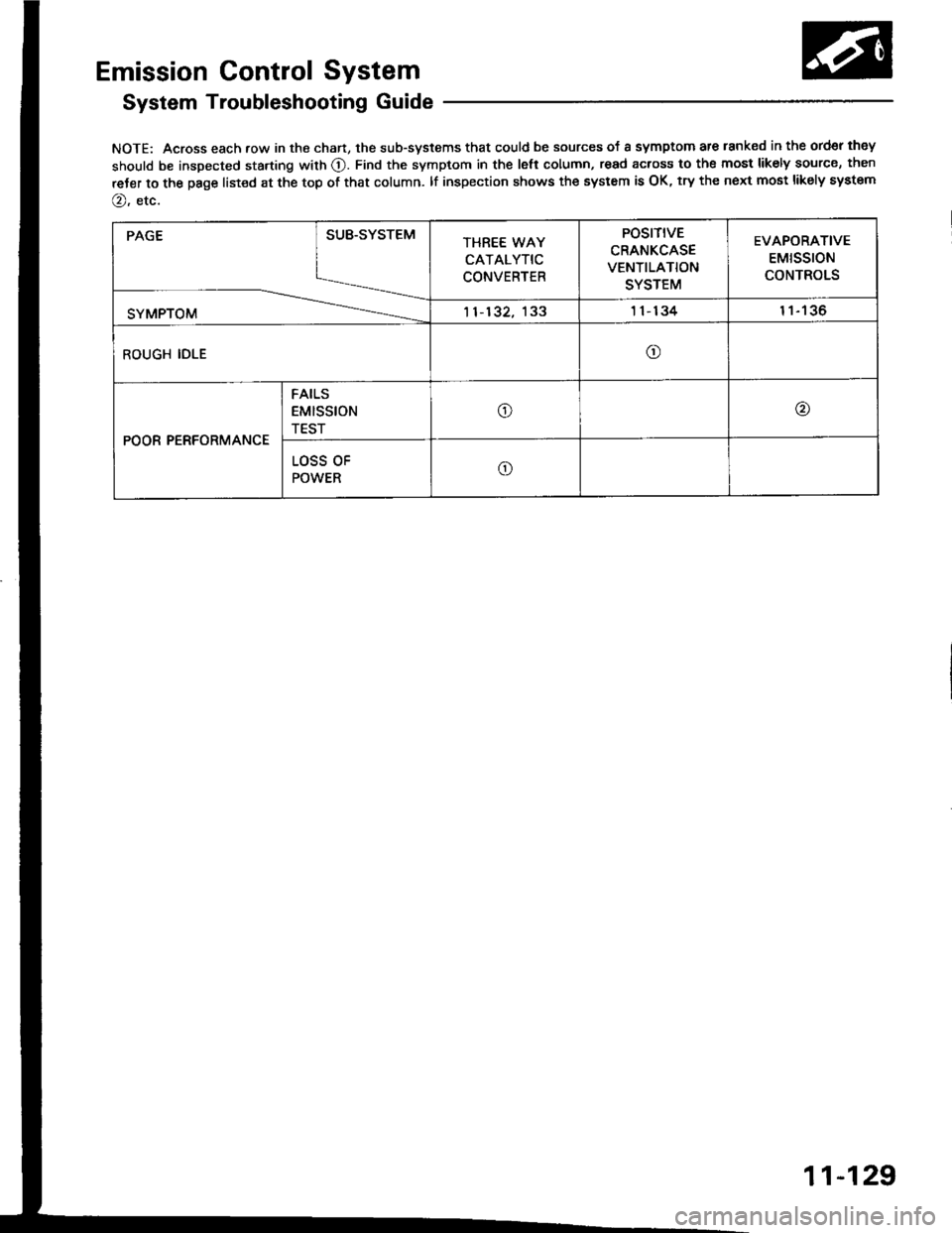
NOTE: Across each row in the chart, the sub-systems that could be sources of a symptom are lanked in the ord€r they
should be inspected starting with O. Find the symptom in the lett column, read across to the most likely source, then
reJer to the page list€d at the top of that column. lf inspection shows the system is OK, try the next most likely system
@, etc.
PAGE
SYMPTOM
SUB.SYSTEMTHREE WAY
CATALYTIC
CONVERTER
POSITIVE
CRANKCASE
VENTILATION
SYSTEM
EVAPORATIVE
EMtSSTON
CONTROLS
11-132, 1331 1- 13411tJo
ROUGH IDLEo
POOR PERFORMANCE
FAILS
EMISStON
TEST
o@
LOSS OF
POWERo
11-129
Page 319 of 1413
Emission Control System
SystemDescription
The emission control system includes a Three Way Cata-
lytic Convener (TWC), Positive Crankcase Ventilation(PCV) system and Evaporstive Emission {EVAP) Contfol
syst€m. The emission control system is designed to meet
federsl and stats emission standards.
Tailpipe Emission
Inspection
f!fifil oo nor amoro ou]rng rnr! Foacqurr. ^!op
any open flame away from yout wotk atca.
Start the engine. Hold the engine at 3,OOO rpm with
no load (A/T in @ or@ position, M/T in neutral) until
the radiator fan comes on, then let it idle,
Connect a tachometer.
Check and adiust the idle speed, if necessary (sss
page 1 1-95).
Warm up and calibrate the CO meter according to
the meter manutacturer's inst.uctions.
Check idle CO with the headlights, hester blower,
rear window defogger, cooling fan, and air condition-
er otf.
NOTE: (Canada) Pull the parking br8ke lever up.
Stan the engine, then check that the headlights are
off.
CO meter should indicate 0.1 maximum.
11-130
Page 321 of 1413
Emission Control System
Three Way Catalytic Converter (TWC) (cont'dl
Inspection
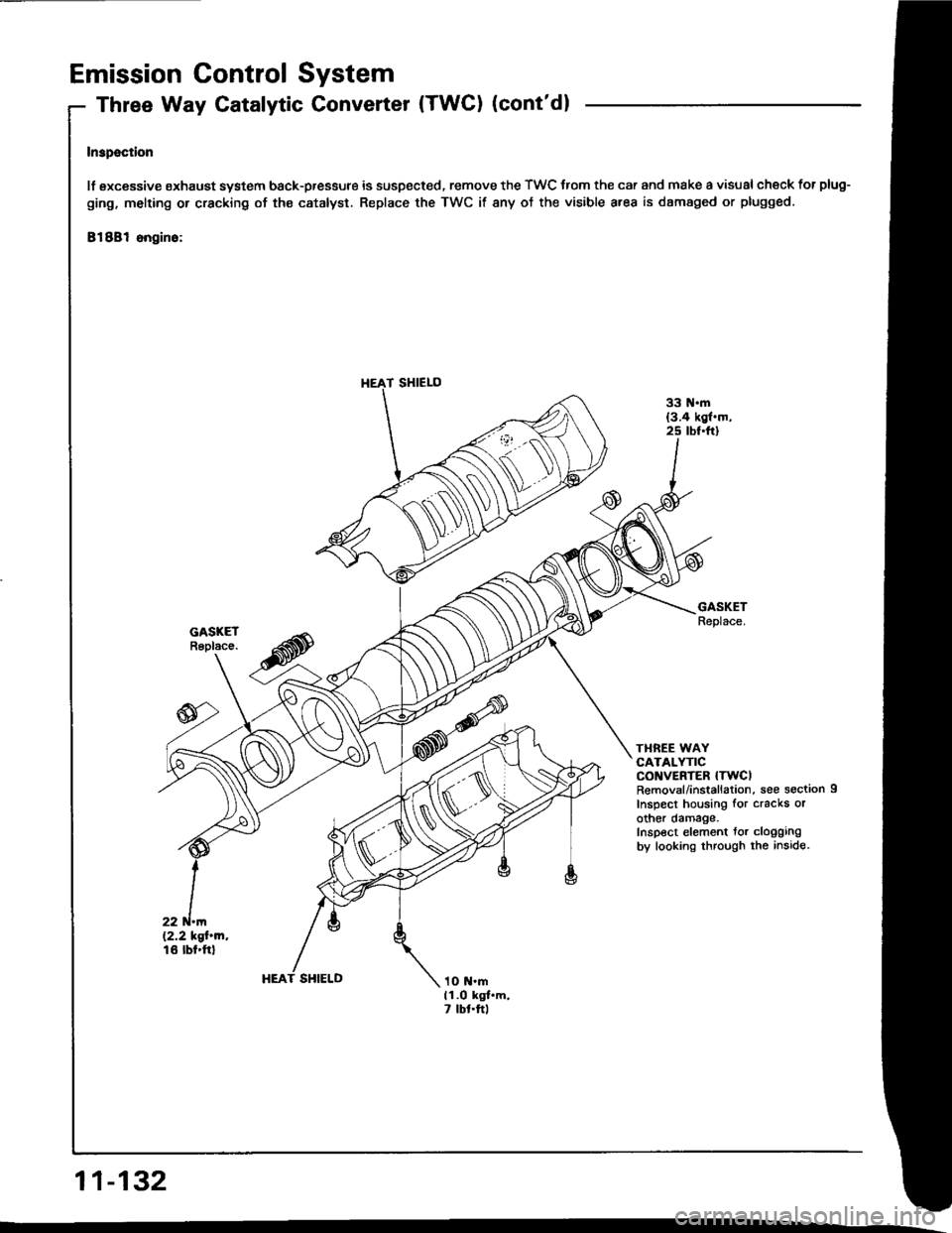
lf sxcessive oxhaust system back-pressure is suspected. remove the TWC trom the car and make a visual check for plug-
ging, melting or cracking of ths catalyst. Replace the TWC if any of the visible area is damaged or plugged.
81881 ongino:
TI{REE WAYCATALYTICCONVERTER {TWCIRemovsl/installation, see section 9
Inspect housing for cracks orother damage.Inspect element tor cloggingby looking through the inside.
HEAT SHIELD
11-132
T SHIELO
Page 323 of 1413
Emission Control System
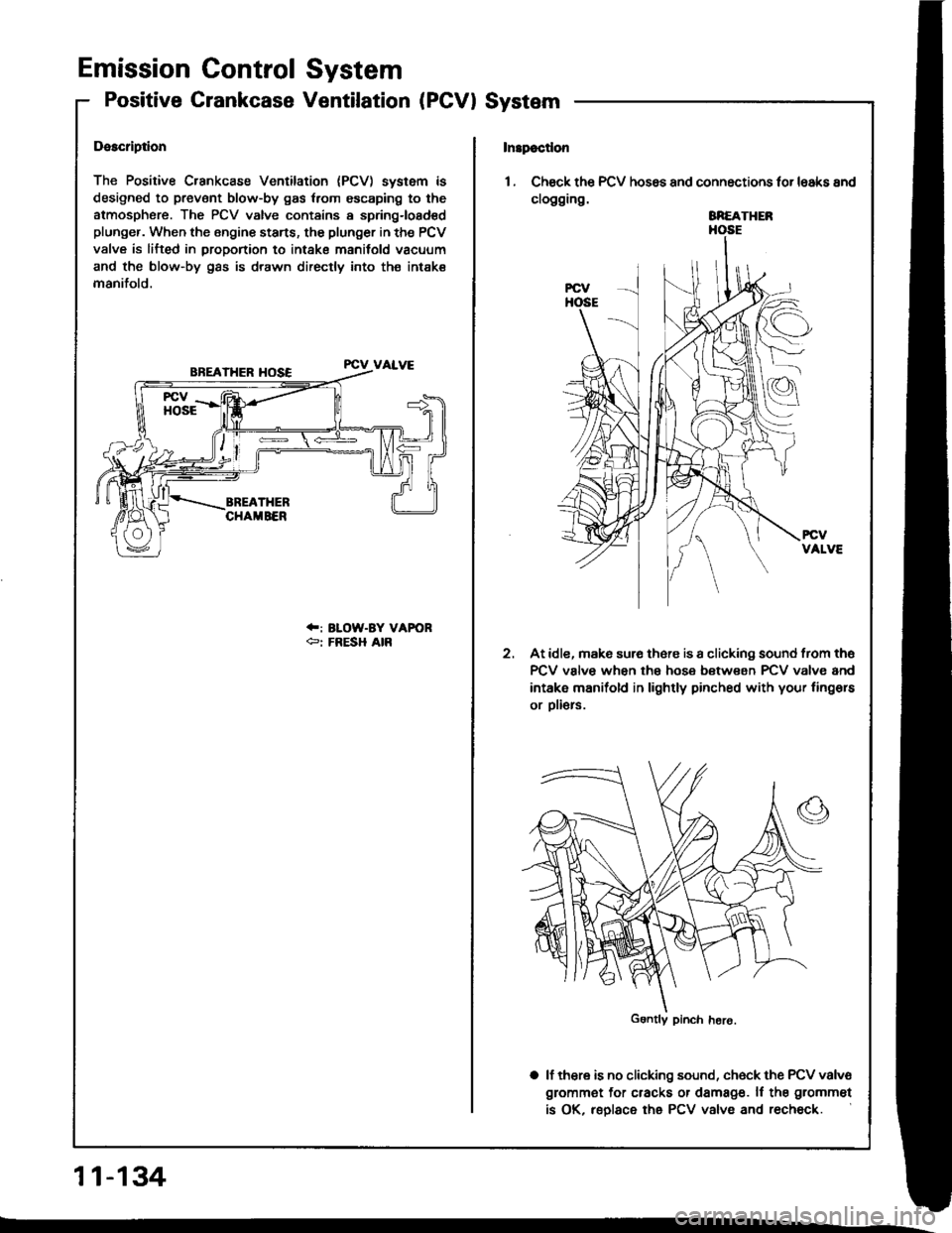
Positive Crankcase Ventilation (PCVI System
Description
The Positive Crankcase Ventilation (PCV) system is
designed to prevent blow-by gas {rom escaping to the
atmosphsre. The PCV valve contains a spring-loadsd
plunger. When the Bngine starts, the plunger in the PCV
valve is lifted in proportion to intake manifold vacuum
and the blow-by gas is drawn directly into th€ intak€
manifold.
FCV VALVE
.F: ILOW-BY VAFORer FRESH AIR
11-134
Insp€cdon
1. Check th€ PCV hos6s and connections tor lsaks and
clogging.
At idle, mak6 sur€ th6fe is a clicking sound from th6
PCV valve when the hose between rcV valve and
intake manifold in lightly pinched with your fingors
or oli€rs.
a lf thera is no clicking sound, ch6ck the PCV valve
grommet for cracks or damage. ll the grommet
is OK, reolace the PCV valve and recheck.
2.
SREATHER
Gontly pinch hero.
Page 324 of 1413
A.
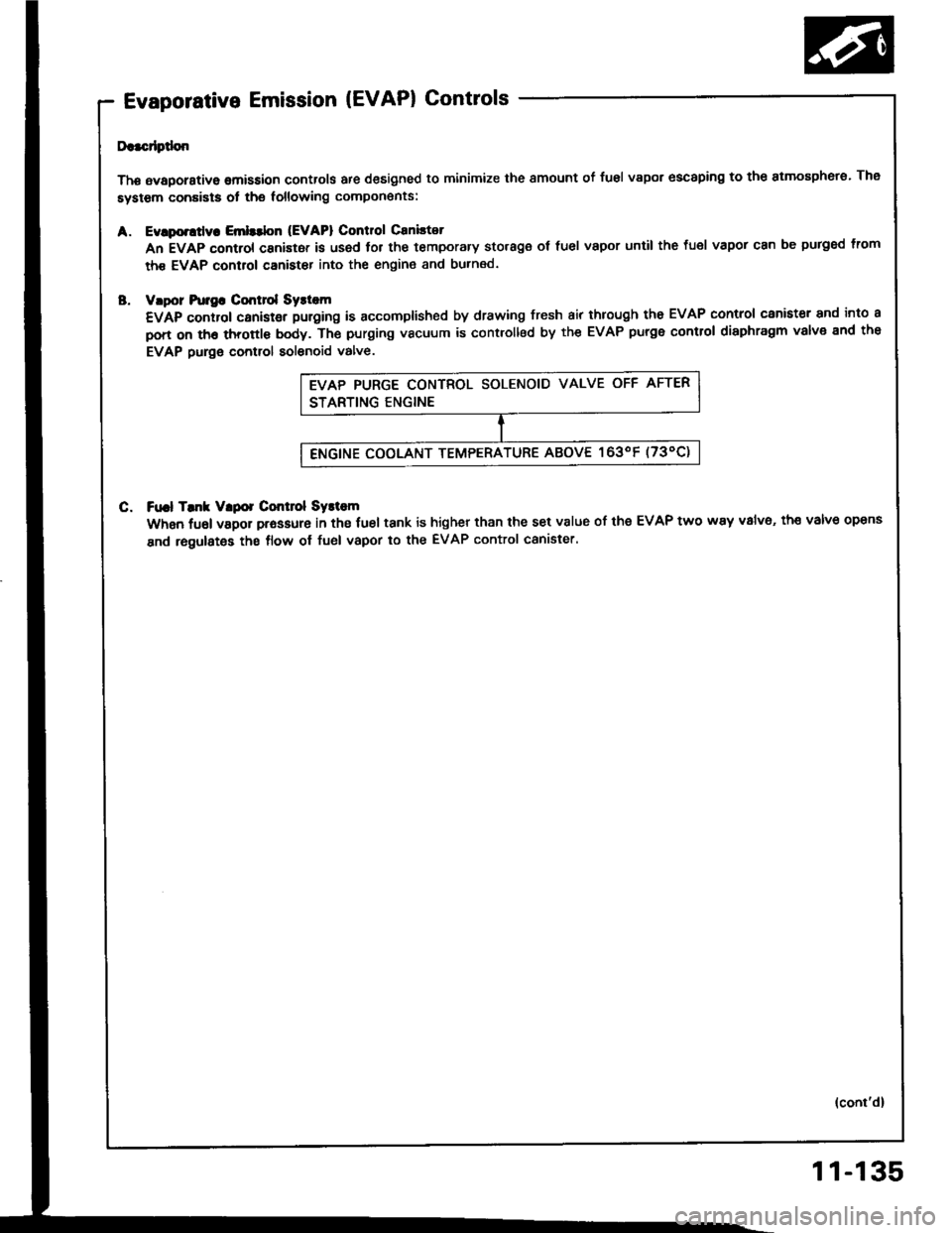
Evaporative Emission (EVAPI Controls
Da.cdptlon
Thg avaporstive omission controls are designed to minimize the smount of fusl vapor escaping to the atmosphero. The
system conaists ot the following compon€nts:
Evlporttly. Emlttbn (EVAPI Control Caniltot
An EVAP control canistor is used lor the temporary storage ot fuel vapor until the fuel vapor can be purged lrom
th€ EVAP control canister into the engin€ and burned.
vlpor hr]gG Cmt]ol Syst m
€VAp control canistgr puroing is accomplished by drawing fresh air through tho EVAP control canister and into a
pon on th6 throttl€ body. Th€ purging vacuum is controllsd by the EVAP purge control diaphragm valve end the
EVAP purge control solenoid valve.
C. Ft|.l Tmk Vlpor Control Systom
When fuel vapor prassure in the fuel tank is higher than the set v8lue of the EVAP two way v8lv6, th€ valve opens
and regulates the flow ol fuel vapor to the EVAP control canister.
(cont'd)
11-135
Page 325 of 1413
Emission Gontrol System
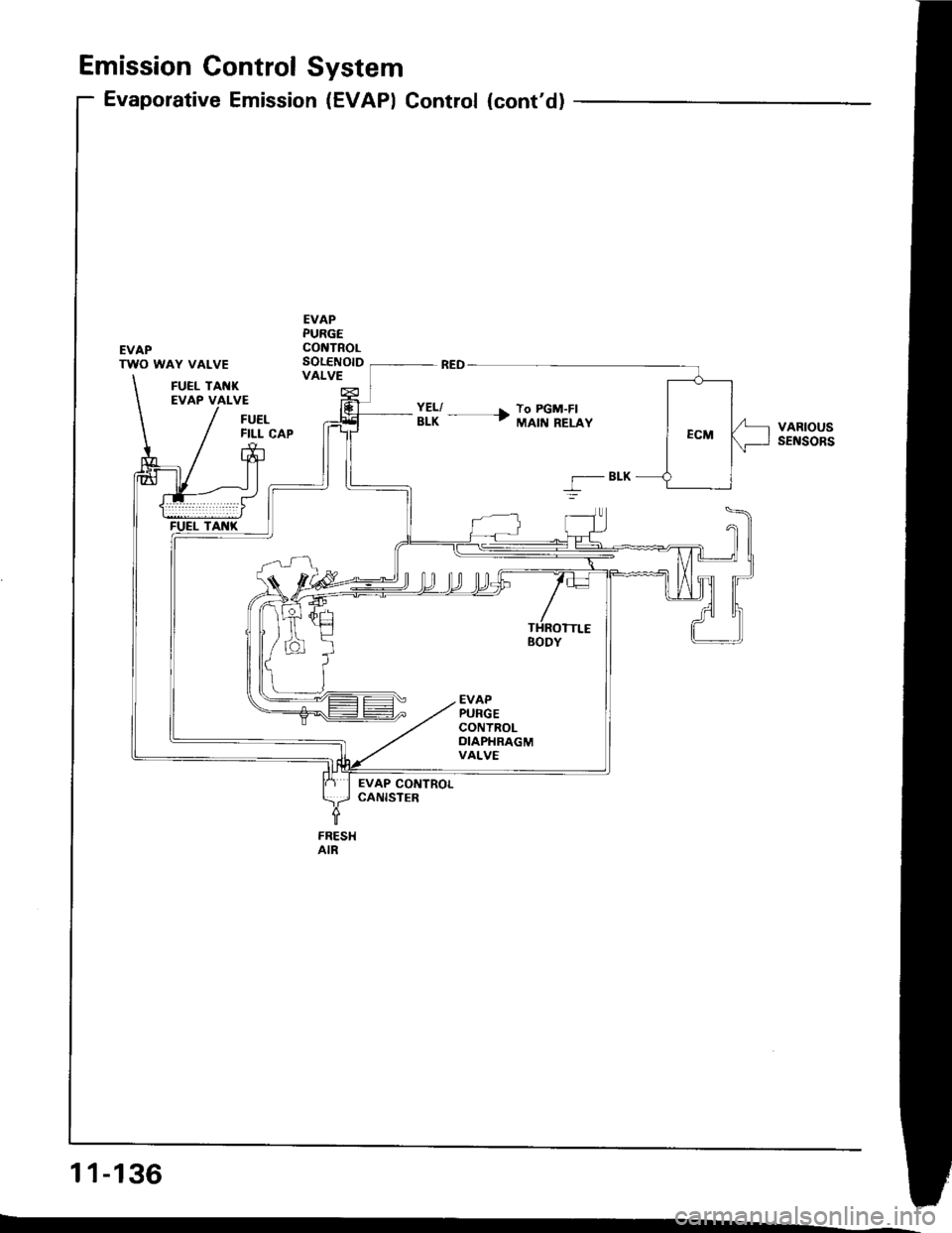
Evaporative Emission (EVAPI Control (cont'd)
EVAPTWO WAY VALVE
EVAPPURGECONTROLSOLENOIDVALVEFUEL TANKEVAP VALVE
FUELFILL CAPVARIOUSsEt{soRs
BLK
5
EVAP CONTROLCANISTEB
FRESHAIR
11-136
Page 327 of 1413
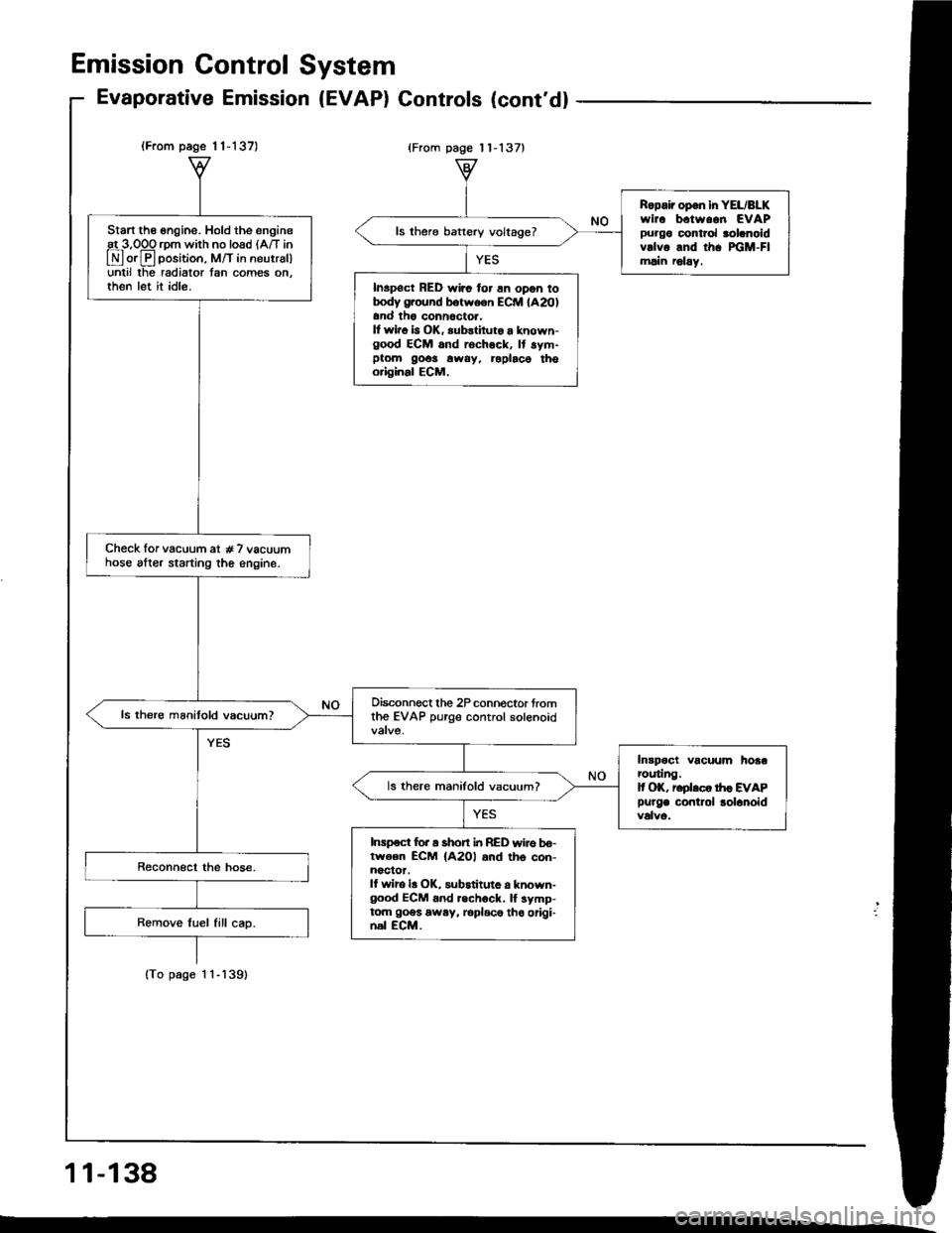
(From page 1 1-137)
lTo page 1 1-'l39)
Start the engine. Hold the engineat 3,OOO rom with no load lA/T in
E orE position, M/T in neutrsl)unlil lhe radiator tan comes on.then let it idle.
Check lor vacuum at # 7 vacuumhose alter starting the engine.
Oisconnect the 2P connoctor fromthe EVAP purge control solenoid
Intpoct vacuum hoaarcuting.It OK, reolrco tr|c EVAP
Purge contlol lolanoid
ls there manifold vacuum?
Inrpoct for a short i|t RED wire bo-lwoen ECM {A2Ol and th6 con-noclor.ll wiro la OK, substituto a known-good ECM 6nd .echock. lf symp-tom goes away, loplace tho origi-nal ECM.
Ropair opon in YEL/BLKwirc b.tw..n EVAPpurgo control rolanoidvrlvo and th. xiM-Flmlin r6lay.
ls there baftery voltage?
Inspoct RED wirc for 6n opon totrody g.ound botween ECM lA20)and th6 conn6ctor.It wir. b OK, substiluto a known-good ECM and rochock, It sym-ptom 9o6s away, roplaco thooriginal ECM,
Emission Gontrol System
Evaporative Emission (EVAP) Gontrols (cont'd)
{From page 11-137}
11-138
Page 329 of 1413
Emission Control System
Evaporative Emission Controls
(cont'dl
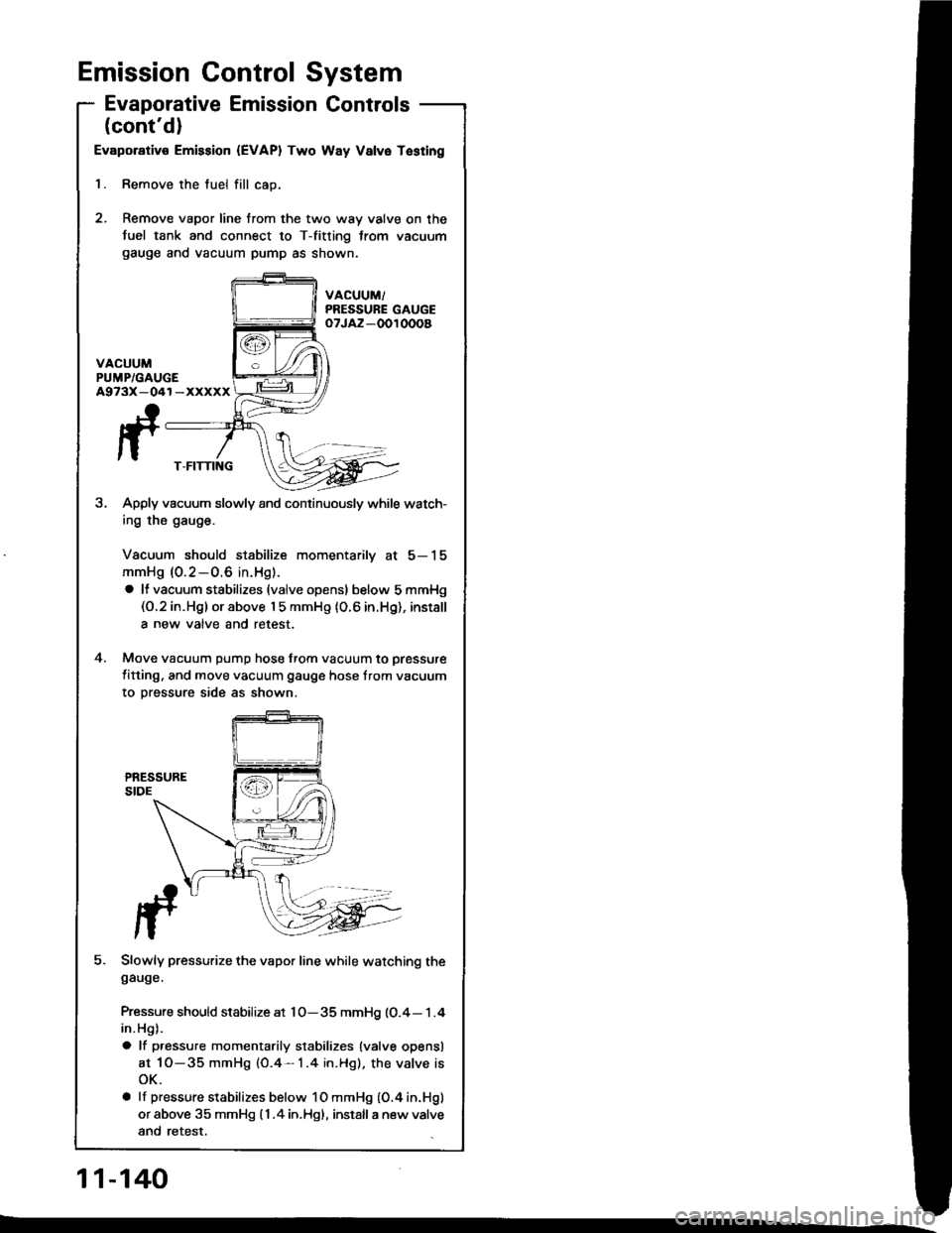
Evaporativ€ Emission {EVAPI Two Way Valvo Tasting
l. Remove the tuel fill cao.
2. Remove vapor line trom the two way valve on the
fuel tank and connect to T-fitting trom vacuum
gauge ano vacuum pump as snown.
VACUUM/PRESSURE GAUGEoTJAZ-OOI OOOa
A973X-041-XXXXX
fT-FITTING
Apply vacuum slowly and continuously while watch-
ing the gauge.
Vacuum should stabilize momentarilv at 5-15
mmHg (0.2-0.6 in. Hg).
a It vacuum stabilizes (valve opensl below5mmHg(O.2 in.Hg) or above I 5 mmHg (O.6 in.Hg), install
a new valve and retest.
Move vacuum pump hose from vacuum to pressure
titting, and move vacuum gauge hose trom vacuum
to oressure side as shown.
Pressure should stabilize at 1O-35 mmHg (0.4- 1 .4
in. Hg).
a lf p.essure momentarily stabilizes {valve opensl
at 1O-35 mmHg (O.4- 1.4 in.Hg), the valve is
oK.
a lf pressure stabilizes below 10 mmHg {O.4 in.Hg)
or above 35 mmHg (1 .4 in.Hgl, install a new valve
and retest.
4.
J-.
fF . -,-/ asr^:
,T 4?e
Slowly pressurize the vapor line while watching thegauge.
11-140
Page 1107 of 1413
Electrical
Special Tools
Troubleshooting
Tips and Precautions ................................ 23-3Five-stop Tloubleshooting ..............,...-..-... Z3-sSchematic Symbols ................................_. 23-6wire Color Cod€s ..................................... 23-6Relay and Control Unit Locations
Engine Compartment .........,............ ... --. 23-7Dsshboard and Door ..,,......................... 23-gDashboard and Floor ............................. 23-t OOuaner Panel .....-.....23-12Connector ldentification and WireHarness Routing ........ 23-i 3
Index to Circuits and Systems
Airbag ............... ...-..-... 2g-26sAir Conditioning ....,.. Section 2lAltelnator ......_.............. 23-99Anti-lock Brake Systsm (ABS) Section 19Automatic Transmission Section 14Battery .............. .......... 23-66Chafging System ........... 23-98rCigalstte Lighter .....................-...-......-..-.. Z3-2O4Cfock ................. ..........23-197rcruise Controf .......--..-... 23-242Distributor .................... 23-87Fan Controls ................. 23-1ogFuel and Emissions ... Section 1i*Fuses
Under-dash Fuse/Relay Box ................... 23-48Undor-hood ABS Fuse/Retay Box ............ 23-51Under-hood Fuse/Relay Box,.................. 23-52rGauges
Engine Coolant Temperature {ECT)Gauge ................ ..23-126Fuef cauge ............... 2g-123'Gauge Assembly ....--.23-113Speedometer .....-...,,. 23-114Tachometer .....,.....-.. 23-114Ground Distribution ........ 23-60Heater ,,,........,.... ..... Section 2lrHorn ................. ........... 23-199*fgnition Switch ............. 23-70fgnition Syst6m .......-..-.. 23-A7lgnition Timing .............. 23-89Indicator Lights"A/T Gear Position .............. ................... 23-1 32B1ak6 System ...,..,..-.23-127Engine Oil Pressura .............................. _ 23-1 51Low Fuel ............ ......23-125Malfunction Indicator Lamp {MlL} ...,,. Section I l
tfnteglated Control Unit ...29-144*lnterlock System ...................................... 23-1 3gLights, Exteriol
Back-up Lights ........... 23-179Brake Lights .............. 23-t8ltDaytime Running Lights {Csnada} ........... 23-156Front Palking Lights ............................. 23-1 65Flont Side Marker Lights ....................... 23-165Front Turn Signal Lights ........................ 23-1 65*Hazard Warning Lights .........................- 2g-1A4Headlights ................. 23-t6tLicense Plate Lights .............................. 23-1 69Taillights(Harchback) .......... 23-166
{Sedan) .............. .. 23-167Lights. Inteliol
Cargo Area Light {Hatchback) ...... -.. -.. -... 23-177Ceifing Light ........-..-.23-175
Dash Lights Blightness Controt .............. 23-t70Glove Box Lighr ................................... 23-1 69Spotfighr ............ ....-.23-174Trunk Light (Sedanl ............... .............. - 23.-177*Lighting Sysrem .......-.-... 23-152:Moonroof ,,.,.......,..,,,,,.-.23-211PGM-FI Systom ........ S€crion 11Power Distribution .,.-..--..23-54Power Door Locks .............,,..................... 23-233Power Mirors ..,..,....-...- 23-216Power Relays ...........,..... 23-68Power Windows ............ 29-222*Rear Window Defogger ........,... ..........,..... - 23-20,6Reminder Systems
Key-in Remindel System ....,.............,.... 23-1 50Lights-on Reminder System ................... 23-l 5f*Maintenance Reminder system ..,,.... -.. - -. 23-.1 2gSeat Belt Reminder System ..................- 23-125*Side Markel/Turn Signal/Hazard
Ffasher System .,..,..-.23.-1A4Spark Pfugs .........-...-..... 23-97Starting System ....,,.....-. 23-73*Stereo Sound System ...,.......................,,.. 23-l gg
Supplemental Restraint System {SRS} ......... 23-265Vehicfe Speed Sensor {VSS) .............--..-.... 23-122*Wiper/Washer Systom ...............--.........-..- Zg-254
rRead SRS pi€cautions on Page 23-271 betore workingin these areas.
-+