Valve cover HONDA INTEGRA 1998 4.G User Guide
[x] Cancel search | Manufacturer: HONDA, Model Year: 1998, Model line: INTEGRA, Model: HONDA INTEGRA 1998 4.GPages: 1681, PDF Size: 54.22 MB
Page 450 of 1681
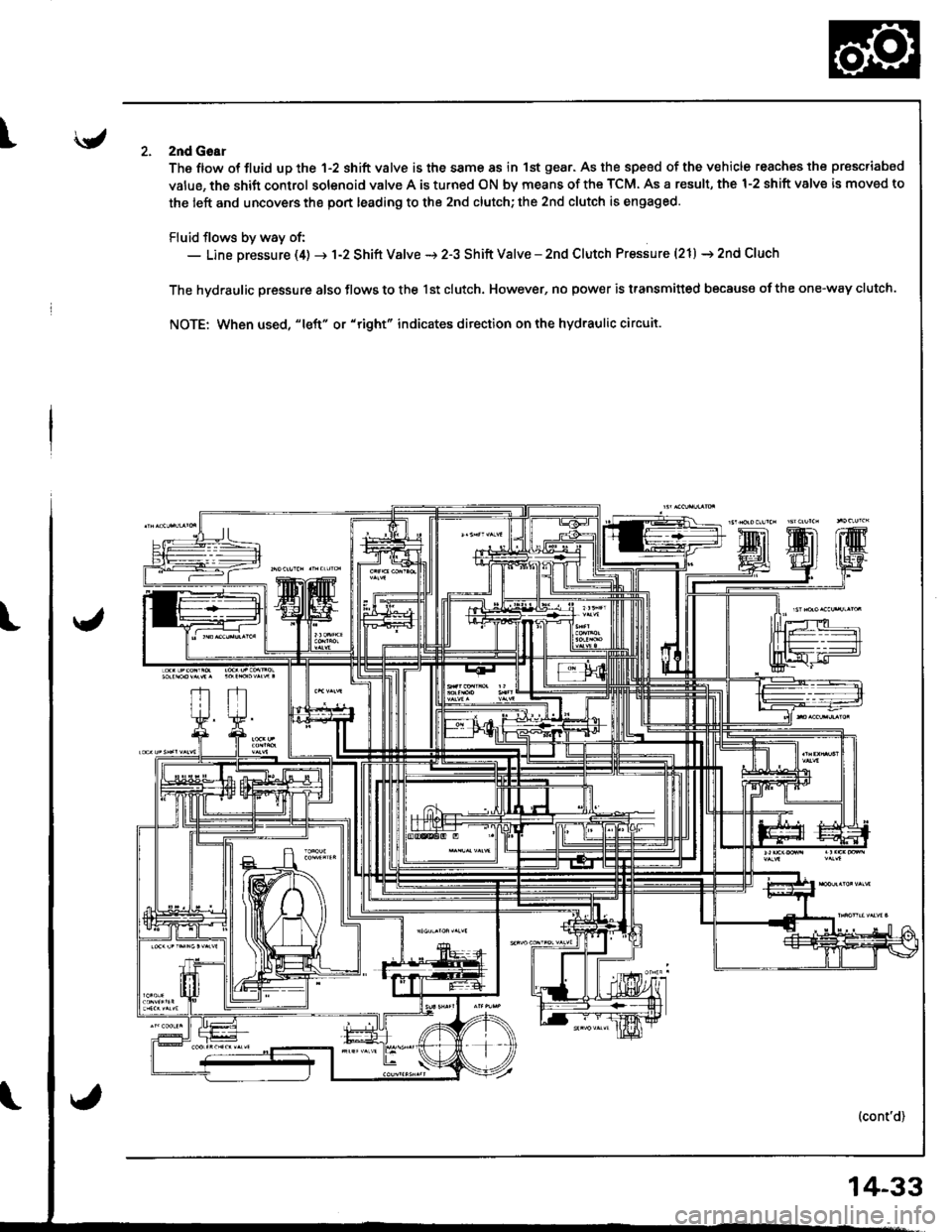
Iznd Goar
The ftow ot fluid up the 1-2 shift valve is the same 8s in 1st gear. As the speed of the vehicle reaches the prescriabed
value, the shift control solenoid valve A is turned ON by means of the TCM. As a result, the 1-2 shift valve is moved to
the left and uncovers the port leading to the 2nd clutch; the 2nd clutch is engaged.
Fluid flows by way of:- Line pressure (4) -r 1-2 Shift Valve i 2-3 Shift Valve - znd Clutch Pressure (21) i 2nd Cluch
The hydraulic pressure also flows to the lst clutch. However, no pow€r is transmitted because ofthe one-way clutch.
NOTE: When used, "Ieft" or "right" indicates ditection on the hydraulic circuit.
14-33
Page 451 of 1681
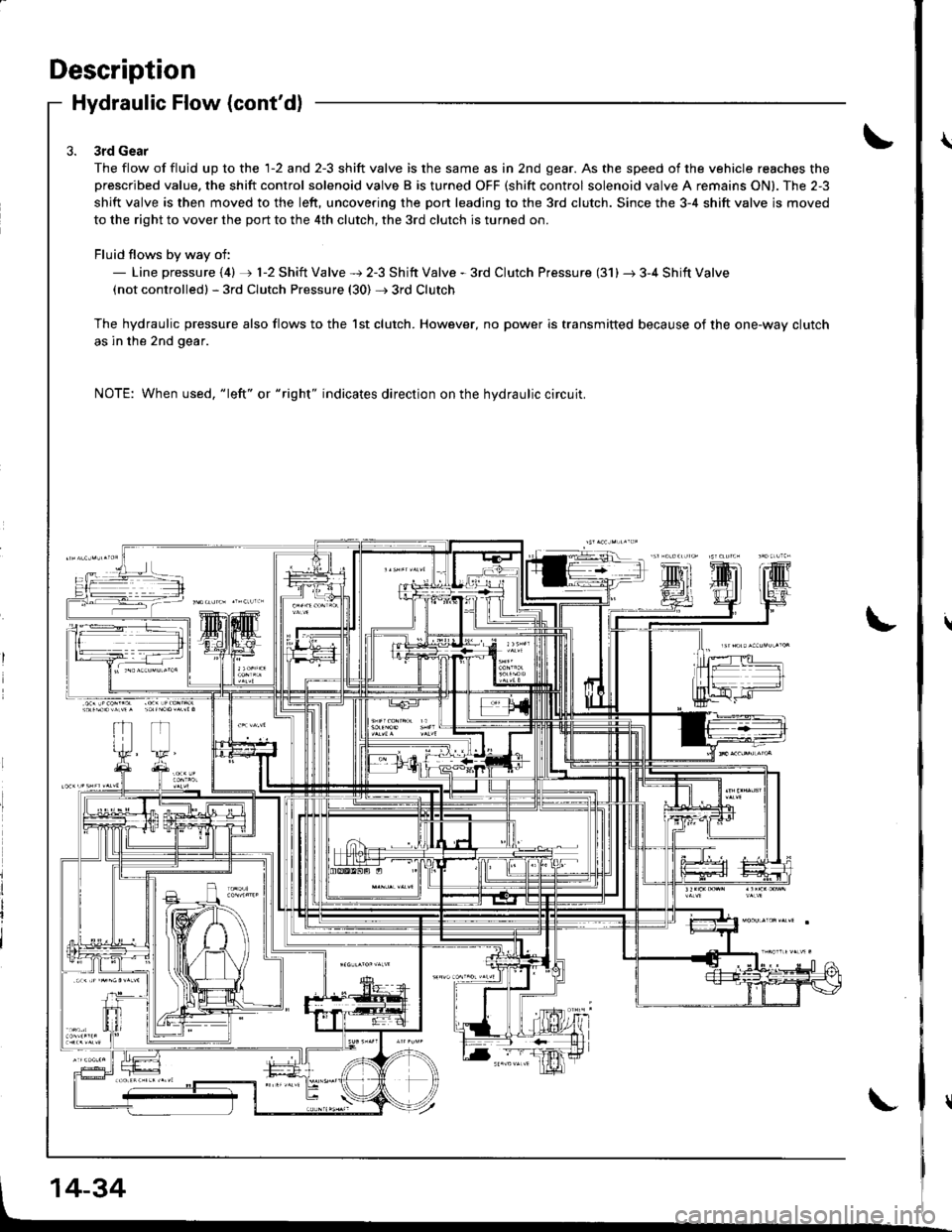
Description
Hydraulic Flow (cont'dl
3rd Gear
The flow of fluid up to the 1-2 and 2-3 shift valve is the same as in 2nd gear. As the speed of the vehicle reaches theprescribed value. the shift control solenoid valve B is turned OFF (shift control solenoid valve A remains ON). The 2-3
shift valve is then moved to the left, uncovering the port leading to the 3rd clutch. Since the 3-4 shift valve is moved
to the right to vover the port to the 4th clutch, the 3rd clutch is turned on.
Fluid flows by way of:- Line pressure (4) rj) 1-2 Shift Valve + 2-3 Shift Valve - 3rd Clutch Pressure (31) r 3-4 Shift Valve(not controlledl - 3rd Clutch Pressure (30) + 3rd Clutch
The hydraulic pressure also flows to the lst clutch. However, no power is transmitted because of the one-way clutch
as in the 2nd gear.
NOTE: When used, "|eft" or "right" indicates direction on the hydraulic circuit.
14-34
Page 452 of 1681
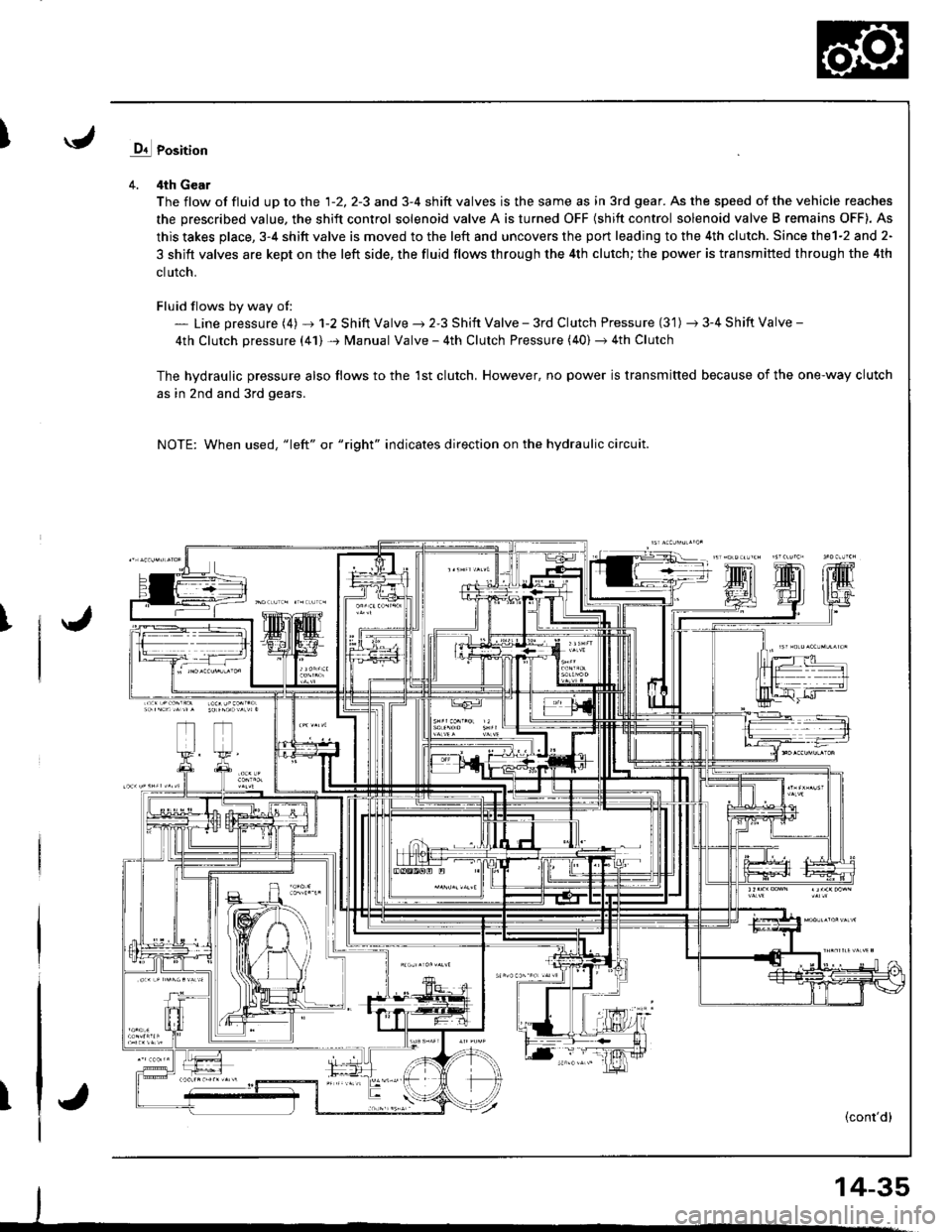
Iq1 Position
4. 4th Gear
The flow of fluid up to the 1-2, 2-3 and 3-4 shift valves is the same as in 3rd gear. As the speed of the vehicle reaches
the prescribed value, the shift control solenoid valve A is turned OFF (shift control solenoid valve B remains OFF). As
this takes place, 3-4 shitt valve is moved to the left and uncovers the port leading to the 4th clutch. Since thel-2 and 2-
3 shift valves are kept on the left side, the fluid flows through the 4th clutch; the power is transmitted through the 4th
clutch.
Fluid flows by way of:- Line pressure (4) + 1-2 Shift Valve ) 2-3 Shift Valve - 3rd Clutch Pressure (3'1) -t 3-4 Shift Valve -
4th Clutch pressure (41) + Manual Valve - 4th Clutch Pressure (40) + 4th Clutch
The hvdraulic pressure also flows to the 1st clutch, However, no power is transmitted because of the one-way clutch
as in 2nd and 3rd gears.
NOTE: When used, "1eft" or "right" indicates direction on the hydraulic circuit.
I
T(cont'd)
14-35
Page 456 of 1681
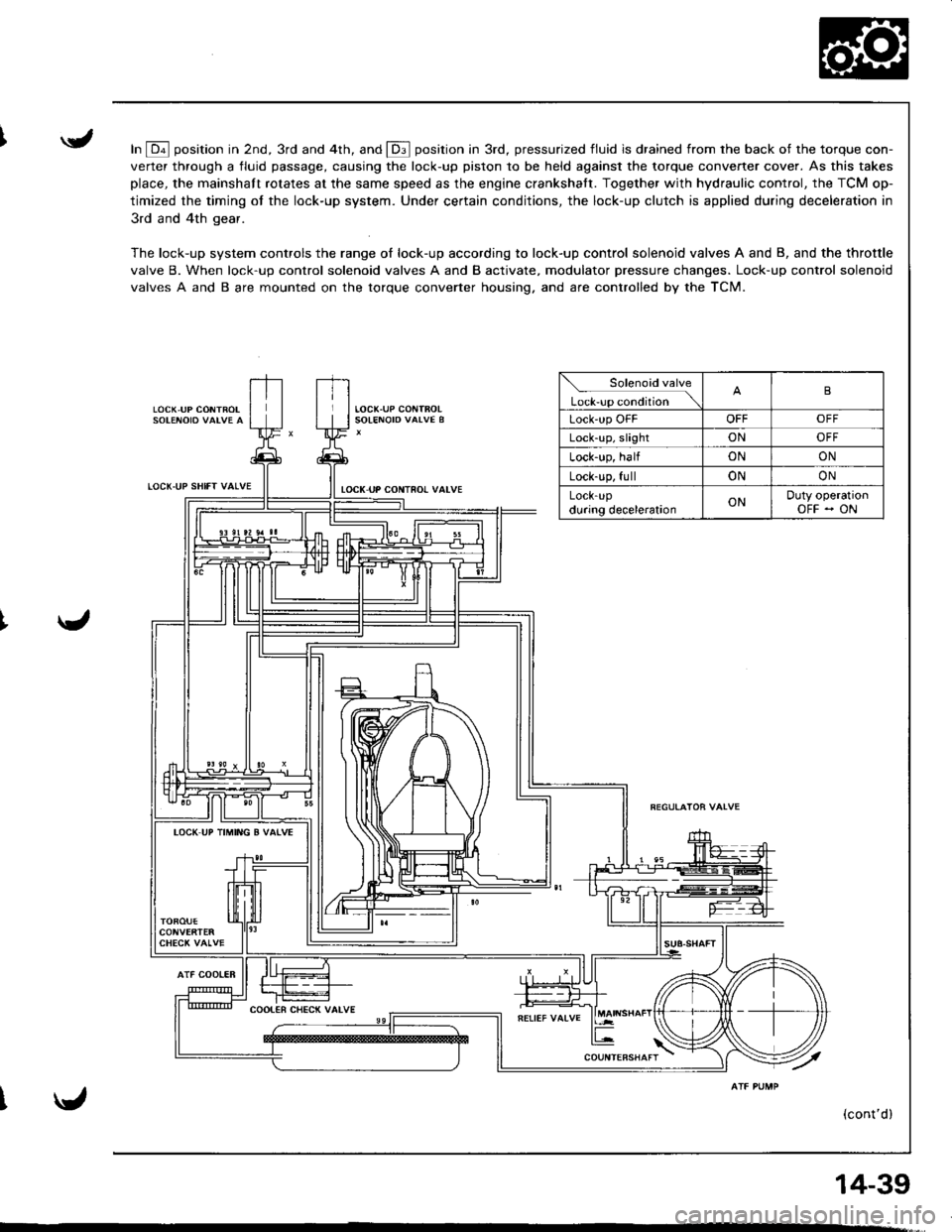
In E position in 2nd, 3rd and 4th, and E position in 3rd, pressurized fluid is drained from rhe back of the torque con-
verter through a fluid passage, causing the lock-up piston to be held against the torque converter cover. As this takes
place, the mainshaft rotates at the same speed as the engine crankshatt. Together with hydraulic control, the TCM op-
timized the timing of the lock-up system. Under certain conditions, the lock-up clutch is applied during deceleration in
3rd and 4th gear.
The lock-up system controls the range of lock-up according to lock-up control solenoid valves A and B, and the throttle
valve B. When lock-up control solenoid valves A and B activate, modulator pressure changes. Lock-up control solenoid
valves A and B are mounted on the torque converter housing. and are controlled by the TCM.
LOCK,UP CONTROL
LOCT.UP SHIfT VALVE
AlF COOIER
tocK uP coNTno! valvE
Solenoid valve
L*r""r "o.Jtio" \B
Lock'up OFFOFFOFF
Lock-up, slightONOFF
Lock-up, halfONON
Lock-up, fullONON
LOCK-Updu.ing decelerationONDuty operationOFF - ON
IOCK UP TIMING B VATVE
(cont'd)
14-39
Page 510 of 1681
NOTES
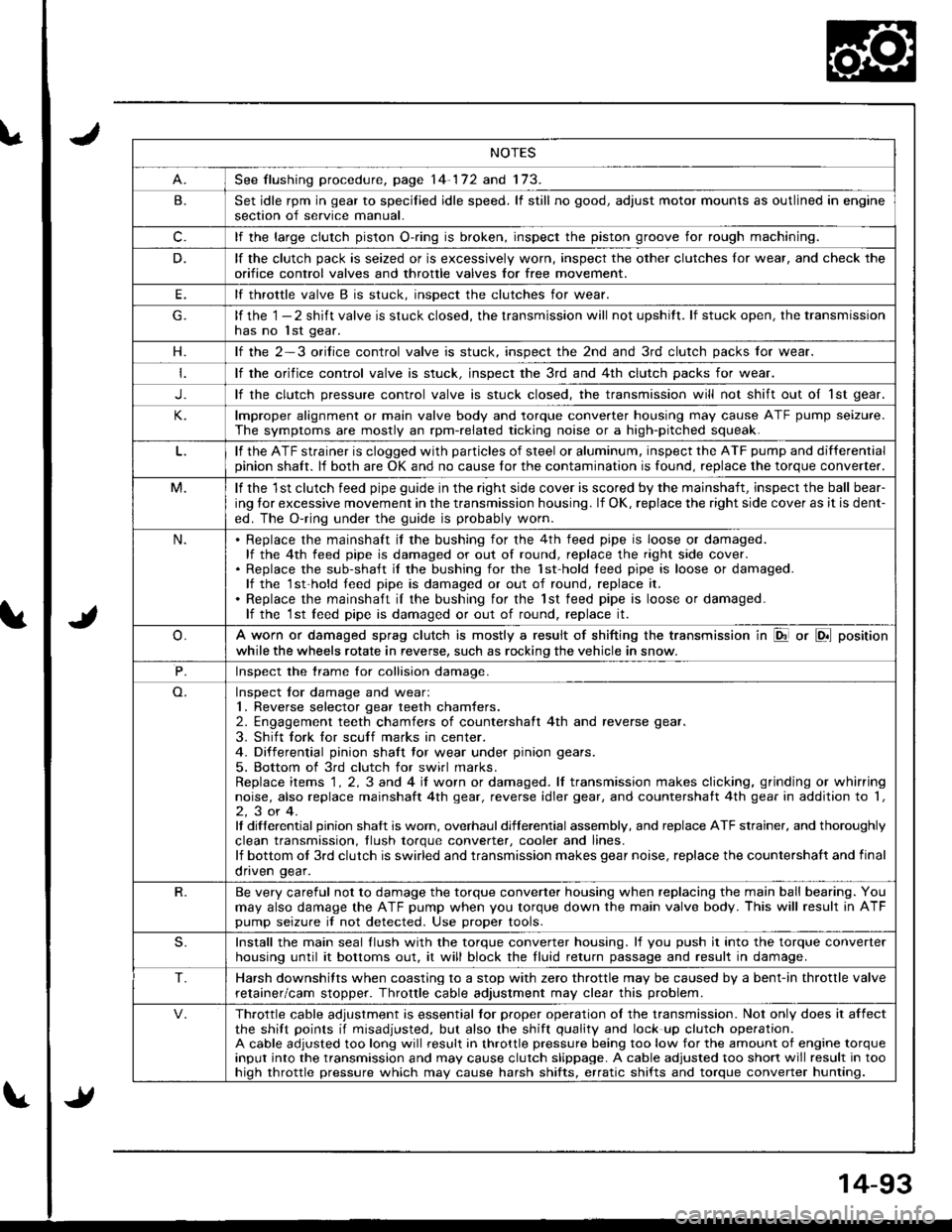
See flushing procedure, page 14-172 and 173.
B.Set idle rpm in gear to specilied idle speed. lf still no good, adjust motor mounts as outlined in enginesection of service manual.
c.lf the large clutch piston O-.ing is broken, inspect the piston groove for rough machining.
D.lf the clutch pack is seized or is excessively worn, inspect the other clutches lor wear, and check the
orifice control valves and throttle valves for free mov€ment.
E.lf throttle valve B is stuck. insDect the clutches for wear.
lf the 1 - 2 shift valve is stuck closed, the transmission will not upshitt. lf stuck open, the transmissionhas no lst gear.
H.lf the 2-3 orilice control valve is stuck, inspect the 2nd and 3rd clutch packs for wear.
lf the orifice control valve is stuck. inspect the 3rd and 4th clutch packs for wear.
J.lf the clutch pressure control valve is stuck closed, the transmission will not shift out oI 1st gear.
lmproper alignment or main valve body and torque converter housing may cause ATF pump seizure.
The symptoms are mostly an rpm-related ticking noise or a high-pitched squeak.
lf the ATF strainer is clogged with particles of steel or aluminum, inspect the ATF pump and differentialpinion shaft. lf both are OK and no cause for the contamination is found, replace the torque converter.
M.lf the 1st clutch feed pipe guide in the right side cover is scored by the mainshaft, inspect the ball bear-
ing lor excessive movement in the transmission housing. lf OK, replace the right side cover as it is dent-
ed. The O-ring under the guide is probably worn.
N.Replace the mainshaft if the bushing for the 4th feed pipe is loose or damaged.lf the 4th feed pipe is damaged or out of round, replace the right side cover.Replace the sub-shaft il the bushing for the 1st-hold teed pipe is loose or damaged.lf the 1st-hold teed pipe is damaged or out of round, replace it.
Replace the mainshaft iI the bushing for the lst feed pipe is loose or damaged.lf the 1st leed pipe is damaged or out of round, replace it.
A worn or damaged sprag clutch is mostly a result of shifting the transmission in El or LDll position
while the wheels rotate in reverse, such as rocking the vehicle in snow.
P.Inspect the trame for collision damage.
Inspect lor damage and wear:1. Reverse selector gear teeth chamfers.2. Engagement teeth chamfers of countershaft 4th and reverse gear.
3. Shift fork for scuff marks in center.4. Differential pinion shaft tor wear under pinion gears.
5. Bottom of 3rd clutch for swirl marks.Replace items 1 . 2, 3 and 4 iI worn or damaged. lf transmission makes clicking, grinding or whirringnoise, also replace mainshaft 4th gear, reverse idler gear, and countershatt 4th gear in addition to '1,
2,3or4.It differential pinion shalt is worn, overhaul differential assembly, and replace ATF strainer, and thoroughly
clean transmission, tlush torque conveder, cooler and lines.lf bottom ot 3rd clutch is swirled and transmission makes gear noise, replace the countershaft and final
onven qear.
R.Be very careful not to damage the torque converter housing when replacing the main ball bearing. You
may also damage the ATF pump when you torque down the main valve body. This will result in ATFpump seizure if not detected. Use proper tools.
S.Install the main seal llush with the torque converter housing. lf you push it into the torque converterhousing until it bottoms out. it will block the fluid return passage and result in damage.
T.Harsh downshifts when coasting to a stop with zero throttle may be caused by a bent-in throttle valve
retainer/cam stopper. Throttle cable adjustment may clear this problem.
Throttle cable adjustment is essential tor proper operation ol the transmission. Not only does it affectthe shift points if misadjusted, but also the shift quality and lock up clutch operation.A cable adjusted too long will result in throttle pressure being too low for the amount of engine torqueinput into the transmission and may cause clutch slippage. A cable adjusted too short will result in toohiqh throttle pressure which may cause harsh shifts, erratic shifts and torque converter hunting.
Page 521 of 1681
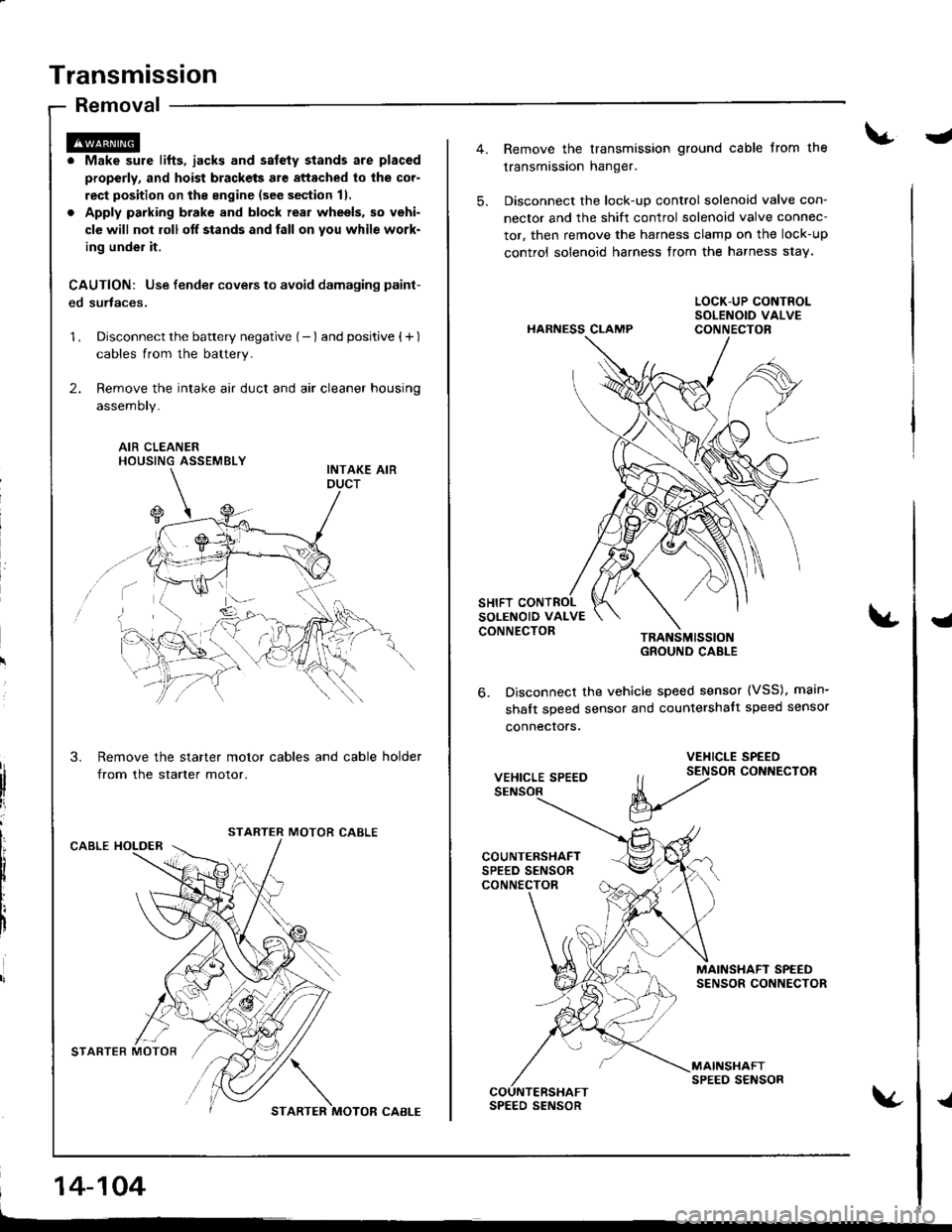
Transmission
Removal
. Make sure lifts, iacks and salety stands are placed
properly, and hoist brackets are attached to lhe cor-
rect position on the engine (see section 11.
. Apply parking brake and block real wheels, so vehi-
cle will nol roll off stands and fall on you while work-
ing under it.
CAUTION: Use fender covers to avoid damaging paint-
ed surtaces.
1 . Disconnect the battery negative (- ) and positive { + )
cables from the battery.
2. Remove the intake air duct and air cleaner housing
assemoty.
AIR CLEANERHOUSING ASSEMBLY
Remove the starter motor cables and cable holder
from the starter motor.
MOTOR CABLECABLE HOLDER
STARTER MOTOR'/,/ \
STARTER MOTOR CABI-E
14-104
-
5.
Remove the transmission ground cable from the
transmission hanger.
Disconnect the lock-up control solenoid valve con-
nector and the shift control solenoid valve connec-
tor, then remove the harness clamp on the lock-up
control solenoid harness from the harness s1ay.
HARNESS CLAMP
TRANSMISSIOIGROUND CABLE
Disconnect the vehicle speed sensor (VSS), main-
shalt speed sensor and countershalt speed sensor
connecrors.
{
6.
VEHICLE SPEED
VEHICLE SPEED
ll t2tor coNNEcroR
V
MAINSHAFT SPEEDSENSOR CONNECTOR
MAINSHAFTSPEED SENSORCOUNTERSHAFTSPEED SENSOR{
Page 530 of 1681
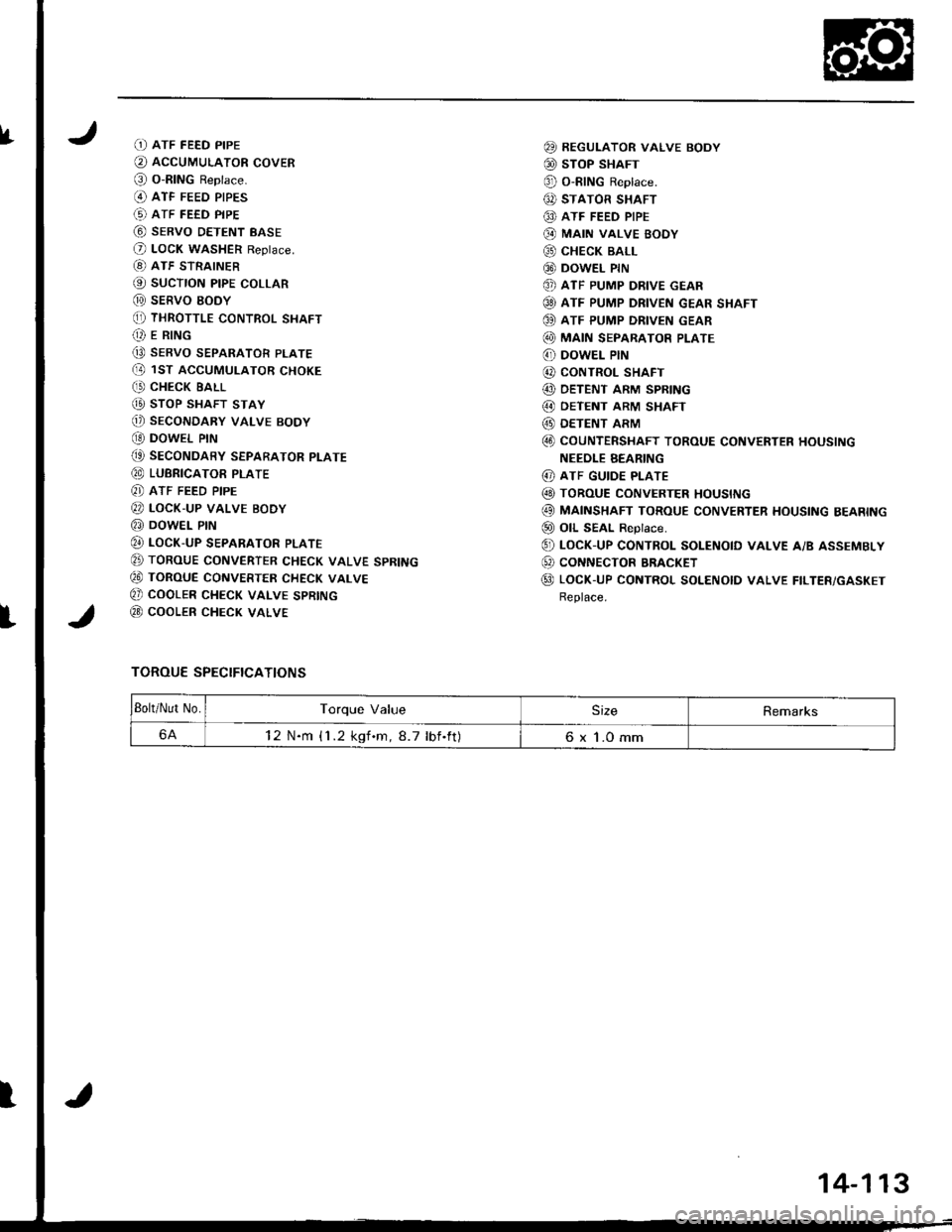
IfD ATF FEED PIPE
O AccUMULAToR covER
@ o-RING Reptace.(O ATF FEED PIPES
(!) ATF FEED PIPE
@ sERvo DETENT BASE
O LocK WASHER Reptace.
[8) ATF STRAINER
@ sucTroN ptpE coLLAR
@ sERVO EODY(, THRoTTLE coNTRoL SHAFT(t E R|NG
Q9 SERVO SEPARATOR PLATE(D 1ST ACCUMULAToR cHoKE
C' CHECK EALL
@ sToP SHAFT STAY
@) SECONDARY VALVE BODY
OO DOWEL PIN
(t SEcoNDARY SEPARAToR PLATE
@ LUBRICAToR PTATE
8] ATF FEED PIPE
@ LocK-uP vALvE BoDy
@ DowEL PrN
@ LocK-uP SEPARAToR PLATE
E TORoUE CoNVERTER cHEcK VALVE SPRING
€0 ToRouE CoNVERTER cHEcK vALvE
Q) COOLER CHECK VALVE SPRING
@ cooLER cHEcK VALVE
TOROUE SPECIFICATIONS
@ REGULAToR vALvE BoDY
@ sToP SHAFT
@ o-RING Reptace.
6, STATOR SHAFT
@ ATF FEED PIPE
@ MA|N VALVE BOOY
@ cHEcK BALL
@ DowEL PrN
@ ATF PUMP DRIVE GEAR
@ ATF PUMP DRIVEN GEAR SHAFT
OO ATF PUMP DRIVEN GEAR
@ MA|N SEPARAToR PLATE
6' DowEL PIN
@ CONTROL SHAFT
@ DETENT ARM SPRING
@ OETENT ARM SHAFT
@ DETENT ARM
@ coUNTERSHAFT ToRoUE coNVERTER HoUSING
NEEOLE BEARING
@ ATF GUIDE PLATE
@ ToRouE coNvERTER HoustNG
@ MAINSHAFT ToRoUE coNvERTER HousING BEARING
@ oll SEAL ReDtace.
@ LocK-up coNTRoL soLENotD vALvE A/B ASSEMBLy
@ coNNEcToR BRACKET
@ LocK-UP coNTRoL SoLENoID vALvE FILTER/GASKET
Replace.
Bolt/Nut No.Torque ValueSizeRemarks
6A12 N.m {1 .2 kgf.m,8.7 lbf.ft)6 x 1.0 mm
I
14-113
Page 535 of 1681
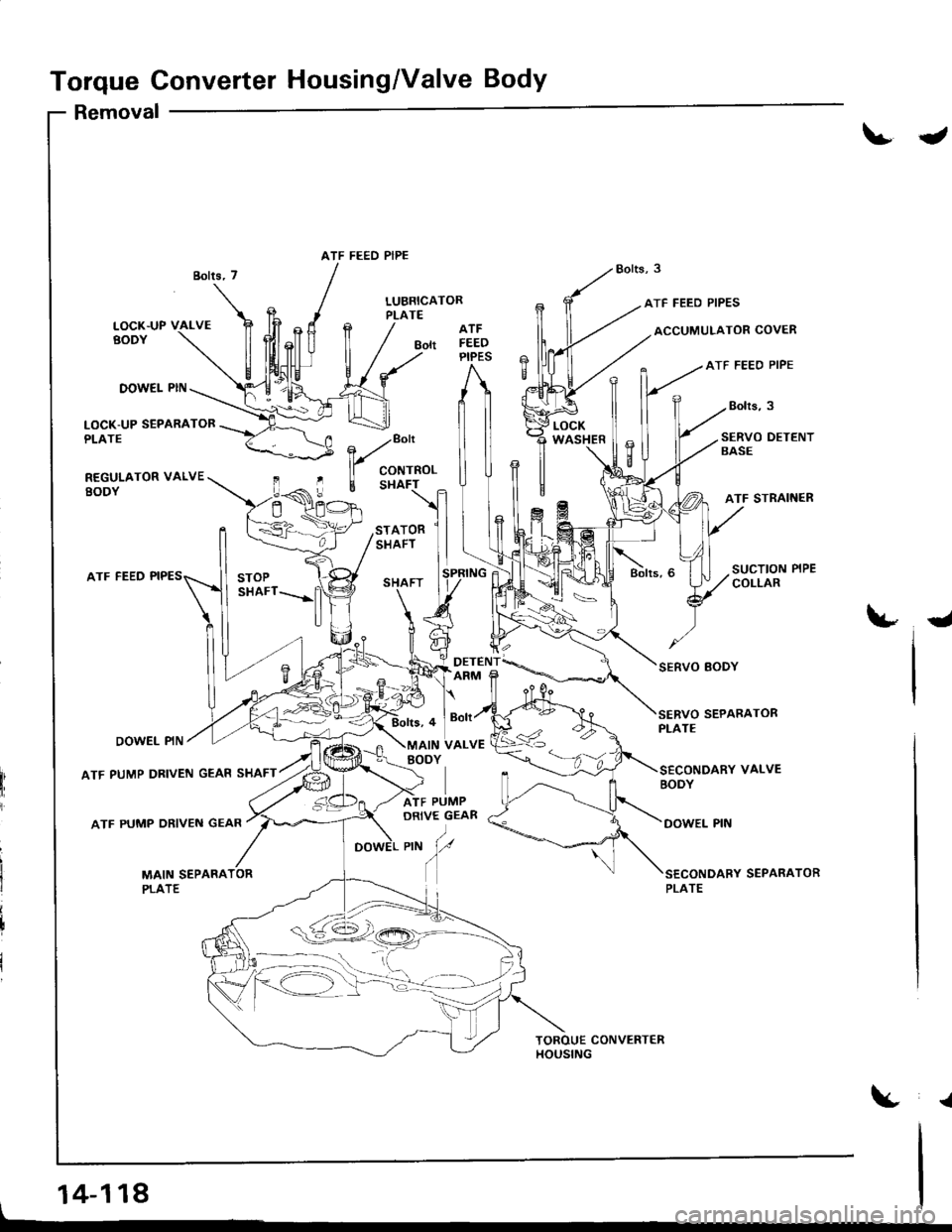
Torque Converter Housing/Valve Body
Removal
t
LUBRICATORPLATEATF FEED PIPES
ACCUMULATOR COVER
ATF FEEO PIPE
Bolrs,3
ATF
Bott FEEDPIPES
DOW€I- PIN
LOCK-UP SEPARATORPLATE
REGULATOR VALVEEODY
SERVO DETENTSASE
ATF STRAINER
LOCKWASHER
ATF FEED
DOWEL PIN
ATF PUMP DRIVEN GEAR SHAFT
ATF PUMP ORIVEN GEAR
-
SEPARATOR
.a
ATF FEED PIPE
, ./"o"
ll coNrRoL
E Sl{AF-r
ATOR
PLATE
_ro-rr!_
Page 536 of 1681
I
l"
I
J
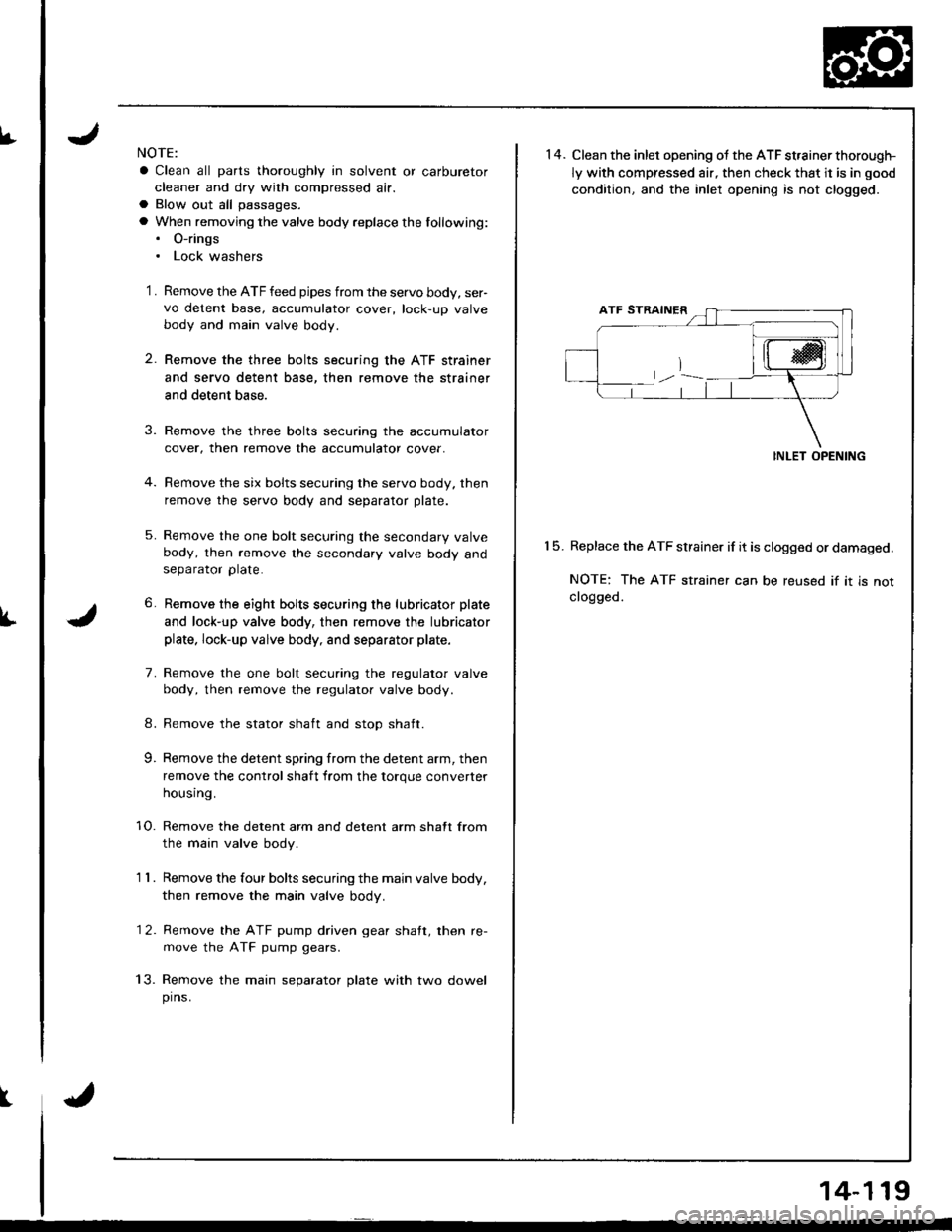
NOTE:
a Clean all parts thoroughly in solvent or carburetor
cleaner and dry with compressed air.
a Blow out all passages.
a When removing the valve body replace the lollowing:. O-rings. Lock washers
1 . Remove the ATF feed pipes from the servo body, ser-vo detent base, accumulator cover, lock-up valve
body and main valve body.
2. Remove the three bolts securing the ATF strainer
and servo detent base, then remove the strainer
and detent base.
3. Remove the three bolts securing the accumulator
cover, then remove the accumulator cover.
4. Remove the six bolts securing the servo body. then
remove the servo body and separator plate.
5. Remove the one bolt securing the secondary valvebody, then remove lhe secondary valve body andseparator plate.
6. Remove the eight bolts securing the lubricator plate
and lock-up valve body, then remov€ th€ lubricator
plate. Iock-up valve body, and separator plate.
7. Remove the one bolt securing the regulator valve
body, then remove the regulator valve body.
8. Remove the stator shaft and stop shaft.
9. Remove the detent spring from the detent arm, then
remove the control shaft from the torque converter
housrng.
1O. Remove the detent arm and detent arm shatt from
the main valve body.
1 'l . Remove the four bolts securing the main valve body,
then remove the main valve body.
'I2. Remove the ATF pump driven gear shatt, then re-
move the ATF pump gears.
13. Remove the main separator plate with two dowel
pins.
15.
14. Clean the inlet opening ot the ATF st,ainer thorough-
ly with compressed air, then check that it is in good
condition. and the inlet opening is not clogged.
INLET OPENING
Replace the ATF strainer if it is clogged or damaged.
NOTE: The ATF strainer can be reused if it is notclogged.
14-119
Page 576 of 1681
Transmission
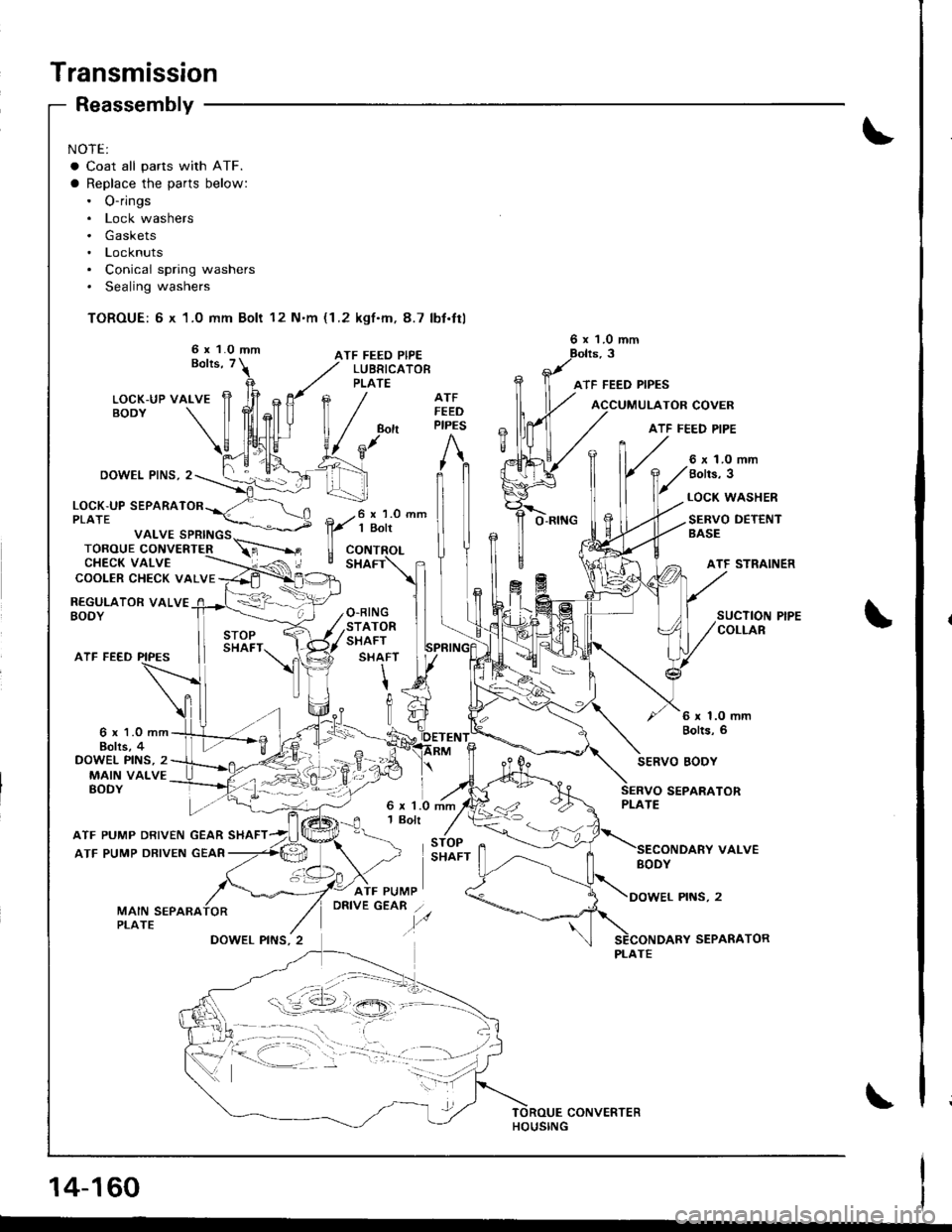
NOTE:
a Coat all parts with ATF.
a Replace the parts below:. O-rings. Lock washers. Gaskets. Locknuts. Conical spring washers. Sealing washers
TOROUE: 6 x 1.0 mm Bolt 12 N'm (1.2 kgf.m, 8.7 lbt.ttl
6 x 1.0 mmATF FEED PIPEBolts, T
Reassembly
DOWEL PINS, 2
ATF FEED
LUBRICATOBPLATE
6 x 1.0 mm
ATF FEED PIPES
O.RINGSTATORSHAFT
SHAFT
\tIt]U
ATFFEEDPIPES
STOPSHAFT
6 x 1.0 mmBolts, 6
TOR COVER
ATF FEED PIPE
VALVE SPRINGSTOROUE CONVERTERCHECK VALVECOOLER CHECK VALVE
LOCK-UP SEPARATPLATE
REGULATOR VALVEBODY
6 x 1.0 mm8olls, 3
LOCK WASHER
SERVO DETENTBASE
ATF STRAINER
SUCTION PIPECOLLAR
6 x 1.0 mmBohs, 4DOWEL PINS, 2MAIN VALVEBODY
SERVO EODY
SEPARATOR
VALVE
PINS,2
SEPARATOR
6 x 1.0 mm1 Bolt
ATF PUMP DRIVEN GEAR SHAFT
ATF PUMP DRIVEN GEAR
GEAR /.
.,,o
{--==,.-,,..;;,,, :_ :,_11,
PLATE
14-160
CONVERTER