maintenance schedule HONDA ODYSSEY 1995 User Guide
[x] Cancel search | Manufacturer: HONDA, Model Year: 1995, Model line: ODYSSEY, Model: HONDA ODYSSEY 1995Pages: 240, PDF Size: 2.44 MB
Page 140 of 240
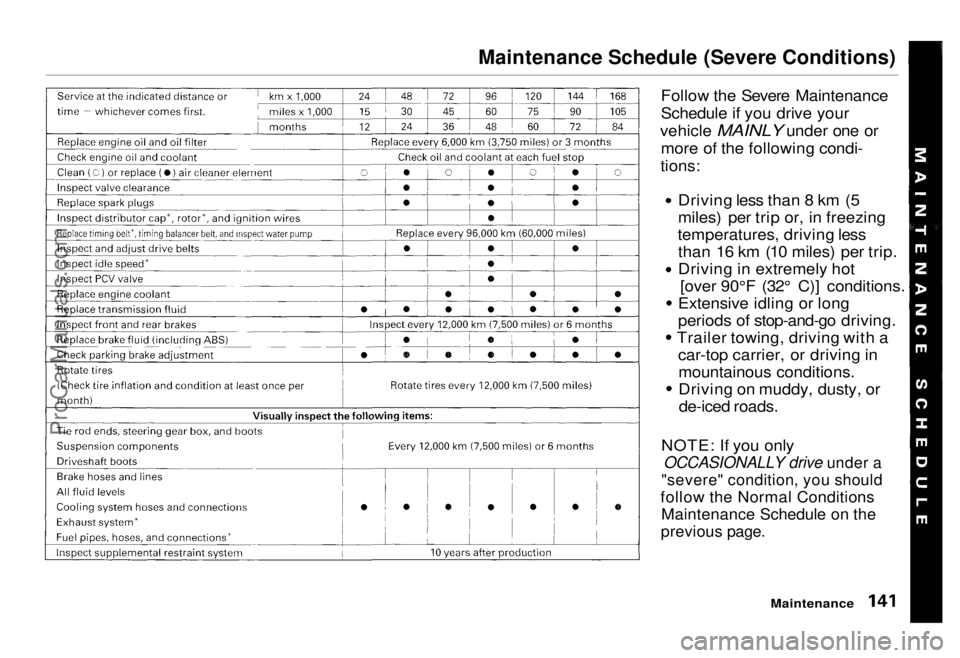
Maintenance Schedule (Severe Conditions)
Follow the Severe Maintenance
Schedule if you drive your
vehicle MAINLY under one or
more of the following condi-
tions:
Driving less than 8 km (5
miles) per trip or, in freezing
temperatures, driving less than 16 km (10 miles) per trip. Driving in extremely hot
[over 90°F (32° C)] conditions.
Extensive idling or long
periods of stop-and-go driving. Trailer towing, driving with a
car-top carrier, or driving inmountainous conditions. Driving on muddy, dusty, or
de-iced roads.
NOTE: If you only
OCCASIONALLY drive under a
"severe" condition, you should
follow the Normal Conditions Maintenance Schedule on the
previous page.
Maintenance
ProCarManuals.comMain Menu Table of Contents s t
Page 142 of 240
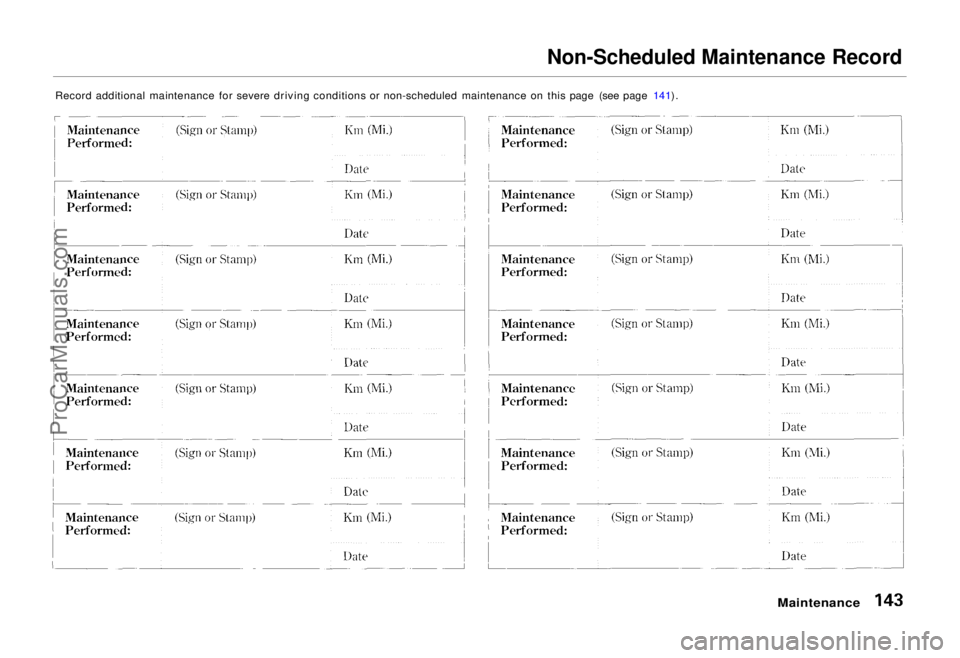
Non-Scheduled Maintenance Record
Maintenance
Record additional maintenance for severe driving conditions or non-scheduled maintenance on this page (see page 141).ProCarManuals.comMain Menu Table of Contents s t
Page 147 of 240
Engine Oil
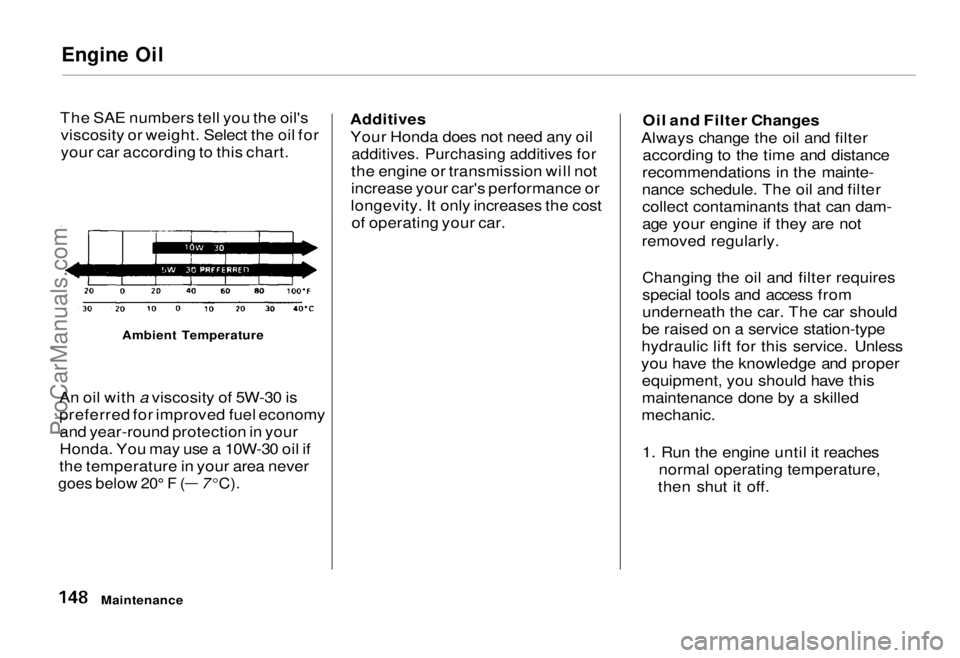
The SAE numbers tell you the oil's viscosity or weight. Select the oil for
your car according to this chart.
Ambient Temperature
An oil with a viscosity of 5W-30 is
preferred for improved fuel economy and year-round protection in your
Honda. You may use a 10W-30 oil if
the temperature in your area never
goes below 20° F ( —
7° C).
Additives
Your Honda does not need any oil
additives. Purchasing additives for
the engine or transmission will not
increase your car's performance or
longevity. It only increases the cost of operating your car. Oil and Filter Changes
Always change the oil and filter according to the time and distance
recommendations in the mainte-
nance schedule. The oil and filter collect contaminants that can dam-
age your engine if they are not
removed regularly.
Changing the oil and filter requires
special tools and access from
underneath the car. The car should
be raised on a service station-type
hydraulic lift for this service. Unless
you have the knowledge and proper equipment, you should have this
maintenance done by a skilled
mechanic.
1. Run the engine until it reaches normal operating temperature,
then shut it off.
MaintenanceProCarManuals.comMain Menu Table of Contents s t
Page 151 of 240
Cooling System
Do not add any rust inhibitors or other additives to your car's cooling
system. They may not be compatible
with the coolant or engine compo- nents.
Replacing Engine Coolant
The cooling system should be completely drained and refilled with
new coolant according to the time
and distance recommendations in
the maintenance schedule. Only use
recommended antifreeze.
Draining the coolant requires access
to the underside of the car. Unless
you have the tools and knowledge,
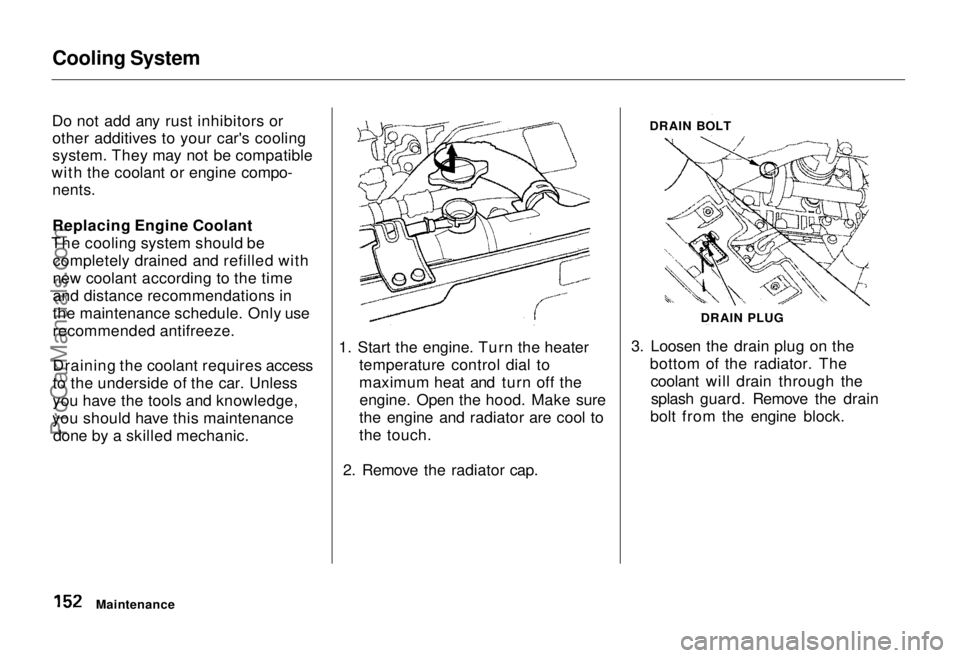
you should have this maintenance done by a skilled mechanic. 1. Start the engine. Turn the heater
temperature control dial to
maximum heat and turn off theengine. Open the hood. Make sure
the engine and radiator are cool to
the touch.
2. Remove the radiator cap. DRAIN BOLT
3. Loosen the drain plug on the bottom of the radiator. Thecoolant will drain through thesplash guard. Remove the drain
bolt from the engine block.
Maintenance DRAIN PLUGProCarManuals.comMain Menu Table of Contents s t
Page 181 of 240
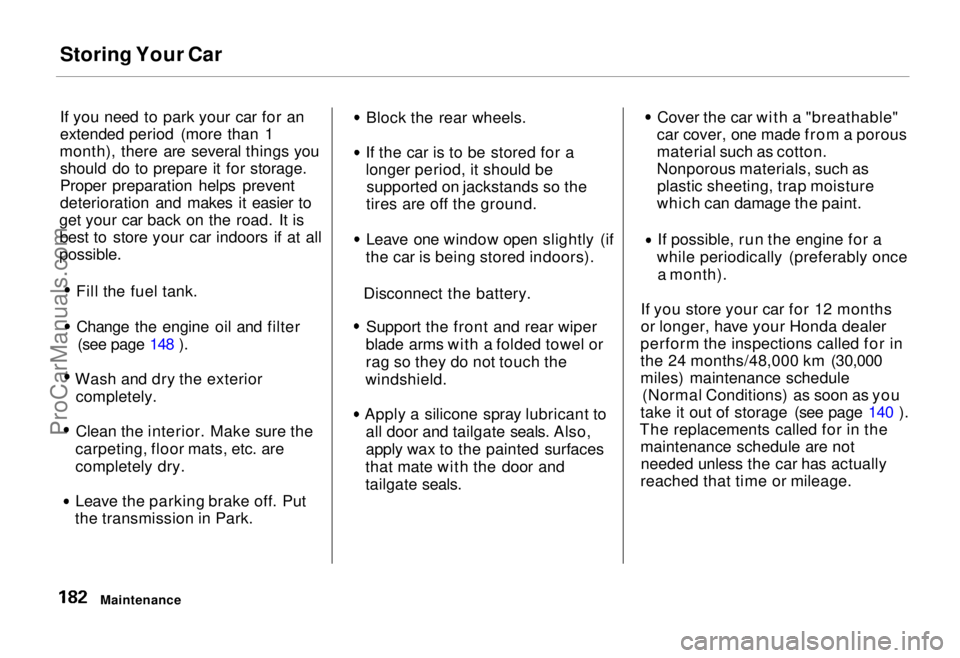
Storing Your Car
If you need to park your car for an
extended period (more than 1
month), there are several things you should do to prepare it for storage.
Proper preparation helps prevent
deterioration and makes it easier to
get your car back on the road. It is best to store your car indoors if at all
possible.
Fill the fuel tank. Change the engine oil and filter
(see page 148 ). Wash and dry the exterior
completely.
Clean the interior. Make sure the
carpeting, floor mats, etc. are
completely dry. Leave the parking brake off. Put
the transmission in Park. Block the rear wheels.
If the car is to be stored for a
longer period, it should be supported on jackstands so the
tires are off the ground. Leave one window open slightly (if
the car is being stored indoors).
Disconnect the battery. Support the front and rear wiper
blade arms with a folded towel or
rag so they do not touch the
windshield. Apply a silicone spray lubricant to
all door and tailgate seals. Also,
apply wax to the painted surfaces
that mate with the door and
tailgate seals. Cover the car with a "breathable"
car cover, one made from a porous
material such as cotton.
Nonporous materials, such as plastic sheeting, trap moisture
which can damage the paint. If possible, run the engine for a
while periodically (preferably once a month).
If you store your car for 12 months
or longer, have your Honda dealer
perform the inspections called for in
the 24 months/48,000 km (30,000
miles) maintenance schedule (Normal Conditions) as soon as you
take it out of storage (see page 140 ).
The replacements called for in the maintenance schedule are notneeded unless the car has actually
reached that time or mileage.
MaintenanceProCarManuals.comMain Menu Table of Contents s t
Page 222 of 240
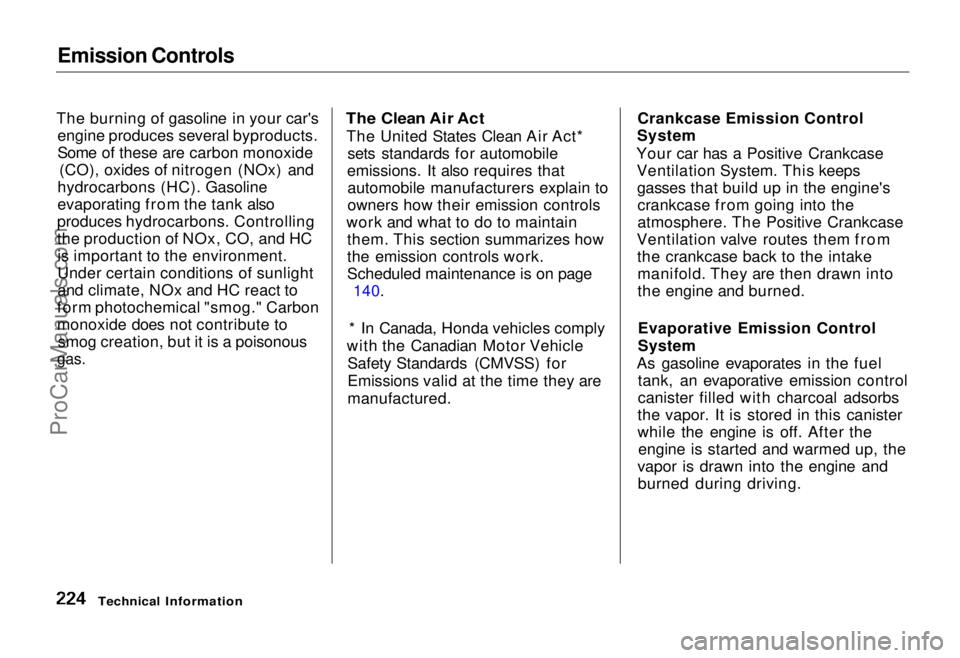
Emission Controls
The burning of gasoline in your car's engine produces several byproducts.
Some of these are carbon monoxide (CO), oxides of nitrogen (NOx) and
hydrocarbons (HC). Gasoline
evaporating from the tank also
produces hydrocarbons. Controlling
the production of NOx, CO, and HC is important to the environment.
Under certain conditions of sunlight
and climate, NOx and HC react to
form photochemical "smog." Carbon
monoxide does not contribute to smog creation, but it is a poisonous
gas.
The Clean Air Act
The United States Clean Air Act* sets standards for automobile
emissions. It also requires that automobile manufacturers explain to
owners how their emission controls
work and what to do to maintain them. This section summarizes how
the emission controls work.
Scheduled maintenance is on page
140.
* In Canada, Honda vehicles comply
with the Canadian Motor Vehicle Safety Standards (CMVSS) for
Emissions valid at the time they are
manufactured. Crankcase Emission Control
System
Your car has a Positive Crankcase Ventilation System. This keepsgasses that build up in the engine'scrankcase from going into the
atmosphere. The Positive Crankcase
Ventilation valve routes them from the crankcase back to the intakemanifold. They are then drawn into
the engine and burned.
Evaporative Emission Control
System
As gasoline evaporates in the fuel tank, an evaporative emission control
canister filled with charcoal adsorbs
the vapor. It is stored in this canister
while the engine is off. After the engine is started and warmed up, the
vapor is drawn into the engine and burned during driving.
Technical InformationProCarManuals.comMain Menu Table of Contents s t
Page 236 of 240
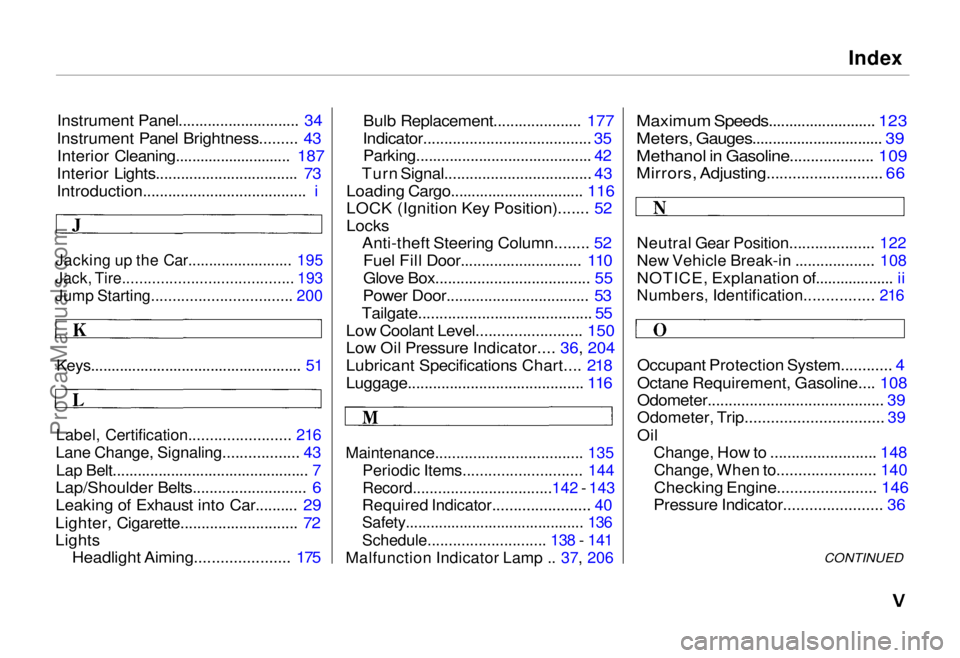
Index
Instrument Panel............................. 34
Instrument Panel Brightness......... 43 Interior Cleaning............................ 187
Interior Lights.................................. 73
Introduction....................................... i
Jacking up the Car......................... 195
Jack, Tire........................................ 193
Jump Starting................................. 200
Keys................................................... 51
Label, Certification........................ 216
Lane Change, Signaling.................. 43
Lap Belt............................................... 7
Lap/Shoulder Belts........................... 6
Leaking of Exhaust into Car.......... 29
Lighter, Cigarette............................ 72
Lights Headlight Aiming...................... 175 Bulb Replacement..................... 177
Indicator........................................ 35
Parking.......................................... 42
Turn Signal................................... 43
Loading Cargo................................ 116
LOCK (Ignition Key Position)....... 52
Locks Anti-theft Steering Column........ 52
Fuel Fill Door............................. 110
Glove Box..................................... 55
Power Door.................................. 53
Tailgate......................................... 55
Low Coolant Level......................... 150
Low Oil Pressure Indicator.... 36, 204
Lubricant Specifications Chart.... 218
Luggage.......................................... 116
Maximum Speeds.......................... 123
Meters, Gauges................................ 39
Methanol in Gasoline.................... 109
Mirrors, Adjusting........................... 66
Neutral Gear Position.................... 122
New Vehicle Break-in ................... 108
NOTICE, Explanation of................... ii
Numbers, Identification................ 216
Occupant Protection System............ 4
Octane Requirement, Gasoline.... 108
Odometer.......................................... 39
Odometer, Trip................................ 39
Oil
Change, How to ......................... 148
Change, When to....................... 140
Checking Engine....................... 146
Pressure Indicator....................... 36
CONTINUED
Maintenance................................... 135
Periodic Items............................ 144
Record.................................142 - 143
Required Indicator....................... 40
Safety........................................... 136
Schedule............................ 138 - 141
Malfunction Indicator Lamp .. 37, 206ProCarManuals.comMain Menu s t
Page 237 of 240
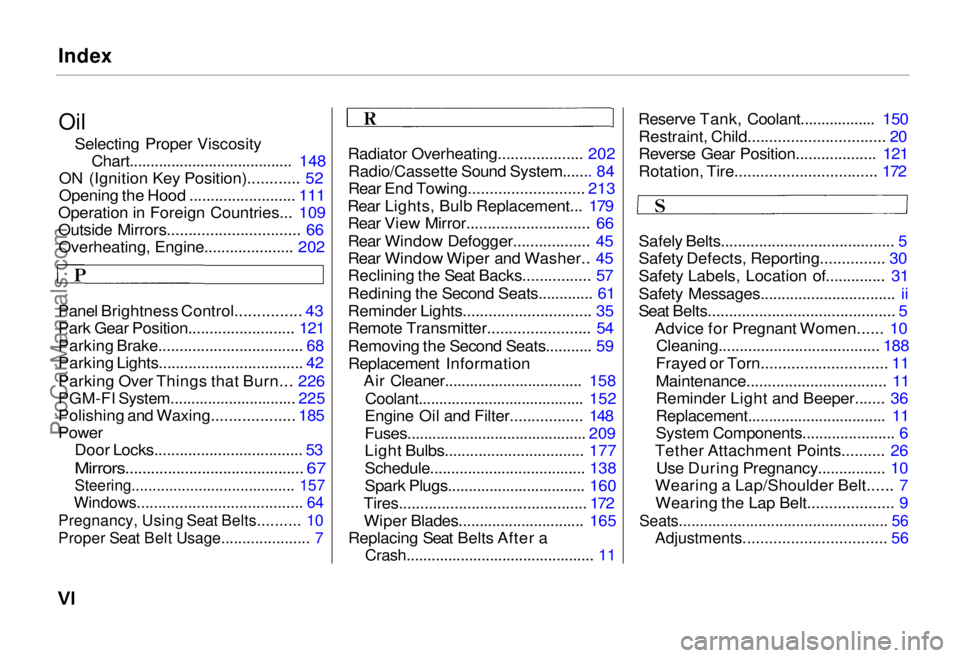
Index
Oil
Selecting Proper Viscosity Chart....................................... 148
ON (Ignition Key Position)............ 52
Opening the Hood ......................... 111
Operation in Foreign Countries... 109
Outside Mirrors............................... 66 Overheating, Engine..................... 202
Panel Brightness Control............... 43
Park Gear Position......................... 121
Parking Brake.................................. 68
Parking Lights.................................. 42
Parking Over Things that Burn... 226
PGM-FI System.............................. 225
Polishing and Waxing................... 185
Power
Door Locks................................... 53
Mirrors.......................................... 67
Steering....................................... 157
Windows....................................... 64
Pregnancy, Using Seat Belts.......... 10
Proper Seat Belt Usage..................... 7
Radiator Overheating.................... 202
Radio/Cassette Sound System....... 84
Rear End Towing........................... 213
Rear Lights, Bulb Replacement... 179 Rear View Mirror............................. 66
Rear Window Defogger.................. 45
Rear Window Wiper and Washer.. 45
Reclining the Seat Backs................ 57
Redining the Second Seats............. 61
Reminder Lights.............................. 35
Remote Transmitter........................ 54
Removing the Second Seats........... 59
Replacement Information Air Cleaner................................. 158
Coolant........................................ 152
Engine Oil and Filter................. 148
Fuses........................................... 209
Light Bulbs................................. 177
Schedule..................................... 138
Spark Plugs................................. 160
Tires............................................ 172 Wiper Blades.............................. 165
Replacing Seat Belts After a
Crash............................................. 11
Reserve Tank, Coolant.................. 150
Restraint, Child................................ 20
Reverse Gear Position................... 121
Rotation, Tire................................. 172
Safely Belts......................................... 5
Safety Defects, Reporting............... 30
Safety Labels, Location of.............. 31
Safety Messages................................ ii
Seat Belts............................................ 5 Advice for Pregnant Women...... 10Cleaning...................................... 188
Frayed or Torn............................. 11
Maintenance................................. 11
Reminder Light and Beeper....... 36
Replacement................................. 11
System Components...................... 6
Tether Attachment Points.......... 26 Use During Pregnancy................ 10
Wearing a Lap/Shoulder Belt...... 7
Wearing the Lap Belt.................... 9
Seats.................................................. 56
Adjustments................................. 56ProCarManuals.comMain Menu s t