pressure HONDA ODYSSEY 1996 User Guide
[x] Cancel search | Manufacturer: HONDA, Model Year: 1996, Model line: ODYSSEY, Model: HONDA ODYSSEY 1996Pages: 240, PDF Size: 2.64 MB
Page 148 of 240
Engine Oil
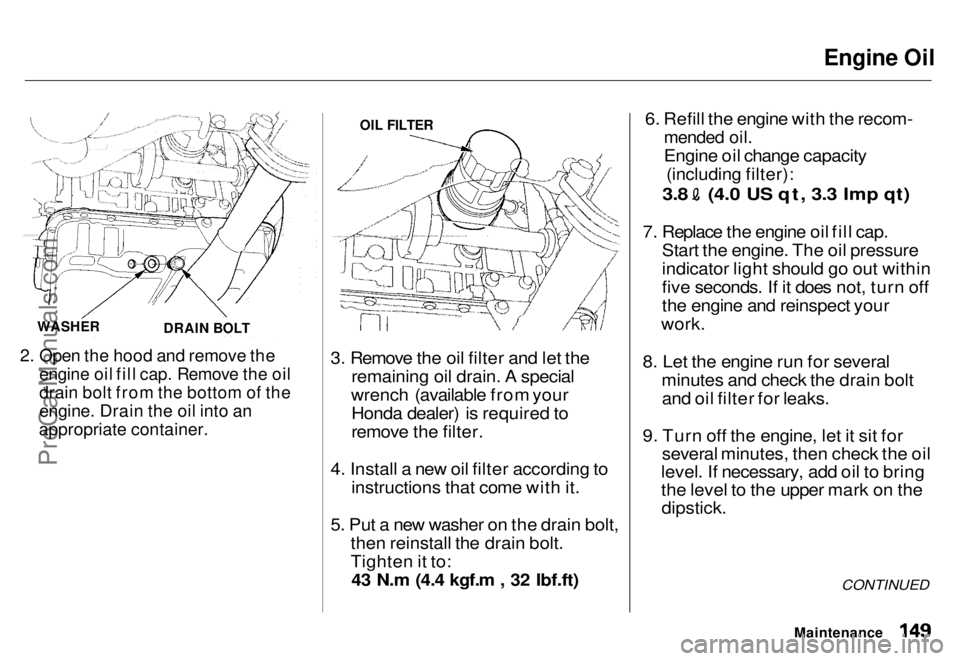
2. Open the hood and remove the
engine oil fill cap. Remove the oil
drain bolt from the bottom of the
engine. Drain the oil into an
appropriate container.
3. Remove the oil filter and let the
remaining oil drain. A special
wrench (available from your Honda dealer) is required to
remove the filter.
4. Install a new oil filter according to instructions that come with it.
5. Put a new washer on the drain bolt, then reinstall the drain bolt.
Tighten it to:43 N.m (4.4 kgf.m , 32 Ibf.ft) 6. Refill the engine with the recom-
mended oil.
Engine oil change capacity
(including filter):
3.8 (4.0 US qt, 3.3 Imp qt)
7. Replace the engine oil fill cap. Start the engine. The oil pressure
indicator light should go out within
five seconds. If it does not, turn off
the engine and reinspect your
work.
8. Let the engine run for several minutes and check the drain boltand oil filter for leaks.
9. Turn off the engine, let it sit for several minutes, then check the oil
level. If necessary, add oil to bring
the level to the upper mark on the
dipstick.
CONTINUED
Maintenance
WASHER
DRAIN BOLT OIL FILTER
ProCarManuals.comMain Menu s t Table of Contents
Page 150 of 240
Cooling System
Adding Engine Coolant If the reserve tank is completely
empty, you should also check the
coolant level in the radiator.
1. Make sure the engine and radiator
are cool.
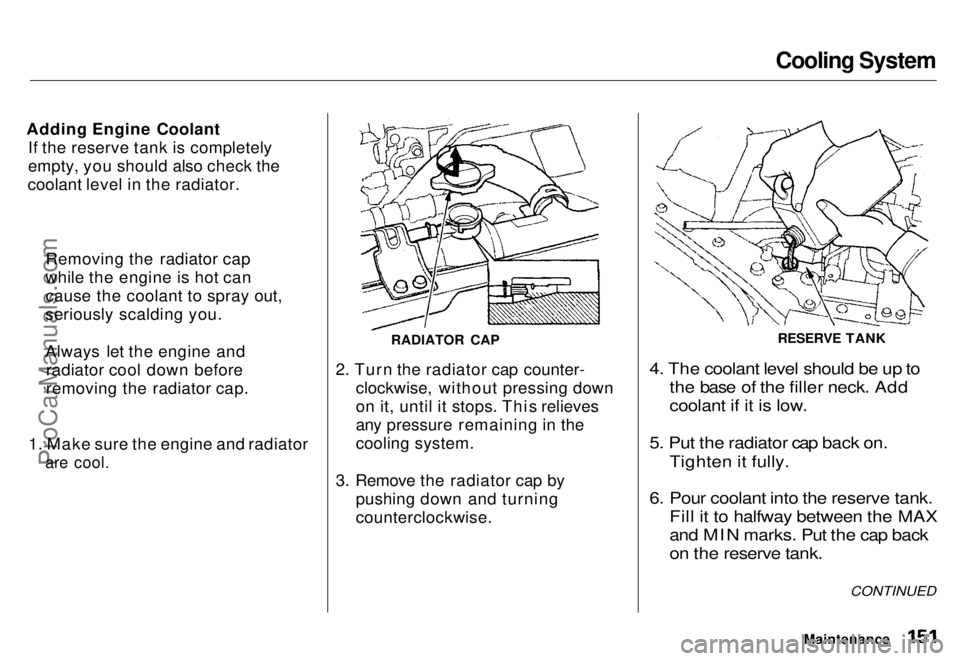
2. Turn the radiator cap counter-
clockwise, without pressing down
on it, until it stops. This relieves
any pressure remaining in the
cooling system.
3. Remove the radiator cap by pushing down and turning
counterclockwise.
4. The coolant level should be up to
the base of the filler neck. Add
coolant if it is low.
5. Put the radiator cap back on. Tighten it fully.
6. Pour coolant into the reserve tank. Fill it to halfway between the MAX
and MIN marks. Put the cap back
on the reserve tank.
Maintenance
CONTINUED
Removing the radiator cap
while the engine is hot can cause the coolant to spray out,
seriously scalding you.
Always let the engine and radiator cool down before
removing the radiator cap. RADIATOR CAP
RESERVE TANKProCarManuals.comMain Menu s t Table of Contents
Page 161 of 240

Battery
Check the condition of your car's
battery monthly. You should check for proper electrolyte level andcorrosion on the terminals. Emergency Procedures
Eyes — Flush with water from a cup
or other container for at least fifteen
minutes. (Water under pressure can damage the eye.) Immediately call a
physician or 911.
Skin — Remove contaminated
clothing. Flush the skin with large quantities of water. Call a physician
immediately.
Swallowing — Drink water or milk.Call your local Poison Control Center
or a physician immediately.
Maintenance
The battery contains sulfuric
acid (electrolyte) which is highly
corrosive and poisonous.
Getting electrolyte in your eyes
or on your skin can cause
serious burns.
Wear protective clothing andeye protection when workingnear the battery.ProCarManuals.comMain Menu s t Table of Contents
Page 167 of 240
Air Conditioning
Your car's air conditioning is a sealed system. Any major maintenance,
such as recharging, should be done
by a qualified technician. There are a couple of things you can do to makesure the air conditioning works
efficiently.
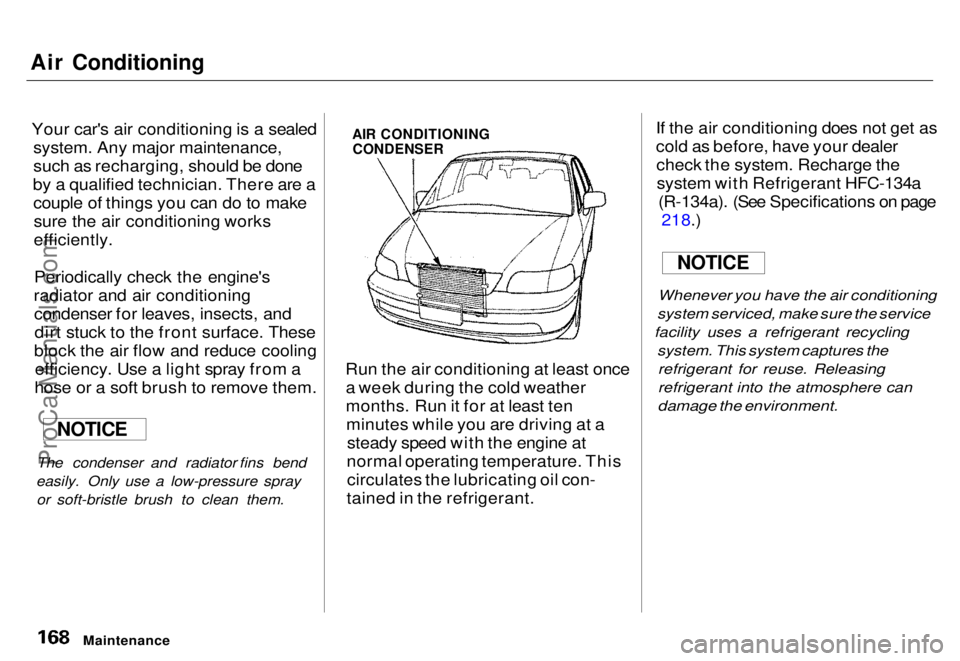
Periodically check the engine's
radiator and air conditioning condenser for leaves, insects, anddirt stuck to the front surface. These
block the air flow and reduce cooling efficiency. Use a light spray from a
hose or a soft brush to remove them.
The condenser and radiator fins bend
easily. Only use a low-pressure spray or soft-bristle brush to clean them.
AIR CONDITIONING
CONDENSER
Run the air conditioning at least once a week during the cold weather
months. Run it for at least tenminutes while you are driving at a steady speed with the engine at
normal operating temperature. This circulates the lubricating oil con-
tained in the refrigerant. If the air conditioning does not get as
cold as before, have your dealer
check the system. Recharge thesystem with Refrigerant HFC-134a (R-134a). (See Specifications on page 218.)
Whenever you have the air conditioning
system serviced, make sure the service
facility uses a refrigerant recycling
system. This system captures the
refrigerant for reuse. Releasing
refrigerant into the atmosphere can
damage the environment.
Maintenance
NOTICE
NOTICEProCarManuals.comMain Menu s t Table of Contents
Page 168 of 240
Drive Belts, Tires
Drive Belts
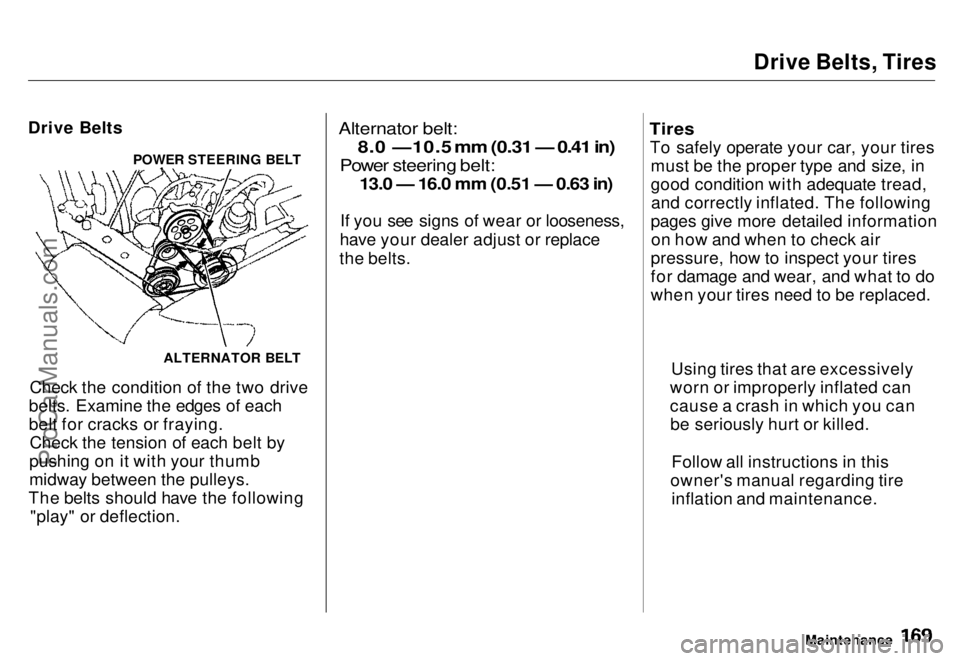
Check the condition of the two drive
belts. Examine the edges of each
belt for cracks or fraying. Check the tension of each belt by
pushing on it with your thumb
midway between the pulleys.
The belts should have the following "play" or deflection.
Alternator belt:
8.0 —10.5 mm (0.31 — 0.41 in)
Power steering belt:
13.0 — 16.0 mm (0.51 — 0.63 in)
If you see signs of wear or looseness,
have your dealer adjust or replace
the belts.
Tires
To safely operate your car, your tires must be the proper type and size, in
good condition with adequate tread,and correctly inflated. The following
pages give more detailed information on how and when to check air
pressure, how to inspect your tires
for damage and wear, and what to do
when your tires need to be replaced.
Maintenance
POWER STEERING BELT
ALTERNATOR BELT Using tires that are excessively
worn or improperly inflated can
cause a crash in which you can be seriously hurt or killed.
Follow all instructions in this
owner's manual regarding tire inflation and maintenance.ProCarManuals.comMain Menu s t Table of Contents
Page 169 of 240
Tires
InflationKeeping the tires properly inflatedprovides the best combination of
handling, tread life and riding
comfort. Under-inflated tires wear
unevenly, adversely affect handling
and fuel economy, and are more
likely to fail from being overheated. Overinflated tires can make your car
ride more harshly, are more prone to damage from road hazards, and wear
unevenly.
We recommend that you visually check your tires every day and use a
gauge to measure the air pressure at least once a month. If you think a tire
might be low, check it immediately. Remember to check the spare tire at
the same time you check all the other tires.
Check the pressure in the tires when
they are cold. This means the car has been parked for at least three
hours. If you have to drive the car
before checking the tire pressure,
the tires can still be considered
"cold" if you drive less than 1.6 km
(1 mile).
If you check the pressure when the
tires are hot (the car has been driven
several miles), you will see readings
30 to 40 kPa (0.3 to 0.4 kg/cm2,4 to
6 psi) higher than the cold reading.
This is normal. Do not let air out to
match the specified cold pressure.
The tire will be underinflated.
Recommended Tire Pressures for
Normal Driving
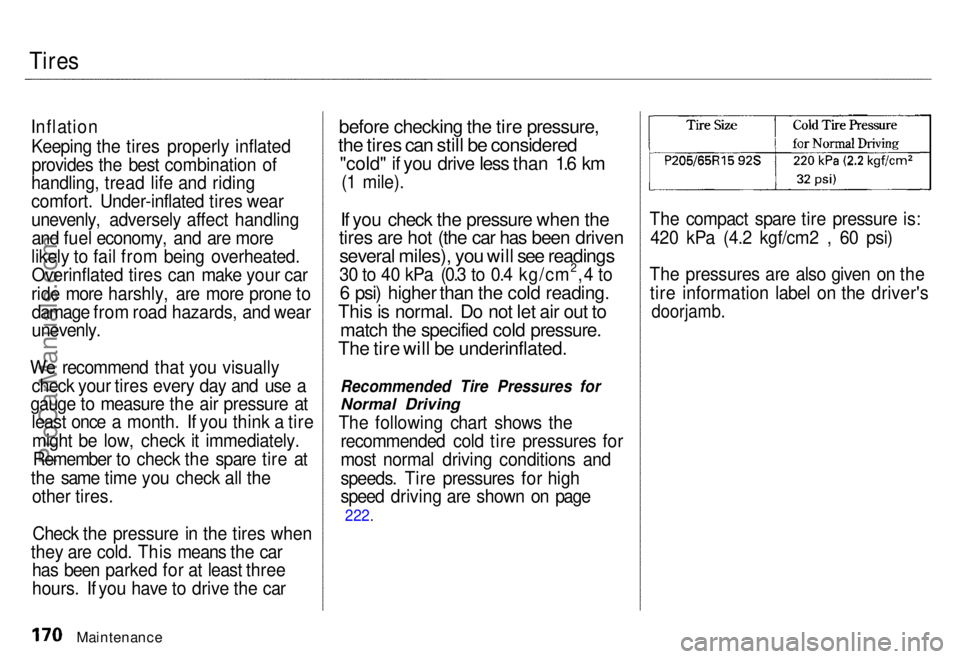
The following chart shows the recommended cold tire pressures for
most normal driving conditions and
speeds. Tire pressures for high
speed driving are shown on page 222. The compact spare tire pressure is:
420 kPa (4.2 kgf/cm2 , 60 psi)
The pressures are also given on the tire information label on the driver's
doorjamb.
MaintenanceProCarManuals.comMain Menu s t Table of Contents
Page 170 of 240
Tires
You should get your own tire pressure gauge and use it whenever
you check your tire pressures. This
will make it easier for you to tell if a pressure loss is due to a tire problem and not due to a variation between
gauges.
Tubeless tires have some ability to self-seal if they are punctured.
However, because leakage is often
very slow, you should look closely
for punctures if a tire starts losing
pressure.
Inspection
Every time you check inflation, you should also examine the tires fordamage, foreign objects, and wear. You should look for: Bumps or bulges in the tread or
side of the tire. Replace the tire if
you find either of these conditions. Cuts, splits, or cracks in the side
of the tire. Replace the tire if you
can see fabric or tread.
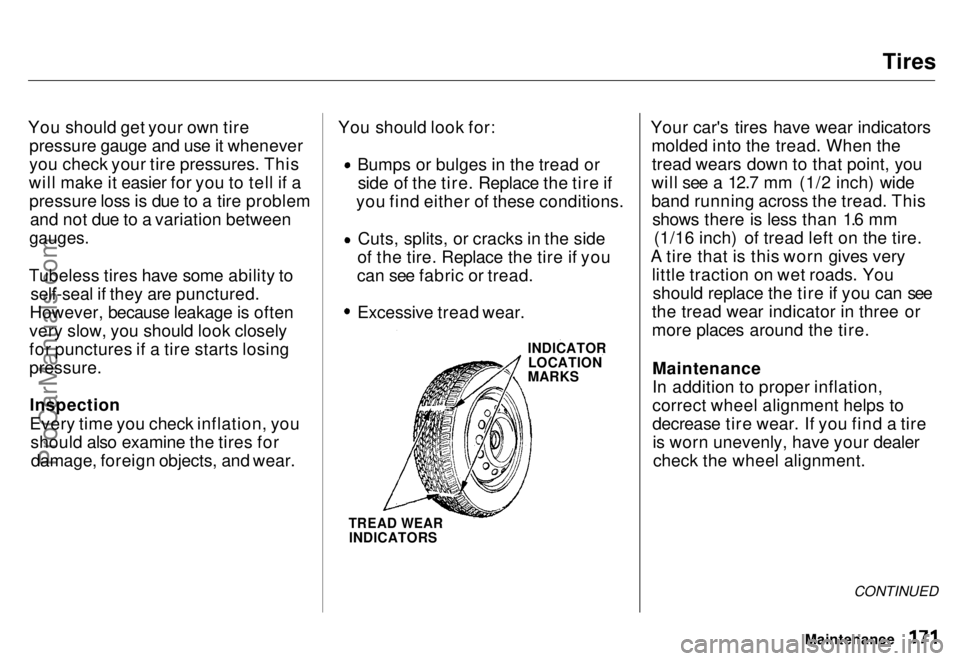
Excessive tread wear. Your car's tires have wear indicators
molded into the tread. When thetread wears down to that point, you
will see a 12.7 mm (1/2 inch) wide
band running across the tread. This shows there is less than 1.6 mm (1/16 inch) of tread left on the tire.
A tire that is this worn gives very little traction on wet roads. Youshould replace the tire if you can see
the tread wear indicator in three or
more places around the tire.
Maintenance
In addition to proper inflation,
correct wheel alignment helps to
decrease tire wear. If you find a tireis worn unevenly, have your dealercheck the wheel alignment.
CONTINUED
Maintenance
INDICATOR
LOCATION
MARKS
TREAD WEAR
INDICATORSProCarManuals.comMain Menu s t Table of Contents
Page 171 of 240
Tires
The tires were properly balanced by the factory. They may need to be
rebalanced at some time before theyare worn out. Have your dealer
check the tires if you feel a consis-
tent vibration while driving. A tire should always be rebalanced if it is
removed from the wheel for repair.
Make sure the installer balances the
wheels when you have new tires installed. This increases riding
comfort and tire life. Your car's
original tires were dynamic or "spin"
balanced at the factory. For best
results, have the installer perform a dynamic balance.
(U.S.
EX)
Improper wheel weights can damage
your car's aluminum wheels. Use only
genuine Honda wheel weights forbalancing.
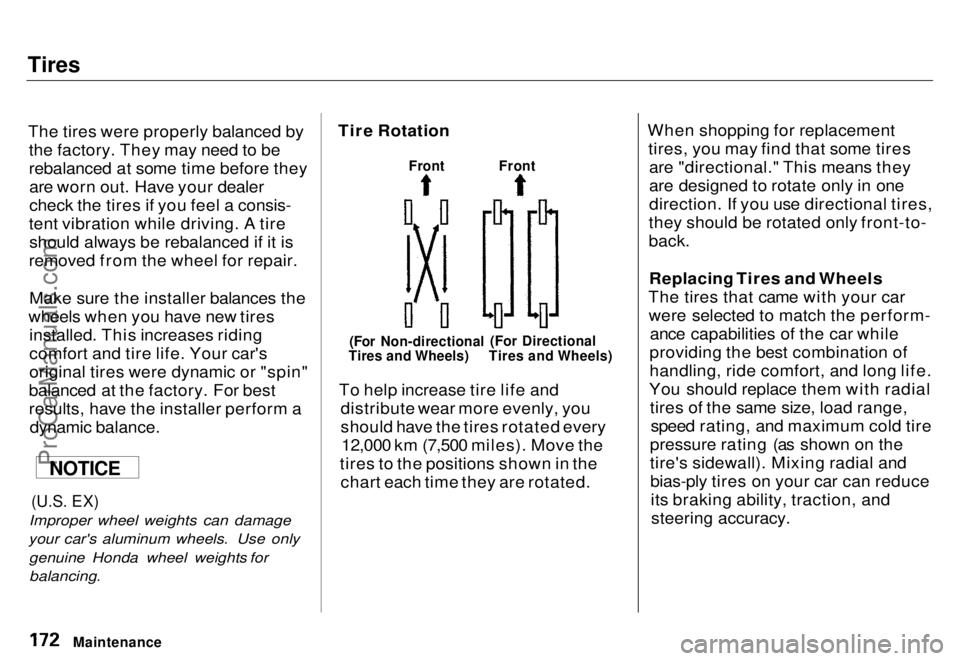
Tire Rotation
To help increase tire life and distribute wear more evenly, you
should have the tires rotated every12,000 km (7,500 miles). Move the
tires to the positions shown in the chart each time they are rotated. When shopping for replacement
tires, you may find that some tiresare "directional." This means they
are designed to rotate only in one
direction. If you use directional tires,
they should be rotated only front-to-
back.
Replacing Tires and Wheels
The tires that came with your car were selected to match the perform- ance capabilities of the car while
providing the best combination of
handling, ride comfort, and long life.
You should replace them with radial tires of the same size, load range,speed rating, and maximum cold tire
pressure rating (as shown on the
tire's sidewall). Mixing radial and bias-ply tires on your car can reduceits braking ability, traction, andsteering accuracy.
Maintenance
(For Directional
Tires and Wheels)
(For Non-directional
Tires and Wheels)
Front
Front
NOTICEProCarManuals.comMain Menu s t Table of Contents
Page 186 of 240
Interior Care
Seat Belts
If your seat belts get dirty, you can
use a soft brush with a mixture ofmild soap and warm water to clean
them. Do not use bleach, dye, or
cleaning solvents. They can weaken
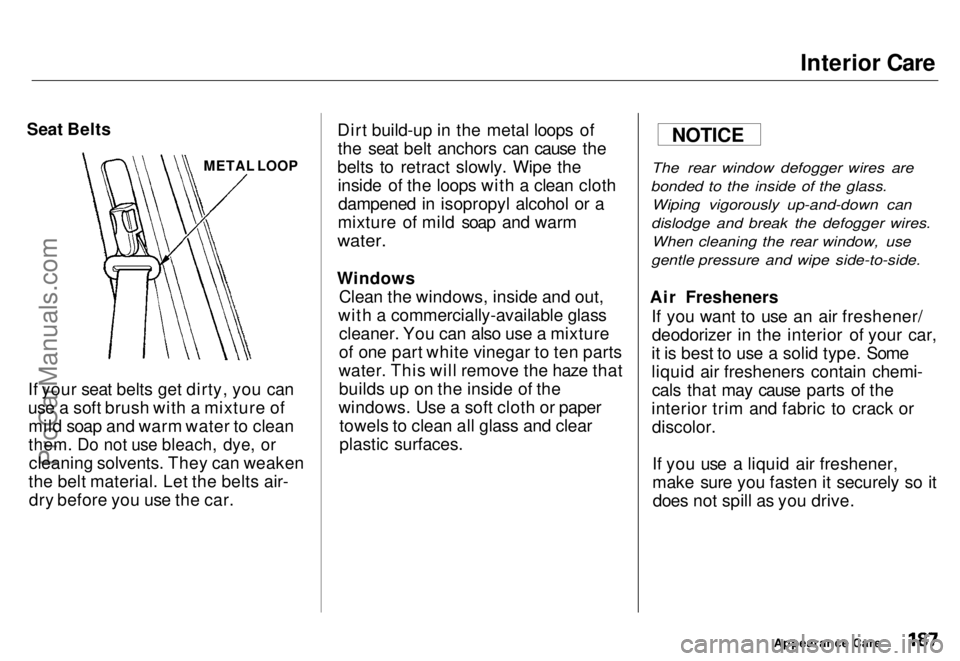
the belt material. Let the belts air- dry before you use the car. Dirt build-up in the metal loops of
the seat belt anchors can cause the
belts to retract slowly. Wipe the inside of the loops with a clean clothdampened in isopropyl alcohol or a
mixture of mild soap and warm
water.
Windows Clean the windows, inside and out,
with a commercially-available glass cleaner. You can also use a mixture
of one part white vinegar to ten parts
water. This will remove the haze that builds up on the inside of the
windows. Use a soft cloth or paper towels to clean all glass and clear
plastic surfaces.
The rear window defogger wires are
bonded to the inside of the glass. Wiping vigorously up-and-down can
dislodge and break the defogger wires. When cleaning the rear window, use
gentle pressure and wipe side-to-side.
Air Fresheners If you want to use an air freshener/deodorizer in the interior of your car,
it is best to use a solid type. Some
liquid air fresheners contain chemi- cals that may cause parts of the
interior trim and fabric to crack or discolor.
If you use a liquid air freshener,
make sure you fasten it securely so itdoes not spill as you drive.
Appearance Care
NOTICE
METAL LOOPProCarManuals.comMain Menu s t Table of Contents
Page 187 of 240
Corrosion Protection
Two factors normally contribute to causing corrosion in your car:
1. Moisture trapped in body cavities. Dirt and road salt that collects in
hollows on the underside of the car stays damp, promoting
corrosion in that area.
2. Removal of paint and protective coatings from the exterior and
underside of the car. Many corrosion-preventive measures
are built into your Honda. You can
help keep your car from corroding
by performing some simple periodic
maintenance:
Repair chips and scratches in the
paint as soon as you discover them.
Inspect and clean out the drain
holes in the bottom of the doors and body. Check the floor coverings for
dampness. Carpeting and floor
mats may remain damp for a long
time, especially in winter. This dampness can eventually cause
the floor panels to corrode. Use a high-pressure spray to clean
the underside of your car. This is especially important in areas that
use road salt in winter. It is also a
good idea in humid climates and areas subject to salt air. Carsequipped with ABS have a sensor
and wiring at each wheel. Be
careful not to damage them. Have the corrosion-preventive
coatings on the underside of your
car inspected and repaired periodically.
Appearance CareProCarManuals.comMain Menu s t Table of Contents