pressure HONDA ODYSSEY 1996 Owner's Manual
[x] Cancel search | Manufacturer: HONDA, Model Year: 1996, Model line: ODYSSEY, Model: HONDA ODYSSEY 1996Pages: 240, PDF Size: 2.64 MB
Page 189 of 240

Taking Care of the Unexpected
This section covers the more- common problems that motorists
experience with their cars. It gives
you information about how to safely evaluate the problem and what to do
to correct it. If the problem has stranded you on the side of the road,
you may be able to get going again. If not, you will also find instructionson getting your car towed. Compact Spare Tire....................... 192
Changing a Flat Tire..................... 193
If Your Engine Won't Start........... 199
Nothing Happens....................... 199
The Starter Operates Normally................................. 200
Jump Starting................................. 200
If Your Engine Overheats............. 202
Low Oil Pressure........................... 204
Charging System Indication......... 205
Malfunction Indicator Lamp........ 206
Closing the Sunroof....................... 207
Fuses............................................... 208
Checking and Replacing........... 209
Towing............................................ 213
Taking Care of the UnexpectedProCarManuals.comMain Menu s t
Page 190 of 240
Compact Spare Tire
Your car has a compact spare tire that takes up less space. Use this spare tire as a temporary replace-
ment only. Get your regular tire
repaired or replaced and put back on
your car as soon as you can.
Check the inflation pressure of the
compact spare tire every time you
check the other tires. It should be
inflated to:420 kPa (4.2 kgf/cm2 , 60 psi)
Follow these precautions whenever
you are using the compact spare tire:
Do not exceed 50 mph (80 km/h)
under any circumstances.
This tire gives a harsher ride and
less traction on some road sur-
faces than the regular tire. Use
greater caution while driving on
this tire.
Do not mount snow chains on the
compact spare.
The wheel of the compact spare
tire is designed especially to fit
your car. Do not use your spare tire on another car unless it is the
same make and model.
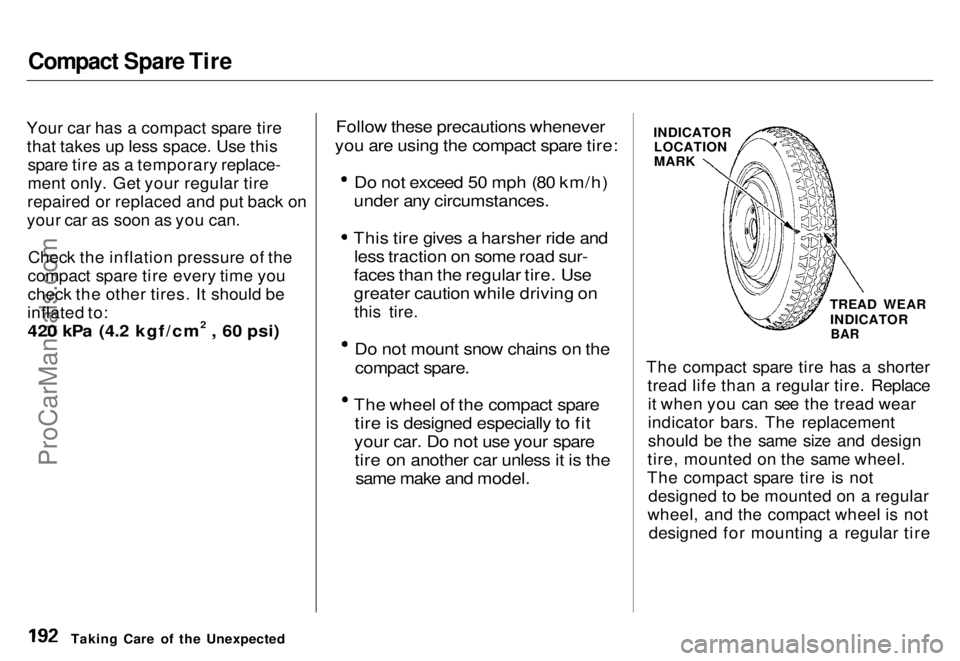
INDICATOR
LOCATION
MARK
TREAD WEARINDICATOR
BAR
The compact spare tire has a shorter tread life than a regular tire. Replaceit when you can see the tread wear
indicator bars. The replacement
should be the same size and design
tire, mounted on the same wheel.
The compact spare tire is not designed to be mounted on a regular
wheel, and the compact wheel is not designed for mounting a regular tire
Taking Care of the Unexpected
ProCarManuals.coms t Main Menu Table of Contents
Page 201 of 240

If Your Engine Overheats
4. If the temperature gauge stays at the red mark, turn off the engine.
5. Wait until you see no more signs of steam or spray, then open the
hood.
6. Look for any obvious coolant leaks, such as a split radiator hose.
Everything is still extremely hot, so use caution. If you find a leak, it
must be repaired before you continue driving (see Towing on
page 213 ).
7. If you don't find an obvious leak, check the coolant level in the
radiator reserve tank (see page150 ). If the level is below the
MIN mark, add coolant to half-way
between the MIN and MAX marks.
8. If there was no coolant in the reserve tank, you may also have toadd coolant to the radiator. Let the
engine cool down until the pointer reaches the middle of the tempera-
ture gauge, or lower, before check-
ing the radiator.
9. Using gloves or a large heavy cloth, turn the radiator capcounterclockwise, without pushing
down, to the first stop. This
releases any remaining pressure in
the cooling system. After the pressure releases, push down on
the cap and turn it until it comesoff. 10.Start the engine and set the
temperature control lever tomaximum. Add coolant to the
radiator up to the base of the filler
neck. If you do not have the
proper coolant mixture available,
you can add plain water. Remember to have the coolingsystem drained and refilled with
the proper mixture as soon as you
can.
11. Put the radiator cap back on tightly. Run the engine and watch
the temperature gauge. If it goesback to the red mark, the engine
needs repair. (See Towing on
page 213.)
12.If the temperature stays normal, check the coolant level in the
radiator reserve tank. If it has gone down, add coolant to theMAX mark. Put the cap back on
tightly.
Taking Care of the Unexpected
Removing the radiator cap
while the engine is hot can
cause the coolant to spray out, seriously scalding you.
Always let the engine and radiator cool down before
removing the radiator cap.ProCarManuals.comMain Menu s t Table of Contents
Page 202 of 240
Low Oil Pressure
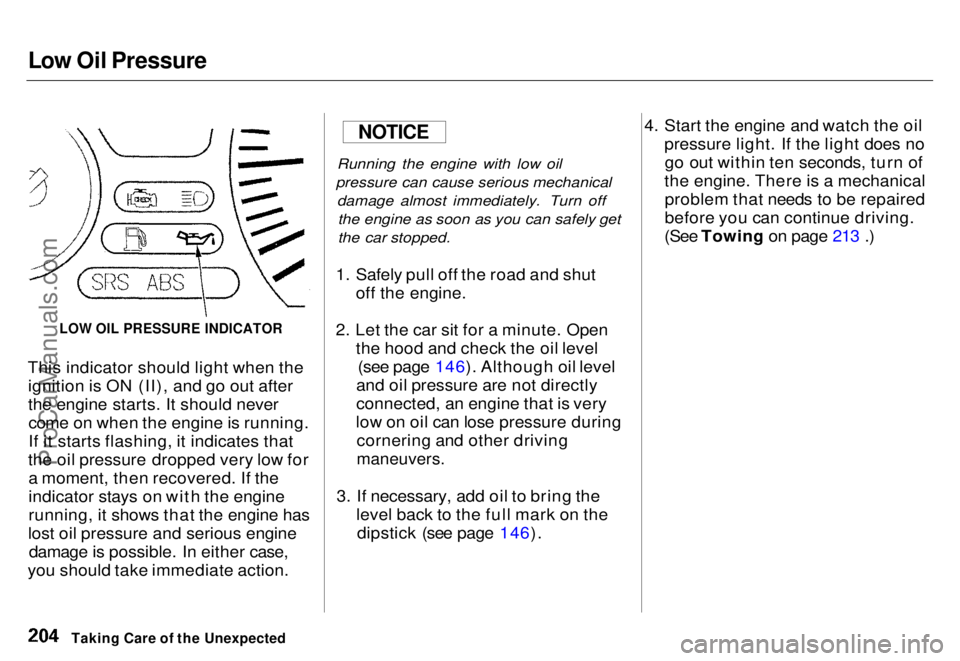
This indicator should light when the ignition is ON (II), and go out after
the engine starts. It should nevercome on when the engine is running.
If it starts flashing, it indicates that
the oil pressure dropped very low for a moment, then recovered. If the
indicator stays on with the engine
running, it shows that the engine has
lost oil pressure and serious engine damage is possible. In either case,
you should take immediate action.
Running the engine with low oil
pressure can cause serious mechanical damage almost immediately. Turn offthe engine as soon as you can safely get
the car stopped.
1. Safely pull off the road and shut off the engine.
2. Let the car sit for a minute. Open the hood and check the oil level(see page 146). Although oil level
and oil pressure are not directly
connected, an engine that is very
low on oil can lose pressure during cornering and other driving
maneuvers.
3. If necessary, add oil to bring the level back to the full mark on thedipstick (see page 146). 4. Start the engine and watch the oil
pressure light. If the light does nogo out within ten seconds, turn of
the engine. There is a mechanical problem that needs to be repaired
before you can continue driving.
(See Towing on page 213 .)
Taking Care of the Unexpected
NOTICE
LOW OIL PRESSURE INDICATORProCarManuals.comMain Menu s t Table of Contents
Page 212 of 240
Technical Information
The diagrams in this section give
you the dimensions and capacities of
your Honda, and the locations of the identification numbers. The expla-
nations of several electronic and
mechanical systems on your Honda
are for the more technically-orientedowner. Identification Numbers................. 216
Specifications................................. 218
Anti-lock Brake System................ 220 Tire Information............................ 221
Tire Size Designation................ 221Wheel Size Designation............ 221
Tire Speed Ratings.................... 221 Tire Pressure Adjustment For High Speed Driving........ 222
DOT Tire Quality Grading....... 222
Treadwear.............................. 222
Traction.................................. 223
Temperature.......................... 223 Emission Controls......................... 224
The Clean Air Act...................... 224Crankcase Emission Control System..................................... 224
Evaporative Emission Control
System.....................................224
Exhaust Emission Controls...... 225 PGM-FI System..................... 225
Ignition Timing Control System................................. 225
Exhaust Gas Recirculation (EGR) System.................... 225
Three Way Catalytic Converter............................ 225
Replacement Parts..................... 225
Three Way Catalytic Converter... 226
Technical InformationProCarManuals.comMain Menu s t
Page 217 of 240

Anti-lock Brake System
The Anti-lock Brake System (ABS) is standard equipment on all U.S.
models and the Canadian six-
passenger model. It is optional on the
Canadian seven-passenger model.
The ABS works by measuring how fast the wheels are turning during
braking and comparing their speeds.
If any wheel is rotating much slower
than the others (on the verge of locking up and skidding), the systemreduces hydraulic pressure to that
wheel's brake caliper. When that wheel's speed matches the other
wheels, the system applies normal
hydraulic pressure. This can take
place several times per second at
each wheel. You feel the ABS
working as rapid pulsations in the
brake pedal.
Each wheel has a wheel speed
sensor assembly. As the wheel
rotates, the sensor sends electrical pulses to the ABS control unit. The
pulse frequency varies with the
wheel speed.
The electrical output of the ABS control unit is connected to the
modulator/solenoid unit. During
braking, the ABS control unit monitors the pulse frequencies from
the four wheels. When the control unit detects a wheel locking up, itenergizes the appropriate solenoid in
the modulator/solenoid unit. There are six solenoids: two for each front
wheel, and two for the rear wheels.
The energized solenoid reduces hydraulic pressure to one side of amodulator valve. This, in turn,
reduces hydraulic pressure in the
brake line going to the affected
wheel. When that wheel speeds up because of the reduced braking effort, the control unit de-energizes the solenoid. This builds hydraulic
pressure on the modulator valve.
The pressure increases in the hydraulic line to the wheel.
For the system to react quickly, the
modulator/solenoid unit must have
brake fluid under high pressure.
This is supplied by a piston-type accumulator that is pressurized by
an electric pump. A pressure-sensingswitch on the accumulator controls
this pump.
The control unit also contains error detection circuitry. It monitors the
operation of the wheel sensors,solenoids, pump, and electronics. If
the control unit detects any faults, it shuts off power to the pump motor
and solenoids, disabling the ABS.
The indicator on the instrument panel comes on. The brakes then
work like a conventional system
without anti-lock capabilities.
Technical InformationProCarManuals.comMain Menu s t Table of Contents
Page 219 of 240
Tire Information
Tire Pressure Adjustment For
High Speed Driving
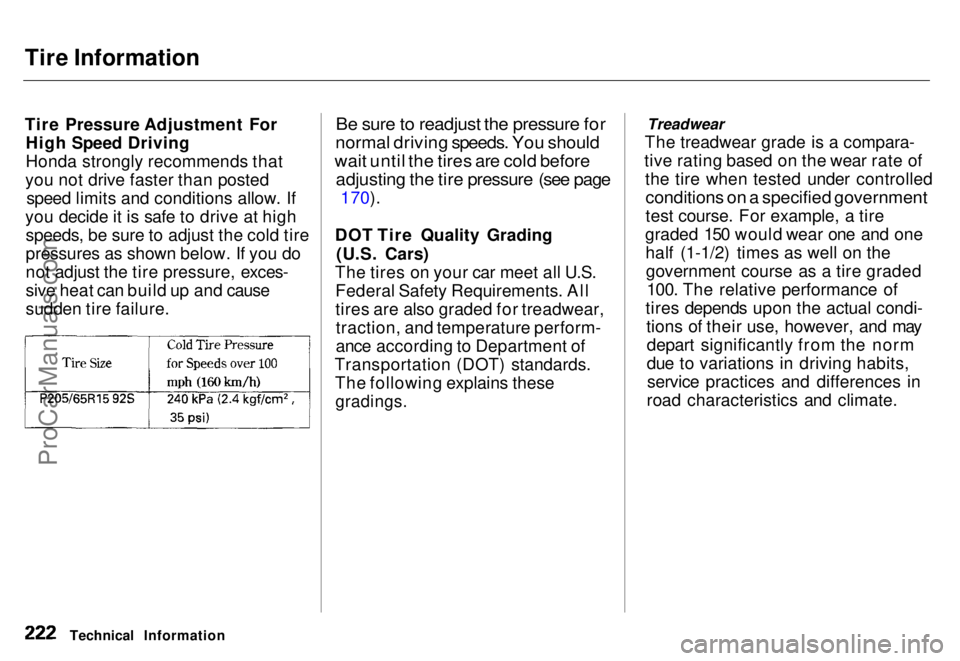
Honda strongly recommends that
you not drive faster than posted speed limits and conditions allow. If
you decide it is safe to drive at high speeds, be sure to adjust the cold tire
pressures as shown below. If you do
not adjust the tire pressure, exces-
sive heat can build up and cause
sudden tire failure.
Be sure to readjust the pressure for
normal driving speeds. You should
wait until the tires are cold before adjusting the tire pressure (see page
170).
DOT Tire Quality Grading (U.S. Cars)
The tires on your car meet all U.S. Federal Safety Requirements. All
tires are also graded for treadwear,traction, and temperature perform-
ance according to Department of
Transportation (DOT) standards. The following explains these
gradings.
Treadwear
The treadwear grade is a compara-
tive rating based on the wear rate of the tire when tested under controlled
conditions on a specified government
test course. For example, a tire
graded 150 would wear one and one half (1-1/2) times as well on thegovernment course as a tire graded 100. The relative performance of
tires depends upon the actual condi- tions of their use, however, and maydepart significantly from the norm
due to variations in driving habits,service practices and differences in
road characteristics and climate.
Technical InformationProCarManuals.comMain Menu s t Table of Contents
Page 232 of 240
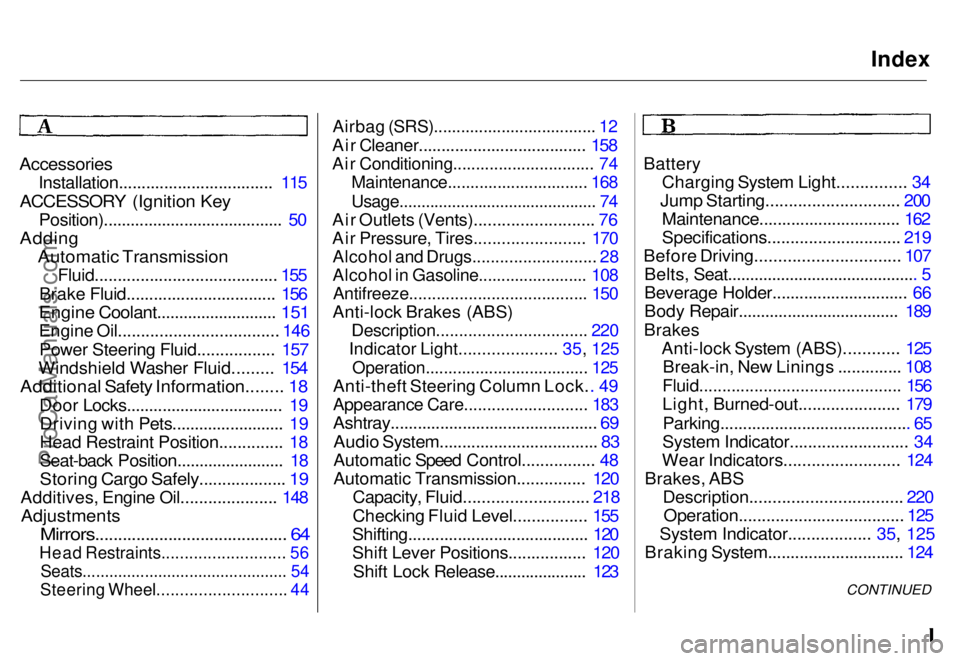
Index
Accessories
Installation.................................. 115
ACCESSORY (Ignition Key
Position)........................................ 50
Adding Automatic Transmission
Fluid........................................ 155
Brake Fluid................................. 156
Engine Coolant........................... 151
Engine Oil................................... 146
Power Steering Fluid................. 157
Windshield Washer Fluid......... 154
Additional Safety Information........ 18
Door Locks................................... 19Driving with Pets......................... 19
Head Restraint Position.............. 18
Seat-back Position........................ 18
Storing Cargo Safely................... 19
Additives, Engine Oil..................... 148
Adjustments
Mirrors.......................................... 64
Head Restraints........................... 56
Seats.............................................. 54
Steering Wheel............................ 44
Airbag (SRS).................................... 12
Air Cleaner..................................... 158
Air Conditioning............................... 74
Maintenance............................... 168
Usage............................................. 74
Air Outlets (Vents).......................... 76
Air Pressure, Tires........................ 170
Alcohol and Drugs........................... 28
Alcohol in Gasoline........................ 108
Antifreeze....................................... 150
Anti-lock Brakes (ABS)
Description................................. 220
Indicator Light..................... 35, 125
Operation.................................... 125
Anti-theft Steering Column Lock.. 49
Appearance Care........................... 183
Ashtray.............................................. 69
Audio System................................... 83
Automatic Speed Control................ 48
Automatic Transmission............... 120
Capacity, Fluid........................... 218
Checking Fluid Level................ 155
Shifting........................................ 120
Shift Lever Positions................. 120
Shift Lock Release..................... 123 Battery
Charging System Light............... 34
Jump Starting............................. 200 Maintenance............................... 162
Specifications............................. 219
Before Driving............................... 107
Belts, Seat........................................... 5
Beverage Holder.............................. 66
Body Repair.................................... 189
Brakes Anti-lock System (ABS)............ 125Break-in, New Linings .............. 108
Fluid............................................ 156
Light, Burned-out...................... 179
Parking.......................................... 65
System Indicator.......................... 34
Wear Indicators......................... 124
Brakes, ABS Description................................. 220Operation.................................... 125
System Indicator.................. 35, 125
Braking System.............................. 124
CONTINUEDProCarManuals.comMain Menu s t
Page 234 of 240
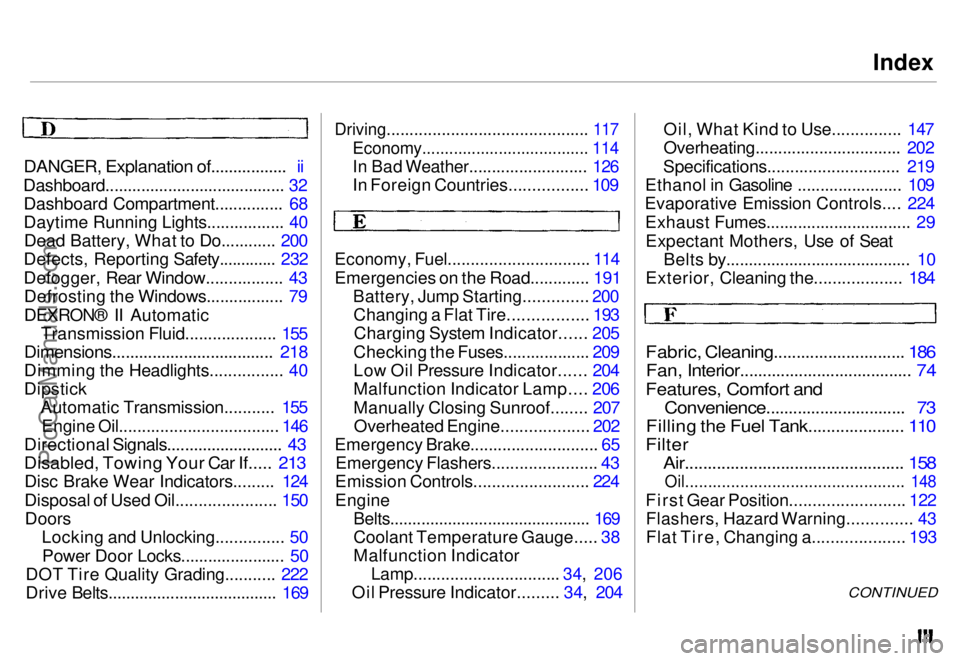
Index
DANGER, Explanation of................. ii
Dashboard........................................ 32 Dashboard Compartment............... 68
Daytime Running Lights................. 40Dead Battery, What to Do............ 200
Defects, Reporting Safety............. 232
Defogger, Rear Window................. 43 Defrosting the Windows................. 79
DEXRON® II Automatic Transmission Fluid.................... 155
Dimensions.................................... 218
Dimming the Headlights................ 40
Dipstick Automatic Transmission........... 155
Engine Oil................................... 146
Directional Signals.......................... 43
Disabled, Towing Your Car If..... 213
Disc Brake Wear Indicators......... 124
Disposal of Used Oil...................... 150Doors Locking and Unlocking............... 50
Power Door Locks....................... 50
DOT Tire Quality Grading........... 222
Drive Belts...................................... 169
Driving............................................ 117
Economy..................................... 114
In Bad Weather.......................... 126
In Foreign Countries................. 109
Economy, Fuel............................... 114
Emergencies on the Road............. 191
Battery, Jump Starting.............. 200
Changing a Flat Tire................. 193
Charging System Indicator...... 205
Checking the Fuses................... 209
Low Oil Pressure Indicator...... 204
Malfunction Indicator Lamp.... 206
Manually Closing Sunroof........ 207
Overheated Engine................... 202
Emergency Brake............................ 65
Emergency Flashers....................... 43
Emission Controls......................... 224
Engine
Belts............................................. 169
Coolant Temperature Gauge..... 38
Malfunction Indicator
Lamp................................ 34,
206
Oil Pressur e
Indicator......... 34, 204Oil, What Kind to Use............... 147
Overheating................................ 202
Specifications............................. 219
Ethanol in Gasoline ....................... 109
Evaporative Emission Controls.... 224
Exhaust Fumes................................ 29Expectant Mothers, Use of Seat Belts by......................................... 10
Exterior, Cleaning the................... 184
Fabric, Cleaning............................. 186
Fan, Interior...................................... 74
Features, Comfort and
Convenience............................... 73
Filling the Fuel Tank..................... 110
Filter
Air................................................ 158
Oil................................................ 148
First Gear Position......................... 122
Flashers, Hazard Warning.............. 43
Flat Tire, Changing a.................... 193
CONTINUEDProCarManuals.comMain Menu s t
Page 236 of 240
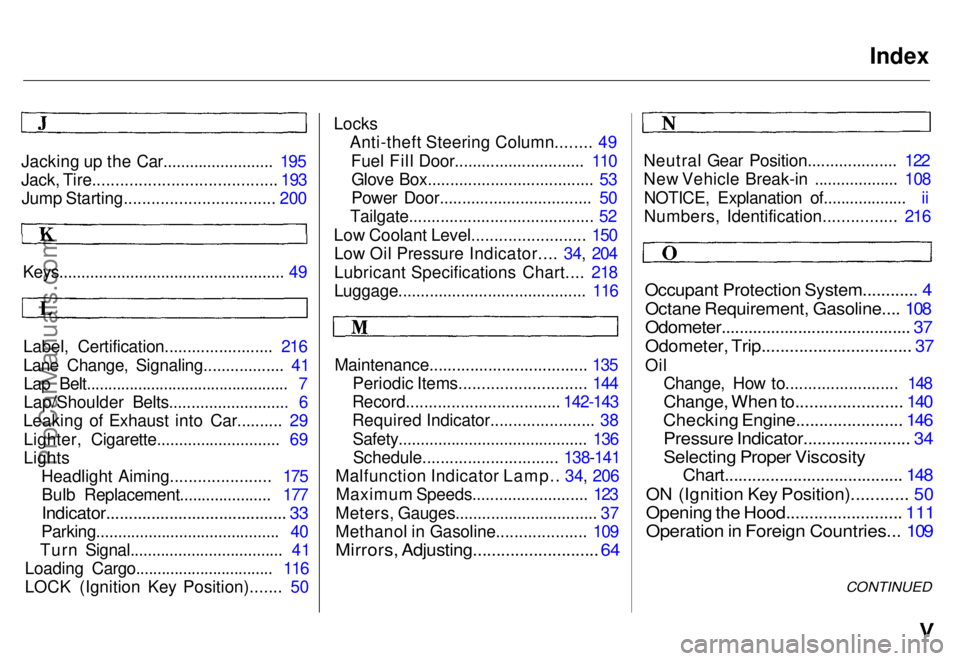
Index
Jacking up the Car......................... 195
Jack, Tire........................................ 193
Jump Starting................................. 200
Keys................................................... 49
Label, Certification........................ 216
Lane Change, Signaling.................. 41Lap Belt............................................... 7
Lap/Shoulder Belts........................... 6
Leaking of Exhaust into Car.......... 29
Lighter, Cigarette............................ 69
Lights Headlight Aiming...................... 175Bulb Replacement..................... 177
Indicator........................................ 33
Parking.......................................... 40
Turn Signal................................... 41
Loading Cargo................................ 116
LOCK (Ignition Key Position)....... 50 Locks
Anti-theft Steering Column........ 49
Fuel Fill Door............................. 110Glove Box..................................... 53
Power Door.................................. 50
Tailgate......................................... 52
Low Coolant Level......................... 150 Low Oil Pressure Indicator.... 34, 204
Lubricant Specifications Chart.... 218
Luggage.......................................... 116
Maintenance................................... 135 Periodic Items............................ 144
Record.................................. 142-143
Required Indicator....................... 38
Safety........................................... 136Schedule.............................. 138-141
Malfunction Indicator Lamp.. 34, 206 Maximum Speeds.......................... 123
Meters, Gauges................................ 37
Methanol in Gasoline.................... 109
Mirrors, Adjusting...........................
64
Neutral Gea r
Position.................... 122
New Vehicle Break-in ................... 108
NOTICE, Explanation of................... ii
Numbers, Identification................ 216
Occupant Protection System............ 4
Octane Requirement, Gasoline.... 108
Odometer.......................................... 37
Odometer, Trip................................ 37
Oil Change, How to......................... 148
Change, When to....................... 140
Checking Engine....................... 146
Pressure Indicator....................... 34
Selecting Proper Viscosity
Chart....................................... 148
ON (Ignition Key Position)............ 50
Opening the Hood......................... 111
Operation in Foreign Countries... 109
CONTINUEDProCarManuals.comMain Menu s t