transmission HONDA ODYSSEY 1996 User Guide
[x] Cancel search | Manufacturer: HONDA, Model Year: 1996, Model line: ODYSSEY, Model: HONDA ODYSSEY 1996Pages: 240, PDF Size: 2.64 MB
Page 147 of 240
Engine Oil
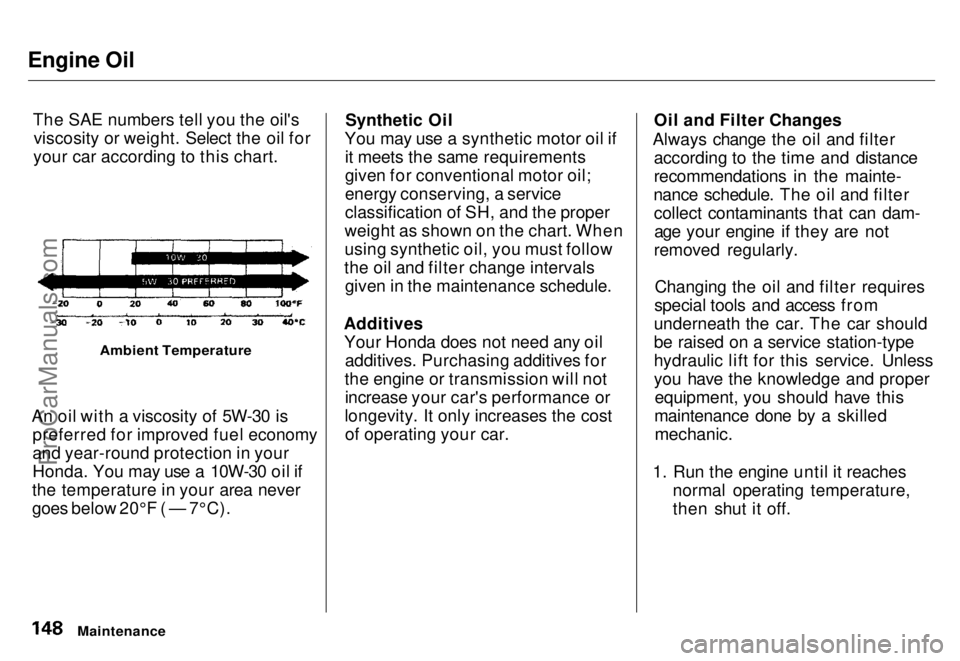
The SAE numbers tell you the oil'sviscosity or weight. Select the oil for
your car according to this chart.
Ambient Temperature
An oil with a viscosity of 5W-30 is preferred for improved fuel economy
and year-round protection in your
Honda. You may use a 10W-30 oil if
the temperature in your area never
goes below 20°F ( — 7°C).
Synthetic Oil
You may use a synthetic motor oil if it meets the same requirements
given for conventional motor oil;
energy conserving, a service
classification of SH, and the proper
weight as shown on the chart. When
using synthetic oil, you must follow
the oil and filter change intervals given in the maintenance schedule.
Additives Your Honda does not need any oil additives. Purchasing additives for
the engine or transmission will not increase your car's performance or
longevity. It only increases the cost of operating your car. Oil and Filter Changes
Always change the oil and filter according to the time and distance
recommendations in the mainte-
nance schedule. The oil and filter collect contaminants that can dam-age your engine if they are not
removed regularly.
Changing the oil and filter requires
special tools and access from
underneath the car. The car should
be raised on a service station-type
hydraulic lift for this service. Unless
you have the knowledge and proper equipment, you should have this
maintenance done by a skilled
mechanic.
1. Run the engine until it reaches normal operating temperature,
then shut it off.
MaintenanceProCarManuals.comMain Menu s t Table of Contents
Page 154 of 240
Automatic Transmission Fluid
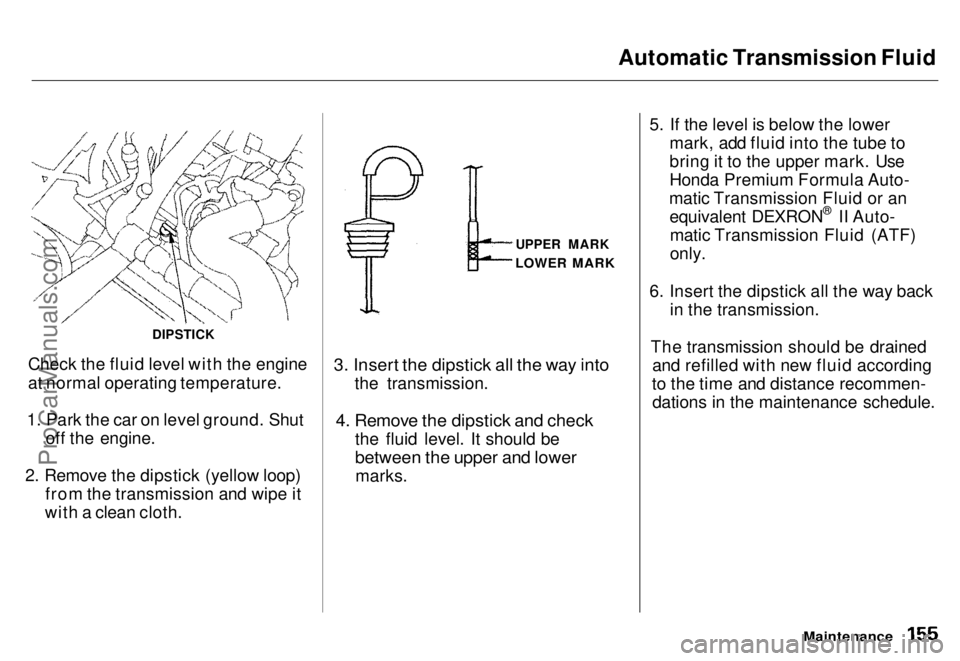
Check the fluid level with the engine
at normal operating temperature.
1. Park the car on level ground. Shut off the engine.
2. Remove the dipstick (yellow loop) from the transmission and wipe it
with a clean cloth. UPPER MARK
3. Insert the dipstick all the way into
the transmission.
4. Remove the dipstick and check
the fluid level. It should be
between the upper and lower
marks. 5. If the level is below the lower
mark, add fluid into the tube to
bring it to the upper mark. Use
Honda Premium Formula Auto-
matic Transmission Fluid or an equivalent DEXRON ®
II Auto-
matic Transmission Fluid (ATF)
only.
6. Insert the dipstick all the way back in the transmission.
The transmission should be drained and refilled with new fluid according
to the time and distance recommen- dations in the maintenance schedule.
Maintenance
DIPSTICK
LOWER MARKProCarManuals.comMain Menu s t Table of Contents
Page 156 of 240
Brake Fluid, Power Steering
Anti-lock Brake System
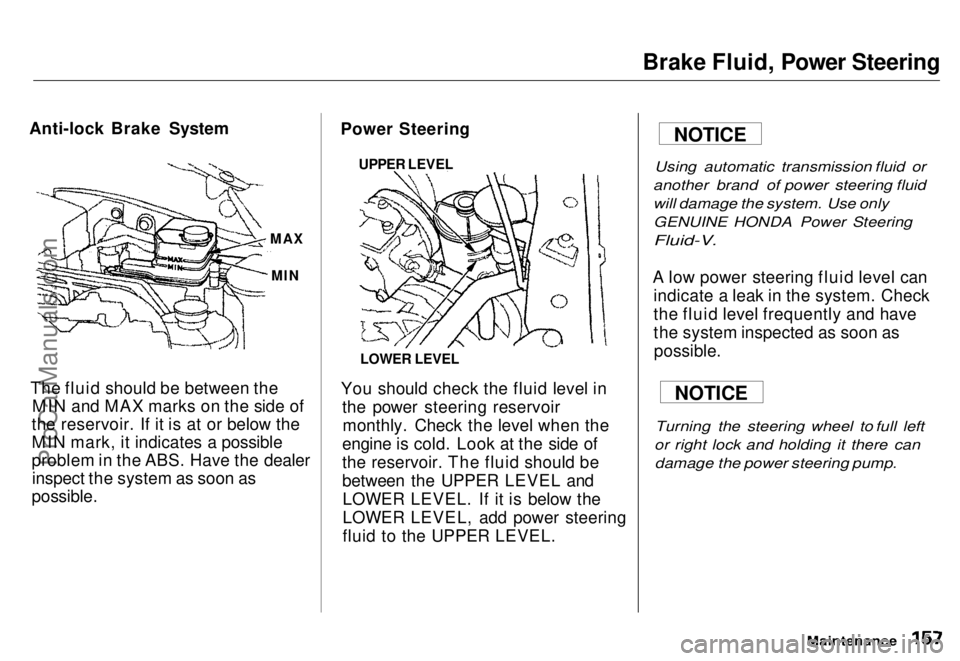
The fluid should be between the MIN and MAX marks on the side of
the reservoir. If it is at or below the
MIN mark, it indicates a possible
problem in the ABS. Have the dealer inspect the system as soon as
possible.
Power Steering
LOWER LEVEL
You should check the fluid level in the power steering reservoirmonthly. Check the level when the
engine is cold. Look at the side of
the reservoir. The fluid should be
between the UPPER LEVEL and LOWER LEVEL. If it is below the
LOWER LEVEL, add power steering
fluid to the UPPER LEVEL.
Using automatic transmission fluid or
another brand of power steering fluid
will damage the system. Use only GENUINE HONDA Power Steering
Fluid-V.
A low power steering fluid level can indicate a leak in the system. Check
the fluid level frequently and have
the system inspected as soon aspossible.
Turning the steering wheel to full left
or right lock and holding it there can damage the power steering pump.
Maintenance
MAX
MIN
UPPER LEVEL
NOTICE
NOTICEProCarManuals.comMain Menu s t Table of Contents
Page 181 of 240
Storing Your Car
If you need to park your car for an
extended period (more than 1
month), there are several things you should do to prepare it for storage.
Proper preparation helps prevent
deterioration and makes it easier to
get your car back on the road. It is
best to store your car indoors if at all
possible.
Fill the fuel tank.
Change the engine oil and filter
(see page 148). Wash and dry the exterior
completely.
Clean the interior. Make sure the
carpeting, floor mats, etc. are
completely dry.
Leave the parking brake off. Put
the transmission in Park. Block the rear wheels.
If the car is to be stored for a
longer period, it should be supported on jackstands so the
tires are off the ground.
Leave one window open slightly (if
the car is being stored indoors).
Disconnect the battery.Support the front and rear wiper
blade arms with a folded towel or
rag so they do not touch the
windshield. Apply a silicone spray lubricant to
all door and tailgate seals. Also,
apply wax to the painted surfaces
that mate with the door and
tailgate seals. Cover the car with a "breathable"
car cover, one made from a porous
material such as cotton.
Nonporous materials, such as
plastic sheeting, trap moisture
which can damage the paint. If possible, run the engine for a
while periodically (preferably once
a month).
If you store your car for 12 months or longer, have your Honda dealer
perform the inspections called for in
the 24 months/48,000 km (30,000 miles) maintenance schedule (Normal Conditions) as soon as you
take it out of storage (see page 140 )
The replacements called for in the maintenance schedule are not
needed unless the car has actually
reached that time or mileage.
MaintenanceProCarManuals.comMain Menu s t Table of Contents
Page 191 of 240
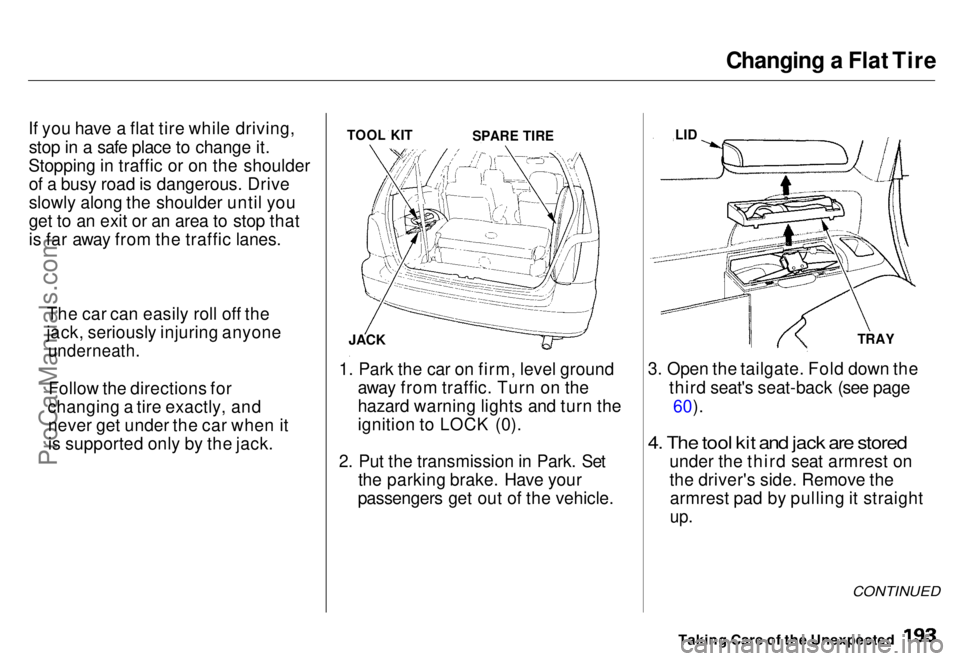
Changing a Flat Tire
If you have a flat tire while driving, stop in a safe place to change it.
Stopping in traffic or on the shoulder of a busy road is dangerous. Drive
slowly along the shoulder until you
get to an exit or an area to stop that
is far away from the traffic lanes. TOOL KIT
JACK
1. Park the car on firm, level ground away from traffic. Turn on the
hazard warning lights and turn the
ignition to LOCK (0).
2. Put the transmission in Park. Set the parking brake. Have your
passengers get out of the vehicle. LID
TRAY
3. Open the tailgate. Fold down the third seat's seat-back (see page60).
4. The tool kit and jack are stored
under the third seat armrest on
the driver's side. Remove thearmrest pad by pulling it straight
up.
CONTINUED
Taking Care of the Unexpected
SPARE TIRE
The car can easily roll off the
jack, seriously injuring anyone
underneath.
Follow the directions for
changing a tire exactly, and never get under the car when it
is supported only by the jack.ProCarManuals.comMain Menu s t Table of Contents
Page 197 of 240
If Your Engine Won't Start
Diagnosing why your engine won't start falls into two areas, depending
on what you hear when you turn the
key to START (III): You hear nothing, or almost
nothing. The engine's starter
motor does not operate at all, oroperates very slowly. You can hear the starter motor
operating normally, but the engine
does not start up and run. Nothing Happens or the Starter
Motor Operates Very Slowly
When you turn the ignition switch to START (III), you do not hear the
normal noise of the engine trying to start. You may hear a clicking sound
or series of clicks, or nothing at all.Check these things:
Check the transmission interlock.
The transmission must be in Park or Neutral or the starter will not
operate.
Turn the ignition switch to ON (II).
Turn on the headlights and check their brightness. If the headlights are very dim or don't light at all,
the battery is discharged. See
Jump Starting on page 200. Turn the ignition switch to START
(III). If the headlights do not dim,
check the condition of the fuses. If
the fuses are OK, there is proba-
bly something wrong with the electrical circuit for the ignition
switch or starter motor. You will
need a qualified technician todetermine the problem. (See
Towing on page 213.)
If the headlights dim noticeably or
go out when you try to start theengine, either the battery is dis-
charged or the connections are
corroded. Check the condition of
the battery and terminal connec- tions (see page 162 ). You can
then try jump starting the car from a booster battery (see page 200 ).
Taking Care of the UnexpectedProCarManuals.comMain Menu s t Table of Contents
Page 198 of 240
If Your Engine Won't Start, Jump Starting
The Starter Operates Normally In this case, the starter motorsounds normal when you turn the
ignition switch to START (III), but
the engine does not run. Are you using the proper starting
procedure? Refer to Starting the
Engine on page 119 . Do you have fuel? Turn the
ignition switch to ON (II) for a
minute and watch the fuel gauge.
The low fuel level warning light may not be working, so you were
not reminded to fill the tank. There may be an electrical
problem, such as no power to the
fuel pump. Check all the fuses (see page 208).
If you find nothing wrong, you will
need a qualified technician to find
the problem. See Towing on page
213.
Jump Starting
If your car's battery has run down,
you may be able to start the engine by using a booster battery. Although
this seems like a simple procedure,
there are several precautions you should take. Follow the directions
closely.
You cannot start a Honda by pushing or pulling it. To jump start your car:
1. Open the hood and check the physical condition of the battery(see page 162 ). In very cold
weather, check the condition of the electrolyte. If it seems slushyor like ice, do not try jump starting
until it thaws.
If a battery sits in extreme cold, the
electrolyte inside can freeze.
Attempting to jump start with a frozen battery can cause it to rupture or
explode.
2. Turn off all the electrical acces- sories: heater, A/C, stereo system
lights, etc. Put the transmission in Neutral or
Park and set the parking brake.
Taking Care of the Unexpected
NOTICE
A battery can explode if you do
not follow the correct procedure,
seriously injuring anyone nearby.
Keep all sparks, open flames,
and smoking materials away
from the battery.ProCarManuals.coms t Main Menu Table of Contents
Page 200 of 240
If Your Engine Overheats
The pointer of your car's tempera-
ture gauge should stay in the mid-
range under most conditions. It may
go higher if you are driving up a long
steep hill on a very hot day. If it
climbs to the red mark, you should
determine the reason.
Driving with the temperature gauge
pointer at the red mark can cause serious damage to your engine.
Your car can overheat for several
reasons, such as lack of coolant or a
mechanical problem. The only
indication may be the temperature
gauge climbing to or above the red
mark. Or you may see steam or
spray coming from under the hood.
In either case, you should take
immediate action.
1. Safely pull to the side of the road.
Put the transmission in neutral or
park and set the parking brake.
Turn off the heating and cooling system and all other accessories.
Turn on the hazard warning indicators.
2. If you see steam and/or spray coming from under the hood, turnoff the engine.
3. If you do not see steam or spray, leave the engine running and
watch the temperature gauge. If the high heat is due to overloading (climbing a long, steep hill on a
hot day with the A/C running, for example), the engine should start
to cool down almost immediately. If it does, wait until the tempera-
ture gauge comes down to the mid
point then continue driving.
Taking Care of the Unexpected
NOTICE
Steam and spray from an
overheated engine can
seriously scald you.
Do not open the hood if steam
is coming out.ProCarManuals.coms t Main Menu Table of Contents
Page 211 of 240
Towing
If your car needs to be towed, call a
professional towing service or, if you
belong to one, an organization that
provides roadside assistance. Never tow your car behind another car with
just a rope or chain. It is very
dangerous.
Emergency Towing
There are three popular methods of towing a car:
Flat-bed Equipment — The operator
loads your car on the back of a truck.
This is the best way of trans- porting your Honda.
Wheel Lift Equipment — The tow
truck uses two pivoting arms that go
under the tires (front or rear) and lift them off the ground. The other two
tires remain on the ground.
Sling-type Equipment — The tow
truck uses metal cables with hooks on the ends. These hooks go around
parts of the frame or suspension and
the cables lift that end of the car off
the ground. Your car's suspension and body can be seriously damaged
if this method of towing is attempted.
If your Honda cannot be transported by flat-bed, it should be towed with
the front wheels off the ground. Ifdue to damage, your car must be
towed with the front wheels on the ground, do the following:
Release the parking brake.Start the engine.
Shift to D4, then to N.
Turn off the engine.
Improper towing preparation will
damage the transmission. Follow the
above procedure exactly. If you cannot
shift the transmission or start the engine, your car must be transported
on a flat-bed.
It is best to tow the car no fartherthan 80 km (50 miles), and keepthe speed below 35 mph (55
km/h).
Trying to lift or tow your car by the
bumpers will cause serious damage.
The bumpers are not designed to
support the car's weight.
Taking Care of the Unexpected
NOTICE
NOTICEProCarManuals.comMain Menu s t Table of Contents
Page 214 of 240
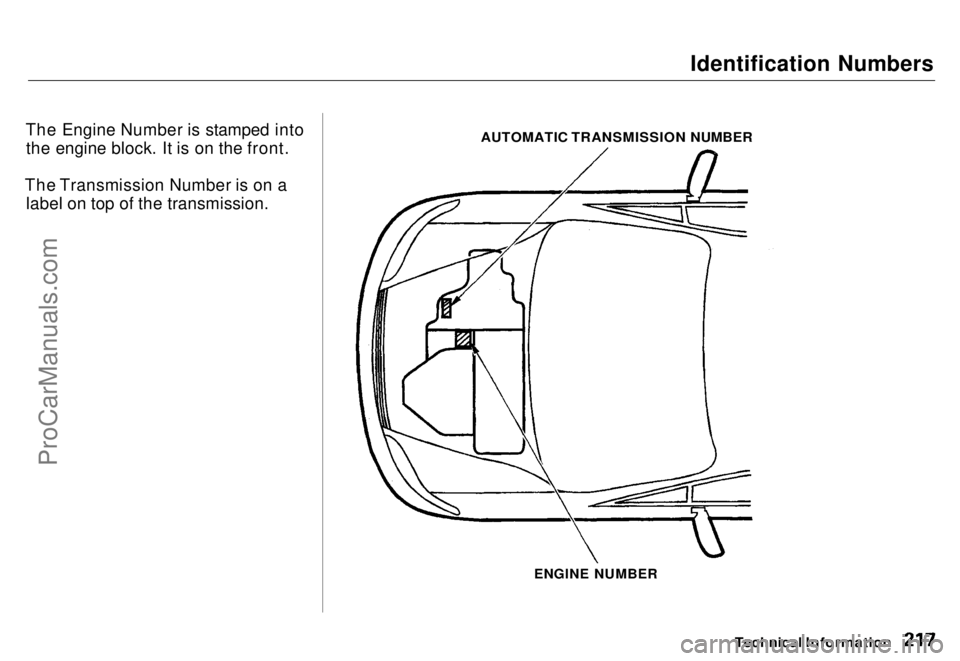
Identification Numbers
The Engine Number is stamped into the engine block. It is on the front.
The Transmission Number is on a label on top of the transmission.
Technical Information
AUTOMATIC TRANSMISSION NUMBER
ENGINE NUMBERProCarManuals.comMain Menu s t Table of Contents