tow HONDA ODYSSEY 1996 Owners Manual
[x] Cancel search | Manufacturer: HONDA, Model Year: 1996, Model line: ODYSSEY, Model: HONDA ODYSSEY 1996Pages: 240, PDF Size: 2.64 MB
Page 1 of 240
1996 Odyssey Online Reference Owner's Manual
Use these links (and links throughout this manual) to navigate through this reference.
For a printed owner's manual, click on authorized manuals or go to www.helminc.com.
Contents
Introduction........................................................................\
........................................................................... i
A Few Words About Safety ........................................................................\
................................................ ii
Driver and Passenger Safety ........................................................................\
............................................. 3
Proper use and care of your vehicle's seat belts, and Supplemental Restraint System.
Instruments and Controls........................................................................\
...................................................31
Instrument panel in
dicator and gauge, and how to use dashboard and steering column controls.
Comfort and Convenience Features........................................................................\
.................................73
How t o
op
erate the climate control system, the audio system, and other convenience features.
Before Driving ........................................................................\
.................................................................... 107
What gasoli n
e to u
se, how to break-in your new vehicle, and how to load luggage and other cargo.
Driving........................................................................\
.................................................................................. 117
The proper way t o
start the engine, shift the tr ansmission, and park, plus towing a trailer.
Maintenance........................................................................\
........................................................................ 135
T h
e Ma
intenance Schedule shows you when you need to take your vehicle to the dealer.
Appearance Care........................................................................\
................................................................ 183
T i
ps on cl
eaning and protecting your vehicle. Things to look for if your car ever needs body repairs.
Taking Care of the Unexpected........................................................................\
...................................... 191
This section covers sever
a
l problems motorists someti mes experience, and how to handle them.
Technical Information........................................................................\
...................................................... 215
ID numbers, dimens ions, capacities, and techn
ical information.
Warranty and Customer Relations (U.S. and Canada)..................................................................... 227
A summary of th
e warr
anties covering your new Honda, and how to contact us.
Authorized Manuals (U.S. only)........................................................................\
...................................... 233
How t o
order
manuals and other technical literature.
Index ........................................................................\
......................................................................................... I
Gas Station Information
Information you need when you pull up to the fuel pump.
Owner's Identification Form
ProCarManuals.com
Page 19 of 240
Additional Safety Information
The seat belts and airbags are obvi- ously important parts of your occu-
pant protection system.
In addition, you should know that
sitting upright, adjusting the head
restraints properly, locking the doors,
and stowing things properly can also
increase your safety and possibly
even save your life. Seat-back Position
The seat-backs should be in an upright position for you and your
passengers to get the most protec-
tion from the seat belts.
If you recline a seat-back, you reduce
the protective capability of your seat
belt. The farther a seat-back is
reclined, the greater the risk that
you will slide under the belt in a severe crash and be very seriously
injured.
For information on how to adjust the
seat-back, see page 55. Head Restraint Position
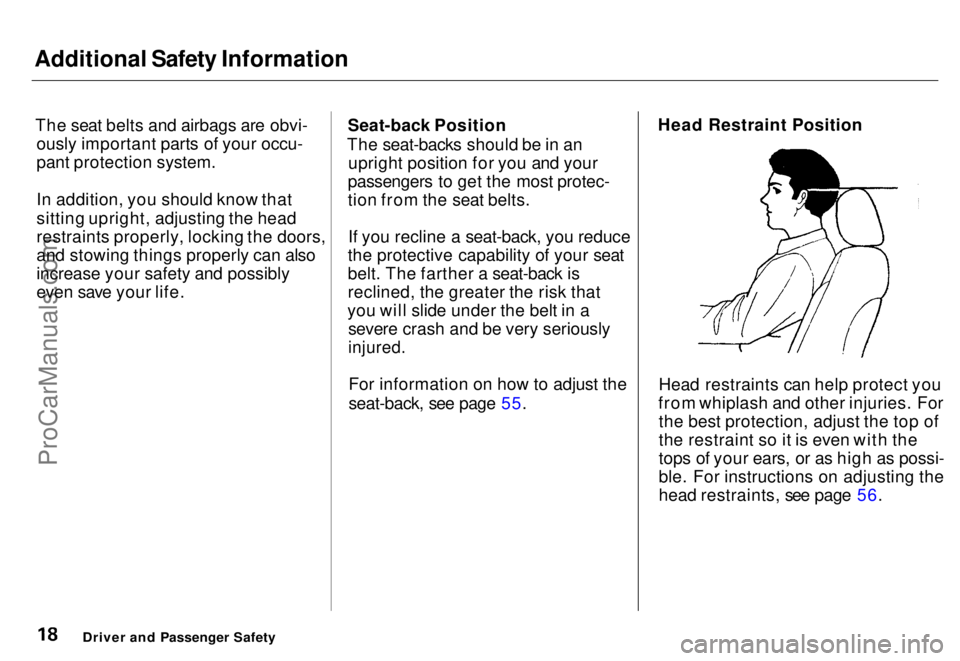
Head restraints can help protect you
from whiplash and other injuries. For the best protection, adjust the top of
the restraint so it is even with the
tops of your ears, or as high as possi-
ble. For instructions on adjusting the
head restraints, see page 56.
Driver and Passenger SafetyProCarManuals.comMain Menu s t Table of Contents
Page 25 of 240
Child Safety
If you are using a toddler seat in the
front passenger's seat, move the
passenger's seat as far back as
possible before installing the child
seat. If the passenger's bag inflates,
it could seriously hurt a toddler who
is not in the proper position or
properly restrained.
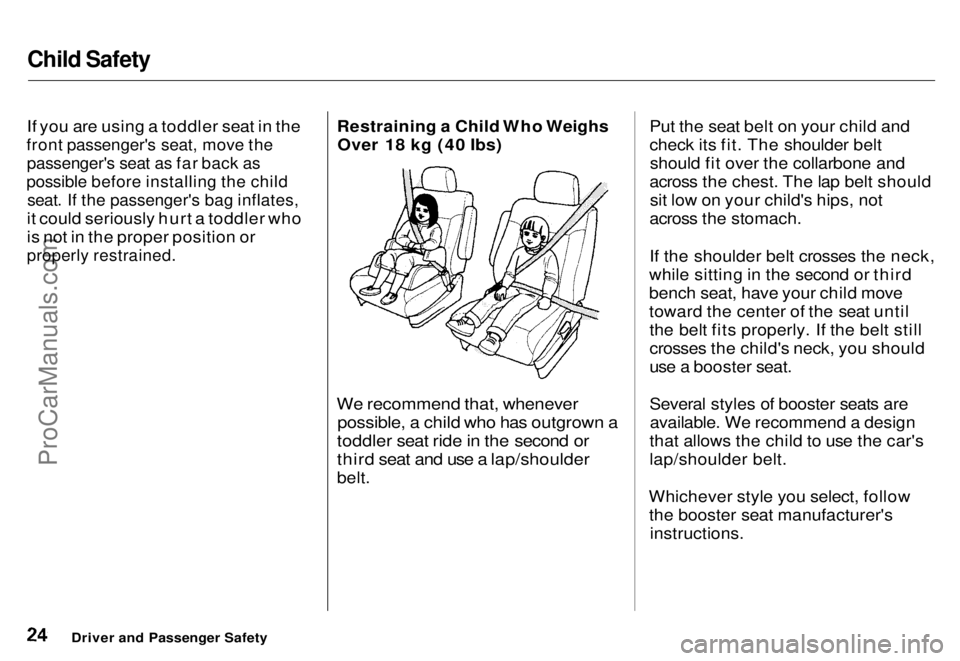
Restraining a Child Who Weighs
Over 18 kg (40 Ibs)
We recommend that, whenever
possible, a child who has outgrown a
toddler seat ride in the second or
third seat and use a lap/shoulder
belt. Put the seat belt on your child and
check its fit. The shoulder belt
should fit over the collarbone and
across the chest. The lap belt should sit low on your child's hips, not
across the stomach.
If the shoulder belt crosses the neck,
while sitting in the second or third
bench seat, have your child move
toward the center of the seat until the belt fits properly. If the belt still
crosses the child's neck, you should
use a booster seat.
Several styles of booster seats areavailable. We recommend a design
that allows the child to use the car's
lap/shoulder belt.
Whichever style you select, follow the booster seat manufacturer's
instructions.
Driver and Passenger SafetyProCarManuals.comMain Menu s t Table of Contents
Page 62 of 240
Seats
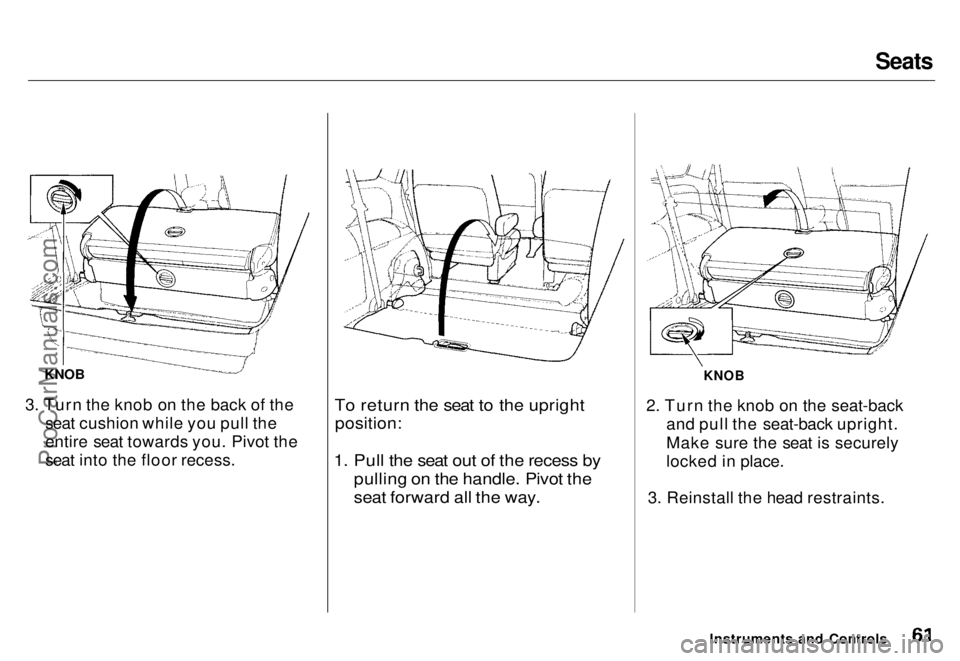
KNOB
3. Turn the knob on the back of the seat cushion while you pull the
entire seat towards you. Pivot the
seat into the floor recess.
To return the seat to the upright
position:
1. Pull the seat out of the recess by
pulling on the handle. Pivot the
seat forward all the way.
KNOB
2. Turn the knob on the seat-back and pull the seat-back upright.
Make sure the seat is securely
locked in place.
3. Reinstall the head restraints.
Instruments and ControlsProCarManuals.coms t Main Menu Table of Contents
Page 107 of 240
Before Driving
Before you begin driving your Honda,
you should know what gasoline to use, and how to check the levels ofimportant fluids. You also need to
know how to properly stow luggage
or packages. This section will help
you. If you plan to add any accesso- ries to your car, please read theinformation in this section first. Break-in Period.............................. 108
Gasoline.......................................... 108
Oxygenated Fuels...................... 108
Driving in Foreign Countries... 109
Service Station Procedures .......... 110 Filling the Fuel Tank................. 110Opening the Hood..................... 111
Fuel Economy................................ 114
Vehicle Condition...................... 114Driving Habits............................ 114
Accessories..................................... 115
Loading Cargo................................ 116
Before DrivingProCarManuals.comMain Menu s t
Page 112 of 240
Service Station Procedures
Oil Check
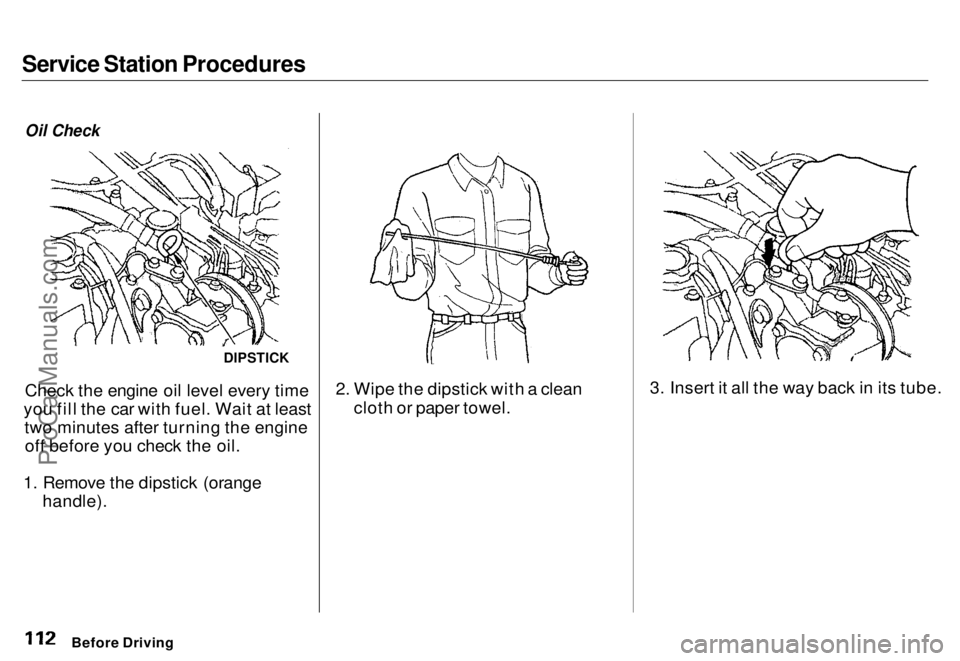
Check the engine oil level every time
you fill the car with fuel. Wait at least two minutes after turning the engineoff before you check the oil.
1. Remove the dipstick (orange handle). 2. Wipe the dipstick with a clean
cloth or paper towel. 3. Insert it all the way back in its tube.
Before Driving
DIPSTICKProCarManuals.comMain Menu s t Table of Contents
Page 116 of 240
Loading Cargo
The maximum load you can carry in your Honda is 535 kg (1,150 Ibs). It includes the total weight of all
passengers and their belongings, anyaccessories, and the tongue weight
figure is shown as the Vehicle Capacity Weight on the tire infor-
mation label attached to the driver's doorjamb. To figure out how much cargo you
can carry:
Figure the total "occupant weight"
you will be transporting. To. do this. (driver and all passengers) by 70
kg
(150 Ibs).
Subtract this number from the
Vehicle Capacity Weight (535 kg/ 1,150 Ibs).
If you are towing a trailer, subtract
the tongue weight. See Towing a
Trailer on page 128.
This final number is the total weight of cargo you can load in or on the car.
With seven occupants (driver and six passengers), the maximum recom-
mended weight for cargo is 45 kg (100 Ibs).
Where you store this cargo, and how
well you secure it, are just as important as how much it weighs.Make sure you load cargo so it will not shift while driving. Items stored
in the cargo area behind the third
seat should be placed as far forward
as possible. You could store addi-
tional items on the floor behind the
roll under the front seat and
interfere with the pedals.
For greater cargo capacity, the third seat can be folded into the floor and
the second row seats can either be
removed or folded up (depending on
model). Passengers should never sit in the open cargo area while the car
is moving. They should sit in one of
the seats and wear their seat belts.
If you must carry large objects that
prevent you from closing the tailgate
be aware that exhaust gas can enter
the interior. See Carbon Monoxide
Hazard on page 29 .
Before DrivingProCarManuals.comMain Menu s t Table of Contents
Page 117 of 240
Driving
This section gives you tips on starting the engine under various
conditions, and how to operate the automatic transmission. It also
includes important information on
your car's braking system and facts
you need if you are planning to tow a trailer.
Preparing to Drive......................... 118
Starting the Engine........................ 119
Starting in Cold Weather at High Altitude ..................... 119
Automatic Transmission............... 120 Shift Lever Positions................. 120
Maximum Speeds...................... 123
Shift Lock Release..................... 123
The Braking System...................... 124 Brake Wear Indicators.............. 124Brake System Design................ 124
Anti-lock Brakes........................ 125
Driving in Bad Weather................ 126
Towing a Trailer............................ 128
DrivingProCarManuals.comMain Menu s t
Page 121 of 240
Automatic Transmission
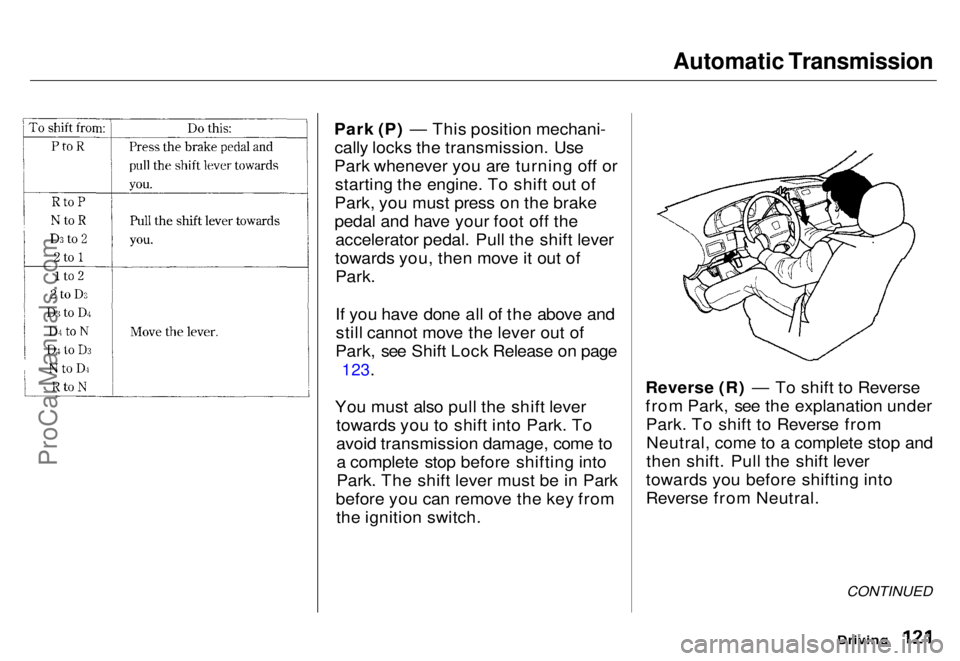
Park (P) — This position mechani- cally locks the transmission. Use
Park whenever you are turning off or starting the engine. To shift out of
Park, you must press on the brake
pedal and have your foot off the accelerator pedal. Pull the shift lever
towards you, then move it out of Park.
If you have done all of the above andstill cannot move the lever out of
Park, see Shift Lock Release on page
123.
You must also pull the shift lever towards you to shift into Park. To
avoid transmission damage, come toa complete stop before shifting into
Park. The shift lever must be in Park
before you can remove the key from the ignition switch. Reverse (R) — To shift to Reverse
from Park, see the explanation under
Park. To shift to Reverse fromNeutral, come to a complete stop and
then shift. Pull the shift lever
towards you before shifting into
Reverse from Neutral.
Driving
CONTINUEDProCarManuals.comMain Menu s t Table of Contents
Page 122 of 240
Automatic Transmission
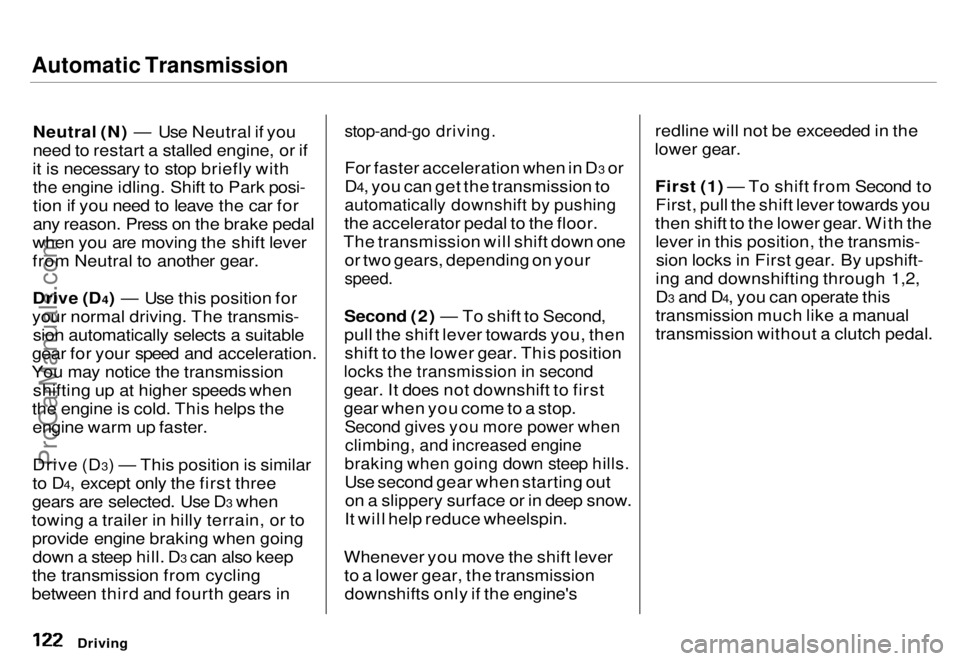
Neutral (N) — Use Neutral if you
need to restart a stalled engine, or if
it is necessary to stop briefly with the engine idling. Shift to Park posi-
tion if you need to leave the car for
any reason. Press on the brake pedal
when you are moving the shift lever
from Neutral to another gear.
Drive (D4) — Use this position for
your normal driving. The transmis- sion automatically selects a suitable
gear for your speed and acceleration.
You may notice the transmission shifting up at higher speeds when
the engine is cold. This helps the engine warm up faster.
Drive (D3) — This position is similar
to D4, except only the first three
gears are selected. Use D3 when
towing a trailer in hilly terrain, or to provide engine braking when goingdown a steep hill. D3 can also keep
the transmission from cycling
between third and fourth gears in
stop-and-go driving.
For faster acceleration when in D3 or
D4, you can get the transmission to
automatically downshift by pushing
the accelerator pedal to the floor.
The transmission will shift down one or two gears, depending on your
speed.
Second (2) — To shift to Second,
pull the shift lever towards you, then shift to the lower gear. This position
locks the transmission in second
gear. It does not downshift to first
gear when you come to a stop.
Second gives you more power when
climbing, and increased engine
braking when going down steep hills.
Use second gear when starting out on a slippery surface or in deep snow.
It will help reduce wheelspin.
Whenever you move the shift lever to a lower gear, the transmissiondownshifts only if the engine's redline will not be exceeded in the
lower gear.
First (1) — To shift from Second toFirst, pull the shift lever towards you
then shift to the lower gear. With the lever in this position, the transmis-sion locks in First gear. By upshift-
ing and downshifting through 1,2,
D3 and D4, you can operate this
transmission much like a manual
transmission without a clutch pedal.
DrivingProCarManuals.comMain Menu s t Table of Contents