fuel HONDA ODYSSEY 1996 Owners Manual
[x] Cancel search | Manufacturer: HONDA, Model Year: 1996, Model line: ODYSSEY, Model: HONDA ODYSSEY 1996Pages: 240, PDF Size: 2.64 MB
Page 1 of 240
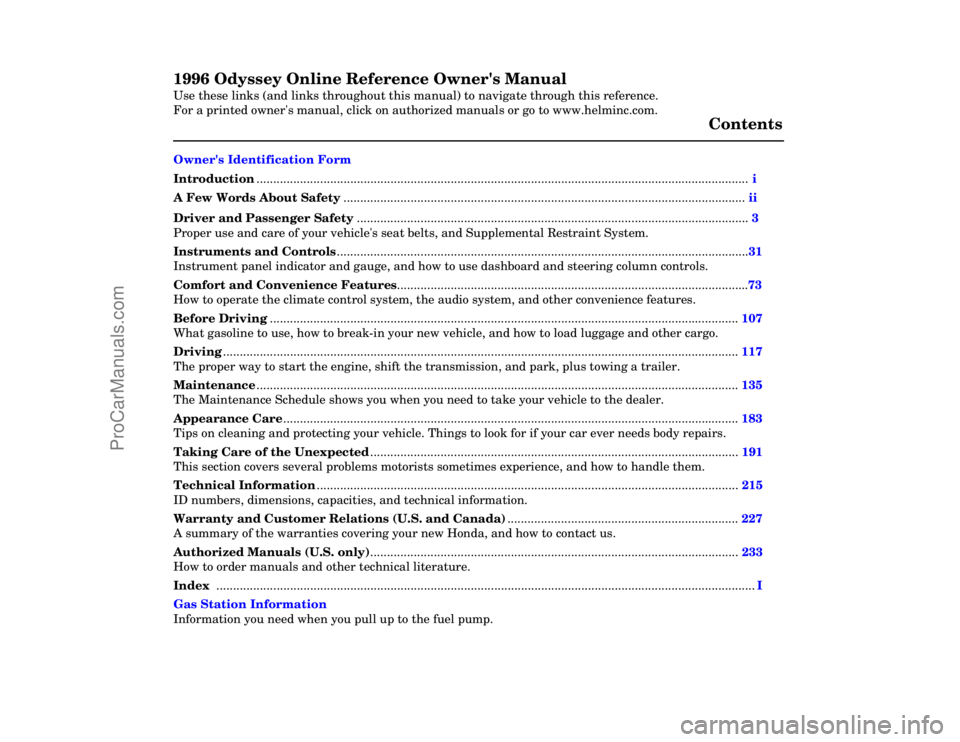
1996 Odyssey Online Reference Owner's Manual
Use these links (and links throughout this manual) to navigate through this reference.
For a printed owner's manual, click on authorized manuals or go to www.helminc.com.
Contents
Introduction........................................................................\
........................................................................... i
A Few Words About Safety ........................................................................\
................................................ ii
Driver and Passenger Safety ........................................................................\
............................................. 3
Proper use and care of your vehicle's seat belts, and Supplemental Restraint System.
Instruments and Controls........................................................................\
...................................................31
Instrument panel in
dicator and gauge, and how to use dashboard and steering column controls.
Comfort and Convenience Features........................................................................\
.................................73
How t o
op
erate the climate control system, the audio system, and other convenience features.
Before Driving ........................................................................\
.................................................................... 107
What gasoli n
e to u
se, how to break-in your new vehicle, and how to load luggage and other cargo.
Driving........................................................................\
.................................................................................. 117
The proper way t o
start the engine, shift the tr ansmission, and park, plus towing a trailer.
Maintenance........................................................................\
........................................................................ 135
T h
e Ma
intenance Schedule shows you when you need to take your vehicle to the dealer.
Appearance Care........................................................................\
................................................................ 183
T i
ps on cl
eaning and protecting your vehicle. Things to look for if your car ever needs body repairs.
Taking Care of the Unexpected........................................................................\
...................................... 191
This section covers sever
a
l problems motorists someti mes experience, and how to handle them.
Technical Information........................................................................\
...................................................... 215
ID numbers, dimens ions, capacities, and techn
ical information.
Warranty and Customer Relations (U.S. and Canada)..................................................................... 227
A summary of th
e warr
anties covering your new Honda, and how to contact us.
Authorized Manuals (U.S. only)........................................................................\
...................................... 233
How t o
order
manuals and other technical literature.
Index ........................................................................\
......................................................................................... I
Gas Station Information
Information you need when you pull up to the fuel pump.
Owner's Identification Form
ProCarManuals.com
Page 32 of 240
Instruments and Controls
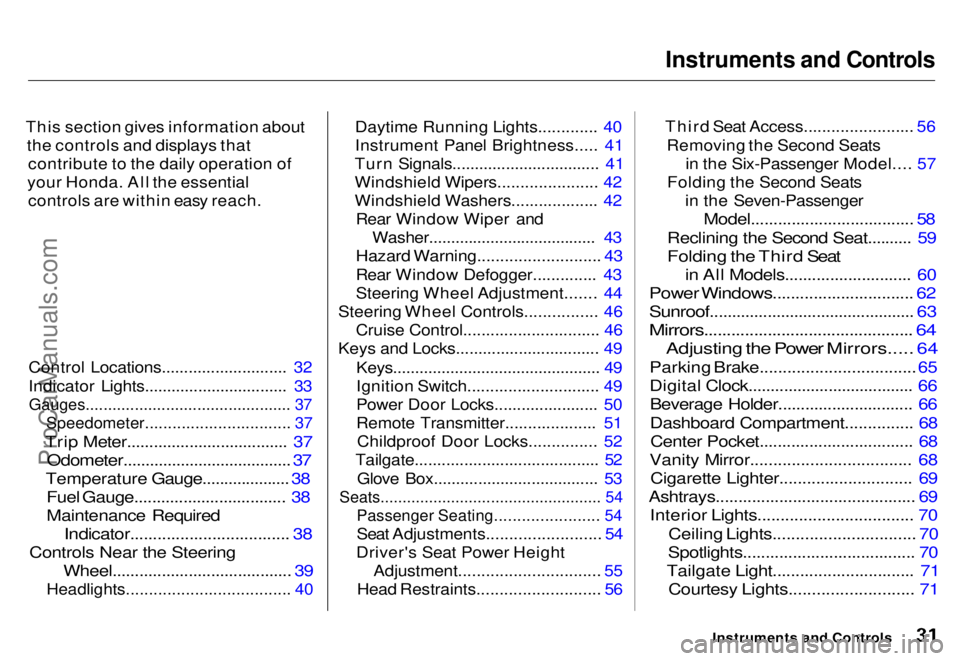
This section gives information about the controls and displays thatcontribute to the daily operation of
your Honda. All the essential controls are within easy reach.
Control Locations............................ 32
Indicator Lights................................ 33
Gauges.............................................. 37
Speedometer................................ 37
Trip Meter.................................... 37
Odometer......................................
37
Temperature Gauge................... .
38
Fuel Gauge.................................. 38
Maintenanc
e Required
Indicator...................................
38
Controls Nea r
the Steering
Wheel........................................ 39
Headlights.................................... 40
Daytime Running Lights............. 40
Instrument Panel Brightness..... 41
Turn Signals................................. 41
Windshield Wipers...................... 42
Windshield Washers................... 42 Rear Window Wiper and Washer...................................... 43
Hazard Warning........................... 43
Rear Window Defogger.............. 43
Steering Wheel Adjustment....... 44
Steering Wheel Controls................ 46 Cruise Control.............................. 46
Keys and Locks................................ 49
Keys............................................... 49
Ignition Switch............................. 49
Power Door Locks....................... 50
Remote Transmitter.................... 51Childproof Door Locks............... 52
Tailgate......................................... 52
Glove Box..................................... 53
Seats.................................................. 54
Passenger Seating....................... 54
Seat Adjustments......................... 54
Driver's Seat Power Height Adjustment............................... 55
Head Restraints........................... 56 Third Seat Access........................ 56
Removing the Second Seats in the Six-Passenger Model.... 57
Folding the Second Seats in the Seven-Passenger
Model....................................
58
Reclining th e
Second Seat.......... 59
Folding the Third Seat
in All Models............................ 60
Power Windows............................... 62
Sunroof.............................................. 63
Mirrors.............................................. 64
Adjusting the Power Mirrors..... 64
Parking Brake..................................
65
Digital Clock.................................... .
66
Beverage Holder.............................. 66
Dashboard Compartment............... 68 Center Pocket.................................. 68
Vanity Mirror................................... 68 Cigarette Lighter............................. 69
Ashtrays............................................ 69 Interior Lights.................................. 70
Ceiling Lights............................... 70
Spotlights...................................... 70
Tailgate Light............................... 71 Courtesy Lights........................... 71
Instruments and ControlsProCarManuals.comMain Menu s t
Page 33 of 240
Control Locations
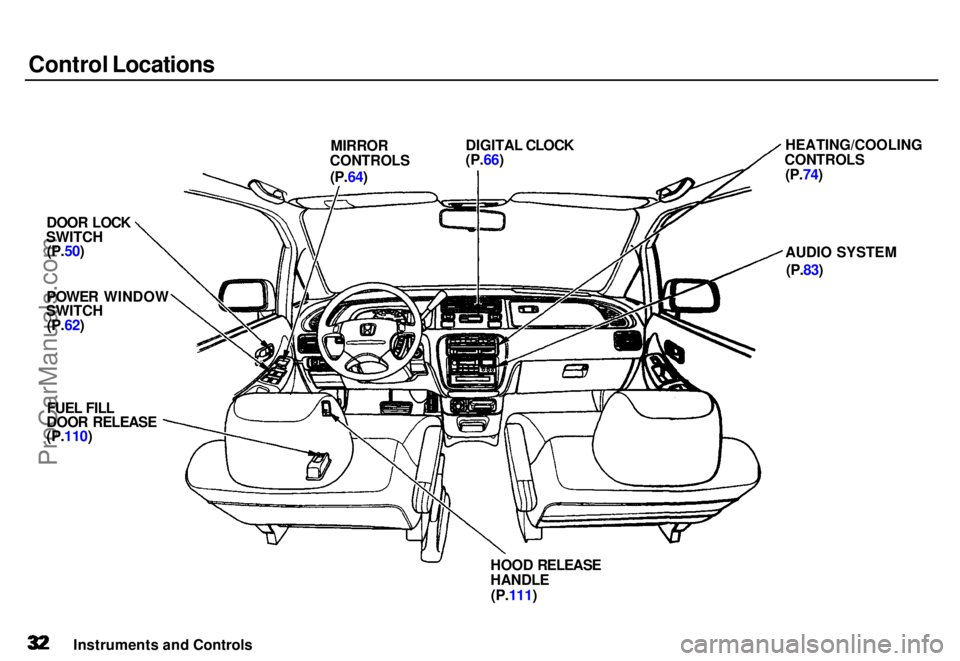
MIRROR
CONTROLS DIGITAL CLOCK
(P.66)
DOOR LOCK
SWITCH
(P.50)
POWER WINDO
W
SWITCH
(P.62)
FUEL FILL
DOOR RELEASE
(P.110)
HEATING/COOLIN
G
CONTROLS (P.74)
AUDIO SYSTEM
(P.83)
HOOD
RELEASE
HANDLE
(P.111)
Instruments and Controls
(P.64)
ProCarManuals.comMain Menu s t Table of Contents
Page 34 of 240
Indicator Lights
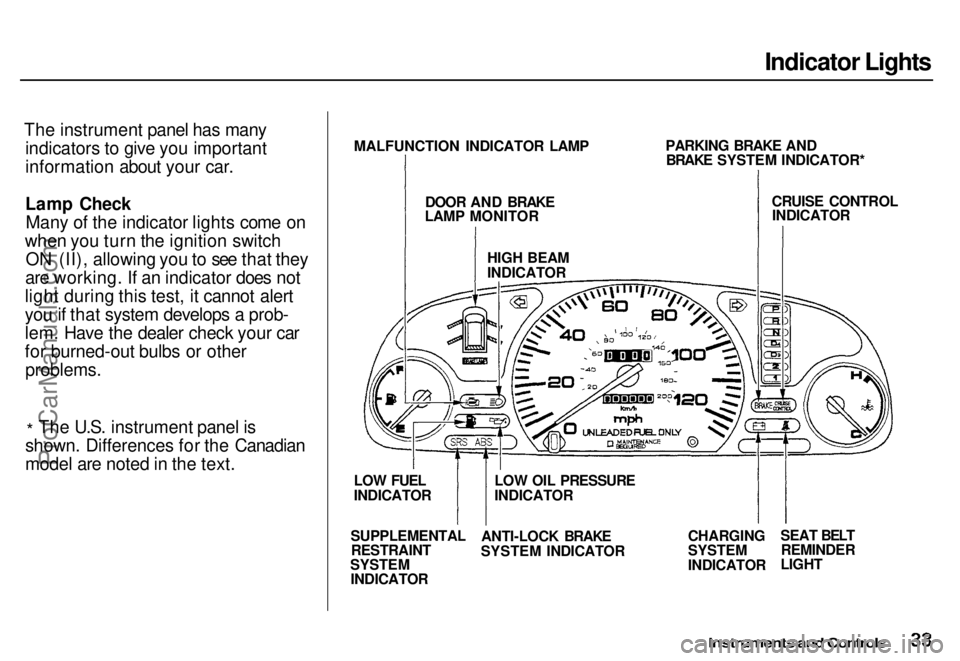
The instrument panel has many indicators to give you important
information about your car.
Lamp CheckMany of the indicator lights come on
when you turn the ignition switch ON (II), allowing you to see that they
are working. If an indicator does not
light during this test, it cannot alert
you if that system develops a prob-
lem. Have the dealer check your car
for burned-out bulbs or other
problems.
* The U.S. instrument panel is
shown. Differences for the Canadian
model are noted in the text.
Instruments and Controls
MALFUNCTION INDICATOR LAMP
DOOR AND BRAKE
LAMP MONITOR
HIGH BEAM
INDICATOR
PARKING BRAKE AND
BRAKE SYSTEM INDICATOR*
CRUISE CONTROL
INDICATOR
CHARGING
SYSTEM
INDICATOR
SEAT BELT
REMINDER
LIGHT
LOW OIL PRESSURE
INDICATOR
ANTI-LOCK BRAKE
SYSTEM INDICATOR
SUPPLEMENTAL
RESTRAINT
SYSTEM
INDICATOR
LOW FUEL
INDICATORProCarManuals.comMain Menu s t Table of Contents
Page 37 of 240
Indicator Lights
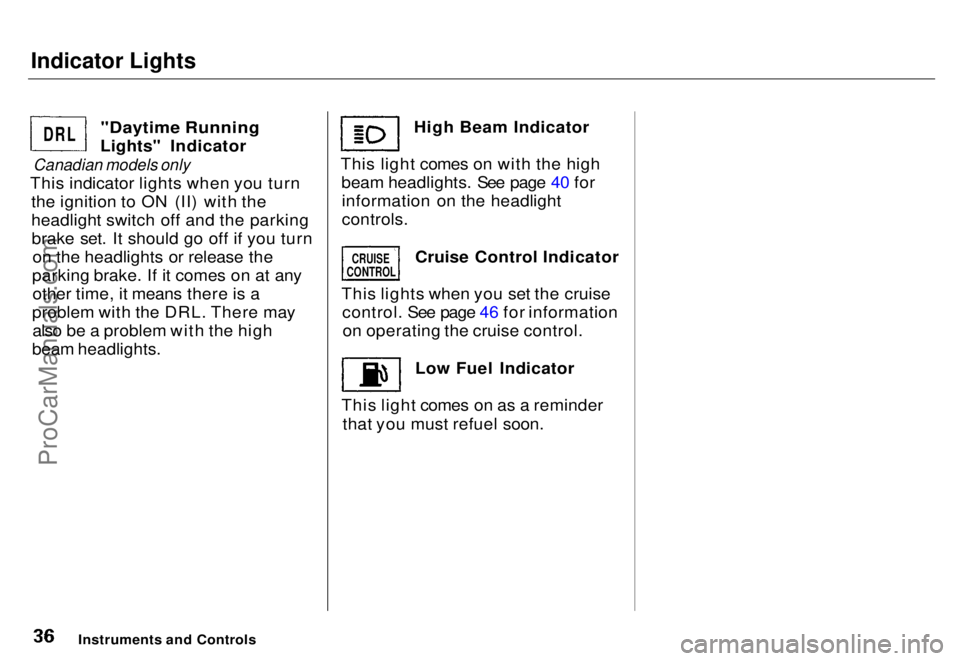
"Daytime Running
Lights" Indicator
Canadian models only
This indicator lights when you turn the ignition to ON (II) with the
headlight switch off and the parkingbrake set. It should go off if you turn on the headlights or release the
parking brake. If it comes on at any other time, it means there is a
problem with the DRL. There may also be a problem with the high
beam headlights. High Beam Indicator
This light comes on with the high beam headlights. See page 40 forinformation on the headlight
controls.
Cruise Control Indicator
This lights when you set the cruise control. See page 46 for informationon operating the cruise control.
Low Fuel Indicator
This light comes on as a reminder that you must refuel soon.
Instruments and Controls
DRL
CRUISE
CONTROL
ProCarManuals.comMain Menu s t Table of Contents
Page 38 of 240
Gauges
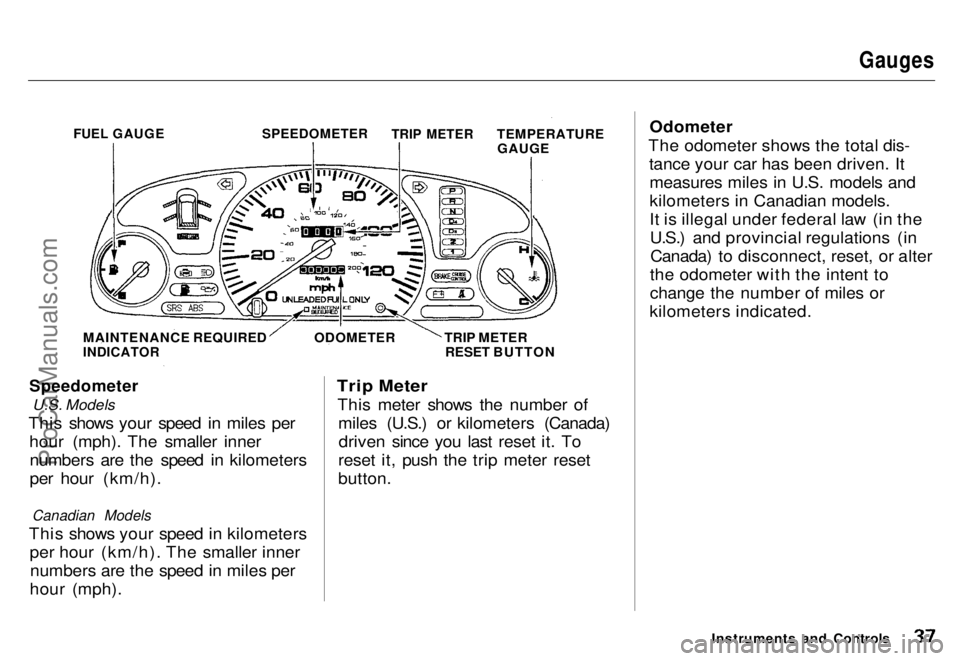
Speedometer
U.S. Models
This shows your speed in miles per hour (mph). The smaller innernumbers are the speed in kilometers
per hour (km/h).
Canadian Models
This shows your speed in kilometers per hour (km/h). The smaller innernumbers are the speed in miles per
hour (mph).
Trip Meter
This meter shows the number of miles (U.S.) or kilometers (Canada)driven since you last reset it. To
reset it, push the trip meter reset
button. Odometer
The odometer shows the total dis- tance your car has been driven. Itmeasures miles in U.S. models and
kilometers in Canadian models.
It is illegal under federal law (in theU.S.) and provincial regulations (inCanada) to disconnect, reset, or alter
the odometer with the intent to
change the number of miles or
kilometers indicated.
Instruments and Controls
FUEL GAUGE
SPEEDOMETER
TRIP METER
TEMPERATURE
GAUGE
MAINTENANCE REQUIRED
INDICATOR
ODOMETER
TRIP METER
RESET BUTTONProCarManuals.comMain Menu s t Table of Contents
Page 39 of 240
Gauges
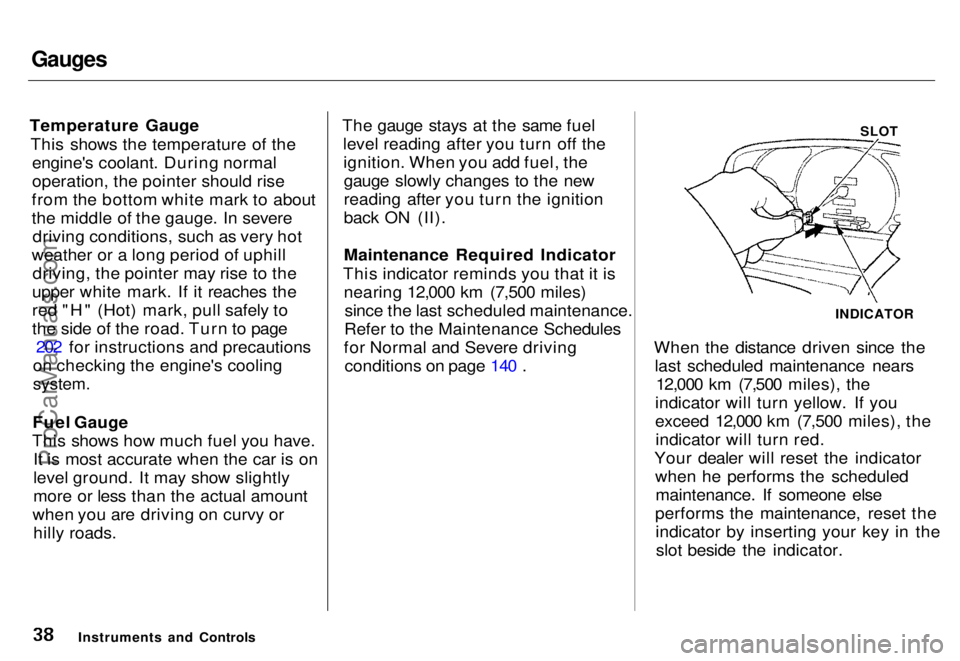
Temperature Gauge This shows the temperature of the engine's coolant. During normal
operation, the pointer should rise
from the bottom white mark to about
the middle of the gauge. In severe driving conditions, such as very hot
weather or a long period of uphill driving, the pointer may rise to the
upper white mark. If it reaches the
red "H" (Hot) mark, pull safely to
the side of the road. Turn to page 202 for instructions and precautions
on checking the engine's cooling
system.
Fuel Gauge
This shows how much fuel you have. It is most accurate when the car is on
level ground. It may show slightly
more or less than the actual amount
when you are driving on curvy or hilly roads. The gauge stays at the same fuel
level reading after you turn off theignition. When you add fuel, thegauge slowly changes to the new
reading after you turn the ignition
back ON (II).
Maintenance Required Indicator
This indicator reminds you that it is nearing 12,000 km (7,500 miles)since the last scheduled maintenance.
Refer to the Maintenance Schedules
for Normal and Severe driving conditions on page 140 . When the distance driven since the
last scheduled maintenance nears 12,000 km (7,500 miles), the
indicator will turn yellow. If you
exceed 12,000 km (7,500 miles), the indicator will turn red.
Your dealer will reset the indicator when he performs the scheduledmaintenance. If someone else
performs the maintenance, reset the indicator by inserting your key in theslot beside the indicator.
Instruments and Controls SLOT
INDICATORProCarManuals.comMain Menu s t Table of Contents
Page 107 of 240
Before Driving
Before you begin driving your Honda,
you should know what gasoline to use, and how to check the levels ofimportant fluids. You also need to
know how to properly stow luggage
or packages. This section will help
you. If you plan to add any accesso- ries to your car, please read theinformation in this section first. Break-in Period.............................. 108
Gasoline.......................................... 108
Oxygenated Fuels...................... 108
Driving in Foreign Countries... 109
Service Station Procedures .......... 110 Filling the Fuel Tank................. 110Opening the Hood..................... 111
Fuel Economy................................ 114
Vehicle Condition...................... 114Driving Habits............................ 114
Accessories..................................... 115
Loading Cargo................................ 116
Before DrivingProCarManuals.comMain Menu s t
Page 108 of 240
Break-in Period, Gasoline
Break-in Period
Help assure your car's future
reliability and performance by payingextra attention to how you drive
during the first 1,000 km (600 miles).
During this period:
Avoid full-throttle starts and rapid
acceleration.
If you need to add oil, use the
engine oil recommended in this
owner's manual.
Avoid hard braking. New brakes need to be broken-in by moderate
use for the first 300 km (200
miles).
You should follow these same re- commendations with an overhauled
or exchanged engine, or when the
brakes are relined.
Gasoline
Your Honda operates most effec- tively on unleaded gasoline with a
pump octane number of 86 or higher.
Use of a lower octane gasoline can
cause a persistent, heavy metallicrapping noise in the engine that can
lead to mechanical damage.
We recommend gasolines containing detergent additives that help prevent
fuel system and engine deposits.
Using gasoline containing lead will
damage your car's emission controls.
This contributes to air pollution and can void certain parts of your
warranty. Oxygenated Fuels
Some conventional gasolines are
being blended with alcohol or an
ether compound. These gasolines
are collectively referred to as
oxygenated fuels. To meet clean air standards, some areas of the United
States and Canada use oxygenated
fuels to help reduce emissions.
If you use an oxygenated fuel, besure it is unleaded and meets the
minimum octane rating requiremen
Before using an oxygenated fuel,
to confirm the fuel's contents. Some states/provinces require this
information to be posted on the
pump.
Before DrivingProCarManuals.comMain Menu s t Table of Contents
Page 109 of 240

Gasoline
The following are the EPA-approved percentages of oxygenates:
ETHANOL (ethyl or grain alcohol)
You may use gasoline containing up to 10% ethanol by volume. Gasoline containing ethanol may be marketed
under the name "Gasohol."
MTBE (Methyl Tertiary Butyl
Ether)
You may use gasoline containing up to 15% MTBE by volume. METHANOL (methyl or wood
alcohol)
You may use gasoline containing up to 5% methanol by volume as long asit also contains cosolvents andcorrosion inhibitors to protect the
fuel system. Gasoline containing more than 5% methanol by volume
may cause starting and/or perform-ance problems. It may also damage
metal, rubber and plastic parts of
your fuel system.
If you notice any undesirableoperating symptoms, try another
service station or switch to another
brand of gasoline.
Fuel system damage or performance
problems resulting from the use of an oxygenated fuel containing morethan the percentages of oxygenates
given above are not covered under
warranty.
Driving in Foreign Countries
If you are planning to take your
Honda outside the U.S. or Canada,
contact the tourist bureaus in the areas you will be traveling in to find
out about the availability of unleaded
gasoline with the proper octane
rating.
If unleaded gasoline is not available,
be aware that using leaded gasoline in your Honda will affect perfor-
mance and fuel mileage, and damage its emissions controls. It will nolonger comply with U.S. andCanadian emissions regulations, and
will be illegal to operate in North
America. To bring your car back into compliance will require the replace-
ment of several components, such as
the oxygen sensor and the three way catalytic converter. These replace-
ments are not covered under
warranty.
Before DrivingProCarManuals.comMain Menu s t Table of Contents