inflation pressure HONDA ODYSSEY 1996 Owners Manual
[x] Cancel search | Manufacturer: HONDA, Model Year: 1996, Model line: ODYSSEY, Model: HONDA ODYSSEY 1996Pages: 240, PDF Size: 2.64 MB
Page 168 of 240
Drive Belts, Tires
Drive Belts
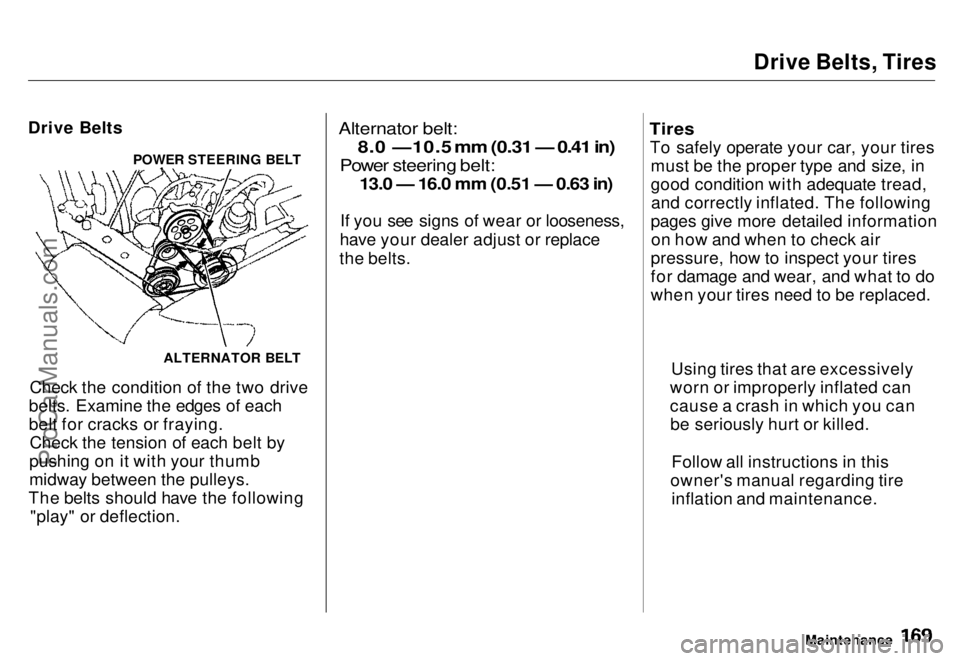
Check the condition of the two drive
belts. Examine the edges of each
belt for cracks or fraying. Check the tension of each belt by
pushing on it with your thumb
midway between the pulleys.
The belts should have the following "play" or deflection.
Alternator belt:
8.0 —10.5 mm (0.31 — 0.41 in)
Power steering belt:
13.0 — 16.0 mm (0.51 — 0.63 in)
If you see signs of wear or looseness,
have your dealer adjust or replace
the belts.
Tires
To safely operate your car, your tires must be the proper type and size, in
good condition with adequate tread,and correctly inflated. The following
pages give more detailed information on how and when to check air
pressure, how to inspect your tires
for damage and wear, and what to do
when your tires need to be replaced.
Maintenance
POWER STEERING BELT
ALTERNATOR BELT Using tires that are excessively
worn or improperly inflated can
cause a crash in which you can be seriously hurt or killed.
Follow all instructions in this
owner's manual regarding tire inflation and maintenance.ProCarManuals.comMain Menu s t Table of Contents
Page 169 of 240
Tires
InflationKeeping the tires properly inflatedprovides the best combination of
handling, tread life and riding
comfort. Under-inflated tires wear
unevenly, adversely affect handling
and fuel economy, and are more
likely to fail from being overheated. Overinflated tires can make your car
ride more harshly, are more prone to damage from road hazards, and wear
unevenly.
We recommend that you visually check your tires every day and use a
gauge to measure the air pressure at least once a month. If you think a tire
might be low, check it immediately. Remember to check the spare tire at
the same time you check all the other tires.
Check the pressure in the tires when
they are cold. This means the car has been parked for at least three
hours. If you have to drive the car
before checking the tire pressure,
the tires can still be considered
"cold" if you drive less than 1.6 km
(1 mile).
If you check the pressure when the
tires are hot (the car has been driven
several miles), you will see readings
30 to 40 kPa (0.3 to 0.4 kg/cm2,4 to
6 psi) higher than the cold reading.
This is normal. Do not let air out to
match the specified cold pressure.
The tire will be underinflated.
Recommended Tire Pressures for
Normal Driving
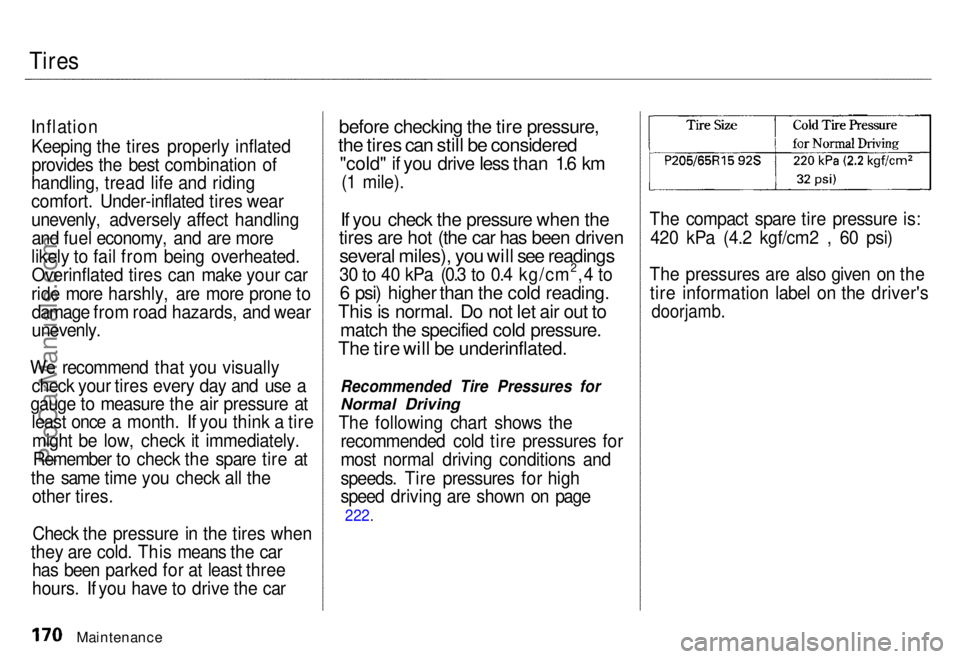
The following chart shows the recommended cold tire pressures for
most normal driving conditions and
speeds. Tire pressures for high
speed driving are shown on page 222. The compact spare tire pressure is:
420 kPa (4.2 kgf/cm2 , 60 psi)
The pressures are also given on the tire information label on the driver's
doorjamb.
MaintenanceProCarManuals.comMain Menu s t Table of Contents
Page 170 of 240
Tires
You should get your own tire pressure gauge and use it whenever
you check your tire pressures. This
will make it easier for you to tell if a pressure loss is due to a tire problem and not due to a variation between
gauges.
Tubeless tires have some ability to self-seal if they are punctured.
However, because leakage is often
very slow, you should look closely
for punctures if a tire starts losing
pressure.
Inspection
Every time you check inflation, you should also examine the tires fordamage, foreign objects, and wear. You should look for: Bumps or bulges in the tread or
side of the tire. Replace the tire if
you find either of these conditions. Cuts, splits, or cracks in the side
of the tire. Replace the tire if you
can see fabric or tread.
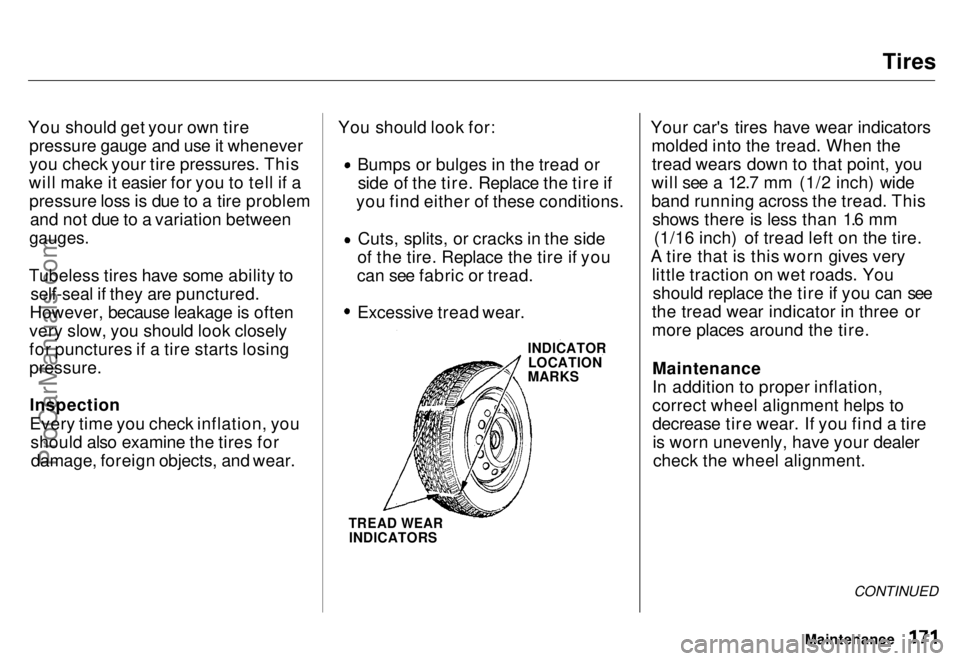
Excessive tread wear. Your car's tires have wear indicators
molded into the tread. When thetread wears down to that point, you
will see a 12.7 mm (1/2 inch) wide
band running across the tread. This shows there is less than 1.6 mm (1/16 inch) of tread left on the tire.
A tire that is this worn gives very little traction on wet roads. Youshould replace the tire if you can see
the tread wear indicator in three or
more places around the tire.
Maintenance
In addition to proper inflation,
correct wheel alignment helps to
decrease tire wear. If you find a tireis worn unevenly, have your dealercheck the wheel alignment.
CONTINUED
Maintenance
INDICATOR
LOCATION
MARKS
TREAD WEAR
INDICATORSProCarManuals.comMain Menu s t Table of Contents
Page 190 of 240
Compact Spare Tire
Your car has a compact spare tire that takes up less space. Use this spare tire as a temporary replace-
ment only. Get your regular tire
repaired or replaced and put back on
your car as soon as you can.
Check the inflation pressure of the
compact spare tire every time you
check the other tires. It should be
inflated to:420 kPa (4.2 kgf/cm2 , 60 psi)
Follow these precautions whenever
you are using the compact spare tire:
Do not exceed 50 mph (80 km/h)
under any circumstances.
This tire gives a harsher ride and
less traction on some road sur-
faces than the regular tire. Use
greater caution while driving on
this tire.
Do not mount snow chains on the
compact spare.
The wheel of the compact spare
tire is designed especially to fit
your car. Do not use your spare tire on another car unless it is the
same make and model.
INDICATOR
LOCATION
MARK
TREAD WEARINDICATOR
BAR
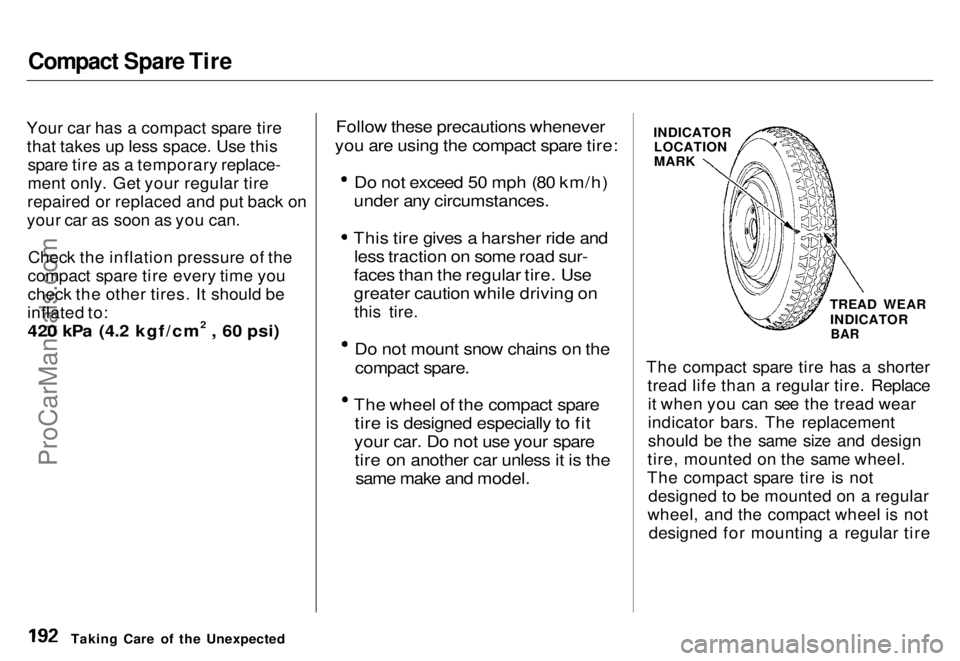
The compact spare tire has a shorter tread life than a regular tire. Replaceit when you can see the tread wear
indicator bars. The replacement
should be the same size and design
tire, mounted on the same wheel.
The compact spare tire is not designed to be mounted on a regular
wheel, and the compact wheel is not designed for mounting a regular tire
Taking Care of the Unexpected
ProCarManuals.coms t Main Menu Table of Contents
Page 238 of 240
Index
Seats
Reclining the Second Seat.......... 59
Removing the Second Seats....... 57
Third Seat Access...................... 56
Serial Number................................ 216
Service Intervals*.......................... 140
Service Manual.............................. 233
Service Station Procedures.......... 110
Setting the Clock............................. 66
Shifting the Automatic
Transmission.............................. 120
Shift Lever Position Indicator...... 120
Side Marker Lights, Bulb
Replacement in.......................... 178
Signaling Turns................................ 41
Snow Tires...................................... 174
Solvent-type Cleaners.................... 184
Sound System................................... 83
Spare Tire
Inflating....................................... 192
Specifications............................. 219
Spark Plugs, Replacing................. 160
Specifications Charts..................... 218
Speed Control...................................
46
Speedometer.................................... 3 7
SR
S Indicator............................. 16,
34
START (Ignitio
n
Key Position)..... 50
Starting the Engine........................ 119 In Cold Weather at HighAltitude................................... 119
With a Dead Battery................. 200
Steam Coming from Engine......... 202
Steering Wheel
Adjustment................................... 44
Anti-theft Column Lock.............. 49
Stereo Sound System...................... 83 Storing Your Car............................ 182
Sunroof............................................. 63
Closing Manually....................... 207
Operation......................................
63
Supplemental Restrain t
System
Service Precautions..................... 17
Servicing....................................... 16
SRS Indicator.......................... 16, 34
System
Components................... .
12
Synthetic Oil................................... 148
Tailgate........................................... 52
Taillights, Changing Bulbs in....... 179
Taking Care of the Unexpected.. 191 Tape Player................................ 87, 99
Technical Descriptions Anti-lock Brake System............ 220Emission Control Systems........ 224
Three Way Catalytic
Converter................................ 226
Tire Information........................
221
Temperature Gauge....................... .
38
Tether Attachment Points.............. 26 Three Way Catalytic Converter... 226
Time, Setting the...........................
66
Tire Chains.................................... .
174
Tire, How to Change a Flat.......... 193
Tires................................................ 169 Air Pressure............................... 170
Checking Wear.......................... 171
Compact Spare........................... 192
DOT Tire Quality Grading....... 222
Inflation....................................... 170
CONTINUED
ProCarManuals.comMain Menu s t