air condition HONDA ODYSSEY 1998 Owner's Manual
[x] Cancel search | Manufacturer: HONDA, Model Year: 1998, Model line: ODYSSEY, Model: HONDA ODYSSEY 1998Pages: 272, PDF Size: 2.67 MB
Page 196 of 272
Tires
If you check the pressure when the
tires are hot (the vehicle has been driven several miles), you will see
readings 4 to 6 psi (30 to 40 kPa, 0.3
to 0.4 kgf/cm2) higher than the cold reading. This is normal. Do not let
air out to match the specified cold
pressure. The tire will be
underinflated.
You should get your own tire pressure gauge and use it whenever
you check your tire pressures. This
will make it easier for you to tell if a pressure loss is due to a tire problemand not due to a variation between
gauges.
Recommended Tire Pressures for
Normal Driving
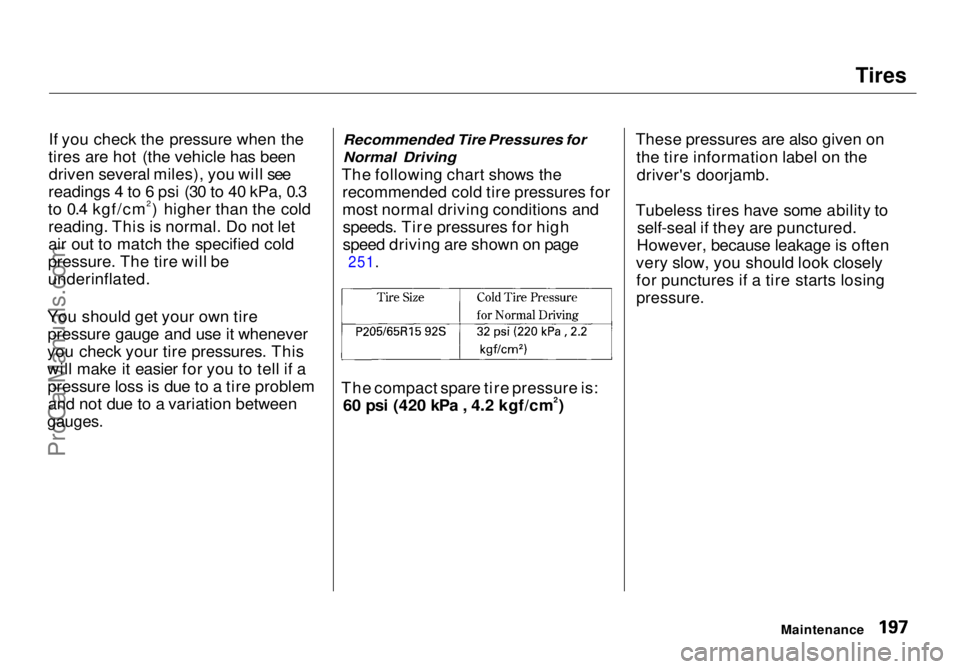
The following chart shows the recommended cold tire pressures for
most normal driving conditions andspeeds. Tire pressures for high
speed driving are shown on page
251.
The compact spare tire pressure is: 60 psi (420 kPa , 4.2 kgf/cm2) These pressures are also given on
the tire information label on thedriver's doorjamb.
Tubeless tires have some ability to self-seal if they are punctured.
However, because leakage is often
very slow, you should look closely for punctures if a tire starts losing
pressure.
MaintenanceProCarManuals.comMain Menu Table of Contents s t
Page 197 of 272
Tires
Inspection
Every time you check inflation, youshould also examine the tires for
damage, foreign objects, and wear.
You should look for: Bumps or bulges in the tread or
side of the tire. Replace the tire if
you find either of these conditions. Cuts, splits, or cracks in the side
of the tire. Replace the tire if you
can see fabric or cord.
Excessive tread wear.
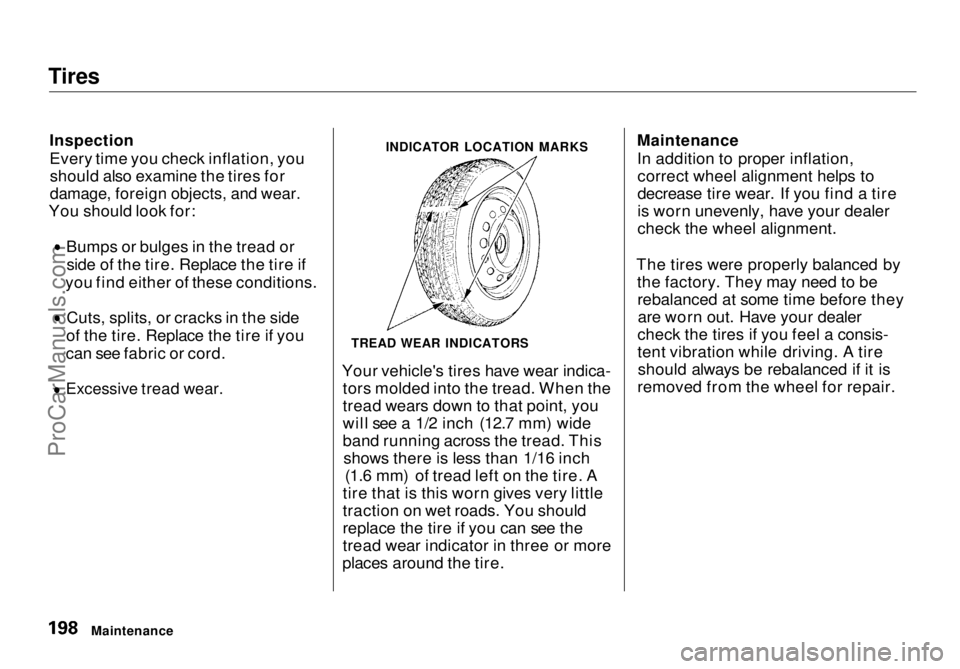
INDICATOR LOCATION MARKS
Your vehicle's tires have wear indica- tors molded into the tread. When the
tread wears down to that point, you
will see a 1/2 inch (12.7 mm) wide
band running across the tread. Thisshows there is less than 1/16 inch (1.6 mm) of tread left on the tire. A
tire that is this worn gives very little
traction on wet roads. You should
replace the tire if you can see the
tread wear indicator in three or more
places around the tire.
Maintenance
In addition to proper inflation,
correct wheel alignment helps to
decrease tire wear. If you find a tire
is worn unevenly, have your dealer
check the wheel alignment.
The tires were properly balanced by the factory. They may need to berebalanced at some time before theyare worn out. Have your dealer
check the tires if you feel a consis-
tent vibration while driving. A tire should always be rebalanced if it is
removed from the wheel for repair.
Maintenance
TREAD WEAR INDICATORSProCarManuals.comMain Menu Table of Contents s t
Page 199 of 272
Tires
It is best to replace all four tires at
the same time. If that is not possible or necessary, then replace the two
front tires or the two rear tires as a
pair. Replacing just one tire can seriously affect your vehicle's han-
dling.
The ABS works by comparing the speed of the wheels. When replacing
tires, use the same size originally supplied with the vehicle. Tire size
and construction can affect wheel speed and may cause the system to
work inconsistently.
If you ever need to replace a wheel,
make sure the wheel's specifications
match those of the original wheel
that came on your vehicle. Re-
placement wheels are available at
your Honda dealer.
Wheels and Tires
Wheel:
15 x 6 JJ
Tire:
P205/65R15 92S
See Tire Information on
page 222 for
additional information about tire and
wheel size designations. See page 251 for information about DOT Tire
Quality Grading.
Winter Driving
Tires that are marked "M + S" or
"All Season" on the sidewall have an
all-weather tread design. They
should be suitable for most winter
driving conditions. Tires without
these markings are designed for optimum traction in dry conditions.
They may not provide adequate performance in winter driving.For the best performance in snowyor icy conditions, you should install
snow tires or tire chains. They may
be required by local laws under certain conditions.
Maintenance
Installing improper tires on your
vehicle can affect handling and stability. This can cause a crashin which you can be seriously
hurt or killed.
Always use the size and type of
tires recommended in this owner's manual.ProCarManuals.comMain Menu Table of Contents s t
Page 234 of 272
Brake System Indicator
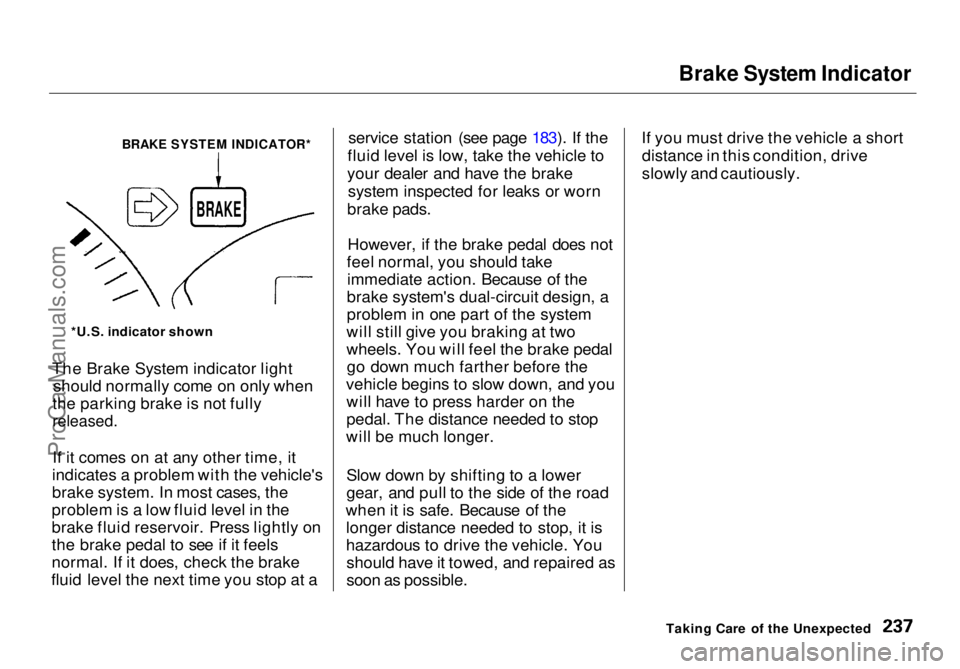
The Brake System indicator light should normally come on only when
the parking brake is not fully
released.
If it comes on at any other time, it
indicates a problem with the vehicle's
brake system. In most cases, the
problem is a low fluid level in the
brake fluid reservoir. Press lightly on
the brake pedal to see if it feels
normal. If it does, check the brake
fluid level the next time you stop at a service station (see page 183). If the
fluid level is low, take the vehicle to
your dealer and have the brake system inspected for leaks or worn
brake pads.
However, if the brake pedal does not
feel normal, you should take immediate action. Because of the
brake system's dual-circuit design, a
problem in one part of the system
will still give you braking at two
wheels. You will feel the brake pedal go down much farther before the
vehicle begins to slow down, and you will have to press harder on the
pedal. The distance needed to stop
will be much longer.
Slow down by shifting to a lower
gear, and pull to the side of the road
when it is safe. Because of the longer distance needed to stop, it is
hazardous to drive the vehicle. Youshould have it towed, and repaired as
soon as possible. If you must drive the vehicle a short
distance in this condition, drive
slowly and cautiously.
Taking Care of the Unexpected
BRAKE SYSTEM INDICATOR*
*U.S. indicator shown
BRAKEProCarManuals.comMain Menu Table of Contents s t
Page 252 of 272
Emissions Controls
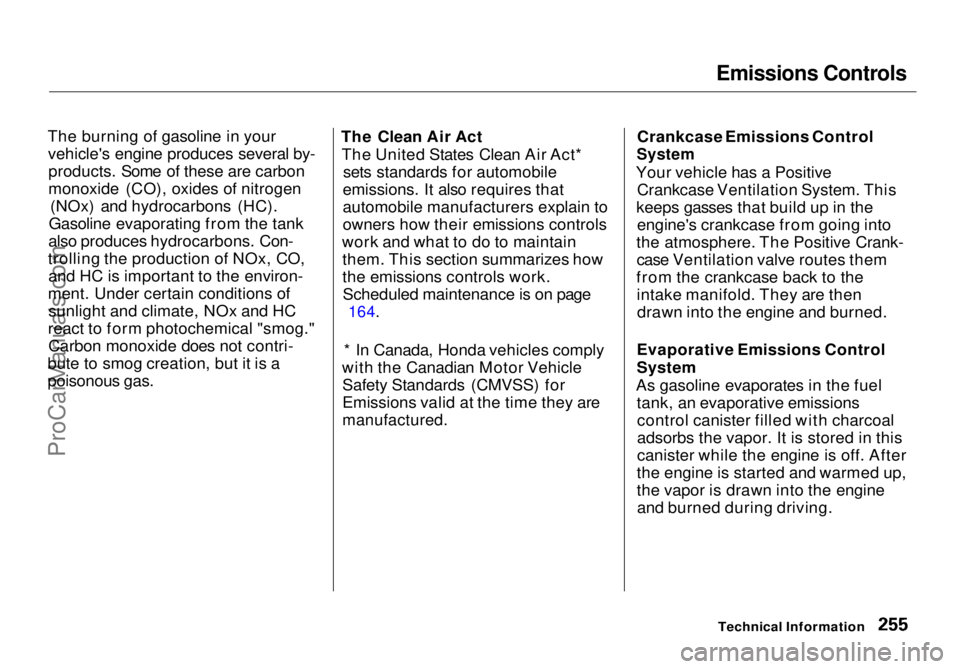
The burning of gasoline in your vehicle's engine produces several by-products. Some of these are carbon
monoxide (CO), oxides of nitrogen (NOx) and hydrocarbons (HC).
Gasoline evaporating from the tank
also produces hydrocarbons. Con-
trolling the production of NOx, CO, and HC is important to the environ-
ment. Under certain conditions of sunlight and climate, NOx and HC
react to form photochemical "smog." Carbon monoxide does not contri-
bute to smog creation, but it is a
poisonous gas. The Clean Air Act
The United States Clean Air Act* sets standards for automobile
emissions. It also requires that
automobile manufacturers explain to
owners how their emissions controls
work and what to do to maintain them. This section summarizes how
the emissions controls work.Scheduled maintenance is on page
164.
* In Canada, Honda vehicles comply
with the Canadian Motor Vehicle Safety Standards (CMVSS) for
Emissions valid at the time they are
manufactured.
Crankcase Emissions Control
System
Your vehicle has a Positive Crankcase Ventilation System. This
keeps gasses that build up in the engine's crankcase from going into
the atmosphere. The Positive Crank- case Ventilation valve routes them
from the crankcase back to the intake manifold. They are thendrawn into the engine and burned.
Evaporative Emissions Control
System
As gasoline evaporates in the fuel tank, an evaporative emissionscontrol canister filled with charcoal
adsorbs the vapor. It is stored in this
canister while the engine is off. After
the engine is started and warmed up,
the vapor is drawn into the engine and burned during driving.
Technical InformationProCarManuals.comMain Menu Table of Contents s t
Page 253 of 272
Emissions Controls
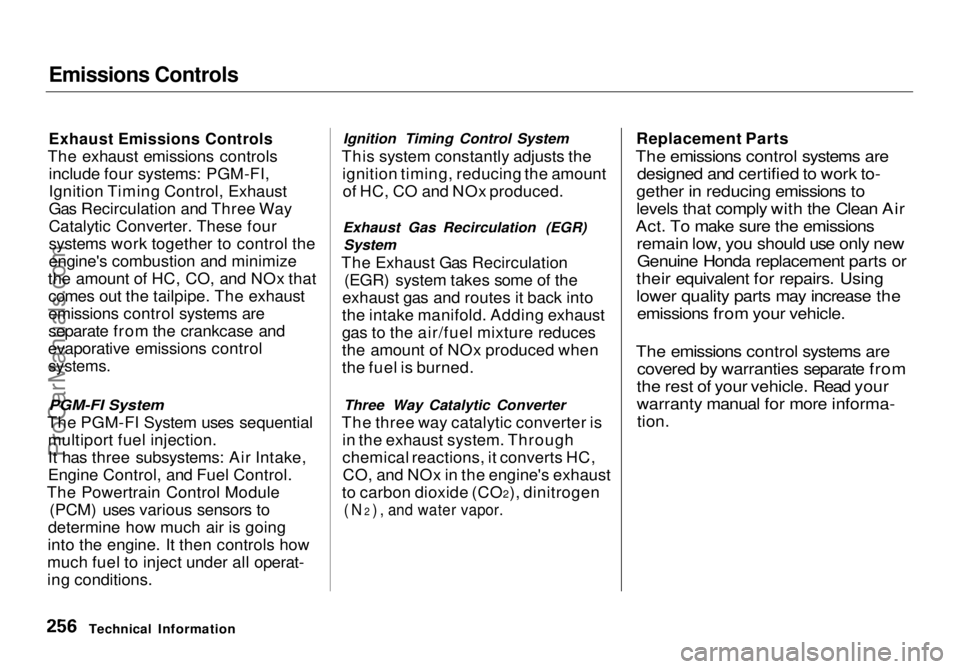
Exhaust Emissions Controls
The exhaust emissions controls include four systems: PGM-FI,
Ignition Timing Control, Exhaust
Gas Recirculation and Three Way
Catalytic Converter. These four
systems work together to control the
engine's combustion and minimize
the amount of HC, CO, and NOx that comes out the tailpipe. The exhaust
emissions control systems are
separate from the crankcase and
evaporative emissions control
systems.
PGM-FI System
The PGM-FI System uses sequential multiport fuel injection.
It has three subsystems: Air Intake,
Engine Control, and Fuel Control.
The Powertrain Control Module (PCM) uses various sensors to
determine how much air is going
into the engine. It then controls how
much fuel to inject under all operat-
ing conditions. Ignition Timing Control System
This system constantly adjusts the ignition timing, reducing the amountof HC, CO and NOx produced.
Exhaust Gas Recirculation (EGR)
System
The Exhaust Gas Recirculation (EGR) system takes some of the
exhaust gas and routes it back into
the intake manifold. Adding exhaust
gas to the air/fuel mixture reduces
the amount of NOx produced when
the fuel is burned.
Three Way Catalytic Converter
The three way catalytic converter is in the exhaust system. Through
chemical reactions, it converts HC,CO, and NOx in the engine's exhaust
to carbon dioxide (CO2), dinitrogen
(N2), and water vapor.
Replacement Parts
The emissions control systems are designed and certified to work to-
gether in reducing emissions to
levels that comply with the Clean Air
Act. To make sure the emissions remain low, you should use only newGenuine Honda replacement parts or
their equivalent for repairs. Using
lower quality parts may increase the emissions from your vehicle.
The emissions control systems are covered by warranties separate from
the rest of your vehicle. Read your
warranty manual for more informa-
tion.
Technical InformationProCarManuals.comMain Menu Table of Contents s t
Page 263 of 272
Index
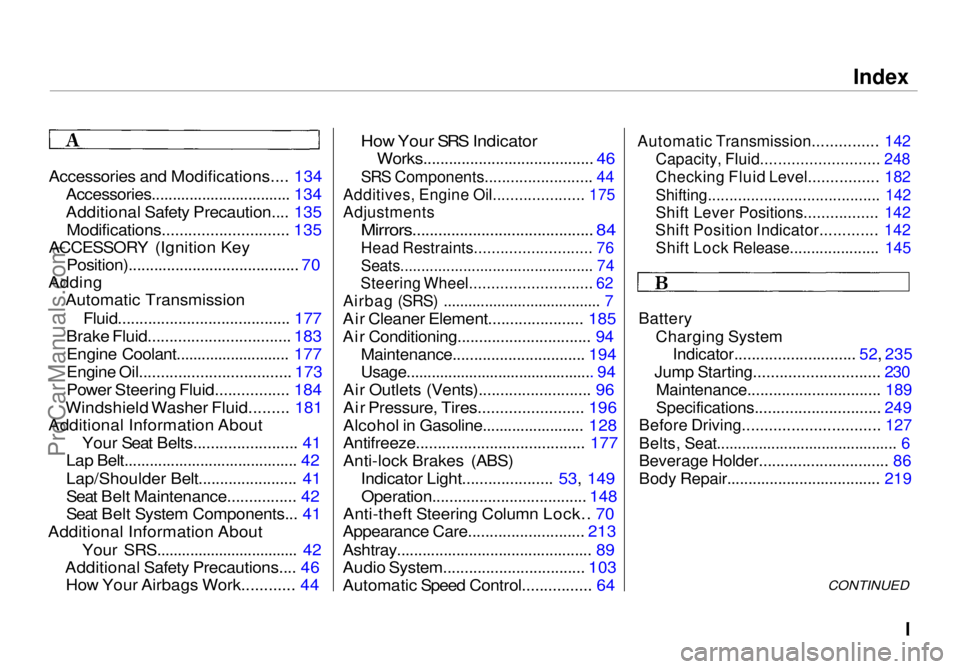
Accessories and Modifications.... 134 Accessories................................. 134
Additional Safety Precaution.... 135Modifications............................. 135
ACCESSORY (Ignition Key
Position)........................................ 70
Adding Automatic Transmission
Fluid........................................ 177
Brake Fluid................................. 183
Engine Coolant........................... 177
Engine Oil................................... 173
Power Steering Fluid................. 184
Windshield Washer Fluid......... 181
Additional Information About
Your Seat Belts........................ 41
Lap Belt......................................... 42
Lap/Shoulder Belt....................... 41
Seat Belt Maintenance................ 42
Seat Belt System Components... 41
Additional Information About
Your SRS.................................. 42
Additional Safety Precautions.... 46 How Your Airbags Work............ 44
How Your SRS Indicator
Works........................................ 46
SRS Components......................... 44
Additives, Engine Oil..................... 175
Adjustments
Mirrors.......................................... 84
Head Restraints........................... 76
Seats.............................................. 74
Steering Wheel............................ 62
Airbag (SRS) ...................................... 7
Air Cleaner Element...................... 185
Air Conditioning............................... 94
Maintenance............................... 194
Usage............................................. 94
Air Outlets (Vents).......................... 96
Air Pressure, Tires........................ 196
Alcohol in Gasoline........................ 128
Antifreeze....................................... 177
Anti-lock Brakes (ABS) Indicator Light..................... 53, 149Operation.................................... 148
Anti-theft Steering Column Lock.. 70
Appearance Care........................... 213
Ashtray.............................................. 89
Audio System................................. 103
Automatic Speed Control................ 64
Automatic Transmission............... 142
Capacity, Fluid........................... 248
Checking Fluid Level................ 182
Shifting........................................ 142
Shift Lever Positions................. 142
Shift Position Indicator............. 142
Shift Lock Release..................... 145
Battery
Charging System
Indicator............................ 52, 235
Jump Starting............................. 230
Maintenance............................... 189
Specifications............................. 249
Before Driving............................... 127
Belts, Seat........................................... 6
Beverage Holder.............................. 86
Body Repair.................................... 219
CONTINUEDProCarManuals.comMain Menu s t
Page 264 of 272
Index
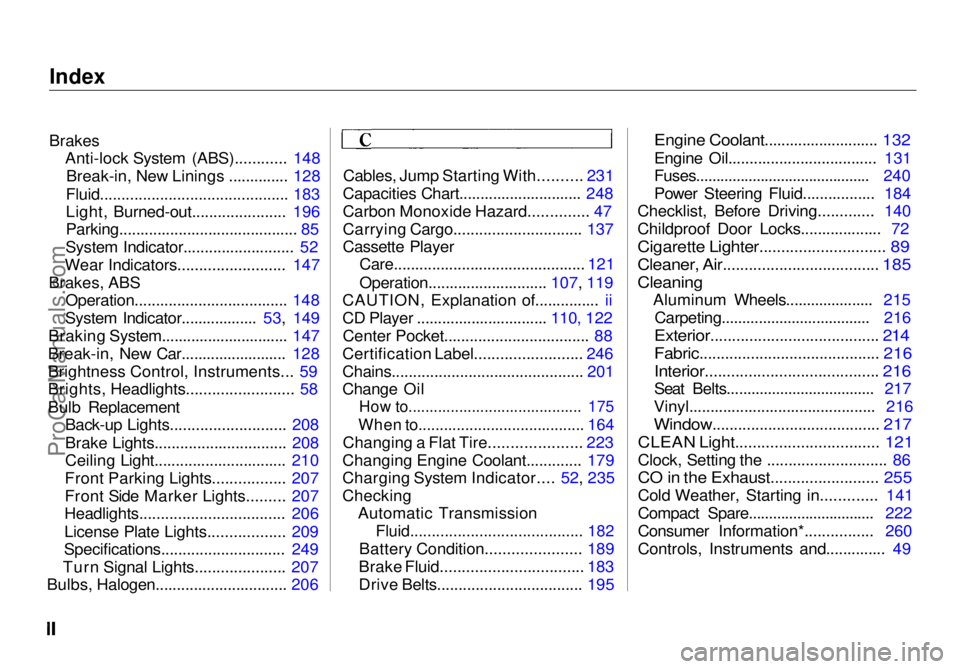
Brakes Anti-lock System (ABS)............ 148
Break-in, New Linings .............. 128
Fluid............................................ 183
Light, Burned-out...................... 196
Parking.......................................... 85
System Indicator.......................... 52
Wear Indicators......................... 147
Brakes, ABS Operation.................................... 148
System Indicator.................. 53, 149
Braking System.............................. 147
Break-in, New Car......................... 128
Brightness Control, Instruments... 59
Brights, Headlights......................... 58
Bulb Replacement Back-up Lights........................... 208
Brake Lights............................... 208
Ceiling Light............................... 210
Front Parking Lights................. 207
Front Side Marker Lights......... 207
Headlights.................................. 206
License Plate Lights.................. 209
Specifications............................. 249
Turn Signal Lights..................... 207
Bulbs, Halogen............................... 206 Cables, Jump Starting With.......... 231
Capacities Chart............................. 248
Carbon Monoxide Hazard.............. 47
Carrying Cargo.............................. 137
Cassette Player Care............................................. 121
Operation............................ 107, 119
CAUTION, Explanation of............... ii
CD Player ............................... 110, 122
Center Pocket.................................. 88
Certification Label......................... 246
Chains............................................. 201
Change Oil
How to......................................... 175
When to....................................... 164
Changing a Flat Tire..................... 223
Changing Engine Coolant............. 179
Charging System Indicator.... 52, 235
Checking Automatic Transmission
Fluid........................................ 182
Battery Condition...................... 189
Brake Fluid................................. 183
Drive Belts.................................. 195
Engine Coolant........................... 132
Engine Oil................................... 131
Fuses........................................... 240
Power Steering Fluid................. 184
Checklist, Before Driving............. 140
Childproof Door Locks................... 72
Cigarette Lighter............................. 89
Cleaner, Air.................................... 185
Cleaning
Aluminum Wheels..................... 215
Carpeting.................................... 216
Exterior....................................... 214
Fabric.......................................... 216
Interior........................................ 216
Seat Belts.................................... 217
Vinyl............................................ 216
Window....................................... 217
CLEAN Light................................. 121
Clock, Setting the ............................ 86
CO in the Exhaust......................... 255
Cold Weather, Starting in............. 141
Compact Spare............................... 222
Consumer Information*................ 260
Controls, Instruments and.............. 49ProCarManuals.comMain Menu s t