ECO mode HONDA ODYSSEY 1998 Owners Manual
[x] Cancel search | Manufacturer: HONDA, Model Year: 1998, Model line: ODYSSEY, Model: HONDA ODYSSEY 1998Pages: 272, PDF Size: 2.67 MB
Page 25 of 272
Protecting Children
3. The child seat should fit the vehicle seating position (or
positions) where it will be used.
Due to variations in the design of
child seats, vehicle seats, and seat
belts, all child seats will not fit all
vehicle seating positions.
However, Acura is confident that oneor more child seat models can fit and
be properly installed in all
recommended seating positions in
your vehicle. Whenever possible, we recommend
that parents test a child seat in thespecific vehicle seating position (or
positions) where they intend to use the seat before making a purchase. If
a previously purchased child seatdoes not fit, you may need to buy a
different one that will fit.
Driver and Passenger SafetyProCarManuals.comMain Menu Table of Contents s t
Page 28 of 272
Protecting Children
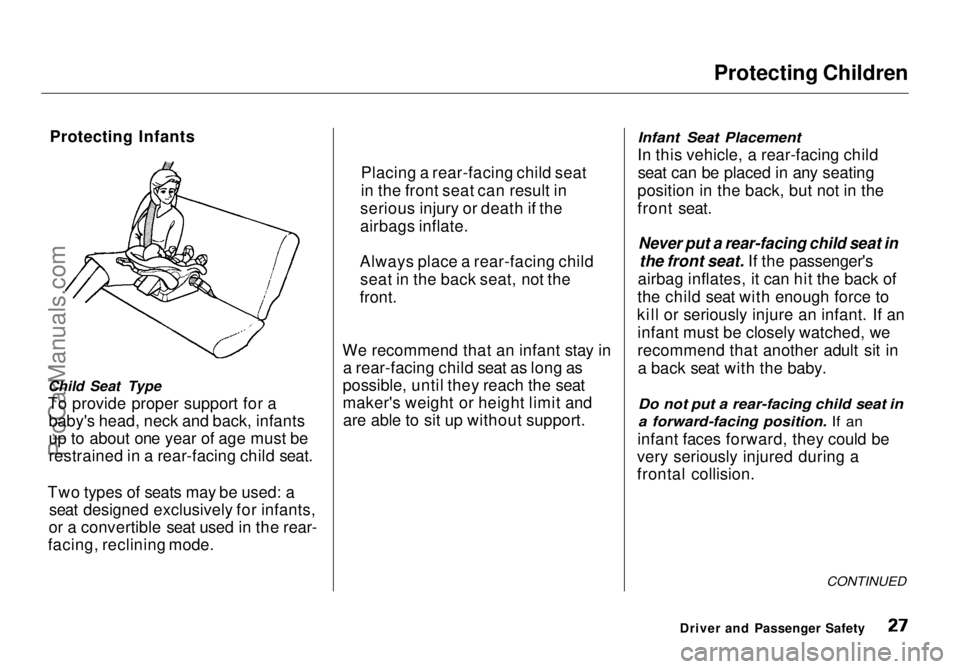
Protecting Infants
Child Seat Type
To provide proper support for a baby's head, neck and back, infants
up to about one year of age must be
restrained in a rear-facing child seat.
Two types of seats may be used: a seat designed exclusively for infants,
or a convertible seat used in the rear-
facing, reclining mode. We recommend that an infant stay in
a rear-facing child seat as long as
possible, until they reach the seat
maker's weight or height limit and are able to sit up without support.
Infant Seat Placement
In this vehicle, a rear-facing child seat can be placed in any seating
position in the back, but not in the
front seat.
Never put a rear-facing child seat in
the front seat. If the passenger's
airbag inflates, it can hit the back of
the child seat with enough force to
kill or seriously injure an infant. If an infant must be closely watched, we
recommend that another adult sit ina back seat with the baby.
Do not put a rear-facing child seat in
a forward-facing position. If an
infant faces forward, they could be
very seriously injured during a
frontal collision.
CONTINUED
Driver and Passenger Safety
Placing a rear-facing child seat
in the front seat can result in
serious injury or death if the
airbags inflate.
Always place a rear-facing child seat in the back seat, not the
front.ProCarManuals.comMain Menu Table of Contents s t
Page 31 of 272
Protecting Children
Installing an Infant Seat With the
Lap Belt
Seven-passenger model only
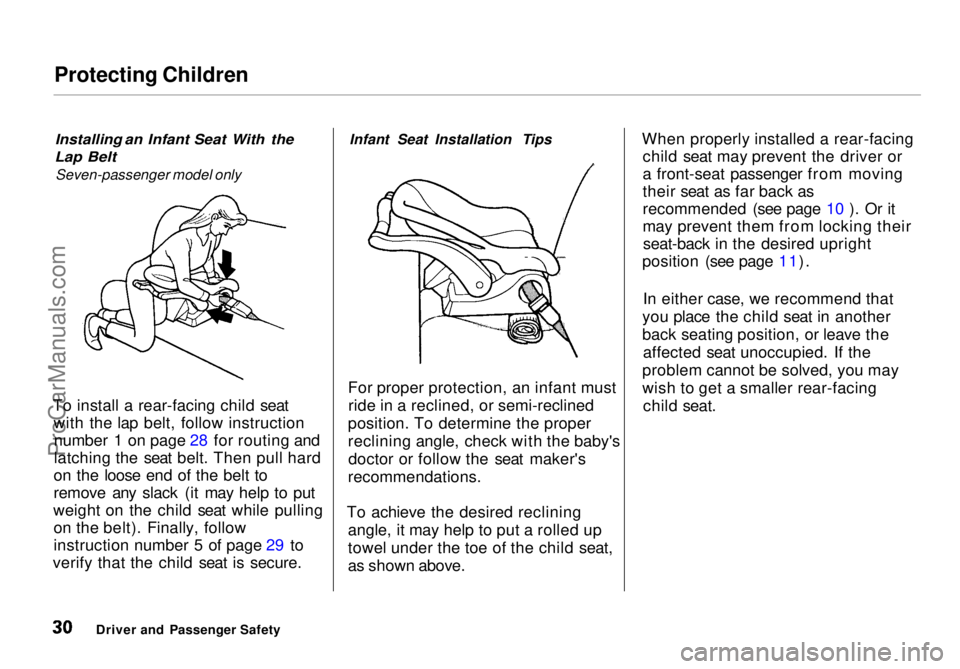
To install a rear-facing child seat with the lap belt, follow instructionnumber 1 on page 28 for routing and
latching the seat belt. Then pull hard
on the loose end of the belt to
remove any slack (it may help to put
weight on the child seat while pulling on the belt). Finally, follow
instruction number 5 of page 29 to
verify that the child seat is secure. Infant Seat Installation Tips
For proper protection, an infant must ride in a reclined, or semi-reclined
position. To determine the proper
reclining angle, check with the baby's doctor or follow the seat maker's
recommendations.
To achieve the desired reclining angle, it may help to put a rolled up
towel under the toe of the child seat,
as shown above. When properly installed a rear-facing
child seat may prevent the driver or
a front-seat passenger from moving
their seat as far back as
recommended (see page 10 ). Or it
may prevent them from locking theirseat-back in the desired upright
position (see page 11).
In either case, we recommend that
you place the child seat in another
back seating position, or leave the affected seat unoccupied. If the
problem cannot be solved, you may
wish to get a smaller rear-facing child seat.
Driver and Passenger SafetyProCarManuals.comMain Menu Table of Contents s t
Page 35 of 272
Protecting Children
To deactivate the locking
mechanism in order to remove a
child seat, unlatch the buckle,
unroute the seat belt, and let the belt
fully retract.
Installing a Child Seat With the Lap
Belt
Seven-passenger model only
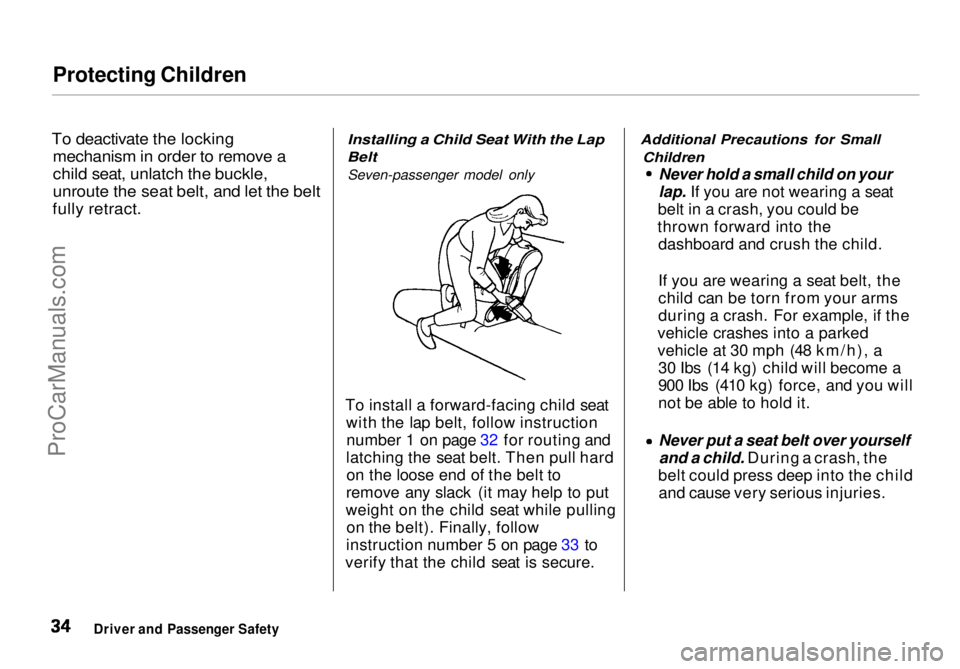
To install a forward-facing child seat with the lap belt, follow instructionnumber 1 on page 32 for routing and
latching the seat belt. Then pull hard on the loose end of the belt to
remove any slack (it may help to put
weight on the child seat while pulling on the belt). Finally, follow
instruction number 5 on page 33 to
verify that the child seat is secure.
Additional Precautions for Small
Children
Never hold a small child on your
lap. If you are not wearing a seat
belt in a crash, you could be
thrown forward into the dashboard and crush the child.
If you are wearing a seat belt, the
child can be torn from your arms
during a crash. For example, if the
vehicle crashes into a parked
vehicle at 30 mph (48 km/h), a 30 Ibs (14 kg) child will become a
900 Ibs (410 kg) force, and you will
not be able to hold it.
Never put a seat belt over yourself
and a child. During a crash, the
belt could press deep into the child and cause very serious injuries.
Driver and Passenger SafetyProCarManuals.comMain Menu Table of Contents s t
Page 39 of 272
Protecting Children
If you decide that a child can safely
ride up front, be sure to:
Carefully read the owner's manual,
and make sure you understand all
seat belt instructions and all safety
information. Move the vehicle seat to the rear-
most position.
Have the child sit up straight with
their back against the seat and
their feet on, or near the floor. Check that the child's seat belt is
properly positioned and secured.
Closely supervise the child. Even
mature children sometimes need
to be reminded to fasten their seat
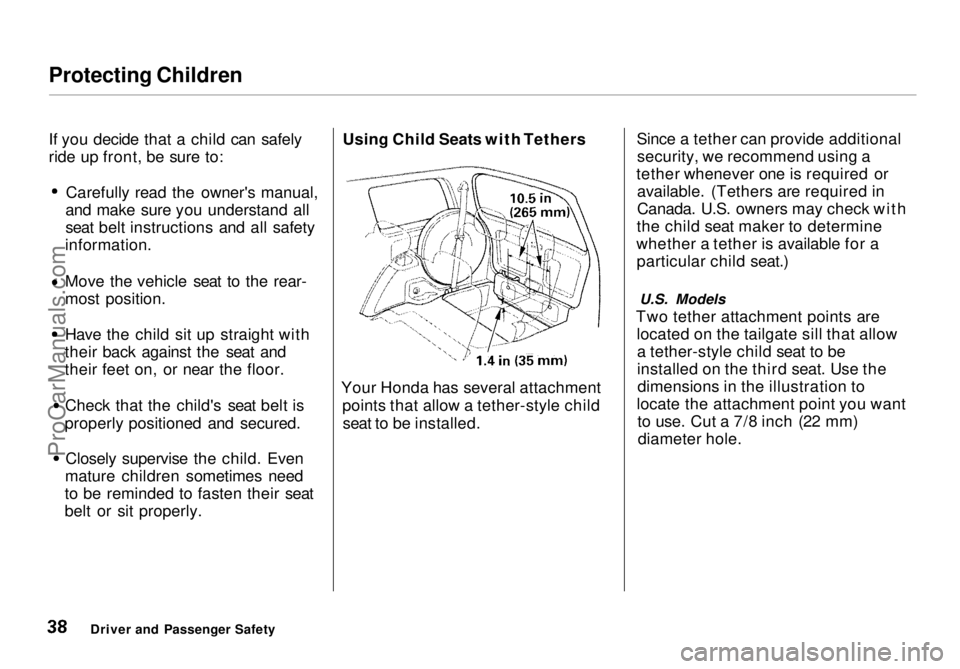
belt or sit properly. Using Child Seats with Tethers
Your Honda has several attachment points that allow a tether-style childseat to be installed. Since a tether can provide additional
security, we recommend using a
tether whenever one is required or available. (Tethers are required in
Canada. U.S. owners may check with
the child seat maker to determine
whether a tether is available for a particular child seat.)
U.S. Models
Two tether attachment points are located on the tailgate sill that allowa tether-style child seat to be
installed on the third seat. Use thedimensions in the illustration to
locate the attachment point you want to use. Cut a 7/8 inch (22 mm)diameter hole.
Driver and Passenger SafetyProCarManuals.comMain Menu Table of Contents s t
Page 40 of 272
Protecting Children
Install the anchor plate and
mounting hardware. The hardware is available for purchase from your
Honda dealer (part number 82410-
SE3-C01).
When installing tether hardware, make sure the toothed washer is on
the bottom of the bolt. Tighten the
bolt to:16 lbf.ft (22 N .
m, 2.2 kgf.m)
To attache
the tether to the child
seat, follow the child seat maker's
instructions.
If you are not sure how to install the
tether, or you need mounting
hardware, contact your Honda dealer.
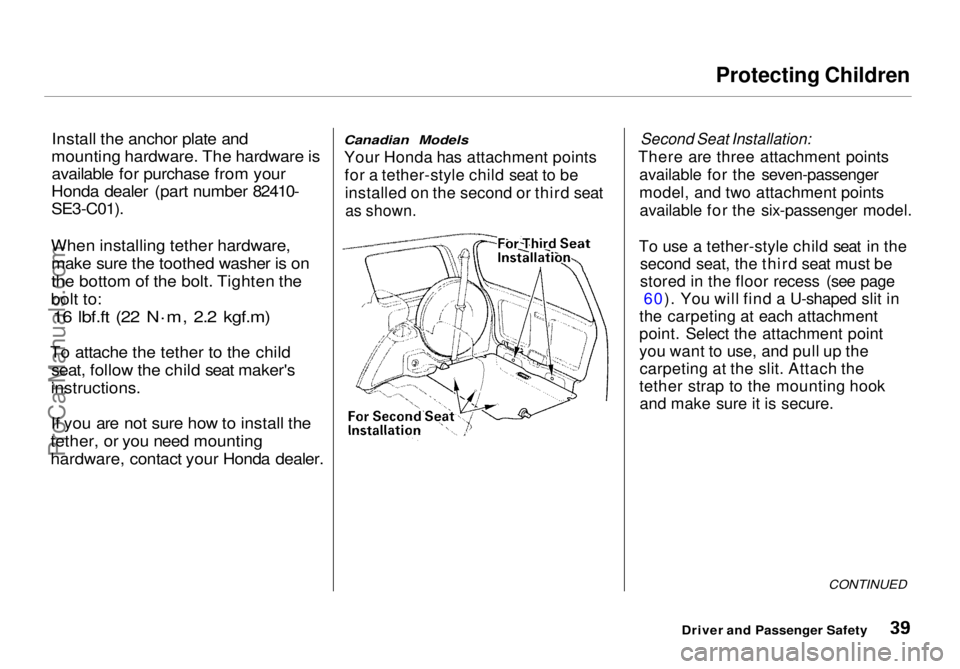
Canadian Models
Your Honda has attachment pointsfor a tether-style child seat to beinstalled on the second or third seat
as shown.
Second Seat Installation:
There are three attachment points available for the seven-passenger
model, and two attachment pointsavailable for the six-passenger model.
To use a tether-style child seat in the second seat, the third seat must be
stored in the floor recess (see page 60). You will find a U-shaped slit in
the carpeting at each attachment
point. Select the attachment point
you want to use, and pull up the carpeting at the slit. Attach the
tether strap to the mounting hook and make sure it is secure.
CONTINUED
Driver and Passenger SafetyProCarManuals.comMain Menu Table of Contents s t
Page 42 of 272
Additional Information About Your Seat Belts
Seat Belt System Components
All the seat belts in the 6-passenger model are lap/shoulder belts. In the7-passenger model, the center
position of the bench-type second seat has a lap belt.
The system also includes alight on the instrument
panel to remind you and your
passengers to fasten your belts. If
the driver's seat belt is not fastened
before the ignition is turned ON (II), the light will come on and a beeper
will also sound. The beeper will stop after a few seconds, but the light will
stay on until the driver's seat belt is
fastened.
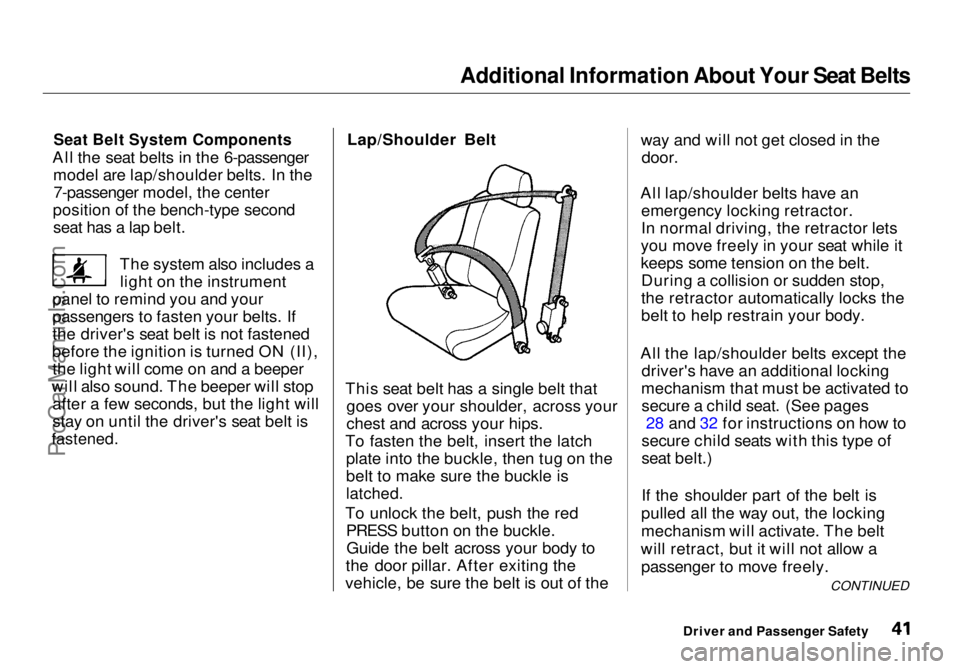
Lap/Shoulder Belt
This seat belt has a single belt that goes over your shoulder, across your
ches
t and
across your hips.
To fasten the belt, insert the latch plate into the buckle, then tug on the
belt to make sure the buckle is
latched.
To unlock the belt, push the red PRESS button on the buckle.Guide the belt across your body to
the door pillar. After exiting the
vehicle, be sure the belt is out of the way and will not get closed in the
door.
All lap/shoulder belts have an emergency locking retractor.
In normal driving, the retractor lets
you move freely in your seat while it
keeps some tension on the belt. During a collision or sudden stop,
the retractor automatically locks the
belt to help restrain your body.
All the lap/shoulder belts except the driver's have an additional locking
mechanism that must be activated to secure a child seat. (See pages 28 and 32 for instructions on how to
secure child seats with this type of
seat belt.)
If the shoulder part of the belt is
pulled all the way out, the locking
mechanism will activate. The belt
will retract, but it will not allow a passenger to move freely.
Driver and Passenger Safety CONTINUEDProCarManuals.comMain Menu Table of Contents s t
Page 49 of 272
Safety Labels
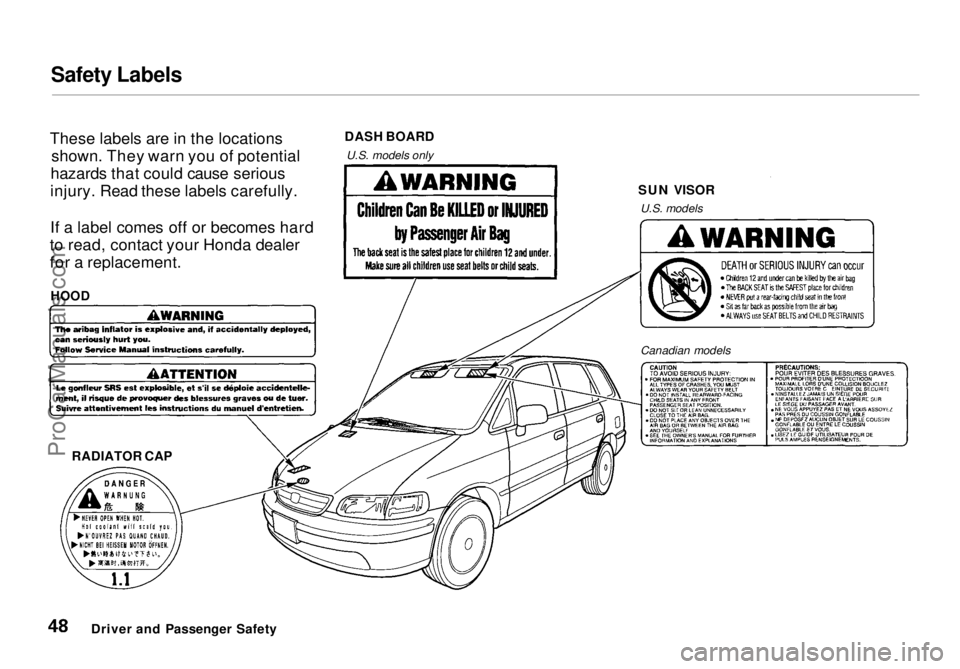
These labels are in the locations shown. They warn you of potential
hazards that could cause serious
injury. Read these labels carefully.
If a label comes off or becomes hard
to read, contact your Honda dealer
for a replacement. DASH BOARD
U.S. models only
Driver and Passenger Safety
HOOD
RADIATOR CAP SUN VISOR
U.S. models
Canadian modelsProCarManuals.comMain Menu Table of Contents s t
Page 50 of 272
Instruments and Controls
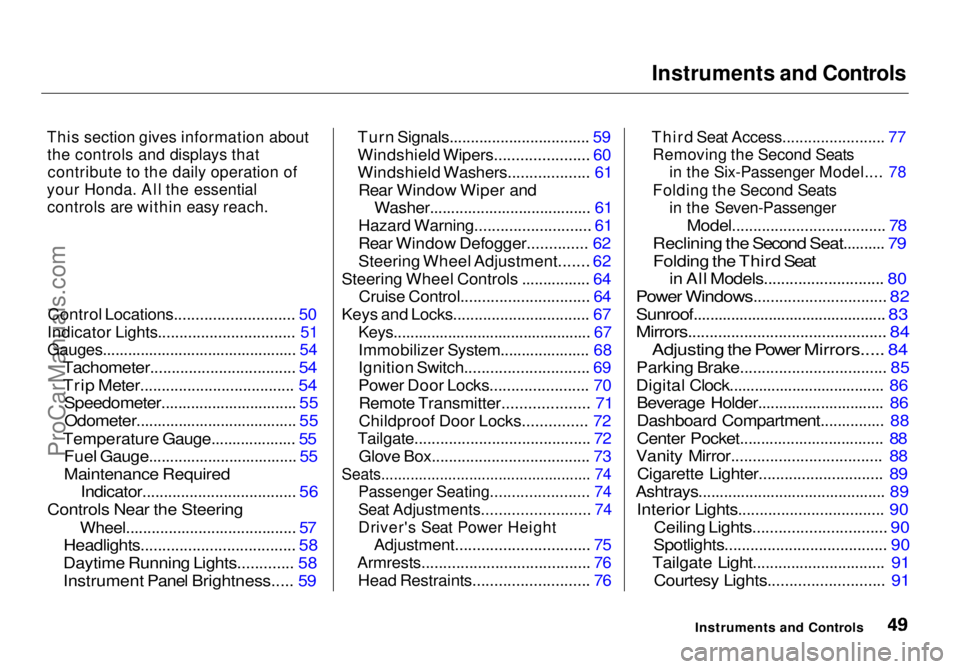
This section gives information about
the controls and displays thatcontribute to the daily operation of
your Honda. All the essential
controls are within easy reach.
Control Locations............................ 50
Indicator Lights................................ 51
Gauges.............................................. 54
Tachometer.................................. 54
Trip Meter.................................... 54
Speedometer................................ 55
Odometer...................................... 55
Temperature Gauge.................... 55
Fuel Gauge................................... 55
Maintenance Required
Indicator.................................... 56
Controls Near the Steering
Wheel........................................ 57
Headlights.................................... 58
Daytime Running Lights............. 58
Instrument Panel Brightness..... 59
Turn Signals................................. 59
Windshield Wipers...................... 60
Windshield Washers................... 61
Rear Window Wiper and
Washer...................................... 61
Hazard Warning........................... 61
Rear Window Defogger.............. 62
Steering Wheel Adjustment....... 62
Steering Wheel Controls ................ 64
Cruise Control.............................. 64
Keys and Locks................................ 67
Keys............................................... 67
Immobilizer System..................... 68
Ignition Switch............................. 69
Power Door Locks....................... 70
Remote Transmitter.................... 71
Childproof Door Locks............... 72
Tailgate......................................... 72
Glove Box..................................... 73
Seats.................................................. 74
Passenger Seating....................... 74
Seat Adjustments......................... 74
Driver's Seat Power Height
Adjustment............................... 75
Armrests....................................... 76
Head Restraints........................... 76
Third Seat Access........................ 77
Removing the Second Seats
in the Six-Passenger Model.... 78
Folding the Second Seats
in the Seven-Passenger
Model.................................... 78
Reclining the Second Seat.......... 79
Folding the Third Seat
in All Models............................ 80
Power Windows............................... 82
Sunroof.............................................. 83
Mirrors.............................................. 84
Adjusting the Power Mirrors..... 84
Parking Brake.................................. 85
Digital Clock..................................... 86 Beverage Holder.............................. 86
Dashboard Compartment............... 88
Center Pocket.................................. 88
Vanity Mirror................................... 88
Cigarette Lighter............................. 89
Ashtrays............................................ 89 Interior Lights.................................. 90
Ceiling Lights............................... 90
Spotlights...................................... 90
Tailgate Light............................... 91 Courtesy Lights........................... 91
Instruments and ControlsProCarManuals.comMain Menu s t
Page 55 of 272
Indicator Lights, Gauges
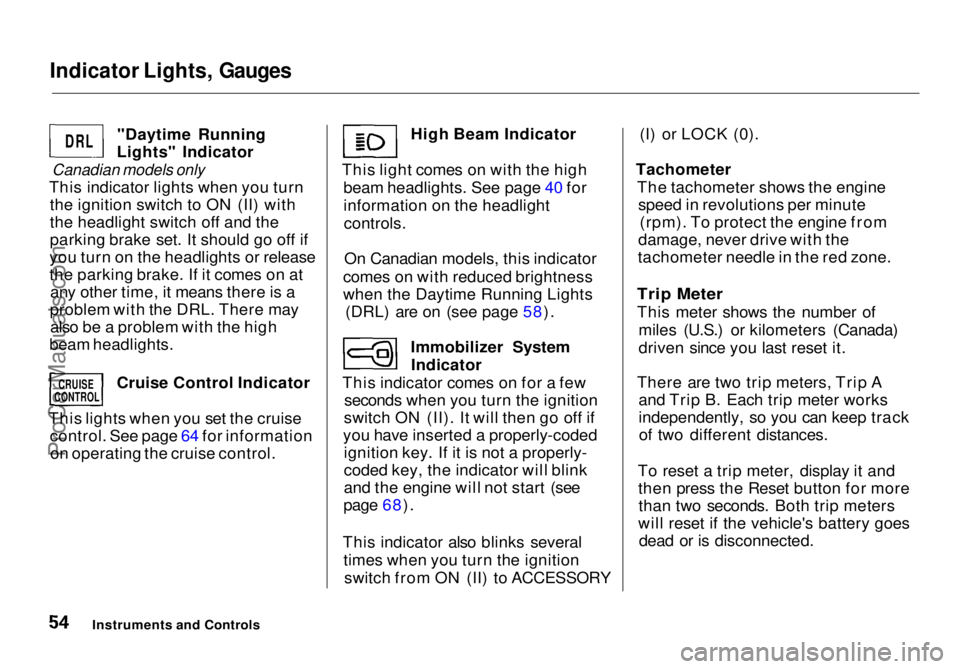
"Daytime Running
Lights" Indicator
Canadian models only
This indicator lights when you turn the ignition switch to ON (II) with
the headlight switch off and the
parking brake set. It should go off if
you turn on the headlights or release
the parking brake. If it comes on at any other time, it means there is a
problem with the DRL. There may also be a problem with the high
beam headlights.
Cruise Control Indicator
This lights when you set the cruise control. See page 64 for informationon operating the cruise control. High Beam Indicator
This light comes on with the high beam headlights. See page 40 for
information on the headlightcontrols.
On Canadian models, this indicator
comes on with reduced brightness
when the Daytime Running Lights (DRL) are on (see page 58).
Immobilizer SystemIndicator
This indicator comes on for a few seconds when you turn the ignition
switch ON (II). It will then go off if
you have inserted a properly-coded ignition key. If it is not a properly-
coded key, the indicator will blink
and the engine will not start (see
page 68).
This indicator also blinks several times when you turn the ignitionswitch from ON (II) to ACCESSORY (I) or LOCK (0).
Tachometer The tachometer shows the enginespeed in revolutions per minute (rpm). To protect the engine from
damage, never drive with the
tachometer needle in the red zone.
Trip Meter
This meter shows the number of miles (U.S.) or kilometers (Canada)
driven since you last reset it.
There are two trip meters, Trip A and Trip B. Each trip meter works
independently, so you can keep trackof two different distances.
To reset a trip meter, display it and then press the Reset button for morethan two seconds. Both trip meters
will reset if the vehicle's battery goes dead or is disconnected.
Instruments and Controls
DRL
CRUISE
CONTROL
ProCarManuals.comMain Menu Table of Contents s t