coolant HONDA ODYSSEY 1999 User Guide
[x] Cancel search | Manufacturer: HONDA, Model Year: 1999, Model line: ODYSSEY, Model: HONDA ODYSSEY 1999Pages: 343, PDF Size: 3.73 MB
Page 233 of 343
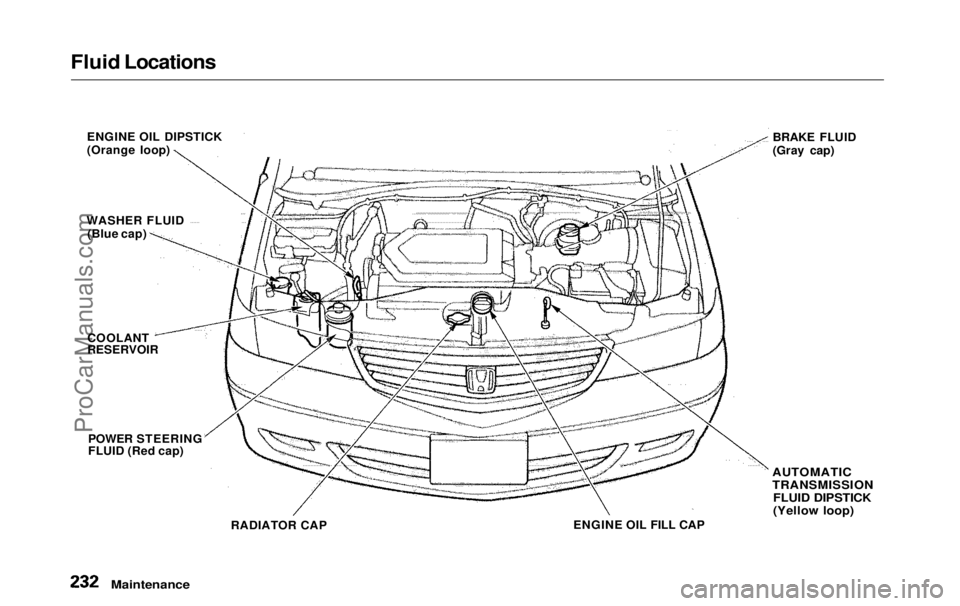
Fluid Locations
ENGINE OIL DIPSTICK
(Orange loop)
WASHER FLUID (Blue cap)
COOLANT
RESERVOIR
POWER STEERING
FLUID (Red cap) BRAKE FLUID
(Gray cap)
RADIATOR CAP ENGINE OIL FILL CAP
AUTOMATIC
TRANSMISSION
FLUID DIPSTICK
(Yellow loop)
MaintenanceProCarManuals.comMain Menu Table of Contents s t
Page 238 of 343
Cooling System
Adding Engine Coolant
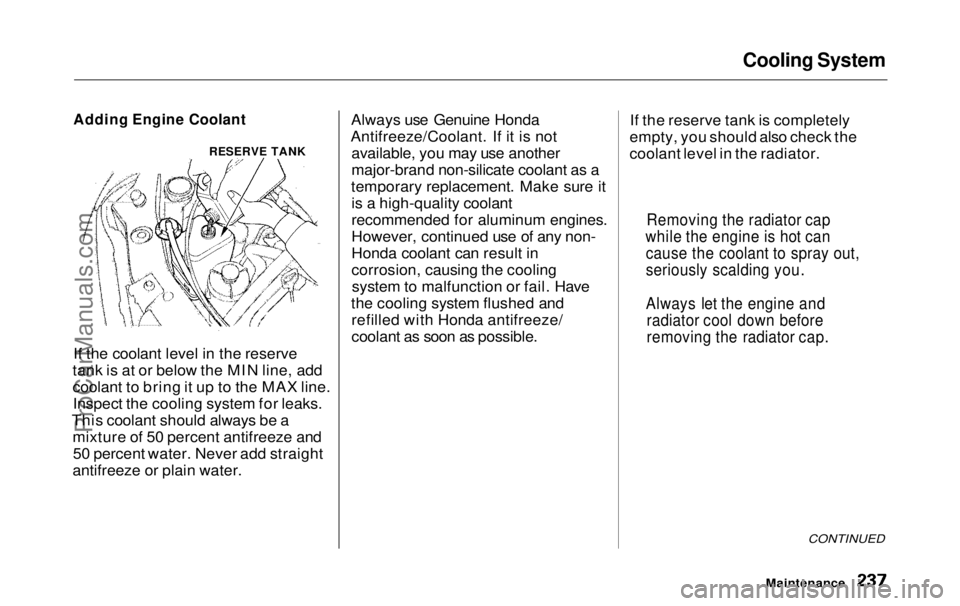
If the coolant level in the reserve
tank is at or below the MIN line, add
coolant to bring it up to the MAX line. Inspect the cooling system for leaks.
This coolant should always be a mixture of 50 percent antifreeze and50 percent water. Never add straight
antifreeze or plain water. Always use Genuine Honda
Antifreeze/Coolant. If it is not available, you may use another
major-brand non-silicate coolant as a
temporary replacement. Make sure it is a high-quality coolant
recommended for aluminum engines.
However, continued use of any non-
Honda coolant can result in
corrosion, causing the coolingsystem to malfunction or fail. Have
the cooling system flushed and refilled with Honda antifreeze/
coolant as soon as possible. If the reserve tank is completely
empty, you should also check the
coolant level in the radiator.
CONTINUED
Maintenance
Removing the radiator cap
while the engine is hot can cause the coolant to spray out,
seriously scalding you.
Always let the engine and radiator cool down before
removing the radiator cap.
RESERVE TANKProCarManuals.comMain Menu Table of Contents s t
Page 239 of 343
Cooling System
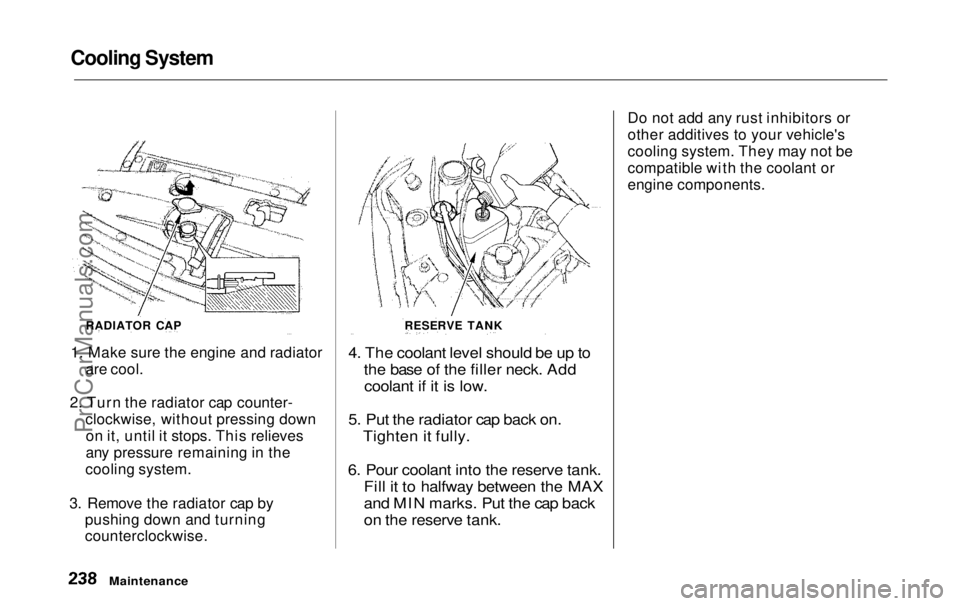
1. Make sure the engine and radiator
are cool.
2. Turn the radiator cap counter- clockwise, without pressing downon it, until it stops. This relieves
any pressure remaining in the
cooling system.
3. Remove the radiator cap by pushing down and turning
counterclockwise.
4. The coolant level should be up to
the base of the filler neck. Addcoolant if it is low.
5. Put the radiator cap back on. Tighten it fully.
6. Pour coolant into the reserve tank. Fill it to halfway between the MAX
and MIN marks. Put the cap back
on the reserve tank.
Do not add any rust inhibitors or
other additives to your vehicle's
cooling system. They may not be
compatible with the coolant or
engine components.
Maintenance
RADIATOR CAP
RESERVE TANKProCarManuals.comMain Menu Table of Contents s t
Page 240 of 343
Cooling System
Replacing Engine Coolant
The cooling system should be completely drained and refilled with
new coolant according to the timeand distance recommendations in
the maintenance schedule. Only use Genuine Honda Antifreeze/Coolant.
Draining the coolant requires access
to the underside of the vehicle. Unless you have the tools and
knowledge, you should have this maintenance done by a skilled
mechanic.
1. Turn the ignition ON (II). Turn
the heater temperature controldial fully clockwise. Turn the
ignition off.
Open the hood. Make sure the
engine and radiator are cool to the
touch.
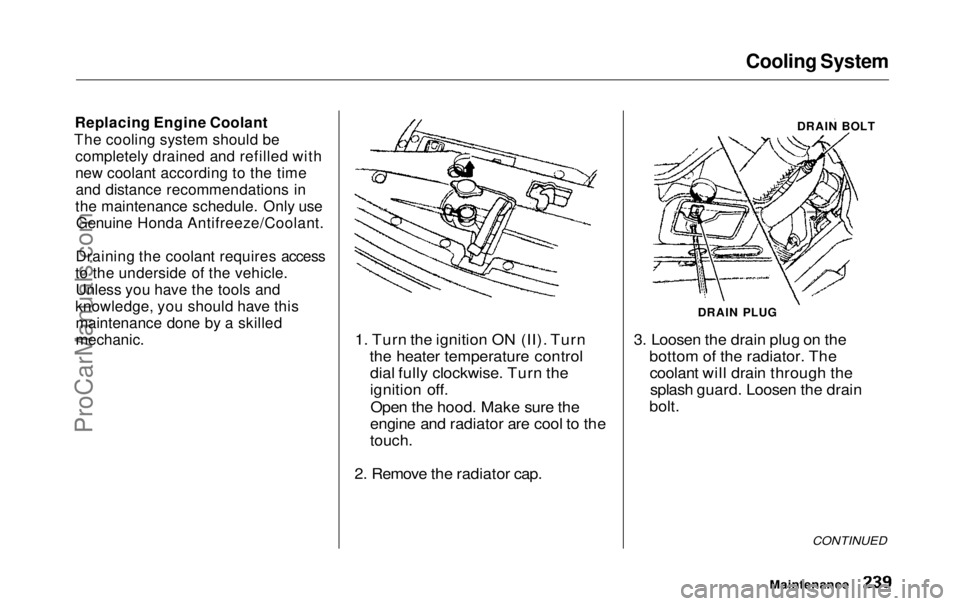
2. Remove the radiator cap. 3. Loosen the drain plug on the
bottom of the radiator. Thecoolant will drain through thesplash guard. Loosen the drain
bolt.
CONTINUED
Maintenance
DRAIN BOLT
DRAIN PLUGProCarManuals.comMain Menu Table of Contents s t
Page 241 of 343
Cooling System
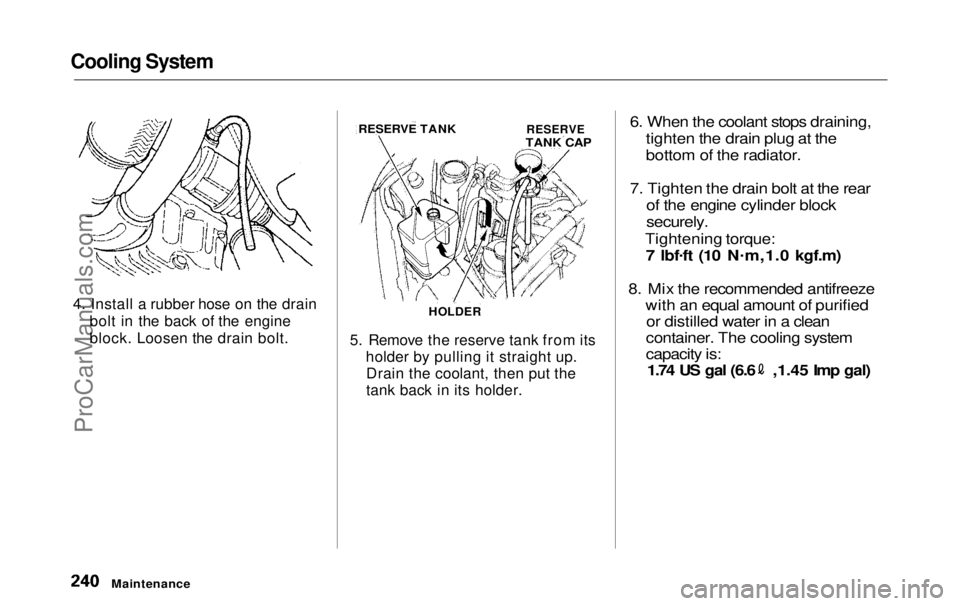
4. Install a rubber hose on the drain bolt in the back of the engine
block. Loosen the drain bolt. 5. Remove the reserve tank from its
holder by pulling it straight up.Drain the coolant, then put the
tank back in its holder.
6. When the coolant stops draining,
tighten the drain plug at the
bottom of the radiator.
7. Tighten the drain bolt at the rear of the engine cylinder block
securely.
Tightening torque: 7 lbf .
ft (10 N .
m,1.0 kgf.m)
8. Mix the recommended antifreeze with an equal amount of purifiedor distilled water in a clean
container. The cooling system
capacity is: 1.74 US gal (6.6 ,1.45 Imp gal)
Maintenance RESERVE TANK
HOLDER
RESERVE
TANK CAPProCarManuals.comMain Menu Table of Contents s t
Page 242 of 343
Cooling System
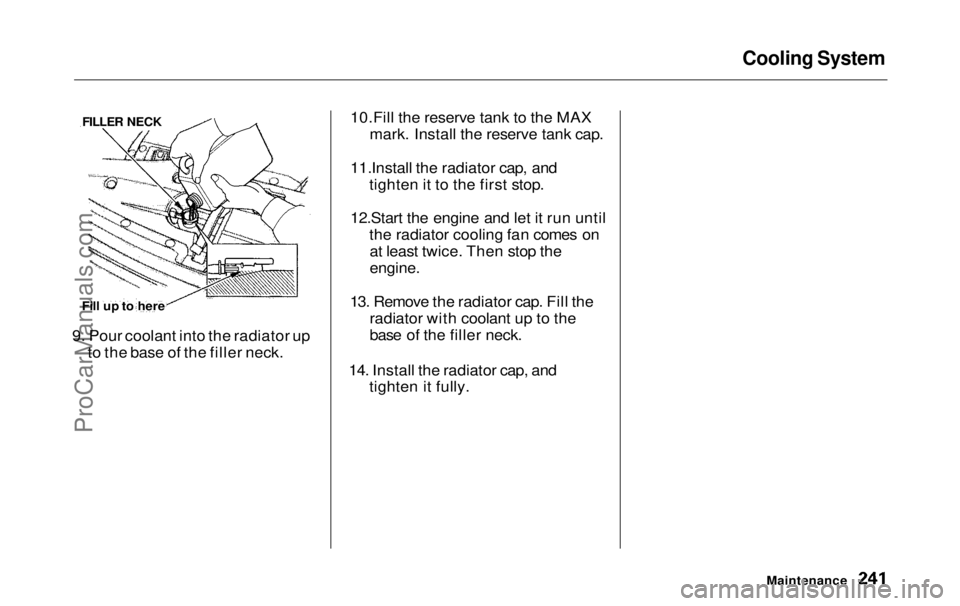
9. Pour coolant into the radiator up to the base of the filler neck. 10.Fill the reserve tank to the MAX
mark. Install the reserve tank cap.
11.Install the radiator cap, and tighten it to the first stop.
12.Start the engine and let it run until the radiator cooling fan comes onat least twice. Then stop the
engine.
13. Remove the radiator cap. Fill the radiator with coolant up to the
base of the filler neck.
14. Install the radiator cap, and tighten it fully.
Maintenance
FILLER NECK
Fill up to hereProCarManuals.comMain Menu Table of Contents s t
Page 248 of 343
Air Cleaner Element
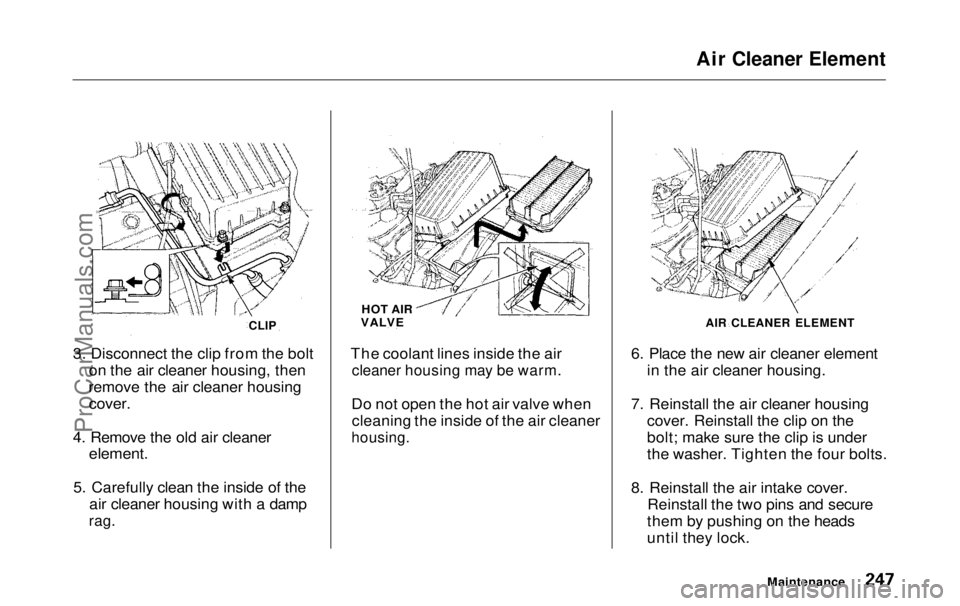
3. Disconnect the clip from the bolt on the air cleaner housing, then
remove the air cleaner housing
cover.
4. Remove the old air cleaner
element.
5. Carefully clean the inside of the air cleaner housing with a damp
rag.
The coolant lines inside the air
cleaner housing may be warm.
Do not open the hot air valve when cleaning the inside of the air cleaner
housing.
6. Place the new air cleaner element
in the air cleaner housing.
7. Reinstall the air cleaner housing cover. Reinstall the clip on the
bolt; make sure the clip is under
the washer. Tighten the four bolts.
8. Reinstall the air intake cover. Reinstall the two pins and secure
them by pushing on the heads
until they lock.
Maintenance
CLIP
HOT AIR
VALVE
AIR CLEANER ELEMENTProCarManuals.comMain Menu Table of Contents s t
Page 298 of 343
If Your Engine Overheats
The pointer of your vehicle's
temperature gauge should stay in
the midrange under most conditions.
It may go higher if you are driving up
a long steep hill on a very hot day. If
it climbs to the red mark, you should
determine the reason.
Driving with the temperature gauge
pointer at the red mark can cause serious damage to your engine.
Your vehicle can overheat for several
reasons, such as lack of coolant or a
mechanical problem. The only
indication may be the temperature
gauge climbing to or above the red
mark. Or you may see steam or
spray coming from under the hood.
In either case, you should take
immediate action.
1. Safely pull to the side of the road.
Put the transmission in Neutral or
Park and set the parking brake.
Turn off the heating and cooling/ climate control system and all
other accessories. Turn on the
hazard warning indicators.
2. If you see steam and/or spray coining from under the hood, turnoff the engine.
3. If you do not see steam or spray, leave the engine running and
watch the temperature gauge. If the high heat is due to overloading (climbing a long, steep hill on a
hot day with the A/C running, for example), the engine should start
to cool down almost immediately.
If it does, wait until the tempera-
ture gauge comes down to the mid-
point then continue driving.
CONTINUED
Taking Care of the Unexpected
NOTICE
Steam and spray from an
overheated engine can
seriously scald you.
Do not open the hood if steam
is coming out.ProCarManuals.comMain Menu Table of Contents s t
Page 299 of 343
If Your Engine Overheats
4. If the temperature gauge stays at
the red mark, turn off the engine.
5. Wait until you see no more signs of steam or spray, then open the
hood.
6. Look for any obvious coolant leaks, such as a split radiator hose.
Everything is still extremely hot, so use caution. If you find a leak, it
must be repaired before you
continue driving (see Emergency
Towing on page 311).
7. If you don't find an obvious leak, check the coolant level in the
radiator reserve tank (see page187). If the level is below the
MIN mark, add coolant to halfway
between the MIN and MAX marks.
8. If there was no coolant in the reserve tank, you may also have to
add coolant to the radiator. Let the
engine cool down until the pointer reaches the middle of the tempera-
ture gauge, or lower, before check-
ing the radiator.
9. Using gloves or a large heavy cloth, turn the radiator cap
counterclockwise, without pushing
down, to the first stop. This
releases any remaining pressure in
the cooling system. After the
pressure releases, push down on
the cap and turn it until it comes off. 10.Start the engine and set the
temperature control dial tomaximum (climate control to
FULL AUTO at 90°F/32°C). Add
coolant to the radiator up to the
base of the filler neck. If you do not have the proper coolant
mixture available, you can add
plain water. Remember to have
the cooling system drained and refilled with the proper mixture assoon as you can.
11.Put the radiator cap back on tightly. Run the engine and watch
the temperature gauge. If it goes
back to the red mark, the engineneeds repair. (See Emergency
Towing on page 311.)
12.If the temperature stays normal, check the coolant level in the
radiator reserve tank. If it has
gone down, add coolant to the MAX mark. Put the cap back on
tightly.
Taking Care of the Unexpected
Removing the radiator cap
while the engine is hot can
cause the coolant to spray out,
seriously scalding you.
Always let the engine and radiator cool down before
removing the radiator cap.ProCarManuals.comMain Menu Table of Contents s t
Page 315 of 343
Specifications
*
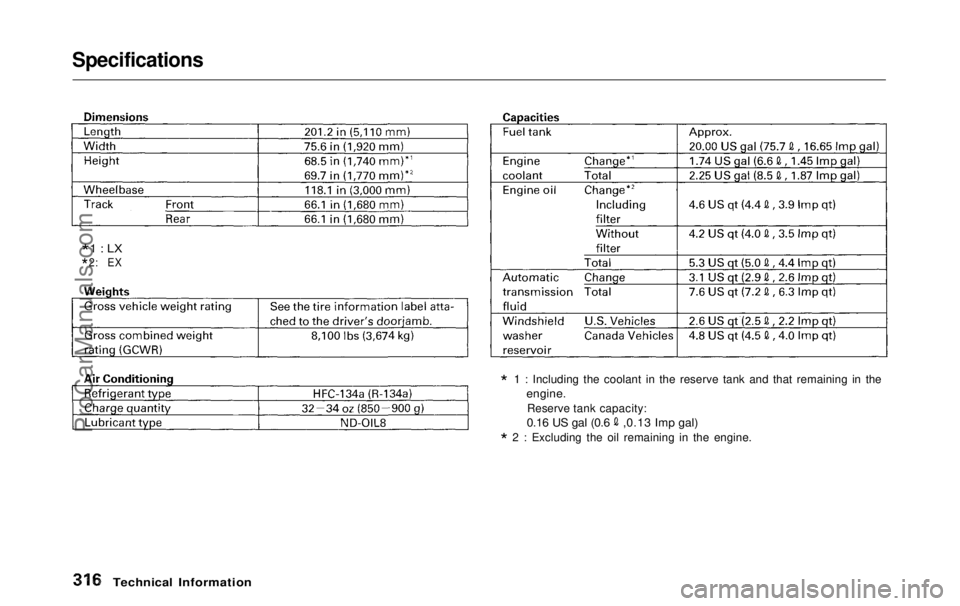
1 : Including the coolant in the reserve tank and that remaining in the
engine.
Reserve tan
k capacity:
0.16 US gal (0.6 ,0.13 Imp gal)
*
2 : Excluding the oil remaining in the engine.
Technical Information
*
1
: LX
*2
:
EX
ProCarManuals.comMain Menu Table of Contents s t