ABS HONDA ODYSSEY 1999 Owners Manual
[x] Cancel search | Manufacturer: HONDA, Model Year: 1999, Model line: ODYSSEY, Model: HONDA ODYSSEY 1999Pages: 343, PDF Size: 3.73 MB
Page 8 of 343
Your Vehicle's Safety Features
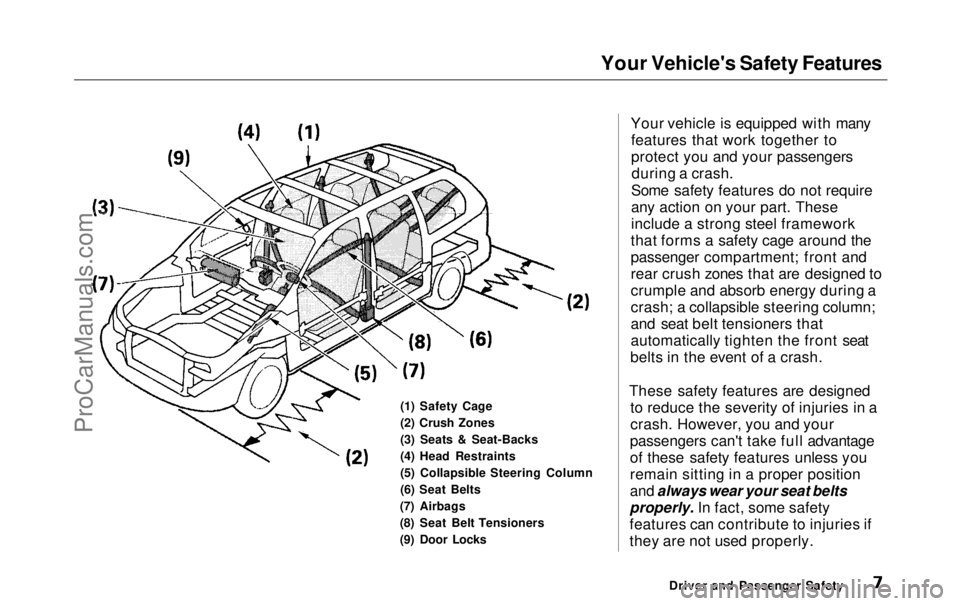
(1) Safety Cage
(2) Crush Zones
(3) Seats & Seat-Backs
(4) Head Restraints
(5) Collapsible Steering Column
(6) Seat Belts
(7) Airbags
(8) Seat Belt Tensioners
(9) Door Locks Your vehicle is equipped with many
features that work together to
protect you and your passengersduring a crash.
Some safety features do not require
any action on your part. These
include a strong steel framework
that forms a safety cage around the
passenger compartment; front and
rear crush zones that are designed to
crumple and absorb energy during a
crash; a collapsible steering column;
and seat belt tensioners that
automatically tighten the front seat
belts in the event of a crash.
These safety features are designed to reduce the severity of injuries in a
crash. However, you and your
passengers can't take full advantage
of these safety features unless you
remain sitting in a proper position
and always wear your seat belts
properly. In fact, some safety
features can contribute to injuries if
they are not used properly.
Driver and Passenger SafetyProCarManuals.comMain Menu Table of Contents s t
Page 11 of 343
Your Vehicle's Safety Features
Seats & Seat-Backs
Your vehicle's seats are designed to keep you in a comfortable, upright
position so you can take full
advantage of the protection offered
by seat belts and the energyabsorbing materials in the seats.
How you adjust your seats and seat-
backs can also affect your safety. For example, sitting too close to the
steering wheel or dashboard
increases the risk of you or your
passenger being injured by striking
the inside of the vehicle, or by an
inflating airbag.
Reclining a seat-back too far reduces
the seat belt's effectiveness and increases the chance that the seat's
occupant will slide under the seat
belt in a crash and be seriously
injured.
What you should do: Move the front
seats as far back as possible, and
keep adjustable seat-backs in an
upright position whenever the
vehicle is moving.
Head Restraints
Head restraints can help protect you
from whiplash and other injuries. For
maximum protection, the back of
your head should rest against the center of the head restraint. Door Locks
Keeping your doors locked reduces
the chance of being thrown out of
the vehicle during a crash. It also
helps prevent occupants from
accidentally opening a door and
falling out, and outsiders from
unexpectedly opening your doors.
Driver and Passenger SafetyProCarManuals.comMain Menu Table of Contents s t
Page 60 of 343
Indicator Lights
U.S.
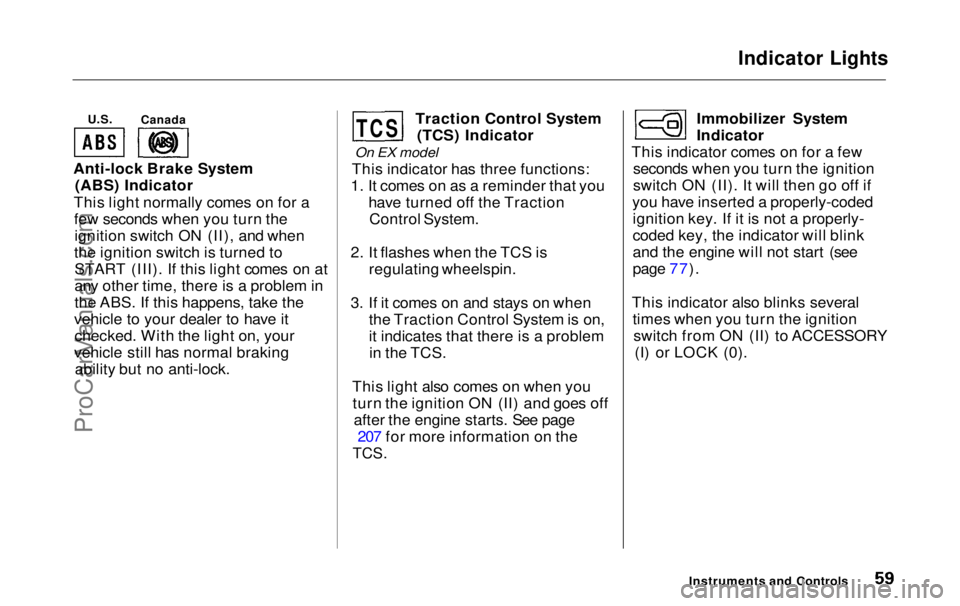
Anti-lock Brake System (ABS) Indicator
This light normally comes on for a few seconds when you turn theignition switch ON (II), and when
the ignition switch is turned to START (III). If this light comes on at
any other time, there is a problem in
the ABS. If this happens, take the
vehicle to your dealer to have it checked. With the light on, your
vehicle still has normal braking ability but no anti-lock. Traction Control System
(TCS) Indicator
On EX model
This indicator has three functions:
1. It comes on as a reminder that you have turned off the TractionControl System.
2. It flashes when the TCS is regulating wheelspin.
3. If it comes on and stays on when the Traction Control System is on,
it indicates that there is a problemin the TCS.
This light also comes on when you turn the ignition ON (II) and goes off after the engine starts. See page 207 for more information on the
TCS.
Immobilizer System
Indicator
This indicator comes on for a few seconds when you turn the ignition
switch ON (II). It will then go off if
you have inserted a properly-coded ignition key. If it is not a properly-
coded key, the indicator will blink
and the engine will not start (see
page 77).
This indicator also blinks several times when you turn the ignitionswitch from ON (II) to ACCESSORY (I) or LOCK (0).
Instruments and Controls
Canada
TCSProCarManuals.comMain Menu Table of Contents s t
Page 81 of 343
Keys and Locks
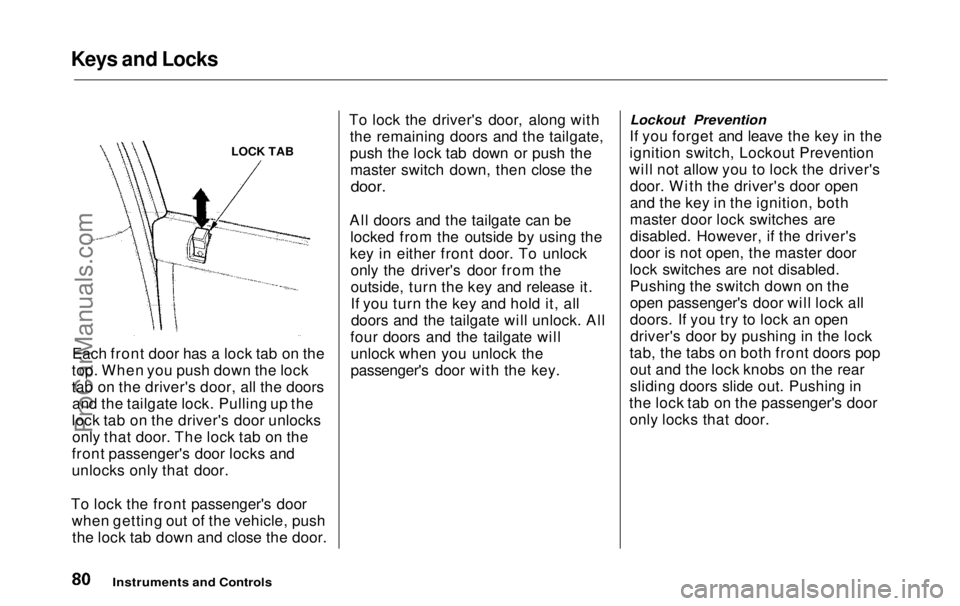
LOCK TAB
Each front door has a lock tab on the
top. When you push down the lock
tab on the driver's door, all the doors and the tailgate lock. Pulling up the
lock tab on the driver's door unlocks only that door. The lock tab on the
front passenger's door locks and
unlocks only that door.
To lock the front passenger's door when getting out of the vehicle, pushthe lock tab down and close the door. To lock the driver's door, along with
the remaining doors and the tailgate,
push the lock tab down or push themaster switch down, then close the
door.
All doors and the tailgate can be locked from the outside by using the
key in either front door. To unlock only the driver's door from the
outside, turn the key and release it.
If you turn the key and hold it, alldoors and the tailgate will unlock. All
four doors and the tailgate will unlock when you unlock the
passenger's door with the key.
Lockout Prevention
If you forget and leave the key in the
ignition switch, Lockout Prevention
will not allow you to lock the driver's door. With the driver's door open
and the key in the ignition, both
master door lock switches are
disabled. However, if the driver's
door is not open, the master door
lock switches are not disabled. Pushing the switch down on the
open passenger's door will lock all
doors. If you try to lock an opendriver's door by pushing in the lock
tab, the tabs on both front doors pop out and the lock knobs on the rear
sliding doors slide out. Pushing in
the lock tab on the passenger's door only locks that door.
Instruments and ControlsProCarManuals.comMain Menu Table of Contents s t
Page 111 of 343
Seats
To reinstall the seat, hook the front of the seat to the floor, then push the
back into the locks. Make sure both
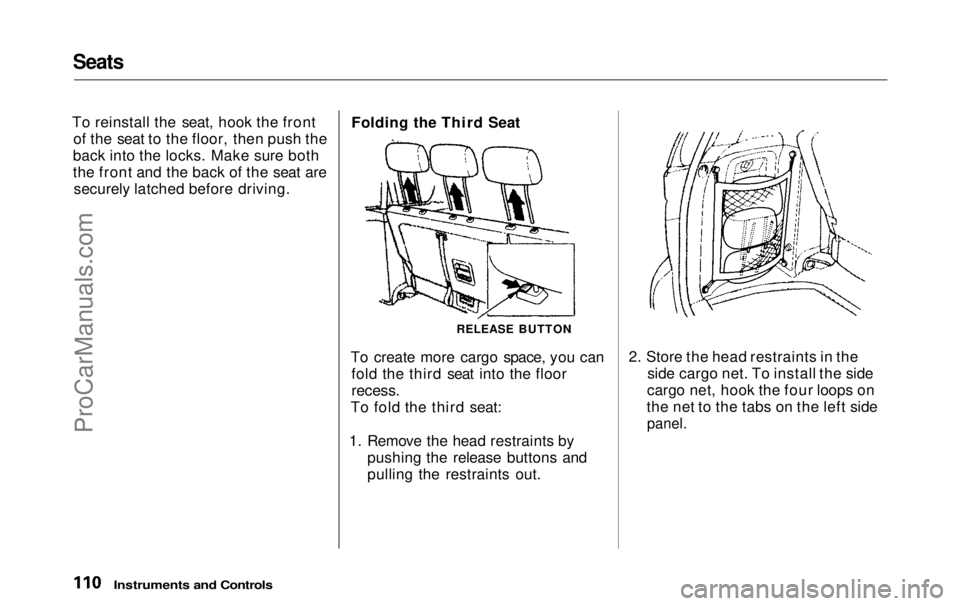
the front and the back of the seat are securely latched before driving. Folding the Third Seat
RELEASE BUTTON
To create more cargo space, you can fold the third seat into the floor
recess.
To fold the third seat:
1. Remove the head restraints by pushing the release buttons and
pulling the restraints out. 2. Store the head restraints in the
side cargo net. To install the side
cargo net, hook the four loops on
the net to the tabs on the left side
panel.
Instruments and ControlsProCarManuals.comMain Menu Table of Contents s t
Page 194 of 343
Carrying Cargo
Carrying Cargo in the Cargo Area
or on a Roof Rack
Distribute cargo evenly on the
floor of the cargo area, placing the
heaviest items on the bottom andas far forward as possible. Tiedown items that could be thrown
about the vehicle during a crash or
sudden stop.
If you carry large items that
prevent you from closing the
tailgate, exhaust gas can enter the
passenger area. To avoid the
possibility of carbon monoxide
poisoning, follow the instructions on page 53 . If you can carry any items on a
roof rack, be sure the total weight of the rack and the items does not
exceed the maximum allowable
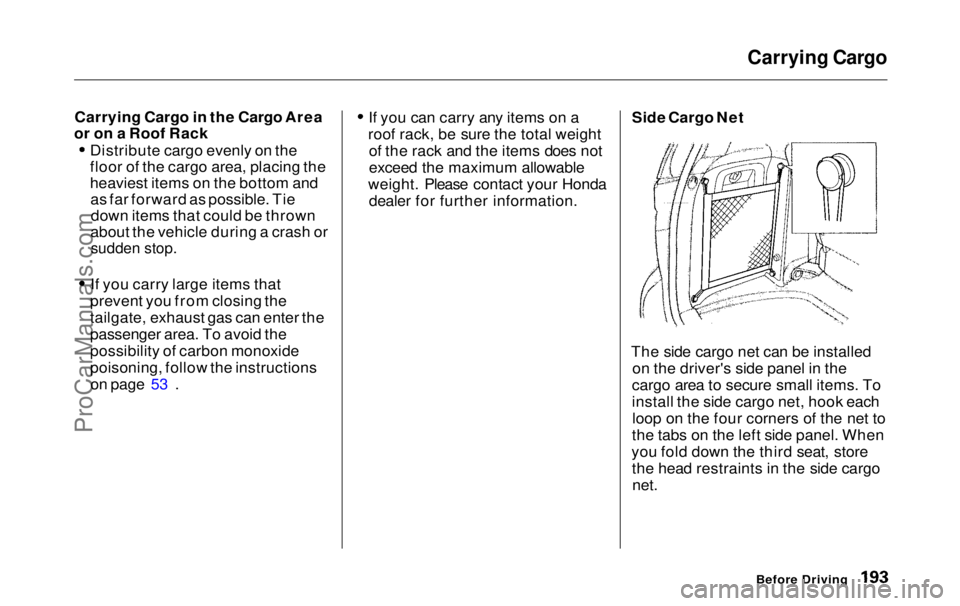
weight. Please contact your Honda dealer for further information. Side Cargo Net
The side cargo net can be installed on the driver's side panel in the
cargo area to secure small items. To
install the side cargo net, hook each loop on the four corners of the net to
the tabs on the left side panel. When
you fold down the third seat, store the head restraints in the side cargo
net.
Before DrivingProCarManuals.comMain Menu Table of Contents s t
Page 195 of 343
Carrying Cargo
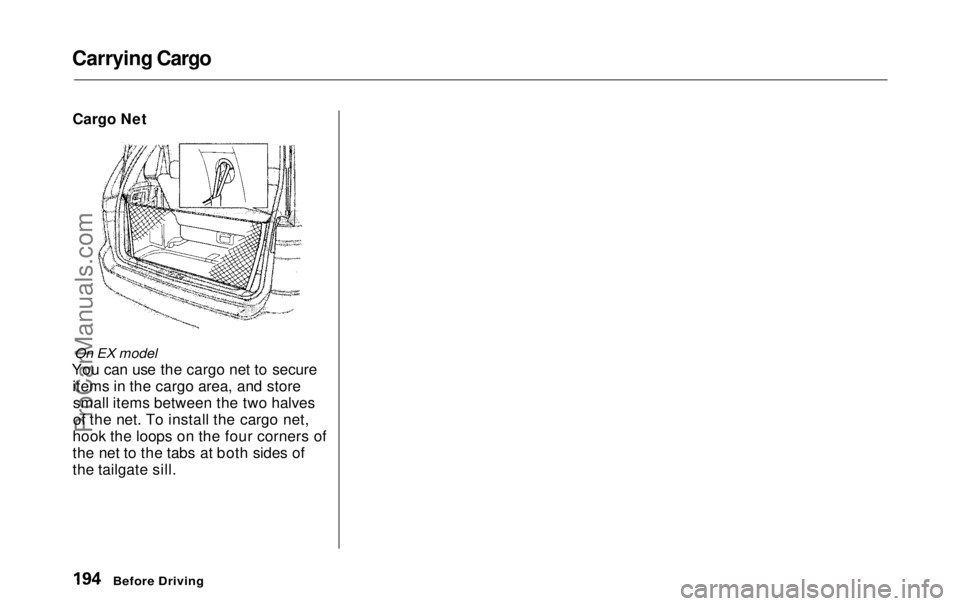
Cargo Net
On EX model
You can use the cargo net to secure items in the cargo area, and storesmall items between the two halves
of the net. To install the cargo net,
hook the loops on the four corners of
the net to the tabs at both sides of
the tailgate sill.
Before DrivingProCarManuals.comMain Menu Table of Contents s t
Page 196 of 343
Driving
This section gives you tips on starting the engine under various
conditions, and how to operate the automatic transmission. It also
includes important information on
parking your vehicle, the braking system, the Traction Control System,
and facts you need if you are
planning to tow a trailer. Preparing to Drive......................... 196
Starting the Engine........................ 197
Starting in Cold Weather at High Altitude ..................... 197
Automatic Transmission............... 198 Shift Lever Position Indicator.. 198
Shift Lever Positions................. 199
Maximum Allowable Speeds.... 201
Shift Lock Release..................... 202
Parking............................................ 203
The Braking System...................... 204 Brake Wear Indicators.............. 204
Brake System Design................ 205
Anti-lock Brakes........................ 205
Important SafetyReminders.......................... 206
ABS Indicator......................... 206
Traction Control System............... 207 TCS ON/OFF Switch................ 209
TCS Indicator............................. 209
Driving in Bad Weather................ 210
Towing a Trailer............................ 212
DrivingProCarManuals.comMain Menu s t
Page 205 of 343
The Braking System
Your Honda is equipped with front disc brakes. The brakes on the rear
wheels are drum. A power assist helps reduce the effort needed on
the brake pedal. The ABS helps you retain steering control when braking
very hard.
Put your foot on the brake pedal only
when you intend to brake. Resting
your foot on the pedal keeps the brakes applied lightly, causing themto build up heat. Heat build-up can
reduce how well your brakes work. Italso keeps your brake lights on all
the time, confusing drivers behind
you.
Constant application of the brakes
when going down a long hill builds up heat and reduces their effective-
ness. Use the engine to assist the
brakes by downshifting to a lower gear and taking your foot off the
accelerator pedal.
Check your brakes after driving
through deep water. Apply the
brakes moderately to see if they feel normal. If not, apply them gently and
frequently until they do. Since a
longer distance is needed to stop
with wet brakes, be extra cautious and alert in your driving. Brake Wear Indicators
The front disc brakes on all vehicles have audible brake wear indicators.
When the brake pads need replacing,
you will hear a distinctive metallic "screeching" sound when you apply
the brakes. If you do not have the
brake pads replaced, they will begin screeching all the time.
Your brakes may sometimes squeal or squeak when you apply them
lightly. Do not confuse this with the
brake wear indicators. They make a
very audible "screeching."
DrivingProCarManuals.comMain Menu Table of Contents s t
Page 206 of 343
The Braking System
Brake System Design
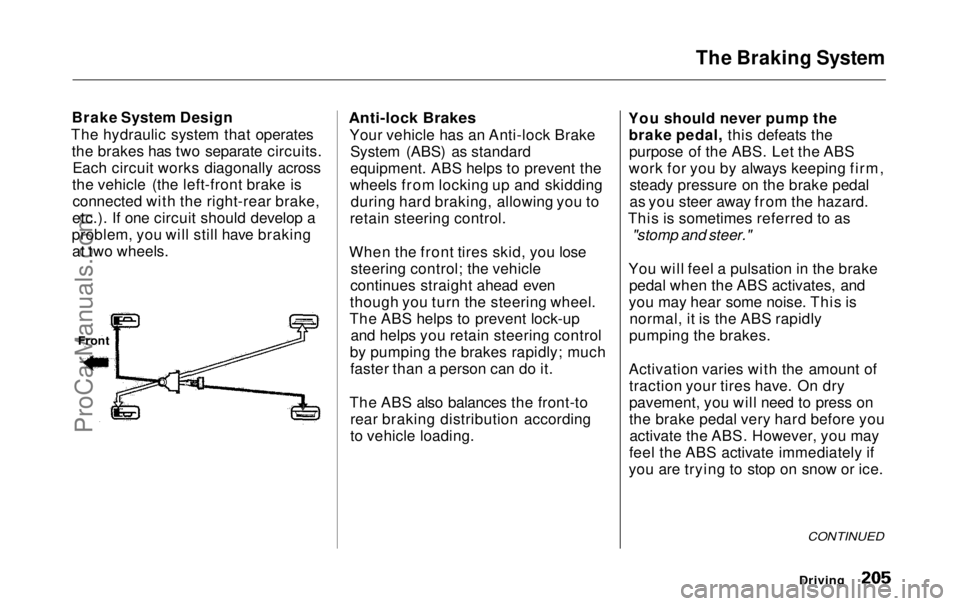
The hydraulic system that operates the brakes has two separate circuits.Each circuit works diagonally across
the vehicle (the left-front brake is connected with the right-rear brake,
etc.). If one circuit should develop a
problem, you will still have braking at two wheels.
Anti-lock Brakes
Your vehicle has an Anti-lock BrakeSystem (ABS) as standard
equipment. ABS helps to prevent the
wheels from locking up and skidding during hard braking, allowing you to
retain steering control.
When the front tires skid, you lose steering control; the vehicle
continues straight ahead even
though you turn the steering wheel.
The ABS helps to prevent lock-up and helps you retain steering control
by pumping the brakes rapidly; much faster than a person can do it.
The ABS also balances the front-to rear braking distribution according
to vehicle loading. You should never pump the
brake pedal, this defeats thepurpose of the ABS. Let the ABS
work for you by always keeping firm, steady pressure on the brake pedal
as you steer away from the hazard.
This is sometimes referred to as
"stomp and steer."
You will feel a pulsation in the brake pedal when the ABS activates, and
you may hear some noise. This is normal, it is the ABS rapidly
pumping the brakes.
Activation varies with the amount of traction your tires have. On dry
pavement, you will need to press on
the brake pedal very hard before youactivate the ABS. However, you may
feel the ABS activate immediately if
you are trying to stop on snow or ice.
Driving
Front
CONTINUEDProCarManuals.comMain Menu Table of Contents s t