ECO HONDA ODYSSEY 2019 (in English) User Guide
[x] Cancel search | Manufacturer: HONDA, Model Year: 2019, Model line: ODYSSEY, Model: HONDA ODYSSEY 2019Pages: 767, PDF Size: 47.46 MB
Page 33 of 767
31
Quick Reference Guide
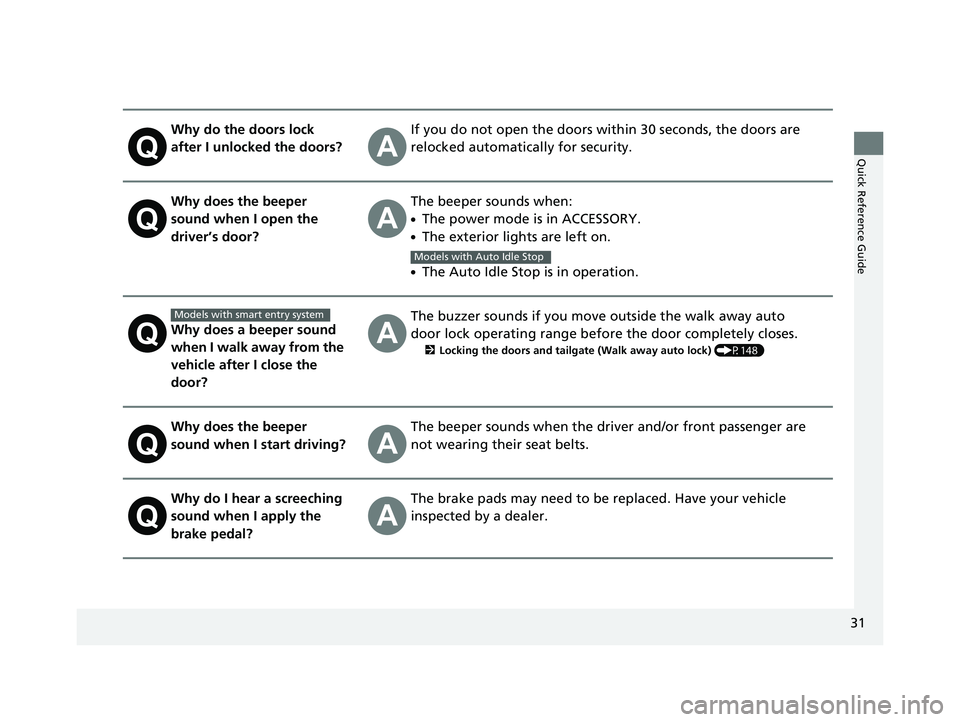
Why do the doors lock
after I unlocked the doors?If you do not open the doors within 30 seconds, the doors are
relocked automatically for security.
Why does the beeper
sound when I open the
driver’s door?The beeper sounds when:
●The power mode is in ACCESSORY.
●The exterior lights are left on.
●The Auto Idle Stop is in operation.
Why does a beeper sound
when I walk away from the
vehicle after I close the
door?The buzzer sounds if you move outside the walk away auto
door lock operating range before the door completely closes.
2Locking the doors and tailgate (Walk away auto lock) (P148)
Why does the beeper
sound when I start driving?The beeper sounds when the driver and/or front passenger are
not wearing their seat belts.
Why do I hear a screeching
sound when I apply the
brake pedal?The brake pads may need to be replaced. Have your vehicle
inspected by a dealer.
Models with Auto Idle Stop
Models with smart entry system
19 ODYSSEY-31THR6120.book 31 ページ 2018年12月6日 木曜日 午後4時35分
Page 35 of 767
33
Safe Driving
You can find many safety recommendations throughout this chapter, and throughout this manual.
For Safe Driving
Important Safety Precautions.............. 34
Your Vehicle’s Safety Features ............ 36
Safety CheckList................................. 37
Seat Belts About Your Seat Belts ........................ 38
Fastening a Seat Belt .......................... 41
Seat Belt Inspection ............................ 46
Airbags Airbag System Components ............... 47
Types of Airbags ................................ 50
Front Airbags (SRS) ............................ 50 Front Knee Airbags ............................ 54
Side Airbags....................................... 56
Side Curtain Airbags .......................... 58
Airbag System Indicators .................... 59
Airbag Care ....................................... 61
Child Safety Protecting Child Passengers ............... 62
Safety of Infants a nd Small Children... 64
Safety of Larger Children ................... 78
Exhaust Gas Hazard Carbon Monoxide Gas ....................... 80 Safety Labels
Label Locations .................................. 81
19 ODYSSEY-31THR6120.book 33 ページ 2018年12月6日 木曜日 午後4時35分
Page 39 of 767
37
uuFor Safe Driving uSafety CheckList
Safe Driving
Safety CheckList
For the safety of you and your passengers, make a habit of checking these items
each time before you drive.
• After everyone has entered the vehicle, be sure all doors and the tailgate are
closed and locked. Locking the doors and the tailgate helps prevent an occupant
from being ejected and an outsider from unexpectedly opening a door or the
tailgate.
2 Locking/Unlocking the Doors from the Inside P. 154
•Adjust your seat to a position suitable for driving. Be sure the front seats are
adjusted as far to the rear as possible while allowing the driver to control the
vehicle. Sitting too close to a front airbag can result in serious or fatal injury in a
crash.
2 Adjusting the Seats P. 209
•Adjust head restraints to the proper position. Head restraints are most effective
when the center of the head restraint alig ns with the center of your head. Taller
persons should adjust their head restraint to the highest position.
2Adjusting the Front and Second Row Outer and Third Row Outer Head
Restraints Positions P. 212
•Always wear your seat belt, and make sure you wear it properly. Confirm that any
passengers are properly belted as well.
2 Fastening a Seat Belt P. 41
•Protect children by using seat belts or chil d seats according to a child’s age, height
and weight.
2 Child Safety P. 62
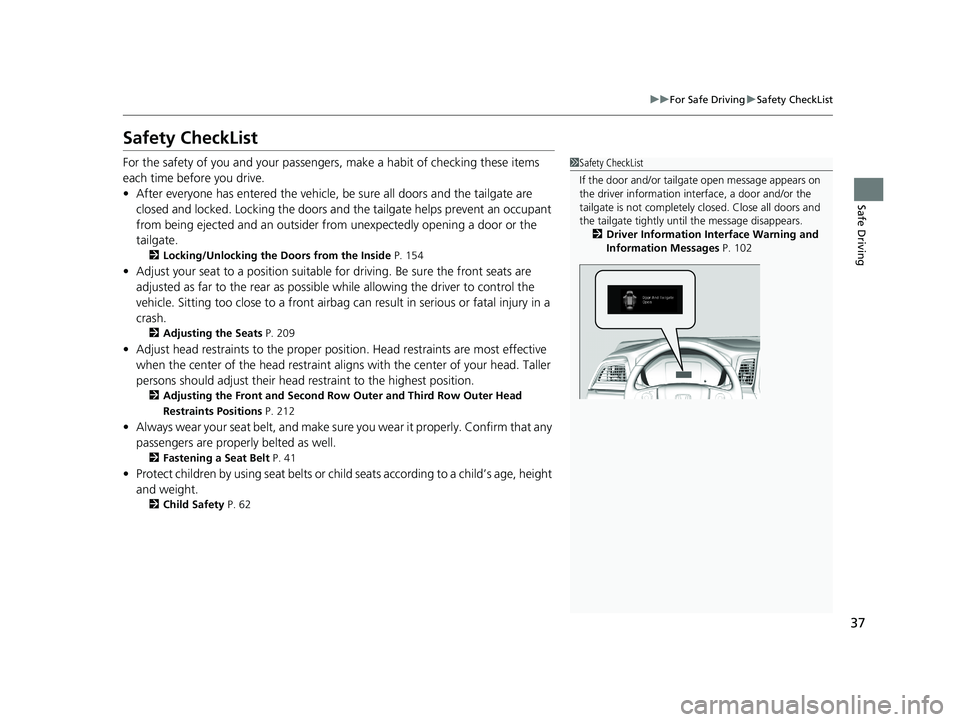
1Safety CheckList
If the door and/or tailga te open message appears on
the driver information inte rface, a door and/or the
tailgate is not completely closed. Close all doors and
the tailgate tightly unti l the message disappears.
2 Driver Information Interface Warning and
Information Messages P. 102
19 ODYSSEY-31THR6120.book 37 ページ 2018年12月6日 木曜日 午後4時35分
Page 40 of 767
38
Safe Driving
Seat Belts
About Your Seat Belts
Seat belts are the single most effective safety device because they keep you
connected to the vehicle so that you can take advantage of many built-in safety
features. They also help keep you from being thrown against the inside of the
vehicle, against any passenger s, or out of the vehicle. When worn properly, seat
belts also keep your body properly positi oned in a crash so that you can take full
advantage of the additional prot ection provided by the airbags.
In addition, seat belts help protect you in almost every type of crash, including:
- frontal impacts
- side impacts
- rear impacts
- rollovers
■Lap/shoulder seat belts
All seven or eight seating positions are eq uipped with lap/shoulder seat belts with
emergency locking retractors. In normal dr iving the retractor lets you move freely
while keeping some tension on the belt.
During a collision or sudden stop the retractor locks to restrain your body. The front,
second, and third row passenger’s seat belt s also have a lockable retractor for use
with child seats.
2 Installing a Child Seat with a Lap/Shoulder Seat Belt P. 72
1About Your Seat Belts
Seat belts cannot complete ly protect you in every
crash. But in most cases, seat belts can reduce your
risk of serious injury.
Most states and all Canadian provinces and territories
require you to wear seat belts.
If you extend the seat belt t oo quickly, it will lock in
place. If this happens, sli ghtly retract the seat belt,
then extend it slowly.
3WARNING
Not wearing a seat belt properly increases
the chance of serious injury or death in a
crash, even though your vehicle has
airbags.
Be sure you and your passengers always
wear seat belts and wear them properly.
19 ODYSSEY-31THR6120.book 38 ページ 2018年12月6日 木曜日 午後4時35分
Page 41 of 767
Continued39
uuSeat Belts uAbout Your Seat Belts
Safe Driving
■Proper use of seat belts
Follow these guidelines for proper use:
• All occupants should sit upright, well back in the seat, and remain in that position
for the duration of the trip. Slouching and leaning reduc e the effectiveness of the
belt and can increase the chance of serious injury in a crash.
• Never place the shoulder part of a lap/shoulder seat belt under your arm or
behind your back. This could cause very serious injuries in a crash.
• Two people should never use the same seat belt. If they do, they could be very
seriously injured in a crash.
• Do not put any accessories on the seat belt s. Devices intended to improve comfort
or reposition the shoulder part of a seat belt can reduce the protective capability
and increase the chance of serious injury in a crash.
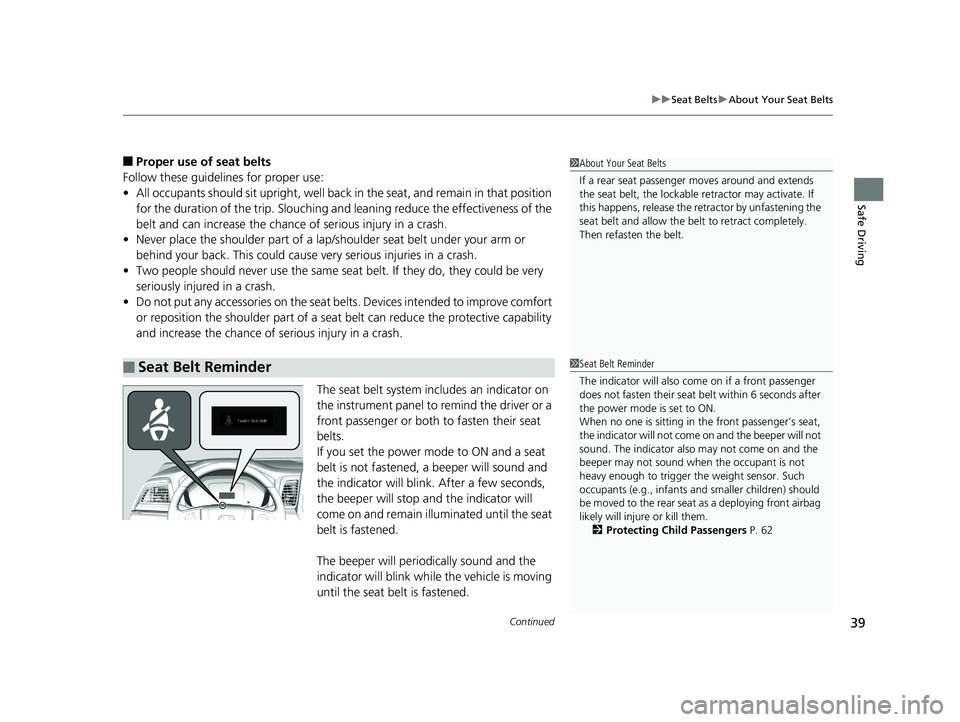
The seat belt system includes an indicator on
the instrument panel to remind the driver or a
front passenger or both to fasten their seat
belts.
If you set the power mode to ON and a seat
belt is not fastened, a beeper will sound and
the indicator will blink. After a few seconds,
the beeper will stop and the indicator will
come on and remain illuminated until the seat
belt is fastened.
The beeper will periodically sound and the
indicator will blink while the vehicle is moving
until the seat belt is fastened.
■Seat Belt Reminder
1About Your Seat Belts
If a rear seat passenger moves around and extends
the seat belt, the lockable retractor may activate. If
this happens, release the retractor by unfastening the
seat belt and allow the belt to retract completely.
Then refasten the belt.
1 Seat Belt Reminder
The indicator will also co me on if a front passenger
does not fasten their seat be lt within 6 seconds after
the power mode is set to ON.
When no one is sitting in th e front passenger’s seat,
the indicator will not come on and the beeper will not
sound. The indicator also may not come on and the
beeper may not sound when the occupant is not
heavy enough to trigger th e weight sensor. Such
occupants (e.g., infants and smaller children) should
be moved to the rear seat as a deploying front airbag
likely will injure or kill them. 2 Protecting Child Passengers P. 62
19 ODYSSEY-31THR6120.book 39 ページ 2018年12月6日 木曜日 午後4時35分
Page 45 of 767
Continued43
uuSeat Belts uFastening a Seat Belt
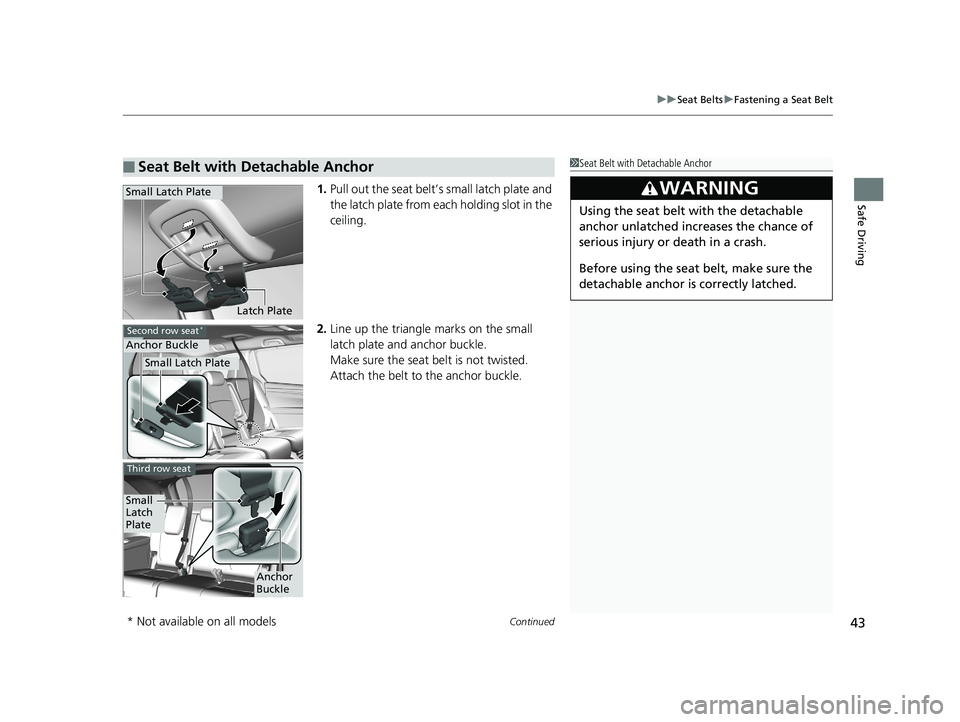
Safe Driving1. Pull out the seat belt’s small latch plate and
the latch plate from each holding slot in the
ceiling.
2. Line up the triangle marks on the small
latch plate and anchor buckle.
Make sure the seat belt is not twisted.
Attach the belt to the anchor buckle.
■Seat Belt with Detachable Anchor1Seat Belt with Detachable Anchor
3WARNING
Using the seat belt with the detachable
anchor unlatched incr eases the chance of
serious injury or death in a crash.
Before using the seat belt, make sure the
detachable anchor is correctly latched.
Small Latch Plate
Latch Plate
Small Latch Plate
Anchor Buckle
Second row seat*
Small
Latch
Plate
Anchor
Buckle
Third row seat
* Not available on all models
19 ODYSSEY-31THR6120.book 43 ページ 2018年12月6日 木曜日 午後4時35分
Page 46 of 767
uuSeat Belts uFastening a Seat Belt
44
Safe Driving
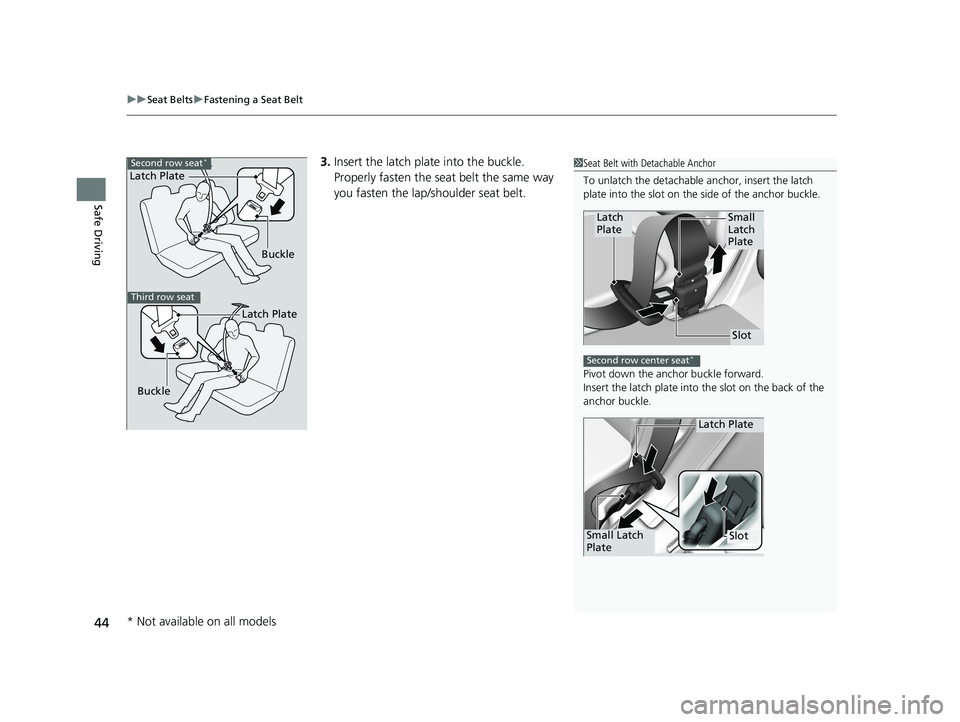
3. Insert the latch plate into the buckle.
Properly fasten the seat belt the same way
you fasten the lap/shoulder seat belt.1Seat Belt with Detachable Anchor
To unlatch the detachable anchor, insert the latch
plate into the slot on the side of the anchor buckle.
Pivot down the anchor buckle forward.
Insert the latch plate into the slot on the back of the
anchor buckle.
Latch
PlateSmall
Latch
Plate
Slot
Second row center seat*
Latch Plate
Small Latch
PlateSlot
Buckle
Latch Plate
Second row seat*
Buckle
Latch Plate
Third row seat
* Not available on all models
19 ODYSSEY-31THR6120.book 44 ページ 2018年12月6日 木曜日 午後4時35分
Page 50 of 767
48
uuAirbags uAirbag System Components
Safe Driving
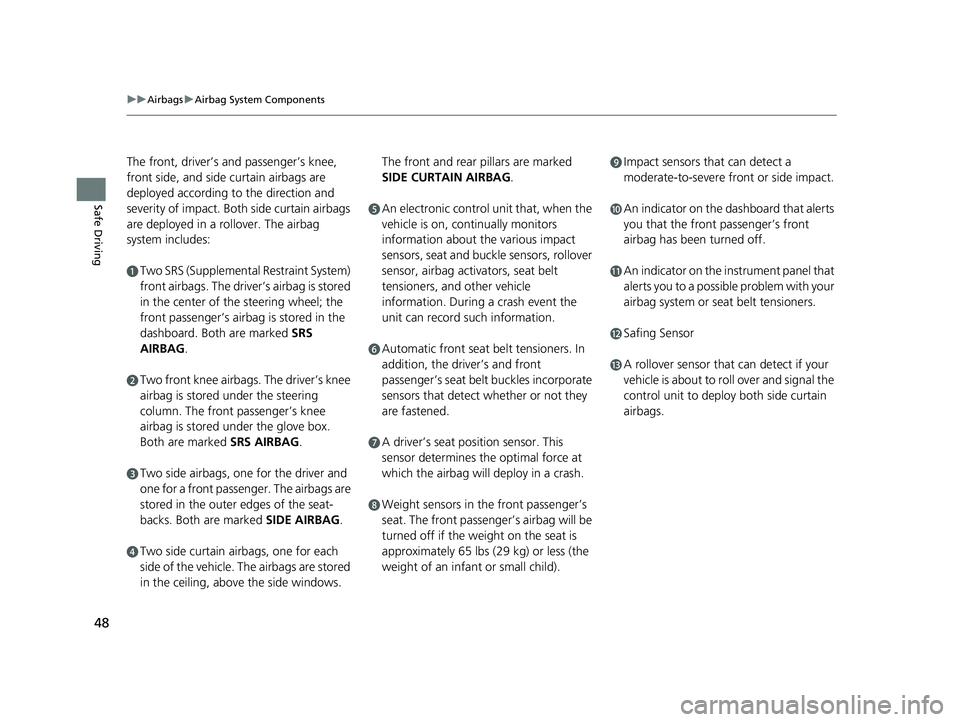
The front, driver’s and passenger’s knee,
front side, and side curtain airbags are
deployed according to the direction and
severity of impact. Both side curtain airbags
are deployed in a ro llover. The airbag
system includes:
aTwo SRS (Supplemental Restraint System)
front airbags. The driver’s airbag is stored
in the center of the steering wheel; the
front passenger’s airbag is stored in the
dashboard. Both are marked SRS
AIRBAG.
bTwo front knee airbags. The driver’s knee
airbag is stored under the steering
column. The front passenger’s knee
airbag is stored under the glove box.
Both are marked SRS AIRBAG.
cTwo side airbags, one for the driver and
one for a front passenger. The airbags are
stored in the outer edges of the seat-
backs. Both are marked SIDE AIRBAG .
dTwo side curtain airbags, one for each
side of the vehicle. The airbags are stored
in the ceiling, above the side windows. The front and rear pillars are marked
SIDE CURTAIN AIRBAG
.
eAn electronic control unit that, when the
vehicle is on, continually monitors
information about the various impact
sensors, seat and buckle sensors, rollover
sensor, airbag activators, seat belt
tensioners, and other vehicle
information. During a crash event the
unit can record such information.
fAutomatic front seat belt tensioners. In
addition, the driver’s and front
passenger’s seat belt buckles incorporate
sensors that detect whether or not they
are fastened.
gA driver’s seat position sensor. This
sensor determines the optimal force at
which the airbag will deploy in a crash.
hWeight sensors in the front passenger’s
seat. The front passenger’s airbag will be
turned off if the weight on the seat is
approximately 65 lbs (29 kg) or less (the
weight of an infant or small child).
iImpact sensors that can detect a
moderate-to-severe front or side impact.
jAn indicator on the dashboard that alerts
you that the front passenger’s front
airbag has been turned off.
kAn indicator on the instrument panel that
alerts you to a possible problem with your
airbag system or seat belt tensioners.
lSafing Sensor
mA rollover sensor that can detect if your
vehicle is about to roll over and signal the
control unit to deploy both side curtain
airbags.
19 ODYSSEY-31THR6120.book 48 ページ 2018年12月6日 木曜日 午後4時35分
Page 53 of 767
Continued51
uuAirbags uFront Airbags (SRS)
Safe DrivingFront airbags are designed to inflate duri ng moderate-to-severe frontal collisions.
When the vehicle decelerates suddenly, the sensors send information to the control
unit which signals one or both front airbags to inflate.
A frontal collision can be either head-on or angled between two vehicles, or when a
vehicle crashes into a stationary object, such as a concrete wall.
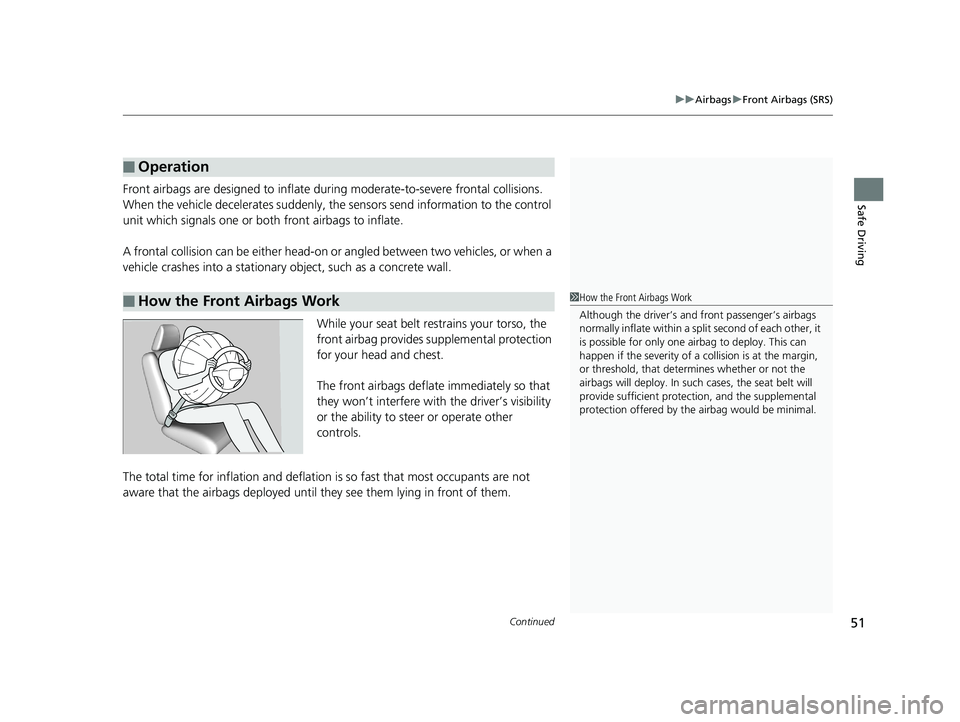
While your seat belt restrains your torso, the
front airbag provides supplemental protection
for your head and chest.
The front airbags deflate immediately so that
they won’t interfere with the driver’s visibility
or the ability to steer or operate other
controls.
The total time for inflation and deflation is so fast that most occupants are not
aware that the airbags deployed until th ey see them lying in front of them.
■Operation
■How the Front Airbags Work1How the Front Airbags Work
Although the driver’s and fr ont passenger’s airbags
normally inflate within a spli t second of each other, it
is possible for only one airbag to deploy. This can
happen if the severity of a collision is at the margin,
or threshold, that determines whether or not the
airbags will deploy. In such cases, the seat belt will
provide sufficient protec tion, and the supplemental
protection offered by the airbag would be minimal.
19 ODYSSEY-31THR6120.book 51 ページ 2018年12月6日 木曜日 午後4時35分
Page 61 of 767
Continued59
uuAirbags uAirbag System Indicators
Safe Driving
■When side curtain airbags deploy in a frontal collision
One or both side curtain ai rbags may also inflate in a moderate-to-severe angled
frontal collision.
Airbag System Indicators
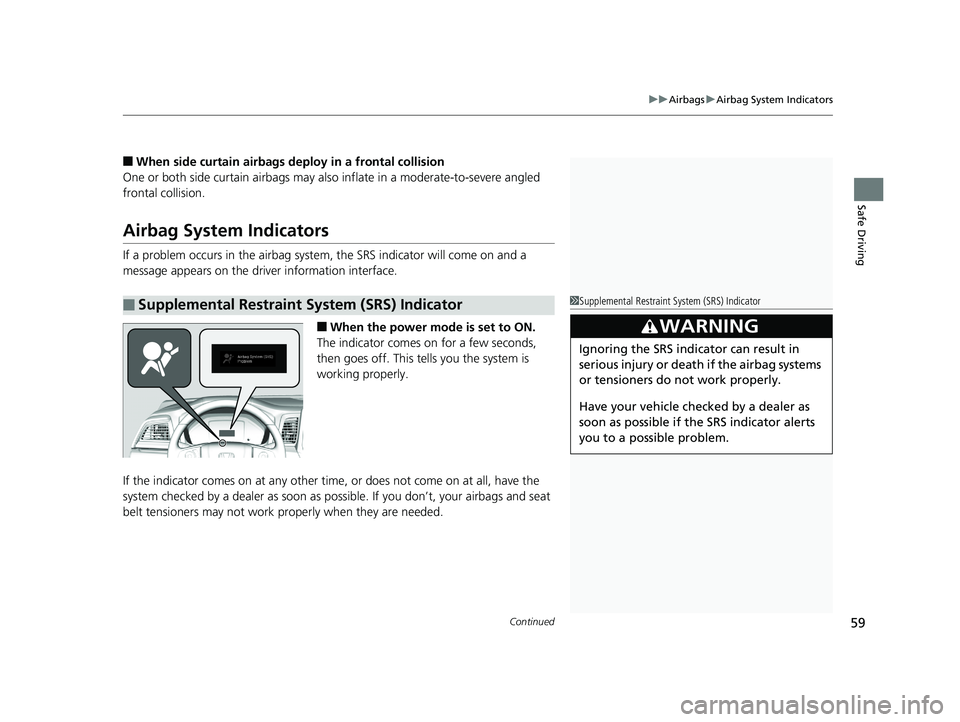
If a problem occurs in the airbag system , the SRS indicator will come on and a
message appears on the driver information interface.
■When the power mode is set to ON.
The indicator comes on for a few seconds,
then goes off. This te lls you the system is
working properly.
If the indicator comes on at any other time, or does not come on at all, have the
system checked by a dealer as soon as po ssible. If you don’t, your airbags and seat
belt tensioners may not work properly when they are needed.
■Supplemental Restraint System (SRS) Indicator1Supplemental Restraint Sy stem (SRS) Indicator
3WARNING
Ignoring the SRS indicator can result in
serious injury or death if the airbag systems
or tensioners do not work properly.
Have your vehicle checked by a dealer as
soon as possible if th e SRS indicator alerts
you to a possible problem.
19 ODYSSEY-31THR6120.book 59 ページ 2018年12月6日 木曜日 午後4時35分