ECU HONDA PASSPORT 2000 2.G User Guide
[x] Cancel search | Manufacturer: HONDA, Model Year: 2000, Model line: PASSPORT, Model: HONDA PASSPORT 2000 2.GPages: 267, PDF Size: 3.03 MB
Page 33 of 267
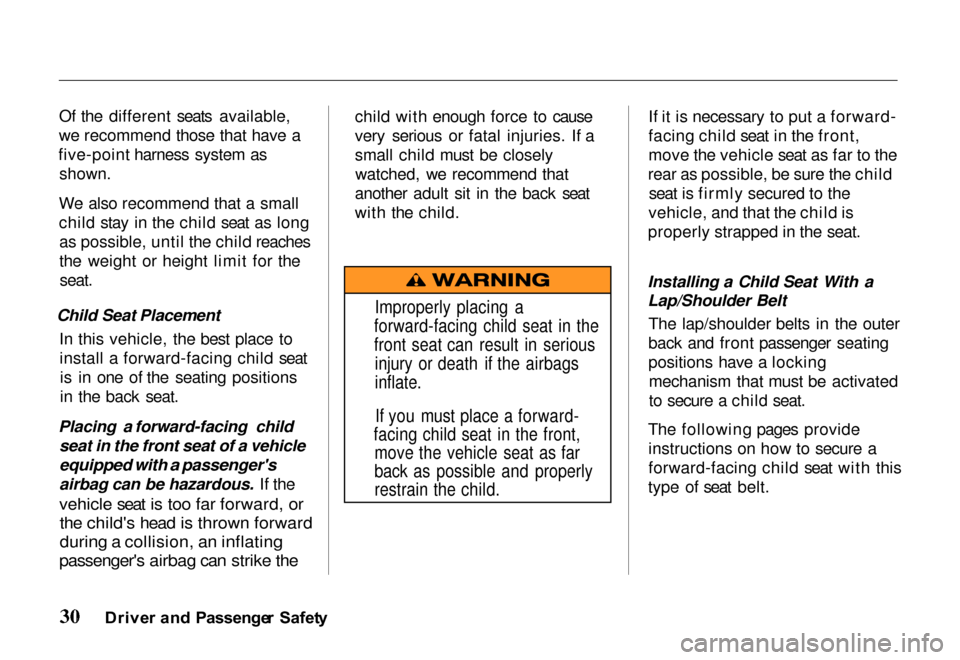
Of the different seats available,
we recommend those that have a
five-point harness system as
shown.
We also recommend that a small
child stay in the child seat as long as possible, until the child reaches
the weight or height limit for the
seat.
Child Seat Placement In this vehicle, the best place toinstall a forward-facing child seatis in one of the seating positions
in the back seat.
Placing a forward-facing child seat in the front seat of a vehicle
equipped with a passenger's
airbag can be hazardous. If the
vehicle seat is too far forward, or
the child's head is thrown forward
during a collision, an inflating
passenger's airbag can strike the
child with enough force to cause
very serious or fatal injuries. If a
small child must be closely
watched, we recommend that
another adult sit in the back seat
with the child. If it is necessary to put a forward-
facing child seat in the front,
move the vehicle seat as far to the
rear as possible, be sure the child seat is firmly secured to the
vehicle, and that the child is
properly strapped in the seat.
Installing a Child Seat With a
Lap/Shoulder Belt The lap/shoulder belts in the outer
back and front passenger seating
positions have a lockingmechanism that must be activated
to secure a child seat.
The following pages provide instructions on how to secure a
forward-facing child seat with this
type of seat belt.
Drive r an d Passenge r Safet y
Improperly placing a
forward-facing child seat in the
front seat can result in serious injury or death if the airbags
inflate.
If you must place a forward-
facing child seat in the front, move the vehicle seat as far
back as possible and properly
restrain the child.
Page 34 of 267
See page 32 for how to secure a
forward-facing child seat in the
center back seat with the lap belt.
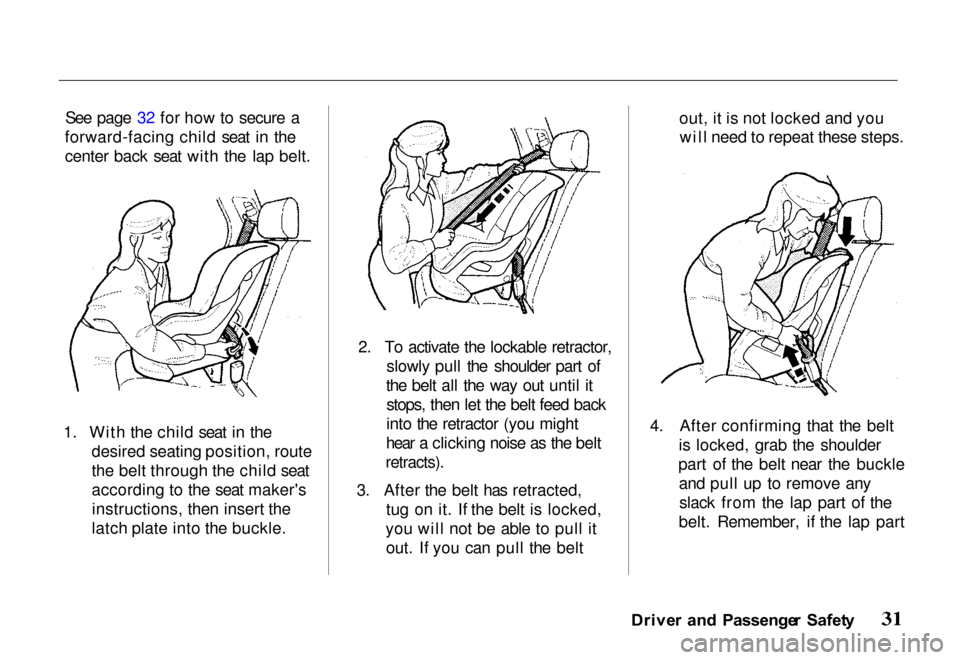
1. With the child seat in the desired seating position, route
the belt through the child seat
according to the seat maker'sinstructions, then insert the
latch plate into the buckle. 2. To activate the lockable retractor,
slowly pull the shoulder part of
the belt all the way out until it stops, then let the belt feed back
into the retractor (you might
hear a clicking noise as the belt
retracts).
3. After the belt has retracted, tug on it. If the belt is locked,
you will not be able to pull it out. If you can pull the belt out, it is not locked and you
will need to repeat these steps.
4. After confirming that the belt is locked, grab the shoulder
part of the belt near the buckle and pull up to remove anyslack from the lap part of the
belt. Remember, if the lap part
Drive r an d Passenge r Safet y
Page 35 of 267
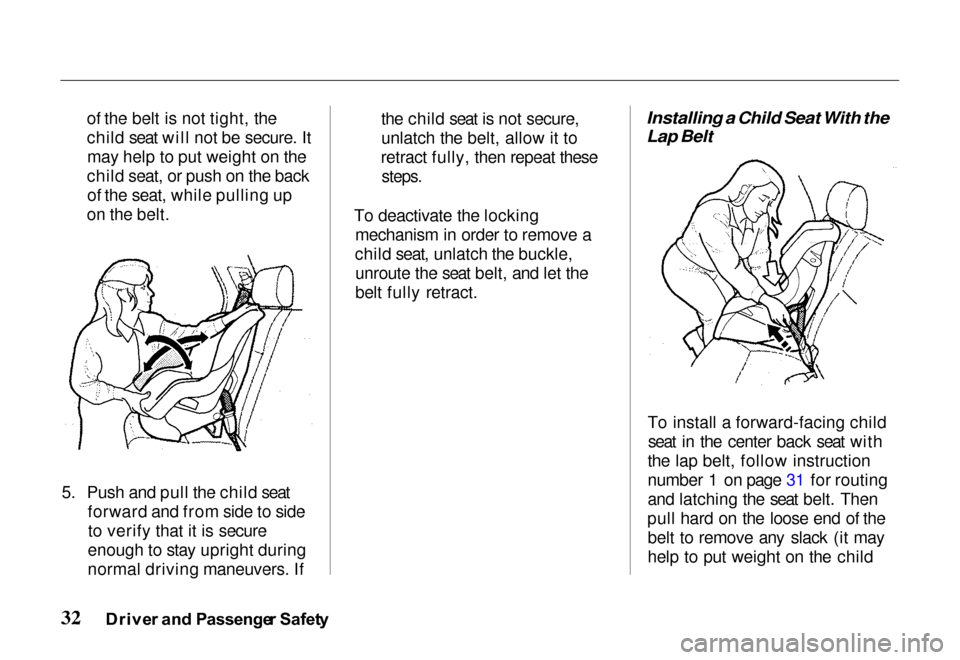
of the belt is not tight, the
child seat will not be secure. It
may help to put weight on the
child seat, or push on the back of the seat, while pulling up
on the belt.
5. Push and pull the child seat forward and from side to sideto verify that it is secure
enough to stay upright during
normal driving maneuvers. If the child seat is not secure,
unlatch the belt, allow it to
retract fully, then repeat these
steps.
To deactivate the locking mechanism in order to remove a
child seat, unlatch the buckle, unroute the seat belt, and let the
belt fully retract.
Installing a Child Seat With the
Lap Belt
To install a forward-facing childseat in the center back seat with
the lap belt, follow instruction
number 1 on page 31 for routing
and latching the seat belt. Then
pull hard on the loose end of the belt to remove any slack (it may
help to put weight on the child
Drive r an d Passenge r Safet y
Page 36 of 267
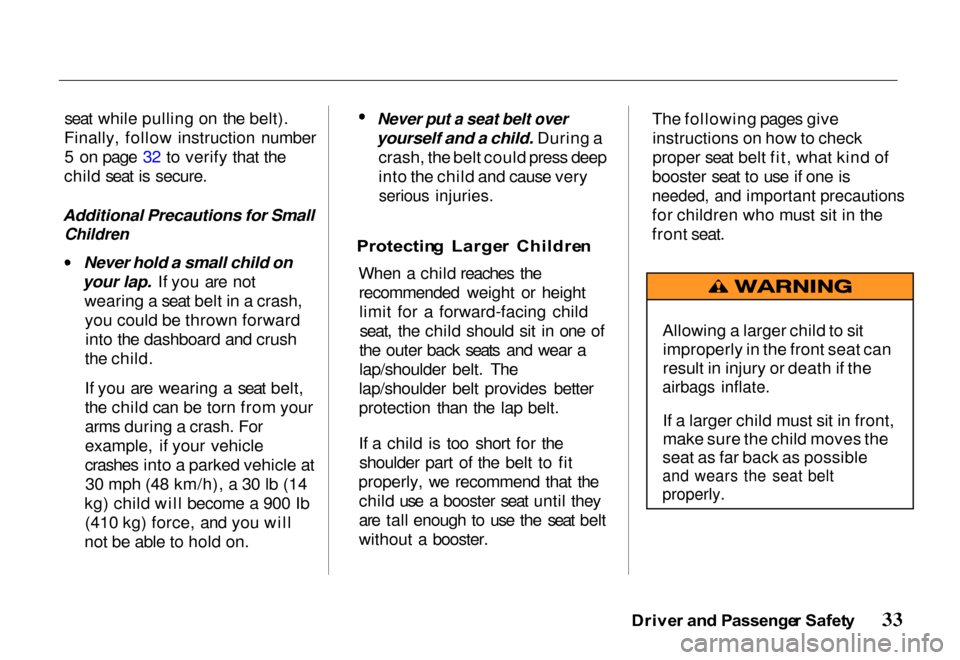
seat while pulling on the belt).
Finally, follow instruction number 5 on page 32 to verify that the
child seat is secure.
Additional Precautions for Small
Children
Never hold a small child on
your lap. If you are not wearing a seat belt in a crash,you could be thrown forwardinto the dashboard and crush
the child.
If you are wearing a seat belt,
the child can be torn from your
arms during a crash. For
example, if your vehicle
crashes into a parked vehicle at 30 mph (48 km/h), a 30 lb (14
kg) child will become a 900 Ib (410 kg) force, and you will
not be able to hold on.
Never put a seat belt over
yourself and a child. During a crash, the belt could press deep
into the child and cause very
serious injuries.
Protectin g Large r Childre n
When a child reaches the recommended weight or heightlimit for a forward-facing childseat, the child should sit in one of
the outer back seats and wear a
lap/shoulder belt. The
lap/shoulder belt provides better
protection than the lap belt.
If a child is too short for the shoulder part of the belt to fit
properly, we recommend that the child use a booster seat until they
are tall enough to use the seat belt
without a booster. The following pages give
instructions on how to check
proper seat belt fit, what kind of
booster seat to use if one is
needed, and important precautions
for children who must sit in the
front seat.
Drive r an d Passenge r Safet y
Allowing a larger child to sit
improperly in the front seat can
result in injury or death if the
airbags inflate.
If a larger child must sit in front,
make sure the child moves the
seat as far back as possible
and wears the seat belt
properly.
Page 39 of 267
Physical Size — Physically, a child
must be large enough for the
lap/shoulder
belt to properly fit
over the hips, chest, and shoulder (see
page 13 and 35). If the seat
belt does not fit properly, the child should
not sit in the front.
Maturity — To safely ride in
front, a child must be able to
follow
the rules, including sitting
properly, and wearing the seat belt
properl
y throughout a ride. If you decide that a child can
safely ride up front, be sure to:
Carefully
read the owner's
manual,
and make sure you
understand all seat belt instructions and all safety
information.
Mov
e the vehicle seat to the
rear-most
position.
Have the child sit up straight,
back against the seat, and feet
on
or near the floor.
Check that the child's seat belt is
properly positioned and
secured.
Supervise the child. Even
mature
children sometimes
need
to be reminded to fasten
their seat belts or sit properly.
Using Child Seats With
Tethers
ANCHO
R POINT
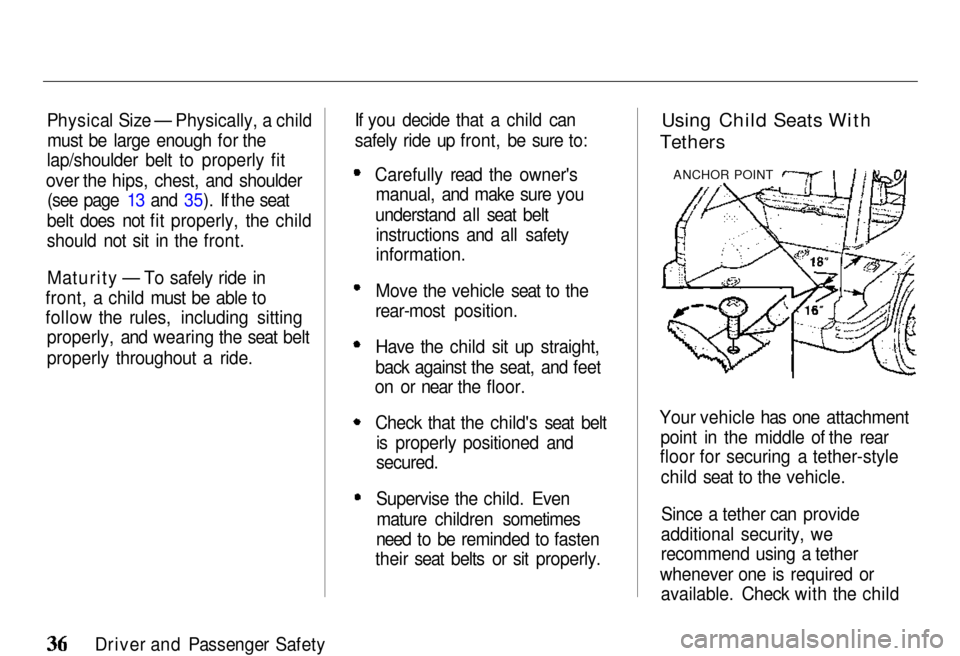
Your vehicle has one attachment point in the middle of the rear
floor
for securing a tether-style
child seat to the vehicle.
Since
a tether can provide
additional security, we
recommend using a tether
whenever
one is required or
available. Check with the child
Driver and Passenger Safety
Page 40 of 267
seat maker to determine whether a
tether is available for a particular
child seat.
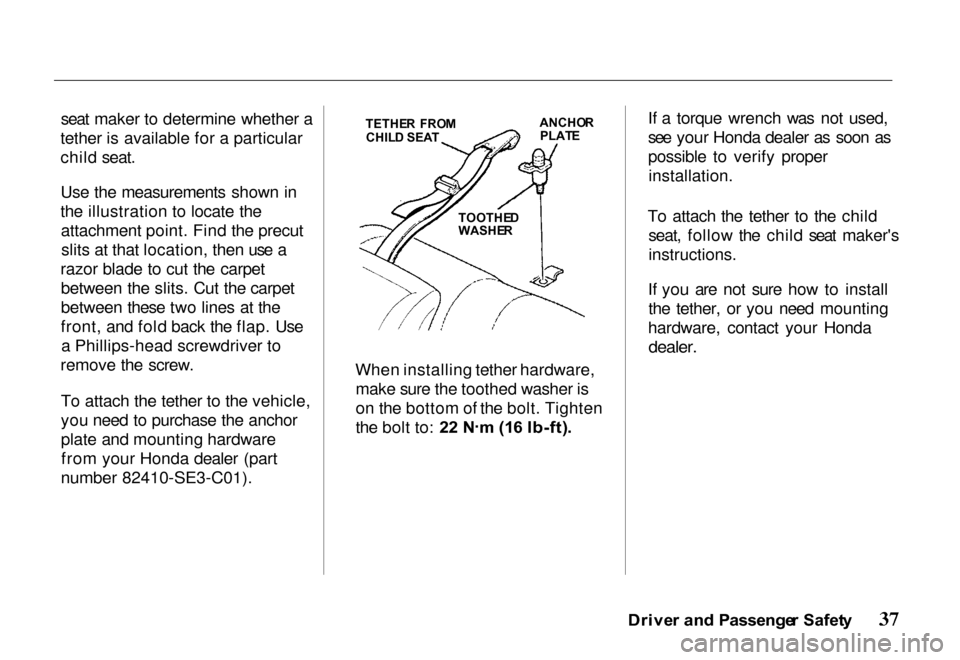
Use the measurements shown in
the illustration to locate the attachment point. Find the precutslits at that location, then use a
razor blade to cut the carpet between the slits. Cut the carpet
between these two lines at the
front, and fold back the flap. Usea Phillips-head screwdriver to
remove the screw.
To attach the tether to the vehicle,
you need to purchase the anchor
plate and mounting hardwarefrom your Honda dealer (part
number 82410-SE3-C01). When installing tether hardware,
make sure the toothed washer is
on the bottom of the bolt. Tighten
the bolt to: 2 2 N .
m (1 6 Ib-ft) . If a torque wrench was not used,
see your Honda dealer as soon as
possible to verify proper
installation.
To attach the tether to the child seat, follow the child seat maker's
instructions.
If you are not sure how to install the tether, or you need mounting
hardware, contact your Honda
dealer.
Drive r an d Passenge r Safet y
TETHE
R FRO M
CHIL D SEA T ANCHO
R
PLAT E
TOOTHE D
WASHE R
Page 42 of 267
All the lap/shoulder belts except
the driver's have an additional
locking mechanism that must beactivated to secure a child seat.(See pages 25 and 30 for
instructions on how to secure
child seats with this type of seat
belt.)
If the shoulder part of the belt is
pulled all the way out, the locking
mechanism will activate. The belt
will retract, but it will not allow a
passenger to move freely.
To deactivate the locking
mechanism, unlatch the buckle
and let the seat belt fully retract.
To refasten the belt, pull it out only as far as needed.
See page 13 for instructions on
how to wear the lap/shoulder belt
properly.
La
p Bel t
The lap belt has one manually adjusted belt that fits across the
hips.
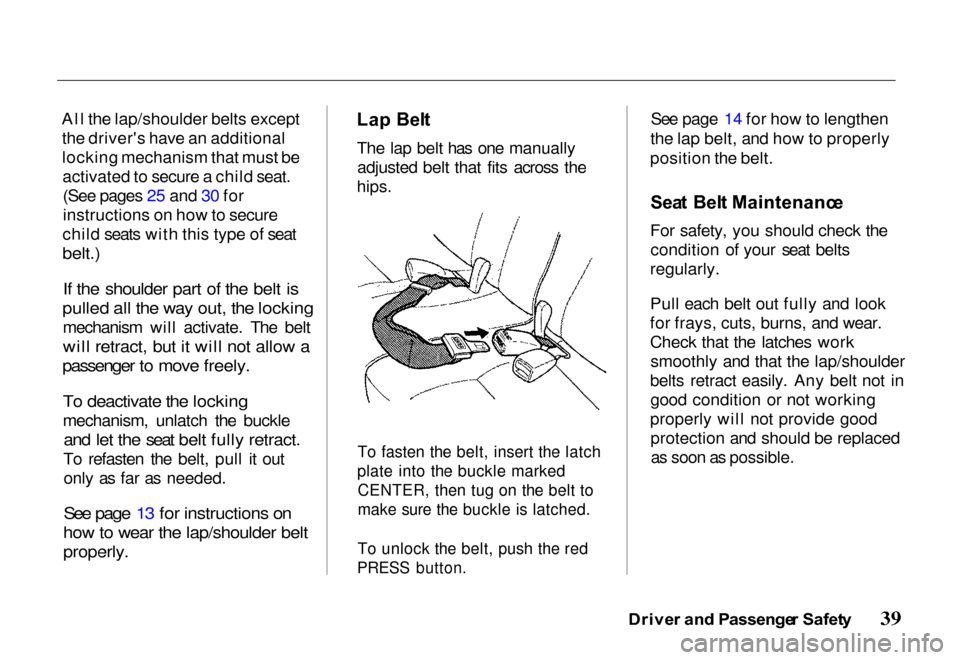
To fasten the belt, insert the latch
plate into the buckle marked
CENTER, then tug on the belt to
make sure the buckle is latched.
To unlock the belt, push the red
PRESS button.
See page 14 for how to lengthen
the lap belt, and how to properly
position the belt.
Sea t Bel t Maintenanc e
For safety, you should check the condition of your seat belts
regularly.
Pull each belt out fully and look
for frays, cuts, burns, and wear.
Check that the latches work smoothly and that the lap/shoulder
belts retract easily. Any belt not in good condition or not working
properly will not provide good protection and should be replacedas soon as possible.
Drive r an d Passenge r Safet y
Page 82 of 267
Shifting the Transfer Control
Lever
4H 4L: Stop the vehicle. Place
the transmission leverin "N" (Neutral)
position. Then move the transfer controllever from 4H to 4L,
or 4L to 4H.
Move the transfer control lever
quickly and securely between
positions. Do not stop midway.
The transfer gear box can be
damaged if the control lever is not
firmly in gear. Some noise is
normal when shifting.
Always stop the vehicle before shifting between low and high range (4H 4L or 4L 4H).
If the 4WD indicator continues to
blink rapidly, it indicates that the system was shifted out of
sequence. Stop the vehicle, select 4WD with the 4WD-2WD switch,
shift the lever from 4L to 4H, then
select 2WD. Drive in a straight
line to reset the system. If the indicator continues to blink, see
your Honda dealer.
Do not use 4-wheel drive for
driving on dry pavement. This
causes noise and wear, and taking
tight turns can damage thetransfer case and driveshafts. It
also reduces fuel economy.
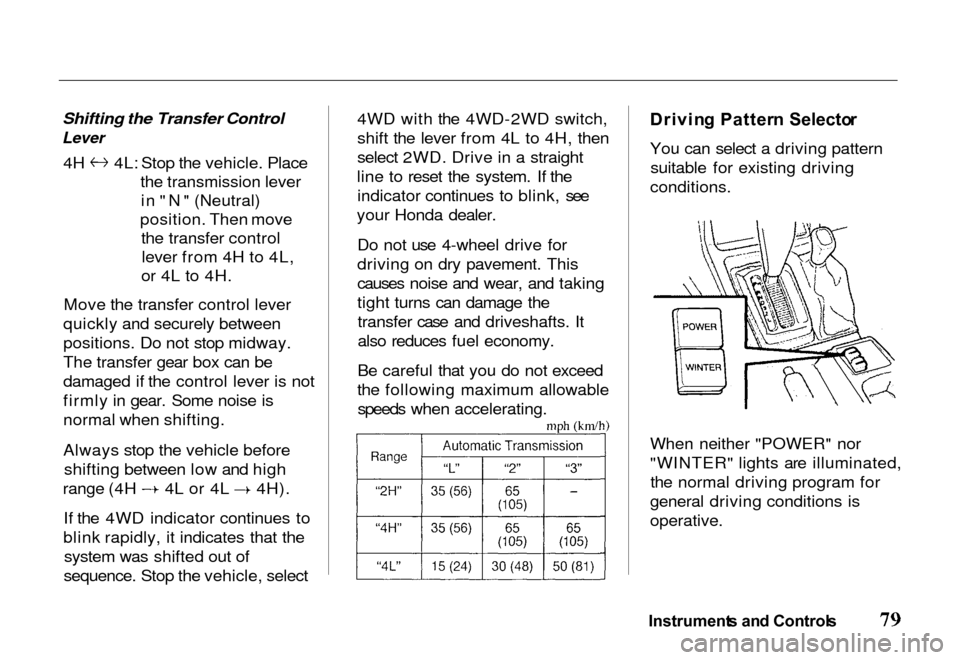
Be careful that you do not exceed
the following maximum allowable speeds when accelerating.
Drivin
g Patter n Selecto r
You can select a driving pattern suitable for existing driving
conditions.
When neither "POWER" nor
"WINTER" lights are illuminated, the normal driving program for
general driving conditions is
operative.
Instrument s an d Control s
Page 86 of 267
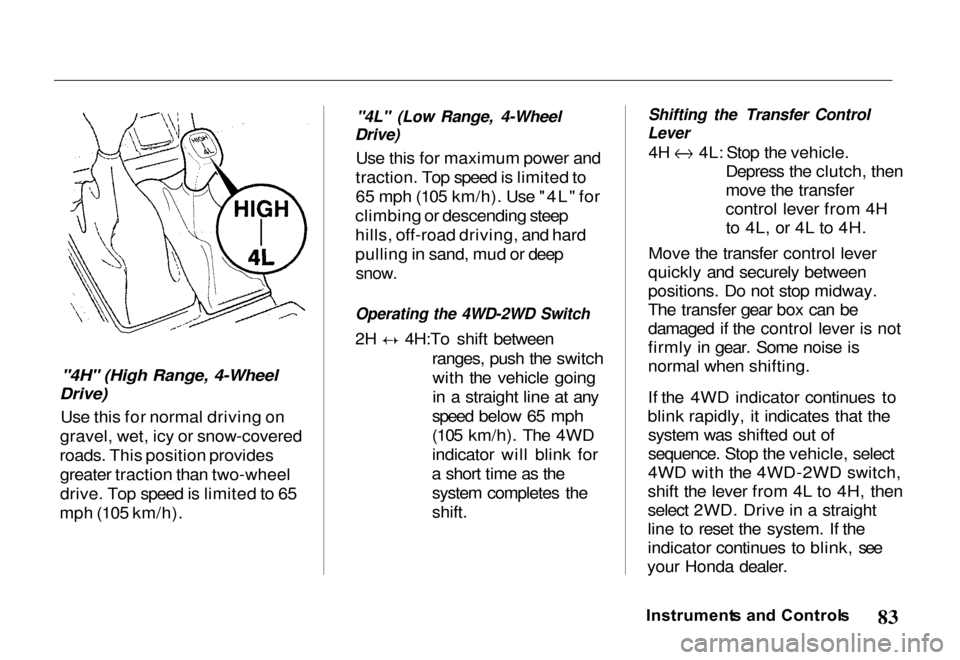
"4H" (High Range, 4-Wheel
Drive)
Use this for normal driving on
gravel, wet, icy or snow-covered
roads. This position provides greater traction than two-wheel
drive. Top speed is limited to 65
mph (105 km/h).
"4L" (Low Range, 4-Wheel
Drive)
Use this for maximum power and
traction. Top speed is limited to
65 mph (105 km/h). Use "4L" for
climbing or descending steep
hills, off-road driving, and hard
pulling in sand, mud or deep
snow.
Operating the 4WD-2WD Switch
2H 4H:To shift between
ranges, push the switchwith the vehicle going
in a straight line at any
speed below 65 mph
(105 km/h). The 4WD
indicator will blink for
a short time as the system completes the
shift.
Shifting the Transfer Control
Lever
4H 4L: Stop the vehicle.
Depress the clutch, then
move the transfer
control lever from 4Hto 4L, or 4L to 4H.
Move the transfer control lever
quickly and securely between
positions. Do not stop midway.
The transfer gear box can be
damaged if the control lever is not
firmly in gear. Some noise is
normal when shifting.
If the 4WD indicator continues to
blink rapidly, it indicates that the system was shifted out of
sequence. Stop the vehicle, select
4WD with the 4WD-2WD switch,
shift the lever from 4L to 4H, then
select 2WD. Drive in a straight
line to reset the system. If the
indicator continues to blink, see
your Honda dealer.
Instrument s an d Control s
Page 95 of 267
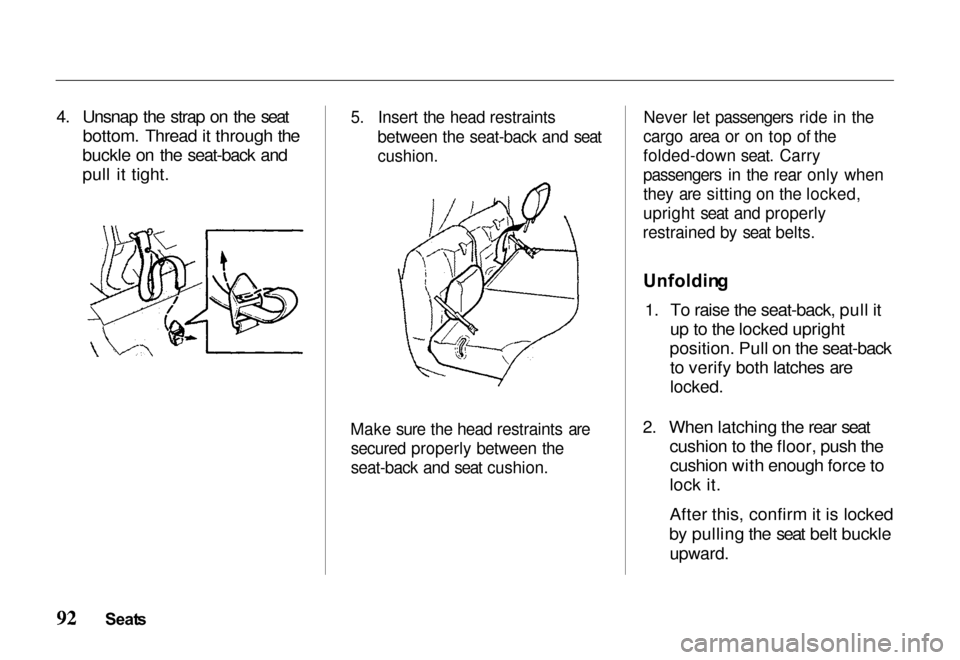
4. Unsnap the strap on the seat
bottom. Thread it through the
buckle on the seat-back and
pull it tight.
5. Insert the head restraints
between the seat-back and seat
cushion.
Make sure the head restraints are secured properly between the
seat-back and seat cushion. Never let passengers ride in the
cargo area or on top of the
folded-down seat. Carry
passengers in the rear only when
they are sitting on the locked,
upright seat and properly
restrained by seat belts.
Unfoldin g
1. To raise the seat-back, pull it up to the locked upright
position. Pull on the seat-back to verify both latches are
locked.
2. When latching the rear seat cushion to the floor, push thecushion with enough force to
lock it.
After this, confirm it is locked
by pulling the seat belt buckle
upward.
Seat s