ECU HONDA PASSPORT 2000 2.G Owner's Manual
[x] Cancel search | Manufacturer: HONDA, Model Year: 2000, Model line: PASSPORT, Model: HONDA PASSPORT 2000 2.GPages: 267, PDF Size: 3.03 MB
Page 100 of 267
Key
s an d Ignitio n
Your Passport comes with two
keys.
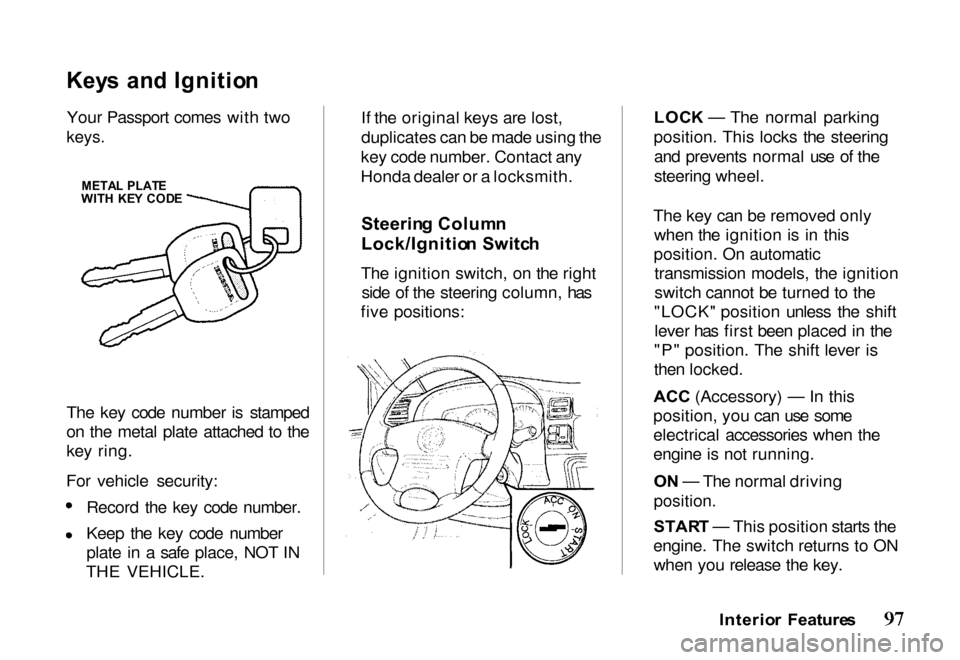
The key code number is stamped
on the metal plate attached to the
key ring.
For vehicle security: Record the key code number.
Keep the key code number
plate in a safe place, NOT IN
THE VEHICLE. If the original keys are lost,
duplicates can be made using the
key code number. Contact any
Honda dealer or a locksmith.
Steerin g Colum n
Lock/Ignitio n Switc h
The ignition switch, on the right side of the steering column, has
five positions: LOC
K — The normal parking
position. This locks the steering and prevents normal use of the
steering wheel.
The key can be removed only when the ignition is in this
position. On automatic transmission models, the ignition
switch cannot be turned to the
"LOCK" position unless the shift lever has first been placed in the
"P" position. The shift lever is
then locked.
ACC (Accessory) — In this
position, yo
u can use some
electrical accessories when the
engine is not running.
O N — The normal driving
position.
STAR T — This position starts the
engine. The switch returns to ON when you release the key.
Interior Feature s
META
L PLAT E
WIT H KE Y COD E
Page 109 of 267
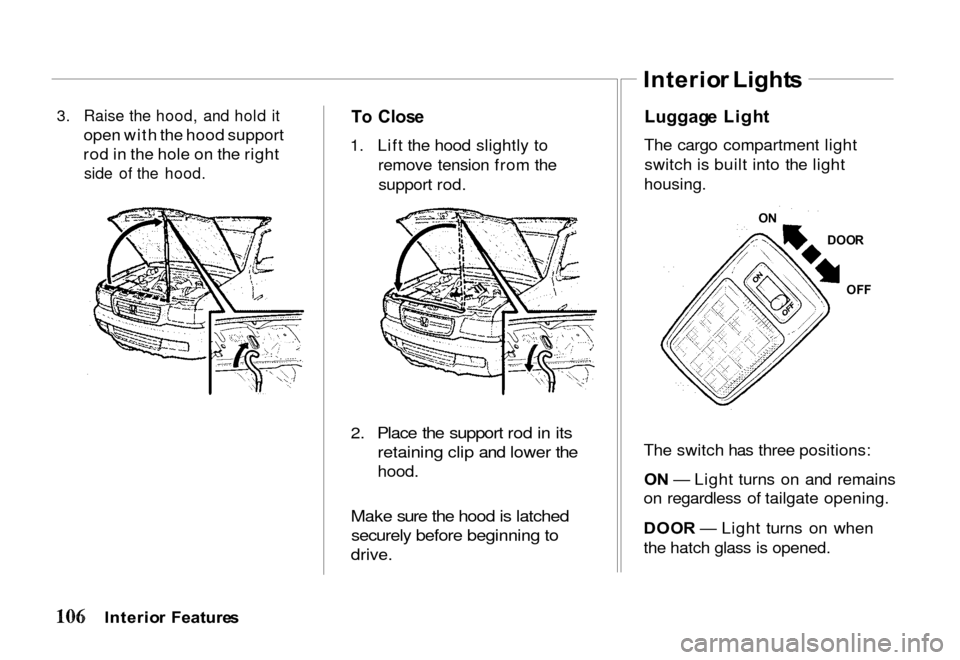
3. Raise the hood, and hold it
open with the hood support
rod in the hole on the right
side of the hood.
T
o Clos e
1. Lift the hood slightly to remove tension from thesupport rod.
2. Place the support rod in its retaining clip and lower the
hood.
Make sure the hood is latched securely before beginning to
drive.
Luggag
e Ligh t
The cargo compartment light switch is built into the light
housing.
The switch has three positions: O N — Light turns on and remains
on regardless of tailgate opening.
DOO R — Light turns on when
the hatch glass is opened.
Interio r Feature s Interio
r Light s
O N
DOOR
OF F
Page 176 of 267
Carryin
g Item s in th e
Passenge r Compartmen t
Store or secure all items that
could be thrown around and
hurt someone during a crash. Be sure items placed on the
floor behind the front seats
cannot roll under the seats
and interfere with the driver's
ability to operate the pedals,
or with the proper operation
of the seats. Keep the glove box closed
while driving. If the lid is open,
a passenger could injure his
knees during a crash or sudden
stop.
Carryin
g Carg o in th e Carg o
Are a o r o n a Roo f Rac k Distribute cargo evenly on the
floor of the cargo area, placing
the heaviest items on the
bottom and as far forward as
possible.
If you fold down the back seat,
tie down items that could be
thrown about the vehicle
during a crash or sudden stop. If you carry large items that
prevent you from closing the hatch glass or rear door,
exhaust gas can enter the
passenger area. To avoid the
possibility of carbon monoxide
poisoning, follow the instructions on page 44. If you carry any items on a roof
rack, be sure the total weight of the rack and the items does not
exceed 200 Ib (90 kg).
Driving Tip s
Page 181 of 267
There are no provisions in your
vehicle to tap into its hydraulic
braking system. Any attempt toattach the trailer's brakes to your
vehicle's hydraulic braking system, no matter how successfulit may seem, will lower braking
effectiveness and create a
potential hazard.
Equipmen t Chec k
Before operating your vehicle,
check all safety equipment to
ensure safe operation. Be sure
your vehicle is properly serviced
to avoid mechanical failure.
Check that your vehicle remains
level when the loaded or unloadedtrailer is hitched. Do not drive if
the rear end of your vehicle is abnormally higher or lower.
Check for proper tongue weight,
overload, improper weight
distribution, worn suspension, or
other possible causes.
Make sure the trailer load is
properly positione
d and secured
so its does not shift around whil
e
driving.
Chec k
if your rearview mirrors
comply with federal, state and
local regulations. If not, confirm
the proper mirrors required for
towing and have them installed.
Perform an equipment check of
all braking, lighting and safety
equipment to ensure they are working properly.
Your safety depends on proper
operation and installation of
equipment. Never operate a
vehicle with faulty equipment.
Limite
d Sli p Differentia l
Standard on 4WD models
The limited slip differential is
designed to improve traction by limiting wheelspin. If one rear
wheel begins to spin on a slipperysurface, the limited slip
differential will automatically
transmit driving force to the other
rear wheel.
Drivin g Tip s
Page 187 of 267
8. Turn the jack handle
clockwise with a slow, smooth
motion to raise the vehicle sothe inflated spare tire will
clear the surface.
9. Remove the wheel nuts and the wheel.
10. Install the wheel and replace the whee
l nuts with the
cone-shaped end toward the
wheel, then hand-tighten each
nut. The wheel must be seated on the hub.
11.
Lower the vehicle by turning
the jac
k handle counter-
clockwise, then fully tighten the wheel nuts in a crisscrosssequence by turning the
wrench clockwise. Have the
wheel nut torque checked at
the nearest automotive service
facility.
87 lb-ft ( 118 N.m)
12.
Stow the jacking tools and flat
tire i
n their proper locations.
Too
l Location s
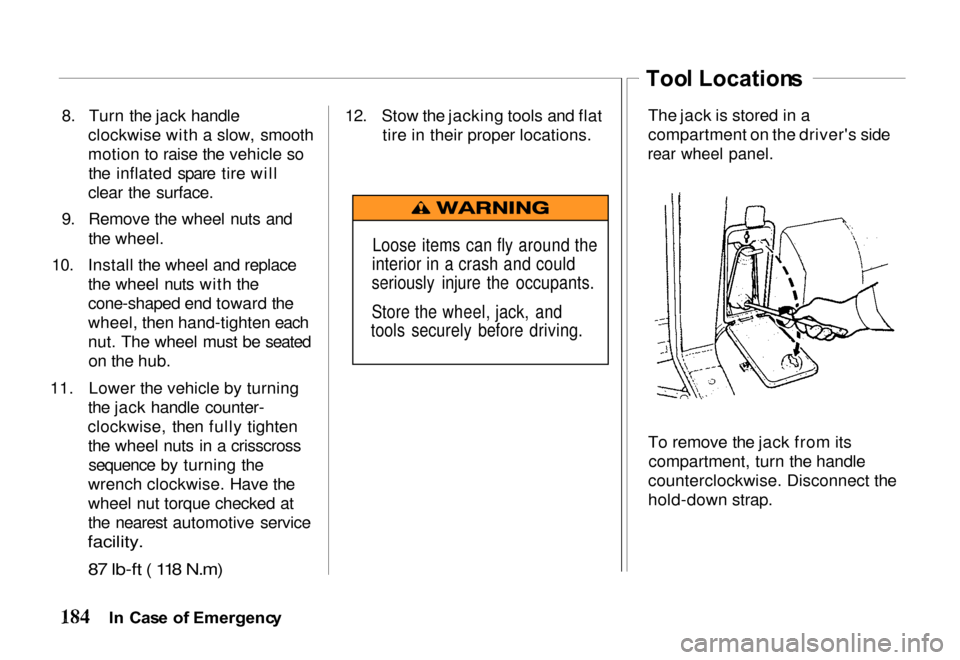
The jack is stored in a
compartment on the driver's side
rear wheel panel.
To remove the jack from itscompartment, turn the handle
counterclockwise. Disconnect the
hold-down strap.
I n Cas e o f Emergenc y
Loose items can fly around the
interior in a crash and could
seriously injure the occupants.
Store the wheel, jack, and
tools securely before driving.
Page 188 of 267
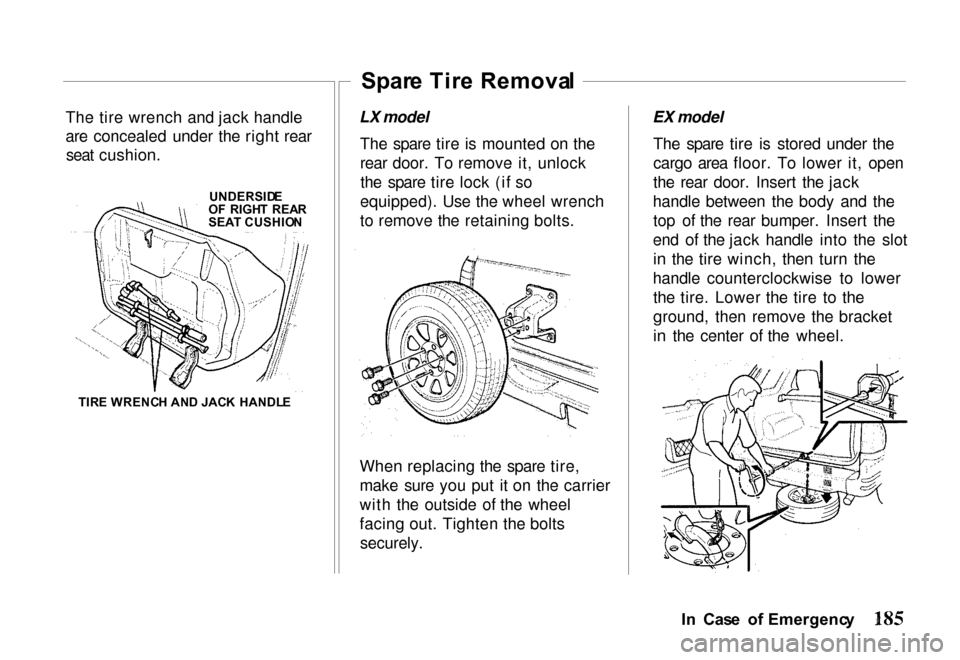
The tire wrench and jack handle
are concealed under the right rear
seat cushion.
UNDERSIDE
O F RIGH T REA R
SEA T CUSHIO N
TIR E WRENC H AN D JAC K HANDL E Spar
e Tir e Remova l
LX model The spare tire is mounted on the
rear door. To remove it, unlockthe spare tire lock (if so
equipped). Use the wheel wrench
to remove the retaining bolts.
When replacing the spare tire,
make sure you put it on the carrier
with the outside of the wheel
facing out. Tighten the bolts securely. EX model
The spare tire is stored under the
cargo area floor. To lower it, open
the rear door. Insert the jack
handle between the body and the top of the rear bumper. Insert the
end of the jack handle into the slot in the tire winch, then turn the
handle counterclockwise to lower the tire. Lower the tire to the
ground, then remove the bracket
in the center of the wheel.
In Cas e o f Emergenc y
Page 189 of 267
Reverse this procedure to store
the spare tire. Connect the spare
tire to the bracket with the outside
of the wheel facing up. Make sure
the tire does not catch on any part
of the underbody of the vehicle as
you are raising it, and that the spare tire is stored securely before
driving.
If the engine overheats:
The engine coolant temperaturegauge pointer will move up to
the "H" or higher. Engine "ping" will become
excessive.
Loss of engine power will be
noticed.
Either steam or boiling water
will squirt out of the radiator.
If you find that the engine is
overheating:
Stop the vehicle, and turn on
the hazard warning lights.
If you see or hear steam or
coolant coming from the
engine compartment, turn off the engine immediately. If you do not see or hear steam
or spray, turn off the A/C (if
on) and run the engine at a
speed slightly higher than idle
speed (about 1,500 rpm) for
several minutes. Watch the
coolant temperature gauge. If it
remains at the ''H" mark, turn
off the engine.
Open the hood only after all
signs of steam or hot coolant
spray have stopped. Look for
signs of an obvious leak, such
as a split radiator hose. If you
I n Cas e o f Emergenc y
Steam and spray from an
overheated engine can
seriously scald you.
Do not open the hood if steam
is coming out.
Engin
e Overheatin g
Page 191 of 267
Use only towing equipment
specifically designed for this
purpose, following the instructions of the equipment
manufacturer. A separate safety
chain system must be used.
For such towing, the parking
brake must be released, thetransmission must be in neutraland the key switch turned to
the "OFF" position (not
"LOCK").
Towing attachments must be made to main structural
members of the vehicle. Do not attach to bumpers or associated
brackets.
Remember that the power brake assist will not beavailable when the engine is
inoperative.
Towin
g Tip s
All Four Wheels on the Ground
1. Transfer case in 2H (4WD model only).
2. Transmission in Neutral
position.
3. Maximum speed 30 mph (50 km/h).
4. Maximum distance 50 miles (80 kilometers).
If you are towing the vehicle at distances and speeds greater thanshown, disconnect the propeller
shaft from the rear axle carrier.
On 4WD models, also disconnect
the front propeller shaft. Safely
secure the propeller shafts so they
will not fall and scrape the
ground.
Front Wheels off the Ground
1. Transfer case in 2H (4WD model only).
2. Transmission in Neutral position.
3. Maximum speed 30 mph (50 km/h).
4. Maximum distance 50 miles (80 kilometers).
If you are towing the vehicle at
distances and speeds greater than shown, disconnect the propeller
shaft from the rear axle carrier.
Safely secure the propeller shaft so it will not fall and scrape the
ground.
I n Cas e o f Emergenc y
Page 192 of 267
Rear Wheels off the Ground
1. Transfer case in 2H (4WD model only).
2. Transmission in Neutral position.
3. Maximum speed 30 mph (50 km/h).
4. Maximum distance 50 miles (80 kilometers).
If you need to tow your vehicle by
this method, secure the steering
wheel to keep the front wheels
pointed straight ahead. Do not
rely on the steering column lock; it is not strong enough to hold the
front wheels straight while
towing. The ignition switch must
be in the OFF position.
Inoperativ
e Electrica l Device s
If you have electrical problems without extreme damage to any
electrical parts, check for burned out fuses, broken wires, poor
connections or poor grounding. Correct as necessary.
The fuse boxes are located under
the left hand side of theinstrument panel and in the right
hand side of the engine compartment. (See "Fuses" on
page 236.)
Replacing a fuse with one that has
a higher rating greatly increases
the chances of damaging the
electrical system. If you do not
have a replacement fuse with the
proper rating for the circuit,
install one with a lower rating.
In Cas e o f Emergenc y
NOTIC
E
Page 199 of 267
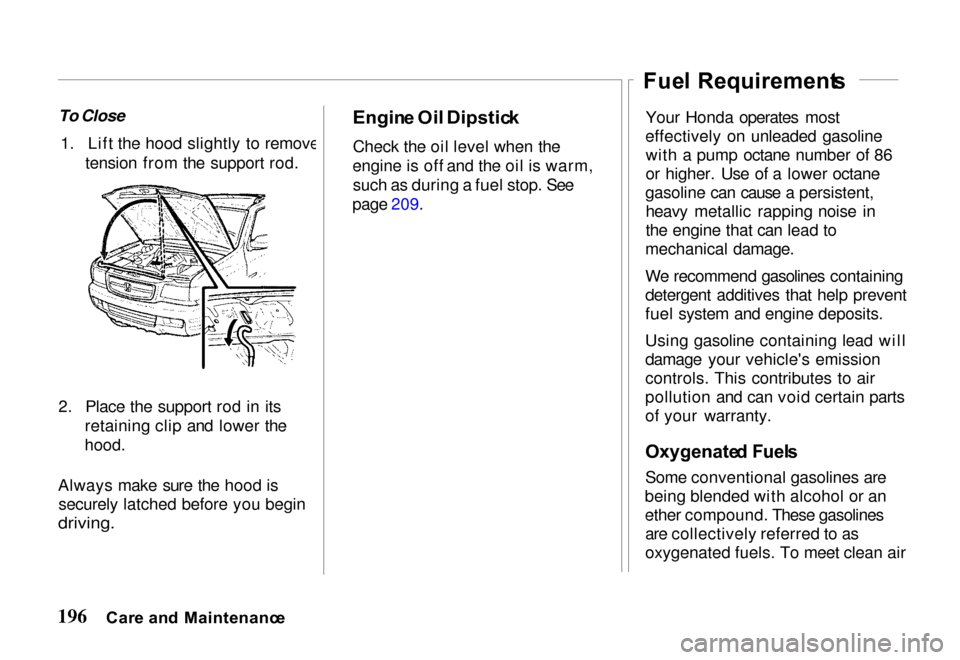
To Close
1. Lift the hood slightly to remove tension from the support rod.
2. Place the support rod in its retaining clip and lower the
hood.
Always make sure the hood is securely latched before you begin
driving.
Engin
e Oi l Dipstic k
Check the oil level when the
engine is off and the oil is warm, such as during a fuel stop. See
page 209. Your Honda operates most
effectively on unleaded gasoline with a pump octane number of 86
or higher. Use of a lower octane
gasoline can cause a persistent, heavy metallic rapping noise in
the engine that can lead to
mechanical damage.
We recommend gasolines containing
detergent additives that help prevent
fuel system and engine deposits.
Using gasoline containing lead will
damage your vehicle's emission
controls. This contributes to air
pollution and can void certain parts
of your warranty.
Oxygenate d Fuel s
Some conventional gasolines are
being blended with alcohol or an
ether compound. These gasolines are collectively referred to as
oxygenated fuels. To meet clean air
Car e an d Maintenanc e
Fue
l Requirement s