lights HONDA PASSPORT 2000 2.G Owner's Manual
[x] Cancel search | Manufacturer: HONDA, Model Year: 2000, Model line: PASSPORT, Model: HONDA PASSPORT 2000 2.GPages: 267, PDF Size: 3.03 MB
Page 154 of 267
Drivin
g Tip s
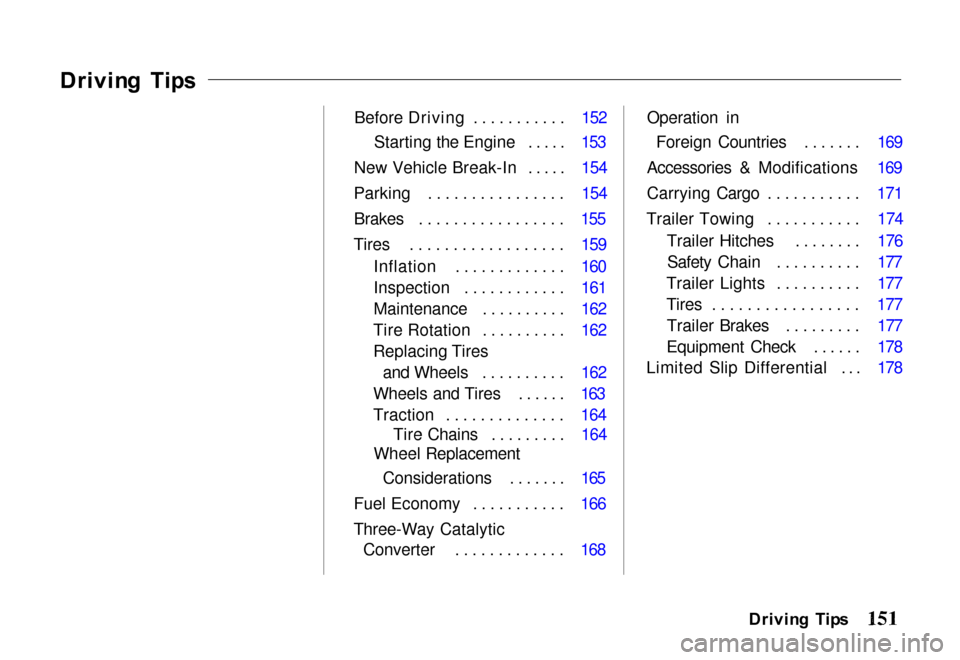
Before Driving ........... 152Starting the Engine ..... 153
New Vehicle Break-In ..... 154
Parking ................ 154 Brakes ................. 155
Tires .................. 159 Inflation ............. 160
Inspection ............ 161
Maintenance .......... 162
Tire Rotation .......... 162
Replacing Tires and Wheels .......... 162
Wheels and Tires ...... 163
Traction .............. 164 Tire Chains ......... 164
Wheel Replacement
Considerations ....... 165
Fuel Economy ........... 166
Three-Way Catalytic Converter ............. 168 Operation in
Foreign Countries ....... 169
Accessories & Modifications 169
Carrying Cargo ........... 171
Trailer Towing ........... 174 Trailer Hitches ........ 176Safety Chain .......... 177
Trailer Lights .......... 177
Tires ................. 177 Trailer Brakes ......... 177
Equipment Check ...... 178
Limited Slip Differential ... 178
Driving Tip s
Page 155 of 267
Befor
e Drivin g
Drivin g Guideline s
Your Honda has higher ground
clearance than a passenger car
designed for use only on
pavement. Higher ground clearance has many advantages
for off-road driving. It allows you
to travel over bumps, obstacles,
and rough terrain. It also provides
good visibility so you can
anticipate problems earlier.
These advantages come at some
cost. Because your vehicle is
taller and rides higher off the
ground, it has a high center of
gravity. This means that your
vehicle can tip or roll over if you make abrupt turns. Utility
vehicles have a significantly
higher rollover rate than other types of vehicles. To prevent rollover or loss of
control:
Take corners at slower speeds
than you would with a
passenger car. Avoid sharp turns and abrupt
maneuvers whenever possible.
Do not modify your vehicle in
any way that would raise the
center of gravity (see page 170). Do not carry heavy cargo on
the roof (see page 173).
For off-road driving guidelines, see the Off-Road Driving
Information booklet that came with your vehicle.
Befor e Enterin g th e Vehicl e
1. Check that the windows,
mirrors, lights and reflectors
are clean and unobstructed.
2. Check the tires to see if they
are low or flat. You will need
a pressure gauge to tell if tires
are properly inflated.
3. Check that all lights work.
4. Check for fluid leaks.
5. Be sure everything is properly
stowed.
6. Check the area behind the vehicle if you are about to
back up.
Befor e Drivin g th e Vehicl e
1. Lock all doors.
2. Adjust the seat and any movable head restraints.
3. Adjust the inside and outside mirrors.
4. Check that all the indicator lights work when the key
Drivin g Tip s
Page 157 of 267
Ne
w Vehicl e Break-I n
You may drive your new vehicle
from its very first mile/kilometer without following a formal
"break-in" schedule. However,
there are things you can do during
the first few hundred miles/
kilometers of driving that will add
to the future performance and
economy of your vehicle.
It is recommended that your speed
during the first 500 miles (800
kilometers) be limited to a
maximum of 55 mph (90 km/h) and that you do not drive for long
periods at any one constant speed, either fast or slow. During this
period, avoid full-throttle starts and, if possible, avoid hard stops;
especially during the first 200
miles (320 kilometers) of driving.
Always drive at moderate speed
until the engine has completely warmed up.
Parkin
g
When leaving your vehicle
unattended:
Set the parking brake.
Place the shift lever in "P" (Park) position for automatic
transmission.
When parking a vehicle equipped
with a manual transmission on an
upward slope, or on a level surface, place the shift lever in
the "1st" position.
When parking a vehicle
equipped with a manual
transmission on a downward slope, place the shift lever in
the "R" (Reverse) position. Turn the key to the "LOCK"
position.
Remove the key. The beeper
will remind you. Close all windows and lock all
doors.
Check to make certain the
lights are turned off. The
beeper will remind you. If your vehicle is equipped with
a transfer case (4WD), make
sure the shift lever is in 4H or
4L.
Parkin g Tip s
Never drive the vehicle with
the parking brake set. This can
overheat the rear brakes,
reducing their effectiveness and
causing excessive wear or
damage.
Always apply the parking brake
whenever you leave the vehicle,
whether it is equipped with a
manual or automatic transmission.
Drivin g Tip s
Page 161 of 267
Self-Adjustin
g Brake s
The brakes on this vehicle are self-adjusting. They have been
designed so that periodic brake
adjustment is not needed.
The brakes adjust themselves each time you firmly apply them.
Thus, if the brake pedal goes down
farther than normal due to a lack of adjustment, drive backward and
forward a few times. Apply the
brakes intermittently.
See your Honda dealer if the
brake pedal height does not return
to normal or if there is a rapidincrease in pedal travel. Either is a
sign of other brake trouble. Also,
see your Honda dealer if the
parking brake needs adjustment.
Brakin
g Tip s
Control your vehicle's speed on a steep or long downhill grade by
shifting the transmission to a
lower gear. Constantly using the
brakes can cause them to overheat
and lose effectiveness.
Resting your foot on the brake
pedal when you are not intending to brake ("riding the brakes") can
cause them to overheat. This
reduces their effectiveness, wears them out faster, and can reduce
fuel mileage. It also causes your
brake lights to stay on all the time, confusing drivers behind you.
Brak e Wea r Indicator s
The front and rear brakes have built-in wear indicators. These make a high-pitched squealing or
cricket-like warning sound when the brake pads or linings are worn
to the point of replacement. Thesound may come and go or be
heard all the time when the vehicle is moving, but may stop when the
brake pedal is pushed down firmly.
Expensive damage can result if
pads or linings are not replaced immediately when needed.
Drivin g o n Slipper y Surface s
Driving, steering, and braking
traction are reduced when the
road is coated with water, snow, ice, gravel, or other materials.
Slow down and adjust your
driving to such conditions. It is important to slow down when it is
slippery because stopping
Drivin g Tip s
Page 169 of 267
Drivin
g fo r Bes t Fue l
Econom y
How, where, and when you drive all affect how many miles/
kilometers you can get from a
gallon/liter of fuel. The careful attention you give your vehicle as
far as maintenance and repairs will also help fuel economy.
Fuel Selection Use only unleaded gasolinemeeting federal government
regulations. The federal
government specifies the
minimum octane rating number of
unleaded gasoline. Unleaded
gasoline must be used for proper
emissions control system
operation. It will also minimize spark plug fouling. The use of
leaded gasoline can damage the
emissions control system and could result in loss of warranty
coverage.
"Jackrabbit" Starts
You can save fuel (and prolong
engine and tire life) by avoiding fast starts away from lights andstop signs.
Stop-and-Go Driving Frequent stop-and-go driving
during a trip will cut down on
your miles per gallon (kilometers
per liter). Plan even your short shopping trips to take advantage
of through streets to avoid traffic
lights. Pace your driving to avoid
unplanned stops.
Excessive Idling
An idling engine uses fuel, too. If
you're faced with more than a few
minutes wait and you're not in traffic, it is better to turn off the
key and start the engine again
later.
Repetitive Harsh Stopping Harsh stops can also waste fuel;instead of moving the vehicle, the
energy is wasted as heat in
braking. Energy in the form of
fuel is also needed to accelerate
back to driving speed.
Lubricants A well-lubricated vehicle meansless friction between moving
parts. This manual lists the proper
lubrication intervals in the "Care
and Maintenance" section.
Air Cleaner Your vehicle gets its power from a
mixture of fuel and air. The air is
taken into the engine through the
Drivin g Tip s
Fue
l Econom y
Page 173 of 267
systems, such as the SRS and
anti-lock brake system.
However, if electronic accessories
are improperly installed, or
exceed your vehicle's electrical
system capacity, they can interfere with the operation of your vehicle,
or even cause the airbags to
deploy.
Before installing any accessory: Make sure the accessory does
not obscure any lights, or interfere with proper vehicle
operation or performance. Be sure electronic accessories
do not overload electrical
circuits (see page 236). Have the installer contact your
Honda dealer for assistance
before installing any electronic
accessory.
If possible, have your dealer
inspect the final installation.
Modification s
Do not remove any original
equipment or modify your vehicle in any way that would alter its
design or operation. This could
make your vehicle unsafe and illegal to drive.
For example, do not make any modifications that would change
the ride height of your vehicle, or
install wheels and tires with a
different overall diameter.
Such modifications can adversely
affect handling, and interfere with
the operation of the vehicle's
anti-lock brakes and other
systems.
In addition, any modifications that
decrease ground clearance increase the chance of
undercarriage parts striking a
curb, speed bump, or other raised object, which could cause your
airbags to deploy.
Do not modify your steering wheel or any other part of your
Supplemental Restraint System.Modifications could make the
system ineffective.
Additiona l Safet y Precautio n
Do not attach or place objects on
the airbag covers. Any object
attached to, or placed on, the
covers marked "SRS," in the
center of the steering wheel and on top of the dashboard, could
interfere with the proper operation
of the airbags. Or, if the airbags
inflate, the objects could be
propelled inside the vehicle and hurt someone.
Drivin g Tip s
Page 180 of 267

Safet
y Chai n
Always use a suitable safety chain
between your vehicle and the
trailer.
Check with your trailer
manufacturer for the required
equipment. Cross the safety
chains under the hitch and attach
them to the trailer hitch hardware.
This will prevent the trailer from
dropping to the ground in the
event the hitch disengages. For
proper use and installation,
consult your trailer manufacturer.
Traile r Light s
Trailer lights and equipment must
comply with federal, state and local regulations. Check with your
local recreational vehicle dealer
for the requirements in your area. Use only equipment designed for
your vehicle.
Improper equipment or installation can cause damage to
your vehicle's electrical system and affect your vehicle warranty.
Consult your Honda dealer for installation.
Tire s
Always check the condition of
your vehicle's tires and trailer's
tires before operation. Replace
worn or damaged tires before
operation.
Inflate tire pressure to the
recommended cold tire pressure indicated in the tire
manufacturer's warranty booklet in the glove box packet.
Check the tire manufacturer's
requirements when replacement
tires are installed on your vehicle.
Trailer tire condition, size, load
rating, and proper inflation
pressure should be in accordance
with the tire manufacturer's
specifications. Improper tire size
and inflation can cause tire
failure, possibly resulting in
vehicle damage and personal
injury.
Traile r Brake s
Trailers with a total weight of
1,000 pounds or more require trailer brakes. If your trailer is
equipped with a braking system,
make sure it conforms to federal,state, and local equipment
regulations.
Driving Tip s
Page 183 of 267
Jum
p Startin g
Do not push or tow your vehicle to start it. Under some conditions
this may damage the three-way catalytic converter or other parts
of the vehicle.
If your vehicle has a discharged
battery, it can be started by using the battery in another vehicle; a
procedure called "jump starting." To jump start your vehicle:
1. Position the vehicle with the good (charged) battery so that
the jump-starting cables will
reach. Do not allow the vehiclesto touch. Check to see that the
bumpers do not touch.
2. Turn off all electric motors and accessories in both
vehicles. Turn off all lights
except hazard flashers and
lights needed to light up the
work area. Turn off theignition, apply the parking
brake firmly, and shift an automatic transmission to
"P" (Park) and a manual
transmission to "N" (Neutral)
in both vehicles.
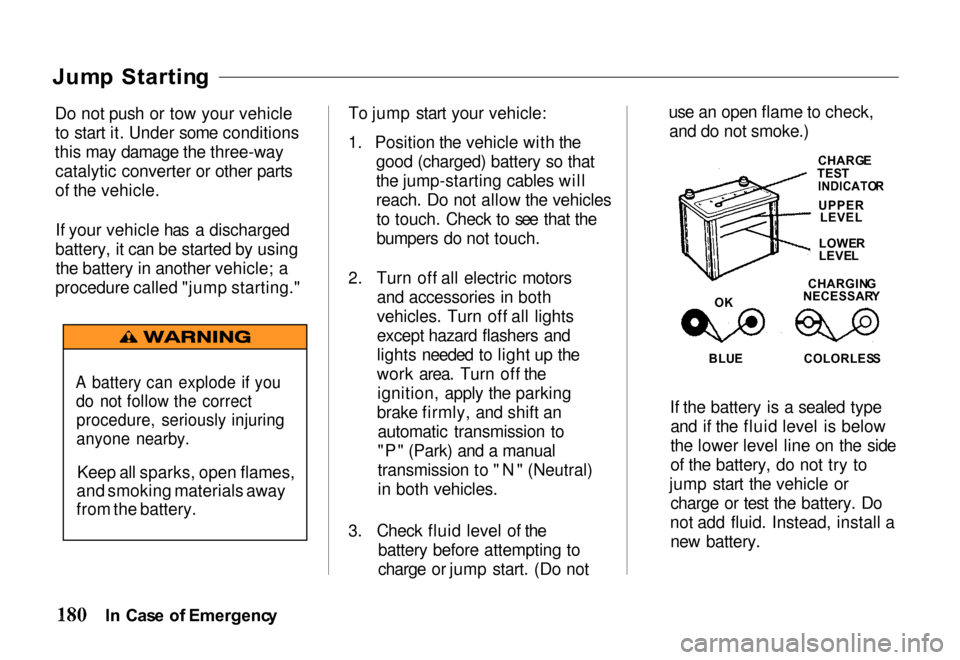
3. Check fluid level of the battery before attempting to
charge or jump start. (Do not use an open flame to check,
and do not smoke.)CHARG ETEST
INDICATO R
BLUE
COLORLES S
If the battery is a sealed type
and if the fluid level is below
the lower level line on the side
of the battery, do not try to
jump start the vehicle or charge or test the battery. Do
not add fluid. Instead, install a new battery.
I n Cas e o f Emergenc y
A battery can explode if you
do not follow the correct
procedure, seriously injuring
anyone nearby.
Keep all sparks, open flames,
and smoking materials away
from the battery.
CHARGIN G
NECESSAR Y
LOWE
R
LEVE L
O K
UPPERLEVEL
Page 189 of 267
Reverse this procedure to store
the spare tire. Connect the spare
tire to the bracket with the outside
of the wheel facing up. Make sure
the tire does not catch on any part
of the underbody of the vehicle as
you are raising it, and that the spare tire is stored securely before
driving.
If the engine overheats:
The engine coolant temperaturegauge pointer will move up to
the "H" or higher. Engine "ping" will become
excessive.
Loss of engine power will be
noticed.
Either steam or boiling water
will squirt out of the radiator.
If you find that the engine is
overheating:
Stop the vehicle, and turn on
the hazard warning lights.
If you see or hear steam or
coolant coming from the
engine compartment, turn off the engine immediately. If you do not see or hear steam
or spray, turn off the A/C (if
on) and run the engine at a
speed slightly higher than idle
speed (about 1,500 rpm) for
several minutes. Watch the
coolant temperature gauge. If it
remains at the ''H" mark, turn
off the engine.
Open the hood only after all
signs of steam or hot coolant
spray have stopped. Look for
signs of an obvious leak, such
as a split radiator hose. If you
I n Cas e o f Emergenc y
Steam and spray from an
overheated engine can
seriously scald you.
Do not open the hood if steam
is coming out.
Engin
e Overheatin g
Page 209 of 267
Seat-bac
k latche s — Seat-back
latches are designed to prevent
forward motion of the seat-back when the vehicle stops suddenly.
Check to see that the seat-backlatches are holding by pulling
forward on the top of the folding
seat-back.
Also check to see that the
reclining seats are operating properly.
Light s an d beepers — Check
panel lighting, warning lights, and
the seat belt reminder light and
beeper. Also check the key beeper and interior lights. On the outside,
check the license plate light, sidemarker lights, headlights, parking
lights, taillights, brake lights, turnsignals, backup lights and hazard
warning flashers. Have the
headlight aim checked promptly if the beams seem to be aimed
improperly.
Glas
s — Check for broken,
scratched or damaged glass that
could reduce visibility or cause injury.
Doo r latches — Check that the
doors close, latch and lock
securely.
Hoo d latc h — Check that the
hood closes firmly. Check for
broken, damaged, or missing parts that might prevent secure
latching. Make sure the secondarylatch keeps the hood from
opening all the way when first
released.
Flui
d leaks — Check for fuel,
water, oil or other fluid leaks by
looking at the surface beneath the
vehicle after it has been parked
for awhile. Water dripping from
the air conditioning system after use is normal. If you notice
gasoline fumes or fluid at any
time, locate the source and have it
corrected at once.
Spar e tir e an d jac k — Check that
the spare tire and all jack gear are securely stowed at all times.
Tailgat e latc h — Check that the
tailgate closes, latches and locks
securely.
Car e an d Maintenanc e