lock HONDA PASSPORT 2000 2.G Workshop Manual
[x] Cancel search | Manufacturer: HONDA, Model Year: 2000, Model line: PASSPORT, Model: HONDA PASSPORT 2000 2.GPages: 267, PDF Size: 3.03 MB
Page 186 of 267
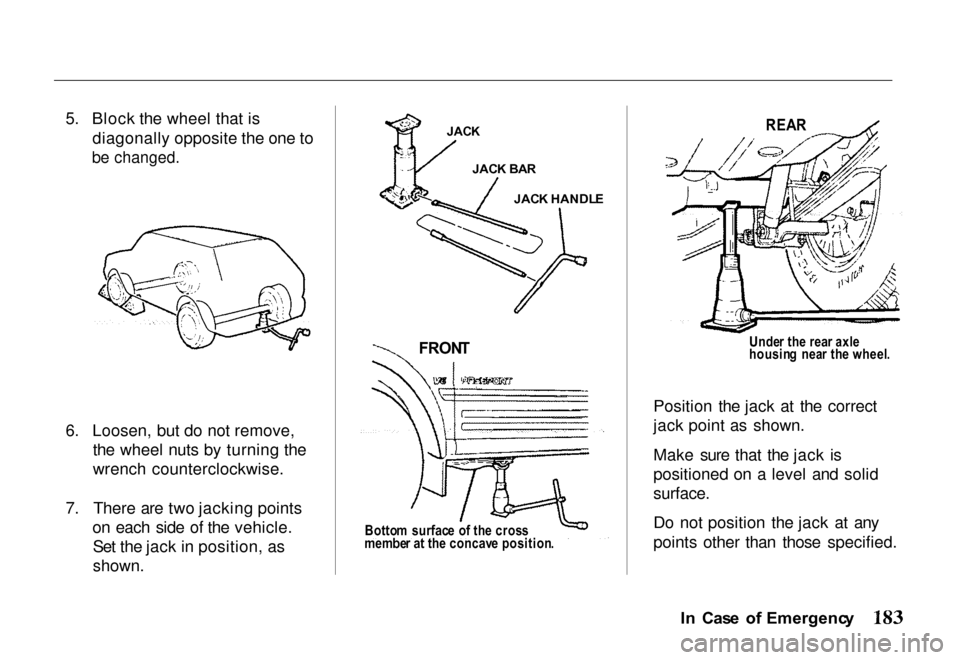
5. Block the wheel that is
diagonally opposite the one to
be changed.
6. Loosen, but do not remove, the wheel nuts by turning the
wrench counterclockwise.
7. There are two jacking points on each side of the vehicle.Set the jack in position, as
shown.
REA
R
Unde r th e rea r axl e
housin g nea r th e wheel .
Position the jack at the correct
jack point as shown.
Make sure that the jack is
positioned on a level and solid
surface.
Do not position the jack at any
points other than those specified.
In Cas e o f Emergenc y
JAC K
JAC K BA R
JAC K
HANDL
E
FRON T
Bottom surfac e o f th e cros s
membe r a t th e concav e position .
Page 187 of 267
8. Turn the jack handle
clockwise with a slow, smooth
motion to raise the vehicle sothe inflated spare tire will
clear the surface.
9. Remove the wheel nuts and the wheel.
10. Install the wheel and replace the whee
l nuts with the
cone-shaped end toward the
wheel, then hand-tighten each
nut. The wheel must be seated on the hub.
11.
Lower the vehicle by turning
the jac
k handle counter-
clockwise, then fully tighten the wheel nuts in a crisscrosssequence by turning the
wrench clockwise. Have the
wheel nut torque checked at
the nearest automotive service
facility.
87 lb-ft ( 118 N.m)
12.
Stow the jacking tools and flat
tire i
n their proper locations.
Too
l Location s
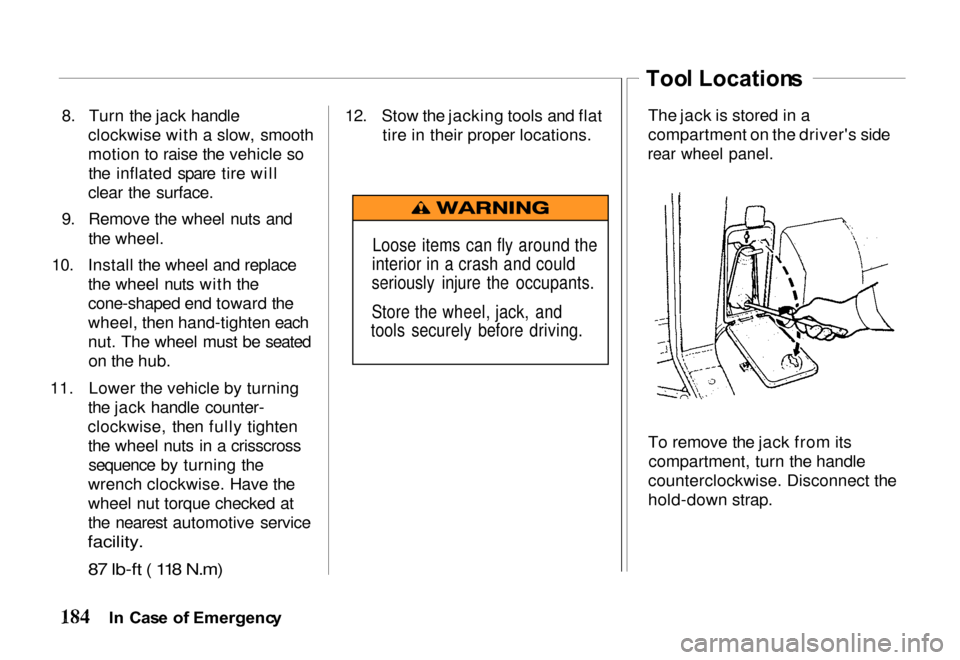
The jack is stored in a
compartment on the driver's side
rear wheel panel.
To remove the jack from itscompartment, turn the handle
counterclockwise. Disconnect the
hold-down strap.
I n Cas e o f Emergenc y
Loose items can fly around the
interior in a crash and could
seriously injure the occupants.
Store the wheel, jack, and
tools securely before driving.
Page 188 of 267
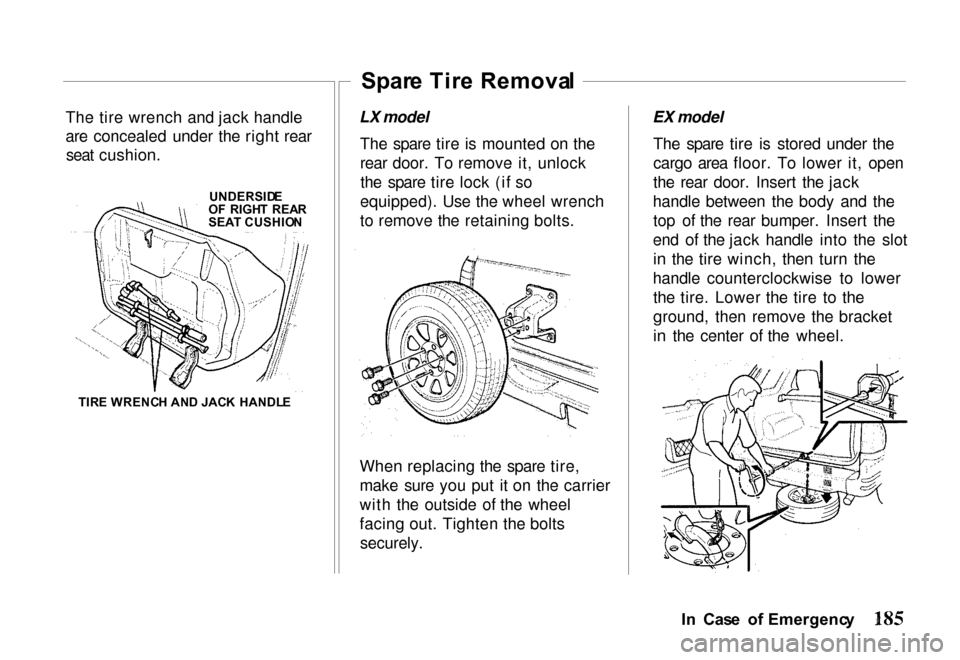
The tire wrench and jack handle
are concealed under the right rear
seat cushion.
UNDERSIDE
O F RIGH T REA R
SEA T CUSHIO N
TIR E WRENC H AN D JAC K HANDL E Spar
e Tir e Remova l
LX model The spare tire is mounted on the
rear door. To remove it, unlockthe spare tire lock (if so
equipped). Use the wheel wrench
to remove the retaining bolts.
When replacing the spare tire,
make sure you put it on the carrier
with the outside of the wheel
facing out. Tighten the bolts securely. EX model
The spare tire is stored under the
cargo area floor. To lower it, open
the rear door. Insert the jack
handle between the body and the top of the rear bumper. Insert the
end of the jack handle into the slot in the tire winch, then turn the
handle counterclockwise to lower the tire. Lower the tire to the
ground, then remove the bracket
in the center of the wheel.
In Cas e o f Emergenc y
Page 191 of 267
Use only towing equipment
specifically designed for this
purpose, following the instructions of the equipment
manufacturer. A separate safety
chain system must be used.
For such towing, the parking
brake must be released, thetransmission must be in neutraland the key switch turned to
the "OFF" position (not
"LOCK").
Towing attachments must be made to main structural
members of the vehicle. Do not attach to bumpers or associated
brackets.
Remember that the power brake assist will not beavailable when the engine is
inoperative.
Towin
g Tip s
All Four Wheels on the Ground
1. Transfer case in 2H (4WD model only).
2. Transmission in Neutral
position.
3. Maximum speed 30 mph (50 km/h).
4. Maximum distance 50 miles (80 kilometers).
If you are towing the vehicle at distances and speeds greater thanshown, disconnect the propeller
shaft from the rear axle carrier.
On 4WD models, also disconnect
the front propeller shaft. Safely
secure the propeller shafts so they
will not fall and scrape the
ground.
Front Wheels off the Ground
1. Transfer case in 2H (4WD model only).
2. Transmission in Neutral position.
3. Maximum speed 30 mph (50 km/h).
4. Maximum distance 50 miles (80 kilometers).
If you are towing the vehicle at
distances and speeds greater than shown, disconnect the propeller
shaft from the rear axle carrier.
Safely secure the propeller shaft so it will not fall and scrape the
ground.
I n Cas e o f Emergenc y
Page 192 of 267
Rear Wheels off the Ground
1. Transfer case in 2H (4WD model only).
2. Transmission in Neutral position.
3. Maximum speed 30 mph (50 km/h).
4. Maximum distance 50 miles (80 kilometers).
If you need to tow your vehicle by
this method, secure the steering
wheel to keep the front wheels
pointed straight ahead. Do not
rely on the steering column lock; it is not strong enough to hold the
front wheels straight while
towing. The ignition switch must
be in the OFF position.
Inoperativ
e Electrica l Device s
If you have electrical problems without extreme damage to any
electrical parts, check for burned out fuses, broken wires, poor
connections or poor grounding. Correct as necessary.
The fuse boxes are located under
the left hand side of theinstrument panel and in the right
hand side of the engine compartment. (See "Fuses" on
page 236.)
Replacing a fuse with one that has
a higher rating greatly increases
the chances of damaging the
electrical system. If you do not
have a replacement fuse with the
proper rating for the circuit,
install one with a lower rating.
In Cas e o f Emergenc y
NOTIC
E
Page 196 of 267
Servic
e Statio n Informatio n
Fuel Fil l Ca p
To remove the fuel fill cap, turn it counterclockwise. To close the fill
cap, turn it clockwise until you
hear it click at least three times.
Put the fuel fill cap in the cap
holder while refueling.
If you need a replacement, use only a genuine Honda fuel fill cap. An
improper fuel fill cap can affect the
fuel system, the emissions system,
and allow fuel spillage.
Car e an d Maintenanc e
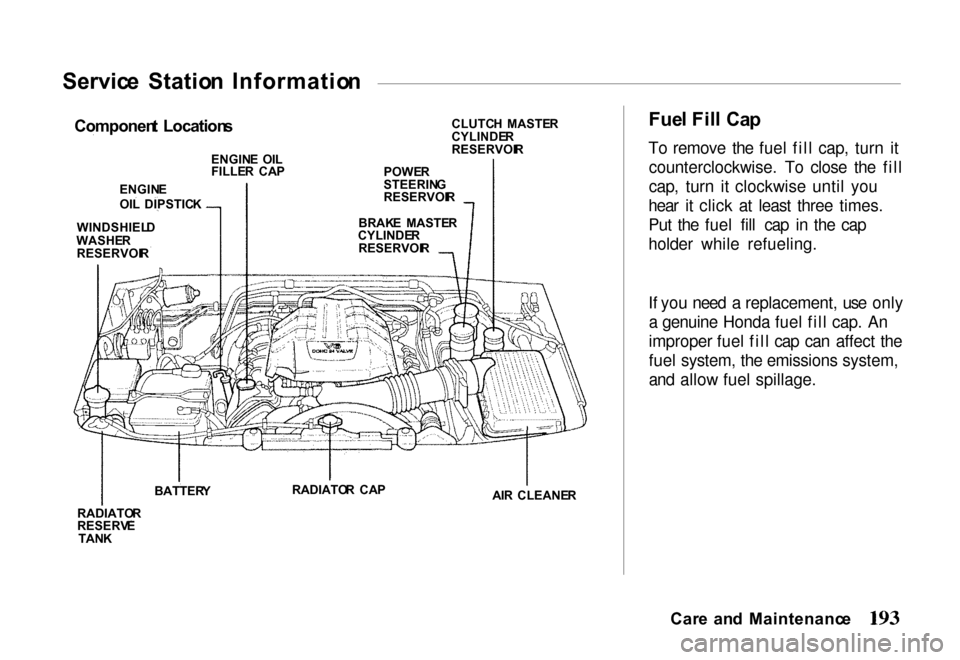
Componen t Location s
ENGIN E
OI
L
FILLE R CA P CLUTC
H MASTE R
CYLINDE R
RESERVOI R
POWE R
STEERIN G
RESERVOI R
ENGIN
E
OI L DIPSTIC K
BRAKE MASTE R
CYLINDE R
RESERVOI R
WINDSHIEL
D
WASHE R
RESERVOI R
BATTER Y
RADIATO R
RESERV E
TAN K
RADIATO
R CA P
AIR CLEANE R
Page 198 of 267
Hoo
d Releas e
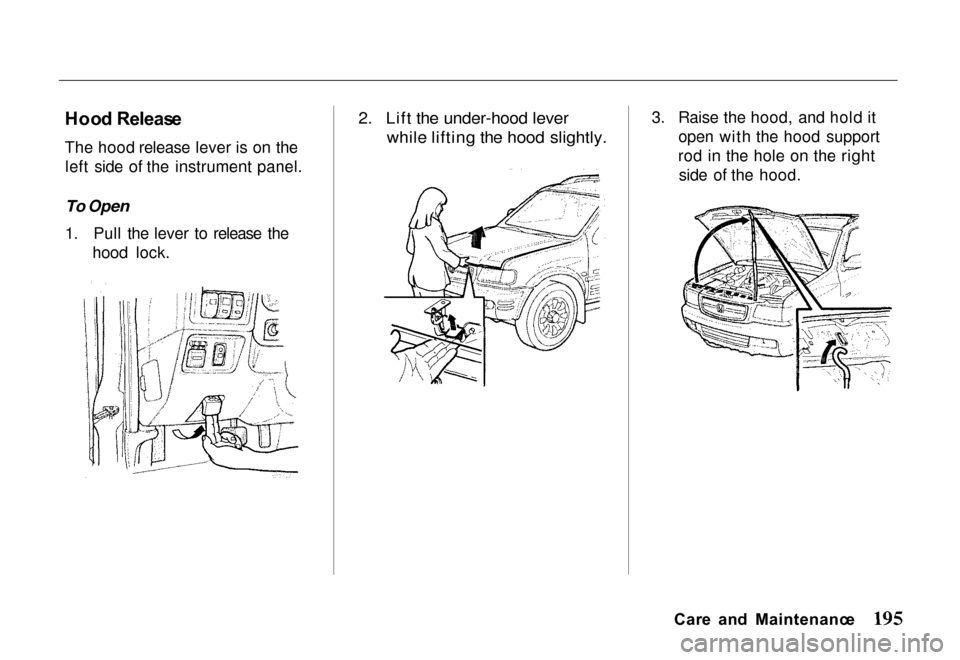
The hood release lever is on the left side of the instrument panel.
To Open
1. Pull the lever to release the hood lock.
2. Lift the under-hood lever
while lifting the hood slightly.
3. Raise the hood, and hold it
open with the hood support
rod in the hole on the right side of the hood.
Car e an d Maintenanc e
Page 209 of 267
Seat-bac
k latche s — Seat-back
latches are designed to prevent
forward motion of the seat-back when the vehicle stops suddenly.
Check to see that the seat-backlatches are holding by pulling
forward on the top of the folding
seat-back.
Also check to see that the
reclining seats are operating properly.
Light s an d beepers — Check
panel lighting, warning lights, and
the seat belt reminder light and
beeper. Also check the key beeper and interior lights. On the outside,
check the license plate light, sidemarker lights, headlights, parking
lights, taillights, brake lights, turnsignals, backup lights and hazard
warning flashers. Have the
headlight aim checked promptly if the beams seem to be aimed
improperly.
Glas
s — Check for broken,
scratched or damaged glass that
could reduce visibility or cause injury.
Doo r latches — Check that the
doors close, latch and lock
securely.
Hoo d latc h — Check that the
hood closes firmly. Check for
broken, damaged, or missing parts that might prevent secure
latching. Make sure the secondarylatch keeps the hood from
opening all the way when first
released.
Flui
d leaks — Check for fuel,
water, oil or other fluid leaks by
looking at the surface beneath the
vehicle after it has been parked
for awhile. Water dripping from
the air conditioning system after use is normal. If you notice
gasoline fumes or fluid at any
time, locate the source and have it
corrected at once.
Spar e tir e an d jac k — Check that
the spare tire and all jack gear are securely stowed at all times.
Tailgat e latc h — Check that the
tailgate closes, latches and locks
securely.
Car e an d Maintenanc e
Page 218 of 267
(—36°C) to ensure protection
against corrosion and loss of
engine coolant from boiling.
This should be done even if freezing temperatures are not
expected.
Add ethylene glycol-basedantifreeze when antifreeze has
to be added because of engine
coolant loss or if more
protection against freezing at
temperatures lower than —33 °F
(—36°C) is needed. Do not use
an alcohol-based or
methanol-based antifreeze, or
plain water. They boil at a
lower point, and do not provide corrosion protection.
Thermosta
t
The engine coolant temperature is
controlled by a thermostat, which stops engine coolant flow through
the radiator until a preset
temperature is reached. This
thermostat is installed in the
engine coolant inlet on the front of the engine block. The same
thermostat is used in both winter
and summer. Othe
r Require d
Maintenanc e
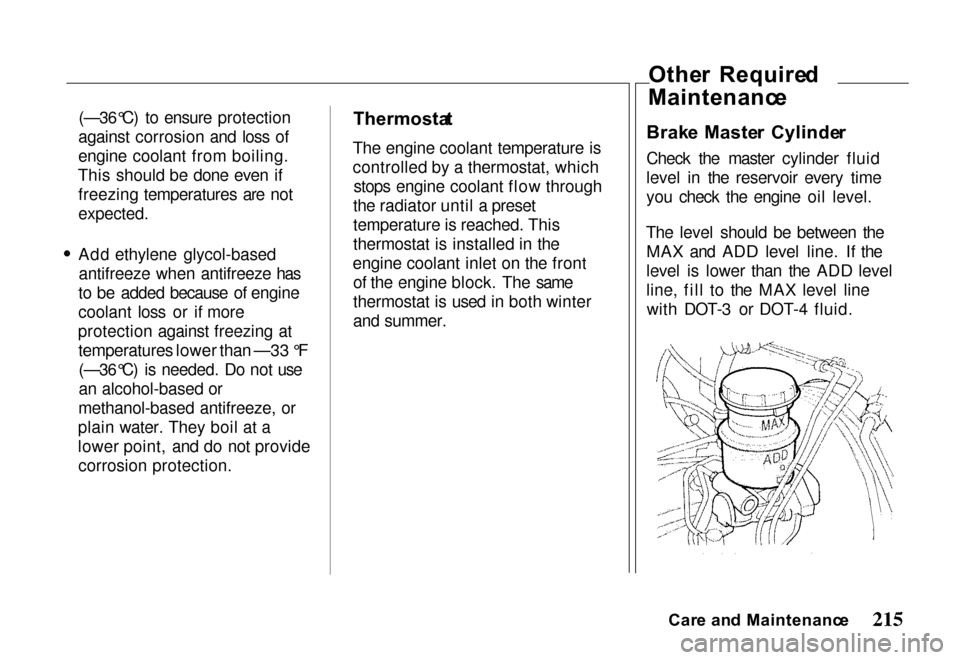
Brak e Maste r Cylinde r
Check the master cylinder fluid
level in the reservoir every time
you check the engine oil level.
The level should be between the MAX and ADD level line. If the
level is lower than the ADD level
line, fill to the MAX level linewith DOT-3 or DOT-4 fluid.
Car e an d Maintenanc e
Page 220 of 267
Hoo
d Latc h an d Hinge s
Lubricate the hood latch assembly
and hood hinge assembly as
follows:
1. Wipe off any accumulatio n of
dirt o
r contamination on the
latch parts.
2. Apply multipurpose-type grease (NLGI No. 1 or 2) to
the hood latch pin cam.
3. Apply light engine oil to all pivot points in the release
mechanism.
4. Lubricate hood hinges with multipurpose-type grease
(NLGI No. 1 or 2).
5. Check the hood hinges and
latch mechanism to assure
they are working correctly.
Ai
r Conditionin g
Periodically have your Honda dealer check your air conditioning
system to be sure there has been
no loss in cooling output. See
your Honda dealer if you suspect
that the system is not performing
as it should.
Bod y Lubricatio n
Normal use of a vehicle causes
metal-to-metal movement at certain
points in the body. Noise, wear and improper operation at these points
will result when a protective film of lubricant is not provided.
For exposed surfaces such as door
checks, door lock bolts, lock striker plates, etc., apply a thin
film of light engine oil.
Any lubricant should be used
sparingly. After application, all excess lubricant should be
carefully wiped off.
The seat adjusters and seat track should be lubricated with water-
resistant EP chassis lubricant.
There are other points on the
vehicle body which may occasionally require lubrication.
Window regulators and controls are confined in the space between
the upholstery and the outside
door panel. Easy access to the
working parts may be made by
removing the trim. Door weatherstrips and rubber hood
bumpers should be lightly coatedwith a rubber lubricant.
Car e an d Maintenanc e