lock HONDA PASSPORT 2000 2.G User Guide
[x] Cancel search | Manufacturer: HONDA, Model Year: 2000, Model line: PASSPORT, Model: HONDA PASSPORT 2000 2.GPages: 267, PDF Size: 3.03 MB
Page 32 of 267
doctor, or follow the seat maker's
recommendations.
To achieve the desired reclining
angle, it may help to put a rolled-
up towel under the toe of the child seat, as shown.
When properly installed, a rear- facing child seat may prevent a
driver or a front seat passenger
from moving the seat as far back as recommended (see page 10).
Or it may prevent them from
locking the seat-back in the
desired upright position (see page
11).
In either case, we recommend that
you place the child seat directly
behind the front passenger seat,
move the front seat as far forward as needed, and leave it
unoccupied. You may also wish to
get a smaller child seat that allows
you to safely carry a front
passenger.
Additional Precautions for
Infants Never hold an infant on your
lap. If you are not wearing a
seat belt in a crash, you could
be thrown forward into the
dashboard and crush the infant.
If you are wearing a seat belt,
the infant can be torn from
your arms. For example, if
your vehicle crashes into a
parked vehicle at 30 mph (48
km/h), a 20 Ib (9 kg) infant will
become a 600 Ib (275 kg)
force, and you will not be able
to hold on.
Never put a seat belt over
yourself and an infant. During a crash, the belt could press
deep into the infant and cause
very serious injuries. Protectin
g Smal l Childre n
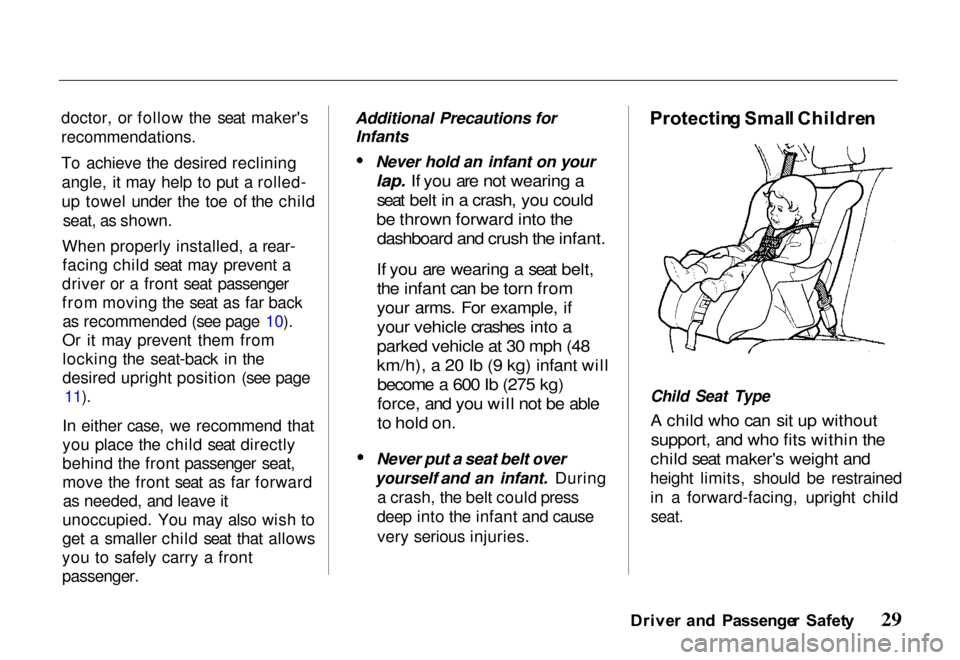
Child Seat Type
A child who can sit up without
support, and who fits within the
child seat maker's weight and
height limits, should be restrained in a forward-facing, upright child
seat.
Drive r an d Passenge r Safet y
Page 33 of 267
Of the different seats available,
we recommend those that have a
five-point harness system as
shown.
We also recommend that a small
child stay in the child seat as long as possible, until the child reaches
the weight or height limit for the
seat.
Child Seat Placement In this vehicle, the best place toinstall a forward-facing child seatis in one of the seating positions
in the back seat.
Placing a forward-facing child seat in the front seat of a vehicle
equipped with a passenger's
airbag can be hazardous. If the
vehicle seat is too far forward, or
the child's head is thrown forward
during a collision, an inflating
passenger's airbag can strike the
child with enough force to cause
very serious or fatal injuries. If a
small child must be closely
watched, we recommend that
another adult sit in the back seat
with the child. If it is necessary to put a forward-
facing child seat in the front,
move the vehicle seat as far to the
rear as possible, be sure the child seat is firmly secured to the
vehicle, and that the child is
properly strapped in the seat.
Installing a Child Seat With a
Lap/Shoulder Belt The lap/shoulder belts in the outer
back and front passenger seating
positions have a lockingmechanism that must be activated
to secure a child seat.
The following pages provide instructions on how to secure a
forward-facing child seat with this
type of seat belt.
Drive r an d Passenge r Safet y
Improperly placing a
forward-facing child seat in the
front seat can result in serious injury or death if the airbags
inflate.
If you must place a forward-
facing child seat in the front, move the vehicle seat as far
back as possible and properly
restrain the child.
Page 34 of 267
See page 32 for how to secure a
forward-facing child seat in the
center back seat with the lap belt.
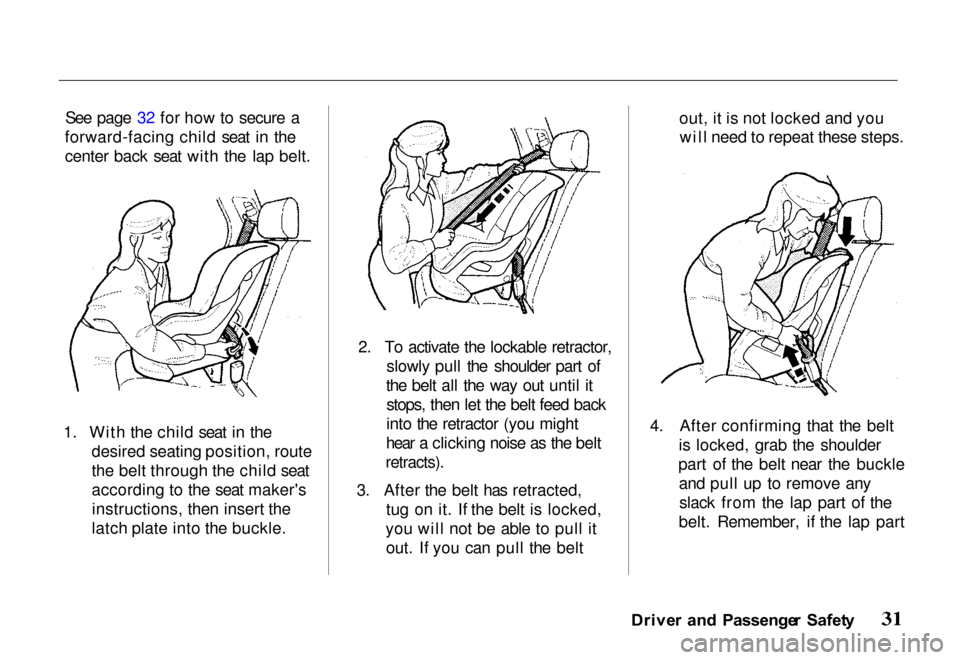
1. With the child seat in the desired seating position, route
the belt through the child seat
according to the seat maker'sinstructions, then insert the
latch plate into the buckle. 2. To activate the lockable retractor,
slowly pull the shoulder part of
the belt all the way out until it stops, then let the belt feed back
into the retractor (you might
hear a clicking noise as the belt
retracts).
3. After the belt has retracted, tug on it. If the belt is locked,
you will not be able to pull it out. If you can pull the belt out, it is not locked and you
will need to repeat these steps.
4. After confirming that the belt is locked, grab the shoulder
part of the belt near the buckle and pull up to remove anyslack from the lap part of the
belt. Remember, if the lap part
Drive r an d Passenge r Safet y
Page 35 of 267
of the belt is not tight, the
child seat will not be secure. It
may help to put weight on the
child seat, or push on the back of the seat, while pulling up
on the belt.
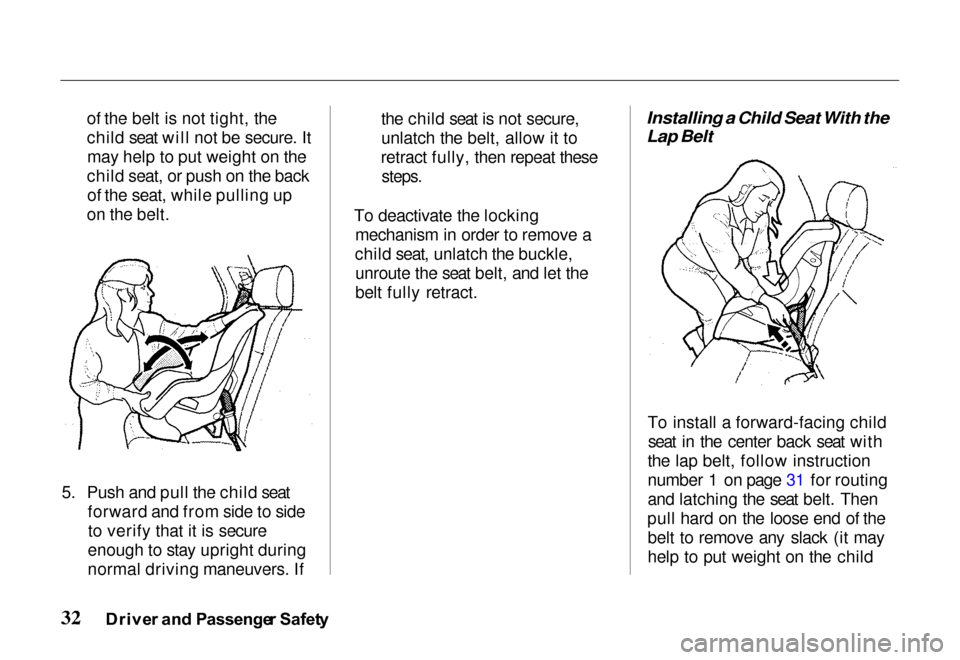
5. Push and pull the child seat forward and from side to sideto verify that it is secure
enough to stay upright during
normal driving maneuvers. If the child seat is not secure,
unlatch the belt, allow it to
retract fully, then repeat these
steps.
To deactivate the locking mechanism in order to remove a
child seat, unlatch the buckle, unroute the seat belt, and let the
belt fully retract.
Installing a Child Seat With the
Lap Belt
To install a forward-facing childseat in the center back seat with
the lap belt, follow instruction
number 1 on page 31 for routing
and latching the seat belt. Then
pull hard on the loose end of the belt to remove any slack (it may
help to put weight on the child
Drive r an d Passenge r Safet y
Page 41 of 267
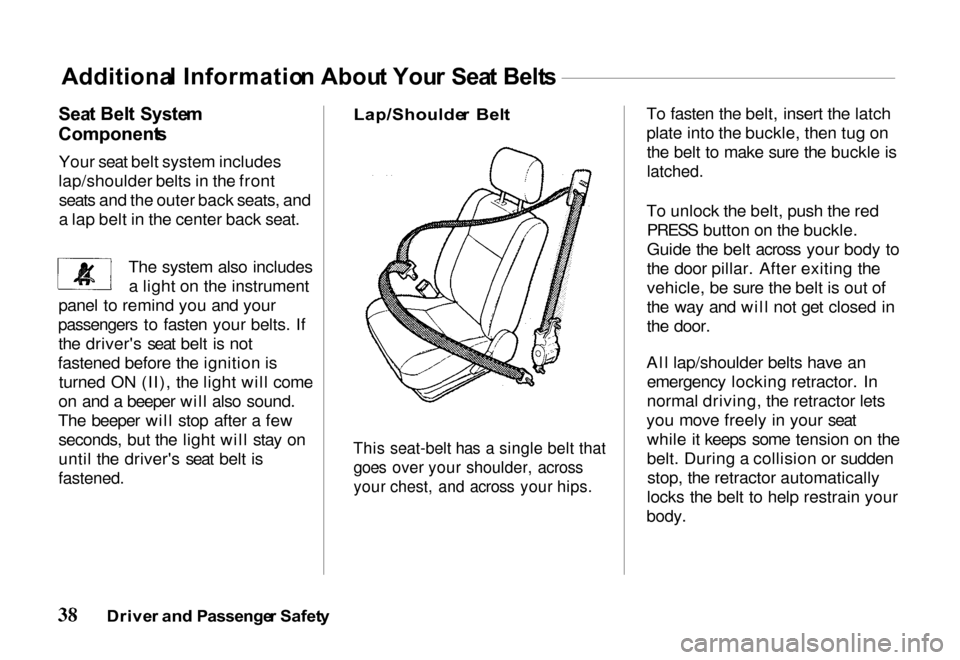
To fasten the belt, insert the latch
plate into the buckle, then tug on
the belt to make sure the buckle is
latched.
To unlock the belt, push the red PRESS button on the buckle.
Guide the belt across your body to
the door pillar. After exiting the
vehicle, be sure the belt is out of
the way and will not get closed in
the door.
All lap/shoulder belts have an emergency locking retractor. In
normal driving, the retractor lets
you move freely in your seat while it keeps some tension on the
belt. During a collision or suddenstop, the retractor automatically
locks the belt to help restrain your
body.
Drive r an d Passenge r Safet y
Additiona
l Informatio n Abou t You r Sea t Belt s
Sea t Bel t Syste m
Component s
Your seat belt system includes
lap/shoulder belts in the front seats and the outer back seats, and
a lap belt in the center back seat.
Lap/Shoulde
r Bel t
This seat-belt has a single belt that
goes over your shoulder, across
your chest, and across your hips.
The system also includes
a light on the instrument
panel to remind you and your
passengers to fasten your belts. If the driver's seat belt is not
fastened before the ignition is turned ON (II), the light will come
on and a beeper will also sound.
The beeper will stop after a few seconds, but the light will stay on
until the driver's seat belt is
fastened.
Page 42 of 267
All the lap/shoulder belts except
the driver's have an additional
locking mechanism that must beactivated to secure a child seat.(See pages 25 and 30 for
instructions on how to secure
child seats with this type of seat
belt.)
If the shoulder part of the belt is
pulled all the way out, the locking
mechanism will activate. The belt
will retract, but it will not allow a
passenger to move freely.
To deactivate the locking
mechanism, unlatch the buckle
and let the seat belt fully retract.
To refasten the belt, pull it out only as far as needed.
See page 13 for instructions on
how to wear the lap/shoulder belt
properly.
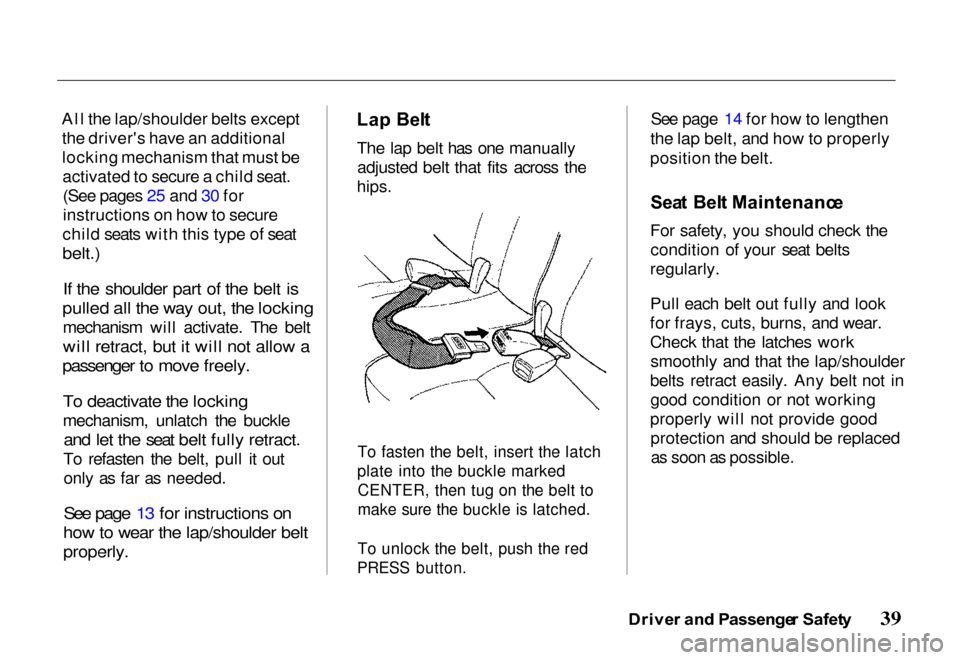
La
p Bel t
The lap belt has one manually adjusted belt that fits across the
hips.
To fasten the belt, insert the latch
plate into the buckle marked
CENTER, then tug on the belt to
make sure the buckle is latched.
To unlock the belt, push the red
PRESS button.
See page 14 for how to lengthen
the lap belt, and how to properly
position the belt.
Sea t Bel t Maintenanc e
For safety, you should check the condition of your seat belts
regularly.
Pull each belt out fully and look
for frays, cuts, burns, and wear.
Check that the latches work smoothly and that the lap/shoulder
belts retract easily. Any belt not in good condition or not working
properly will not provide good protection and should be replacedas soon as possible.
Drive r an d Passenge r Safet y
Page 58 of 267
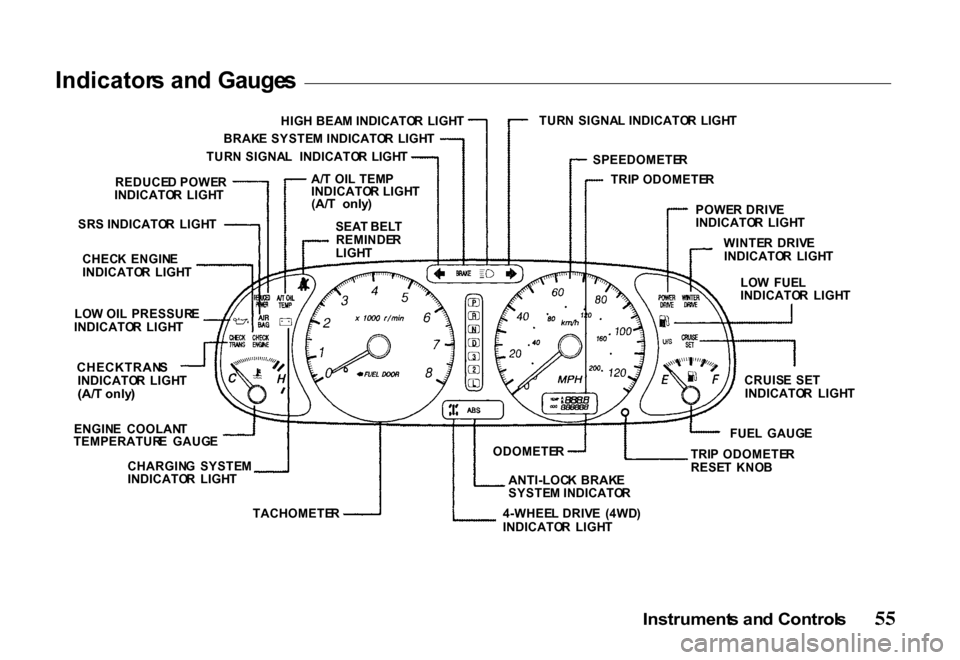
Indicator
s an d Gauge s
TUR N SIGNA L INDICATO R LIGH T
SR S INDICATO R LIGH T
CHEC K ENGIN E
INDICATO R LIGH T
LO W OI L PRESSUR E
INDICATO R LIGH T
ENGIN E COOLAN T
TEMPERATUR E GAUG E
CHARGIN G SYSTE M
INDICATO R LIGH T TUR
N SIGNA L INDICATO R LIGH T
SPEEDOMETE R
POWE R DRIV E
INDICATO R LIGH T
SEA T BEL T
REMINDE R
LIGH T
ANTI-LOCK BRAK E
SYSTE M INDICATO R CRUIS
E SE T
INDICATO R LIGH T
FUE L GAUG E
TRI P ODOMETE R
RESE T KNO B
TACHOMETE R 4-WHEEL DRIV E (4WD )
INDICATO R LIGH T
Instrument s an d Control s
HIG
H BEA M INDICATO R LIGH T
BRAK E SYSTE M INDICATO R LIGH T
TRIP ODOMETE R
WINTE R DRIV E
INDICATO R LIGH T
LO W FUE L
INDICATO R LIGH T
REDUCE
D POWE R
INDICATO R LIGH T
CHECKTRAN S
INDICATO R LIGH T
(A/ T only )
A/
T OI L TEM P
INDICATO R LIGH T
(A/ T only )
ODOMETER
Page 68 of 267
as indicated by the "U/S" (upshift)
light on the instrument panel.
If vehicle speed drops below
20 mph (30 km/h), or if the
engine is not running smoothly,
you should downshift to the next lower gear. You may need to
downshift two or more gears to
keep the engine running smoothly or for satisfactory performance.
This indicator comes on for a fewseconds when you turn the
ignition switch to the "ON"
position. 4-Whee
l Driv e
(4WD ) Indicato r
4WD models only
This indicator lights when the 4-Wheel Drive system is engaged.
With the 4WD-2WD switch in the "OFF" or 2WD position, this light
will come on to provide a "bulb
check" when the key is turned to the "ON" position, but should go
out after the engine is started.
If the 4WD-2WD switch is in the "ON" or 4WD position, this light
will come on when the key is
turned to the "ON" position and
remain on after the engine is
started.
Anti-Loc
k Indicato r
This light will come on and go out when the ignition switch is turned
to the "ON" position. (If the light
does not come on, see your Honda
dealer to have the system
repaired.)
If the light remains on after
engine start-up or comes on
during operation of the vehicle, stop as soon as possible and turn
the key off. Then start the engine
to reset the system. If the light stays on, or it comes on again
while you're driving, the anti-lock
brake system should be checked at your Honda dealer.
Until you get it fixed, you'll have
normal brakes, but you won't
have anti-lock.
Instrument s an d Control s
AB
S
Page 73 of 267
Do not use engine antifreeze or
a vinegar/water solution in the
windshield washer reservoir.
Antifreeze can damage your vehicle's paint, while a
vinegar/water solution can
damage the windshield washer
pump. Use only commercially available windshield washer fluid.
In cold weather, warm the
windshield with the defrosters
before using the washers. This
will help prevent icing of the
windshield that may block your
vision.
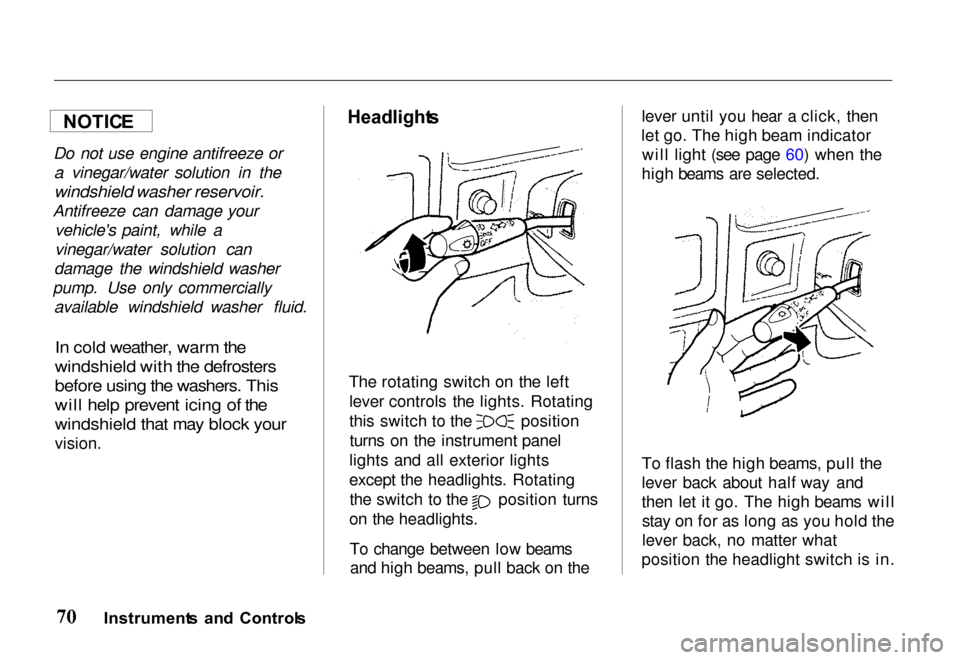
Headlight
s
The rotating switch on the left lever controls the lights. Rotating this switch to the position
turns on the instrument panel
lights and all exterior lights
except the headlights. Rotating the switch to the position turns
on the headlights.
To change between low beamsand high beams, pull back on the lever until you hear a click, then
let go. The high beam indicator will light (see page 60) when the
high beams are selected.
To flash the high beams, pull the
lever back about half way and
then let it go. The high beams will stay on for as long as you hold the
lever back, no matter what
position the headlight switch is in.
Instrument s an d Control s
NOTIC
E
Page 74 of 267
Headlights-On Reminder
You will hear a continuous tone
when the key is out of the ignitionswitch and the driver's door is
opened with the headlight switch in the "ON" position. This will
remind you to turn the headlights off. Never leave the headlights onwhen the engine is not running.
They can rapidly discharge the
battery.
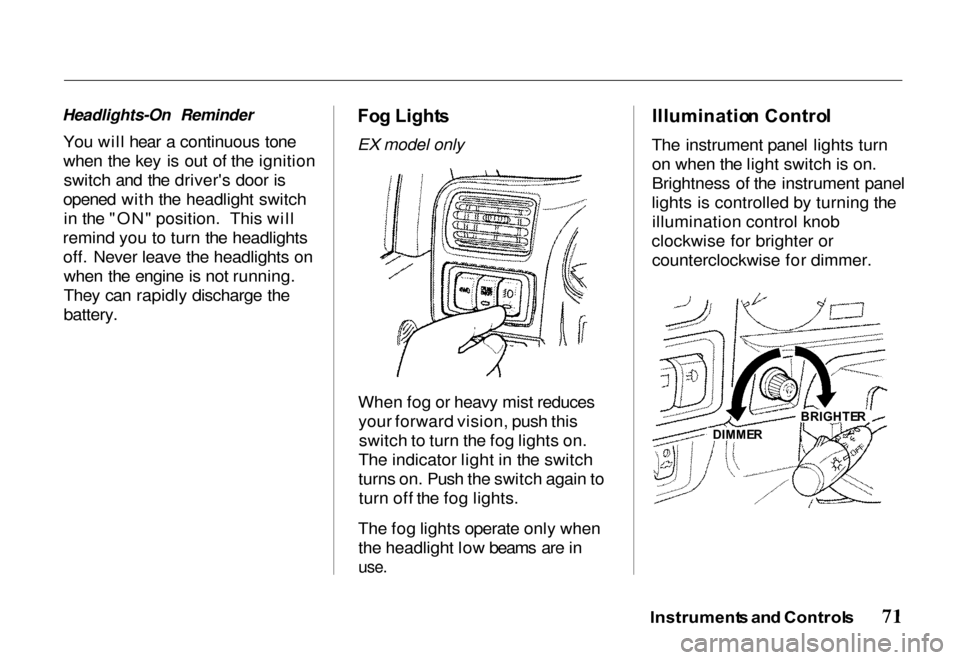
Fo
g Light s
EX model only
When fog or heavy mist reducesyour forward vision, push thisswitch to turn the fog lights on.
The indicator light in the switch
turns on. Push the switch again to turn off the fog lights.
The fog lights operate only when the headlight low beams are in
use.
Illuminatio
n Contro l
The instrument panel lights turn on when the light switch is on.
Brightness of the instrument panel
lights is controlled by turning the illumination control knob
clockwise for brighter or counterclockwise for dimmer.
Instrument s an d Control s
DIMMER BRIGHTE
R