tow HONDA PASSPORT 2002 2.G Owner's Manual
[x] Cancel search | Manufacturer: HONDA, Model Year: 2002, Model line: PASSPORT, Model: HONDA PASSPORT 2002 2.GPages: 294, PDF Size: 3.97 MB
Page 191 of 294
188In Case of Emergency
8. Turn the jack handle
clockwise with a slow, smooth
motion to raise the vehicle so
the inflated spare tire will
clear the surface.
9. Remove the wheel nuts and the wheel.
10. Install the wheel and replace the wheel nuts with the
cone-shaped end toward the
wheel, then hand-tighten each
nut. The wheel must be seated
on the hub.
11. Lower the vehicle by turning the jack handle counter-
clockwise, then fully tighten
the wheel nuts in a crisscross
sequence by turning the
wrench clockwise. Have the
wheel nut torque checked at
the nearest automotive service
facility.
87 lb-ft (118 N·m) 12. Stow the jacking tools and flat
tire in their proper locations.
EX model
Use the screwdriver to remove the
center cap from the wheel before
stowing the flat tire.
Loose items can fly around the
interior in a crash and could
seriously injure the occupants.
Store the wheel, jack, and
tools securely before driving.
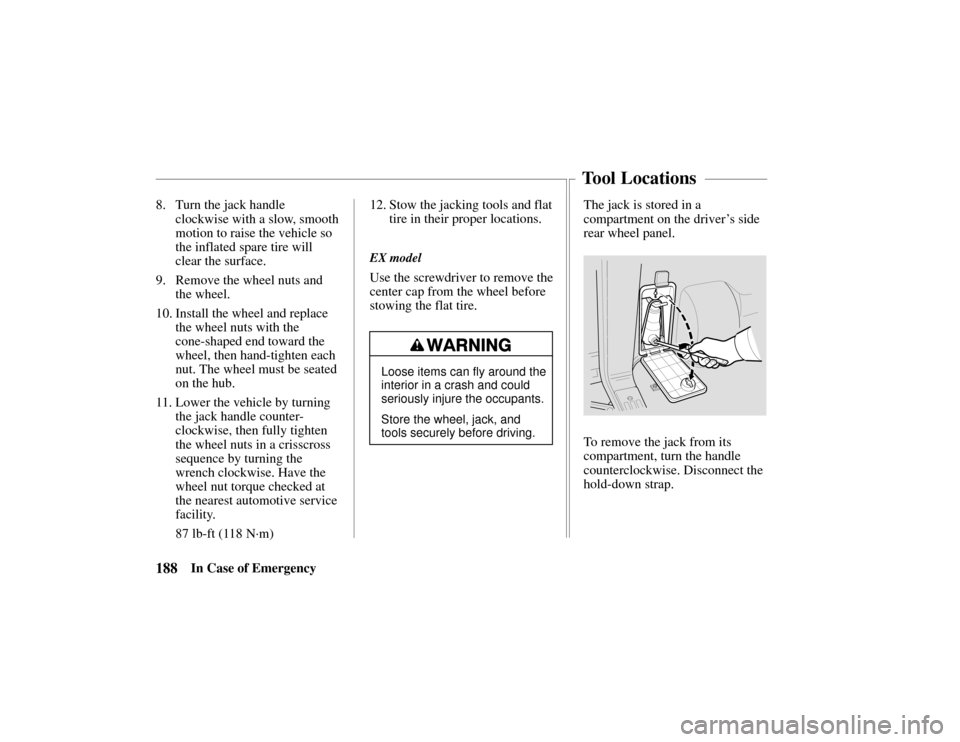
The jack is stored in a
compartment on the driver ’s side
rear wheel panel.
To remove the jack from its
compartment, turn the handle
counterclockwise. Disconnect the
hold-down strap.
Tool Locations
Page 194 of 294

191In Case of Emergency
find a leak, it must be repaired
before you can continue
driving. (See Towing on page
191.)
•If you don’
t find an obvious
leak, check the coolant level in
the radiator reserve tank. If the
level is below the
MIN mark, add
coolant to halfway between the
MIN and MAX marks.
•If there was no coolant in the
reserve tank, you may also
have to add coolant to the
radiator.
Let the engine cool down until
the pointer reaches the middle
of the temperature gauge, or
lower, before checking the
radiator.
Removing the radiator cap
while the engine is hot can
cause the coolant to spray
out, seriously scalding you.
Always let the engine and
radiator cool down before
removing the radiator cap.
•
If needed, add coolant to the
radiator to bring the level up to
the filler neck, and to the
reservoir up to the level
indicated on the reservoir tank. Proper equipment must be used to
prevent damage to vehicles during
any towing. State and local laws
that apply to vehicles in tow must
be followed. Get detailed towing
instructions from your Honda
dealer.
Should it become necessary to
tow your vehicle, follow these
directions.Precautions
•Before towing, make sure that
the power train, axle,
transmission, wheels and
steering system are in good
condition.
If any of these items are
damaged, a flatbed trailer must
be used.
Towing
Page 195 of 294

192In Case of Emergency
•Use only towing equipment
specifically designed for this
purpose, following the
instructions of the equipment
manufacturer. A separate safety
chain system must be used.
•For such towing, the parking
brake must be released, the
transmission must be in neutral
and the key switch turned to
the “
OFF” position (not
“
LOCK”).
•Towing attachments must be
made to main structural
members of the vehicle. Do not
attach to bumpers or associated
brackets.
•Remember that the power
brake assist will not be
available when the engine is
inoperative.
Towing Tips
All Four Wheels on the Ground
1. Transfer case in 2
H (4WD
model only).
2. Transmission in Neutral position.
3. Maximum speed 30 mph (50 km/h).
4. Maximum distance 50 miles (80 kilometers).
If you are towing the vehicle at
distances and speeds greater than
shown, disconnect the propeller
shaft from the rear axle carrier.
On 4
WD models, also disconnect
the front propeller shaft. Safely
secure the propeller shafts so they
will not fall and scrape the
ground. Front Wheels off the Ground
1. Transfer case in 2
H (4WD
model only).
2. Transmission in Neutral position.
3. Maximum speed 30 mph (50 km/h).
4. Maximum distance 50 miles (80 kilometers).
If you are towing the vehicle at
distances and speeds greater than
shown, disconnect the propeller
shaft from the rear axle carrier.
Safely secure the propeller shaft
so it will not fall and scrape the
ground.
Page 196 of 294
193In Case of Emergency
Rear Wheels off the Ground
1.
Transfer case in 2
H (4WD
model only).
2. Transmission in Neutral
position.
3. Maximum speed 30 mph
(50 km/h).
4. Maximum distance 50 miles
(80 kilometers).
If you need to tow your vehicle by
this method, secure the steering
wheel to keep the front wheels
pointed straight ahead. Do not
rely on the steering column lock;
it is not strong enough to hold the
front wheels straight while
towing. The ignition switch must
be in the
OFF position. If you have electrical problems
without extreme damage to any
electrical parts, check for burned
out fuses, broken wires, poor
connections or poor grounding.
Correct as necessary.
The fuse boxes are located under
the left hand side of the
instrument panel and in the right
hand side of the engine
compartment. (See
“Fuses” on
page 240.)
Replacing a fuse with one that has
a higher rating greatly increases
the chances of damaging the
electrical system. If you do not
have a replacement fuse with the
proper rating for the circuit,
install one with a lower rating.
Inoperative Electrical Devices
Page 208 of 294

•
•Repeated short trips in cold weather
• Driving in dusty areas •
Frequent idling and/or frequent low-speed operation
• Towing a trailer Change engine oil and filter
–Every 3,750 miles (6,000 km)
or 3 months
Change rear axle oil –Every 15,000 miles (24,000 km)
205Care and Maintenance
R – Replace L – Lube I – Inspect After inspection, clean, adjust, repair or replace if necessary.
Service at the interval listed x1 000 il ( k ) ft th tx 1,000 miles7.51522.53037.54552.56067.57582.59097.5105Service at the interval listed x1,000 miles (or km) or after thatnumber of months whicheverx 1,000 km1224364860728496108120132144156168number of months, whichever
comes first.months612182430364248546066727884
Steering and suspension, miscellaneousFront and rear axle oilRRRRPropeller shaft flange torqueIIIIIII
Front and rear propeller shaftsLLLLLLLLLL
Body and chassisLLLLLLLLLLLLLL
Front wheel bearingsRepack bearings when replacing front brake pads.Power steering fluidRRR
Tires (inspect and rotate)IIIIIIIIIIIIII
Suspension and steeringIIIIIIIIIIIIIIBrakes/ClutchBrake discs; calipers and padsIIIIIII
Brake drums, wheel cylinders and liningsIIIIIIIBrake lines and hosesIIIIIIIIIIIIIIParking brakeIIIIIIIBrake pedal playIIIIIIIClutch pedal playIIIIIIIClutch pedal spring, bushing and clevis pinLLLLLLL
Clutch lines and hosesIII
Check oil and coolant level at each fuel stop.
Under severe driving conditions, service these items more often. These c\
onditions are: Service for severe driving conditions
Page 213 of 294

210Care and Maintenance
Seat-back latches — Seat-back
latches are designed to prevent
forward motion of the seat-back
when the vehicle stops suddenly.
Check to see that the seat-back
latches are holding by pulling
forward on the top of the folding
seat-back.
Also check to see that the
reclining seats are operating
properly.
Lights and beepers — Check
panel lighting, warning lights, and
the seat belt reminder light and
beeper. Also check the key beeper
and interior lights. On the outside,
check the license plate light, side
marker lights, headlights, parking
lights, taillights, brake lights, turn
signals, backup lights and hazard
warning flashers. Have the
headlight aim checked promptly if the beams seem to be aimed
improperly.
Glass — Check for broken,
scratched or damaged glass that
could reduce visibility or cause
injury.
Door latches — Check that the
doors close, latch and lock
securely.
Hood latch — Check that the
hood closes firmly. Check for
broken, damaged, or missing parts
that might prevent secure
latching. Make sure the secondary
latch keeps the hood from
opening all the way when first
released.
Fluid leaks — Check for fuel,
water, oil or other fluid leaks by
looking at the surface beneath the
vehicle after it has been parked
for awhile. Water dripping from
the air conditioning system after
use is normal. If you notice
gasoline fumes or fluid at any
time, locate the source and have it
corrected at once.
Spare tire and jack — Check that
the spare tire and all jack gear are
securely stowed at all times.
Tailgate latch — Check that the
tailgate closes, latches and locks
securely.
Page 215 of 294

212Care and Maintenance
Change the oil and oil filter every
3,750 miles (6,000 kilometers) or
every three months if you drive
under one or more of these
“severe driving” conditions:
•Driving in dusty areas
•Towing a trailer
•Frequent idling or idling for
long periods
•Frequent short trips (4 miles [6
kilometers] or less) in cold or
freezing weather, where the
engine does not thoroughly
warm up.
•Change the oil and oil filter as
soon as possible after driving in
a dust storm.
Oil Change
Changing the oil and filter requires
special tools and access from
underneath the vehicle. The vehicle
should be raised on a service
station-type hydraulic lift for this
service. Unless you have the
knowledge and proper equipment,
you should have this maintenance
done by a skilled mechanic.
1. Warm up the engine. This
makes the oil drain faster and
more thoroughly.
2. Remove the oil filler cap.
3. Remove the drain plug and drain oil fully.
4. Install the drain plug, with a new gasket, and tighten it.
5. Fill the engine with the proper amount of new oil (see
“Specifications”). Oil Filter Installation
1. Remove the old oil filter with
the filter wrench.
2. Apply a light coat of engine oil to the oil filter gasket.
3. Hand-tighten the filter until the gasket contacts the sealing
face.
4. Using the filter wrench, tighten the filter one full turn.
5. Run the engine and inspect for leaks.
6. Shut off the engine. After a couple of minutes, check the
oil level. If necessary, add oil
to bring it to the
FULL mark.
An improperly installed oil filter
can result in severe engine
damage.
Page 230 of 294

227Care and Maintenance
Cleaning Fabric
Cleaning General Soilage or
Water Spots From Fabric Trim
Multipurpose powdered cleaner is
excellent for this type of cleaning
and for cleaning panel sections
where small cleaning rings may
be left from spot cleaning.
•Vacuum the area thoroughly to
remove loose dirt.
•ALWAYS clean a full trim
assembly or complete trim
section. Mask surrounding trim
along stitch or welt-lines.
•Mix the multipurpose
powdered cleaner in strict
accordance with the directions
on the label of its container.
Mix in proportion for smaller
quantities.
•USE SUDS ONLY ON A
CLEAN SPONGE OR SOFT
BRISTLE BRUSH. DO NOT
SATURATE FABRIC OR RUB
HARSHLY WITH THE
BRUSH
.
•
IMMEDIATELY AFTER
CLEANING, WIPE OFF
EXCESS CLEANER WITH A
SLIGHTLY DAMP ABSORBENT
TOWEL OR CLOTH
.
•
IMMEDIATELY AFTER
WIPING, FORCE-DRY THE
FABRIC WITH AN AIR HOSE,
HEAT DRYER, OR HEAT
LAMP
. Use caution if you are
using a heat dryer or heat lamp
so you do not damage the
fabric.
•When trim materials that have a
sheen or lustrous finish are dry,
wipe them with a soft, clean
cloth to restore the sheen. Spot Cleaning Fabric
With Solvent Cleaner
Before trying to remove a spot or
stain from fabric, determine as
accurately as you can what kind of
spot or stain it is and how long it
has been there. Some spots or
stains can be removed with water
or mild soap solution (see
“Removal of Specific Stains
”).
Spots or stains should always be
removed as soon as possible.
Some types of stains or soilage,
such as lipstick, inks and grease,
are very difficult (sometimes
impossible) to completely remove.
When cleaning this type of stain or
soilage be sure not to enlarge the
soiled area. Fabric cleaner (solvent
type) is excellent for spot-cleaning
grease, oil or fat stains.
Page 231 of 294

228Care and Maintenance
•Gently scrape the stain off trim
material with a clean,
DULL
knife or scraper. USE VERY
LITTLE CLEANER
, light
pressure, and a clean cloth
(preferably cheesecloth).
Cleaning should be from the
outside of the stain,
“
FEATHERING” towards the
center. Keep changing to a clean
section of the cloth.
•When the stain is cleaned from
the fabric, immediately dry the
area with an air hose, heat dryer
or heat lamp to help prevent a
cleaning ring. (Use caution with
a heat dryer or lamp to prevent
damage to fabric.)
•If a ring forms, immediately
repeat the cleaning operation
over a slightly larger area with
emphasis on “
FEATHERING”
towards its center. If a ring still remains, mask off surrounding
trim sections and clean the entire
affected area with a
multipurpose powered cleaner
(as described under
“Cleaning
General Soilage or Water Spots
From Fabric Trim ”).
Removal of Specific Stains
Grease or Oil Stains
These include grease, oil, butter,
margarine, shoe polish, coffee
with cream, chewing gum,
cosmetic creams, vegetable oils,
wax crayon, tar and asphalts.
•Carefully scrape off excess
stain; then use fabric cleaner
(solvent type) as previously
described.
•Shoe polish, wax crayons, tar
and asphalt will stain if allowed
to remain on trim; they should
be removed as soon as possible.
Use caution as cleaner will
dissolve them and may cause
them to “bleed. ”
Non-Greasy Stains
These include catsup, coffee
(black), egg, fruit juice, milk, soft
drinks, wine, vomit and blood.
•Carefully scrape off excess
stain; then sponge stain with
cool water.
•If a stain remains, use a
multipurpose powdered cleaner
(foam type) as previously
described.
Page 233 of 294

230Care and Maintenance
Cleaning Glass Surfaces
Glass surfaces should be cleaned
on a regular basis. Use of glass
cleaner will remove normal
tobacco smoke and dust films
sometimes caused by ingredients
used in vinyls and interior
plastics.
Never use abrasive cleaners to
clean the glass. They may cause
scratches or damage the defogger
wires in the rear window.Tinted Glass
Tinted, heat-reflecting glass has a
metal coating on the interior side.
Always clean this metal coating
with plain water or a neutral
detergent, not harsh chemicals.
Wipe with a clean, soft cloth or a
paper towel.