service HONDA PASSPORT 2002 2.G Owners Manual
[x] Cancel search | Manufacturer: HONDA, Model Year: 2002, Model line: PASSPORT, Model: HONDA PASSPORT 2002 2.GPages: 294, PDF Size: 3.97 MB
Page 3 of 294

We urge you to carefully read this manual and follow its
recommendations to help assure enjoyable and trouble-free operation.
Please keep this Owner’s Manual in the glove box of your Passport as
permanent reference material.
While reading this manual you will notice that specifications are given
in both metric and English measurements. Where accuracy is not
needed, some conversions have been rounded off for your convenience.
When it comes to service, remember that your Honda dealer knows
your vehicle best and is interested in your complete satisfaction.
We thank you for choosing a Honda product, and want to assure you
that we will continue to be interested in your motoring pleasure and
satisfaction.
American Honda Motor Co., Inc.
California Proposition 65 Warning
WARNING: This product contains or emits chemicals known to the
State of California to cause cancer and birth defects or other
reproductive harm.As you read this manual, you will
find information that is preceded by
a symbol. This
information is intended to help you
avoid damage to your Honda, other
property, or the environment.
Preface i
A Word to the Owner
Page 6 of 294
3Driver and Passenger Safety
This section gives you important
information about how to protect
you and your passengers. It shows
how to use seat belts properly. It
explains the Supplemental
Restraint System. And it tells you
how to properly restrain infants
and children in your vehicle.
Important Safety Precautions
4
. .
Your Vehicle’s Safety Features 5
Seat Belts 6
. . . . . . . . . . . . . . .
Airbags 7
. . . . . . . . . . . . . . . .
Seats and Seat-Backs 8
. . . . . .
Head Restraints 8
. . . . . . . . . .
Door Locks 9
. . . . . . . . . . . . .
Pre-Drive Safety Checklist 9
.
Protecting Adults 10
. . . . . . . . . .
1. Close and Lock the Doors 10
2. Adjust the Front Seats 10
. .
3. Adjust the Seat-Backs 11
. .
4. Adjust the Head Restraints12 5. Fasten and Position
the Seat Belts 13
. . . . . . . . .
6. Adjust the Steering Wheel15
7. Maintain a Proper Sitting Position 16
. . . . . . .
Advice for Pregnant Women 16
Additional Safety Precautions 17
Protecting Children 18
. . . . . . . .
All Children Must
Be Restrained 18
. . . . . . . . . .
Children Should Sit in
the Back Seat 19
. . . . . . . . . .
The Passenger’s Airbag Poses
Serious Risks to Children 19
If You Must Drive With
Several Children 20
. . . . . . .
If a Child Requires
Close Attention 21
. . . . . . . .
Additional Safety Precautions 21
General Guidelines for
Using Child Seats 22
. . . . . .
Protecting Infants 26
. . . . . . .
Protecting Small Children 31
. Protecting Larger Children
34
Using Child Seats
With Tethers 38
. . . . . . . . . . .
Using LATCH 39
. . . . . . . . . .
Additional Information About
Your Seat Belts 41
. . . . . . . . . . .
Seat Belt System
Components 41
. . . . . . . . . . .
Lap/Shoulder Belt 41
. . . . . . .
Lap Belt 42
. . . . . . . . . . . . . . .
Seat Belt Maintenance 42
. . . .
Additional Information About
Your SRS 43
. . . . . . . . . . . . . . .
SRS Components 43
. . . . . . . .
How Your Airbags Work 44
. .
How Your SRS Indicator
Light Works 45
. . . . . . . . . . .
SRS Service 46
. . . . . . . . . . . .
Additional Safety Precautions 46
Carbon Monoxide Hazard 47
. . .
Safety Labels 48
. . . . . . . . . . . . .
Driver and Passenger Safety
Page 49 of 294

46 Driver and Passenger Safety
• If the light stays on after the
engine starts.
• If the light comes on or flashes
on and off while you drive.
If you see any of these
indications, your airbags may not
deploy when you need them. See
your Honda dealer as soon as
possible.
Ignoring the SRS indicator light
can result in serious injury or
death if the airbags do not
inflate when needed.
Have your vehicle checked by a
dealer as soon as possible if
the SRS light alerts you to a
potential problem.
SRS Service
Your Supplemental Restraint
System is virtually maintenance-
free, and there are no parts you
can safely service. However, you
must have your vehicle serviced
if:
• Your airbags ever inflate. The
airbags and control unit must
be replaced. Do not try to
remove or replace the airbags
yourself. This must be done by
a Honda dealer or a
knowledgeable body shop.
• The SRS indicator light alerts
you to a problem. Take your
vehicle to an authorized Honda
dealer as soon as possible. If
you ignore this indication, the
airbags might not inflate when
you need them.
Additional Safety
Precautions
• Do not attempt to deactivate
your airbags. Together, airbags
and seat belts provide the best
protection in a moderate to
severe frontal collision.
• Do not tamper with SRS
components or wiring for any
reason. Tampering could cause
the airbags to deploy, possibly
causing very serious injury.
See page 174 for further
information and precautions
relating to your SRS.
Page 63 of 294
60 Instruments and Controls
• The needle may move during
turning, stopping and
acceleration.
Gauge
ReadingRe maining Amount
Approx. Gallons (Liters)
F19.5 (75.0)
1/210.8 (41.0)
E3.6 (13.5)
Fuel Door
This is a reminder that the fuel fill
door is on the left side of the
vehicle. Always park with that
side closest to the service station
pumps.
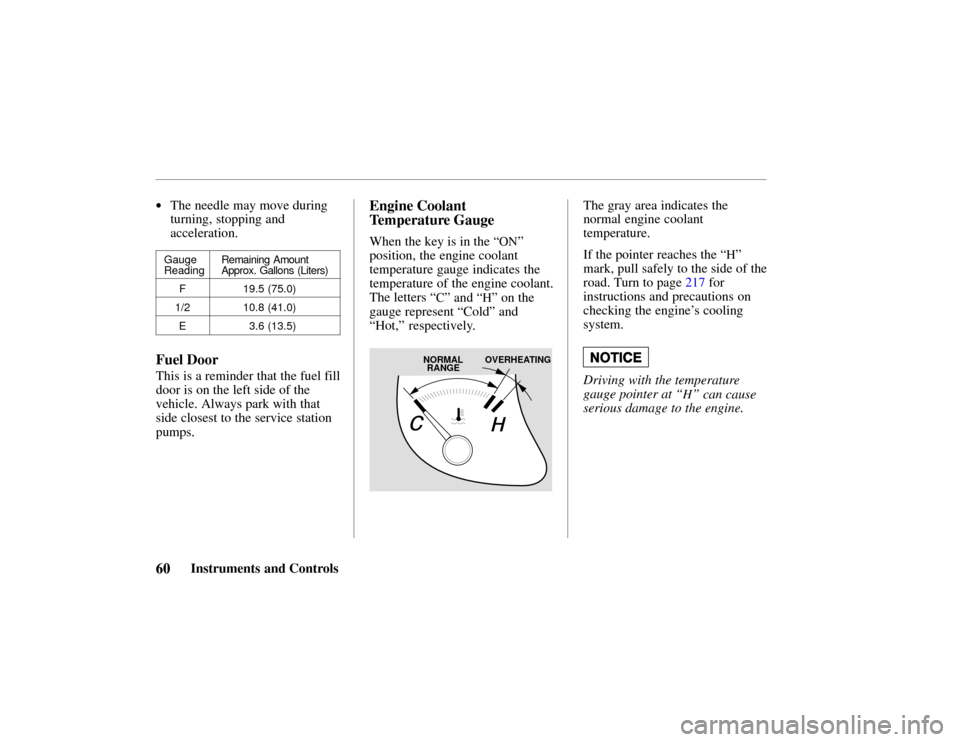
Engine Coolant
Temperature Gauge
When the key is in the “ON”
position, the engine coolant
temperature gauge indicates the
temperature of the engine coolant.
The letters “
C” and “H” on the
gauge represent “Cold” and
“Hot,” respectively.
NORMAL RANGE OVERHEATING
The gray area indicates the
normal engine coolant
temperature.
If the pointer reaches the
“
H”
mark, pull safely to the side of the
road. Turn to page 217 for
instructions and precautions on
checking the engine ’s cooling
system.
Driving with the temperature
gauge pointer at “
H” can cause
serious damage to the engine.
Page 64 of 294
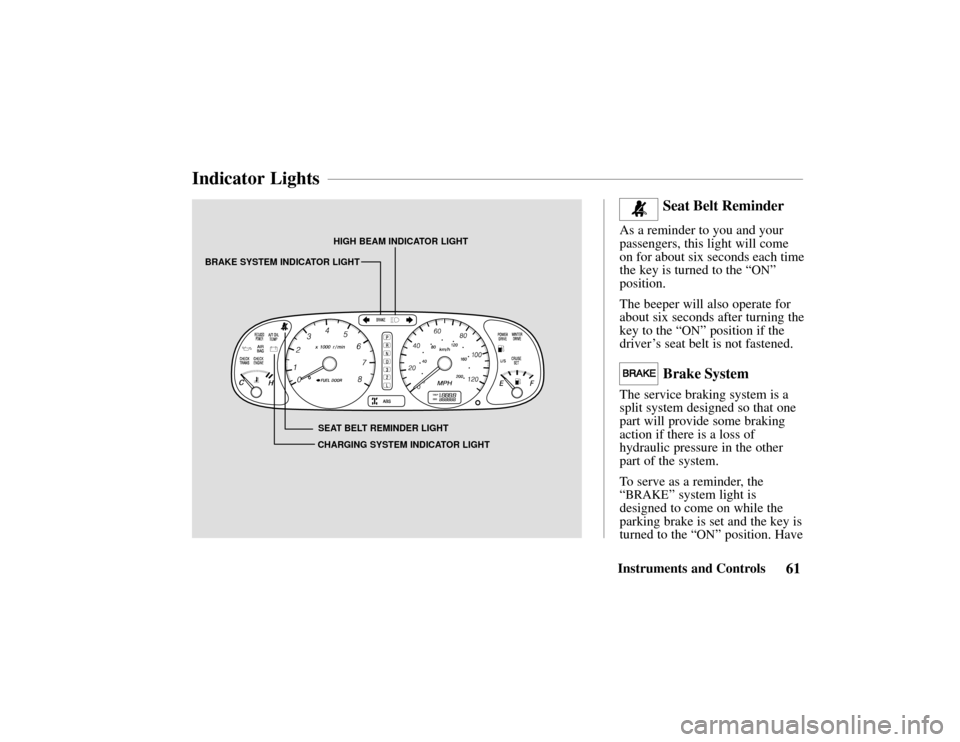
HIGH BEAM INDICATOR LIGHT
SEAT BELT REMINDER LIGHT
BRAKE SYSTEM INDICATOR LIGHT
CHARGING SYSTEM INDICATOR LIGHT
61Instruments and Controls
Seat Belt Reminder
As a reminder to you and your
passengers, this light will come
on for about six seconds each time
the key is turned to the “
ON”
position.
The beeper will also operate for
about six seconds after turning the
key to the “
ON” position if the
driver ’ s seat belt is not fastened.
Brake System
The service braking system is a
split system designed so that one
part will provide some braking
action if there is a loss of
hydraulic pressure in the other
part of the system.
To serve as a reminder, the
“
BRAKE” system light is
designed to come on while the
parking brake is set and the key is
turned to the “
ON” position. Have
Indicator Lights
Page 72 of 294
69Instruments and Controls
Depending on the type of problem,
the “
CHECK TRANS” light will
flash but the transmission may
continue to shift automatically. If
the transmission is shifting
normally, you do not have to
choose gears with the shift lever.
However, continued operation of
the vehicle with this light flashing
can cause serious mechanical
damage. You should have the
vehicle serviced by your Honda
dealer as soon as possible.
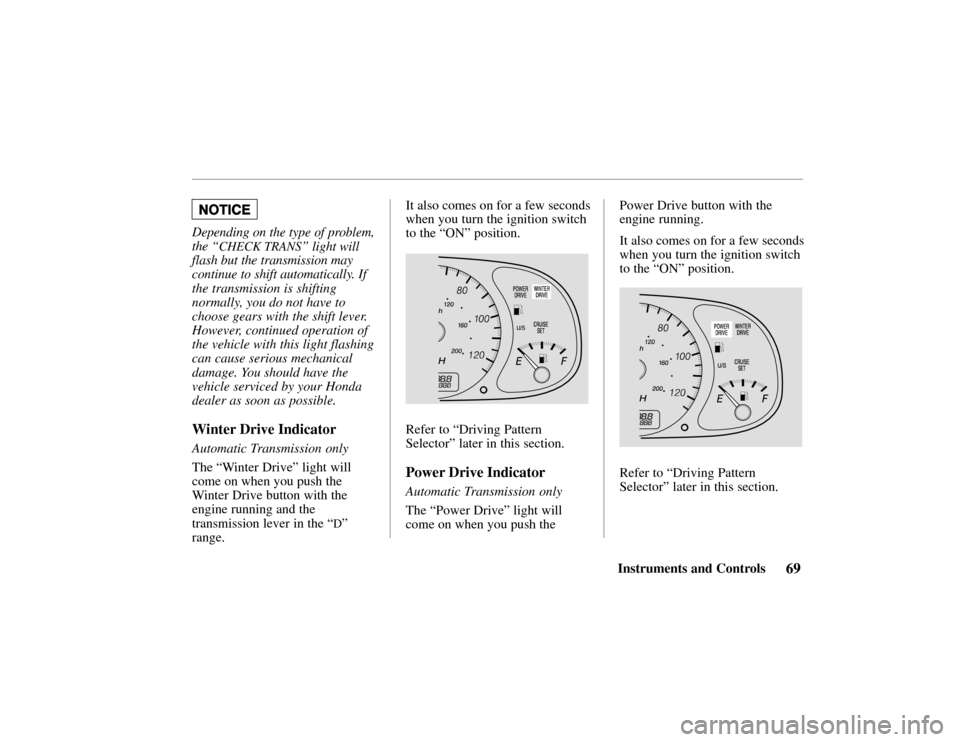
Winter Drive Indicator
Automatic Transmission only
The “Winter Drive” light will
come on when you push the
Winter Drive button with the
engine running and the
transmission lever in the “
D”
range. It also comes on for a few seconds
when you turn the ignition switch
to the “ON” position.
Refer to “Driving Pattern
Selector” later in this section.
Power Drive Indicator
Automatic Transmission only
The “Power Drive” light will
come on when you push the
Power Drive button with the
engine running.
It also comes on for a few seconds
when you turn the ignition switch
to the “ON” position.
Refer to “Driving Pattern
Selector” later in this section.
Page 94 of 294
91Seats
The
EX–L model has a power
adjustable driver’s seat. On the
other models, the driver’s seat
adjusts manually.
The front passenger’s seat and the
rear seat in all models adjust
manually.
Manual Front Seat
Adjustments
See pages 10-11 for important
safety information and warnings
about how to properly position
seats and seat-backs.
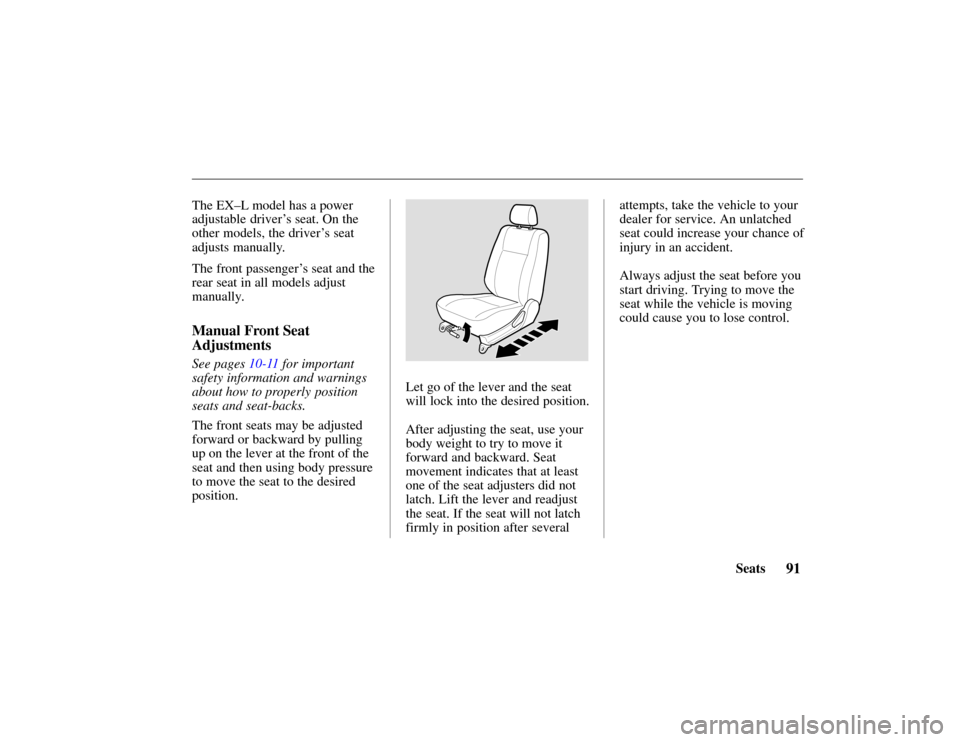
The front seats may be adjusted
forward or backward by pulling
up on the lever at the front of the
seat and then using body pressure
to move the seat to the desired
position.
Let go of the lever and the seat
will lock into the desired position.
After adjusting the seat, use your
body weight to try to move it
forward and backward. Seat
movement indicates that at least
one of the seat adjusters did not
latch. Lift the lever and readjust
the seat. If the seat will not latch
firmly in position after several attempts, take the vehicle to your
dealer for service. An unlatched
seat could increase your chance of
injury in an accident.
Always adjust the seat before you
start driving. Trying to move the
seat while the vehicle is moving
could cause you to lose control.
Page 162 of 294

159Driving Tips
•If your vehicle is equipped with
an automatic transmission, set
the parking brake before you
leave the driver’s seat. If the
vehicle is parked on a grade
and the transmission shift lever
is placed in “P” (Park) position
before you set the parking
brake, the weight of the vehicle
may exert so much force on the
transmission that you may have
difficulty moving the shift
lever out of “P” (Park)
position. To prevent this, apply
the parking brake
BEFORE
moving the shift lever to “P”
(Park). When you want to drive
away, move the shift lever out
of the “P” (Park) position
BEFORE releasing the parking
brake. It is good driving
practice to set the parking
brake first, then place the
transmission in “
PA R K” position, even on level
surfaces.
•If the parking brake does not
seem to hold the vehicle as
well as before, have the vehicle
serviced by your Honda dealer.
•Do not park your vehicle over
high grass, dry leaves or other
combustible materials. The
catalytic converter gets very
hot and could set fire to these
materials.
Anti-Lock Brakes
Your vehicle has an Anti-lock
Brake System (
ABS) as standard
equipment.
ABS helps to prevent
the wheels from locking up and
skidding during hard braking,
allowing you to retain steering
control.
When the front tires skid, you
lose steering control; the vehicle
continues straight ahead even
though you turn the steering
wheel. The
ABS helps to prevent
lock-up and retain steering control
by pumping the brakes rapidly;
much faster than a person can do it.
You should never pump the
brake pedal, this defeats the
purpose of the
ABS. Let the ABS
work for you by always keeping
firm, steady pressure on the brake
pedal as you steer away from the
Brakes
Page 172 of 294

169Driving Tips
Wheel Replacement
Considerations
Damaged wheels must be
replaced. For example, replace
wheels if they are bent, cracked or
heavily rusted, or if wheel nuts
often become loose. Also replace
wheels that leak air (except some
aluminum wheels that can be
repaired). See your Honda dealer.
Do not use bent wheels that have
been straightened, and do not use
tubes in leaking wheels designed
for tubeless tires. Such wheels
may have structural damage and
could fail without warning.
Maximum loads, maximum
inflation pressures, wheel
identification codes, and wheel
sizes are stamped on each wheel.
Service-tested and approvedwheels are available from your
Honda dealer.
When obtaining wheels for any
reason from any other source, the
replacement wheels should be
equal in load capacity, inflation
pressure capacity, diameter, width,
offset and mounting configuration
to those originally installed on
your vehicle. A wheel of the
wrong size or type may adversely
affect load carrying capacity,
wheel and bearing life, brake
cooling, speedometer/odometer
calibration, stopping ability,
headlight aim, bumper height,
vehicle ground clearance, and tire
or tire chain clearance to the body
and chassis. Replacement with
used wheels is not advised: They
may have been subjected to harsh
treatment or very high mileage and
could fail without warning.
Installing wheels and/or tires that
have a higher load carrying limit
than those that originally came on
your vehicle does not increase the
GAWR or GVWR of the vehicle.
Page 175 of 294

172 Driving Tips
The
three-way catalytic converter
is an emissions control device
added to the exhaust system to
reduce exhaust gas pollutants. The
converter contains a ceramic
material coated with noble metal
catalysts. To prevent
contamination of the catalysts,
unleaded gasoline must be used.
Unleaded gasoline also reduces
combustion chamber deposits and
exhaust system corrosion.
The three-way catalytic converter
requires the use of unleaded
gasoline. Use of leaded gasoline
will cause the converter to lose its
effectiveness.
To Help Prevent Damage
1. Keep your engine properly
maintained. Engine
malfunctions involving the electrical,
electronic fuel
injection or ignition systems
may result in unusually high
converter and exhaust system
temperatures. Do not keep
driving your vehicle if you
detect engine misfire,
noticeable loss of performance,
or other unusual operating
conditions. Have it serviced
promptly. A properly
maintained engine will
minimize malfunctions that
could damage the converter. It
will also help provide good
emissions control and fuel
economy. (See the
Maintenance Schedule on page
204 for info rmation on
inspecting and maintaining the
engine, exhaust system and
other components.) 2. Do not push or tow your
vehicle to start it. This could
damage the converter.
3. Do not park your vehicle over high grass, dry leaves or other
combustible materials. The
catalytic converter gets very
hot and could set fire to these
materials.
Three-Way Catalytic Converter