air suspension HONDA PASSPORT 2002 2.G Owners Manual
[x] Cancel search | Manufacturer: HONDA, Model Year: 2002, Model line: PASSPORT, Model: HONDA PASSPORT 2002 2.GPages: 294, PDF Size: 3.97 MB
Page 169 of 294

166Driving Tips
indicator in three or more places
around the tire.
Maintenance
In addition to proper inflation,
correct wheel alignment helps to
decrease tire wear. You should get
your vehicle’
s suspension parts
inspected often, and aligned when
needed.
The tires were properly balanced
at the factory. They may need to
be rebalanced at some time before
they are worn out. Have your
dealer check the tires if you feel a
consistent vibration while driving.
A tire should always be
rebalanced if it is removed from
the wheel for repair.
Make sure the installer balances
the wheels when you have new
tires installed. This increases riding comfort and tire life. Your
vehicle’
s original tires were
dynamic or “spin” balanced at the
factory. For best results, have the
installer perform a dynamic
balance.
Tire Rotation
To help increase tire life and
distribute wear more evenly, you
should have the tires rotated every
7,500 miles (12,000 km).
FRONT
4 WHEEL 5 WHEEL
Move the tires to the positions
shown in the diagram each time
they are rotated.
Replacing Tires and Wheels
The tires that came with your
vehicle were selected to match its
performance capabilities while
providing the best combination of
handling, ride comfort, and long
life. You should replace them with
radial tires of the same size, load
range, speed rating, and maximum
cold tire pressure rating (as shown
on the tire’ s sidewall). Mixing
radial and bias-ply tires on your
vehicle can reduce its braking
ability, traction, and steering
accuracy.
Page 208 of 294

•
•Repeated short trips in cold weather
• Driving in dusty areas •
Frequent idling and/or frequent low-speed operation
• Towing a trailer Change engine oil and filter
–Every 3,750 miles (6,000 km)
or 3 months
Change rear axle oil –Every 15,000 miles (24,000 km)
205Care and Maintenance
R – Replace L – Lube I – Inspect After inspection, clean, adjust, repair or replace if necessary.
Service at the interval listed x1 000 il ( k ) ft th tx 1,000 miles7.51522.53037.54552.56067.57582.59097.5105Service at the interval listed x1,000 miles (or km) or after thatnumber of months whicheverx 1,000 km1224364860728496108120132144156168number of months, whichever
comes first.months612182430364248546066727884
Steering and suspension, miscellaneousFront and rear axle oilRRRRPropeller shaft flange torqueIIIIIII
Front and rear propeller shaftsLLLLLLLLLL
Body and chassisLLLLLLLLLLLLLL
Front wheel bearingsRepack bearings when replacing front brake pads.Power steering fluidRRR
Tires (inspect and rotate)IIIIIIIIIIIIII
Suspension and steeringIIIIIIIIIIIIIIBrakes/ClutchBrake discs; calipers and padsIIIIIII
Brake drums, wheel cylinders and liningsIIIIIIIBrake lines and hosesIIIIIIIIIIIIIIParking brakeIIIIIIIBrake pedal playIIIIIIIClutch pedal playIIIIIIIClutch pedal spring, bushing and clevis pinLLLLLLL
Clutch lines and hosesIII
Check oil and coolant level at each fuel stop.
Under severe driving conditions, service these items more often. These c\
onditions are: Service for severe driving conditions
Page 294 of 294
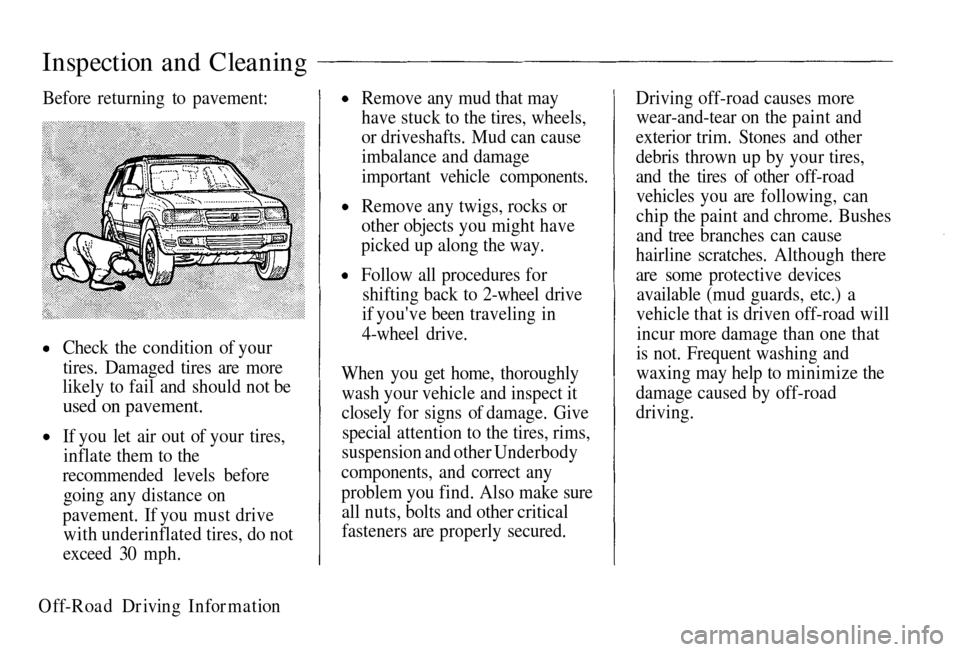
Inspection and Cleaning
Check the condition of your
tires. Damaged tires are more
likely to fail and should not be
used on pavement.
If you let air out of your tires,inflate them to the
recommended
levels before
going
any distance on
pavement.
If you must drive
wit
h underinflated tires, do not
exceed
30 mph. Remove
any mud that may
have
stuck to the tires, wheels,
or driveshafts. Mud can cause
imbalance
and damage
important vehicle components.
Remove any twigs, rocks or
other objects you might have
picked up along the way.
Follow
all procedures for
shifting back to 2-wheel drive
if you've been traveling in
4-wheel
drive.
When you get home, thoroughly wash your vehicle and inspect it
closely
for signs of damage. Give
special attention to the tires, rims,
suspension and other Underbody
components, and correct any
problem you find. Also make sure all
nuts, bolts and other critical
fasteners
are properly secured. Driving off-road causes more
wear-and-tear
on the paint and
exterior trim. Stones and other debris
thrown up by your tires,
and
the tires of other off-road
vehicles you are following, can
chip
the paint and chrome. Bushes
and tree branches can cause
hairline
scratches. Although there
are some protective devices available
(mud guards, etc.) a
vehicle that is driven off-road will
incur
more damage than one that
is not. Frequent washing and
waxing may help to minimize the
damage caused by off-road
driving.
Befor
e returning to pavement:
Off-Road Driving Information