service HONDA PASSPORT 2002 2.G User Guide
[x] Cancel search | Manufacturer: HONDA, Model Year: 2002, Model line: PASSPORT, Model: HONDA PASSPORT 2002 2.GPages: 294, PDF Size: 3.97 MB
Page 182 of 294

179Driving Tips
Follow the recommendations in
this manual and ask your Honda
dealer for further details before
you tow a trailer with your
Passport.
Towing a trailer affects vehicle
maintenance requirements due
to the additional load. More
frequent maintenance intervals
will be required to assure
continued satisfaction with
your vehicle. Consult your
Honda dealer for recommended
maintenance and service.
The gross trailer weight (trailer
weight plus cargo load) must
never exceed 4,500 lb.
Additional equipment will be
required, depending on the
specific model/load combination.
See “Trailer Hitches” in this
section.
Exceeding the weight limit will
cause damage to your vehicle and
possibly result in personal injury.
•The Gross Vehicle Weight
Rating (
GVWR) is the
combined weight of the
unloaded vehicle, passengers,
cargo, trailer hitch, trailer
tongue load, and optional
equipment. This value is
indicated on the
F.M.V.S.S.
Certification Label on the
driver ’ s doorjamb.
•The Gross Combined Weight
Rating (
GCWR) equals the
combined weight of your
vehicle (including passengers
and cargo) plus the total trailer
load. The following limits
apply.
2WD: 8,700 lb
4WD: 8,950 lb
•The Gross Axle Weight Rating
(
GAWR) is also indicated on
the Certification Label. The
load on either the front or rear
axle resulting from distribution
of the gross vehicle weight on
both axles must not exceed the
values listed. Remember to
account for additional
equipment and tongue load.
Page 185 of 294

182Driving Tips
There are no provisions in your
vehicle to tap into its hydraulic
braking system. Any attempt to
attach the trailer
’s brakes to your
vehicle’ s hydraulic braking
system, no matter how successful
it may seem, will lower braking
effectiveness and create a
potential hazard.
Equipment Check
Before operating your vehicle,
check all safety equipment to
ensure safe operation. Be sure
your vehicle is properly serviced
to avoid mechanical failure.
Check that your vehicle remains
level when the loaded or unloaded
trailer is hitched. Do not drive if
the rear end of your vehicle is
abnormally higher or lower.
Check for proper tongue weight,
overload, improper weight distribution, worn suspension, or
other possible causes.
Make sure the trailer load is
properly positioned and secured
so its does not shift around while
driving.
Check if your rearview mirrors
comply with federal, state and
local regulations. If not, confirm
the proper mirrors required for
towing and have them installed.
Perform an equipment check of
all braking, lighting and safety
equipment to ensure they are
working properly.
Your safety depends on proper
operation and installation of
equipment. Never operate a
vehicle with faulty equipment.
Standard on 4WD models
The limited slip differential is
designed to improve traction by
limiting wheelspin. If one rear
wheel begins to spin on a slippery
surface, the limited slip
differential will automatically
transmit driving force to the other
rear wheel.
Limited Slip Differential
Page 191 of 294
188In Case of Emergency
8. Turn the jack handle
clockwise with a slow, smooth
motion to raise the vehicle so
the inflated spare tire will
clear the surface.
9. Remove the wheel nuts and the wheel.
10. Install the wheel and replace the wheel nuts with the
cone-shaped end toward the
wheel, then hand-tighten each
nut. The wheel must be seated
on the hub.
11. Lower the vehicle by turning the jack handle counter-
clockwise, then fully tighten
the wheel nuts in a crisscross
sequence by turning the
wrench clockwise. Have the
wheel nut torque checked at
the nearest automotive service
facility.
87 lb-ft (118 N·m) 12. Stow the jacking tools and flat
tire in their proper locations.
EX model
Use the screwdriver to remove the
center cap from the wheel before
stowing the flat tire.
Loose items can fly around the
interior in a crash and could
seriously injure the occupants.
Store the wheel, jack, and
tools securely before driving.
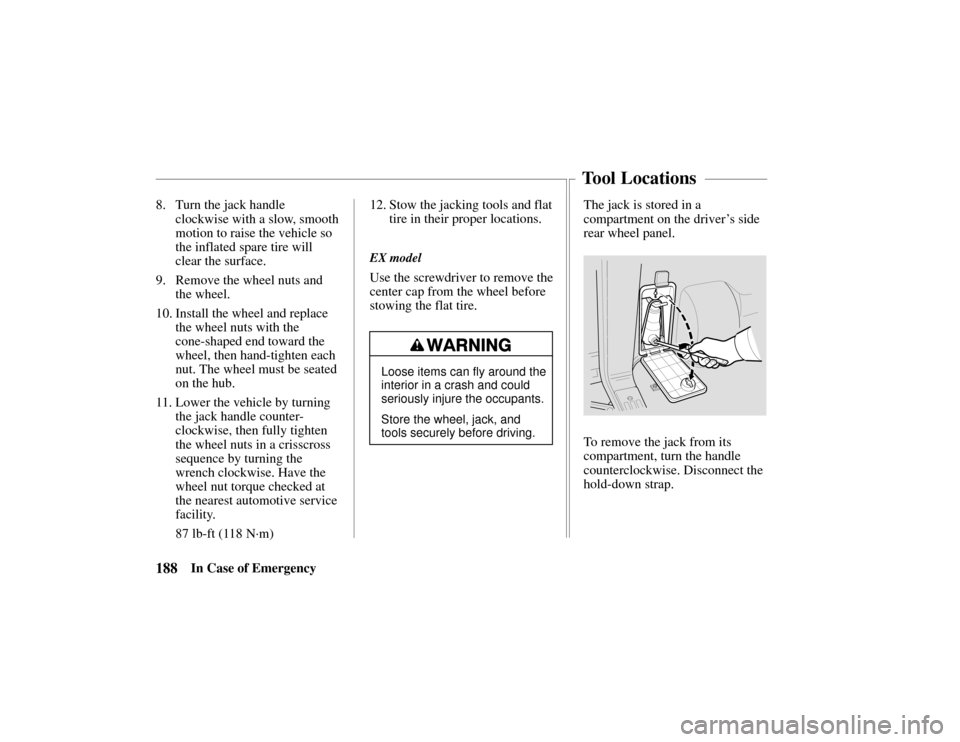
The jack is stored in a
compartment on the driver ’s side
rear wheel panel.
To remove the jack from its
compartment, turn the handle
counterclockwise. Disconnect the
hold-down strap.
Tool Locations
Page 198 of 294
195Care and Maintenance
This section explains why it is
important to keep your vehicle
well maintained and to follow
basic maintenance safety
precautions.
This section also includes
Maintenance Schedules for
normal driving and severe driving
conditions, a Maintenance
Record, and instructions for
simple maintenance tasks you
may want to take care of yourself.
If you have the skills and tools
required
to perform more complex
maintenance tasks on your Honda,
you may want to purchase the
Service Manual. See page 253 for
information on how to obtain a
copy, or see your Honda dealer. Service Station Information
197
.
Fuel Fill Cap 197
. . . . . . . . . .
Fuel Recommendation 198
. . .
Fuel Tank Capacity 198
. . . . .
Engine Oil
Recommendation 198
. . . . . .
Windshield Washer 198
. . . . .
Tire Inflation Pressures 198
. .
Battery 198
. . . . . . . . . . . . . . .
Hood Release 199
. . . . . . . . . .
Engine Oil Dipstick 200
. . . . .
Fuel Requirements 200
. . . . . . . .
Oxygenated Fuels 200
. . . . . .
Maintenance Safety 201
. . . . . . .
Important Safety
Precautions 202
. . . . . . . . . .
Maintenance Schedule 203
. . . . .
Required Maintenance Record 206
Owner Safety Checks 208
. . . . . .
Engine Oil and Filter 211
. . . . . .
Proper Quality Oil 211
. . . . . . Change Interval
211
. . . . . . . .
Oil Change 212
. . . . . . . . . . .
Oil Filter Installation 212
.
Oil Viscosity 213
. . . . . . . . . .
Oil Level Check 213
. . . . . . .
Engine Oil Additives 214
. . .
Air Cleaner Filter 214
. . . . . . . .
Manual Transmission Fluid 215
Automatic Transmission
Fluid 216
. . . . . . . . . . . . . . . . . .
Front (4
WD) and
Rear Axles 216
. . . . . . . . . . . . .
Engine Cooling System 217
. . .
Other Required Maintenance 219
Brake Master Cylinder 219
. .
Shift-on-the-Fly System 220
.
Front Wheel Bearings 220
. . .
Hood Latch and Hinges 221
.
Air Conditioning 221
. . . . . . .
Body Lubrication 221
. . . . . .
Care and Maintenance
Page 200 of 294
197Care and Maintenance
Fuel Fill Cap
To remove the fuel fill cap, turn it
counterclockwise. To close the fill
cap, turn it clockwise until you
hear it click at least three times.
Put the fuel fill cap in the cap
holder while refueling.
If you need a replacement, use only
a genuine Honda fuel fill cap. An
improper fuel fill cap can affect the
fuel system, the emissions system,
and allow fuel spillage.
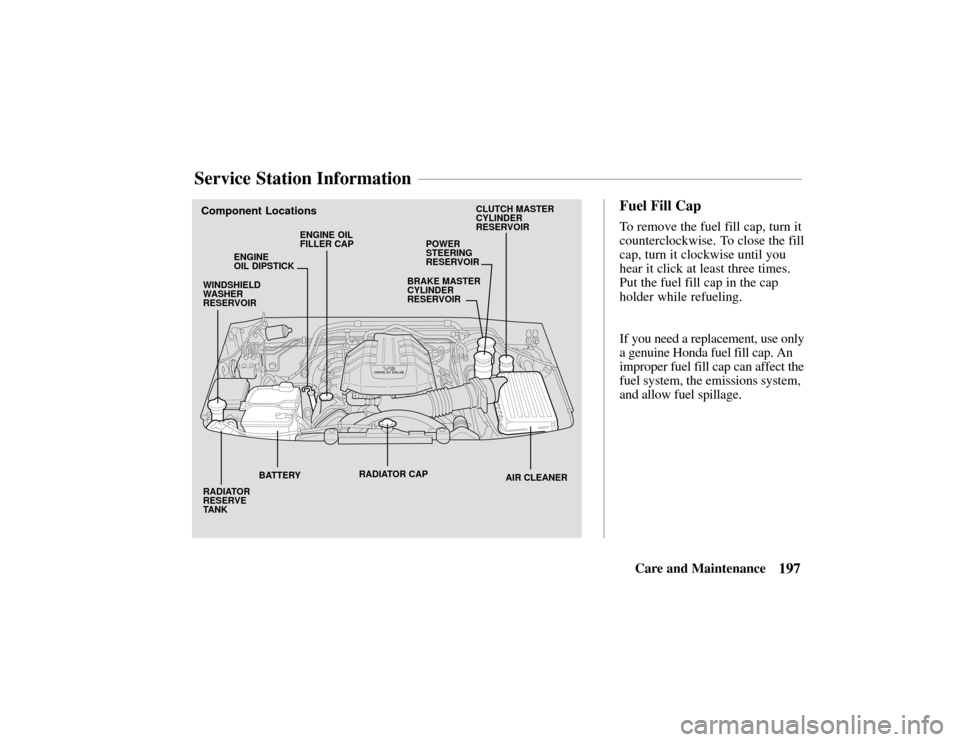
Component Locations
WINDSHIELD
WASHER
RESERVOIRBATTERY RADIATOR CAP
ENGINE OIL
FILLER CAP
AIR CLEANER
ENGINE
OIL DIPSTICK
BRAKE MASTER
CYLINDER
RESERVOIRPOWER
STEERING
RESERVOIR
RADIATOR
RESERVE
TANK
CLUTCH MASTER
CYLINDER
RESERVOIR
Service Station Information
Page 204 of 294
201Care and Maintenance
standards, some areas of the United
States and Canada use oxygenated
fuels to help reduce emissions.
If you use an oxygenated fuel, be
sure it is unleaded and meets the
minimum octane rating requirement.
Before using an oxygenated fuel,
try to confirm the fuel’
s contents.
Some states/provinces require this
information to be posted on the
pump.
The following are the EPA-approved
percentages of oxygenates:
ETHANOL (ethyl or grain alcohol).
You may use gasoline containing up
to 10% ethanol by volume. Gasoline
containing ethanol may be marketed
under the name “Gasohol.”
MTBE (Methyl Tertiary Butyl
Ether). You may use gasoline
containing up to 15%
MTBE by
volume.
METHANOL (methyl or wood
alcohol). Your vehicle was not
designed to use fuel that contains
methanol. Methanol can corrode
metal parts in the fuel system, and
also damage plastic and rubber
components. This damage would not
be covered by your warranties.
If you notice any undesirable
operating symptoms, try another
service station or switch to another
brand of gasoline.
Fuel system damage or performance
problems resulting from the use of
an oxygenated fuel containing
more than the percentages of
oxygenates given above are not
covered under warranty. Regularly maintaining your
vehicle is the best way to protect
your investment. Proper
maintenance is essential to your
safety and the safety of your
passengers. It will also reward
you with more economical,
trouble-free driving and help
reduce air pollution.
Improperly maintaining this
vehicle or failing to correct a
problem before driving can
cause a crash in which you
can be seriously hurt or killed.
Always follow the inspection
and maintenance
recommendations and
schedules in this owner’s
manual.
Maintenance Safety
Page 205 of 294

202Care and Maintenance
This section includes instructions
for simple maintenance tasks,
such as checking and adding oil.
Any service items not detailed in
this section should be performed
by a Honda technician or other
qualified mechanic.
Some of the most important safety
precautions are given below.
However, we cannot warn you of
every conceivable hazard that can
arise in performing maintenance.
Only you can decide whether or
not you should perform a given
task.
Failure to properly follow
maintenance instructions and
precautions can cause you to
be seriously hurt or killed.
Always follow the procedures
and precautions in this owner
’s
manual.
Important Safety Precautions
Before you begin any
maintenance, make sure your
vehicle is parked on level ground
and that the parking brake is on.
Also, be sure the engine is off.
This will help to eliminate several
potential hazards:
•Carbon monoxide poisoning
from engine exhaust.
Be sure
there is adequate ventilation
whenever you operate the engine.
•Burns from hot parts. Let the
engine and exhaust system cool
before touching any parts.
•Injury from moving parts. Do
not run the engine unless
instructed to do so.
Read the instructions before you
begin, and make sure you have
the tools and skills required.
To reduce the possibility of fire or
explosion, be careful when
working around gasoline or
batteries. Use a commercially
available degreaser or parts
cleaner, not gasoline, to clean
parts. Keep cigarettes, sparks, and
flames away from the battery and
all fuel-related parts.
You should wear eye protection
and protective clothing when
working near the battery or when
using compressed air.
Page 206 of 294
203Care and Maintenance
The Maintenance Schedule
specifies how often you should
have your vehicle serviced and
what things need attention. It is
essential that you have your
vehicle serviced as scheduled to
retain its high level of safety,
dependability, and emission
control performance.
The services and time or distance
intervals shown in the
maintenance schedule assume you
will use your vehicle as normal
transportation. You should:
•
Avoid exceeding your vehicle’s
load limit. This puts excess
stress on the engine, brakes, and
many other parts of your vehicle.
The load limit is shown on the
label on the driver’s doorjamb.
• Operate your vehicle on
reasonable roads within the
legal speed limit.
• Drive your vehicle regularly over
a distance of several miles
(kilometers).
• Always use unleaded gasoline
with the proper octane rating
(see page 200).
Your authorized Honda dealer
knows your vehicle best and can
provide competent, efficient
service. However, service at a
dealer is not mandatory to keep
your warranties in effect.
Maintenance may be done by any
qualified service facility or person
who is skilled in this type of
automotive service. Keep all the
receipts as proof of completion,
and have the person who does the
work fill out the Maintenance Record. Check your warranty
booklet for more information.
We recommend the use of
Genuine Honda parts and fluids
whenever you have maintenance
done. These are manufactured to
the same high-quality standards as
the original components, so you
can be confident of their
performance and durability.
U.S. Vehicles:
Maintenance, replacement or repair
of emission control devices and
systems may be done by any
automotive repair establishment or
individual using parts that are
“certified” to EPA standards.
Maintenance Schedule
Page 207 of 294
•
* 1
* 2Under severe driving conditions, service these items more often. –These fluids: brake, clutch, P/S, battery, ATF,
Using SAE 10W-40 oil, or any viscosity other than those recommended, may reduce engin\
e life and affect the warranty. windshield washer
This service is recommended only. – Tire pressure
204 Care and Maintenance
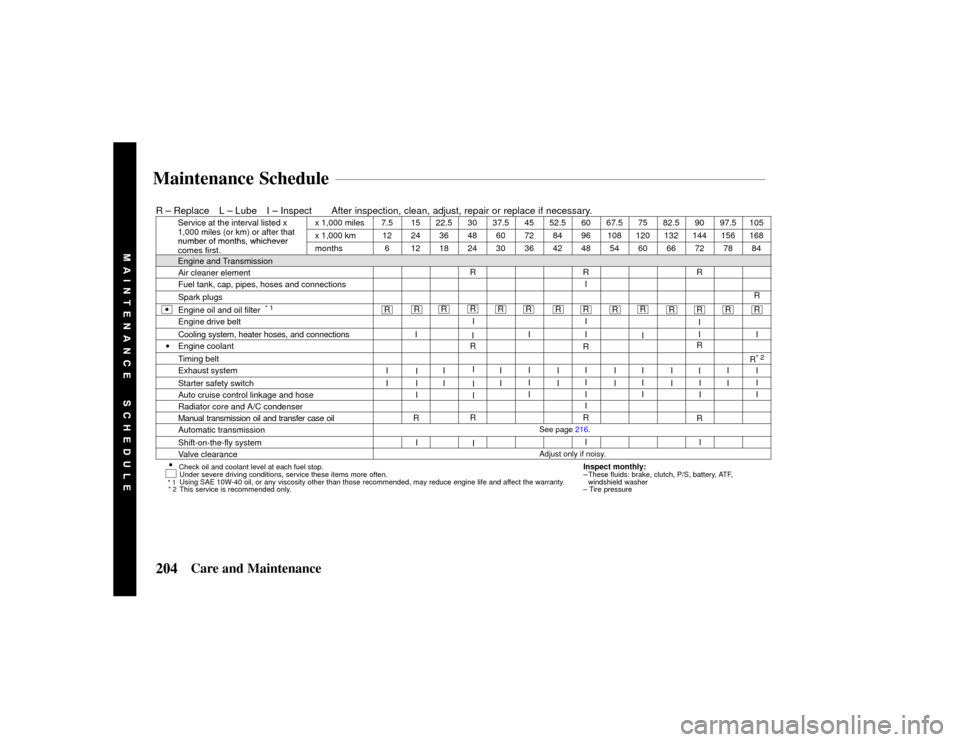
R – Replace L – Lube I – Inspect After inspection, clean, adjust, repair or replace if necessary.Service at the interval listed x1 000 il ( k ) ft th tx 1,000 miles7.51522.53037.54552.56067.57582.59097.5105Service at the interval listed x1,000 miles (or km) or after thatnumber of months whicheverx 1,000 km1224364860728496108120132144156168number of months, whichever
comes first.months612182430364248546066727884
Engine and TransmissionAir cleaner elementRRR
Fuel tank, cap, pipes, hoses and connectionsI
Spark plugsR
•Engine oil and oil filter * 1RRRRRRRRRRRRRREngine drive beltIII
Cooling system, heater hoses, and connectionsIIIIIII•Engine coolantRRR
Timing beltR*
2
Exhaust systemIIIIIIIIIIIIII
Starter safety switchIIIIIIIIIIIIII
Auto cruise control linkage and hoseIIIIIII
Radiator core and A/C condenserI
Manual transmission oil and transfer case oilRRRRAutomatic transmissionSee page 216.
Shift-on-the-fly systemIIIIValve clearanceAdjust only if noisy.
Check oil and coolant level at each fuel stop.Inspect monthly:
Maintenance Schedule
Page 208 of 294
•
•Repeated short trips in cold weather
• Driving in dusty areas •
Frequent idling and/or frequent low-speed operation
• Towing a trailer Change engine oil and filter
–Every 3,750 miles (6,000 km)
or 3 months
Change rear axle oil –Every 15,000 miles (24,000 km)
205Care and Maintenance
R – Replace L – Lube I – Inspect After inspection, clean, adjust, repair or replace if necessary.
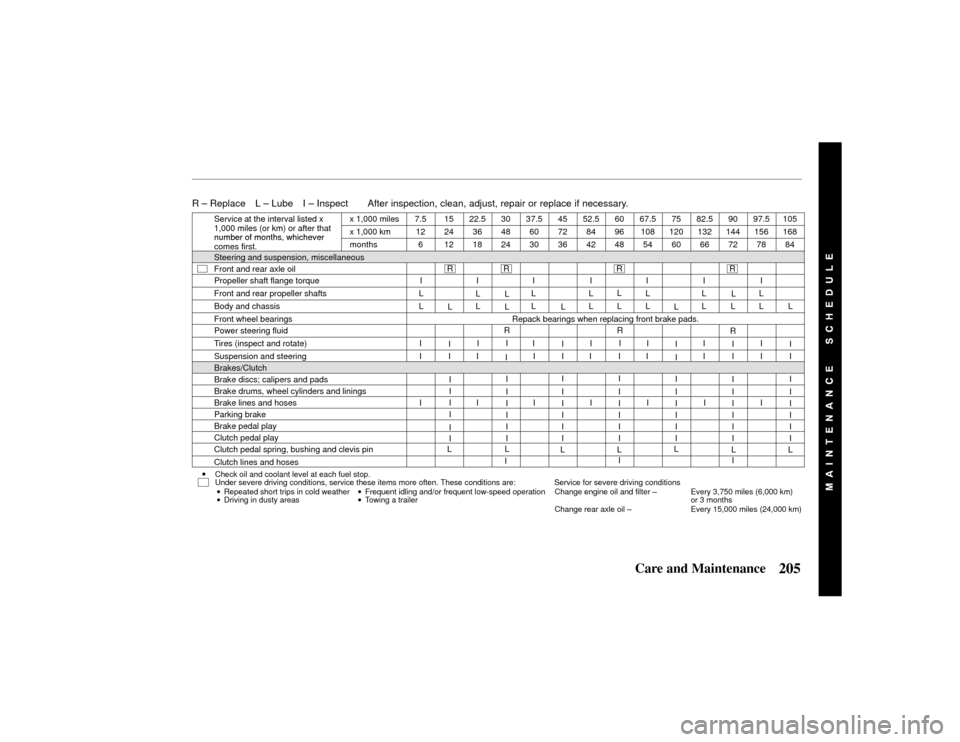
Service at the interval listed x1 000 il ( k ) ft th tx 1,000 miles7.51522.53037.54552.56067.57582.59097.5105Service at the interval listed x1,000 miles (or km) or after thatnumber of months whicheverx 1,000 km1224364860728496108120132144156168number of months, whichever
comes first.months612182430364248546066727884
Steering and suspension, miscellaneousFront and rear axle oilRRRRPropeller shaft flange torqueIIIIIII
Front and rear propeller shaftsLLLLLLLLLL
Body and chassisLLLLLLLLLLLLLL
Front wheel bearingsRepack bearings when replacing front brake pads.Power steering fluidRRR
Tires (inspect and rotate)IIIIIIIIIIIIII
Suspension and steeringIIIIIIIIIIIIIIBrakes/ClutchBrake discs; calipers and padsIIIIIII
Brake drums, wheel cylinders and liningsIIIIIIIBrake lines and hosesIIIIIIIIIIIIIIParking brakeIIIIIIIBrake pedal playIIIIIIIClutch pedal playIIIIIIIClutch pedal spring, bushing and clevis pinLLLLLLL
Clutch lines and hosesIII
Check oil and coolant level at each fuel stop.
Under severe driving conditions, service these items more often. These c\
onditions are: Service for severe driving conditions