airbag HONDA PILOT 2011 2.G User Guide
[x] Cancel search | Manufacturer: HONDA, Model Year: 2011, Model line: PILOT, Model: HONDA PILOT 2011 2.GPages: 574, PDF Size: 14.02 MB
Page 19 of 574
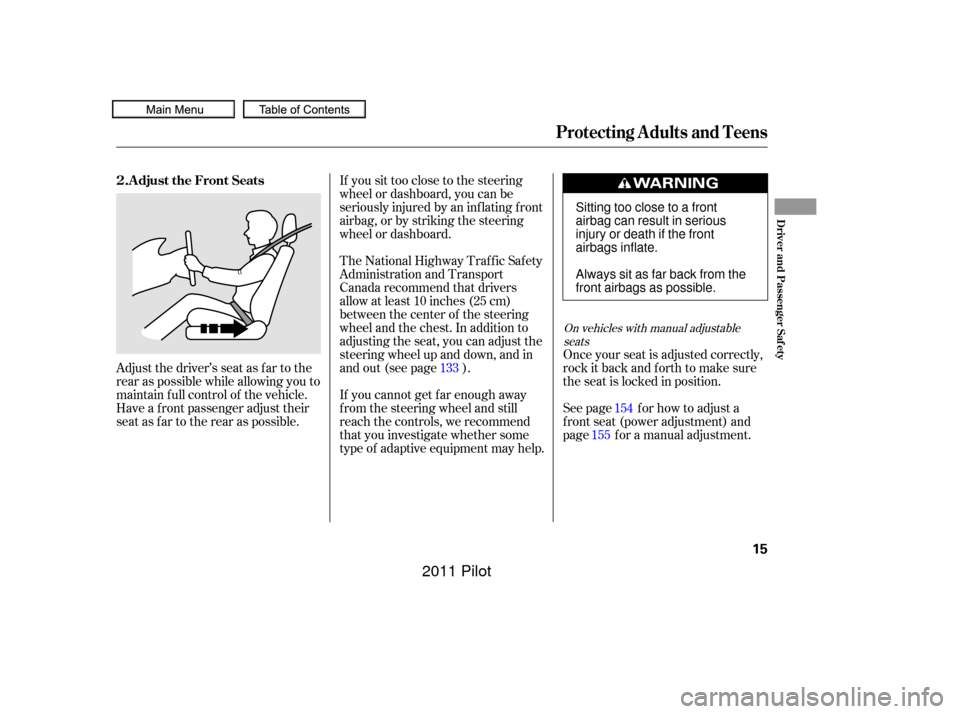
If you sit too close to the steering
wheel or dashboard, you can be
seriously injured by an inf lating f ront
airbag, or by striking the steering
wheel or dashboard.
The National Highway Traffic Safety
Administration and Transport
Canada recommend that drivers
allow at least 10 inches (25 cm)
between the center of the steering
wheel and the chest. In addition to
adjusting the seat, you can adjust the
steering wheel up and down, and in
and out (see page ).
If you cannot get f ar enough away
f rom the steering wheel and still
reach the controls, we recommend
that you investigate whether some
type of adaptive equipment may help.
Adjust the driver’s seat as far to the
rear as possible while allowing you to
maintain f ull control of the vehicle.
Have a f ront passenger adjust their
seat as far to the rear as possible.
Once your seat is adjusted correctly,
rock it back and f orth to make sure
the seat is locked in position.
See page f or how to adjust a
f ront seat (power adjustment) and
page f or a manual adjustment.
133
154
155
On vehicles with manual adjustable seats
Protecting A dults and Teens
Adjust the Front Seats
2.
Driver and Passenger Saf ety
15
Sitting too close to a front
airbag can result in serious
injury or death if the front
airbags inflate.
Always sit as far back from the
front airbags as possible.
10/01/26 18:25:26 31SZA620_020
2011 Pilot
Page 20 of 574
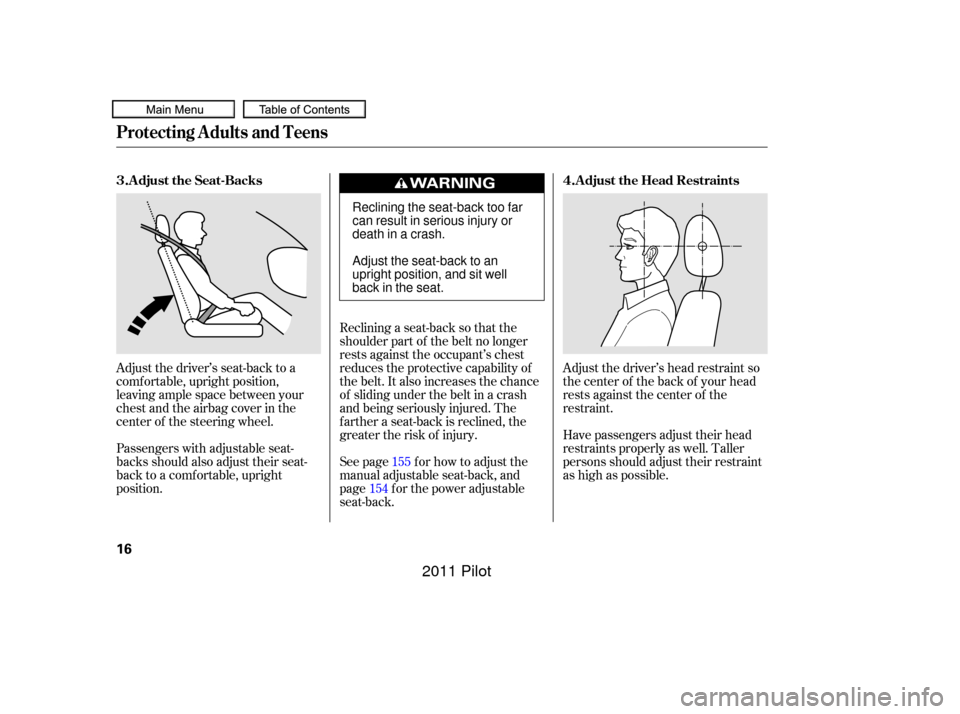
Adjust the driver’s head restraint so
the center of the back of your head
rests against the center of the
restraint.
Have passengers adjust their head
restraints properly as well. Taller
persons should adjust their restraint
as high as possible.
Reclining a seat-back so that the
shoulder part of the belt no longer
rests against the occupant’s chest
reduces the protective capability of
the belt. It also increases the chance
of sliding under the belt in a crash
and being seriously injured. The
farther a seat-back is reclined, the
greater the risk of injury.
Adjust the driver’s seat-back to a
comf ortable, upright position,
leaving ample space between your
chest and the airbag cover in the
center of the steering wheel.
Passengers with adjustable seat-
backs should also adjust their seat-
back to a comf ortable, upright
position.
See page f or how to adjust the
manual adjustable seat-back, and
page f or the power adjustable
seat-back.155
154
Protecting A dults and Teens
A djust the Head Restraints
Adjust the Seat-Backs 4.
3.
16
Reclining the seat-back too far
can result in serious injury or
death in a crash.
Adjust the seat-back to an
upright position, and sit well
back in the seat.
10/01/26 18:25:38 31SZA620_021
2011 Pilot
Page 23 of 574
In addition, an occupant who is out of
position in the f ront seat can be
seriously or f atally injured in a crash
by striking interior parts of the
vehicle or being struck by an
inflating front airbag.
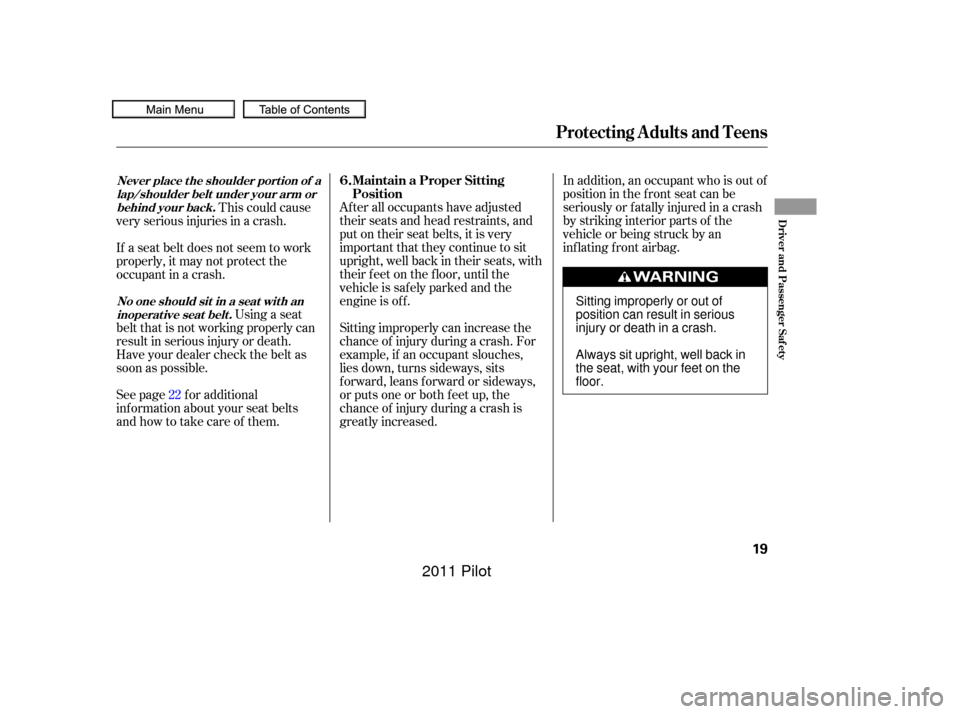
After all occupants have adjusted
their seats and head restraints, and
put on their seat belts, it is very
important that they continue to sit
upright, well back in their seats, with
their feet on the floor, until the
vehicle is safely parked and the
engine is of f .
Sitting improperly can increase the
chance of injury during a crash. For
example, if an occupant slouches,
lies down, turns sideways, sits
forward, leans forward or sideways,
or puts one or both f eet up, the
chance of injury during a crash is
greatly increased.
This could cause
very serious injuries in a crash.
See page f or additional
inf ormation about your seat belts
and how to take care of them. If a seat belt does not seem to work
properly, it may not protect the
occupant in a crash.
Using a seat
belt that is not working properly can
result in serious injury or death.
Have your dealer check the belt as
soon as possible.
22
Protecting A dults and Teens
Maintain a Proper Sitting
Position
6.Never place t he shoulder port ion of a
lap/shoulder belt under your arm orbehind your back.
No one should sit in a seat wit h aninoperat ive seat belt .
Driver and Passenger Saf ety
19
Sitting improperly or out of
position can result in serious
injury or death in a crash.
Always sit upright, well back in
the seat, with your feet on the
floor.
10/01/26 18:26:05 31SZA620_024
2011 Pilot
Page 24 of 574
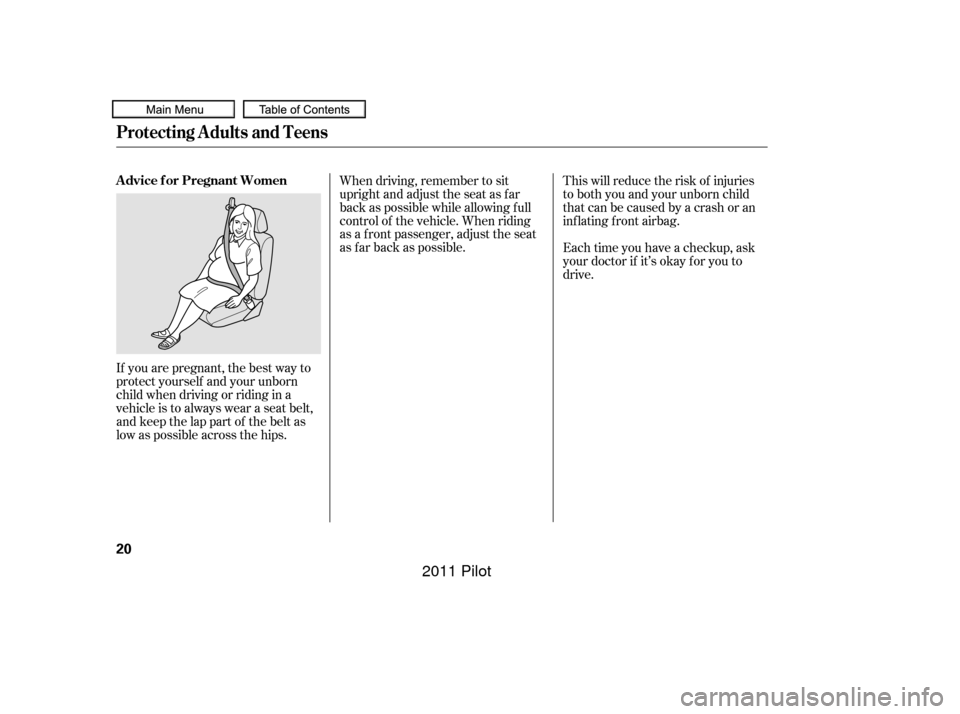
If you are pregnant, the best way to
protect yourself and your unborn
child when driving or riding in a
vehicle is to always wear a seat belt,
and keep the lap part of the belt as
low as possible across the hips.When driving, remember to sit
upright and adjust the seat as f ar
back as possible while allowing f ull
control of the vehicle. When riding
as a f ront passenger, adjust the seat
as far back as possible.
This will reduce the risk of injuries
to both you and your unborn child
that can be caused by a crash or an
inflating front airbag.
Each time you have a checkup, ask
your doctor if it’s okay f or you to
drive.
Protecting A dults and Teens
Advice f or Pregnant Women
20
10/01/26 18:26:13 31SZA620_025
2011 Pilot
Page 25 of 574

If they do, they
could be very seriously injured in a
crash.
A passenger who is not
wearing a seat belt during a crash
or emergency stop can be thrown
against the inside of the vehicle,
against other occupants, or out of
the vehicle.
If they do, they
could be very seriously injured in a
crash. Devices intended to improve
occupant comf ort or reposition the
shoulder part of a seat belt can
reduce the protective capability of
thebeltandincreasethechanceof
serious injury in a crash.
Carrying hard or sharp
objects on your lap, or driving with
a pipe or other sharp object in
your mouth, can result in injuries
if your f ront airbag inf lates.
If your
hands or arms are close to an
airbag cover, they could be injured
if the airbag inf lates. Objects on
the covers marked ‘‘SRS AIRBAG’’
could interf ere with the proper
operation of the airbags or be
propelled inside the vehicle and
hurt someone if the airbags inf late.
If a side airbag or a
side curtain airbag inf lates, a cup
holder or other hard object
attached on or near the door could
be propelled inside the vehicle and
hurt someone.
Improperly replacing
or covering f ront seat-back covers
can prevent your side airbags f rom
inf lating during a side impact.
Protecting A dults and Teens
Additional Saf ety Precautions
Never let passengers ride in t he
cargo area or on t op of a f olded-down back seat .
Passengers should not stand up orchange seats while the vehicle ismoving.
T wo people should never use t hesame seat belt . Do not put any accessories on seat
belts.
Do not place hard or sharp object sbet ween yourself and a f rontairbag.
K eep your hands and arms awayf rom t he airbag covers. Do not at t ach or place object s on
the f ront airbag covers.
Do not at t ach hard object s on ornear a door.
Do not cover or replace f ront seat -back covers wit hout consult ingyour dealer.
Driver and Passenger Saf ety
21
10/01/26 18:26:23 31SZA620_026
2011 Pilot
Page 26 of 574
This system uses the same sensors
as the front airbags to monitor
whether the f ront seat belts are
latched or unlatched, and how much
weight is on the f ront passenger’s
seat (see pages and ).If either the driver or a f ront
passenger does not f asten their seat
belt while driving, the beeper will
sound and the indicator will f lash
again at regular intervals.
The seat belt system
includes an indicator on the
instrument panel and a beeper to
remind you and your passengers to
f asten your seat belts.
This system monitors the f ront seat
belts. If you turn the ignition switch
to the ON (II) position bef ore your
seat belt is f astened, the beeper will
sound and the indicator will f lash. If
your seat belt is not f astened bef ore
the beeper stops, the indicator will
stop f lashing but remain on.
If a f ront passenger does not f asten
their seat belt, the indicator will
come on about 6 seconds af ter the
ignition switch is turned to the ON
(II) position.
Your seat belt system includes lap/
shoulder belts in all seating positions.
The f ront seat belts are also
equipped with automatic seat belt
tensioners.
When no one is sitting in the f ront
passenger’s seat, or a child or small
adult is riding there, the indicator
should not come on and the beeper
should not sound. You will also see a ‘‘FASTEN SEAT
BELT’’ or ‘‘FASTEN PASSENGER
SEAT BELT’’ message on the multi-
inf ormation display (see page ).
31 32 95
On vehicles with navigation system
Additional Inf ormation About Your Seat Belts
Seat Belt System Components
22
10/01/26 18:26:34 31SZA620_027
2011 Pilot
Page 28 of 574
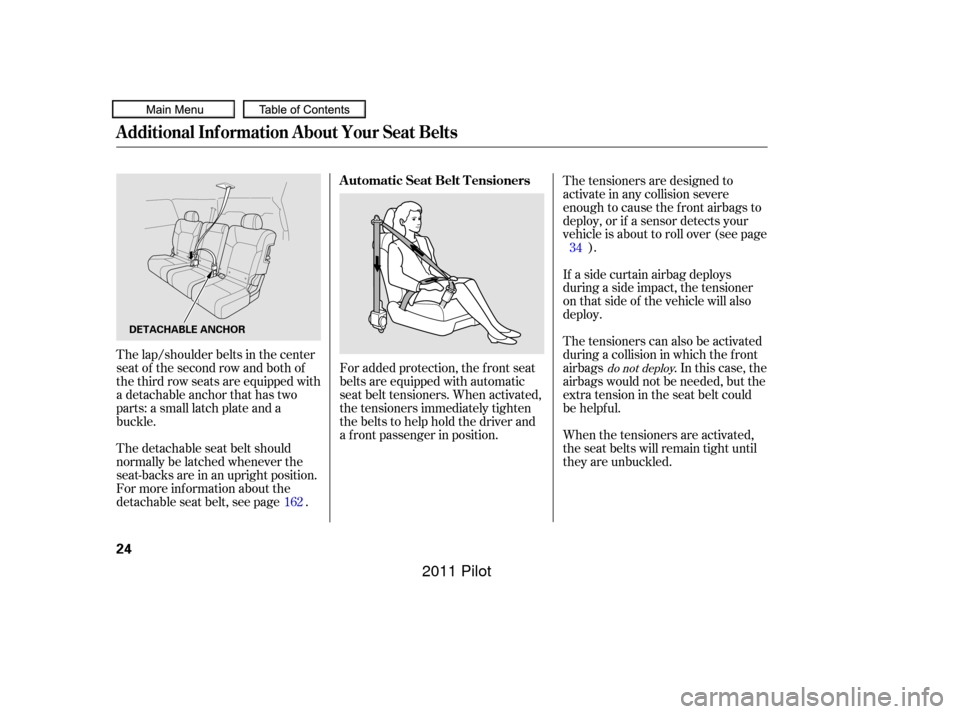
For added protection, the f ront seat
belts are equipped with automatic
seat belt tensioners. When activated,
the tensioners immediately tighten
the belts to help hold the driver and
a f ront passenger in position.The tensioners are designed to
activate in any collision severe
enough to cause the f ront airbags to
deploy, or if a sensor detects your
vehicle is about to roll over (see page
).
The tensioners can also be activated
during a collision in which the f ront
airbags . In this case, the
airbags would not be needed, but the
extra tension in the seat belt could
be helpf ul. If a side curtain airbag deploys
during a side impact, the tensioner
on that side of the vehicle will also
deploy.
The lap/shoulder belts in the center
seat of the second row and both of
the third row seats are equipped with
a detachable anchor that has two
parts: a small latch plate and a
buckle.
The detachable seat belt should
normally be latched whenever the
seat-backs are in an upright position.
For more inf ormation about the
detachable seat belt, see page . When the tensioners are activated,
the seat belts will remain tight until
they are unbuckled.
162 34do not deploy
A utomatic Seat Belt T ensioners
Additional Inf ormation About Your Seat Belts
24
DETACHABLE ANCHOR
10/01/26 18:26:57 31SZA620_029
2011 Pilot
Page 30 of 574
Additional Inf ormation About Your Airbags
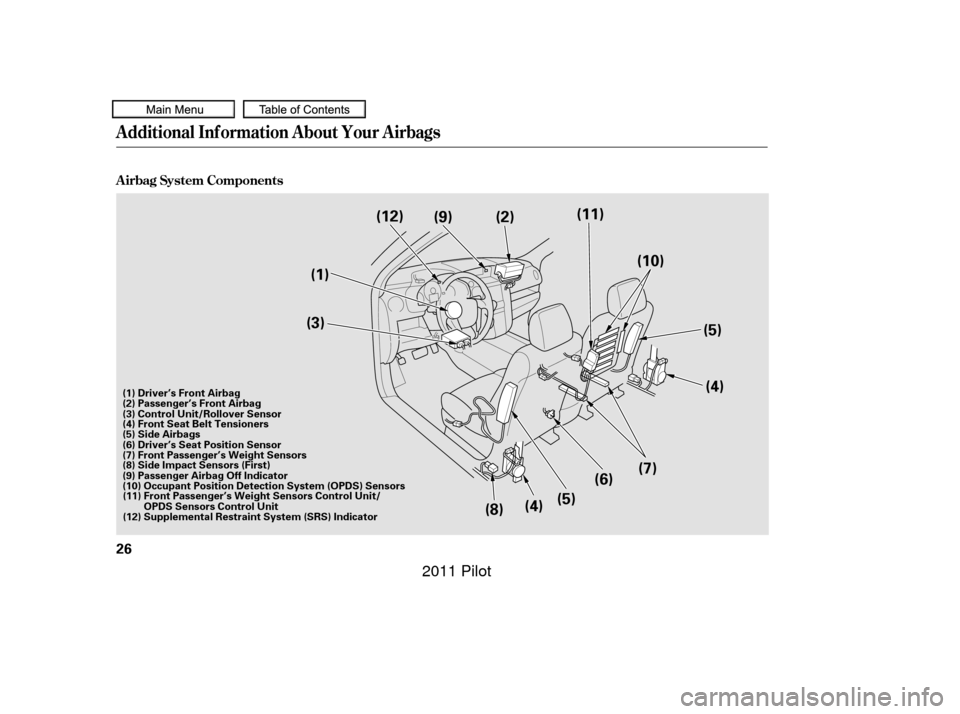
A irbag System Components
26
(5)
(3) (2)
(9)
(1)
(6)(4)
(5) (10)
(11)
(7)
(4)
(8)
(12)
(1) Driver’s Front Airbag
(2) Passenger’s Front Airbag
(3) Control Unit/Rollover Sensor
(4) Front Seat Belt Tensioners
(5) Side Airbags
(6) Driver’s Seat Position Sensor
(7) Front Passenger’s Weight Sensors
(8) Side Impact Sensors (First)
(9) Passenger Airbag Off Indicator
(10) Occupant Position Detection System (OPDS) Sensors
(11) Front Passenger’s Weight Sensors Control Unit/
OPDS Sensors Control Unit
(12) Supplemental Restraint System ( SRS) Indicator
10/01/26 18:27:10 31SZA620_031
2011 Pilot
Page 31 of 574
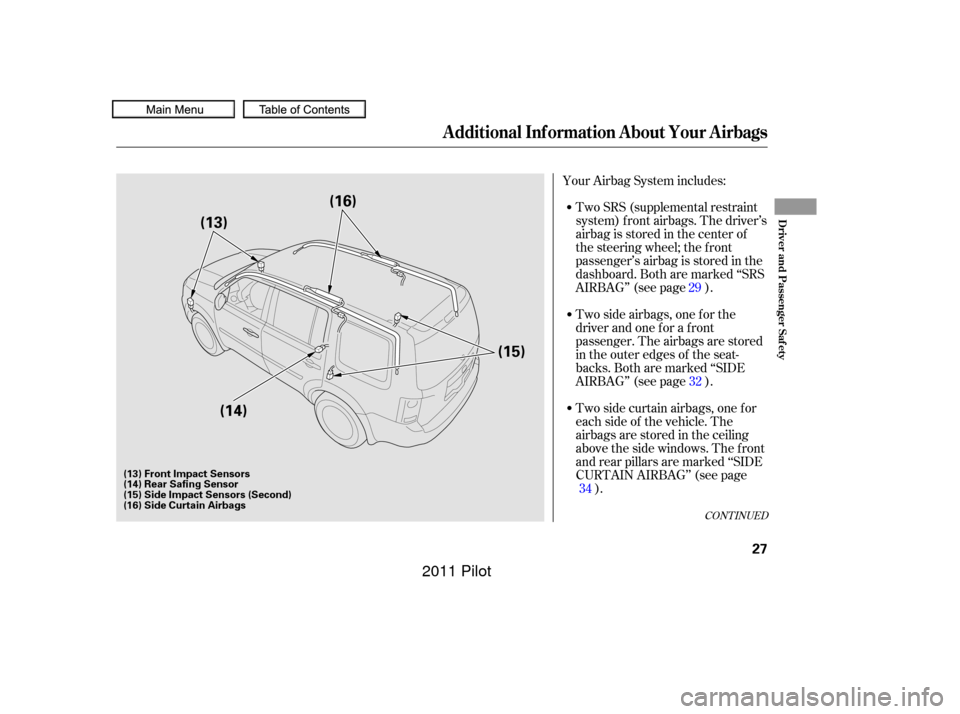
Two side airbags, one f or the
driver and one f or a f ront
passenger. The airbags are stored
in the outer edges of the seat-
backs. Both are marked ‘‘SIDE
AIRBAG’’ (see page ). Two SRS (supplemental restraint
system) f ront airbags. The driver’s
airbag is stored in the center of
the steering wheel; the f ront
passenger’sairbagisstoredinthe
dashboard. Both are marked ‘‘SRS
AIRBAG’’ (see page ).
Two side curtain airbags, one f or
each side of the vehicle. The
airbags are stored in the ceiling
above the side windows. The f ront
and rear pillars are marked ‘‘SIDE
CURTAIN AIRBAG’’ (see page).
Your Airbag System includes:
2932
34
CONT INUED
Additional Inf ormation About Your Airbags
Driver and Passenger Saf ety
27
(13) (16)
(15)
(14)
(13) Front Impact Sensors
(14) Rear Safing Sensor
(15) Side Impact Sensors (Second)
(16) Side Curtain Airbags
10/01/26 18:27:18 31SZA620_032
2011 Pilot
Page 32 of 574
Automatic front seat belt
tensioners (see page ).Weight sensors that monitor the
weight on the f ront passenger’s
seat. If the weight is about 65 lbs
(29 kg) or less (the weight of an
inf ant or small child), the
passenger’s f ront airbag will be
turned of f (see page ).
A rollover sensor that can detect if
your vehicle is about to roll over
and signal the control unit to
deploy both side curtain airbags
and f ront seat belt tensioners (see
page ).
A sophisticated electronic system
that continually monitors and
records inf ormation about the
sensors, the control unit, the
airbag activators, the seat belt
tensioners, and driver and f ront
passenger seat belt use when the
ignition switch is in the ON (II)
position.
Sensors that can detect a
moderate to severe front impact,
side impact, or if your vehicle is
about to rollover.
Sensors that can detect whether a
child is in the passenger’s side
airbag path and signal the control
unit to turn the airbag of f (see
page ).
Sensors that can detect whether
the driver’s seat belt and the f ront
passenger’s seat belt are latched
or unlatched (see page ).
A driver’s seat position sensor that
monitors the distance of the seat
from the front airbag. If the seat is
too f ar f orward, the airbag will
inf late with less f orce (see page
). An indicator on the instrument
panel that alerts you to a possible
problem with your airbag system
components (see page ).
An indicator on the instrument
panel that alerts you that the
passenger’s side airbag has been
turned of f (see page ).
An indicator on the dashboard that
alerts you that the passenger’s
f ront airbag has been turned of f
(see page ).
Emergency backup power in case
your vehicle’s electrical system is
disconnected in a crash.
24
33 22
31 31
34 3535
36
Additional Inf ormation About Your Airbags
28
10/01/26 18:27:30 31SZA620_033
2011 Pilot