brake light HONDA PILOT 2013 2.G Owner's Manual
[x] Cancel search | Manufacturer: HONDA, Model Year: 2013, Model line: PILOT, Model: HONDA PILOT 2013 2.GPages: 488, PDF Size: 10.18 MB
Page 379 of 488
378
Maintenance
Before Performing Maintenance
Inspection and Maintenance
For your safety, perform all listed inspections and maintenance to keep your vehicle
in good condition. If you become aware of any abnormality (noise, smell, insufficient
brake fluid, oil residue on the ground, etc.), have your vehicle inspected by a dealer.
(Note, however, that service at a dealer is not mandatory to keep your warranties in
effect.) Refer to the separate maintenance booklet for detailed maintenance and
inspection information.
■Daily inspections
Perform inspections before long distance trips, when washing the vehicle, or when
refueling.
■Periodic inspections
•Check the automatic transmission fluid level monthly.
2Automatic Transmission Fluid P. 399
•Check the brake fluid level monthly.
2Checking the Brake Fluid P. 400
•Check the tire pressure monthly. Examine the tread for wear and foreign objects.
2Checking and Maintaining Tires P. 414
•Check the operation of the exterior lights monthly.
2Replacing Light Bulbs P. 402
•Check the condition of the wiper blades at least every six months.
2Checking and Maintaining Wiper Blades P. 410
■Types of Inspection and Maintenance
1Inspection and Maintenance
Maintenance, replacement, or repair of
emissions control devices and systems may be done by any automotive repair establishment or
individuals using parts that are “certified” to
EPA standards.
According to state and federal regulations, failure to
perform maintenance on the maintenance main items marked with # will not void your emissions
warranties. However, all maintenance services should
be performed in accordance with the intervals indicated by the information display*/multi-
information display*.
2Maintenance Service Items P. 383
If you want to perform complex maintenance tasks
that require more skills and tools, purchase the service manual.
2Authorized Manuals P. 474
If you want to perform maintenance yourself, make
sure that you have the necessary tools and skills first.
After performing maintenance, update the records in the separate maintenance booklet.
U.S. models
* Not available on all models
Page 391 of 488
390
uuMaintenance Under the HooduOpening the Hood
Maintenance
Opening the Hood
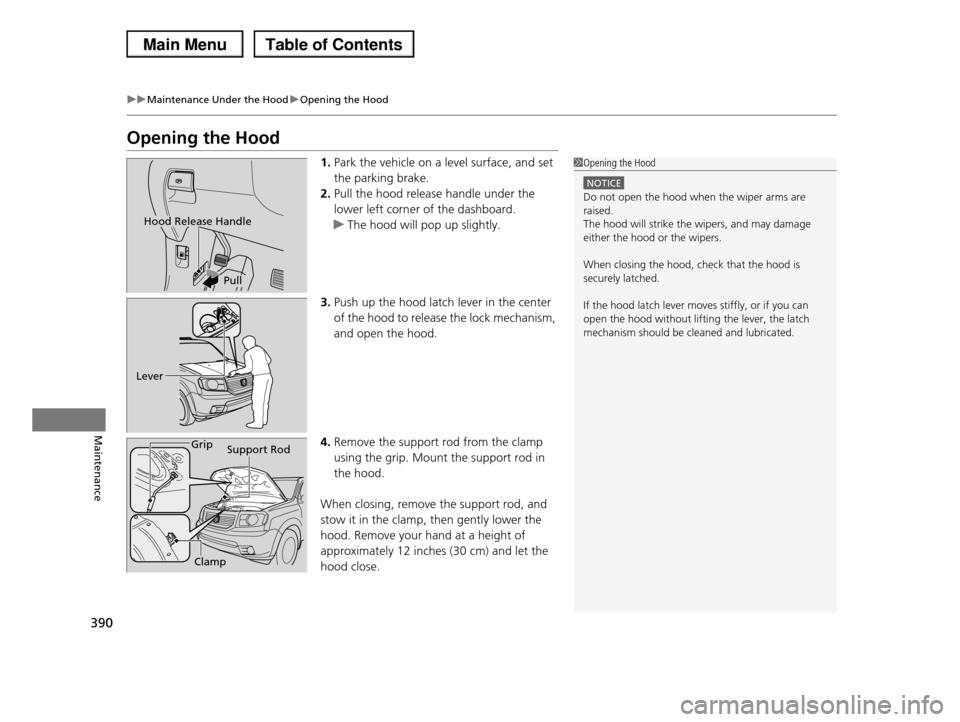
1.Park the vehicle on a level surface, and set
the parking brake.
2.Pull the hood release handle under the
lower left corner of the dashboard.
uThe hood will pop up slightly.
3.Push up the hood latch lever in the center
of the hood to release the lock mechanism,
and open the hood.
4.Remove the support rod from the clamp
using the grip. Mount the support rod in
the hood.
When closing, remove the support rod, and
stow it in the clamp, then gently lower the
hood. Remove your hand at a height of
approximately 12 inches (30 cm) and let the
hood close.
1Opening the Hood
NOTICE
Do not open the hood when the wiper arms are
raised. The hood will strike the wipers, and may damage
either the hood or the wipers.
When closing the hood, check that the hood is
securely latched.
If the hood latch lever moves stiffly, or if you can open the hood without lifting the lever, the latch
mechanism should be cleaned and lubricated.
Hood Release Handle
Pull
Lever
Support RodGrip
Clamp
Page 403 of 488
402
Maintenance
Replacing Light Bulbs
Headlight Bulbs
When replacing, use the following bulbs.
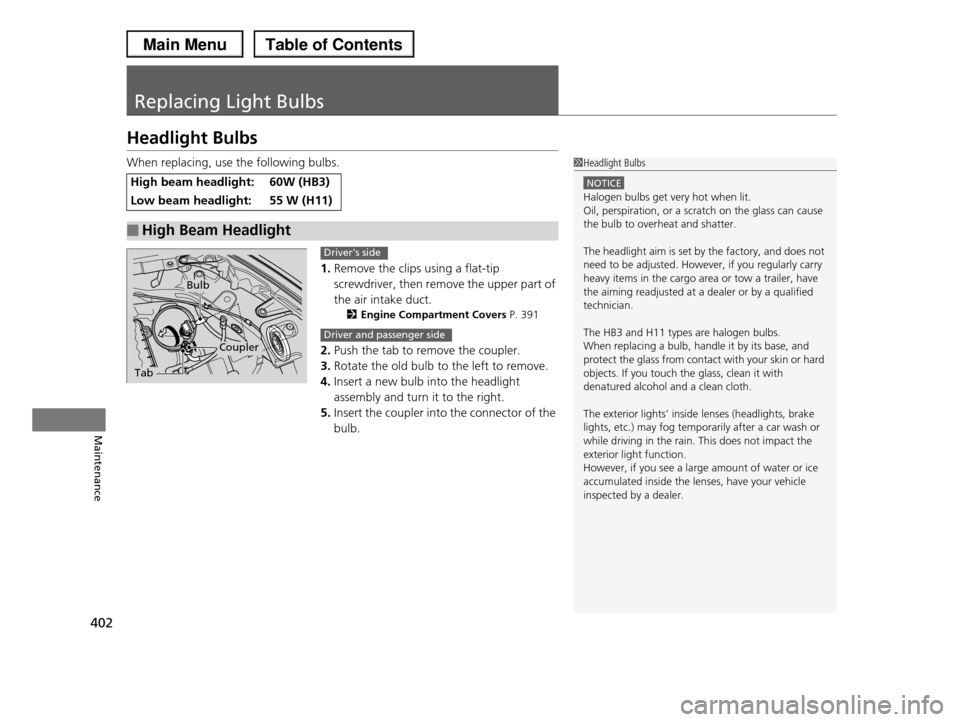
1.Remove the clips using a flat-tip
screwdriver, then remove the upper part of
the air intake duct.
2Engine Compartment Covers P. 391
2.Push the tab to remove the coupler.
3.Rotate the old bulb to the left to remove.
4.Insert a new bulb into the headlight
assembly and turn it to the right.
5.Insert the coupler into the connector of the
bulb.
High beam headlight:60W (HB3)
Low beam headlight:55 W (H11)
■High Beam Headlight
1Headlight Bulbs
NOTICE
Halogen bulbs get very hot when lit.
Oil, perspiration, or a scratch on the glass can cause the bulb to overheat and shatter.
The headlight aim is set by the factory, and does not need to be adjusted. However, if you regularly carry
heavy items in the cargo area or tow a trailer, have
the aiming readjusted at a dealer or by a qualified technician.
The HB3 and H11 types are halogen bulbs.
When replacing a bulb, handle it by its base, and protect the glass from contact with your skin or hard
objects. If you touch the glass, clean it with
denatured alcohol and a clean cloth.
The exterior lights' inside lenses (headlights, brake
lights, etc.) may fog temporarily after a car wash or while driving in the rain. This does not impact the
exterior light function.
However, if you see a large amount of water or ice accumulated inside the lenses, have your vehicle
inspected by a dealer.
Tab
Coupler
Bulb
Driver's side
Driver and passenger side
Page 407 of 488
406
uuReplacing Light BulbsuBrake Light, Taillight, Back-Up Light, Rear Turn Signal Light and Rear Side Marker Light Bulbs
Maintenance
Brake Light, Taillight, Back-Up Light, Rear Turn
Signal Light and Rear Side Marker Light Bulbs
When replacing, use the following bulbs.
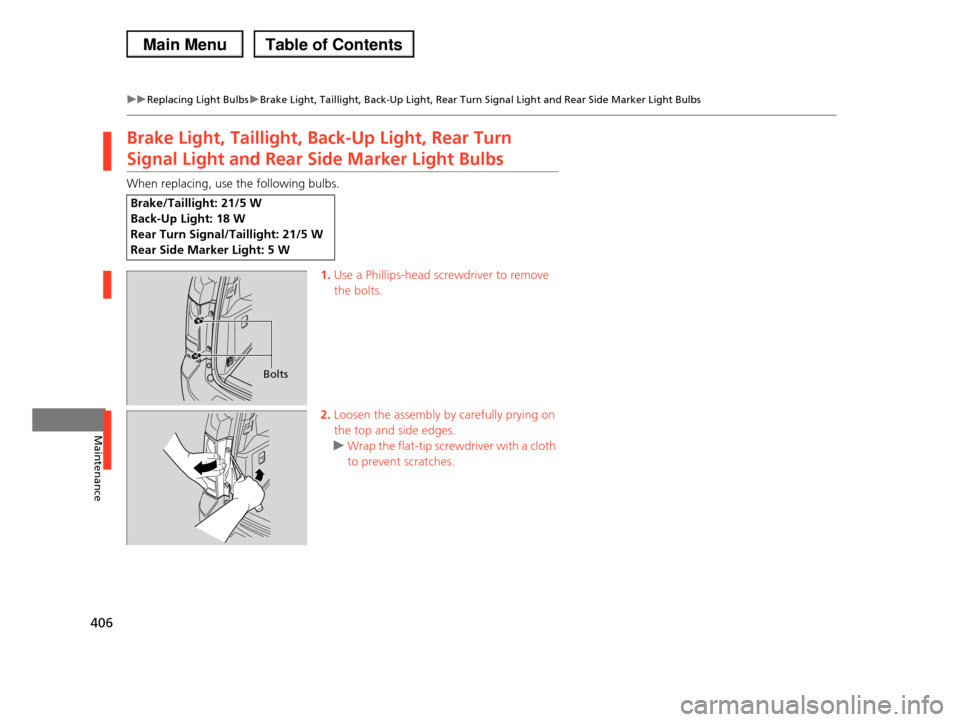
1.Use a Phillips-head screwdriver to remove
the bolts.
2.Loosen the assembly by carefully prying on
the top and side edges.
uWrap the flat-tip screwdriver with a cloth
to prevent scratches.
Brake/Taillight: 21/5 W
Back-Up Light: 18 W
Rear Turn Signal/Taillight: 21/5 W
Rear Side Marker Light: 5 W
Bolts
Page 408 of 488
407
uuReplacing Light BulbsuBrake Light, Taillight, Back-Up Light, Rear Turn Signal Light and Rear Side Marker Light Bulbs
Maintenance
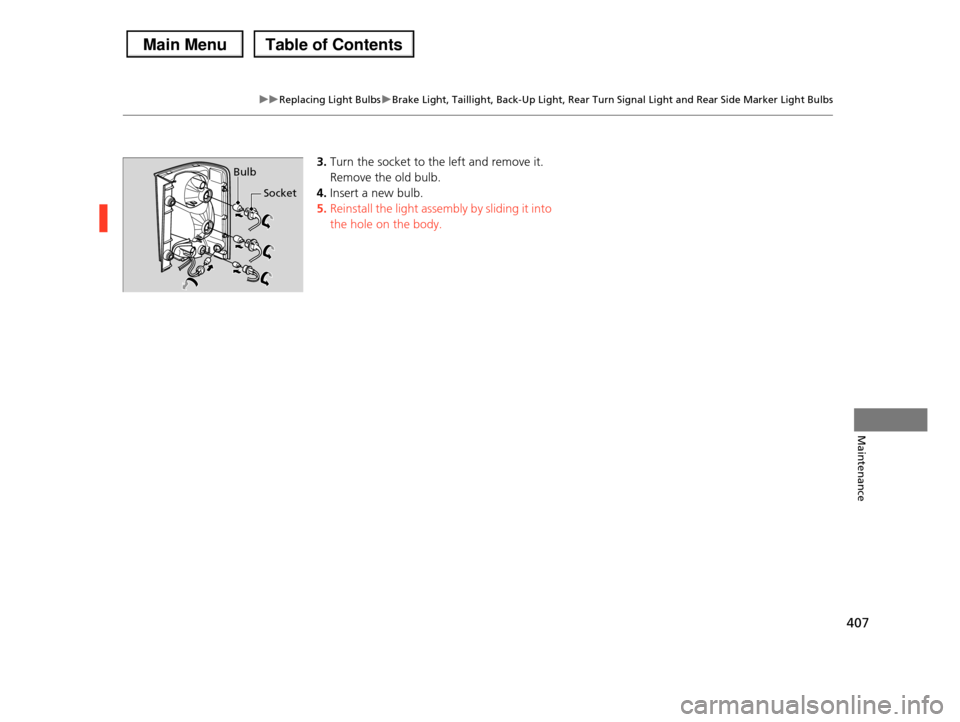
3.Turn the socket to the left and remove it.
Remove the old bulb.
4.Insert a new bulb.
5.Reinstall the light assembly by sliding it into
the hole on the body.
Bulb
Socket
Page 410 of 488
409
uuReplacing Light BulbsuHigh-Mount Brake Light Bulb
Maintenance
High-Mount Brake Light Bulb
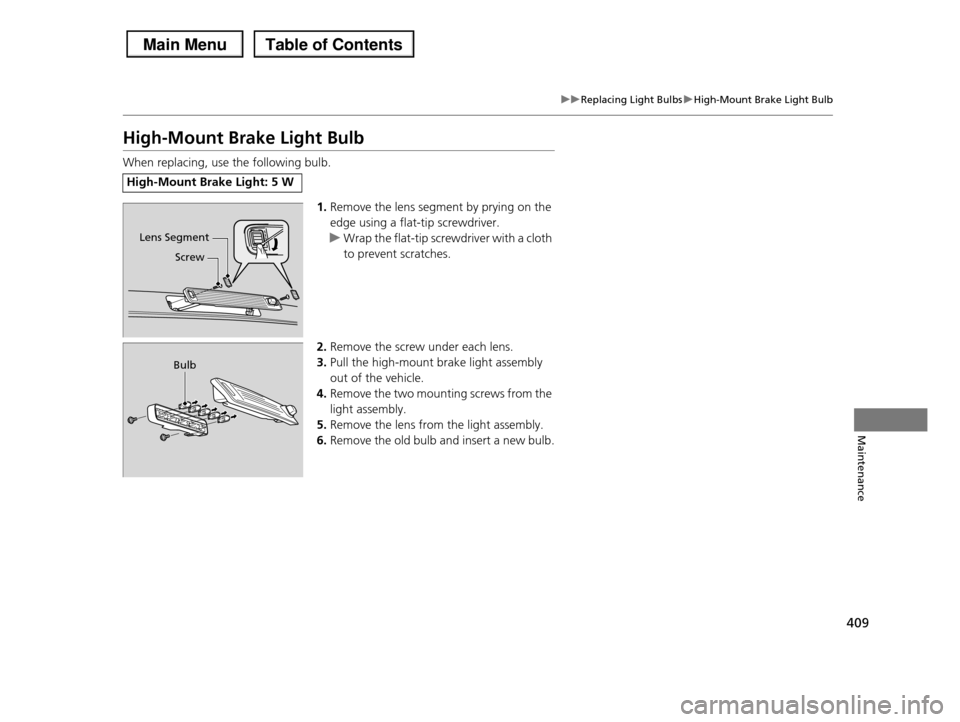
When replacing, use the following bulb.
1.Remove the lens segment by prying on the
edge using a flat-tip screwdriver.
uWrap the flat-tip screwdriver with a cloth
to prevent scratches.
2.Remove the screw under each lens.
3.Pull the high-mount brake light assembly
out of the vehicle.
4.Remove the two mounting screws from the
light assembly.
5.Remove the lens from the light assembly.
6.Remove the old bulb and insert a new bulb.
High-Mount Brake Light: 5 W
Screw
Lens Segment
Bulb
Page 436 of 488
435Continued
Handling the Unexpected
If a Tire Goes Flat
Changing a Flat Tire
If a tire goes flat while driving, grasp the steering wheel firmly, and brake gradually
to reduce speed. Then, stop in a safe place. Replace the flat tire with a compact
spare tire. Go to a dealer as soon as possible to have the full-size tire repaired or
replaced.
1.Park the vehicle on firm, level, and non-slippery surface and apply the parking
brake.
2.Move the shift lever to (P.
3.Turn on the hazard warning lights and turn the ignition switch to LOCK (0.
1Changing a Flat Tire
Periodically check the tire pressure of the compact
spare. It should be set to the specified pressure.
Specified Pressure: 60 psi (420 kPa, 4.2 kgf/cm2)
When driving with the compact spare tire, keep the
vehicle speed under 50 mph (80 km/h). Replace with a full-size tire as soon as possible.
The compact spare tire and wheel in your vehicle are specifically for this model.
Do not use them with another vehicle.
Do not use another type of compact spare tire or wheel with your vehicle.
Do not mount tire chains on a compact spare tire. If a chain-mounted front tire goes flat, remove one of
the full-size rear tires and replace it with the compact
spare tire. Remove the flat front tire and replace it with the full-size tire that was removed from the rear.
Mount the tire chains on the front tire.
Do not use a puncture-repairing agent on a flat tire,
as it can damage the tire pressure sensor.
Page 453 of 488
452
uuIndicator, Coming On/BlinkinguIf the Brake System Indicator (Red) Comes On
Handling the Unexpected
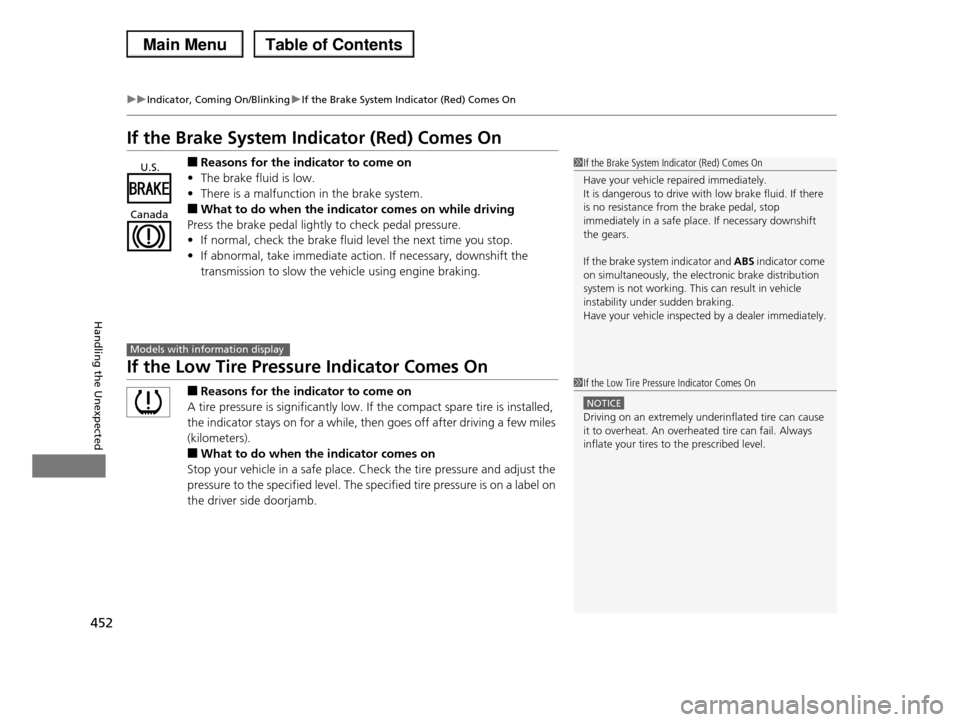
If the Brake System Indicator (Red) Comes On
■Reasons for the indicator to come on
•The brake fluid is low.
•There is a malfunction in the brake system.
■What to do when the indicator comes on while driving
Press the brake pedal lightly to check pedal pressure.
•If normal, check the brake fluid level the next time you stop.
•If abnormal, take immediate action. If necessary, downshift the
transmission to slow the vehicle using engine braking.
If the Low Tire Pressure Indicator Comes On
■Reasons for the indicator to come on
A tire pressure is significantly low. If the compact spare tire is installed,
the indicator stays on for a while, then goes off after driving a few miles
(kilometers).
■What to do when the indicator comes on
Stop your vehicle in a safe place. Check the tire pressure and adjust the
pressure to the specified level. The specified tire pressure is on a label on
the driver side doorjamb.
1If the Brake System Indicator (Red) Comes On
Have your vehicle repaired immediately.
It is dangerous to drive with low brake fluid. If there is no resistance from the brake pedal, stop
immediately in a safe place. If necessary downshift
the gears.
If the brake system indicator and ABS indicator come
on simultaneously, the electronic brake distribution system is not working. This can result in vehicle
instability under sudden braking.
Have your vehicle inspected by a dealer immediately.
U.S.
Canada
Models with information display
1If the Low Tire Pressure Indicator Comes On
NOTICE
Driving on an extremely underinflated tire can cause
it to overheat. An overheated tire can fail. Always inflate your tires to the prescribed level.
Page 456 of 488
455
uuFusesuFuse Locations
Continued
Handling the Unexpected
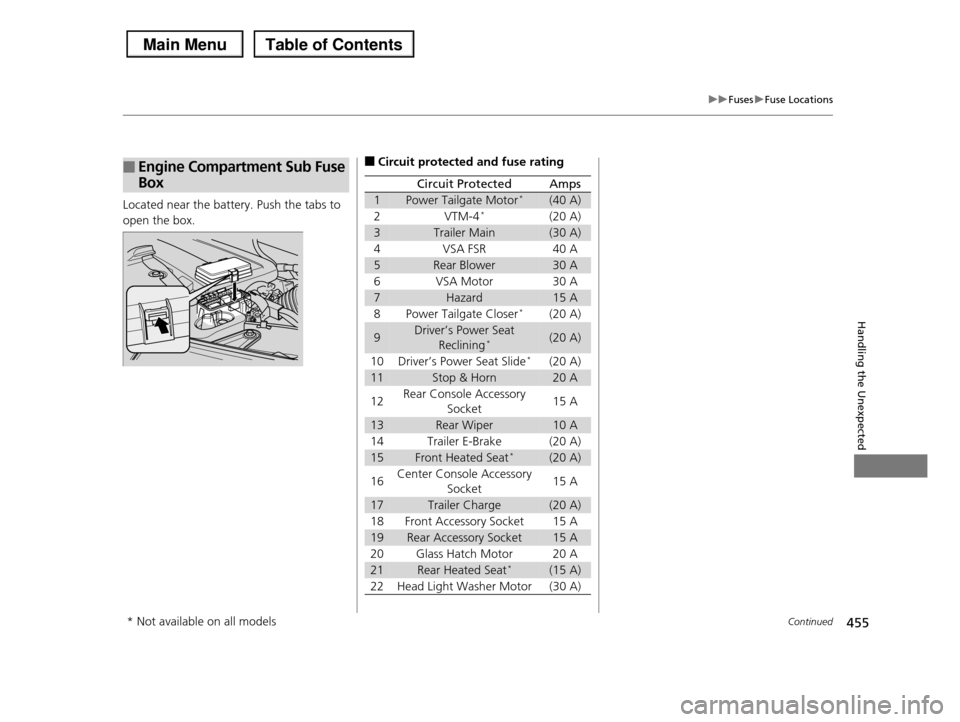
Located near the battery. Push the tabs to
open the box.
■Engine Compartment Sub Fuse
Box
■Circuit protected and fuse rating
Circuit ProtectedAmps
1Power Tailgate Motor*(40 A)
2VTM-4*(20 A)
3Trailer Main(30 A)
4VSA FSR40 A
5Rear Blower30 A
6VSA Motor 30A
7Hazard15 A
8 Power Tailgate Closer*(20 A)
9Driver’s Power Seat
Reclining*(20 A)
10 Driver’s Power Seat Slide*(20 A)
11Stop & Horn20 A
12Rear Console Accessory
Socket15 A
13Rear Wiper10 A
14 Trailer E-Brake (20 A)
15Front Heated Seat*(20 A)
16Center Console Accessory
Socket15 A
17Trailer Charge(20 A)
18 Front Accessory Socket 15 A
19Rear Accessory Socket15 A
20 Glass Hatch Motor 20 A
21Rear Heated Seat*(15 A)
22 Head Light Washer Motor (30 A)
* Not available on all models
Page 465 of 488
464
Information
Specifications
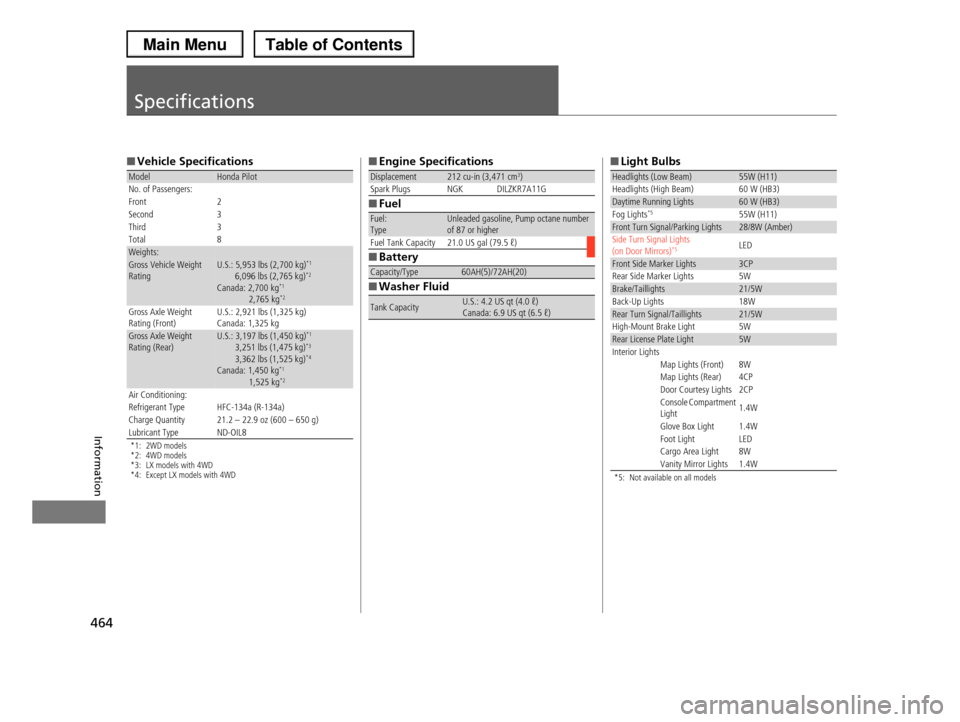
■Vehicle Specifications
*1: 2WD models *2: 4WD models*3: LX models with 4WD*4: Except LX models with 4WD
ModelHonda PilotNo. of Passengers: Front 2Second 3Third 3Total 8Weights:Gross Vehicle Weight Rating U.S.: 5,953 lbs (2,700 kg)*1
6,096 lbs (2,765 kg)*2
Canada: 2,700 kg*1
2,765 kg*2
Gross Axle Weight Rating (Front)U.S.: 2,921 lbs (1,325 kg)Canada: 1,325 kgGross Axle Weight Rating (Rear)U.S.: 3,197 lbs (1,450 kg)*1
3,251 lbs (1,475 kg)*3
3,362 lbs (1,525 kg)*4
Canada: 1,450 kg*1
1,525 kg*2
Air Conditioning:Refrigerant Type HFC-134a (R-134a)Charge Quantity21.2 – 22.9 oz (600 – 650 g)Lubricant TypeND-OIL8
■Engine Specifications
■Fuel
■Battery
■Washer Fluid
Displacement212 cu-in (3,471 cm3)Spark Plugs NGK DILZKR7A11G
Fuel:TypeUnleaded gasoline, Pump octane number of 87 or higherFuel Tank Capacity 21.0 US gal (79.5 ℓ)
Capacity/Type60AH(5)/72AH(20)
Tank CapacityU.S.: 4.2 US qt (4.0 ℓ)Canada: 6.9 US qt (6.5 ℓ)
■Light Bulbs
*5: Not available on all models
Headlights (Low Beam)55W (H11)Headlights (High Beam) 60 W (HB3)Daytime Running Lights60 W (HB3)Fog Lights*555W (H11)Front Turn Signal/Parking Lights28/8W (Amber)Side Turn Signal Lights (on Door Mirrors)*5 LED
Front Side Marker Lights3CPRear Side Marker Lights 5WBrake/Taillights21/5WBack-Up Lights 18WRear Turn Signal/Taillights21/5WHigh-Mount Brake Light 5WRear License Plate Light5WInterior LightsMap Lights (Front) 8W Map Lights (Rear) 4CPDoor Courtesy Lights 2CPConsole Compartment Light1.4W
Glove Box Light 1.4W Foot Light LEDCargo Area Light 8WVanity Mirror Lights 1.4W