brake HONDA PILOT 2013 2.G Workshop Manual
[x] Cancel search | Manufacturer: HONDA, Model Year: 2013, Model line: PILOT, Model: HONDA PILOT 2013 2.GPages: 488, PDF Size: 10.18 MB
Page 408 of 488
407
uuReplacing Light BulbsuBrake Light, Taillight, Back-Up Light, Rear Turn Signal Light and Rear Side Marker Light Bulbs
Maintenance
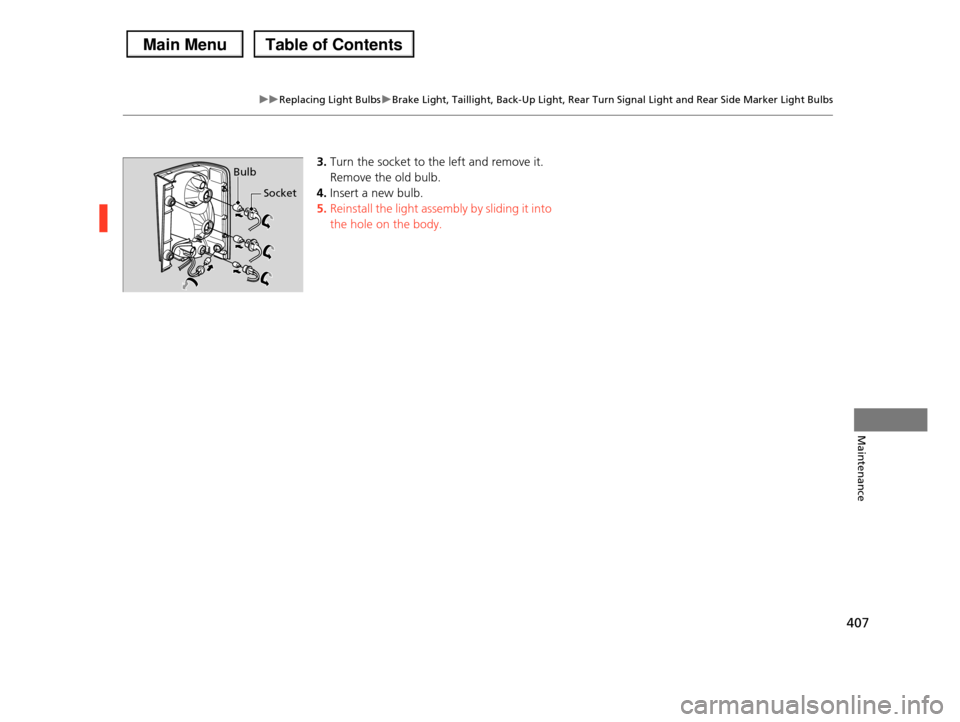
3.Turn the socket to the left and remove it.
Remove the old bulb.
4.Insert a new bulb.
5.Reinstall the light assembly by sliding it into
the hole on the body.
Bulb
Socket
Page 410 of 488
409
uuReplacing Light BulbsuHigh-Mount Brake Light Bulb
Maintenance
High-Mount Brake Light Bulb
When replacing, use the following bulb.
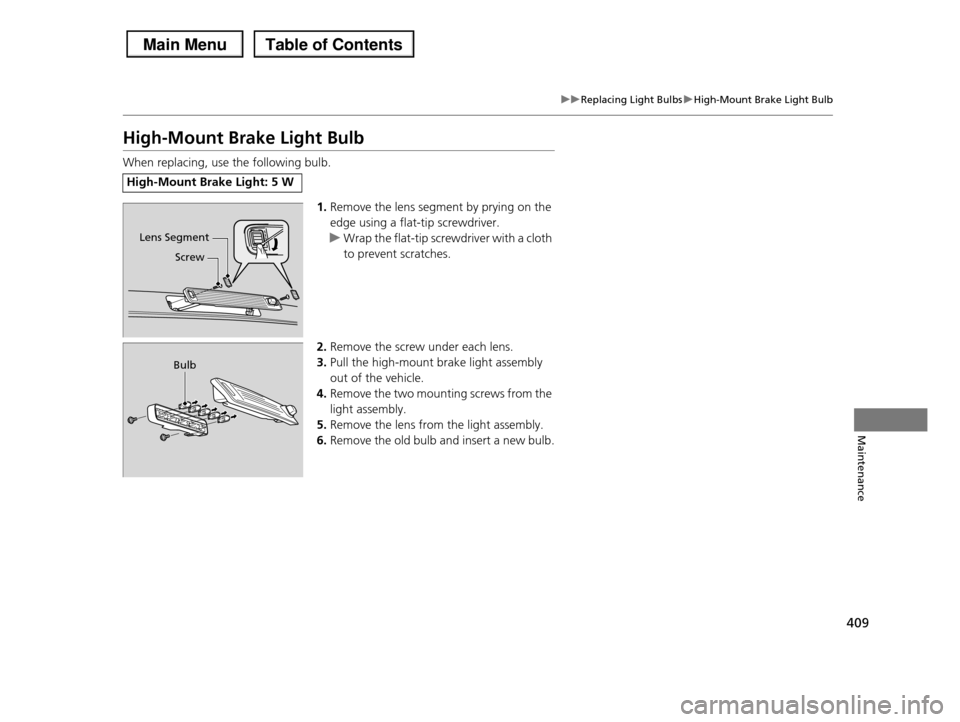
1.Remove the lens segment by prying on the
edge using a flat-tip screwdriver.
uWrap the flat-tip screwdriver with a cloth
to prevent scratches.
2.Remove the screw under each lens.
3.Pull the high-mount brake light assembly
out of the vehicle.
4.Remove the two mounting screws from the
light assembly.
5.Remove the lens from the light assembly.
6.Remove the old bulb and insert a new bulb.
High-Mount Brake Light: 5 W
Screw
Lens Segment
Bulb
Page 423 of 488
422
uuChecking and Maintaining TiresuWinter Tires
Maintenance
Winter Tires
If driving on snowy or frozen roads, mount all season marked “M+S” tires, snow
tires, or tire chains; reduce speed; and maintain sufficient distance between vehicles
when driving.
Be particularly careful when operating the steering wheel or brakes to prevent
skidding.
Use tire chains, snow tires, or all season tires when necessary or according to the law.
When mounting, refer to the following points.
For winter tires:
•Select the size and load ranges that are the same as the original tires.
•Mount the tires to all four wheels.
For tire chains:
•Install them on the front tires only.
•Because your vehicle has limited tire clearance, we strongly recommend using the
chains listed below:
•Follow the chain manufacturer's instruction when installing. Mount them as
tightly as you can.
•Check that the chains do not touch the brake lines or suspension.
•Drive slowly.
Cable-type: QCC Premium Cobra 1046P
1Winter Tires
NOTICE
Traction devices that are the wrong size or improperly
installed can damage your vehicle's brake lines, suspension, body, and wheels. Stop driving if they are
hitting any part of the vehicle.
When tire chains are mounted, follow the chain
manufacturer's instructions regarding vehicle
operational limits.
If your vehicle is equipped with summer tires, be
aware that these tires are not designed for winter driving conditions. For more information, contact a
dealer.
3WARNING
Using the wrong chains, or not properly
installing chains, can damage the brake
lines and cause a crash in which you can be
seriously injured or killed.
Follow all instructions in this owner's
manual regarding the selection and use of
tire chains.
Page 434 of 488
433
Handling the Unexpected
This chapter explains how to handle unexpected troubles.
Tools
Types of Tools .................................. 434
If a Tire Goes Flat
Changing a Flat Tire ......................... 435
Engine Does Not Start
Checking the Engine ........................ 444
Jump Starting.................................... 445
Shift Lever Does Not Move.............. 447
Overheating
How to Handle Overheating ............. 448
Indicator, Coming On/Blinking
If the Low Oil Pressure Indicator Comes
On ............................................. 450
If the Charging System Indicator Comes
On ................................................. 450
If the Malfunction Indicator Lamp Comes
On or Blinks ................................... 451
If the Brake System Indicator (Red) Comes
On ................................................. 452
If the Low Tire Pressure Indicator Comes
On ................................................. 452
If the TPMS Indicator Comes On ...... 453
If the Low Tire Pressure/TPMS Indicator
Comes On or Blinks ....................... 453
Fuses
Fuse Locations ................................. 454
Inspecting and Changing Fuses ........ 458
Emergency Towing........................... 459
When You Cannot Open the Tailgate..... 461
Page 436 of 488
435Continued
Handling the Unexpected
If a Tire Goes Flat
Changing a Flat Tire
If a tire goes flat while driving, grasp the steering wheel firmly, and brake gradually
to reduce speed. Then, stop in a safe place. Replace the flat tire with a compact
spare tire. Go to a dealer as soon as possible to have the full-size tire repaired or
replaced.
1.Park the vehicle on firm, level, and non-slippery surface and apply the parking
brake.
2.Move the shift lever to (P.
3.Turn on the hazard warning lights and turn the ignition switch to LOCK (0.
1Changing a Flat Tire
Periodically check the tire pressure of the compact
spare. It should be set to the specified pressure.
Specified Pressure: 60 psi (420 kPa, 4.2 kgf/cm2)
When driving with the compact spare tire, keep the
vehicle speed under 50 mph (80 km/h). Replace with a full-size tire as soon as possible.
The compact spare tire and wheel in your vehicle are specifically for this model.
Do not use them with another vehicle.
Do not use another type of compact spare tire or wheel with your vehicle.
Do not mount tire chains on a compact spare tire. If a chain-mounted front tire goes flat, remove one of
the full-size rear tires and replace it with the compact
spare tire. Remove the flat front tire and replace it with the full-size tire that was removed from the rear.
Mount the tire chains on the front tire.
Do not use a puncture-repairing agent on a flat tire,
as it can damage the tire pressure sensor.
Page 448 of 488
447
Handling the Unexpected
Shift Lever Does Not Move
Follow the procedure below if you cannot move the shift lever out of the (P
position.
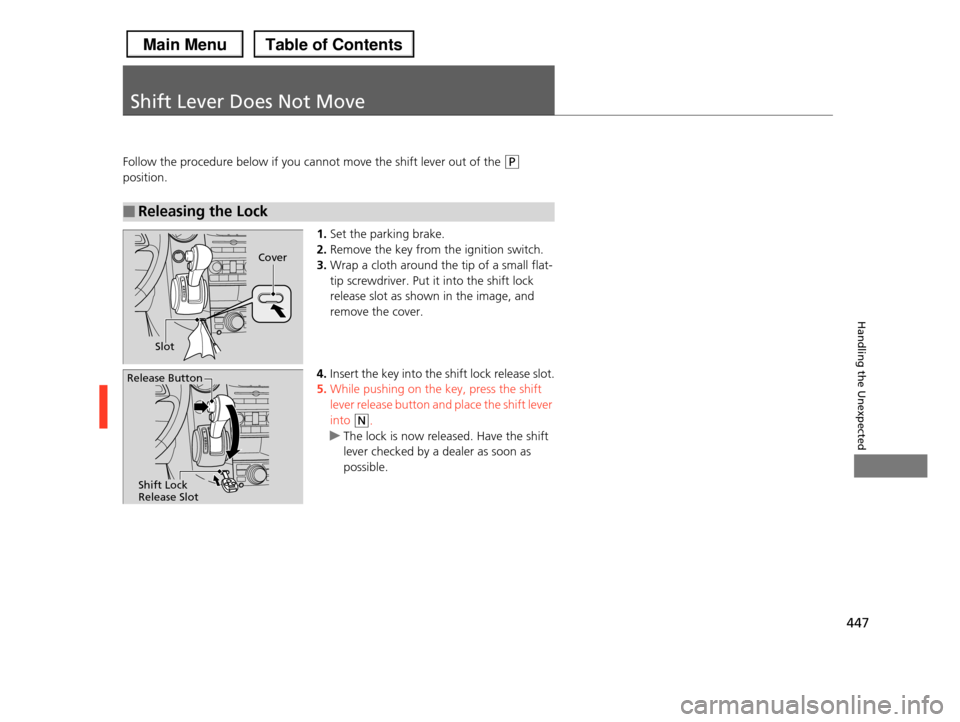
1.Set the parking brake.
2.Remove the key from the ignition switch.
3.Wrap a cloth around the tip of a small flat-
tip screwdriver. Put it into the shift lock
release slot as shown in the image, and
remove the cover.
4.Insert the key into the shift lock release slot.
5.While pushing on the key, press the shift
lever release button and place the shift lever
into (N.
uThe lock is now released. Have the shift
lever checked by a dealer as soon as
possible.
■Releasing the Lock
Slot
Cover
Release Button
Shift Lock Release Slot
Page 453 of 488
452
uuIndicator, Coming On/BlinkinguIf the Brake System Indicator (Red) Comes On
Handling the Unexpected
If the Brake System Indicator (Red) Comes On
■Reasons for the indicator to come on
•The brake fluid is low.
•There is a malfunction in the brake system.
■What to do when the indicator comes on while driving
Press the brake pedal lightly to check pedal pressure.
•If normal, check the brake fluid level the next time you stop.
•If abnormal, take immediate action. If necessary, downshift the
transmission to slow the vehicle using engine braking.
If the Low Tire Pressure Indicator Comes On
■Reasons for the indicator to come on
A tire pressure is significantly low. If the compact spare tire is installed,
the indicator stays on for a while, then goes off after driving a few miles
(kilometers).
■What to do when the indicator comes on
Stop your vehicle in a safe place. Check the tire pressure and adjust the
pressure to the specified level. The specified tire pressure is on a label on
the driver side doorjamb.
1If the Brake System Indicator (Red) Comes On
Have your vehicle repaired immediately.
It is dangerous to drive with low brake fluid. If there is no resistance from the brake pedal, stop
immediately in a safe place. If necessary downshift
the gears.
If the brake system indicator and ABS indicator come
on simultaneously, the electronic brake distribution system is not working. This can result in vehicle
instability under sudden braking.
Have your vehicle inspected by a dealer immediately.
U.S.
Canada
Models with information display
1If the Low Tire Pressure Indicator Comes On
NOTICE
Driving on an extremely underinflated tire can cause
it to overheat. An overheated tire can fail. Always inflate your tires to the prescribed level.
Page 456 of 488
455
uuFusesuFuse Locations
Continued
Handling the Unexpected
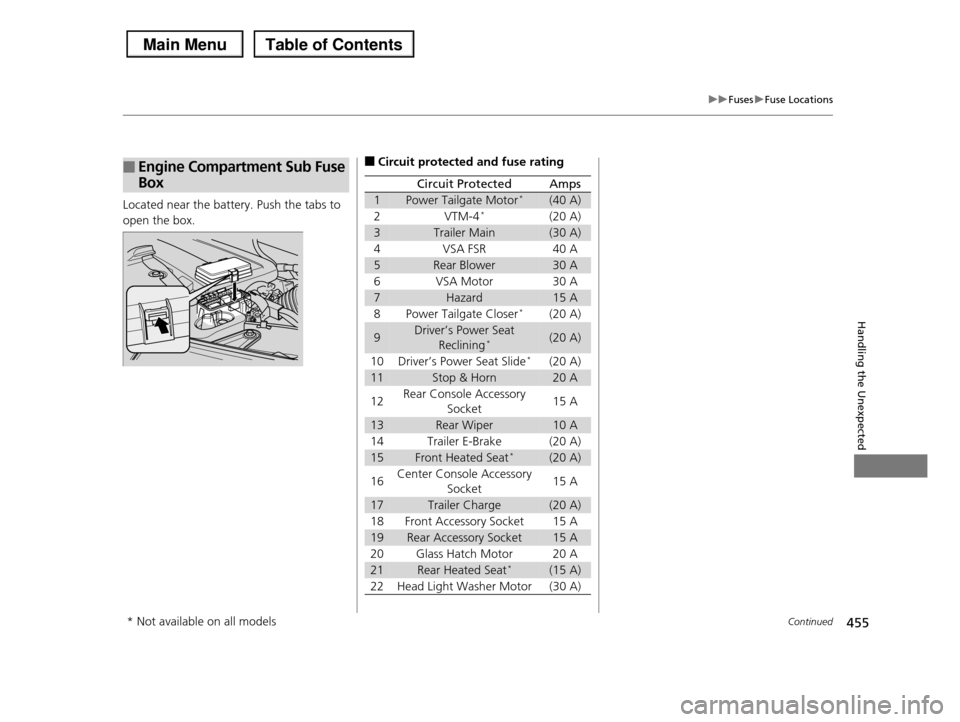
Located near the battery. Push the tabs to
open the box.
■Engine Compartment Sub Fuse
Box
■Circuit protected and fuse rating
Circuit ProtectedAmps
1Power Tailgate Motor*(40 A)
2VTM-4*(20 A)
3Trailer Main(30 A)
4VSA FSR40 A
5Rear Blower30 A
6VSA Motor 30A
7Hazard15 A
8 Power Tailgate Closer*(20 A)
9Driver’s Power Seat
Reclining*(20 A)
10 Driver’s Power Seat Slide*(20 A)
11Stop & Horn20 A
12Rear Console Accessory
Socket15 A
13Rear Wiper10 A
14 Trailer E-Brake (20 A)
15Front Heated Seat*(20 A)
16Center Console Accessory
Socket15 A
17Trailer Charge(20 A)
18 Front Accessory Socket 15 A
19Rear Accessory Socket15 A
20 Glass Hatch Motor 20 A
21Rear Heated Seat*(15 A)
22 Head Light Washer Motor (30 A)
* Not available on all models
Page 465 of 488
464
Information
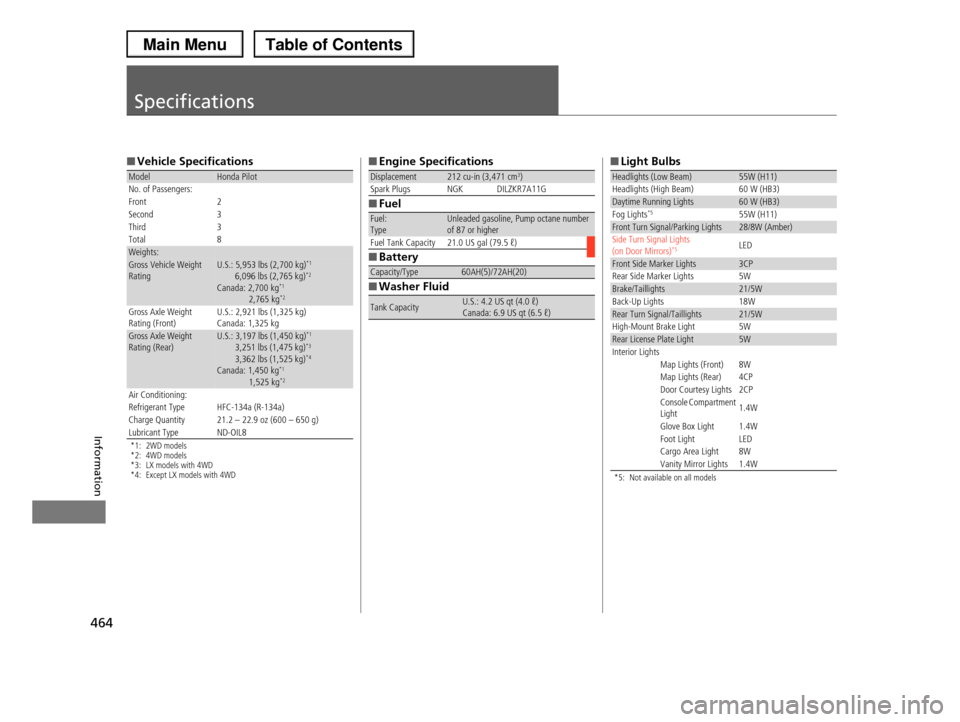
Specifications
■Vehicle Specifications
*1: 2WD models *2: 4WD models*3: LX models with 4WD*4: Except LX models with 4WD
ModelHonda PilotNo. of Passengers: Front 2Second 3Third 3Total 8Weights:Gross Vehicle Weight Rating U.S.: 5,953 lbs (2,700 kg)*1
6,096 lbs (2,765 kg)*2
Canada: 2,700 kg*1
2,765 kg*2
Gross Axle Weight Rating (Front)U.S.: 2,921 lbs (1,325 kg)Canada: 1,325 kgGross Axle Weight Rating (Rear)U.S.: 3,197 lbs (1,450 kg)*1
3,251 lbs (1,475 kg)*3
3,362 lbs (1,525 kg)*4
Canada: 1,450 kg*1
1,525 kg*2
Air Conditioning:Refrigerant Type HFC-134a (R-134a)Charge Quantity21.2 – 22.9 oz (600 – 650 g)Lubricant TypeND-OIL8
■Engine Specifications
■Fuel
■Battery
■Washer Fluid
Displacement212 cu-in (3,471 cm3)Spark Plugs NGK DILZKR7A11G
Fuel:TypeUnleaded gasoline, Pump octane number of 87 or higherFuel Tank Capacity 21.0 US gal (79.5 ℓ)
Capacity/Type60AH(5)/72AH(20)
Tank CapacityU.S.: 4.2 US qt (4.0 ℓ)Canada: 6.9 US qt (6.5 ℓ)
■Light Bulbs
*5: Not available on all models
Headlights (Low Beam)55W (H11)Headlights (High Beam) 60 W (HB3)Daytime Running Lights60 W (HB3)Fog Lights*555W (H11)Front Turn Signal/Parking Lights28/8W (Amber)Side Turn Signal Lights (on Door Mirrors)*5 LED
Front Side Marker Lights3CPRear Side Marker Lights 5WBrake/Taillights21/5WBack-Up Lights 18WRear Turn Signal/Taillights21/5WHigh-Mount Brake Light 5WRear License Plate Light5WInterior LightsMap Lights (Front) 8W Map Lights (Rear) 4CPDoor Courtesy Lights 2CPConsole Compartment Light1.4W
Glove Box Light 1.4W Foot Light LEDCargo Area Light 8WVanity Mirror Lights 1.4W
Page 466 of 488
465
uuSpecificationsu
Information
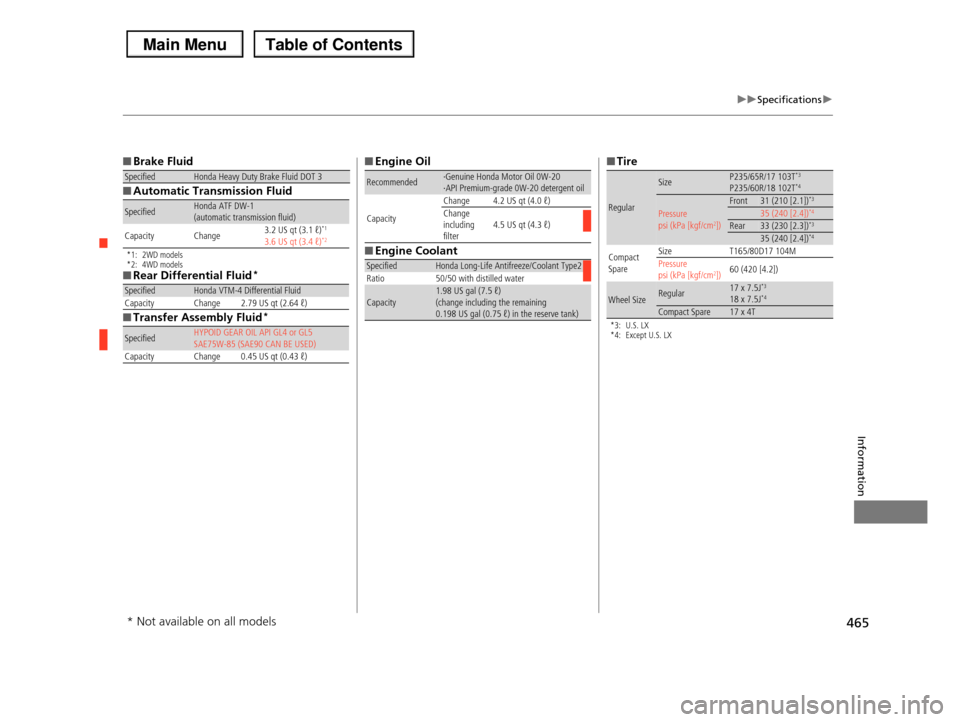
■Brake Fluid
■Automatic Transmission Fluid
*1: 2WD models *2: 4WD models■Rear Differential Fluid*
■Transfer Assembly Fluid*
SpecifiedHonda Heavy Duty Brake Fluid DOT 3
SpecifiedHonda ATF DW-1 (automatic transmission fluid)
Capacity Change3.2 US qt (3.1 ℓ)*1
3.6 US qt (3.4 ℓ)*2
SpecifiedHonda VTM-4 Differential FluidCapacity Change 2.79 US qt (2.64 ℓ)
SpecifiedHYPOID GEAR OIL API GL4 or GL5 SAE75W-85 (SAE90 CAN BE USED)Capacity Change 0.45 US qt (0.43 ℓ)
■Engine Oil
■Engine Coolant
Recommended·Genuine Honda Motor Oil 0W-20·API Premium-grade 0W-20 detergent oil
Capacity
Change 4.2 US qt (4.0 ℓ) Change including filter4.5 US qt (4.3 ℓ)
SpecifiedHonda Long-Life Antifreeze/Coolant Type2Ratio 50/50 with distilled water
Capacity1.98 US gal (7.5 ℓ) (change including the remaining 0.198 US gal (0.75 ℓ) in the reserve tank)
■Tire
*3: U.S. LX *4: Except U.S. LX
Regular
SizeP235/65R/17 103T*3
P235/60R/18 102T*4
Pressure psi (kPa [kgf/cm2])
Front31 (210 [2.1])*3
35 (240 [2.4])*4
Rear33 (230 [2.3])*3
35 (240 [2.4])*4
Compact Spare
SizeT165/80D17 104MPressure psi (kPa [kgf/cm2])60 (420 [4.2])
Wheel SizeRegular17 x 7.5J*3
18 x 7.5J*4
Compact Spare17 x 4T
* Not available on all models