air condition HONDA PRELUDE 1990 Owners Manual
[x] Cancel search | Manufacturer: HONDA, Model Year: 1990, Model line: PRELUDE, Model: HONDA PRELUDE 1990Pages: 143, PDF Size: 2.07 MB
Page 17 of 143

Inspection
All parts of the seat belts, including the belt fabric, should be regularly inspected for fraying, loosening, wear and other damage.
Keep the belts in good condition at all times to reduce the chance of
being injured in an accident, and to minimize any injuries that do
occur. Make sure the buckles, retractors, tongue plates, guides and anchors all work properly.
Don't let anything get inside the buckle or the retractor; it could
cause latch or retractor failure.
The components of the front automatic lap/shoulder belts are
contained in the doors. If the doors are damaged in an accident, have the dealer check the restraint system's function. The
automatic lap/shoulder belts may not function properly if the door is not completely repaired.
Cleaning
The belts should be always kept clean and dry; wet or damp belts can cause rewinding problems. The front seat belts are coated for resistance to water and stains. To clean the belts, pull them all the
way out of their retractors and use warm water; then let them air-
dry fully extended, in the shade, with the car windows open. Do not scrub or use detergents to clean the seat belts.
Never bleach, dye or clean the belts with chemical solvents; it
will weaken the fabric.
Do not remove the seat belts from the car to wash them.
Replacement
Replace the seat belt if:
1. The beltin g is cut, punctured, burned, etc.
2. Th
e buckle or retractor does not work properly.
3. It was being worn at the time of a collision (also cheek for deformation damage at all seat belt anchor points).
4. Its condition is questionable.ProCarManuals.comMain Menu t s
Page 41 of 143
Heating and Cooling
The vents, heater and air conditioner are combined in one system; adjusting four basic controls to different settings can provide a fullrange of interior temperatures for safe and comfortable driving,
(Air conditioner is optional on the 2.0 S and 2.0 Si models.)
Ventilation
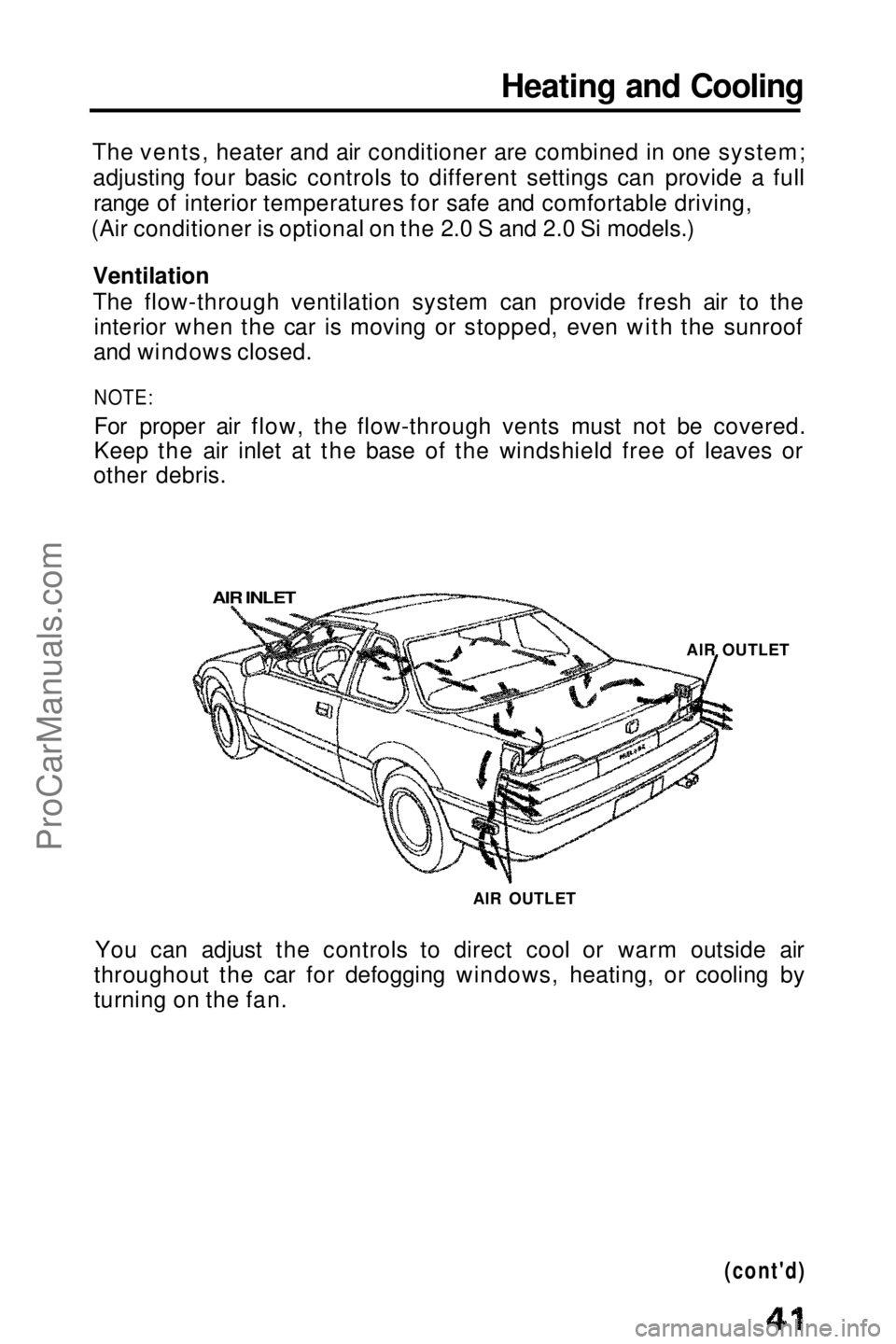
The flow-through ventilation system can provide fresh air to theinterior when the car is moving or stopped, even with the sunroof
and windows closed.
NOTE:
For proper air flow, the flow-through vents must not be covered.
Keep the air inlet at the base of the windshield free of leaves or
other debris.
You can adjust the controls to direct cool or warm outside air
throughout the car for defogging windows, heating, or cooling by
turning on the fan.
(cont'd)
AIR INLET
AIR OUTLET
AIR OUTLETProCarManuals.comMain Menu t s
Page 43 of 143
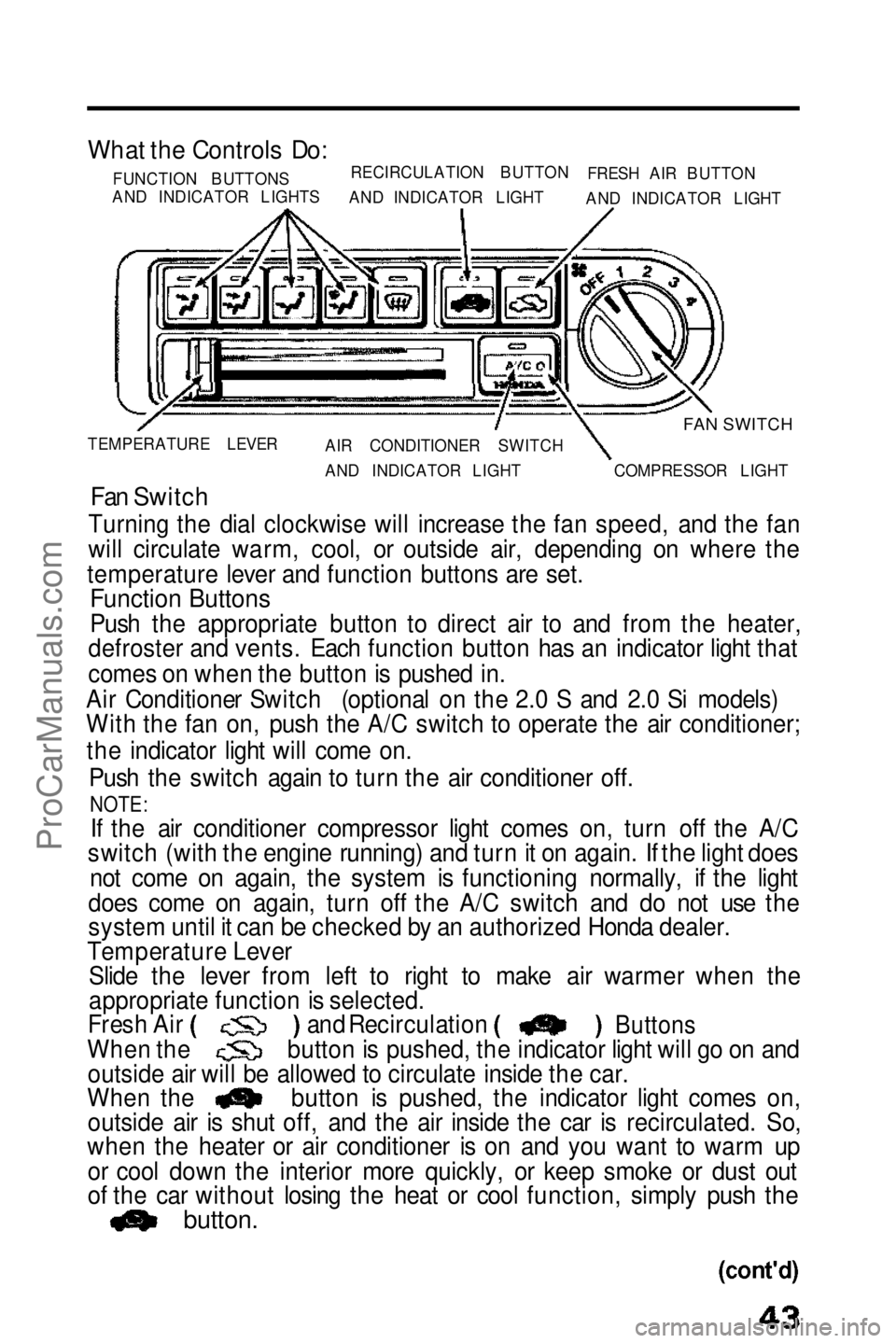
What the Controls Do:
FUNCTION BUTTONS
AND INDICATOR LIGHTS RECIRCULATION BUTTON
AND INDICATOR LIGHT FRESH AIR BUTTON
AND INDICATOR LIGHT
FAN SWITCH
TEMPERATURE LEVER AIR CONDITIONER SWITCH
AND INDICATOR LIGHT COMPRESSOR LIGHT
Fan Switch
Turning the dial clockwise will increase the fan speed, and the fan
will circulate warm, cool, or outside air, depending on where the
temperature lever and function buttons are set.
Function Buttons
Push the appropriate button to direct air to and from the heater,
defroster and vents. Each function button has an indicator light that
comes on when the button is pushed in.
Air Conditioner Switch (optional on the 2.0 S and 2.0 Si models)
With the fan on, push the A/C switch to operate the air conditioner;
the indicator light will come on.
Push the switch again to turn the air conditioner off.
NOTE:
If the air conditioner compressor light comes on, turn off the A/C
switch (with the engine running) and turn it on again. If the light does
not come on again, the system is functioning normally, if the light
does come on again, turn off the A/C switch and do not use the
system until it can be checked by an authorized Honda dealer.
Temperature Lever Slide the lever from left to right to make air warmer when the
appropriate function is selected. and Recirculation
Fresh Air
When the
Buttons
button is pushed, the indicator light will go on and
outside air will be allowed to circulate inside the car.
When the outside air is shut off, and the air inside the car is recirculated. So,
when the heater or air conditioner is on and you want to warm up
or cool down the interior more quickly, or keep smoke or dust out
of the car without losing the heat or cool function, simply push the
button.
button is pushed, the indicator light comes on,ProCarManuals.comMain Menu t s
Page 44 of 143
Heating and Cooling (cont'd)
NOTE:
The windows may become fogged if the system is in the
position for an extended period of time with the air
conditioner off. As soon as the interior is warmed, switch to the
position.
How to Use the Controls
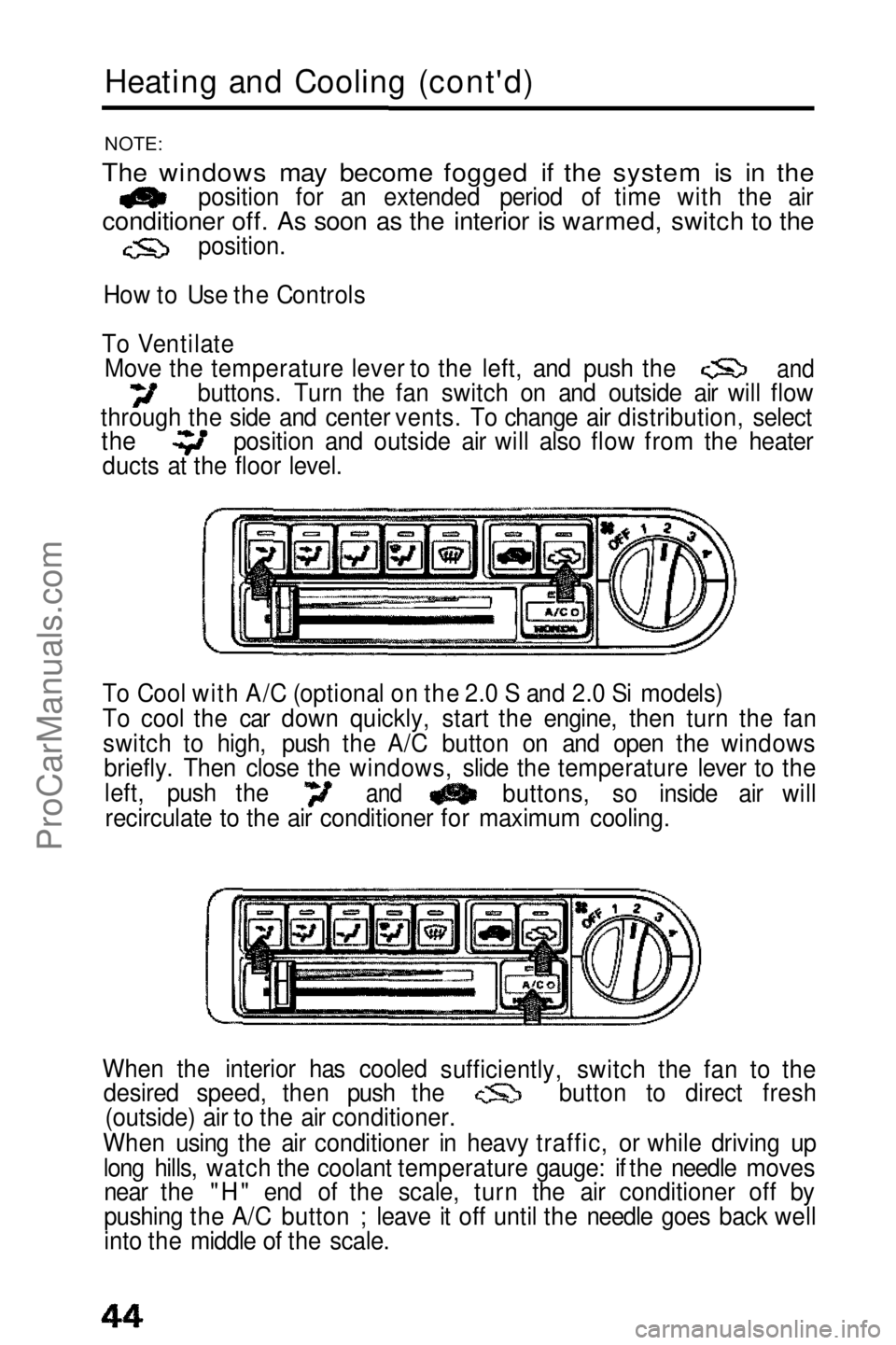
To Ventilate Move the temperature lever to the left, and push the buttons. Turn the fan switch on and outside air will flow
through the side and center vents. To change air distribution, select
To Cool with A/C (optional on the 2.0 S and 2.0 Si models)
To cool the car down quickly, start the engine, then turn the fanswitch to high, push the A/C button on and open the windows briefly. Then close the windows, slide the temperature lever to the
When the interior has cooled desired speed, then push the (outside) air to the air conditioner.
When using the air conditioner in heavy traffic, or while driving up long hills, watch the coolant temperature gauge: if the needle movesnear the "H" end of the scale, turn the air conditioner off by
pushing the A/C button ; leave it off until the needle goes back well
into the middle of the scale.
and
the
ducts at the floor level. position and outside air will also flow from the heater
sufficiently, switch the fan to thebutton to direct fresh
and
left, push the
recirculate to the buttons, so inside air will
air conditioner for maximum cooling.ProCarManuals.comMain Menu t s
Page 46 of 143
Heating and Cooling (cont'd)
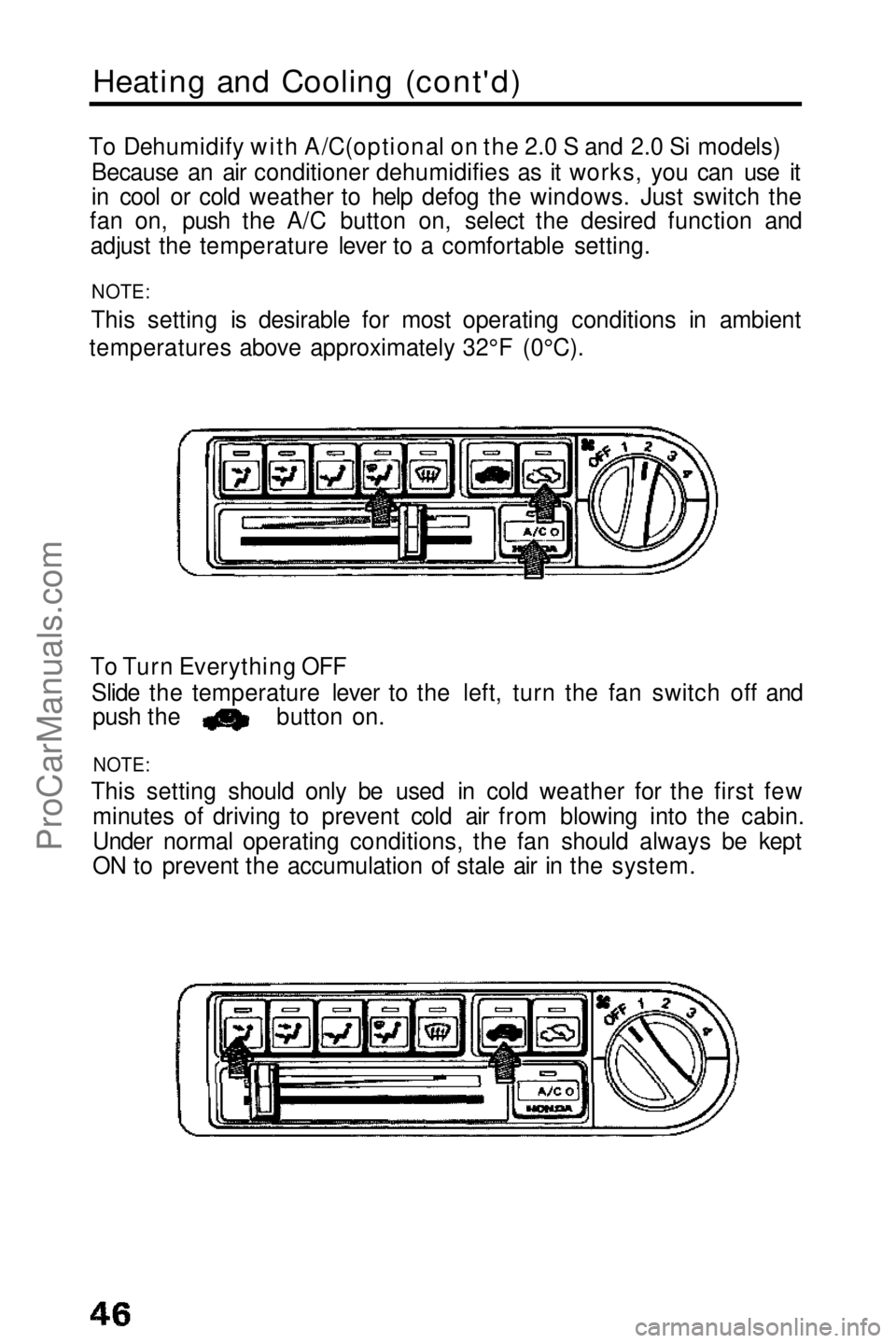
To Dehumidify with A/C(optional on the 2.0 S and 2.0 Si models) Because an air conditioner dehumidifies as it works, you can use it
in cool or cold weather to help defog the windows. Just switch the
fan on, push the A/C button on, select the desired function and
adjust the temperature lever to a comfortable setting.
NOTE:
This setting is desirable for most operating conditions in ambient
temperatures above approximately 32°F (0°C).
To Turn Everything OFFSlide the temperature lever to the left, turn the fan switch off and push the
NOTE:
This setting should only be used in cold weather for the first few minutes of driving to prevent cold air from blowing into the cabin.
Under normal operating conditions, the fan should always be kept
ON to prevent the accumulation of stale air in the system. button on.ProCarManuals.comMain Menu t s
Page 56 of 143

Gasoline (cont'd)
NOTE:
Fuel system damage or vehicle performance problems resulting
from the use of such fuels is not covered under the new car warranties. Honda cannot endorse the use of fuels containingmethanol since evidence of their suitability is as yet incomplete. Before purchasing fuel from an unfamiliar station, try to confirm
whether the fuel contains alcohol; of what kind, and how much. If
you notice any undesirable operating symptoms after using a
gasoline that contains alcohol, or one that you think contains
alcohol, switch to an unleaded gasoline, as recommended on page 55.
Operation In Foreign Countries In order to comply with U.S. Federal Emissions Regulations, you
must use unleaded fuels of the recommended octane rating. These
fuels may not be available in other countries. If you intend taking your car outside the U.S. or Canada, write to American Honda
Consumer Affairs (stating the year and model of your car) at the
address below for information regarding modifications you mayneed to have done.
American Honda Motor Co., Inc.
Consumer Affairs
100 W. AIondra Blvd.,
Gardena, CA 90248
Fuel Filler Door and Cap
Gasoline is extremely flammable and is explosive under certain
conditions. Perform this operation in a well-ventilated area with
the engine stopped. Do not smoke or allow open flames or sparks in the area or where gasoline is stored.
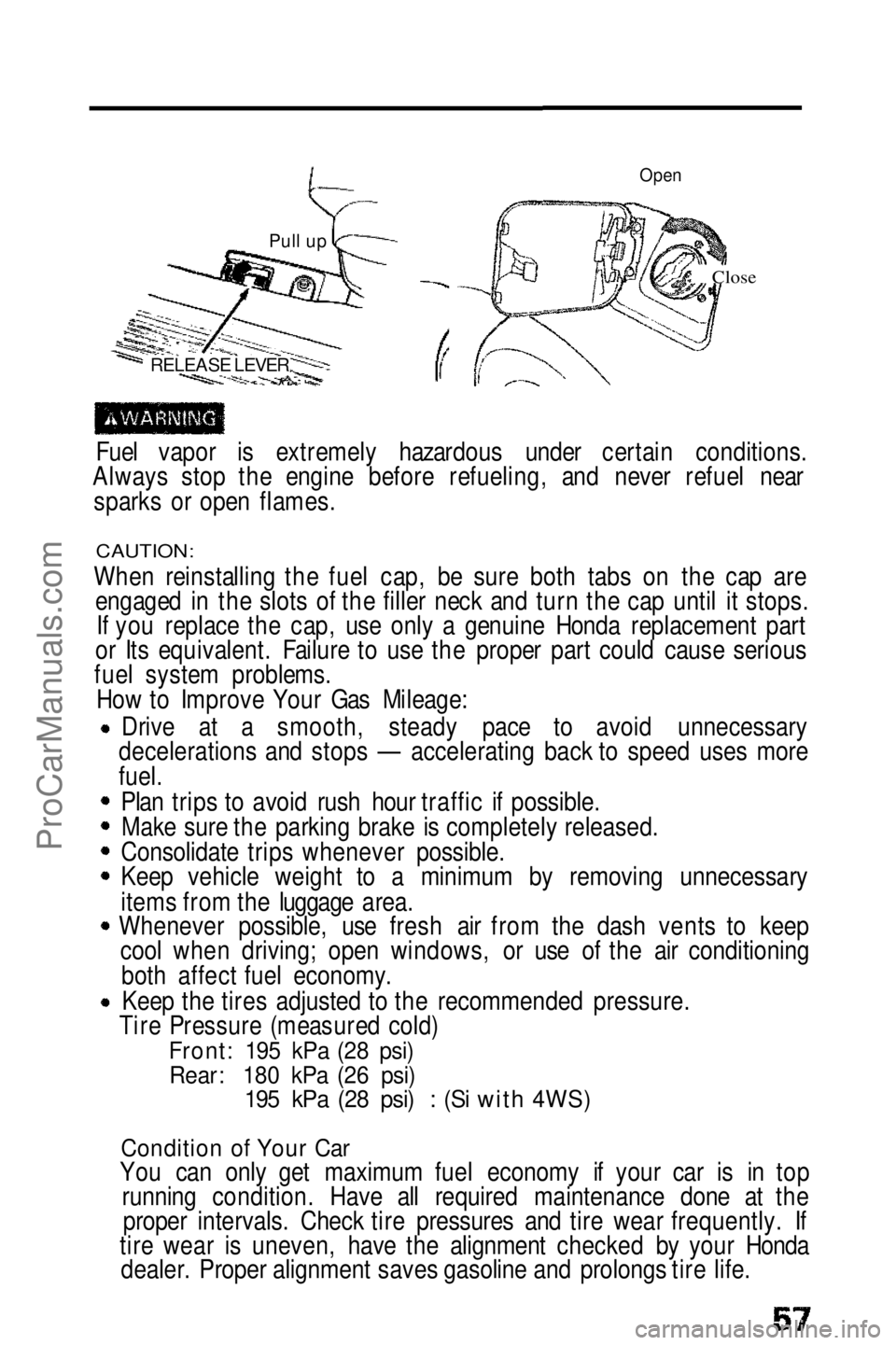
The fuel filler door is opened by pulling up on the lever at the leftside of the driver's seat.
The door will lock automatically when closed; push it until it clicks.
CAUTION:
You may hear a hiss when you open the filler cap. This sound is residual pressure escaping from the fuel tank. Open the cap slowly
and remove the cap after the hissing stops. Do not overfill the tank;
fill only until the gas pump clicks off automatically and never top off.ProCarManuals.comMain Menu t s
Page 57 of 143
Open
Close
Fuel vapor is extremely hazardous under certain conditions.
Always stop the engine before refueling, and never refuel near
sparks or open flames.
CAUTION:
When reinstalling the fuel cap, be sure both tabs on the cap are engaged in the slots of the filler neck and turn the cap until it stops.
If you replace the cap, use only a genuine Honda replacement part
or Its equivalent. Failure to use the proper part could cause serious
fuel system problems.
How to Improve Your Gas Mileage:
Drive at a smooth, steady pace to avoid unnecessary
decelerations and stops — accelerating back to speed uses more
fuel.
Plan trips to avoid rush hour traffic if possible.Make sure the parking brake is completely released.
Consolidate trips whenever possible.
Keep vehicle weight to a minimum by removing unnecessary
items from the luggage area.
Whenever possible, use fresh air from the dash vents to keep
cool when driving; open windows, or use of the air conditioningboth affect fuel economy.
Keep the tires adjusted to the recommended pressure.
Tire Pressure (measured cold)
Front: 195 kPa (28 psi)
Rear: 180 kPa (26 psi)
195 kPa (28 psi) : (Si with 4WS)
Condition of Your Car
You can only get maximum fuel economy if your car is in top running condition. Have all required maintenance done at theproper intervals. Check tire pressures and tire wear frequently. If
tire wear is uneven, have the alignment checked by your Honda dealer. Proper alignment saves gasoline and prolongs tire life.
RELEASE LEVER
Pull upProCarManuals.comMain Menu t s
Page 64 of 143

Engine Exhaust Gas Warning
A properly maintained car is your best protection against exhaust
gas entering the passenger compartment. The exhaust system should be thoroughly inspected by acompetent mechanic whenever:
The car is raised for an oil change.
You notice a change in the sound of the exhaust.
The exhaust system or the rear or underside of the car is
damaged.
Avoid breathing exhaust gases. They contain carbon monoxide, which is a colorless, odorless gas that can cause loss of
consciousness and eventual death. If you suspect that exhaust gas is entering the passenger compartment, have the cause
determined and corrected as soon as possible. If you must drive
under these conditions, drive only with all windows fully open. Do not drive with the trunk lid open. An open trunk may draw
exhaust gases into the passenger compartment. If you must
drive with the trunk lid open, drive only with all the windows
wide open.
Do not run the engine in confined areas, such as garages, any
longer than necessary to move the car in or out. If you must sit in a parked car with the engine running for more
than a short time, adjust the heating/ventilation system as
follows:
1. Push the
and buttons on.
2. Set the temperature lever for best comfort.
3.Turn the fan to the highest speed.
NOTE:
To insure proper operation of the car's ventilation system, keep the
front air inlet clear of snow, mud, leaves or other obstructions.ProCarManuals.comMain Menu t s
Page 75 of 143

CAUTION:
Before starting out, check the operation of the lights and all car/
trailer connections. After driving a short distance, stop and
recheck the lights and connections.
Reversing is difficult and requires practice. While backing-up,
the trailer may pivot off-course. To correct for this, grip the bottom of the steering wheel and move your hand to the left to
move the trailer to the left, or to the right to move the trailer to
the right. Turn the steering wheel a little at a time, and keep the
speed very low. Have someon e guide you when backing.
To help
prevent overheating of the brakes, shift into a lower
gear to make use of engine braking before descending steep or
long grades. Do not make sudden downshifts. Pay strict attention to the coolant temperature gauge when
going up hills. Because of the added load of the trailer, your car's
engine may overheat on hot days. Turning off the air conditioner
will reduce the load on the cooling system.
On cars equipped with automatic transmission. —Do not hold the car stationary on an incline by using the accelerator pedal; this can cause the transmission fluid tooverheat. Instead, use the handbrake or footbrake.
—When towing trailers, avoid high transmission fluid temperatures (caused by the transmission frequently shiftingbetween 3rd and 4th gears) by driving in S3.
NOTE:
Be sure to check state and local laws concerning maximum speed or
other driving restrictions for cars towing trailers. If you are driving
across several states, check each state's requirements before
leaving home, because restrictions may vary.
Parking with a Trailer
Whenever parking your car on an incline with a trailer attached, first
place and seat chocks at each wheel of the car and trailer. This is in
addition to the normal parking preparations of firmly applying the parking brake and placing the transmission in first or reverse
(manual transmission) or P (automatic transmission).
CAUTION:
Parking on an incline is not recommended and should be done only
if it cannot be avoided. Follow all precautions mentioned above
and turn the wheels to point towards a curb if facing downhill,
away from a curb if facing uphill. When leaving an inclined parking place, move the car slightly to unseat the chocks. Then while
keeping the foot brakes firmly applied, have an assistant remove
the chocks.ProCarManuals.comMain Menu t s
Page 76 of 143

Your Honda automobile must be properly maintained to ensure that
it is in peak operating condition and the emission levels are within
the standards set by the Federal Clean Air Act, The following instructions and maintenance procedures are based
on the assumption that your car will be used exclusively for the purpose for which it was designed:
1. To carry passengers and cargo within the load limits shown on the label on the edge of the driver's door.
2. To be driven on reasonable road surfaces within legal limits.
3. To generally be driven daily over a distance of several miles.
4. Use gasoline from pumps labeled unleaded, with a pump octane number of 68 or higher. The pump octane number is an average of
the Research (R) octane and Motor (M) octane numbers.
NOTE:
Failures which occur due to a lack of maintenance will not be
covered under warranty.
The Required Maintenance Schedule * specifies all maintenance required to keep your car in peak operating condition. Work should
be done by an authorized Honda dealer but may be done by any qualified service facility or individual who is competent in this type
of work.
Maintenance, replacement, or repair of emission control devicesand systems may be done by any automotive repair establishment
or individual using parts that are "certified" to EPA standards.
After the maintenance has been done, be sure to complete the Maintenance Records on pages 79 — 81 . All required maintenance is
considered normal owner operating cost and you will be charged for it by your dealer.
* For vehicles sold in California, maintenance operations indicated
by * 3 on page 78 are recommended by the manufacturer.
Other maintenance operations are required by California
regulations and condition the emission warranty.
Maintenance Schedule and RecordsProCarManuals.comMain Menu t s