air condition HONDA PRELUDE 1990 User Guide
[x] Cancel search | Manufacturer: HONDA, Model Year: 1990, Model line: PRELUDE, Model: HONDA PRELUDE 1990Pages: 143, PDF Size: 2.07 MB
Page 80 of 143
Maintenance Schedule and Records (cont'd)
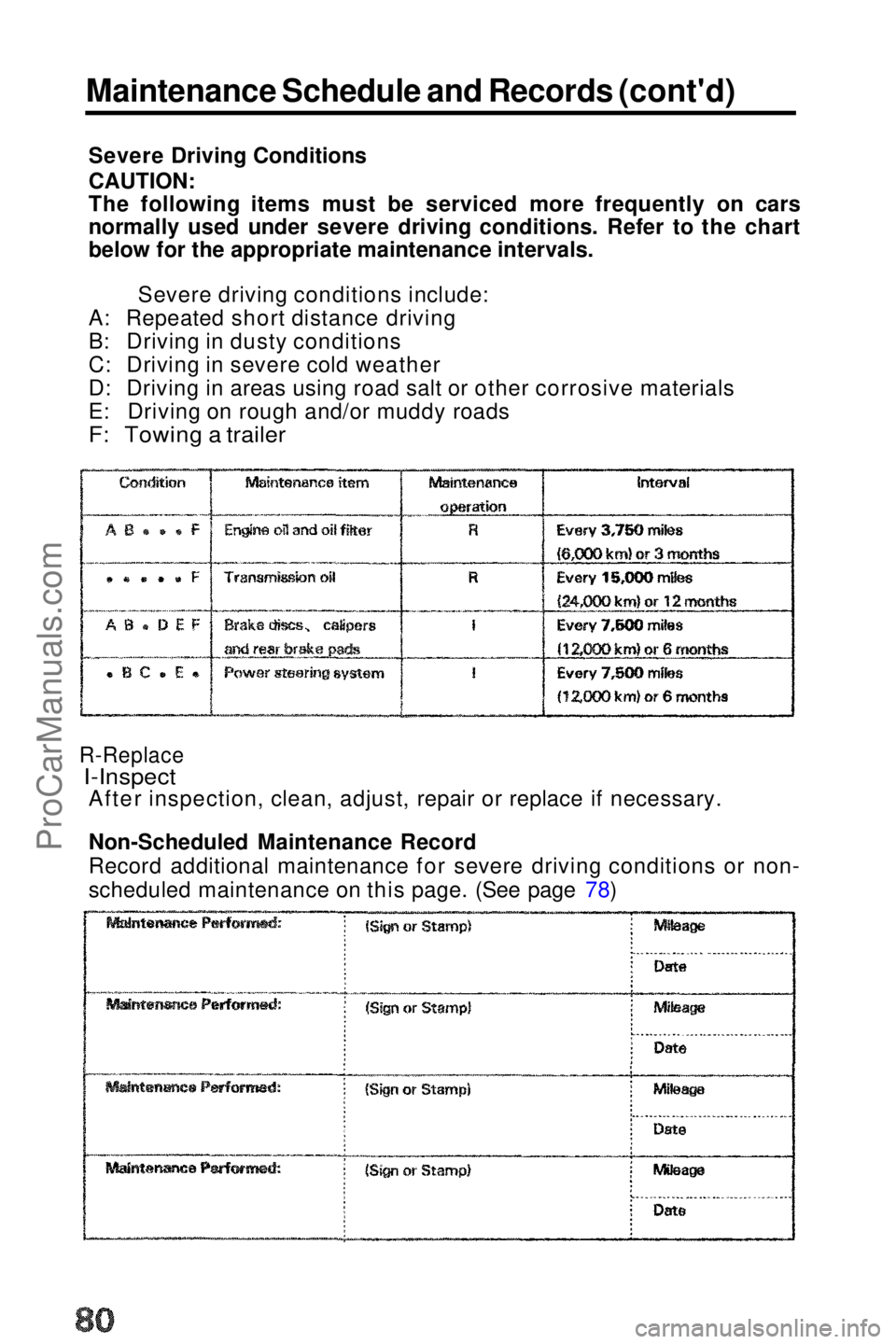
Severe Driving Conditions
CAUTION:
The following items must be serviced more frequently on cars
normally used under severe driving conditions. Refer to the chart
below for the appropriate maintenance intervals. Severe driving conditions include:
A: Repeated short distance driving
B: Driving in dusty conditions
C: Driving in severe cold weather
D: Driving in areas using road salt or other corrosive materials
E: Driving on rough and/or muddy roads
F: Towing a trailer
R-Replace
I-Inspect
After inspection, clean, adjust, repair or replace if necessary.
Non-Scheduled Maintenance Record
Record additional maintenance for severe driving conditions or non-
scheduled maintenance on this page. (See page 78)ProCarManuals.comMain Menu t s
Page 95 of 143
Air Filter
Replace the air filter every 24 months or 30,000 miles (48,000 km),
whichever comes first (more often in extremely dusty conditions).
Replacement
(2.0 S)
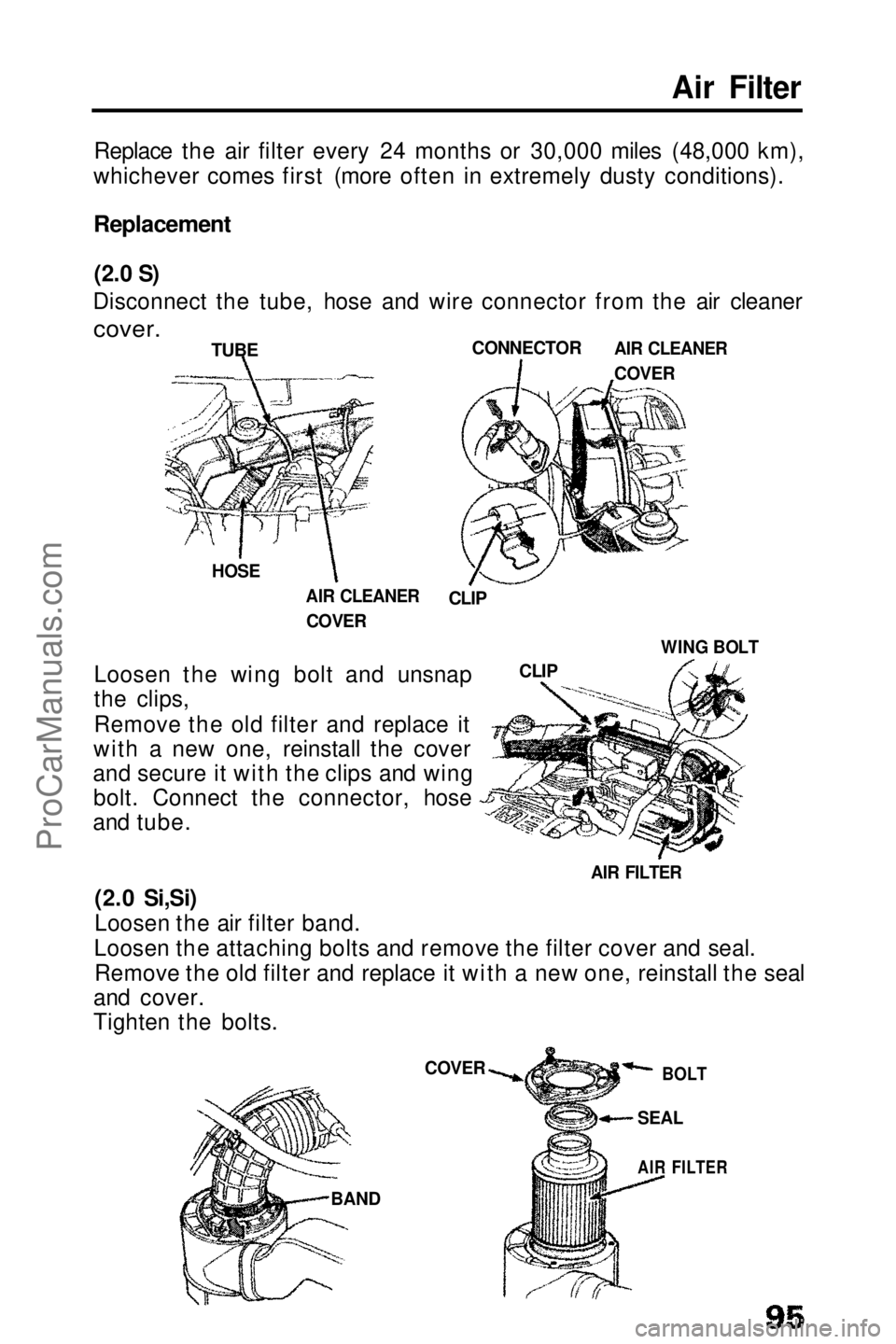
Disconnect the tube, hose and wire connector from the air cleaner
cover.
WING BOLT
CLIP
Loosen the wing bolt and unsnap
the clips,
Remove the old filter and replace it
with a new one, reinstall the cover
and secure it with the clips and wing bolt. Connect the connector, hose
and tube.
(2.0 Si,Si)
Loosen the air filter band.
Loosen the attaching bolts and remove the filter cover and seal. Remove the old filter and replace it with a new one, reinstall the seal
and cover.
Tighten the bolts.
TUBE
CLIP
AIR CLEANER
COVER
CONNECTOR
AIR CLEANER
COVER
HOSE
AIR FILTER
BAND COVER
BOLT
SEAL
AIR FILTERProCarManuals.comMain Menu t s
Page 108 of 143
Air Conditioner Care
Condenser and Radiator
Check the engine radiator and the air conditioner condenser (in front
of the radiator) for accumulated dirt, insects or leaves. Carefully brush or hose them off to assure maximum cooling performance.
CAUTION:
Radiator and condenser fins are very thin and easily damaged; do
not bend them with the high water pressure or brush.
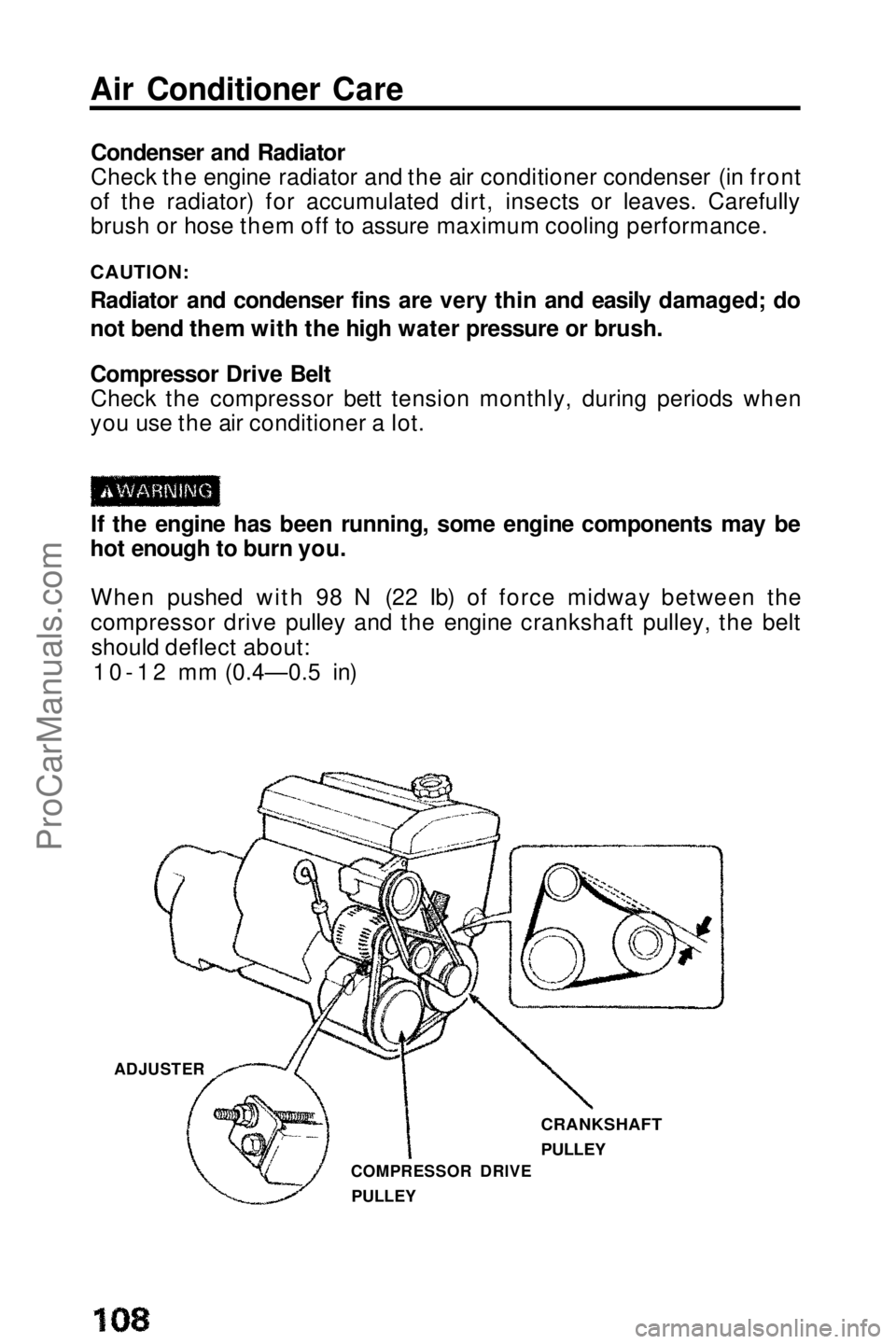
Compressor Drive Belt Check the compressor bett tension monthly, during periods when
you use the air conditioner a lot.
If the engine has been running, some engine components may be
hot enough to burn you.
When pushed with 98 N (22 Ib) of force midway between the
compressor drive pulley and the engine crankshaft pulley, the beltshould deflect about: 10-12 mm (0.4—0.5 in)
ADJUSTER COMPRESSOR DRIVE
PULLEY
CRANKSHAFT
PULLEYProCarManuals.comMain Menu t s
Page 109 of 143

System Maintenance
Run your air conditioner at least once a week for about ten minutes,
even during the off season, to lubricate the seals and the inside of
the compressor and, to verify that the system is functional.
If the air conditioner is not cooling properly, it may indicate an
undercharged system. Have your dealer check the system for leaks,
then evacuate and charge the system with refrigerant 12. Charging quantity:
850-950 g(30.1-33.6 oz)
CAUTION:
Prolonged use of an undercharged system may damage the
compressor.ProCarManuals.comMain Menu t s
Page 113 of 143

Body Repair
Replacement Body and Fender Parts
If your vehicle incurs body damage and requires replacement parts,
we encourage you to use only Genuine Honda sheet metal body and
fender parts. Many insurance companies are specifying imitation sheet metal parts for collision repairs in an effort to reduce claim
costs; however, if imitation parts are used the following conditionsmay apply: There is no assurance that imitation parts will equal the fit and
finish of Genuine Honda sheet metal parts; and in our experience
they often do not.
There is no assurance that imitation parts will resist corrosion as
well as Genuine Honda sheet metal parts. Imitation sheet metal parts are not covered by the Honda Limited
Warranty.
To ensure your continued satisfaction with your Honda vehicle in
the event of an accident, contact your insurance adjuster and insist on Genuine Honda parts in the repair of your vehicle.ProCarManuals.comMain Menu t s
Page 114 of 143
Spare Tire
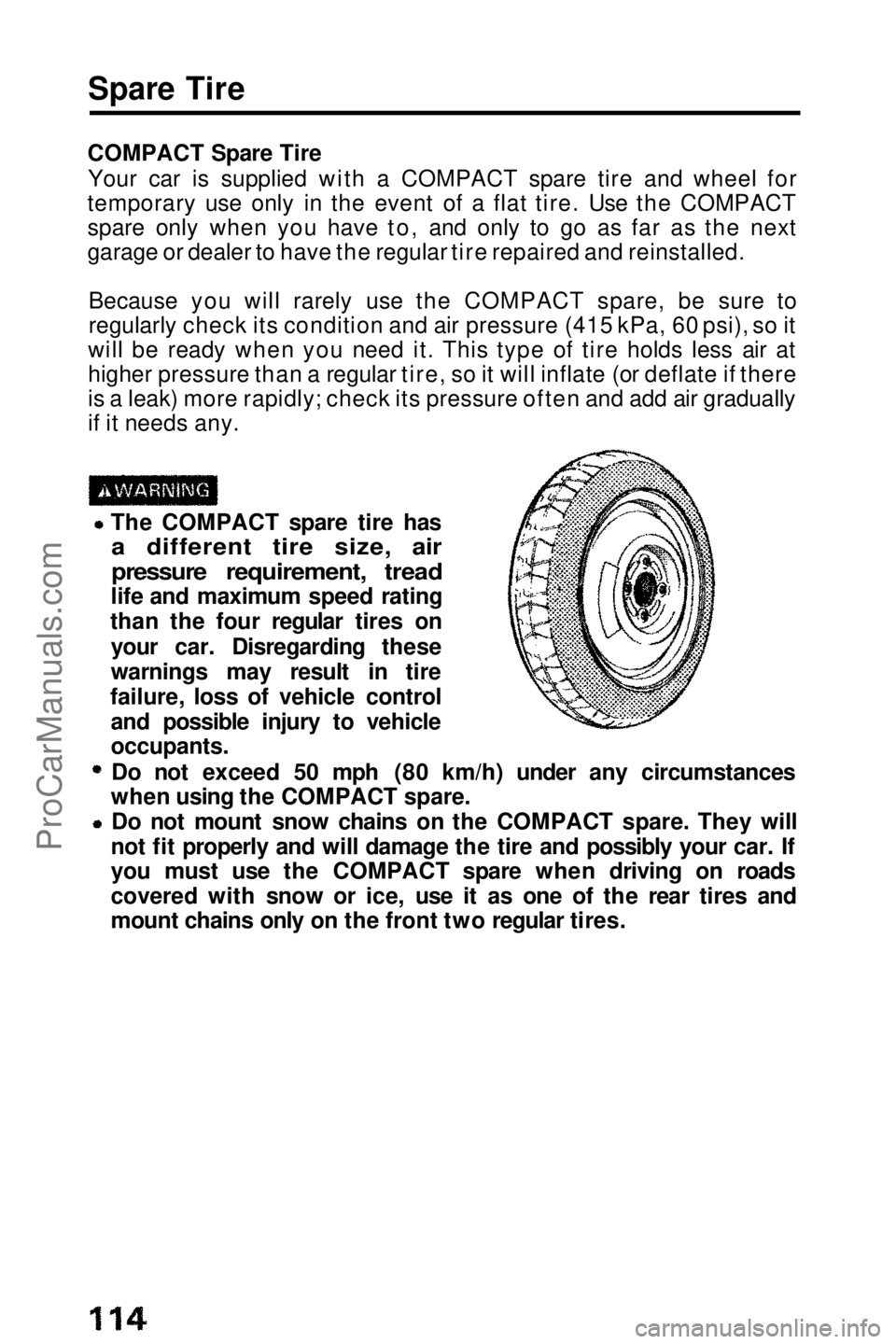
COMPACT Spare Tire Your car is supplied with a COMPACT spare tire and wheel for
temporary use only in the event of a flat tire. Use the COMPACT
spare only when you have to, and only to go as far as the next
garage or dealer to have the regular tire repaired and reinstalled.
Because you will rarely use the COMPACT spare, be sure to
regularly check its condition and air pressure (415 kPa, 60 psi), so it
will be ready when you need it. This type of tire holds less air at
higher pressure than a regular tire, so it will inflate (or deflate if there
is a leak) more rapidly; check its pressure often and add air gradually
if it needs any. The COMPACT spare tire has
a different tire size, air
pressure requirement, tread
life and maximum speed rating
than the four regular tires on
your car. Disregarding these
warnings may result in tire
failure, loss of vehicle control and possible injury to vehicle
occupants.
Do not exceed 50 mph (80 km/h) under any circumstances
when using the COMPACT spare. Do not mount snow chains on the COMPACT spare. They will
not fit properly and will damage the tire and possibly your car. If
you must use the COMPACT spare when driving on roads
covered with snow or ice, use it as one of the rear tires and
mount chains only on the front two regular tires.ProCarManuals.comMain Menu t s
Page 130 of 143

Emission Controls
Sources of Emissions
The combustion process produces carbon monoxide, oxides of nitrogen and hydrocarbons. The evaporation of fuel in the fuel tank
also produces hydrocarbons. Control of oxides of nitrogen and
hydrocarbons is very important since, under certain conditions,
when subjected to sunlight, they react to form photochemical smog. Carbon monoxide does not react to form smog, but it is toxic.
Honda Motor Co., Ltd. has developed a number of systems which
are highly effective in reducing carbon monoxide, oxides of nitrogen
and hydrocarbons.
The Clean Air Act
The Clean Air Act requires all vehicle manufacturers to explain in writing, the operation and maintenance of their emission control
systems.
Maintenance instructions are included on pages 76—81 ; the
operation of each system is explained on the following.
Replacement Parts
The emission control systems on your new Honda were designed, built and certified to conform with the Federal regulations
implementing the Clean Air Act. Honda recommends only the use of
new, genuine Honda parts or their equivalent. The use of other
replacement parts which are not of equivalent quality may impair
the effectiveness of your car's emission control systems.
Crankcase Emission Control System
To prevent crankcase emissions, your car is equipped with a Positive Crankcase Ventilation (PCV) System which routes blowby
gases from the crankcase, through the PCV valve and intake manifold, into the combustion chamber.ProCarManuals.comMain Menu t s
Page 131 of 143

Evaporative Emission Control System
The Evaporative Emission Control System is designed to prevent
fuel vapors from escaping into the atmosphere.
(2.0 Si,Si)
Fuel vapors from the fuel tank are directed into the charcoal
canister where they are adsorbed and stored while the engine is
stopped or idling. When the coolant temperature rises to a certain
value, the vapors are drawn into the engine through the throttle body and the intake manifold during normal engine operation.
(2.0 S)Fuel vapors from the fuel tank and carburetor are directed into the
charcoal canister where they are adsorbed and stored while the
engine is stopped.
When the engine is running and engine coolant temperature is above
the set temperature of the thermo sensor, the purge control diaphragm valve is open so that fuel vapors in the charcoal canister may be drawn into the engine through the carburetor and the intake
manifold.
Engine Exhaust Controls
The engine exhaust emission control systems are designed to
control combustion during idle, acceleration, cruise, and deceleration.
These systems are entirely separate from the crankcase and evaporative emission control systems described previously. HONDA PGM-FI System (2.0 Si,Si)
The PGM-FI system consists of three independent sub-systems; Air intake, Electronic Control and Fuel Control, thus allowing moreaccurate control of air/fuel ratios under all operating conditions.
The Electronic Control Unit (ECU) detects the amount of air
drawn into the cylinders and determines the amount of fuel to be injected to provide the optimum air/fuel ratio for all engine needs.
(cont'd)ProCarManuals.comMain Menu t s
Page 137 of 143
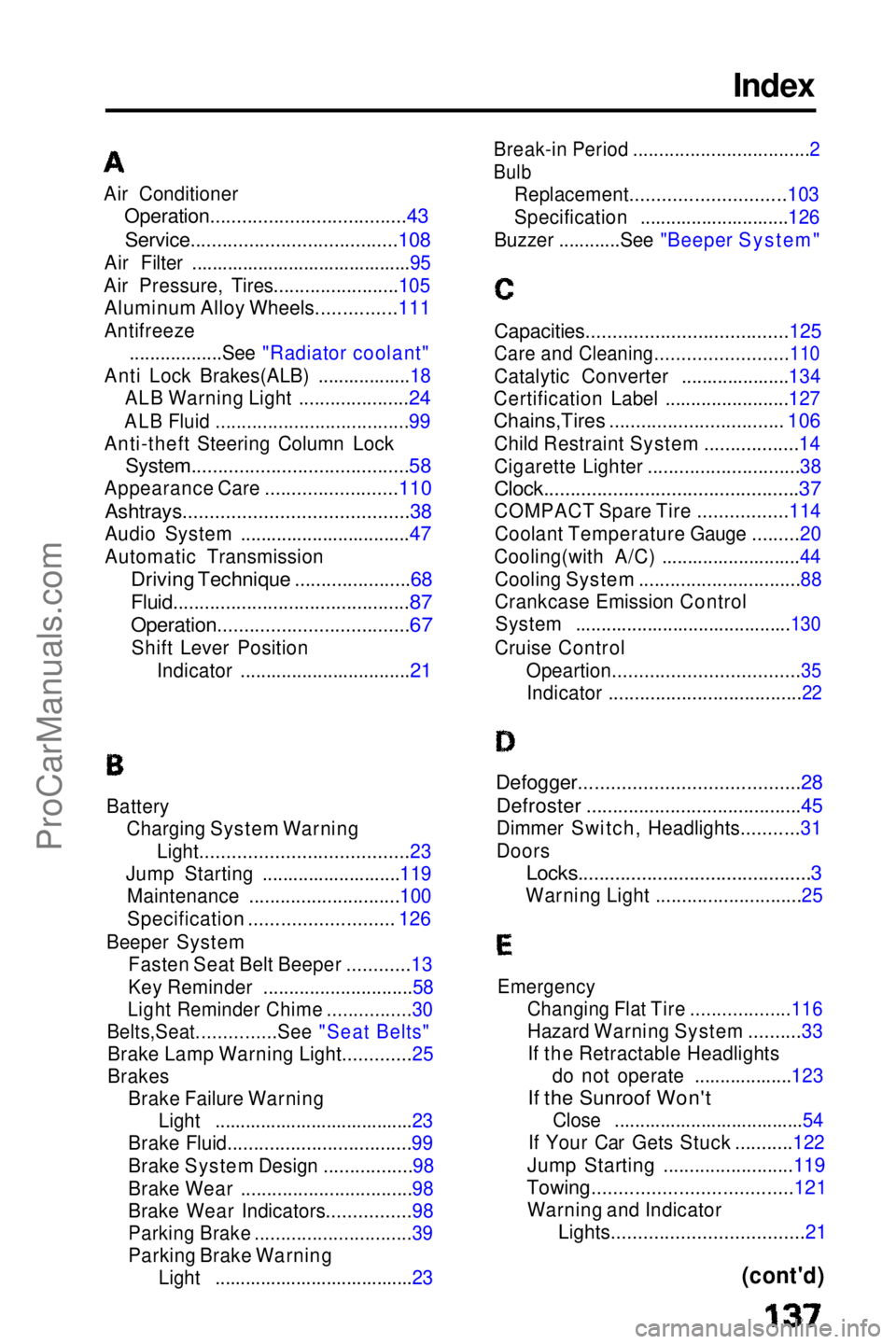
Index
(cont'd)
Air Conditioner
Operation.....................................
43
Service.......................................108
Air Filte
r ...........................................95
Air Pressure, Tires........................105
Aluminum Alloy Wheels...............111
Antifreeze ..................See
"Radiator coolant"
Anti Lock Brakes(ALB) ..................18 ALB Warning Light .....................
24
ALB Fluid
.....................................
99
Anti-theft Steering
Column Lock
System.........................................58
Appearance Care .........................
110
Ashtrays..........................................38
Audio System
.................................
47
Automatic Transmission
Driving Technique ......................68
Fluid.............................................87
Operation....................................67
Shift Lever
Position
Indicator .................................
21 Battery
Charging System Warning
Light.......................................23
Jump Starting ...........................119 Maintenance .............................100
Specification ........................... 126
Beeper System Fasten Seat Belt Beeper ............13
Key Reminder .............................58
Light Reminder Chime ................30
Belts,Seat...............See "Seat Belts"
Brake Lamp Warning Light.............25
Brakes Brake Failure Warning Light .......................................23
Brake Fluid...................................99
Brake System Design .................98
Brake Wear .................................98
Brake Wear Indicators................98
Parking Brake ..............................39
Parking Brake Warning Light .......................................23
Break-in Period ..................................2
Bulb
Replacement.............................103
Specification .............................126
Buzzer ............See "Beeper System"
Capacities......................................125
Care and Cleaning.........................110
Catalytic Converter .....................134
Certification Label ........................127
Chains,Tires ................................. 106
Child Restraint System ..................14
Cigarette Lighter .............................38
Clock................................................37
COMPACT Spare Tire .................114Coolant Temperature Gauge .........20
Cooling(with A/C) ...........................44 Cooling System ...............................88
Crankcase Emission ControlSystem ..........................................
130
Cruise Control
Opeartion...................................
35Indicator .....................................22
Defogger.........................................28
Defroster .........................................45
Dimmer Switch, Headlights...........31
Doors
Locks............................................3
Warning Light ............................25
Emergency
Changing Flat Tire ...................116
Hazard Warning System ..........33If the Retractable Headlights do not operate ...................123
If the Sunroof Won't
Close .....................................54
If Your Car Gets Stuck ...........122
Jump Starting .........................119Towing.....................................121Warning and
Indicator
Lights....................................21
ProCarManuals.comMain Menu t s