tow HONDA PRELUDE 1990 Owners Manual
[x] Cancel search | Manufacturer: HONDA, Model Year: 1990, Model line: PRELUDE, Model: HONDA PRELUDE 1990Pages: 143, PDF Size: 2.07 MB
Page 1 of 143
 to navigate through\
this reference.
For a printed owners manual, click on authorized manuals or go")
1990 Prelude Online Reference Owner's Manual
Use these links (and links throughout this manual) to navigate through\
this reference.
For a printed owner's manual, click on authorized manuals or go to www.h\
elminc.com.
Features & Safety ........................................................................\
........................................................ 2
What you should know before driving your car.
Starting & Driving........................................................................\
.....................................................
55
What gas to use, how to change gears, etc.
Maintenance
........................................................................\
............................................................... 76
The Required Maintenance Schedule and some items you can service.
Emergency Service
........................................................................\
................................................ 116
Changing a flat, jump starting, towing.
Specifications
........................................................................\
......................................................... 125
Dimensions, weights and capacities.
Consumer Information
........................................................................\
.......................................... 127
Reporting Safety Detects, warranty service, vehicle identification numbe\
rs, etc.
Index ........................................................................\
....................... .................................................
137
Gas Station Information
Contents
Owner's Identification Form
ProCarManuals.com
Page 7 of 143
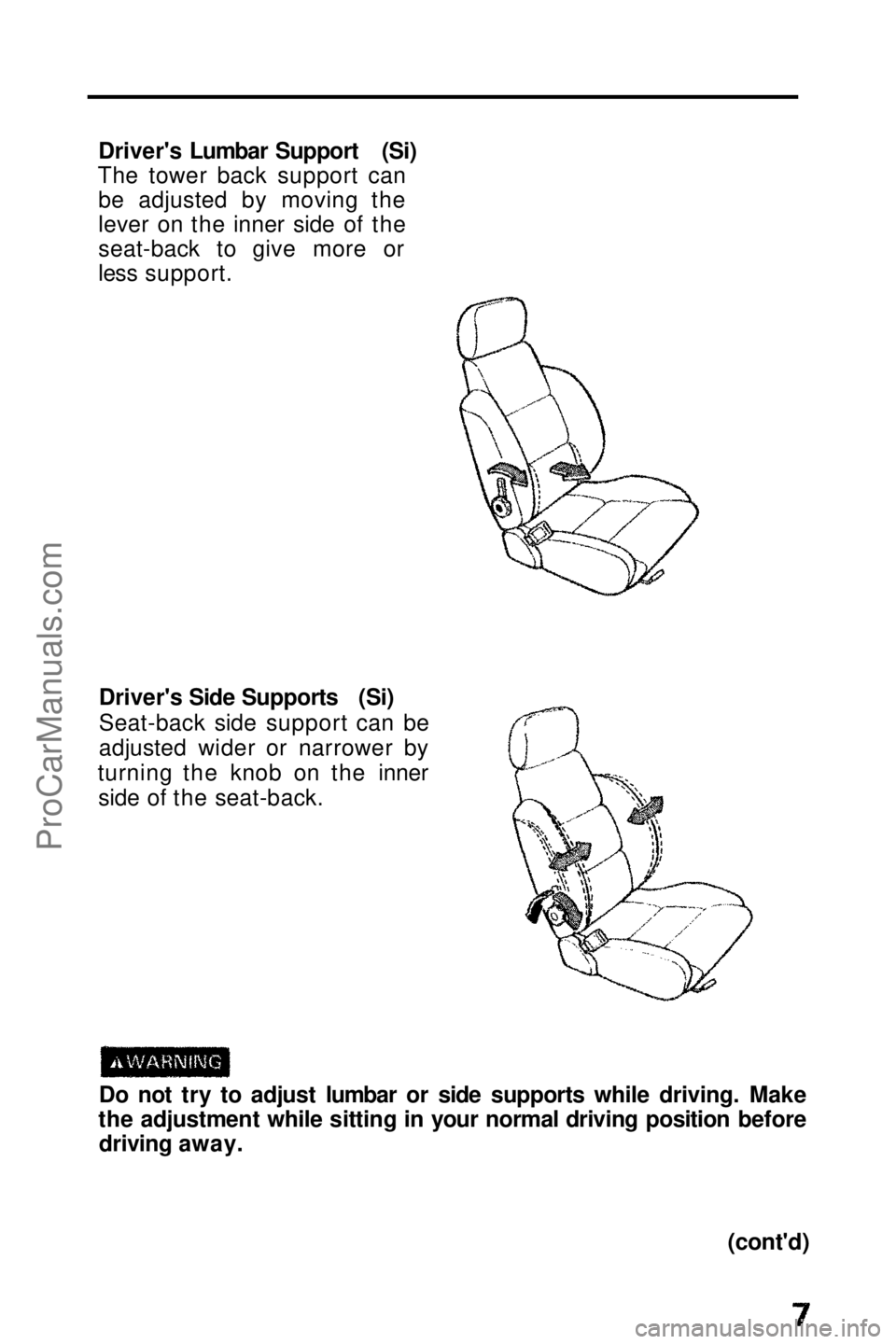
Driver's Lumbar Support (Si)
The tower back support can be adjusted by moving the
lever on the inner side of the
seat-back to give more or
less support.
Driver's Side Supports (Si)
Seat-back side support can be
adjusted wider or narrower by
turning the knob on the inner side of the seat-back.
Do not try to adjust lumbar or side supports while driving. Make
the adjustment while sitting in your normal driving position before driving away.
(cont'd)ProCarManuals.comMain Menu t s
Page 26 of 143
Tilt Steering
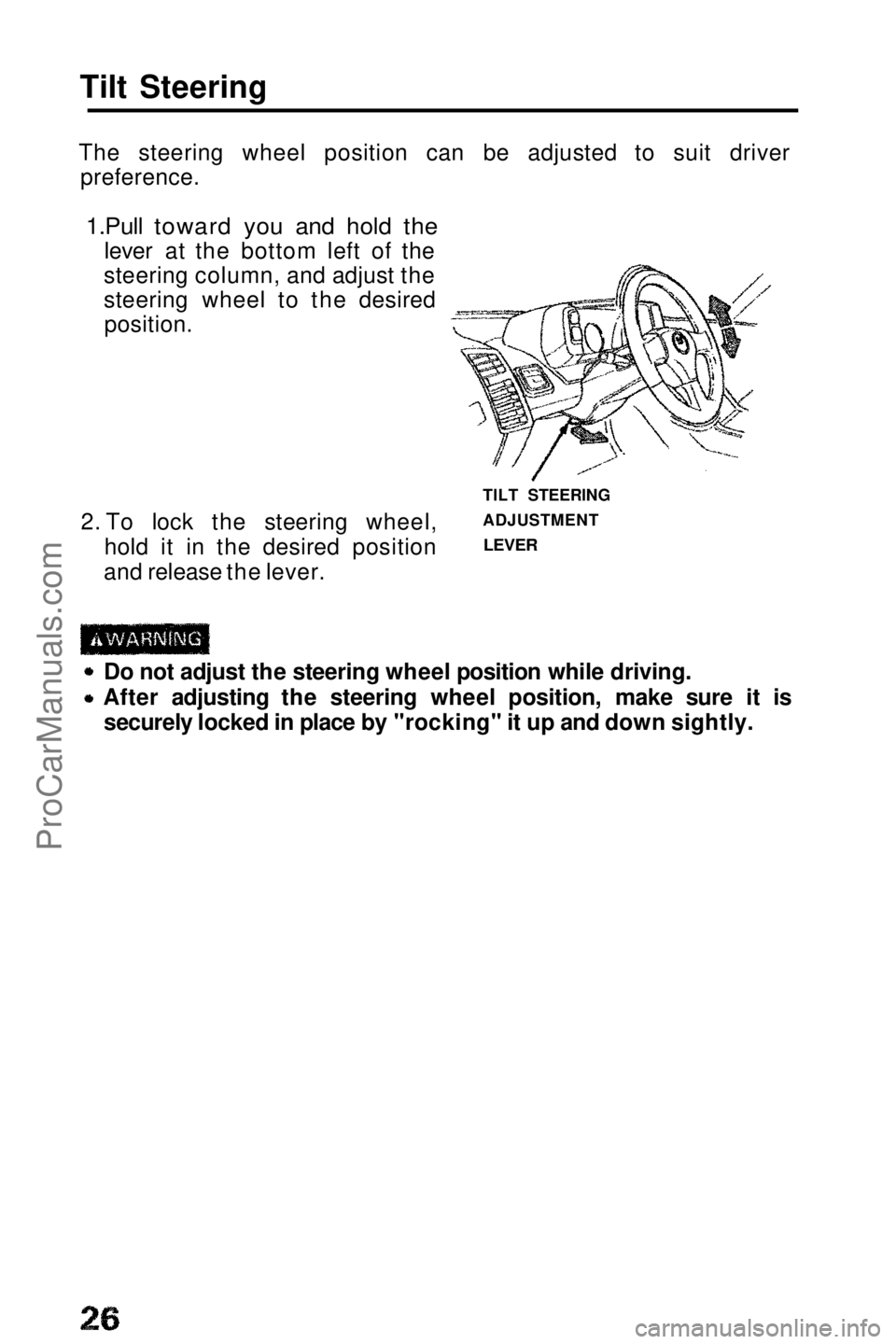
The steering wheel position can be adjusted to suit driver preference.
1.Pull toward you and hold the
lever at the bottom left of the
steering column, and adjust the
steering wheel to the desired position.
2. To lock the steering wheel, hold it in the desired position
and release the lever. TILT STEERING
ADJUSTMENT
LEVER
Do not adjust the steering wheel position while driving. After adjusting the steering wheel position, make sure it is
securely locked in place by "rocking" it up and down sightly.ProCarManuals.comMain Menu s t
Page 27 of 143
Windshield Wipers/Washer/Defogger
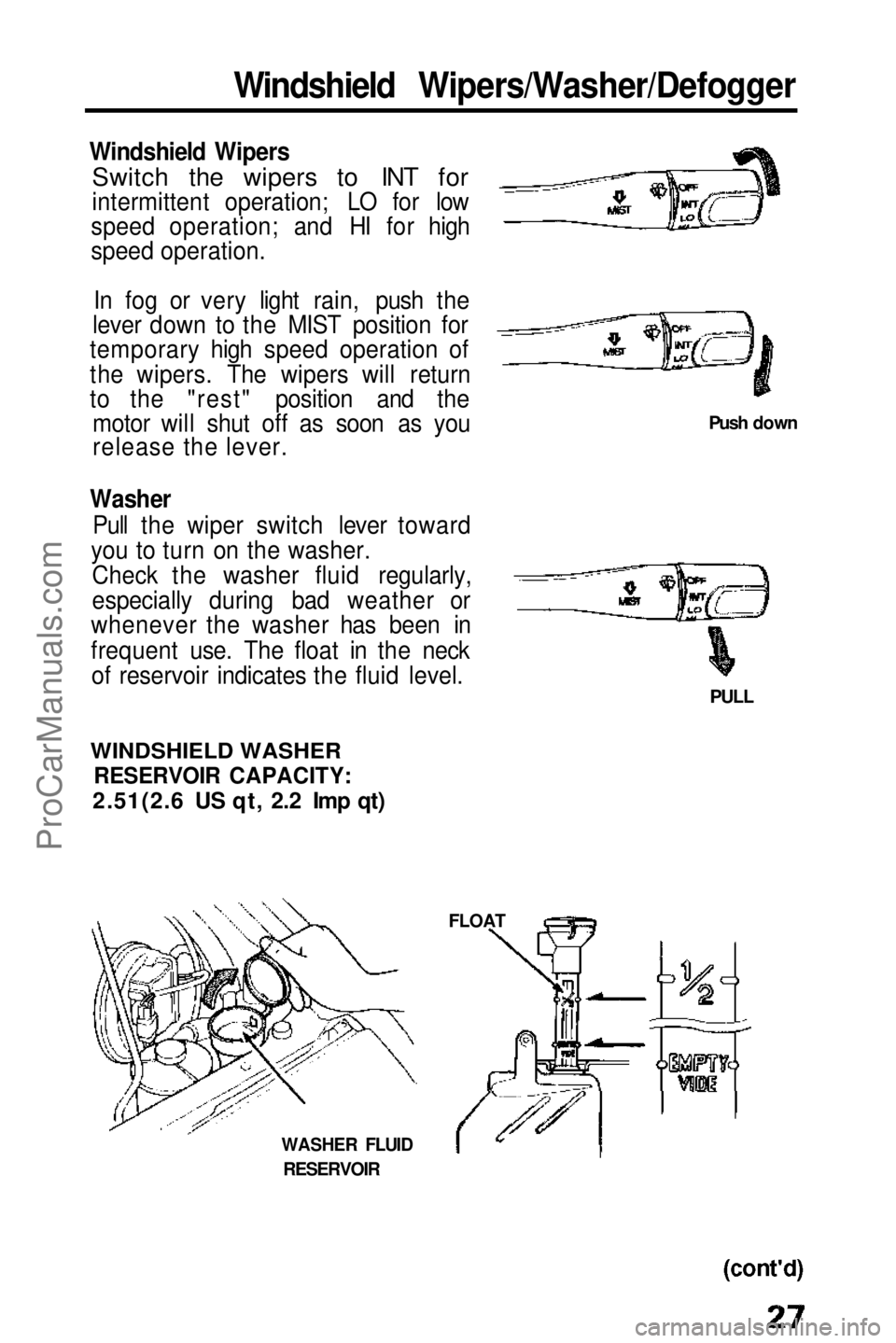
Windshield Wipers
Switch the wipers to INT for
intermittent operation; LO for low
speed operation; and HI for high
speed operation.
In fog or very light rain, push the
lever down to the MIST position for
temporary high speed operation of
the wipers. The wipers will return
to the "rest" position and the motor will shut off as soon as you
release the lever.
Washer Pull the wiper switch lever toward
you to turn on the washer.
Check the washer fluid regularly,
especially during bad weather or
whenever the washer has been in
frequent use. The float in the neck of reservoir indicates the fluid level.
Push down
PULL
WINDSHIELD WASHER
RESERVOIR CAPACITY:
2.51(2.6 US qt, 2.2 Imp qt)
FLOAT
WASHER FLUID
RESERVOIRProCarManuals.comMain Menu s t
Page 31 of 143
NOTE:
If the headlight motor switch is pushed in, the headlights will not
retract when the light switch is turned off.
If the headlights neither rise nor retract, they can be operated
manually; see page 123.
If you're driving in wet snow or freezing rain, keep the headlights
in the raised position by using the headlight motor switch; this
way,they can still be used if the headlight motors freeze. If the headlights have frozen in either the up or down position,
remove all ice before operating the headlight motors.
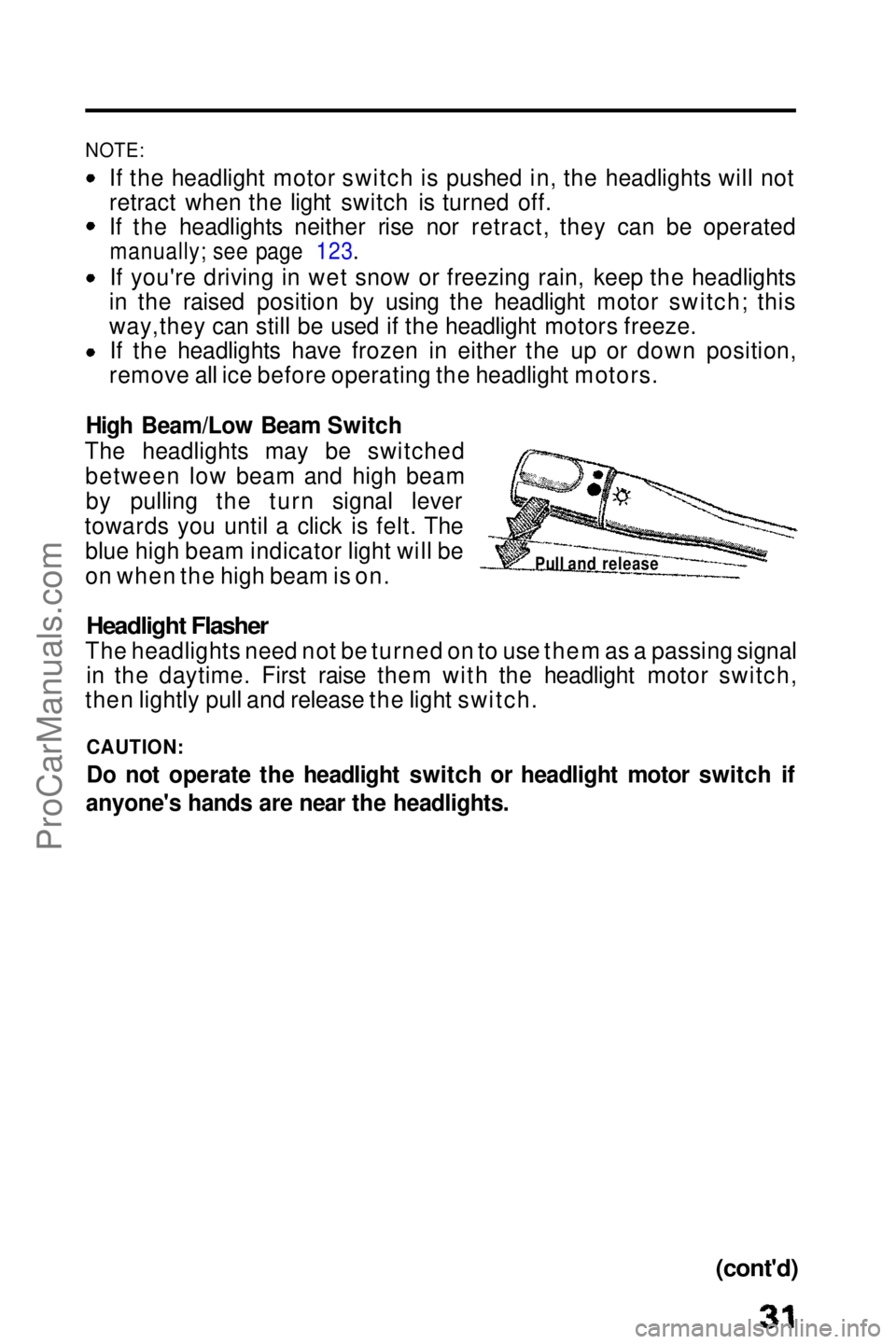
High Beam/Low Beam Switch
The headlights may be switched between low beam and high beamby pulling the turn signal lever
towards you until a click is felt. The blue high beam indicator light will be
on when the high beam is on.
Headlight Flasher
The headlights need not be turned on to use them as a passing signal in the daytime. First raise them with the headlight motor switch,
then lightly pull and release the light switch.
CAUTION:
Do not operate the headlight switch or headlight motor switch if
anyone's hands are near the headlights.
(cont'd)
Pull and releaseProCarManuals.comMain Menu t s
Page 38 of 143
Cigarette Lighter and Ashtrays
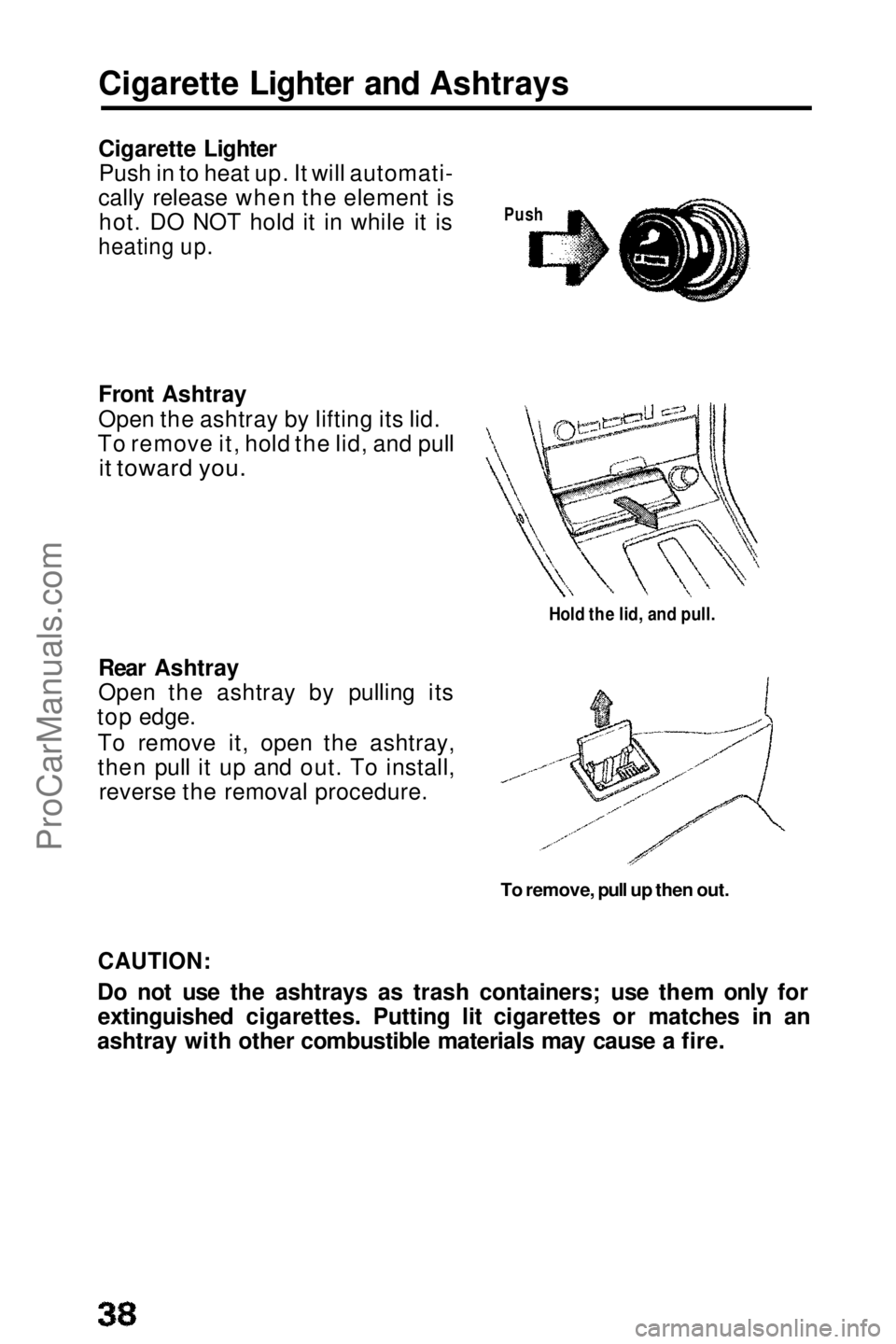
Cigarette Lighter
Push in to heat up. It will automati-
cally release when the element is hot. DO NOT hold it in while it is
heating up.
Front Ashtray
Open the ashtray by lifting its lid.
To remove it, hold the lid, and pull
it toward you.
Rear Ashtray
Open the ashtray by pulling its
top edge.
To remove it, open the ashtray,
then pull it up and out. To install, reverse the removal procedure.
CAUTION:
Do not
use the ashtrays as trash containers; use them only for
extinguished cigarettes. Putting lit cigarettes or matches in an
ashtray with other combustible materials may cause a fire.
Push
Hold the lid, and pull.
To remove, pull up then out.ProCarManuals.comMain Menu t s
Page 63 of 143

Safety Items
Before driving away, check that: The doors are closed properly. The mirrors are properly adjusted, and the windows clean.
The driver and passengers are wearing properly adjusted seat
belts.
The head restraints are properly adjusted.
The warning and indicator lights are operating properly.
The brake pedal feels normal.
All luggage and cargo is secured.
Nothing is interfering with the driver's feet or blocking vision to
the rear.
While driving remember to: Always drive defensively; expect the unexpected. Reduce your speed during night hours and bad weather.
Follow at a safe distance; don't tailgate.
Get off the highway when you are tired; stop and take a rest.
When stopping for repairs: Park the car well off the road.
Turn on the hazard warning flasher. Use flares or other warning devices to warn other motorists.
After parking your car: Apply the parking brake and shift to first gear if equipped withmanual transmission, or PARK on automatic transmission
equipped cars.
Make sure the windows are closed and all doors are locked.
If parked on a hill:
Turn the front wheels away from the curb if facing uphill.
Turn the front wheels toward the curb if facing downhill. Never leave children unattended in a parked car.
Take your
keys.ProCarManuals.comMain Menu t s
Page 68 of 143

Operating Tips
For smoother operation, apply the brakes when shifting from
Neutral or Park to a forward or reverse gear.
When parking: bring the car to a stop with the foot brake, hold the brake on and shift into Park, set the hand brake and then turn off
the engine.
NOTE:
Your 4 speed automatic transmission is equipped with a torque
converter lock-up clutch. Because of this, you may notice what
feels like an extra shift as the clutch engages.
CAUTION: Shift into P only after the car has come to a complete stop.
Shift into or out of R only after the car has come to a complete
stop.
Do not "rev-up" the engine when the brake is on and the shift
lever is in D, S, 2 or R.
When stopped on a hill, use the brakes to hold your position, not the accelerator pedal.Do not shift from N or P into D, S, 2 or R when the engine is
above idle speed. Before shifting into gear, make sure your foot
is firmly on the brake pedal. Do not rest your hand on the shift lever or push the shift button
while driving.
Driving Technique
D-4th
Use the D range for normal in-town and highway driving. The car
will start off in 1st and shift automatically to 2nd, 3rd, and 4th. The
further down you push the accelerator, the later the transmission will shift and the faster the car will accelerate.
S3/S4
The "S" shift selector range changes the shift points under part
throttle acceleration, allowing the transmission to stay in each lower
gear for a longer period before automatically upshifting. With the shift selector in the "S" range, the "S3" indicator light in the dashpanel will come on and the transmission will shift from 1st to 2nd
and 3rd but not 4th. This is especially useful when climbing or
descending grades. While driving in the "S" range, the car's performance is improved but fuel economy is reduced.
Shifting the Automatic (cont'd)ProCarManuals.comMain Menu t s
Page 71 of 143
Towing a Trailer
Your car is designed primarily to carry passengers and a normal
amount of luggage. Although your car is capable of towing a trailer,
there will be an effect on handling, performance, braking, general
vehicle and tire durability and fuel economy. The weight of the trailer plus its cargo must not exceed a total
of 1,000 Ibs. (450 kg).
The gross vehicle weight must not exceed the Gross Vehicle
Weight Rating (GVWR) indicated on the Certification label (see page 127). The gross vehicle weight is the total weight of the
car, driver, passengers, luggage, hitch and trailer tongue load.
The total weight supported by each axle must not exceed the Gross Axle Weight Rating (GAWR). The front and rear GAWR's
are shown on the Certification label (page 127). The
distribution of luggage and passengers in the car, as well as the
tongue load and hitch weight should also be considered in terms of the GAWR, which is the maximum amount of weight that
should be supported over the front and the rear axles. You
should have your car and trailer weighed at a commercial
weighing station to check both the GVWR and GAWR's to
confirm that the total weight and weight distribution are within safe driving limits.
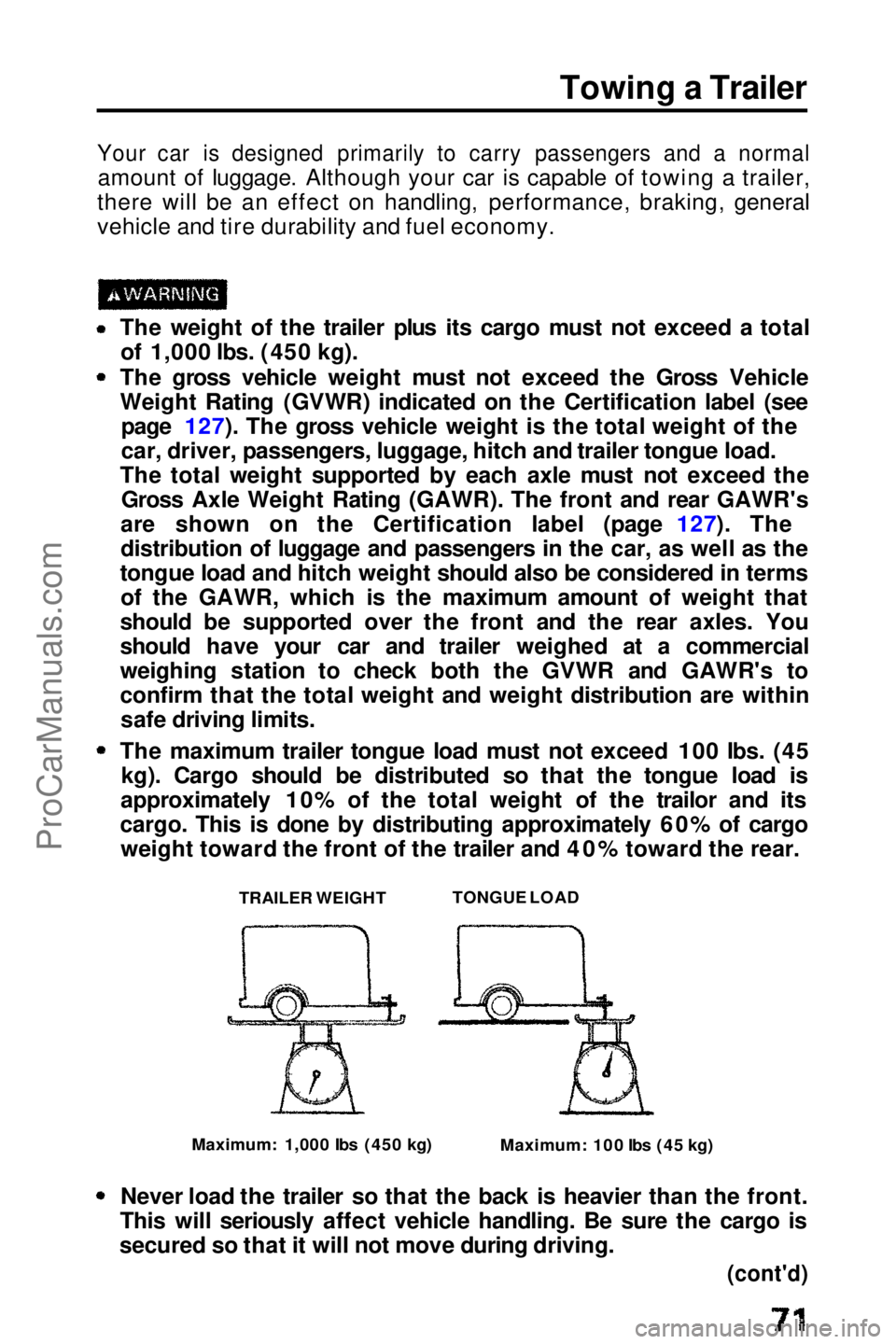
The maximum trailer tongue load must not exceed 100 Ibs. (45 kg). Cargo should be distributed so that the tongue load is
approximately 10% of the total weight of the trailor and its
cargo. This is done by distributing approximately 60% of cargo weight toward the front of the trailer and 40% toward the rear. Never load the trailer so that the back is heavier than the front.
This will seriously affect vehicle handling. Be sure the cargo is
secured so that it will not move during driving. TONGUE LOAD
TRAILER WEIGHT
Maximum: 100 Ibs (45 kg)
Maximum: 1,000 Ibs (450 kg)
(cont'd)ProCarManuals.comMain Menu t s
Page 72 of 143

Towing a Trailer (cont'd)
Hitches
Use only a hitch recommended by your Honda dealer. The hitch
should be bolted securely to the car and installed by a qualified
technician. Do not use a hitch designed for temporary installation
and never use one that attaches only to the bumper.
Trailer Brakes and safety chains
The Honda Automobile Division recommends that trailers equippedwith brakes, should conform to any applicable federal and stateregulations, When using a trailer equipped with electric brakes, a
trailer brake controller that connects to the car's electrical system is recommended. Installing a brake controller that connects to the car's
brake hydraulic system could result in brake fluid contamination or
leaks, A safety chain must always be used between the car and the
trailer. Leave sufficient slack in the chain so that it does not bind in
sharp turns. The chain should cross under the trailer tongue to prevent the tongue from dropping to the ground.
Tires
Make sure your car's are properly inflated. Adjust tire pressure
to the recommended tire pressure indicated on the label attached to
the edge of the driver's door.The trailer tires should be of the proper size, load rating and inflated to the pressure recommended
by the trailer manufacturer.
Trailer Lights
Trailer light must comply with federal, state and local regulations. See your local recreation vehicle dealer or rental agency for the
correct type of lighting and wiring for your trailer, Check for correct
operation of the turn signals and stop lights each time you hitch up.
CAUTION:
Connections to your car's electrical system should be made by
your Honda dealer or a qualified electrician.Improper installation
may damage your vehicle's electrical system and cause a
malfunction of the lights.
ProCarManuals.comMain Menu t s