tow HONDA PRELUDE 1990 User Guide
[x] Cancel search | Manufacturer: HONDA, Model Year: 1990, Model line: PRELUDE, Model: HONDA PRELUDE 1990Pages: 143, PDF Size: 2.07 MB
Page 73 of 143

Break-in Schedule
Do not tow a trailer during the 600 mile (1,000 km) break-in period:
see page 2.
Maintenance
If you tow a trailer, your vehicle will require more frequent
maintenance due to the additional load. Refer to the "Maintenance
Schedule under severe driving conditions" on page 80 for specific
information.
Before Towing
With the car and trailer completely loaded and parked on a level surface, confirm that the tongue loading is correct. If the car has an
abnormal nose-up or nose-down attitude, check for improper cargo
distribution. Check also for excessive cargo weight, worn
suspension or other causes and correct the problem before driving.
Be sure the cargo is secured so it will not shift while driving. Check
that your rearview mirrors conform to any federal, state, or local regulations. If not, install rearview mirrors designed for towing.Before towing a trailer, practice turning, stopping and reversing with
a trailor in an area away from traffic until you learn the technique.
(cont'd)
ProCarManuals.comMain Menu t s
Page 74 of 143

Towing a Trailer (cont'd)
Towing Safety
Stopping distance will be increased when towing a trailer. For
each 10 mph (16 km/h) of speed, allow at least two car lengths between you and the vehicle ahead. Avoid sudden braking
which may cause trailer jackknifing and loss of control.
Avoid jerky starts and sudden acceleration. If your car has amanual transmission, always start out in first gear and release
the clutch at moderate engine rpm.
Avoid rapid lane changing and sharp turns. The trailer could hit your car in a tight turn. Slow down before making a turn.
Remember, the total length of your car plus trailer will require a
wider turning circle.
Crosswinds may adversely affect handling of your car and
trailer, Use the rearview mirrors frequently to warn you of approaching large vehicles that may pass you causing your car
and trailer to sway. When being passed, firmly grip the steering wheel and be prepared to reduce speed immediately but
gradually. Never increase speed. Steer straight ahead.
Towing a trailer in bad weather will magnify any difficulty in
controlling the car caused by the weather itself. Avoid sudden maneuvers: slow down and use extra caution.
Be careful when passing other vehicles. Passing requires
considerable distance because of the added weight and length
of your trailer.ProCarManuals.comMain Menu t s
Page 75 of 143

CAUTION:
Before starting out, check the operation of the lights and all car/
trailer connections. After driving a short distance, stop and
recheck the lights and connections.
Reversing is difficult and requires practice. While backing-up,
the trailer may pivot off-course. To correct for this, grip the bottom of the steering wheel and move your hand to the left to
move the trailer to the left, or to the right to move the trailer to
the right. Turn the steering wheel a little at a time, and keep the
speed very low. Have someon e guide you when backing.
To help
prevent overheating of the brakes, shift into a lower
gear to make use of engine braking before descending steep or
long grades. Do not make sudden downshifts. Pay strict attention to the coolant temperature gauge when
going up hills. Because of the added load of the trailer, your car's
engine may overheat on hot days. Turning off the air conditioner
will reduce the load on the cooling system.
On cars equipped with automatic transmission. —Do not hold the car stationary on an incline by using the accelerator pedal; this can cause the transmission fluid tooverheat. Instead, use the handbrake or footbrake.
—When towing trailers, avoid high transmission fluid temperatures (caused by the transmission frequently shiftingbetween 3rd and 4th gears) by driving in S3.
NOTE:
Be sure to check state and local laws concerning maximum speed or
other driving restrictions for cars towing trailers. If you are driving
across several states, check each state's requirements before
leaving home, because restrictions may vary.
Parking with a Trailer
Whenever parking your car on an incline with a trailer attached, first
place and seat chocks at each wheel of the car and trailer. This is in
addition to the normal parking preparations of firmly applying the parking brake and placing the transmission in first or reverse
(manual transmission) or P (automatic transmission).
CAUTION:
Parking on an incline is not recommended and should be done only
if it cannot be avoided. Follow all precautions mentioned above
and turn the wheels to point towards a curb if facing downhill,
away from a curb if facing uphill. When leaving an inclined parking place, move the car slightly to unseat the chocks. Then while
keeping the foot brakes firmly applied, have an assistant remove
the chocks.ProCarManuals.comMain Menu t s
Page 80 of 143
Maintenance Schedule and Records (cont'd)
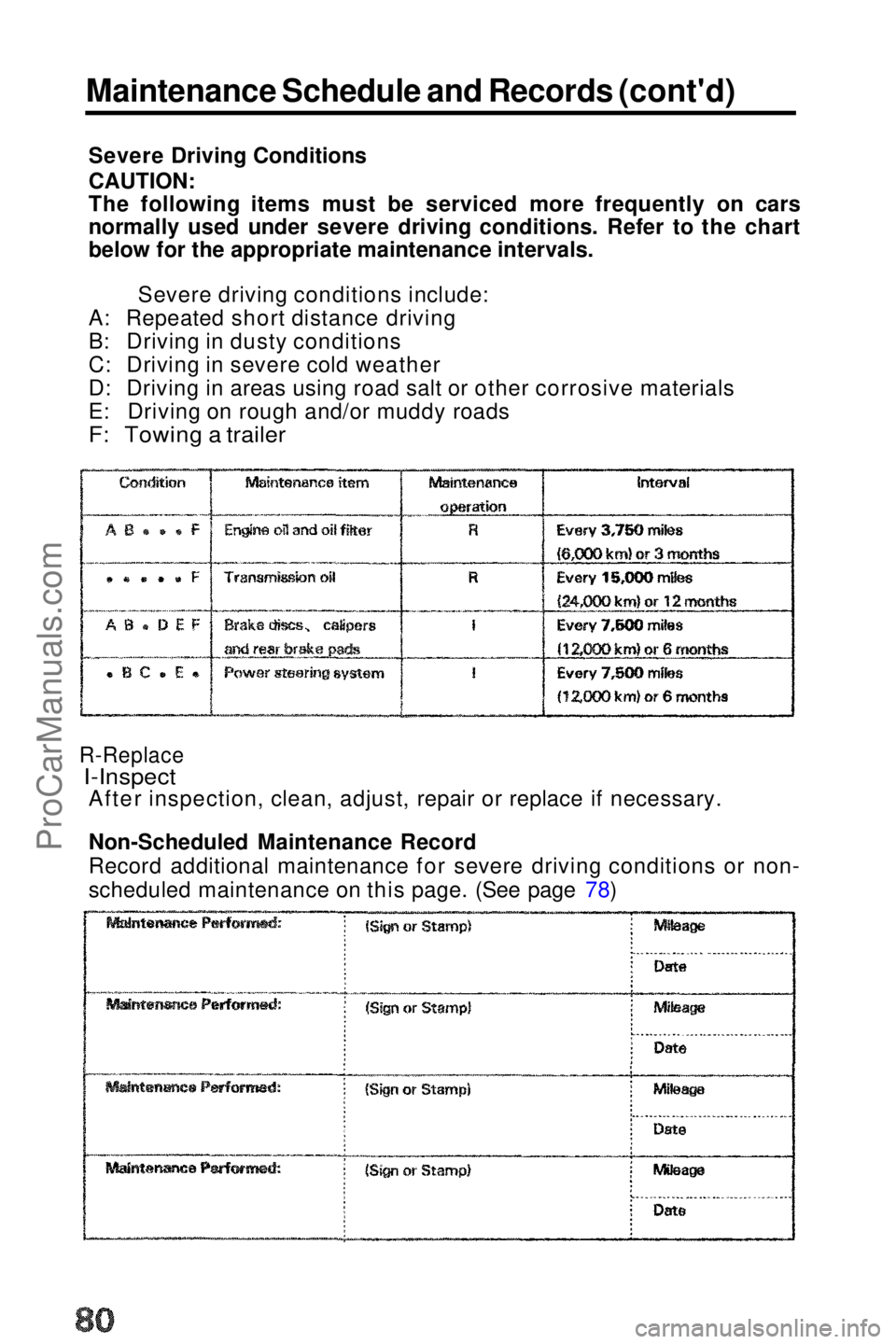
Severe Driving Conditions
CAUTION:
The following items must be serviced more frequently on cars
normally used under severe driving conditions. Refer to the chart
below for the appropriate maintenance intervals. Severe driving conditions include:
A: Repeated short distance driving
B: Driving in dusty conditions
C: Driving in severe cold weather
D: Driving in areas using road salt or other corrosive materials
E: Driving on rough and/or muddy roads
F: Towing a trailer
R-Replace
I-Inspect
After inspection, clean, adjust, repair or replace if necessary.
Non-Scheduled Maintenance Record
Record additional maintenance for severe driving conditions or non-
scheduled maintenance on this page. (See page 78)ProCarManuals.comMain Menu t s
Page 94 of 143
Wiper Blades
For maximum visibility, replace worn or cracked wiper blades when
you notice they do not wipe the windshield cleanly or smoothly.
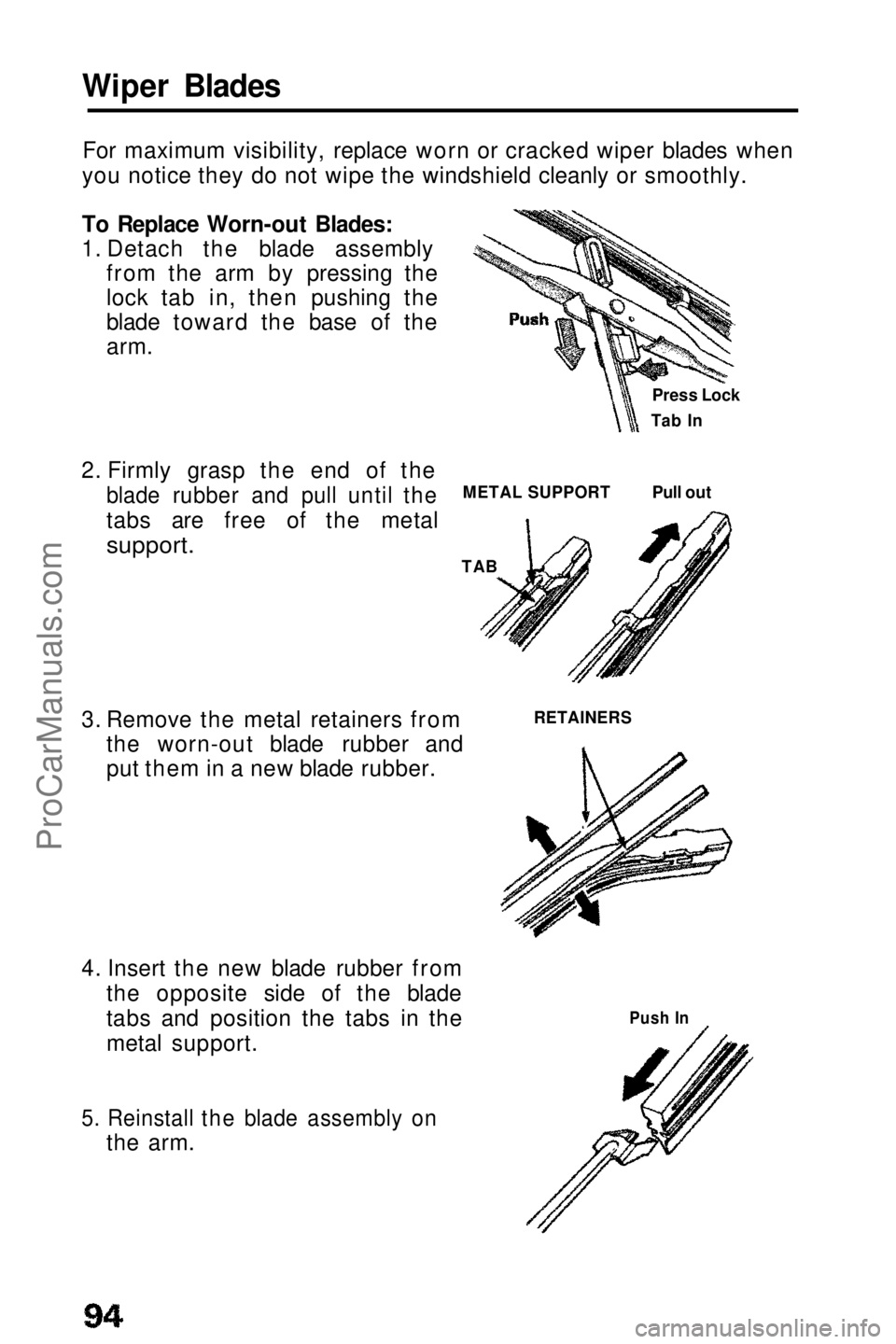
To Replace Worn-out Blades:
1. Detach the blade assembly from the arm by pressing the
lock tab in, then pushing the
blade toward the base of the
arm.
2. Firmly grasp the end of the
blade rubber and pull until the
tabs are free of the metal
support.
METAL SUPPORT
TAB
Pull out
3. Remove the metal retainers from the worn-out blade rubber and
put them in a new blade rubber. RETAINERS
4. Insert the new blade rubber from the opposite side of the blade
tabs and position the tabs in the
metal support.
5. Reinstall the blade assembly on
the arm. Press Lock
Tab In
Push InProCarManuals.comMain Menu t s
Page 110 of 143

Appearance Care
Interior Trim
Remove dust and loose dirt with a vacuum cleaner.
Wipe the vinyl with a clean, damp cloth or sponge. Stains can be removed with a commercially available vinyl cleaner.
CAUTION:
Do not use thinner, gasoline, kerosene, naphtha or other solvents
on the interior. They are toxic, flammable and hazardous and could damage the material you're cleaning.
Windows A 10 to 1 mix of water and white vinegar, or a commercially
available glass cleaner may be used to clean windows and to remove
the dust film sometimes caused by the ingredients used in interior vinyls and plastics.
NOTE:
Do not put this solution in the windshield washer reservoir, it will
damage the windshield washer pump.
Be careful not to scratch or damage the defogger wires when
cleaning the inside of the rear window; wipe the window horizontally along the wires, not up and down. Dry the windows
with a lint-free cloth or paper towel. Keep all the windows clean formaximum visibility.
Exterior Care
Waxing Wax the car when water will no longer "bead" on the paint. Always wash and dry the car before you wax it.
Use a good quality liquid or paste wax, and follow the manufacturer's
instructions. Wax all the metal trim to keep its luster.
NOTE:
Removing oil, tar, etc., with a spot remover will usually strip the
wax from the surrounding finish. Be sure to re-wax these areas even if the rest of the car does not yet need waxing.ProCarManuals.comMain Menu t s
Page 111 of 143

Washing
NOTE:
Retract the headlights before washing the car. However, make sure
the headlight lenses are cleaned periodically.
Rinse all loose dirt off the car by spraying it with lukewarm or cold
water. Do not use hot water.
Wash using a soft bristle brush, sponge, or cloth with water
containing a mild detergent, such as a liquid dishwashing detergent.
Remove oil, tar, tree sap, etc., with tar remover or turpentine.
Remove road salt, insects, etc., with mild detergent and lukewarm
water. Any of these substances may damage the finish if left on
painted surfaces.
Rinse the car well. Promptly wipe with a chamois or soft towel toprevent water-spotting. Do not let water or soap air-dry on painted
surfaces.
During wiping, inspect the surface for stone chips and scratches;paint them with touch-up paint so they won't rust (touch-up paint
is available through your Honda dealer).
For further instructions on corrosion protection, refer to the Rust
Prevention section on page 112.
Aluminum Alloy Wheels (Si with 4WS or ALB)
CAUTION:
Wash the wheels after driving on snowy or icy roads where salt
has been applied.
Avoid off-road driving. Brush, rocks, dirt and severe impact may
damage the wheels.
Install tire chains carefully. Improperly installed chains can cause
damage to the wheels.
Honda aluminum alloy wheels are treated with a protective
finish. Wash them with a low-phosphate detergent and sponge.
Do not use abrasive cleaners or stiff brushes. Always install aluminum wheels in sets of four. If mixed with
other types, the car's handing may be affected.
(cont'd)ProCarManuals.comMain Menu t s
Page 118 of 143
Changing a Flat Tire (cont'd)
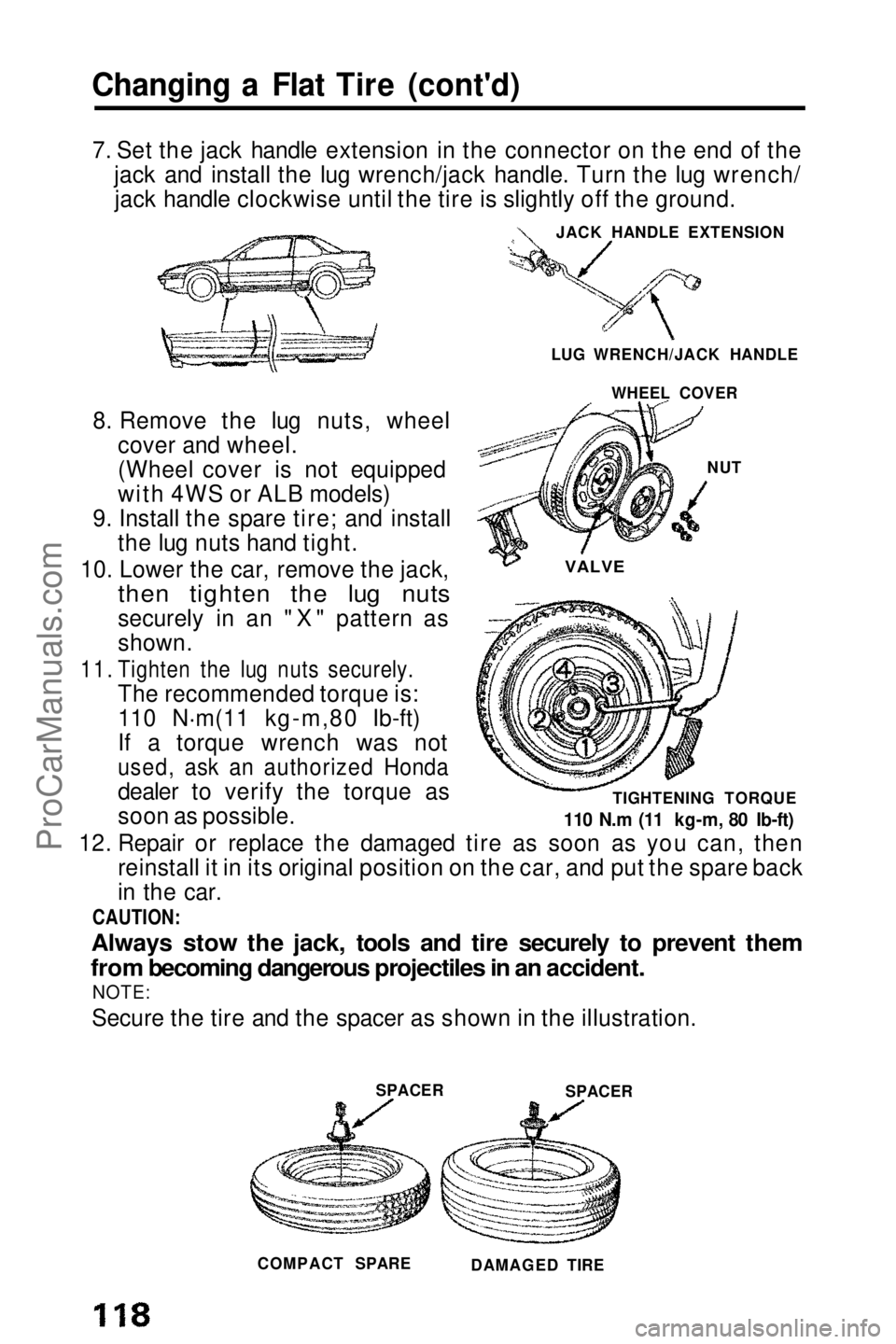
7. Set the jack handle extension in the connector on the end of the jack and install the lug wrench/jack handle. Turn the lug wrench/jack handle clockwise until the tire is slightly off the ground.
8. Remove the lug nuts, wheel cover and wheel.
(Wheel cover is not equipped
with 4WS or ALB models)
9. Install the spare tire; and install the lug nuts hand tight.
10. Lower the car, remove the jack,
then tighten the lug nuts
securely in an "X" pattern as
shown.11. Tighten the lug nuts securely.
The recommended torque is:
110 N .
m(11 kg-m,80 Ib-ft)
If a torque wrench was not
used, ask an authorized Honda
dealer to verify the torque as
soon as possible.
12. Repai
r or replace the damaged tire as soon as you can, then
reinstall it in its original position on the car, and put the spare back
in the car.
CAUTION:
Always stow the jack, tools and tire securely to prevent them
from becoming dangerous projectiles in an accident.
NOTE:
Secure the tire and the spacer as shown in the illustration.
COMPACT SPARE
DAMAGED TIRESPACER
SPACER TIGHTENING TORQUE
110 N.m (11 kg-m, 80 Ib-ft)
VALVE
NUT
WHEEL COVER
LUG WRENCH/JACK HANDLE JACK HANDLE EXTENSIONProCarManuals.comMain Menu t s
Page 120 of 143

Jump Starting (cont'd)
3. Use the other cable to connect the negative terminal of the booster battery to the engine at the ground cable as shown.
4.To remove the cables, reverse the above procedures exactly.
DO NOT push or tow a car to start it. The forward surge when the
engine starts could cause a collision. Also, under some conditions,
the catalytic converter could be damaged. A car equipped with an
automatic transmission cannot be started by pushing or towing.
NOTE:
After jump-starting the car, there is a possibility that the ALB
warning light may come on due to insufficient battery voltage. After
the battery is sufficiently recharged and the engine is turned off and restarted, the ALB warning light should indicate that the ALB
system is OK, by coming on for a few seconds each time the engine is started. If the light remains on after recharging, have it checked
by a Honda dealer.ProCarManuals.comMain Menu t s
Page 121 of 143

If towing is necessary, contact a professional towing service. Your
authorized Honda dealer can assist you with detailed towing
instructions.
Never use tow chains or rope to tow a car; your ability to safety
control the car may be adversely affected.
We recommend the following:
Flat Bed Equipment — Entire car is winched on a flat bed vehicle.
This is the best way of transporting your Honda.
Wheel Lift Type — Tow with the front wheels off the ground.
If the
car can only be towed with the front wheels on the ground:
make sure the transmission is full of fluid (see page 86 — 87)
and tow with the transmission in neutral (N) and the ignition key in
the I position.
CAUTION:
To avoid serious damage on automatic transmission cars, first start the engine and shift to D, then to N and shut the engine off. If
the engine does not run or the transmission cannot be shifted
while the engine is running, the car must be transported on flatbed equipment.
Check local regulations for towing.
CAUTION:
Do not exceed 35 mph (55 km/h) or tow for distances of more
than 50 miles (80 km). If a Sling Type tow is used, the tow truck driver should position
wood spacer blocks between your car's frame and the chains
and lift straps to avoid damaging the bumper and the body. Do not use the bumpers to lift the car or to support the car's
weight while towing.
When towing a car with 4WS even with the front wheels off the ground, turn the wheels straight ahead and tie the steering wheel in place. TowingProCarManuals.comMain Menu s t