transmission HONDA PRELUDE 1992 User Guide
[x] Cancel search | Manufacturer: HONDA, Model Year: 1992, Model line: PRELUDE, Model: HONDA PRELUDE 1992Pages: 225, PDF Size: 2.1 MB
Page 123 of 225
Towing a Trailer
Towing Safety
Your car will not stop as quickly
with a trailer in tow. Leave extra distance between your car and
other vehicles. Avoid braking or
turning suddenly. This could cause
the trailer to jackknife or possibly
turn over.
Keep in mind that your total
vehicle is now much longer. Leave
more room when making turns.
The trailer tracks a smaller arc than the car and can hit or run over
something that the car misses.
When passing another vehicle,
make sure the trailer is clear before changing lanes. The car/trailer combination is more
affected by crosswinds and buffet-
ing. When being passed by a large
vehicle, keep a constant speed and steer straight ahead. If there is too
much wind buffeting, slow down to
get out of the other vehicle's air
turbulence.
Towing a trailer puts an extra load on your car. You should have your
car serviced according to the
"Maintenance schedule under
severe driving conditions" on page
130.
This extra load is magnified when
you are driving in hilly terrain.
Watch the temperature gauge
closely when climbing hills. If it
gets near the hot area, turn off the
air conditioner (if it is on). If this
does not reduce the heat, it may be
necessary to pull to the side of the
road and wait for the engine to cool. If the automatic transmission shifts
frequently between 3rd and 4th
gears, put it in D3. This will help
prevent the transmission from
overheating. Help keep the brakes
from overheating by shifting to a
lower gear when going downhill. If you have to stop while going up-
hill, do not hold the car in place by pressing on the accelerator. This
can cause the automatic transmis-
sion to overheat. Use the parking
brake or footbrake.
DrivingProCarManuals.comMain Menu Table of Contents s t
Page 124 of 225
Towing a Trailer
Driving
When parking your car and trailer,
especially on a hill, be sure to
follow all the normal precautions.
Turn your front wheels into the curb, set the parking brake firmly,
and put the transmission in 1st or
Reverse (5-speed) or Park (auto-
matic). In addition, place wheel chocks at each of the trailer's tires.
Backing up with a trailer is diffi-
cult and takes practice. Drive
slowly, make small movements
with the steering wheel, and havesomeone stand outside to guide you.
Grip th e
steering wheel on the
bottom (rather than the usual posi- tion near the top). Move your hand
to the left to get the trailer to move
to the left, and right to move the
trailer right.ProCarManuals.comMain Menu Table of Contents s t
Page 125 of 225
Maintenance
Regularly maintaining your Honda
is the best way to protect your investment. You will be rewarded
with safer, more economical,
trouble-free driving. This section
lists items that need to be checked
regularly and explains how to check them. It also details some
simple maintenance tasks you can
do yourself. The maintenance
schedules for normal and severe
driving conditions show you when
these things need to be done.
If you are interested in how to per-
form more complex maintenance
on your Honda, you can purchase
the Service Manual. See page 221 for information on how to
obtain a copy, or see your Honda
dealer.
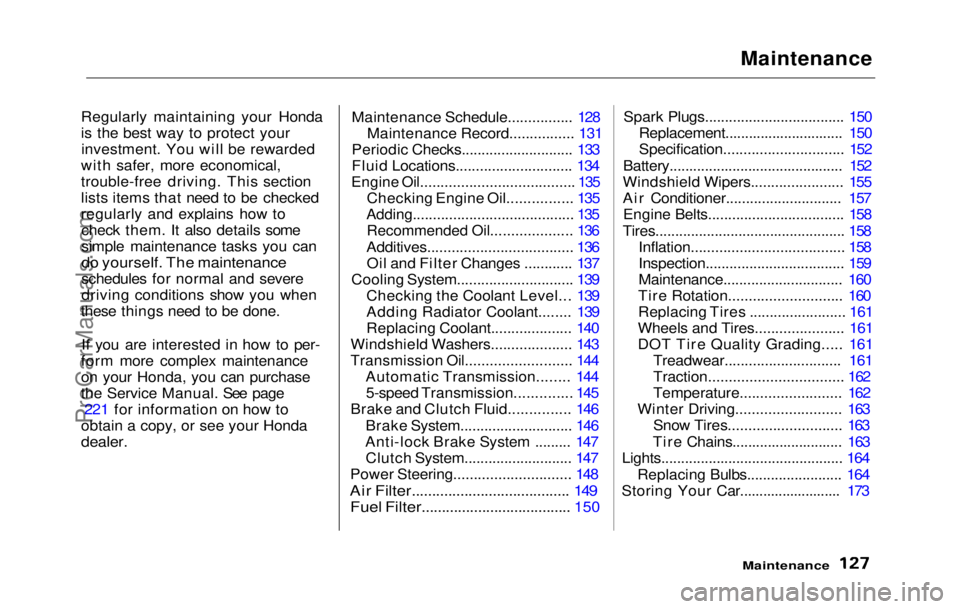
Maintenance Schedule................ 128
Maintenance Record................ 131
Periodic Checks............................ 133
Fluid Locations............................. 134
Engine Oil...................................... 135
Checking Engine Oil................ 135
Adding........................................ 135
Recommended Oil.................... 136
Additives.................................... 136 Oil and Filter Changes ............ 137
Cooling System............................. 139 Checking the Coolant Level... 139
Adding Radiator Coolant........ 139
Replacing Coolant.................... 140
Windshield Washers.................... 143
Transmission Oil.......................... 144
Automatic Transmission........ 144
5-speed Transmission.............. 145
Brake and Clutch Fluid............... 146
Brake System............................ 146
Anti-lock Brake System ......... 147 Clutch System........................... 147
Power Steering............................. 148
Air Filter....................................... 149
Fuel Filter..................................... 150
Spark Plugs.................................. .
150
Replacement.............................. 150
Specification.............................. 152
Battery............................................ 152
Windshield Wipers....................... 155
Air Conditioner............................. 157 Engine Belts.................................. 158
Tires................................................ 158 Inflation...................................... 158
Inspection................................... 159
Maintenance.............................. 160
Tire Rotation............................ 160
Replacing Tires ........................ 161
Wheels and Tires...................... 161
DOT Tire Quality Grading..... 161 Treadwear............................. 161
Traction................................. 162
Temperature......................... 162
Winter Driving.......................... 163 Snow Tires............................ 163
Tire Chains............................ 163
Lights.............................................. 164
Replacing Bulbs........................ 164
Storing Your Car.......................... 173
MaintenanceProCarManuals.comMain Menu s t
Page 127 of 225
Maintenance Schedule
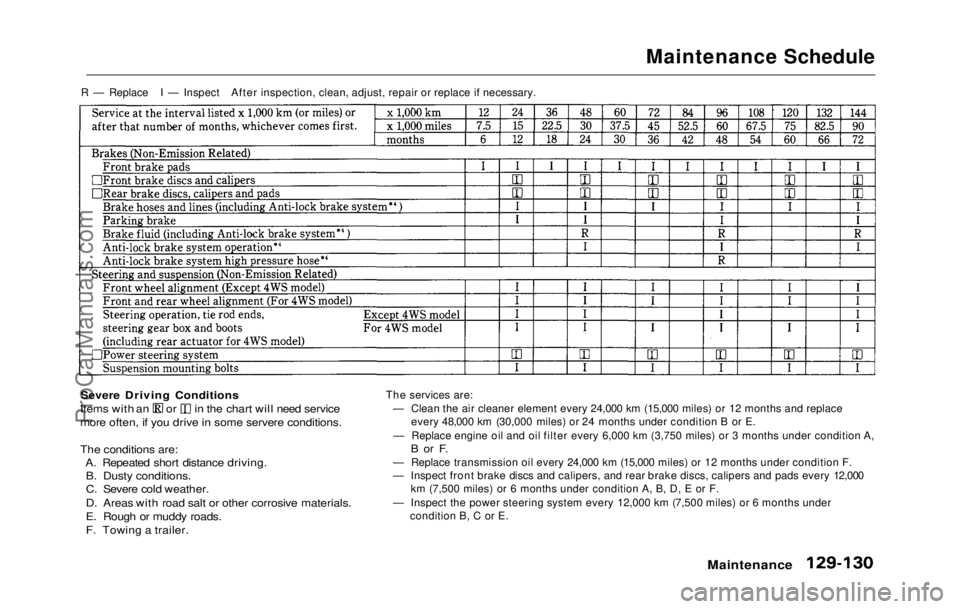
R — Replace I — Inspect After inspection, clean, adjust, repair or replace if necessary.
Severe Driving Conditions Items with an or in the chart will need service
more often, if you drive in some servere conditions.
The conditions are:
A. Repeated short distance driving.B. Dusty conditions.
C. Severe cold weather.
D. Areas with road salt or other corrosive materials.
E. Rough or muddy roads.
F. Towing a trailer.
The services are:
— Clean the air cleaner element every 24,000 km (15,000 miles) or 12 months and replace every 48,000 km (30,000 miles) or 24 months under condition B or E.
— Replace engine oil and oil filter every 6,000 km (3,750 miles) o r 3 months under condition A,
B or F
.
— Replace transmission oil every 24,000 km (15,000 miles) or 12 months under condition F.
— Inspect front brake discs and calipers, and rear brake discs, calipers and pads every 12,000 km (7,500 miles) or 6 months under condition A, B, D, E or F.
— Inspect the power steering system every 12,000 km (7,500 miles) o
r 6 months under
condition B, C or E.
Maintenance
ProCarManuals.comMain Menu Table of Contents s t
Page 131 of 225
Periodic Checks
You should check the following items at the specified intervals. If
you are unsure of how to perform
any check, turn to the page given. Engine oil level — Check every
time you fill the gas tank. See
page 102.
Engine coolant level — Check
the radiator reserve tank every
time you fill the gas tank. See
page 103.
Windshield washer fluid —
Check the level in the reservoir
monthly. If weather conditions
cause you to use the washers
frequently, check the reservoir each time you stop for gas. See
page 143 .
Automatic transmission — Check the fluid level monthly.
See page 144. Brakes, clutch and power
steering — Check the fluid level
monthly. See page 146.Tires — Check the tire pressure
monthly. Examine the tread for
wear and foreign objects. See
page 159.
Battery — Check its condition
and the terminals for corrosion
monthly. See page 152.
Air conditioner — Check its operation weekly. See page 157.
Lights — Check the operation of
the headlights, parking lights,
taillights, high-mount brake light,
turn signals, brake lights, and
license plate lights monthly. See
page 164.
MaintenanceProCarManuals.comMain Menu Table of Contents s t
Page 132 of 225
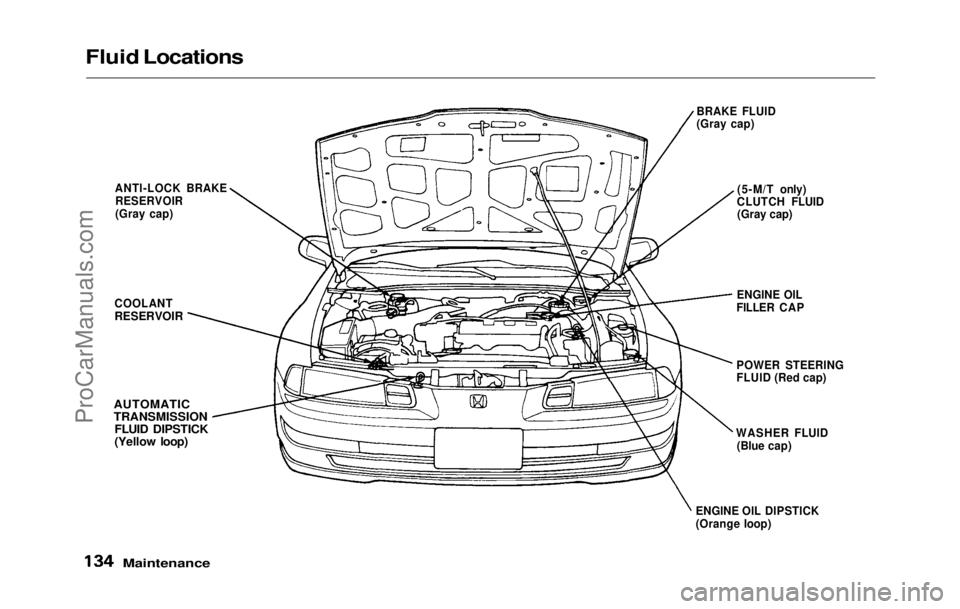
Fluid Locations
Maintenance
BRAKE FLUID
(Gray cap)
(5-M/T only)
CLUTCH FLUID (Gray cap)
ENGINE OIL
FILLER CAP
POWER STEERING
FLUID (Red cap)
ANTI-LOCK BRAKE
RESERVOIR
(Gray cap)
COOLANT
RESERVOIR
AUTOMATIC
TRANSMISSION FLUID DIPSTICK
(Yellow loop)
ENGINE OIL DIPSTICK
(Orange loop)WASHER FLUID
(Blue cap)ProCarManuals.comMain Menu Table of Contents s t
Page 134 of 225
Engine Oil
Recommended Oil
Oil is a major contributor to your
engine's performance and longevity.
Always use a premium-grade deter-
gent oil. You can determine an oil's
SAE viscosity and Service Classifi-
cation from the API Service label
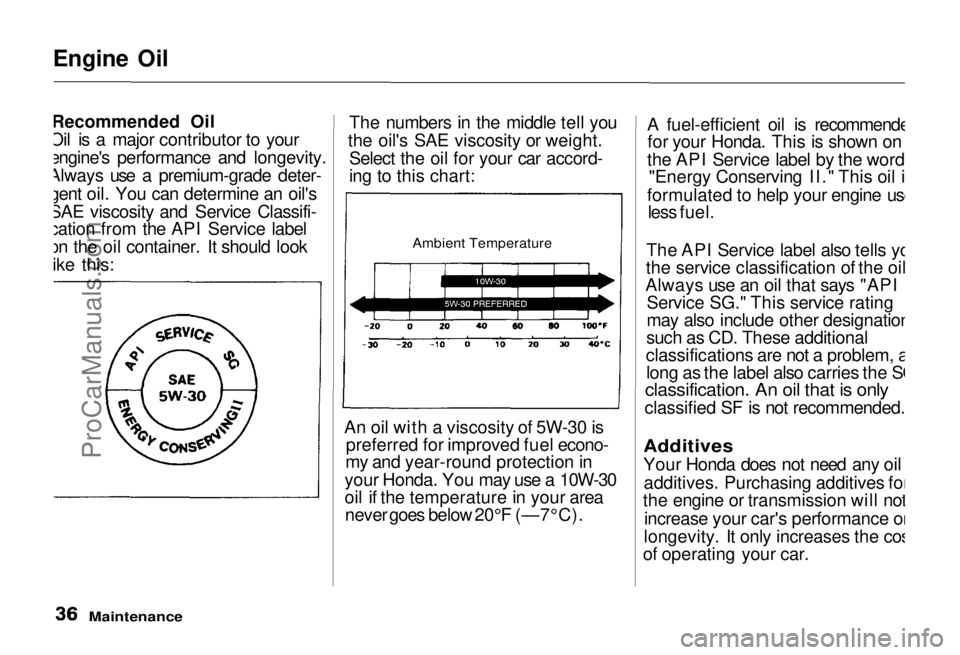
on the oil container. It should look
like this: The numbers in the middle tell you
the oil's SAE viscosity or weight. Select the oil for your car accord-
ing to this chart:
Ambient Temperature
An oil with a viscosity of 5W-30 is preferred for improved fuel econo-
my and year-round protection in
your Honda. You may use a 10W-30
oil if the temperature in your area never goes below 20°F (—7°C). A fuel-efficient oil is recommended
for your Honda. This is shown on
the API Service label by the words "Energy Conserving II." This oil is
formulated to help your engine use less fuel.
The API Service label also tells you
the service classification of the oil.
Always use an oil that says "API
Service SG." This service rating
may also include other designations,
such as CD. These additional
classifications are not a problem, as long as the label also carries the SG
classification. An oil that is only
classified SF is not recommended.
Additives
Your Honda does not need any oil additives. Purchasing additives for
the engine or transmission will not
increase your car's performance or
longevity. It only increases the cost
of operating your car.
MaintenanceProCarManuals.comMain Menu Table of Contents s t
Page 140 of 225
Cooling System
6. Mix the recommended antifreeze with an equal amount of purifiedor distilled water in a clean
container. The cooling system
capacity is:
With 5-speed transmission:
(US: S, Canada: S)
3.5
(0.92 US gal, 0.77 Imp gal)
(US: Si, Si 4WS, Canada: SR, SR 4WS)
3.8
(1.00 US gal, 0.84 Imp gal)
With automatic transmission:
(US: S, Canada: S)
3.4
(0.90 US gal, 0.75 Imp gal)
(US: Si, Si 4WS, Canada: SR, SR 4WS)
3.7
(0.98 US gal, 0.81 Imp gal)
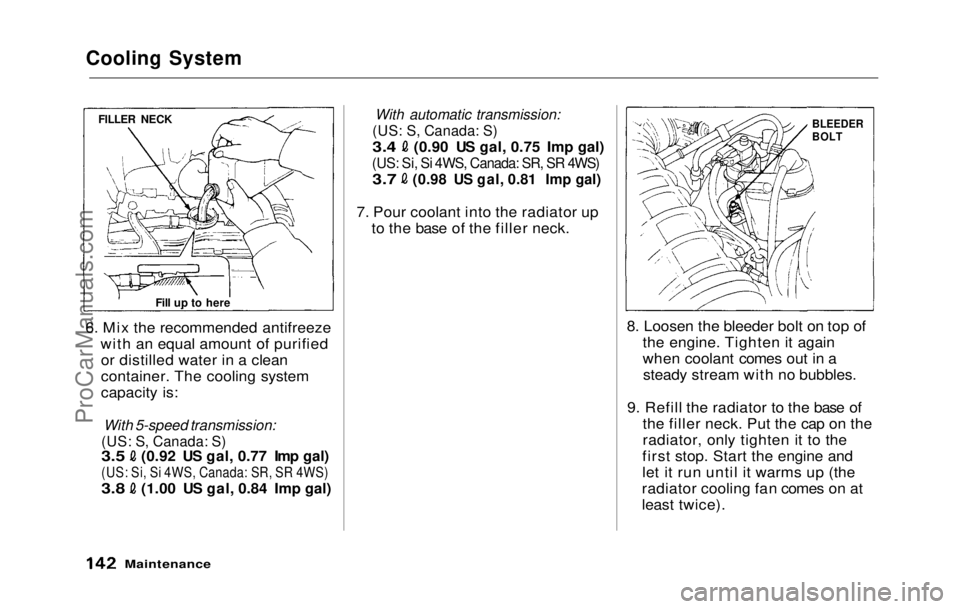
7. Pour coolant into the radiator up to the base of the filler neck.
8. Loosen the bleeder bolt on top ofthe engine. Tighten it again
when coolant comes out in asteady stream with no bubbles.
9. Refill the radiator to the base of the filler neck. Put the cap on the
radiator, only tighten it to the
first stop. Start the engine and
let it run until it warms up (the
radiator cooling fan comes on at
least twice).
Maintenance
FILLER NECK
Fill up to here
BLEEDER
BOLTProCarManuals.comMain Menu Table of Contents s t
Page 142 of 225
Transmission Oil
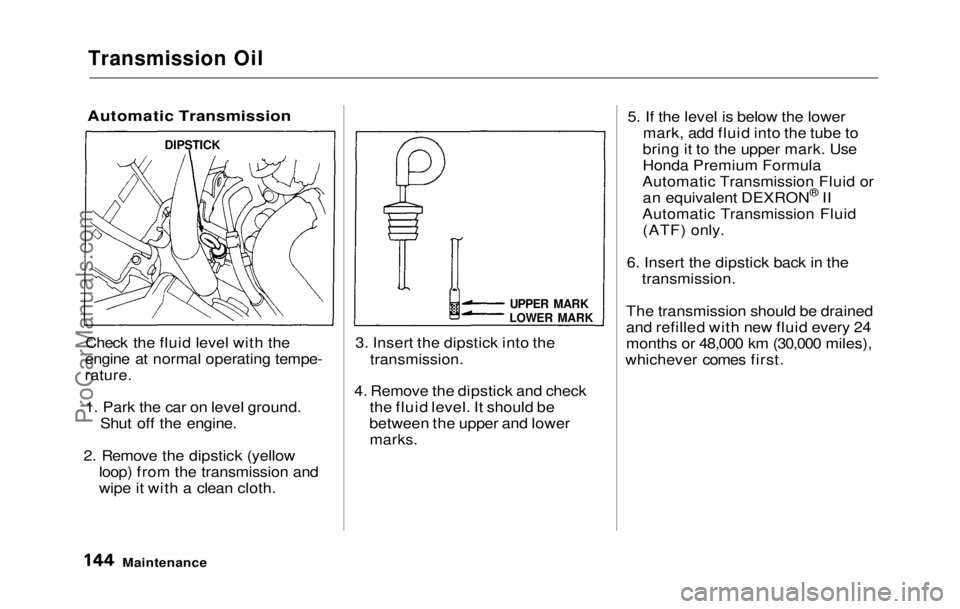
Automatic Transmission
Check the fluid level with the
engine at normal operating tempe-
rature.
1. Park the car on level ground. Shut off the engine.
2. Remove the dipstick (yellow loop) from the transmission and
wipe it with a clean cloth. 3. Insert the dipstick into the
transmission.
4. Remove the dipstick and check the fluid level. It should be
between the upper and lower
marks.
5. If the level is below the lower
mark, add fluid into the tube to
bring it to the upper mark. Use
Honda Premium Formula
Automatic Transmission Fluid or an equivalent DEXRON ®
II
Automatic Transmission Fluid (ATF) only.
6. Insert the dipstick back in the transmission.
The transmission should be drained
and refilled with new fluid every 24
months or 48,000 km (30,000 miles),
whichever comes first.
Maintenance
DIPSTICK
UPPER MARK
LOWER MARKProCarManuals.comMain Menu Table of Contents s t
Page 143 of 225
Transmission Oil
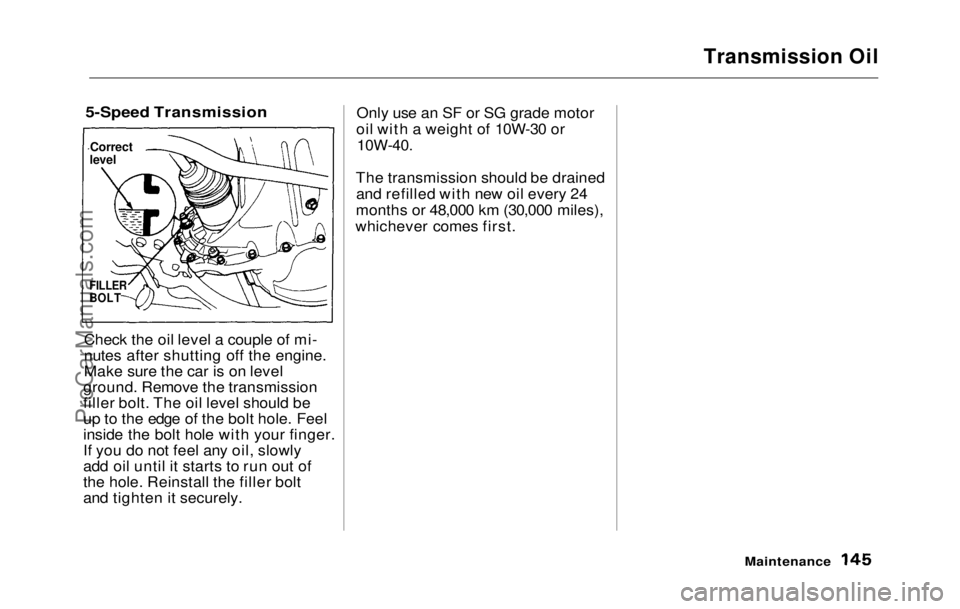
5-Speed Transmission
Check the oil level a couple of mi-
nutes after shutting off the engine.
Make sure the car is on level
ground. Remove the transmission
filler bolt. The oil level should be
up to the edge of the bolt hole. Feel
inside the bolt hole with your finger.
If you do not feel any oil, slowly
add oil until it starts to run out of
the hole. Reinstall the filler bolt
and tighten it securely. Only use an SF or SG grade motor
oil with a weight of 10W-30 or
10W-40.
The transmission should be drained and refilled with new oil every 24
months or 48,000 km (30,000 miles),
whichever comes first.
Maintenance
Correct
level
FILLER
BOLTProCarManuals.comMain Menu Table of Contents s t