instrument panel HONDA PRELUDE 1992 Owner's Manual
[x] Cancel search | Manufacturer: HONDA, Model Year: 1992, Model line: PRELUDE, Model: HONDA PRELUDE 1992Pages: 225, PDF Size: 2.1 MB
Page 112 of 225
Automatic Transmission
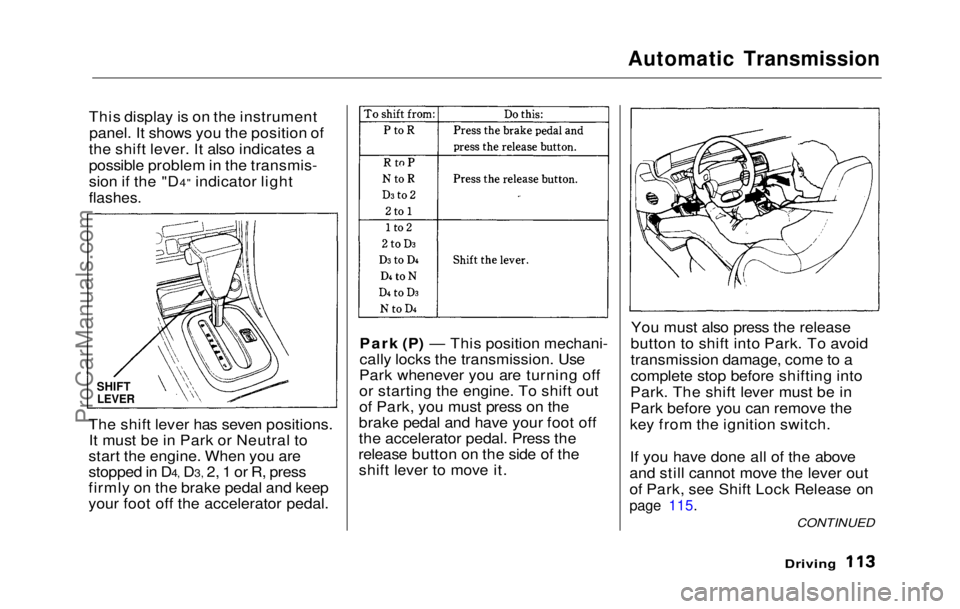
This display is on the instrument panel. It shows you the position of
the shift lever. It also indicates a
possible problem in the transmis-
sion if the "D4" indicator light
flashes.
The shift lever has seven positions. It must be in Park or Neutral to
start the engine. When you are
stopped in D4, D3, 2, 1 or R, press
firmly on the brake pedal and keep
your foot off the accelerator pedal. Park (P) — This position mechani-
cally locks the transmission. Use
Park whenever you are turning off
or starting the engine. To shift out
of Park, you must press on the
brake pedal and have your foot off
the accelerator pedal. Press the
release button on the side of the shift lever to move it. You must also press the release
button to shift into Park. To avoid
transmission damage, come to a
complete stop before shifting into
Park. The shift lever must be in
Park before you can remove the
key from the ignition switch.
If you have done all of the above
and still cannot move the lever out
of Park, see Shift Lock Release on
page 115.
Driving
SHIFT
LEVER
CONTINUEDProCarManuals.comMain Menu Table of Contents s t
Page 117 of 225
The Braking System, Four Wheel Steering
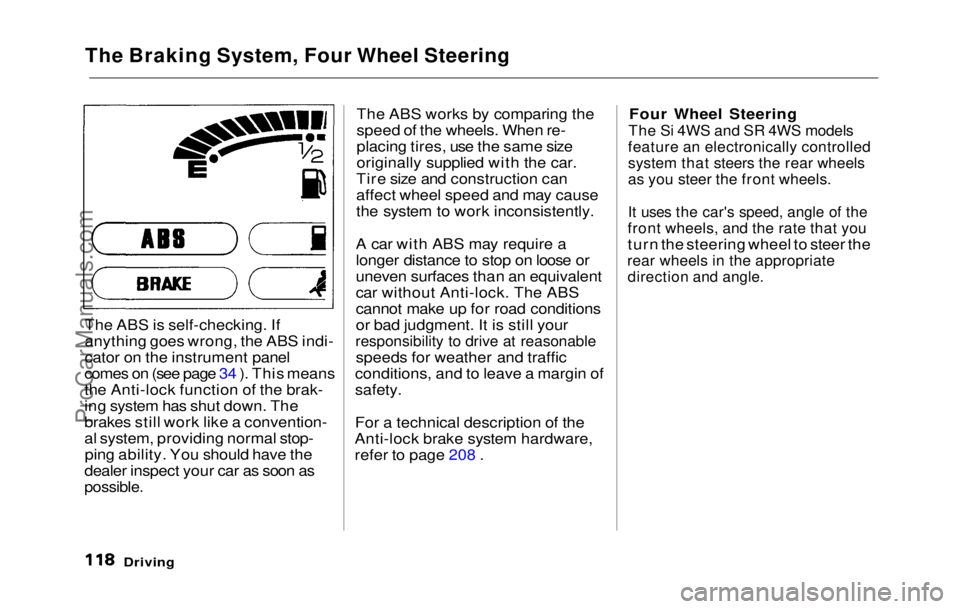
The ABS is self-checking. If
anything goes wrong, the ABS indi-
cator on the instrument panel
comes on (see page 34 ). This means
the Anti-lock function of the brak-
ing system has shut down. The
brakes still work like a convention-
al system, providing normal stop- ping ability. You should have the
dealer inspect your car as soon as
possible.
The ABS works by comparing the
speed of the wheels. When re-
placing tires, use the same size
originally supplied with the car.
Tire size and construction can
affect wheel speed and may cause
the system to work inconsistently.
A car with ABS may require a
longer distance to stop on loose or
uneven surfaces than an equivalent
car without Anti-lock. The ABS
cannot make up for road conditions
or bad judgment. It is still yourresponsibility to drive at reasonable
speeds for weather and
traffic
conditions, and to leave a margin of
safety.
For a technical description of the
Anti-lock brake system hardware,
refer to page 208 . Four Wheel Steering
The Si 4WS and SR 4WS models
feature an electronically controlled
system that steers the rear wheels
as you steer the front wheels.
It uses the car's speed, angle of the
front wheels, and the rate that you
turn the steering wheel to steer the
rear wheels in the appropriate
direction and angle.
DrivingProCarManuals.comMain Menu Table of Contents s t
Page 118 of 225
Four Wheel Steering, Driving in Bad Weather
At very slow speeds, the rear
wheels steer in the opposite direction to the front wheels. This
helps in maneuvers such as parallelparking and U-turns.
At higher speeds, the rear wheels
first steer in the same direction as the front wheels. This aids with
changing lanes. As you turn the
steering wheel more, the rear
wheels return to straight ahead and
then steer in the opposite direction
to the front wheels. This givesimproved handling when going
around curves at highway speeds. The rear wheels return to the
straight ahead position when you
turn off the engine. They also
return to straight ahead if you sit
still for more than two minutes
with the engine running. They
return to steering mode as soon as
you move the steering wheel or
start to drive away.
The 4WS system is self-checking.
If it detects a problem anywhere in
the system, it turns on the 4WS indicator on the instrument panel
(see page 35) and points the rear
wheels straight ahead. Your car
will then drive like a conventional car without 4WS.
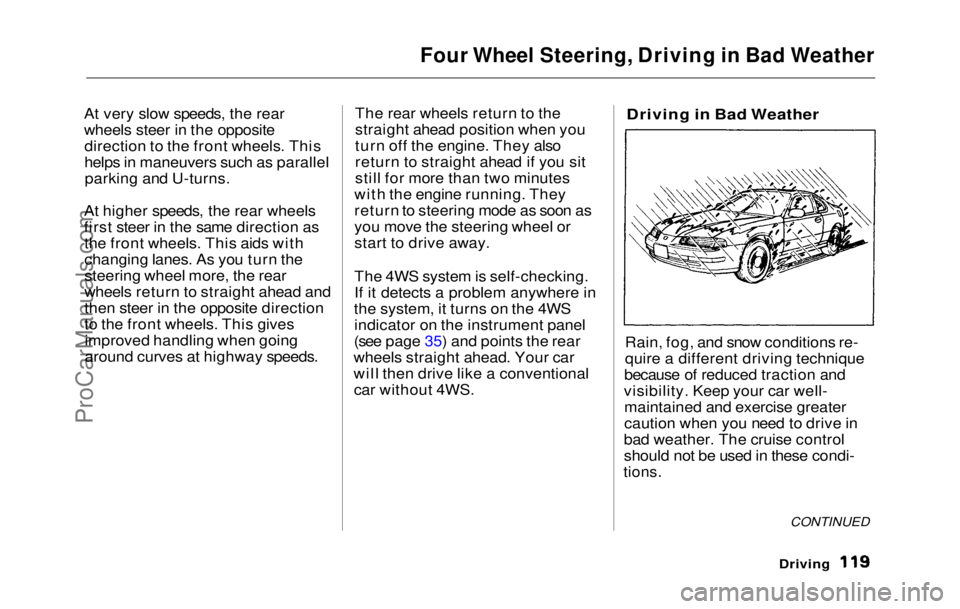
Driving in Bad Weather
Rain, fog, and snow conditions re-
quire a different driving technique
because of reduced traction and
visibility. Keep your car well- maintained and exercise greater
caution when you need to drive in
bad weather. The cruise control
should not be used in these condi-
tions.
CONTINUED
DrivingProCarManuals.comMain Menu Table of Contents s t
Page 204 of 225

Anti-lock Brake System
The Anti-lock Brake System (ABS) is standard equipment on the
Prelude Si, Si 4WS sold in the U.S.
and SR, SR 4WS sold in Canada. It
is not available on any other models.
The ABS works by measuring how
fast the wheels are turning during
braking and comparing their speed.If any wheel is rotating much
slower than the others (on the
verge of locking up and skidding),
the system reduces hydraulicpressure to that wheel's brake
caliper. When that wheel's speed
matches the other wheels, the
system applies normal hydraulic pressure. This can take place
several times per second at each
wheel. You feel the ABS working as rapid pulsations in the brake
pedal.
Each wheel has a wheel speed
sensor assembly. As the wheel
rotates, the sensor sends electrical
pulses to the ABS control unit. The
pulse frequency varies with the
wheel speed.
The electrical output of the ABScontrol unit is connected to the
modulator/solenoid unit. During
braking, the ABS control unit monitors the pulse frequencies
from the four wheels. When the control unit detects a wheel locking
up, it energizes the appropriate
solenoid in the modulator/solenoid
unit. There are three solenoids: one
for each front wheel, and one for
the rear wheels. The energized solenoid reduces hydraulic pres-
sure to one side of a modulator
valve. This, in turn, reduces hydrau- lic pressure in the brake line going
to the affected wheel. When that
wheel speeds up because of the re- duced braking effort, the control unit de-energizes the solenoid. This
builds hydraulic pressure on the
modulator valve. The pressure in-
creases in the hydraulic line to the
wheel.
For the system to react quickly, the
modulator/solenoid unit must have
brake fluid under high pressure.
This is supplied by an accumulator
that is pressurized by an electric pump. A pressure-sensing switch
on the accumulator controls this
pump.
The control unit also contains error detection circuitry. It monitors the
operation of the wheel sensors, solenoids, pump, and electronics. If
the control unit detects any faults,
it shuts off power to the pump
motor and solenoids. The light on
the instrument panel comes on.
The brakes then work like a conventional system without anti-
lock capabilities.
Technical InformationProCarManuals.comMain Menu Table of Contents s t
Page 205 of 225

Supplemental Restraint System
The Honda
Supplemental Restraint
System (SRS) is standard on all
Preludes sold in the U.S. and the
SR, SR 4WS sold in Canada.
The SRS includes the steering
wheel airbag assembly, sensors in the dashboard, and a control unit
with sensors behind the center
console.
(On Si 4WS model)
The system also has a dashboard-
mounted airbag assembly for the
passenger.
The sensors are decelerometers,
set to trigger in a frontal impact that generates more force than a 10
mile per hour barrier crash. For the
SRS to activate, at least two sen-
sors must trigger. This duplication
is to prevent accidental activation. When the control unit receives
trigger signals from at least two
sensors, it sends voltage to the
airbag. The control unit stores this
charge in capacitors to insure
reliability even if a severe impact damages the car's battery or
electrical connections.
The electrical charge sent to the
airbag assembly ignites its propel-
lant, which burns instantaneously.
The gas produced by the burning propellant inflates the airbag in
about 40 milliseconds (1/25 of a
second).
The airbag is vented so it stays inflated for only an instant and
does not block the driver's vision.
Smoke from the burned propellant
comes out of the airbag and into
the car's interior. This is normal
and does not mean there is a fire.
The airbag collapses onto the driver's lap. The airbag unit can inflate only one
time. After use, your Honda dealer
must check the complete Supple-
mental Restraint System and re-
place the airbag assembly.
To ensure long-term reliability, the
SRS uses gold-plated electrical
connections throughout. Exposed
components are sealed with epoxy.
The control unit monitors the SRS circuitry whenever the ignition is
ON (II). If the control unit senses
any faults, it turns on the SRS
indicator light on the instrument
panel. Take the car to your Honda
dealer to diagnose and repair the system as soon as possible.
The SRS needs no regular mainte-
nance other than an inspection by
your Honda dealer ten years after
manufacture.
Technical InformationProCarManuals.comMain Menu Table of Contents s t
Page 206 of 225

Four Wheel Steering
The Si 4WS model in the U. S and
the SR 4WS model in Canada are
equipped with an electronic Four
Wheel Steering system.
As inputs, the 4WS system uses a
vehicle speed sensor and a sensor to measure how far the front
wheels are turned.
The electronic control unit for 4WS system uses these inputs to deter-
mine which direction to steer the
rear wheels, and at what angle. Depending on vehicle speed and the
angle of the front wheels, the rear
wheels will be "countersteered"
(steered in the opposite direction of
the front wheels) or "same-steered"
(steered in the same direction as
the front wheels). The 4WS electronic control unit
drives an electric motor built into
the rear steering box. Sensors for
rear wheel angle and speed provide
feedback. The electronic control
unit uses this feedback to compare
the actual rear wheel angle to the
desired angle.
When the driver turns the front
wheels with the car traveling less
than 18 mph (30 km/h), the rear
wheels are countersteered. The angle of countersteer increases as
the angle of the front wheels in-
creases, to a maximum counter-
steer angle of six degrees. This
improves response when parallel
parking or making sharp turns.
Above 18 mph (30 km/h), the rear
wheels are same-steered as the driver begins to turn the steering
wheel. The rear wheel angle for
any given steering wheel angle is
not fixed; it increases as vehicle speed increases. This improves
response in lane-changing maneu-
vers.
As the driver continues to turn the
steering wheel, the rear wheels are
steered back to the straight-ahead
position and then to countersteer
mode. As with same steer, the
angle of countersteer varies with
vehicle speed; increasing and then decreasing as the speed rises. This
gives improved handling in low, medium, and high speed curves.
The 4WS system's electronic
control unit monitors the sensors
whenever the ignition is ON. If it detects a problem anywhere in the
system, it lights the 4WS indicator
on the instrument panel and turns
the system off. With the system off,
the rear wheels remain pointed
straight ahead. Your car will then
drive like a conventional car
without 4WS.
Technical InformationProCarManuals.comMain Menu Table of Contents s t
Page 221 of 225
Index
Ignition
Keys.............................................. 47
Switch.......................................... 47
Timing Control System........... 212
Indicator Lights,
Instrument
Panel............................................. 31
Infant Restraint.............................. 19
Inflation, Proper Tire..................
158
Inside Mirror...................................
59
Inspection, Tire.............................
159
Instrument Panel............................
30
Instrument Panel Brightness....... 41
Interior Cleaning..........................
179
Interior Lights................................
66
Introduction........................................ i
Jacking up the Car.......................
185
Jack, Tire...................................... .
185
Jump Starting...............................
.
191
Keys.................................................. 4
7
Label, Certification...................... 204
Lane Change, Signaling................ 41
Lap/Shoulder Belts......................... .
6
Leaking of Exhaust into Car........ 25
Lighter, Cigarette.......................... 65
Lights
Bulb Replacement.................... 164
Indicator....................................... 3 1
Parking........................................
. 40
Turn Signal.................................. 41
Loading Cargo..............................
106
LOCK (Ignitio n
Key Position).....
47
Locks
Anti-theft Steerin
g Column..... 47
Fuel Filler Door........................
100
Glove Box................................... .
62
Power Door.................................. 48
Trunk...........................................
50
Low Coolan t
Level.......................
139
Lower Gear
,
Downshifting to a . 112
Low Oil Pressure Light........ 33, 195
Lubricant Specifications Chart.
206
Luggage.........................................
106
Maintenance.................................. 127
Periodi
c Items........................... 133
Record................................. 131-
132
Schedule ............................ .
128-129
Manual Transmission..................
111
Manual Transmissio n
Fluid.......
145
Maximum Shif
t
Speeds....... 112, 115
Meters, Gauges............................... 37
Methanol in Gasoline..................... 98
Mirrors, Adjusting......................... 59
Neutral Gear Position..................
114
New Vehicl e
Break-in................... 98
Normal Shift Speeds....................
111
NOTICE, Explanatio n
of................ ii
Numbers, Identification..............
204
Occupant Protectio n
System ......... 4
CONTINUEDProCarManuals.comMain Menu s t