brake HONDA PRELUDE 1992 Service Manual
[x] Cancel search | Manufacturer: HONDA, Model Year: 1992, Model line: PRELUDE, Model: HONDA PRELUDE 1992Pages: 225, PDF Size: 2.1 MB
Page 184 of 225
Changing a Flat Tire
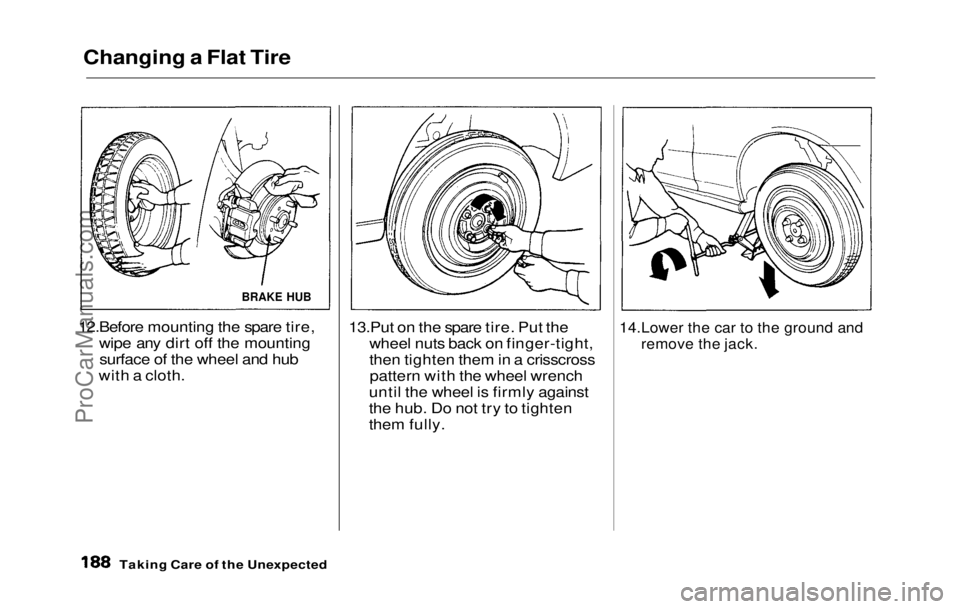
12.Before mounting
the spare tire,
wipe any dirt off the mounting
surface of the wheel and hub
with a cloth.
13.Put on
the spare tire. Put the
wheel nuts back on finger-tight,
then tighten them in a crisscross
pattern with the wheel wrench
until the wheel is firmly against
the hub. Do not try to tighten
them fully.
14.Lower th e
car to the ground and
remove the jack.
Taking Car
e
of the Unexpected
BRAKE HUBProCarManuals.comMain Menu Table of Contents s t
Page 187 of 225
If Your Engine Won't Start, Jump Starting
The Starter Operates
Normally
In this case, the starter motor
sounds normal when you turn the
ignition switch to START (III), but
the engine does not run. Are you using the proper starting
procedure? Refer to Starting
the Engine on page 109 . Do you have gas? Turn the
ignition switch to ON (II) for a
minute and watch the fuel gauge.
There may be an electrical
problem, such as no power to the
fuel pump. Check all the fuses
(see page 199 ).
If you find nothing wrong, you will
need a qualified technician to find
the problem. See Towing on page
202.
Jump Starting
If your car's battery has run down,
you may be able to start the engine
by using a booster battery. Although this seems like a simple
procedure, there are several precau-
tions you should take. Follow the
directions closely.
You cannot start a Honda with an
automatic transmision by pushingor pulling it. To jump start your car:
1. Open the hood and check the physical condition of the battery
(see page 152 ). In very cold
weather, check the condition of the electrolyte. If it seems slushy
or like ice, do not try jump
starting until it thaws.
If a battery sits in extreme cold, the
electrolyte inside can freeze.
Attempting to jump start with a frozen battery can cause it to
rupture or explode.
2. Turn off all the electrical acces- sories: heater, A/C, stereo system,
lights, etc. Put the transmission in Neutral
or Park and set the parking
brake.
Taking Care of the Unexpected
CONTINUED
A battery can explode if you
do not follow the correct
procedure, seriously injuring
anyone nearby.
Keep all sparks, open flames,
and smoking materials away
from the battery.
NOTICE
ProCarManuals.comMain Menu Table of Contents s t
Page 189 of 225
If Your Engine Overheats
Your car's temperature gauge
should register in the midrange
under most conditions. It may register higher if you are driving
up a long steep hill on a very hot
day. If it illuminates the red
marker at the right end of the
gauge, you should determine the
reason.
Driving with the temperature
gauge's red marker lit can cause serious damage to your engine. Your car can overheat for several
reasons, such as lack of coolant or a
mechanical problem. The only
indication may be the temperature
gauge illuminating the red marker. Or you may see steam or spray
coming from under the hood. In
either case, you should take
immediate action.
1. Safely pull to the side of the road.
Put the transmission in neutral
or Park and set the parking
brake. Turn off the climate control and all other accessories.
Turn on the hazard warning indicators.
2. I f
you see steam and/or spray
coming from under the hood,
turn off the engine.
3. If you do not see steam or spray,
leave the engine running and
watch the temperature gauge. If
the high heat is due to overload- ing (climbing a long, steep hill on
a hot day with the A/C running,
for example), the engine should
start to cool down almost immedi-
ately. If it does, wait until the
temperature gauge comes down
to the midpoint then continue
driving.
4. If
the temperature gauge
continues to display the red
marker, turn off
the
engine.
5. Wait until you see no more signs
of steam or spray, then open the
hood.
Taking Care of the Unexpected
NOTICE
Steam and spray from an over-
heated engine can seriously
scald you.
Do not open the hood if steam
is coming out.
CONTINUEDProCarManuals.comMain Menu Table of Contents s t
Page 198 of 225
Towing
If your car needs to be towed, call a
professional towing service or, if
you belong to one, an organization
that provides roadside assistance.
Never tow your car behind another car with just a rope or chain. It is
very dangerous.
Emergency Towing
There are three popular methods of
towing a car:
Flat-bed Equipment — The
operator loads your car on the back
of a truck. This is the best way
of transporting your Honda.
Wheel Lift Equipment — The tow
truck uses two pivoting arms that
go under the tires (front or rear)
and lift them off the ground. The
other two wheels remain on the
ground.
Sling-type Equipment — The tow
truck uses metal cables with hooks
on th
e
ends. These hooks go around
parts of the frame or suspension
and the cables lift that end of the
car off the ground. Your car's sus-
pension and body can be seriously
damaged if this method
of towing
is attempted.
If your Honda cannot be trans-
ported by flat-bed, it should be
towed with the front wheels off the
ground. If due to damage, your car
must be towed with the front
wheels on the ground, do the
following:
5-Speed Transmission
Release the parking brake.
Shift the transmission to Neutral.
Automatic Transmission
Release the parking brake.
Start the engine.
Shift to D4, then to N.
Turn off the engine. Improper towing preparation will
damage the transmission. Follow
the above procedure exactly. If you
cannot shift the transmission or
start the engine (automatic trans-
mission), your car must be trans-
ported on a flat-bed. It is best to tow the car no far-
ther than 80 km (50 miles), and
keep the speed below 35 mph (55
km/h).
Trying to lift or tow your car by
the bumpers will cause serious
damage. The bumpers are not
designed to support the car's
weight.
Taking Care
of the Unexpected NOTICE
NOTICEProCarManuals.comMain Menu Table of Contents s t
Page 199 of 225

Technical Information
The diagrams in this section give
you the dimensions and capacities
of your Honda, and the locations of
the identification numbers. The explanations of several electronic
and mechanical systems on your Honda are for the more technically-
oriented owner. Identification Numbers............... 204
Specifications................................ 206
Anti-lock Brake System ............. 208
Supplemental Restraint
System........................................ 209
Four Wheel Steering ................... 210
Emission Controls......................... 211 The Clean Air Act.................... 211
Crankcase Emission Control
System.................................... 211
Evaporative Emission Control
System.................................... 211
Exhaust Emission Controls.... 212 PGM-FI System.................... 212
Ignition Timing Control
System................................ 212
Exhaust Gas
Recirculation..................... 212
Catalytic Converter............. 212
Replacement Parts................... 212
Catalytic Converter..................... 213
Technical InformationProCarManuals.comMain Menu s t
Page 204 of 225

Anti-lock Brake System
The Anti-lock Brake System (ABS) is standard equipment on the
Prelude Si, Si 4WS sold in the U.S.
and SR, SR 4WS sold in Canada. It
is not available on any other models.
The ABS works by measuring how
fast the wheels are turning during
braking and comparing their speed.If any wheel is rotating much
slower than the others (on the
verge of locking up and skidding),
the system reduces hydraulicpressure to that wheel's brake
caliper. When that wheel's speed
matches the other wheels, the
system applies normal hydraulic pressure. This can take place
several times per second at each
wheel. You feel the ABS working as rapid pulsations in the brake
pedal.
Each wheel has a wheel speed
sensor assembly. As the wheel
rotates, the sensor sends electrical
pulses to the ABS control unit. The
pulse frequency varies with the
wheel speed.
The electrical output of the ABScontrol unit is connected to the
modulator/solenoid unit. During
braking, the ABS control unit monitors the pulse frequencies
from the four wheels. When the control unit detects a wheel locking
up, it energizes the appropriate
solenoid in the modulator/solenoid
unit. There are three solenoids: one
for each front wheel, and one for
the rear wheels. The energized solenoid reduces hydraulic pres-
sure to one side of a modulator
valve. This, in turn, reduces hydrau- lic pressure in the brake line going
to the affected wheel. When that
wheel speeds up because of the re- duced braking effort, the control unit de-energizes the solenoid. This
builds hydraulic pressure on the
modulator valve. The pressure in-
creases in the hydraulic line to the
wheel.
For the system to react quickly, the
modulator/solenoid unit must have
brake fluid under high pressure.
This is supplied by an accumulator
that is pressurized by an electric pump. A pressure-sensing switch
on the accumulator controls this
pump.
The control unit also contains error detection circuitry. It monitors the
operation of the wheel sensors, solenoids, pump, and electronics. If
the control unit detects any faults,
it shuts off power to the pump
motor and solenoids. The light on
the instrument panel comes on.
The brakes then work like a conventional system without anti-
lock capabilities.
Technical InformationProCarManuals.comMain Menu Table of Contents s t
Page 217 of 225
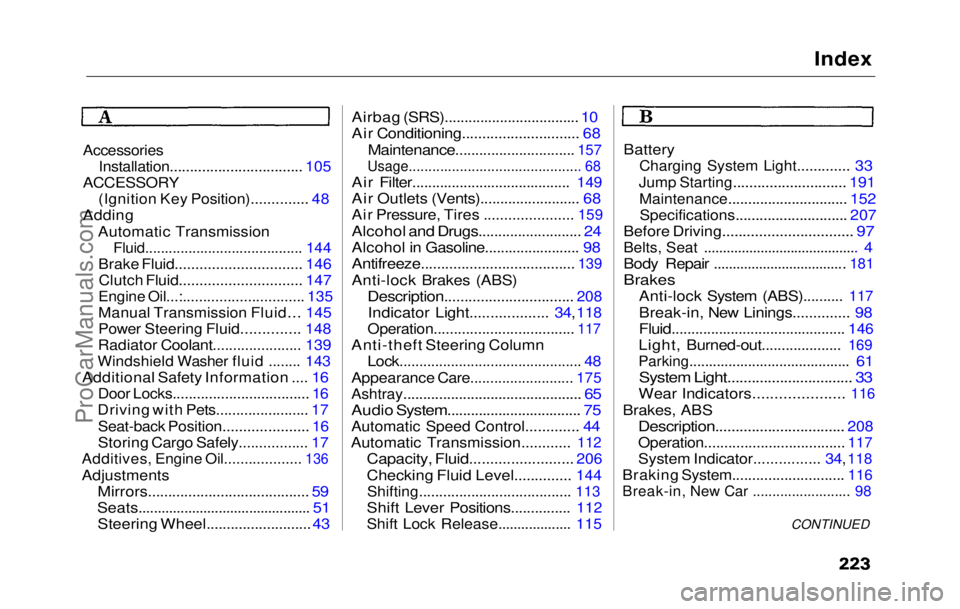
Index
Accessories
Installation................................. 105
ACCESSORY
(Ignition Key Position).............. 48
Adding
Automatic Transmission
Fluid........................................ 144
Brake Fluid............................... 146 Clutch Fluid.............................. 147
Engine Oil...:.............................. 135
Manual Transmission Fluid... 145
Power Steering Fluid.............. 148
Radiator Coolant...................... 139
Windshield Washer fluid ........ 143
Additional Safety Information .... 16
Door Locks.................................. 16
Driving with Pets....................... 17
Seat-back Position..................... 16
Storing Cargo Safely................. 17
Additives, Engine Oil................... 136
Adjustments
Mirrors....................................... .
59
Seats............................................. 51
Steering Wheel..........................
43
Airbag (SRS).................................. 1
0
Air Conditioning............................. 68
Maintenance..............................
157
Usage............................................ 6 8
Ai
r Filter........................................
149
Air Outlet
s
(Vents)......................... 68
Air Pressure, Tires ......................
159
Alcohol an d
Drugs.......................... 24
Alcohol in Gasoline........................ 98
Antifreeze......................................
139
Anti-lock Brake s
(ABS)
Description................................
208
Indicator Light.................. .
34,
118
Operation................................... 117
Anti-theft Steerin
g
Column
Lock.............................................. 48
Appearance Care..........................
175
Ashtray............................................. 65
Audio System................................. .
75
Automatic Speed Control............. 44
Automatic Transmission............ 112
Capacity, Fluid........................
.
206
Checking Fluid Level.............. 144
Shifting
...................................... 113
Shift Leve r
Positions...............
112
Shift Lock Release................... 115
Battery
Charging System Light............. 33
Jump Starting............................ 191
Maintenance.............................. 152
Specifications............................ 207
Before Driving
................................ 97
Belts, Seat ......................................... 4
Body Repair
...................................
181
Brakes
Anti-lock Syste
m (ABS)..........
117
Break-in, Ne
w
Linings.............. 98
Fluid............................................
146
Light, Burned-out................... .
169
Parking......................................... 61
System Light.............................. .
33
Wear Indicators.....................
116
Brakes, AB S
Description...............................
.
208
Operation................................... 117
System Indicator...............
.
34,
118
Braking System...........................
.
116
Break-in, Ne
w
Car ......................... 98
CONTINUEDProCarManuals.comMain Menu s t
Page 218 of 225
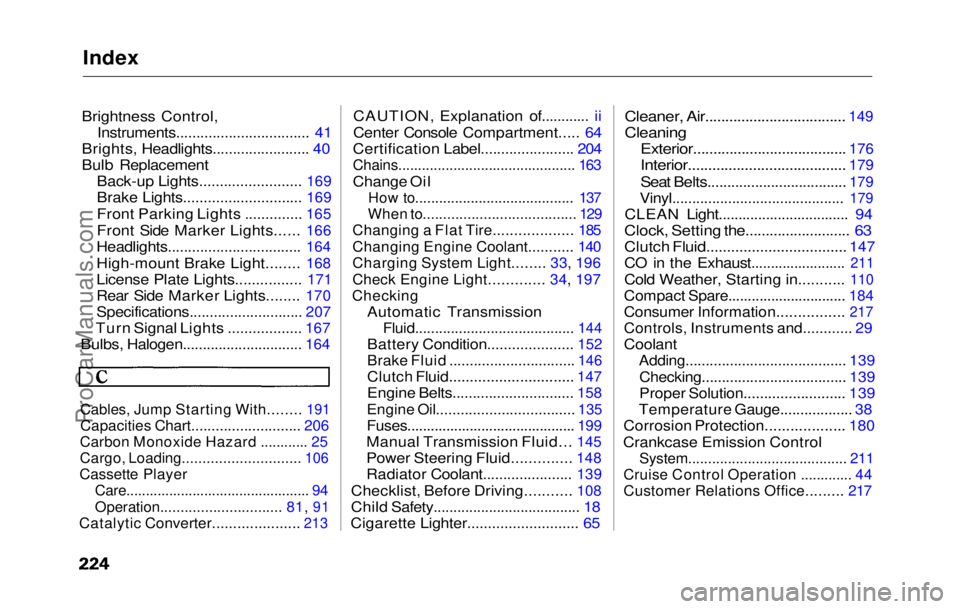
Index
Brightness Control, Instruments................................. 41
Brights, Headlights........................ 40
Bulb Replacement Back-up Lights......................... 169
Brake Lights.............................
169
Front Parking
Lights ..............
165
Front Side
Marker Lights......
166
Headlights................................. 164
High-mount Brake
Light........
168
License Plate
Lights................
171
Rear Sid
e
Marker Lights........
170
Specifications............................ 207
Turn Signa
l
Lights ..................
167
Bulbs, Halogen.............................
.
164
Cables, Jum
p
Starting With........
191
Capacities Chart...........................
206
Carbo
n Monoxide Hazard ............ 25
Cargo, Loading.............................
106
Cassette Playe r
Care..............................................
. 94
Operation.............................. 81,
91
Catalytic Converter.................... .
213
CAUTION, Explanatio
n
of............ ii
Center Console Compartment..... 64
Certification Label....................... 204
Chains............................................. 163
Change Oil
How to........................................ 137
When to...................................... 129
Changing a Flat Tire................... 185
Changing Engine Coolant........... 140
Charging System Light........ 33, 196
Check Engine Light............. 34, 197
Checking
Automatic Transmission
Fluid........................................
144
Battery Condition.................... .
152
Brake Flui
d
...............................
146
Clutch Fluid.............................
.
147
Engine Belts.............................
.
158
Engine Oil.................................
.
135
Fuses........................................... 199
Manual Transmissio
n
Fluid...
145
Power Steerin
g
Fluid..............
148
Radiator Coolant.....................
.
139
Checklist, Befor
e
Driving...........
108
Child Safety....................................
.
18
Cigarette Lighter........................... 65
Cleaner, Air...................................
149
Cleaning
Exterior......................................
176
Interior....................................... 179
Seat Belts...................................
179
Vinyl........................................... 179
CLEAN Light................................
.
94
Clock, Setting the.......................... 63
Clutch Fluid..................................
147
CO i n
the Exhaust........................
211
Cold Weather
,
Starting in...........
110
Compact Spare.............................
.
184
Consumer Information................
217
Controls, Instruments
and............ 29
Coolant
Adding........................................ 139
Checking.................................... 139
Proper Solution......................... 139
Temperature Gauge.................. 38
Corrosion Protection................... 180
Crankcase Emission Control
System........................................ 211
Cruise Control Operation ............. 44
Customer Relations Office......... 217ProCarManuals.comMain Menu s t
Page 219 of 225
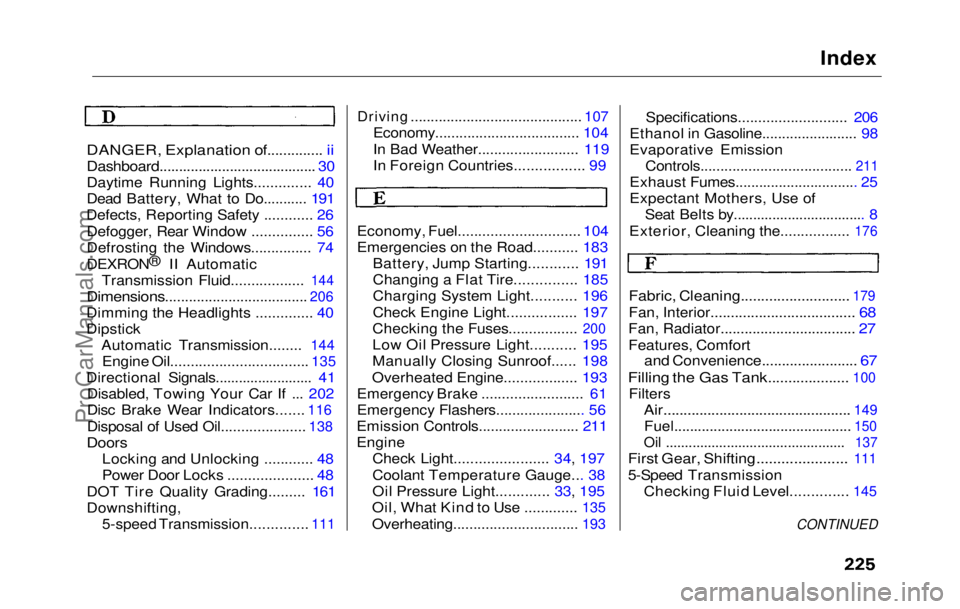
Index
DANGER, Explanation of.............. ii
Dashboard........................................ 30
Daytime Running Lights.............. 40
Dead Battery, What to Do........... 191
Defects, Reporting Safety ............ 26
Defogger, Rear Window ............... 56
Defrosting the Windows............... 74
DEXRON ®
II Automatic
Transmission Fluid.................. 144
Dimensions.................................... 206
Dimming the Headlight
s .............. 40
Dipstick Automatic Transmission........
144
Engine Oil................................. .
135
Directional Signals........................
.
41
Disabled, Towing Your Car If ... 202
Disc Brake Wear Indicators.......
116
Disposal o f
Used Oil.....................
138
Doors
Locking an
d Unlocking ............ 48
Power Door Locks ..................... 48
DOT Tire Quality Grading......... 161
Downshifting,
5-speed Transmission.............. 111
Driving .......................................... .
107
Economy.................................... 104
In Bad Weather......................... 119
In Foreign Countries................. 99
Economy, Fuel.............................. 104
Emergencies on the Road........... 183 Battery, Jump Starting............ 191
Changing a Flat Tire............... 185
Charging System Light........... 196
Check Engine Light................. 197
Checking the Fuses.................
200
Low Oi l
Pressure Light........... 195
Manually Closing Sunroof...... 198
Overheated Engine.................. 193
Emergency Brake ......................... 61
Emergency Flashers...................... 56
Emission Controls......................... 211
Engine Check Light....................... 34, 197
Coolant Temperature Gauge... 38
Oil Pressure Light............. 33, 195
Oil, What Kind to Use .............
135
Overheating............................... 193
Specifications........................... 206
Ethano l
in Gasoline........................ 98
Evaporative Emission Controls......................................
211
Exhaust Fumes.............................. .
25
Expectant Mothers, Use of Seat Belts by.................................. 8
Exterior, Cleaning the.................
176
Fabric, Cleaning........................... 179
Fan, Interior.................................... 68
Fan, Radiator.................................. 27
Features, Comfort
and Convenience........................ 67
Filling the Gas Tank.................... 100
Filters
Air
............................................... 149
Fuel............................................. 150
Oil ............................................... 137
First Gear, Shifting...................... 111
5-Speed Transmissio n
Checkin
g Fluid Level..............
145
CONTINUED
ProCarManuals.comMain Menu s t
Page 220 of 225
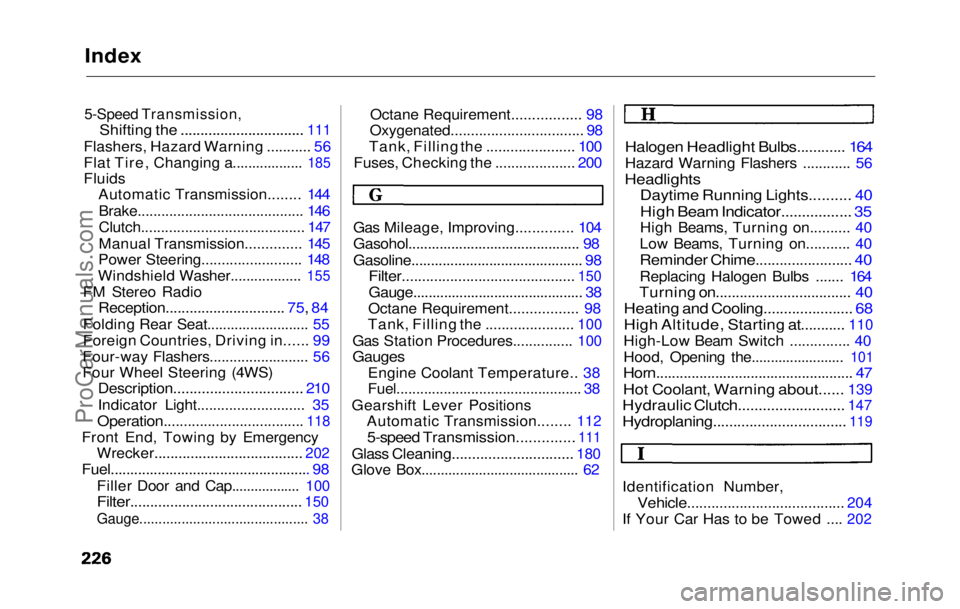
Index
5-Speed Transmission,
Shifting the ............................... 111
Flashers, Hazard
Warning ........... 56
Flat Tire, Changing a..................
185
Fluids Automatic Transmission.......
. 144
Brake.......................................... 146
Clutch......................................... 147
Manual Transmission.............. 145
Power Steering......................... 148
Windshield Washer..................
155
FM Stereo
Radio
Reception.............................. 75, 84
Folding Rear Seat.......................... 55
Foreign Countries, Driving in...... 99
Four-way Flashers......................... 56
Four Wheel Steering (4WS)
Description................................ 210
Indicator Light........................... 35
Operation...................................
118
Front End ,
Towing by Emergency
Wrecker..................................... 202
Fuel................................................... 9
8
Fille
r Door and Cap..................
100
Filter........................................... 150
Gauge............................................ 3
8
Octan
e Requirement................. 98
Oxygenated................................. 98
Tank, Filling the ...................... 100
Fuses, Checking the .................... 200
Gas Mileage, Improving.............. 104
Gasohol............................................ 98
Gasoline............................................ 98
Filter...........................................
150
Gauge............................................ 3 8
Octan
e Requirement................. 98
Tank, Filling the ......................
100
Gas Statio n
Procedures...............
100
Gauges
Engine Coolan
t Temperature.. 38
Fuel............................................... 38
Gearshift Lever Positions Automatic Transmission........
112
5-speed Transmission............. .
111
Glass Cleaning.............................
.
180
Glove Box........................................
.
62
Halogen Headlight Bulbs............ 164
Hazard Warning Flashers ............ 56
Headlights
Daytime Running Lights.......... 40
High Beam Indicator................. 35
High Beams, Turning on.......... 40
Low Beams, Turning on........... 40
Reminder Chime........................ 40
Replacing Halogen Bulbs ....... 164
Turning on.................................. 40
Heating and Cooling...................... 68
High Altitude, Starting at...........
110
High-Low Bea m
Switch ............... 40
Hood, Opening the........................
101
Horn.................................................. 4 7
Ho
t Coolant, Warning about......
139
Hydraulic Clutch.........................
.
147
Hydroplaning................................. 119
Identification Number
,
Vehicle......................................
.
204
If You
r
Car Has to be Towed ....
202
ProCarManuals.comMain Menu s t