child seat HONDA PRELUDE 1992 Owners Manual
[x] Cancel search | Manufacturer: HONDA, Model Year: 1992, Model line: PRELUDE, Model: HONDA PRELUDE 1992Pages: 225, PDF Size: 2.1 MB
Page 4 of 225
Driver and Passenger Safety
This section gives you important
information about occupant protection. It shows how to use seat
belts properly. It explains the Supplemental Restraint System.
And it gives useful information about how to protect infants and
children in your car. Your Occupant Protection
System........................................ 4
The Seat Belt System
and How It Works.................... 5
Why Wear Seat Belts................... 5 Important Safety Reminders..... 5
Seat Belt System Components... 6
Lap/Shoulder Belt........................ 6
Wearing Seat Belts Properly...... 6
Wearing a Lap/Shoulder
Belt ............................................. 7
Advice for Pregnant Women..... 8 Seat Belt Maintenance................ 9
Supplemental Restraint System.. 10 Important Safety Reminder..... 11
How the Driver's Airbag
Works........................................ 12
How the Passenger's Airbag
Works........................................ 13
How the SRS Indicator Light
Works ...................................... 14
System Service.......................... .
14
System Service Precautions..... 15
Additional Safety Information .... 16 Seat-back Position..................... 16
Door Locks.................................. 16 Storing Cargo Safely ................
17
Driving wit
h
Pets....................... 17
Child Safety..................................... 18
Where Should Children Sit?..... 18
Important Safety Reminders... 19
General Guidelines
for Restraining Children Under 18 kg (40 Ibs)............... 19
Restraining an Infant Who Weighs Less Than 9 kg (20 Ibs)......... 20
Restraining a Child Who Weighs Between
9 and 18 kg (20 and 40 Ibs).... 20
Using Child Restraints with Tethers............................
21
Using a
Seat Belt
Locking Clip............................ 22
Restraining a Child Who Weigh
s
Over 1 8
kg (40 Ibs)..................
23
Storing a
Chil
d Seat...................
23
Alcohol and Drugs..........................
24
Carbon Monoxid
e
Hazard ............
25
Reporting Safet
y
Defects
(US Cars)......................................
26
Safety Labels .................................
27
Driver an d
Passenger SafetyProCarManuals.comMain Menu s t
Page 6 of 225
The Seat Belt System and How It Works
Why Wear
Seat Belts
Wearing seat belts, and wearing
them properly, is fundamental to your safety and the safety of your
passengers.
During a crash or emergency stop,
seat belts can help keep you from
being thrown against the inside of the car, against other occupants, orout of the car.
Of course, seat belts cannot
completely protect you in every crash. But, in most cases, seat belts
reduce your chance of serious injury. They can even save your
life. That is why many states and all Canadian provinces require you
to wear seat belts.
Important Safety Reminders
Seat belts are designed for adults
and larger children. All infants and
small children must be properly
restrained in child safety seats (see
page 18).
A pregnant woman needs to wear a seat belt to protect herself and her
unborn child (see page 9).
Two people should never use the same seat belt. If they do, they
could be very seriously injured in a
crash.
Do not put shoulder belt pads or
other accessories on seat belts.
They can reduce the effectiveness of the belts and increase the chance
of injury.
Driver and Passenger Safety
Not wearing a seat belt in-
creases the chance of being killed or seriously hurt in a
crash.
Be sure you and your passen-
gers always wear seat belts
and wear them properly.ProCarManuals.comMain Menu Table of Contents s t
Page 9 of 225
The Seat Belt System and How It Works
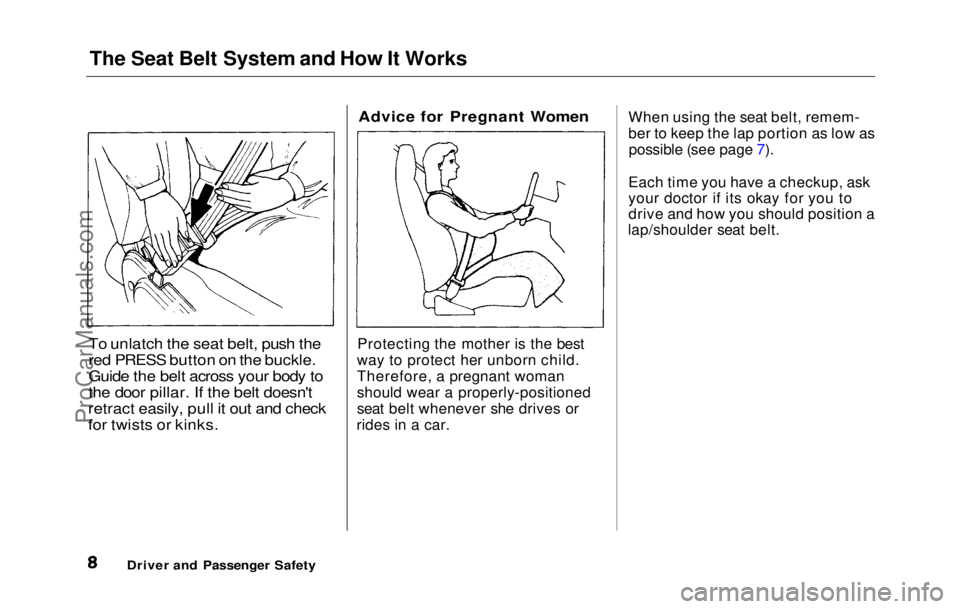
To unlatch the seat belt, push the
red PRESS button on the buckle.
Guide the belt across your body to
the door pillar. If the belt doesn't
retract easily, pull it out and check
for twists or kinks. Advice for Pregnant Women
Protecting the mother is the best
way to protect her unborn child.
Therefore, a pregnant woman
should wear a properly-positioned
seat belt whenever she drives or
rides in a car. When using the seat belt, remem-
ber to keep the lap portion as low as
possible (see page 7).
Each time you have a checkup, ask
your doctor if its okay for you to
drive and how you should position a
lap/shoulder seat belt.
Driver and Passenger SafetyProCarManuals.comMain Menu Table of Contents s t
Page 14 of 225
Supplemental Restraint System
The airbag is stored in the center
of the steering wheel. For your safety, do not attach any items to
the steering wheel. They could interfere with the proper operation
of the airbag. Or, if the airbag
inflates, they could be propelled
inside the car and hurt someone.
How the Passenger's Airbag
Works
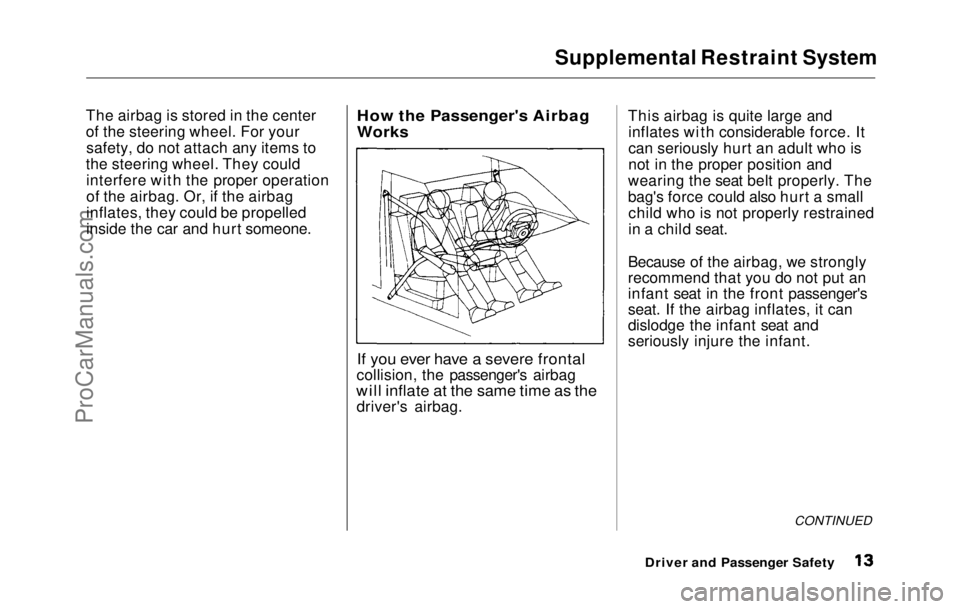
If you ever have a severe frontal
collision, the passenger's airbag
will inflate at the same time as the
driver's airbag. This airbag is quite large and
inflates with considerable force. It
can seriously hurt an adult who is
not in the proper position and
wearing the seat belt properly. The
bag's force could also hurt a small child who is not properly restrained
in a child seat.
Because of the airbag, we strongly
recommend that you do not put an
infant seat in the front passenger's
seat. If the airbag inflates, it can
dislodge the infant seat and
seriously injure the infant.
CONTINUED
Driver and Passenger SafetyProCarManuals.comMain Menu Table of Contents s t
Page 17 of 225
Additional Safety Information
The seat belts and airbag are obvi-
ously important parts of your occu- pant protection system.
In addition, you should know that
sitting upright, locking the doors,
and stowing things properly can
increase your safety and possibly
even save your life.
Seat-back Position
The seat-backs should be in an
upright position for you and your
passengers to get the most protec-
tion from the seat belts.
If you recline a seat-back, you
reduce the protective capability of
your seat belt. The farther a seat-
back is reclined, the greater the
risk that you will slide under the
belt in a severe crash and be very seriously injured.
For information on how to adjust
the seat-back, see page 52.
Door Locks
It is not safe to leave your car doors
unlocked. A passenger, especially a
child, could open a door and
accidentally fall out. Also, there is a
greater chance of being thrown out
of the car during a crash when the
doors are not locked.
Driver and Passenger SafetyProCarManuals.comMain Menu Table of Contents s t
Page 19 of 225
Child Safety
Children depend on adults to
protect them. To help make sure
we do, every state and Canadian province has laws requiring infants
and young children to be properly
restrained whenever they ride in a car.
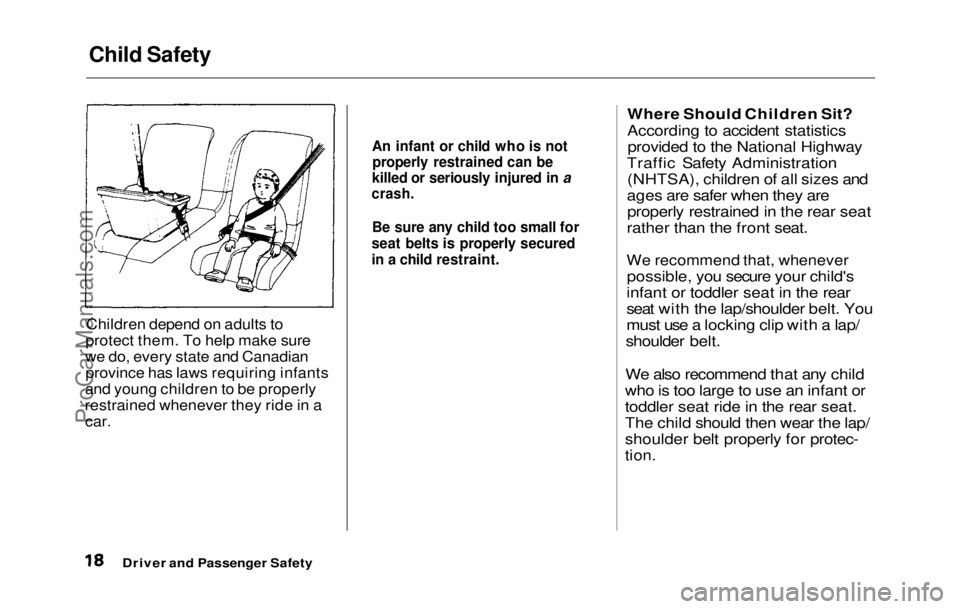
Where Should Children Sit?
According to accident statistics
provided to the National Highway
Traffic Safety Administration (NHTSA), children of all sizes and
ages are safer when they are properly restrained in the rear seat
rather than the front seat.We recommend that, whenever
possible, you secur
e your child's
infant or toddler seat in the rear
seat with the lap/shoulder belt. You
must use a locking clip with a lap/
shoulder belt.
We also recommend that any child
who is too large to use an infant or
toddler seat ride in the rear seat.
The child should then wear the lap/
shoulder belt properly for protec-
tion.
Driver and Passenger Safety
An infant or child who is not
properly restrained can be
killed or seriously injured in a
crash.
Be sure any child too small for
seat belts is properly secured
in a child restraint.ProCarManuals.comMain Menu Table of Contents s t
Page 20 of 225
Child Safety
Important Safety Reminders
Never hold
a baby or child on your
lap when riding in a car. If you are
wearing your seat belt, the violent
forces created during a crash will
tear the child from your arms. The
child could be seriously hurt or
killed.
If you are holding a child and not
wearing a seat belt in a crash, you could crush the child against the
car's interior.
Never put your seat belt over
yourself an d
a child. During a crash,
the belt could press deep into the
child; causin
g
serious internal
injuries.
Two children should never use the same seat belt. If they do, they
could be very seriously injured in a
crash.
General Guidelines for
Restraining Children Under
18 kg (40 Ibs)
Use an approved child seat. The
seat must meet Federal Motor
Vehicle Safety Standard 213 (FMVSS-213) or Canadian Motor
Vehicle Safety Standards. Look for
the manufacturer's statement of compliance on the box and seat.
Use a seat of the right size. Make
sure the seat fits your child. Check
the seat manufacturer's instruc-
tions and labels for height and
weight limits.
Secure the child seat to the car. All
approved child seats are designed
to be secured in the car seat by the
lap belt or the lap belt portion of a
lap/shoulder belt. A child whose
seat is not properly secured to the
car can be endangered in a crash.
To properl y
route a seat belt
through a child seat, follow the seat
maker's instructions. Be sure you
install a locking clip on a lap/
shoulder belt (see page 22).
Secure the child in the child seat.
Make sure the infant or child is
firmly secured to the child seat.
Use the straps provided, and
carefully follow the manufacturer's
instructions.
Driver an d
Passenger SafetyProCarManuals.comMain Menu Table of Contents s t
Page 21 of 225
Child Safety
Restraining an Infant Who
Weighs Less Than 9 kg
(20 Ibs)
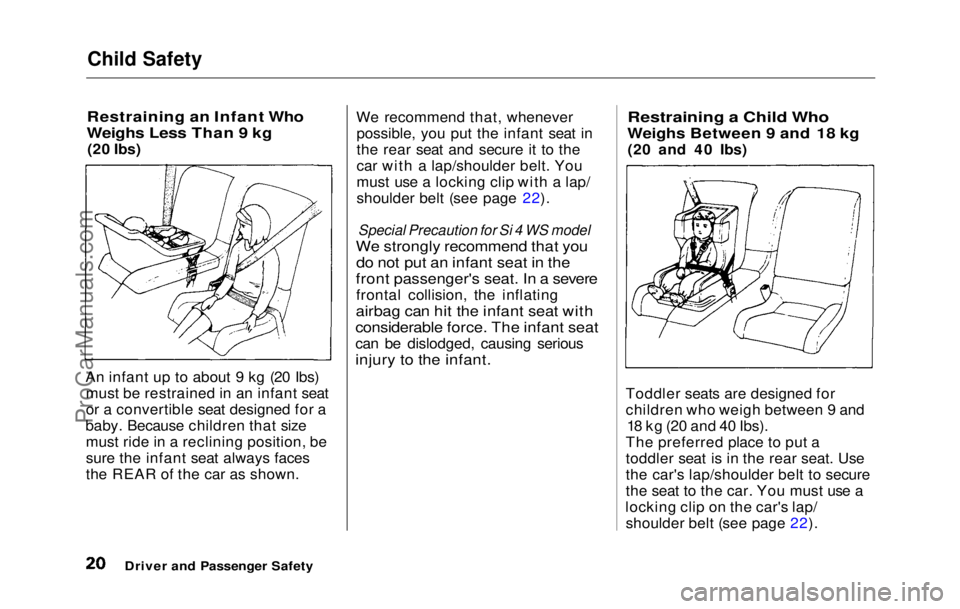
An infant up to about 9 kg (20 Ibs) must be restrained in an infant seat
or a convertible seat designed for a
baby. Because children that size must ride in a reclining position, be
sure the infant seat always faces
the REAR of the car as shown. We recommend that, whenever
possible, you put the infant seat in
the rear seat and secure it to the
car with a lap/shoulder belt. You
must use a locking clip with a lap/
shoulder belt (see page 22).
Special Precaution for Si 4 WS model
We strongly recommend that you do not put an infant seat in the
front passenger's seat. In a severe
frontal collision, the inflating
airbag can hit the infant seat with
considerable force. The infant seat
can be dislodged, causing serious
injury to the infant.
Restraining a Child Who
Weighs Betwee n
9 and 18 kg
(20 and 40 Ibs)
Toddler seats are designed for
children who weigh between 9 and 18 kg (20 and 40 Ibs).
The preferred place to put a
toddler seat is in the rear seat. Use
the car's lap/shoulder belt to secure
the seat to the car. You must use a
locking clip on the car's lap/ shoulder belt (see page 22).
Driver and Passenger SafetyProCarManuals.comMain Menu Table of Contents s t
Page 22 of 225
Child Safety
Using Child Restraints with
Tethers
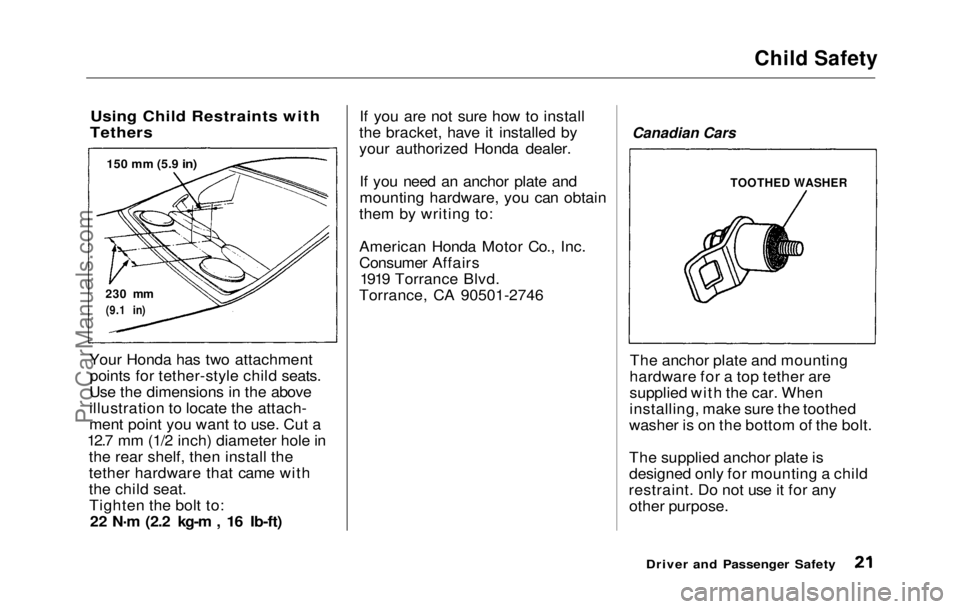
Your Honda has two attachment points for tether-style child seats.
Use the dimensions in the above
illustration to locate the attach-
ment point you want to use. Cut a
12.7 mm (1/2 inch) diameter hole in the rear shelf, then install the
tether hardware that came with
the child seat.Tighten the bolt to: 22 N .
m (2.2 kg-m , 16 Ib-ft) If you are not sure how to install
the bracket, have it installed by
your authorized Honda dealer.
If you need an anchor plate and
mounting hardware, you can obtain
them by writing to:
American Honda Motor Co., Inc.
Consumer Affairs 1919 Torrance Blvd.
Torrance, CA 90501-2746
Canadian Cars
The anchor plate and mounting
hardware for a top tether are
supplied with the car. When
installing, make sure the toothed
washer is on the bottom of the bolt.
The supplied anchor plate is
designed only for mounting a child
restraint. Do not use it for any other purpose.
Driver and Passenger Safety
TOOTHED WASHER
150 mm (5.9
in)
230 mm
(9.1 in)ProCarManuals.comMain Menu Table of Contents s t
Page 23 of 225
Child Safety
Using a Seat Belt Locking
Clip
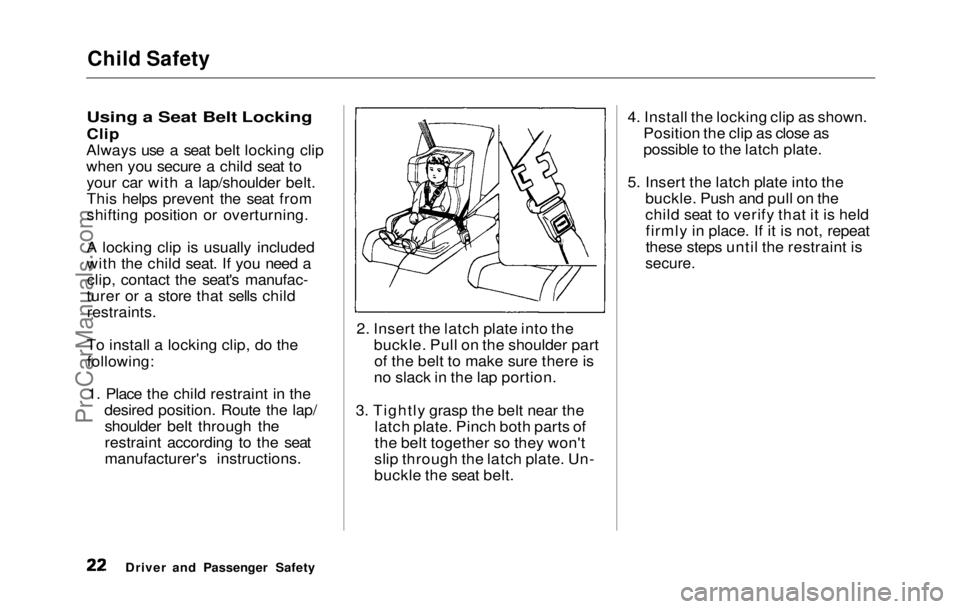
Always us
e a seat belt locking clip
when you secure a child seat to your car with a lap/shoulder belt.
This helps prevent the seat from
shifting position or overturning.
A locking clip is usually included
with the child seat. If you need aclip, contact the seat's manufac-
turer or a store that sells child restraints.
To install a locking clip, do the following:
1. Place the child restraint in the
desired position. Route the lap/shoulder belt through the
restraint according to the seat
manufacturer's instructions.
2. Inser t
the latch plate into the
buckle. Pull on the shoulder part
of the belt to make sure there is
no slack in the lap portion.
3. Tightl y
grasp the belt near the
latch plate. Pinch both parts of
the belt together so they won't
slip through the latch plate. Un-
buckle the seat belt.
4. Instal l
the locking clip as shown.
Position the clip as close as
possible to the latch plate.
5. Insert the latch plate into the
buckle. Push and pull on the
child seat to verify that it is held firmly in place. If it is not, repeat
these steps until the restraint is
secure.
Driver an d
Passenger SafetyProCarManuals.comMain Menu Table of Contents s t