fuel pump HONDA PRELUDE 1998 Owners Manual
[x] Cancel search | Manufacturer: HONDA, Model Year: 1998, Model line: PRELUDE, Model: HONDA PRELUDE 1998Pages: 278, PDF Size: 2.61 MB
Page 1 of 278
 to navigate through\
this reference.
For a printed owners manual, click on authorized manuals or go")
1998 Prelude Online Reference Owner's Manual
Use these links (and links throughout this manual) to navigate through\
this reference.
For a printed owner's manual, click on authorized manuals or go to www.h\
elminc.com.
Contents
Introduction ........................................................................\
................................................................. i
A Few Words About Safet y........................................................................\
.........................................ii
Driver and Passenger Safety ........................................................................\
......................................3
Proper use and care of your vehicle's seat belts, and Supplemental Restr\
aint System.
Instruments and Control s........................................................................\
.........................................49
Instrument panel indicator and gauge, and how to use dashboard and steering colu\
mn controls.
Comfort and Convenience Features ........................................................................\
..................... 91
How to operate the climate control system, the audio system, and other c\
onvenience features.
Before Driving........................................................................\
..........................................................119
What gasoline to use, how to break-in your new vehicle, and how to load luggage and other cargo.
Driving ........................................................................\
......................................................................131
The proper way to start the engine, shift the transmission, and park, pl\
us towing a trailer.
Maintenance........................................................................\
.............................................................159
The Maintenance Schedule shows you when you need to take your vehicle to the dealer.
Appearance Car e........................................................................\
..................................................... .219
Tips on cleaning and protecting your vehicle. Things to look for if your\
vehicle ever needs body repairs.
Taking Care of the Unexpecte d........................................................................\
..............................227
This section covers several problems motorists sometimes experience, and how to handle them.
Technical Informatio n........................................................................\
.............................................251
ID numbers, dimensions, capacities, and technical information.
Warranty and Customer Relations (U.S. and Canada)................................................................265
A summary of the warranties covering your new Acura, and how to contact \
us.
Authorized Manu als (U.S. only)........................................................................\
..............................271
How to order manuals and other technical literature.
Index........................................................................\
.............................................................................. I
Service Information Summary
A summary of information you need when you pull up to the fuel pump.
Accord Value Package Audio System Owner's Identification Form
ProCarManuals.com
Page 120 of 278
Break-in Period, Gasoline
Break-in Period
Help assure your vehicle's future
reliability and performance by paying
extra attention to how you drive
during the first 600 miles (1,000 km).
During this period: Avoid full-throttle starts and rapid
acceleration.
Avoid hard braking. New brakes need to be broken-in by moderate
use for the first 200 miles (300
km).
You should follow these same re- commendations with an overhauled
or exchanged engine, or when the
brakes are relined.
Gasoline
Your Honda is designed to operate on premium unleaded gasoline with a
pump octane number of 91 or higher.
If you are unable to find premium
unleaded gasoline, you may substi-
tute an unleaded regular gasoline.
The engine will compensate for the lower octane, but you may notice aslight decrease in power as a result.
We recommend gasolines containing detergent additives that help prevent
fuel system and engine deposits.
Using gasoline containing lead willdamage your vehicle's emission
controls. This contributes to air
pollution. In Canada, some gasolines contain
an octane-enhancing additive called
MMT. If you use such gasolines,
your emission control system performance may deteriorate and
the Malfunction Indicator Lamp on
your instrument panel may turn on. If this happens, contact your
authorized Honda dealer for service.
Before DrivingProCarManuals.comMain Menu Table of Contents s t
Page 121 of 278
Service Station Procedures
Filling the Fuel Tank
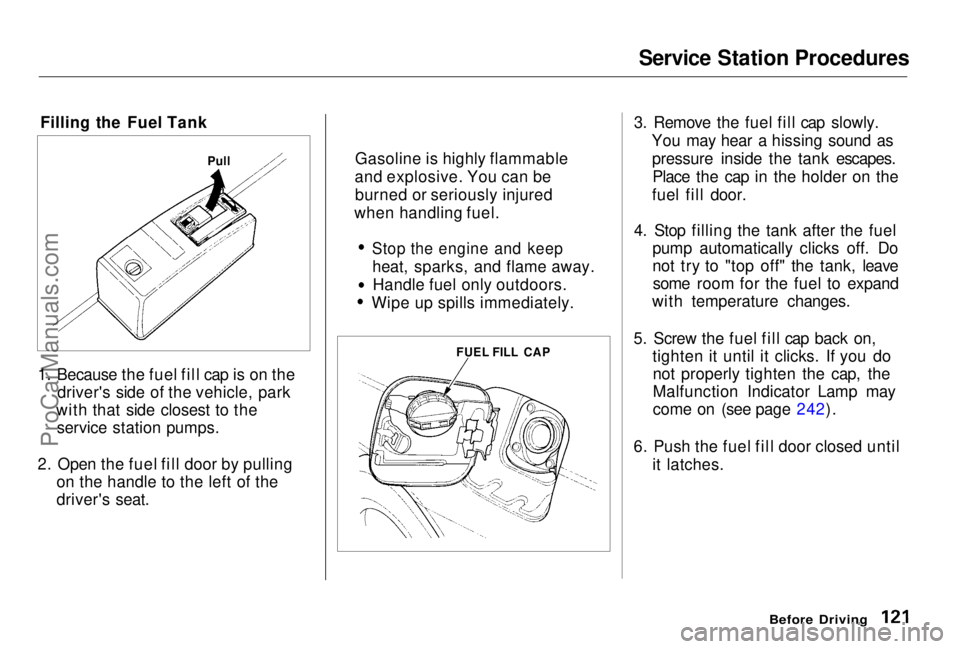
1. Because the fuel fill cap is on the driver's side of the vehicle, park
with that side closest to the service station pumps.
2. Open the fuel fill door by pulling on the handle to the left of the
driver's seat. 3. Remove the fuel fill cap slowly.
You may hear a hissing sound aspressure inside the tank escapes.Place the cap in the holder on the
fuel fill door.
4. Stop filling the tank after the fuel pump automatically clicks off. Do
not try to "top off" the tank, leavesome room for the fuel to expand
with temperature changes.
5. Screw the fuel fill cap back on, tighten it until it clicks. If you donot properly tighten the cap, the
Malfunction Indicator Lamp may
come on (see page 242).
6. Push the fuel fill door closed until it latches.
Before Driving
Pull
FUEL FILL CAP
Gasoline is highly flammable
and explosive. You can be burned or seriously injured
when handling fuel.
Stop the engine and keep
heat, sparks, and flame away.Handle fuel only outdoors.
Wipe up spills immediately.ProCarManuals.comMain Menu Table of Contents s t
Page 181 of 278
Windshield Washers
Check the level in the windshield
washer reservoir at least monthly
during normal usage. In bad weather,
when you use the washers often,
check the level every time you stop
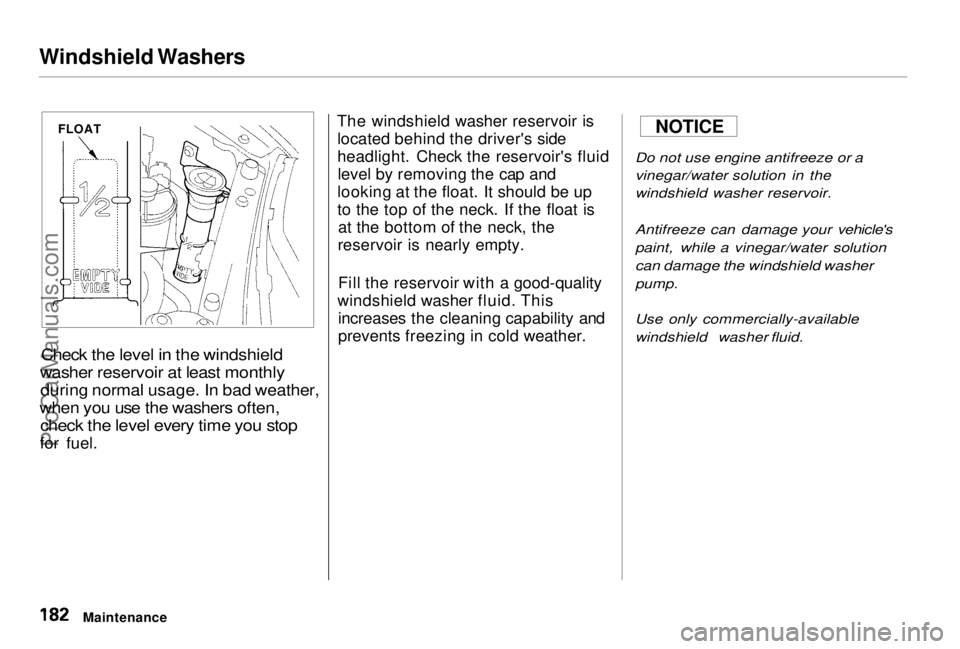
for fuel. The windshield washer reservoir is
located behind the driver's side
headlight. Check the reservoir's fluidlevel by removing the cap and
looking at the float. It should be up
to the top of the neck. If the float is at the bottom of the neck, the
reservoir is nearly empty.
Fill the reservoir with a good-quality
windshield washer fluid. This increases the cleaning capability and
prevents freezing in cold weather.
Do not use engine antifreeze or a
vinegar/water solution in the
windshield washer reservoir.
Antifreeze can damage your vehicle's
paint, while a vinegar/water solution
can damage the windshield washer
pump.
Use only commercially-available
windshield washer fluid.
Maintenance
NOTICE
FLOATProCarManuals.comMain Menu Table of Contents s t
Page 233 of 278
If Your Engine Won't Start, Jump Starting
The Starter Operates Normally In this case, the starter motor'sspeed sounds normal, or even faster
than normal, when you turn the
ignition switch to START (III), but
the engine does not run. Are you using the proper starting
procedure? Refer to Starting the
Engine on page 133.
Do you have fuel? Turn the
ignition switch to ON (II) for a
minute and watch the fuel gauge.
The low fuel level warning light
may not be working, so you were
not reminded to fill the tank.
There may be an electrical
problem, such as no power to the
fuel pump. Check all the fuses
(see page 245).
If you find nothing wrong, you will
need a qualified technician to find
the problem. See Towing on page
250. Jump Starting
If your vehicle's battery has rundown, you may be able to start the
engine by using a booster battery.
Although this seems like a simple procedure, you should take several
precautions.
You cannot start a Honda with an automatic transmission by pushing
or pulling it. To jump start your vehicle, follow
these directions closely:
1. Open the hood and check the physical condition of the battery(see page 190). In very cold
weather, check the condition of
the electrolyte. If it seems slushy or like ice, do not try jump starting
until it thaws.
If a battery sits in extreme cold, the
electrolyte inside can freeze.
Attempting to jump start with a frozen
battery can cause it to rupture.
2. Turn off all the electrical acces- sories: heater, A/C, stereo system,
lights, etc.
Put the transmission in Neutral or
Park and set the parking brake.
Taking Care of the Unexpected
NOTICE
A battery can explode if you do
not follow the correct procedure,
seriously injuring anyone nearby.
Keep all sparks, open flames,
and smoking materials away
from the battery.ProCarManuals.comMain Menu Table of Contents s t
Page 256 of 278

Oxygenated Fuels
Some conventional gasolines are
being blended with alcohol or an
ether compound. These gasolines
are collectively referred to as
oxygenated fuels. To meet clean air
standards, some areas of the United
States and Canada use oxygenated
fuels to help reduce emissions.
If you use an oxygenated fuel, be
sure it is unleaded and meets the
minimum octane rating requirement.
Before using an oxygenated fuel, try
to confirm the fuel's contents. Some
states/provinces require this
information to be posted on the
pump.
The following are the EPA-approved
percentages of oxygenates:
ETHANOL (ethyl or grain alcohol)
You may use gasoline containing up to 10 percent ethanol by volume.Gasoline containing ethanol may be
marketed under the name "Gasohol."
MTBE (Methyl Tertiary Butyl Ether)
You may use gasoline containing up to 15 percent MTBE by volume.
METHANOL (methyl or wood
alcohol)
You may use gasoline containing up to 5 percent methanol by volume as
long as it also contains cosolvents and corrosion inhibitors to protect
the fuel system. Gasoline containing more than 5 percent methanol by
volume may cause starting and/or performance problems. It may alsodamage metal, rubber and plastic
parts of your fuel system. If you notice any undesirable
operating symptoms, try another
service station or switch to another
brand of gasoline.
Fuel system damage or performance
problems resulting from the use ofan oxygenated fuel containing more
than the percentages of oxygenates
given above are not covered under
warranty.
Technical InformationProCarManuals.comMain Menu Table of Contents s t
Page 278 of 278
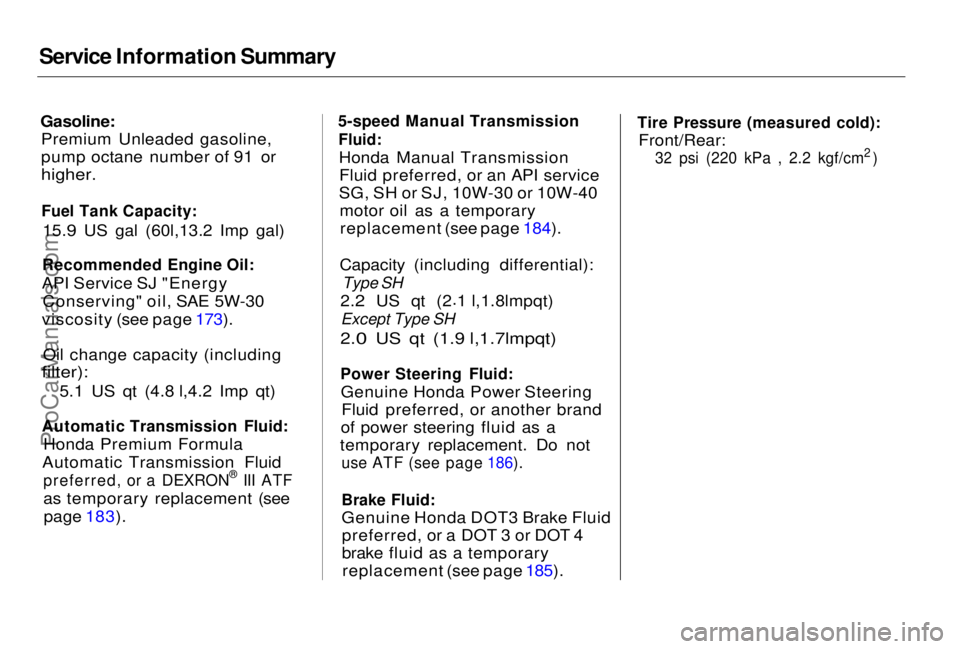
Service Information Summary
Gasoline:
Premium Unleaded gasoline,
pump octane number of 91 or
higher.
Fuel Tank Capacity:
15.9 US gal (60l,13.2 Imp gal)
Recommended Engine Oil:
API Service SJ "Energy Conserving" oil, SAE 5W-30
viscosity (see page 173).
Oil change capacity (including
filter):
5.1 US qt (4.8 l,4.2 Imp qt)
Automatic Transmission Fluid:
Honda Premium Formula
Automatic Transmission Fluid
preferred, or a DEXRON ®
III ATF
as temporary replacement (see page 183).
5-speed Manual Transmission
Fluid:
Honda Manual TransmissionFluid preferred, or an API service
SG, SH or SJ, 10W-30 or 10W-40 motor oil as a temporaryreplacement (see page 184).
Capacity (including differential):
Type SH
2.2 US qt (2 .
1 l,1.8lmpqt)
Except Type SH
2.0 US qt (1.9 l,1.7lmpqt)
Power Steering Fluid:
Genuine Honda Power Steering Fluid preferred, or another brand
of power steering fluid as a
temporary replacement. Do not
use ATF (see page 186).
Brake Fluid:
Genuine Honda DOT3 Brake Fluidpreferred, or a DOT 3 or DOT 4
brake fluid as a temporaryreplacement (see page 185).
Tire Pressure (measured cold):
Front/Rear:
32 psi (220 kPa , 2.2 kgf/cm2)
ProCarManuals.comMain Menu s t